A homecoming for Maddon?

2019-09-30 MikeSciosciaJoeMaddon

Joe Maddon (right) was Mike Scioscia’s consigliere in the Angels’ dugout before he became a successful manager himself.

So you think Joe Maddon isn’t the real reason the Cubs imploded down the stretch? What do you think about the man the Angels just cashiered while Maddon is a managerial free agent?

Sure, Los Angeles Times reporter Maria Torres has said Brad Ausmus was safe through the end of 2020 at minimum. And the Chicago Tribune said Maddon returning to the Angels was “unlikely.” But two better known and normally sharp baseball reporters, Buster Olney (ESPN) and Ken Rosenthal (The Athletic) have said a little more strongly that if Maddon became available, Ausmus became a retroactive lame duck.

Even as I sat down to write, the Angels weren’t the only team being tied to Maddon. The safest wager now is that Maddon’s unemployment isn’t liable to last as long the postseason probably will. It’s just a question of who’s going to employ him gainfully again.

Ausmus is the Angels’ first manager of the post-Mike Scioscia era, which ended sadly in three straight losing seasons. Hell of a way for the franchise’s single most successful manager to finish his tenure. But Ausmus started with one arm tied behind his back as it was and finished with his arms amputated, so to say. And he has even less culpability for the Angels’ disappearance than Maddon had for the Cubs’.

It wasn’t Ausmus’s brilliant idea that this year’s Angel starting rotation would be an injury-and-inconsistency infected mess almost from the beginning. Or that the Angel bullpen (their collective 5.10 ERA was the fifth worst in baseball this year) would be their own game morticians. Even working in one of the Show’s most favourable pitchers’ parks as their home park.

It wasn’t Ausmus’s idea to miss Justin Upton in the outfield for most of the year or that the Jonathan Lucroy experiment behind the plate and the Matt Harvey experiment on the mound would implode.

It wasn’t Ausmus’s idea that Albert Pujols—a Hall of Famer in waiting otherwise, but an injury-compromised wreck for most of his Angels life—can still play at mere replacement-level on his best days, now, no matter how earnest he remains, no matter how honest his effort. (For that matter, tell yourself it was Pujols’s idea that his legs and feet should begin a continuing betrayal after just his first Angels season.)

It wasn’t Ausmus’s idea that the morale winds got knocked completely out of the Angels’ sails when Tyler Skaggs was found dead in a Texas hotel room to begin their final road series before the All-Star break. Skaggs’s death shocked all baseball but nobody really knows just how deeply it cut into the Angels’s psyches. The Angels were a game under .500 at the All-Star break but 22 below it in the second half.

If you can consider it good news, Skaggs’s death brought Mike Trout forward as a team leader who leads with far more than just what he does in the field and at the plate. (He was striking firmly for his third American League Most Valuable Player award before his foot nerve issue forced him to season-ending surgery in early September. The Astros’ Alex Bregman could very easily win this year’s award if Trout doesn’t.)

But what good is leadership on a team that still isn’t really worthy of its own and baseball’s continuing greatest all-around player? Trout remained Trout and then some even after Skaggs’s death. Ended prematurely, his season was still a season for the books: he still led the majors in on-base percentage and OPS+ and the American League in slugging, OPS, and intentional walks.

The Angels otherwise? That magnificent combined no-hit blowout of the Mariners in their first home game after losing Skaggs was maybe the season’s most spiritually transcendent game—and maybe their last real gasp. Their clubhouse may have held together but they just weren’t a good team on the field. And it’s no more Trout’s fault than it is Ausmus’s.

Ausmus may not be one of the game’s better tactical or strategic managers but neither has he really made the kind of brain-twisters that may yet put paid to men like Mickey Callaway, Gabe Kapler, and maybe even a couple of postseason entrants whose futures probably depend on how far their teams go toward the Promised Land this time.

But Ausmus is now history with the Angels and Maddon has history with them. He took the bridge briefly in 1999 after Terry Collins walked rather than deal any longer with a clubhouse he helped blow up himself, when he was younger, more foolish, and more like a walking exposed nerve. He led those Angels to a 19-10 finish before handing Scioscia the bridge and becoming Scioscia’s consigliere on the bench.

He served long and well as Scioscia’s bench coach. He earned the respect and affection of owner Arte Moreno while he was at it. And now that he’s a free agent, the Angels—as MLB Trade Rumours so delicately phrases it—are “contemplating” Ausmus’s job status.

Rick Renteria, call your office. The Cubs “contemplated” your job status once upon a time as Maddon became available, too. You know how that worked out, amirite? Sure you might be content on the south side of Chicago helping to bring the White Sox back to the land of the living, but that’s not the same thing as you knowing the Cubs were on the threshold of postseason revival and conquest.

And the Angels aren’t considered the only prospective suitors for Maddon’s hand in managerial marriage.

The perpetually rebuilding Padres pinked Andy Green with eight games left this season and they’re thought to have eyes for Maddon now. The Mets and the Phillies are thought to be pondering execution orders for Mickey Callaway and Gabe Kapler, respectively. Don’t think Maddon isn’t in their dugout wet dreams now. (For that matter, don’t think all three teams aren’t pondering further alterations in the front offices, either.)

The Pirates dumped Clint Hurdle somewhat unceremoniously on the final day, letting bench coach Tom Prince have the bridge for a season-ending 3-1 loss to the Reds. The man who skippered the Pirates back to competitiveness for awhile watched his 2019 edition earn a reputation for headhunting, his front office swap out assets for liabilities on field and in the clubhouse, his clubhouse turn into a toxic mess, and himself almost helpless to stop the mass suicide.

(Early last year, when the Nationals were thought to have clubhouse trouble, former manager Dusty Baker observed, “Jayson Werth. That’s who they miss in that clubhouse.” The Pirates could probably say, “Andrew McCutchen. That’s who we miss in this clubhouse.” Just as the Cubs can say, “David Ross. That’s who we miss in this clubhouse.”)

Maddon may be in the Pirates’ periscope sights, too. But then, maybe not. Maddon isn’t the whiplash type. Like legendary Navy fleet admiral Chester Nimitz, Maddon’s command style is reason, not reaming. This collection of Pirates probably needs something more blunt in the dugout. And maybe something a lot more broad-sighted in the front office.

It must be humbling for Maddon, who’s not exactly bereft of modesty, to realise he’s one of those men who inspires others to dump their incumbents when he shows even a hint of actual or pending availability. But for growing members of the club becoming known as Men Fired (Or Likely To Be) That Joe Maddon Be Hired, it must be a little sobering.

Absent answers, don’t judge Skaggs

2019-08-31 TylerSkaggsAngels

Mike Trout (in blue T-shirt, front) and the Angels paid a final tribute to Tyler Skaggs after blowing out the Mariners in a combined no-hitter in their first game home following Skaggs’s unexpected death. The toxicology report now raises even more questions.

No, I don’t know yet what delivered Tyler Skaggs into the clutch of opioids, whether a one-time or more-than-once deliverance. And neither do you. But that doesn’t stop people from drawing conclusions, and it doesn’t stop some of those conclusions ranging from the dismissive to the ridiculous all the way back to the obscene.

The prospect of the 27-year-old Skaggs merely being reckless in taking even once doses of fetanyl and oxycodone and maybe washing them down at once with a stiff drink is a prospect not to have been wished in the hurricane of grief his death whipped up all around baseball in early July.

“Now, we are faced with our own emotions,” writes USA Today baseball columnist Bob Nightengale, “knowing the death wasn’t an act of God or a suicide, but self-induced by the careless use of pain killers.” Remember that “careless” doesn’t mean reckless, exclusively.

We’re also faced with asking honestly whether Skaggs acted entirely on his own, as the Angels arrived in Texas for a pre-All Star break set against the Rangers, or whether he was prompted persuasively enough by someone who thought he was doing Skaggs a pain management favour.

Skaggs’s family wants to know for dead last certain. They’ve hired Texas attorney Rusty Hardin to help them know. “We are heartbroken to learn that the passing of our beloved Tyler was the result of a combination of dangerous drugs and alcohol,’’ they said in a formal statement. “That is completely out of character for someone who worked so hard to become a Major League Baseball player and had a very promising future in the game he loved so much.”

The Angels want to know, too. Suspicions point as I referred on Friday, toward a so far unidentified Angels employee the family and perhaps the team itself thinks or fears had a hand in Skaggs’s demise, perhaps by supplying him fetanyl and oxycodone through other than lawful or proper medical means.

“Everyone’s searching for facts, and everyone within the organization wants facts,’’ said general manager Billy Eppler at a press session before the Angels played the Red Sox Friday night. “Which is why we are actively cooperating with an investigation. It kind of goes without saying that I cannot comment more on the situation until the police conclude their investigation.”

Asked whether the employee the Skaggs family suspects is still with the team, Eppler wouldn’t answer. “I’m sorry,” the GM replied. “I really understand your asking that question, but again, it’s an active investigation.” Eppler said only that the Angels have told investigators everything they know. Which may or may not yet be anything substantial. Thus the proverbial thickening of the plot.

The least-kept secret in professional sports is that performing athletes are not always the best tended alive by their teams or supervising organisations when it comes to injuries or illnesses. For too many decades sports medicine involved the fastest remedy available to get the player back onto the field, the court, the course, as fast as possible.

And for too many of the same decades athletes took to their own measures of desperation to get back to the field, the court, the course, as soon as they could, within what they considered reason, the better to keep someone else from taking their jobs when they knew in their heart of hearts that there was always someone else behind them just itching for the chance.

It was one thing, for example, to know that there were enough baseball players dabbling in actual or alleged performance-enhancing substances because they were led somehow to believe the dabbling might help them inflate their performance papers. But the arguable Joe Valachi of the actual or alleged PEDs, the late third baseman Ken Caminiti, stepped forth after his career ended to say it started for him not out of any statistical interest but out of desperation to escape the deep pain of a 1996 shoulder injury.

Caminiti surely wasn’t alone in turning that way when few to none of his team’s medical personnel seemed able to provide such relief. To name another somewhat notorious example, longtime Yankee pitcher Andy Pettitte is on record as saying he took to a brief usage of human growth hormone because his continuing elbow pain finally drove him mad enough to give it a try.

Skaggs had an injury history. After the Diamondbacks traded him back to the Angels for 2014 (he’d previously gone to the Snakes with current Nationals pitcher Patrick Corbin in a deal making pitcher Dan Haren an Angel), Skaggs pitched in eighteen games before his elbow sent him to Tommy John surgery, causing him to miss the entire 2015 season.

He returned to make ten 2016 starts, then missed 98 days in 2017 with a strained oblique. In 2018, Skaggs opened with sixteen starts and a 2.64 ERA before his adductor muscle gave out and cost him three months. And this year, he sprained his left ankle after making three season-opening starts. costing him most of April.

“[A] normally developed, well-nourished and well-hydrated large build adult,” the toxicology report described him. Except that it couldn’t determine whether or to what extend he remained in any pain. Physical or otherwise. That, too, would be something both his family and the Angels should want to know.

Skaggs otherwise was known as a likeable fellow who was freshly married when spring training began this year and had everything else for which to live. He loved his young wife, Carli; he loved his teammates; he loved the game. The hurricane of grief his death provoked around baseball was real.

So were the emotions when, after the Rangers kindly canceled the game the day Skaggs died, they re-convened with Skaggs’s uniform number 45 in the dirt behind the pitching rubber in the Angels’s uniform font style. And, when the Angels beat them, 9-5.

And, especially, when the Angels returned home, the players fashioned a loving pre-game tribute including Skaggs’s mother throwing out a ceremonial first pitch, before the Angels hit the field one and all wearing Skaggs jerseys and beat the Mariners in a combined no-hitter and an 11-0 blowout. Paced by Skaggs’s closest friend and team leader Mike Trout blowing the lid off all emotion with a two-run homer in the first inning.

And, after the game, when Trout and his fellow Angels covered the entire pitching mound except for the number 45 behind the rubber with the Skaggs jerseys they wore all game long.

The toxicology report wasn’t close to completion that night. Now that it is, the questions continue as only too many seem to think they have the answers. Nightengale isolates several of the key questions. Did Skaggs slip somehow into drug addiction? Did anyone know to the extent that they may carry a degree of guilt for lack of previous intervention? Did something appear to indicate such a problem?

But Nightengale doesn’t stop there. Appropriately. “This was a young main in pain. Perhaps more physical than even the doctors and trainers knew. Maybe more mental than even any team therapist knew,” he writes. “It will be a bigger tragedy if we never understand why. Prescription painkillers are a scourge in this country, and professional sports—with catastrophic injuries and the expectation to play through the pain they cause—are ripe for potential abuse.”

This wasn’t Cubs second baseman Ken Hubbs, who’d only taken up flying a few months earlier, flying his single-engine Cessna propeller airplane over Utah and crashing to his death in spring 1964, running into an atmospheric disturbance he was probably too inexperienced to navigate successfully. The tragic irony: Hubbs took up flying to conquer his fear of it.

This wasn’t Yankee legend Thurman Munson, who’d bought a sophisticated Cessna Citation jet the better to spend more time with his wife and children during the season when the Yankee schedule allowed, and crashed at an airport near his Ohio home while practising evening landings. Munson was still well short of full qualification to handle the complex jet entirely on his own.

This wasn’t the Indians’ spring training boat crash of 1993. In which relief pitchers Tim Olin and Steve Crews were killed when their off-day boating with Crews at the wheel ended with a crash into a dock, killing Crews at once, with Olin dying the next day and pitching teammate Bob Ojeda suffering a severed scalp. Crews was considered legally drunk at the time of the crash.

This wasn’t Marlins pitcher Jose Fernandez, as effervescent a young player as you ever saw, around whom the Marlins only thought they’d build for seasons to follow. He and two friends drank somewhat copiously before boarding his 32-foot boat, Kaught Looking, and with Fernandez at the wheel crashed a jetty killing all three. Fernandez’s estate faces litigation from the families of the other two passengers; Fernandez’s attorney argues the pitcher was framed in the crash investigation.

This wasn’t Oscar Taveras, the young Cardinal who electrified the game in his postseason debut, hitting a pinch homer in the 2014 National League division series against the Dodgers. (He’d also hit one out in his first regular-season major league game that year.) He was killed with his girlfriend a month later when his Camaro ran off a wet road in their native Dominican Republic. Driving six times the legal limit for drunk driving, perhaps. Seven years after another Cardinal, pitcher Josh Hancock, died in a DUI crash.

On the other hand, Ojeda needed and received copious therapy to relieve him of suicidal thoughts following that ferocious case of survivor’s guilt. And Rays minor league pitcher Blake Bivens will need about a hundred times that to survive the murder of his wife, baby son, and mother-in-law last week, for which his teenage brother-in-law has been charged.

Hubbs and Munson died from inexperience. Crews, Fernandez, and Taveras could be argued to have died irresponsibly and likewise causing others’ deaths. But we don’t know yet what led Skaggs to the Elysian Fields. Was it irresponsibility? Did he battle heretofore unsuspected and/or undetected drug addiction or even mental illness to even a small degree? Did he have physical pain greater than his known baseball injuries?

One dismisses the kind of reckless thinking that prompts the likes of one particularly witless Tweeter who dismisses Skaggs as a junkie. Ignorant of the point that “junkie” customarily applies to heroin addicts, heroin being nicknamed “junk” for a very long time.

Absent any final answers otherwise, it’s wise not to assume the judges’ robes. As if even wisdom would prevent that from happening, anyway.

One pitcher’s death and another’s murderous bereavement

2019-08-30 SkaggsBivens

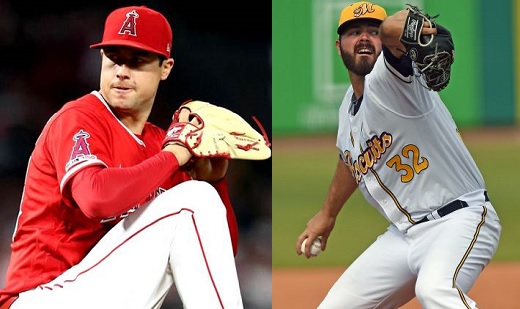
The Angels’ Tyler Skaggs’s (left) painkiller-related death raises a suspicion or three; murder robbed Rays minor league reliever Blake Bivens (right) of his wife, infant son, and mother-in-law. Bivens should be just as worthy of our sympathy and perhaps a degree or three more . . .

Fetanyl is a synthetic pain reliever usually though not exclusively administered for relief in cancer patients. Oxycodone, perhaps the most infamous among opioid pain relievers, is prescribed normally for those who need long-term, around-the-clock pain relief.

The Tarrant County (Texas) medical examiner says both plus alcohol were in Tyler Skaggs’s system the night he died unexpectedly on 1 July. “[A]lcohol, fentanyl and oxycodone intoxication with terminal aspiration of gastric contents,” the medical examiner’s report is quoted as saying.

That clinical language translates to the 27-year-old Angels’ lefthander vomiting and choking on it under the influence in his sleep.

Skaggs’s death provoked a hurricane of grief around baseball that seemed exacerbated when the Rangers, whom the Angels were in town to play, not only canceled that night’s game out of respect to the Angels but put Skaggs’s uniform number, 45, in the Angels’ uniform lettering style, behind the pitching rubber the following night, before the Angels beat them 9-4.

And when the Angels returned home from that road trip, they kicked off their first homestand since Skaggs’s death with a staggering 13-0 combined no-hitter against the Mariners that electrified its own sport and others, from Taylor Cole pitching two and Felix Pena pitching the final seven innings to Mike Trout himself accounting for about half the Angels’ destruction, his share only beginning with a two-run homer into the Angel Stadium center field rocks in the bottom of the first.

Assorted players around baseball have scratched their own little tributes to Skaggs since, including many scrawling his number 45 onto their game hats. The sole admirable sight on the otherwise execrable black (for visiting teams) and white (for home teams) Players’ Weekend uniforms—which made the games resemble contests between Mad‘s memorably “Spy vs. Spy” strips—was the circular black patch with 45 in white in the middle on every sleeve.

We’ll know soon enough, I’m very certain, as to just why Skaggs needed to take fetanyl and oxycodone. There’s already an ugly rumour that an Angels employee may have had a hand in Skaggs’s death; Los Angeles Times sports editor Bill Shaikin says MLB will investigate the claim. And Skaggs’s family has hired a Texas attorney to investigate for themselves.

Unless there was foul play of the type Tarrant County’s police couldn’t determine, or unless Skaggs suffered a medical condition about which none seems to have been aware, his is only slightly less senseless a death than what was done to the family of Rays minor league relief pitcher Blake Bivens.

Bivens’s wife, Emily; their year-old son, Cullen; and, his mother-in-law, Joan Jefferson Bernard, were shot to death Tuesday morning. Emily and Cullen Bivens were found dead inside Mrs. Bernard’s Keeling, Virginia home; Mrs. Bernard was found dead in the driveway. Bivens’s teenage brother-in-law, Matthew Bernard, is in custody charged with the crimes.

A neighbour told police Bernard came to her door and punched her in the arm before she heard subsequent gunshots at Mrs. Bernard’s home. Investigators found shell casings from a 30-30 rifle near the victims’ bodies; Bernard was arrested naked and trembling up the road after being found in a nearby wooded area. He was jogging in a circle and refused to stop at first even despite being pepper-sprayed by one officer; when he tried to choke another neighbour, police finally subdued the naked Bernard.

“My life as I knew it was destroyed,” said Bivens, a righthanded pitcher with a 4-0 won-lost record and a 3.98 earned run average but a proneness to walks for the Montgomery Biscuits (AA) this season, in an Instagram post Thursday. “The pain my family and I feel is unbearable and cannot be put into words.”

The stricken reliever tried anyway.

He called his wife the one “who made me into the man I am today and you loved me with all of my flaws.” He said of his little son, “I can’t breathe without you here. I finally understood what love was when you were born and I would have done anything for you.” And, he said of his mother-in-law, “You loved your family more than anyone I’ve ever seen. You raised the most wonderful girl in the world. I’m so glad y’all are still together.”

It says nothing against Blake Bivens that an established major league pitcher freshly married and unexpectedly dead at 27 provoked a wider, deeper choke of game-wide grief than a six-year minor league pitcher having not even a single cup of major league coffee whose wife, infant child, and mother-in-law were murdered.

But it’s impossible not to notice that Skaggs left a loving wife behind while Bivens was robbed grotesquely of his. Both are to mourn a little more deeply.

The Angels gave Skaggs a past-heaven home farewell

2019-07-12 MikeTrout

Wearing Tyler Skaggs’s name and number, Mike Trout finishes running out the two-run bomb he launched to start the Angels’ memorial massacre Friday night.

The stricken finally returned home to start the season’s second half. And the way they did it didn’t just defy belief, it drove belief almost as far out of Angel Stadium Friday night as Mike Trout’s two-run homer flew out in the bottom of the first.

The Angels paid one more tribute to the unexpectedly late Tyler Skaggs before the home audience Friday night. On the night before Skaggs would have turned 28. With a combined no-hitter and a sinking of the Mariners all the way to Davy Jones’s Locker.

It only began with a 45-second pre-game moment of silence in Skaggs’ memory, the time in honour of his uniform number. The Angels one and all wore Skaggs’ number 45 for the moment and for the game. Some dare call that tempting the baseball demigods, others dare call it divine inspiration.

After the Angels put the 13-0 no-no squarely into the bank, nobody really knew what to call it. Assuming God was available for comment, even He Himself might have been lost for words, and His words are usually the best words any side of heaven.

“Tyler’s birthday is 7/13. Tomorrow,” said Trout following the game. “They’d tell you to rewrite this script to make it more believable if you turned this in.” Which is pretty astute coming from a guy who claimed to be speechless over what he and his mates just did.

“Absolutely incredible,” tweeted Astros pitcher Justin Verlander. “Meant to be.”

The Mariners joined the Angels, showing shiploads of class, in lining up the baselines from the plate as a Skaggs jersey was placed behind the Angel Stadium pitcher’s mound in a frame.

Skaggs’ widow, Carli, his mother Debbie, his stepfather Dan, and his stepbrother Garrett, made for the mound accompanied by Angels pitcher Andrew Heaney. Then Debbie wound up and threw a ceremonial first pitch, before embracing Heaney and Mike Trout, the Angels’ all-everything center fielder suddenly emergent as the team’s no questions asked leader in the immediate aftermath of Skaggs’ unexpected death.

And those genuinely touching moments were almost nothing compared to what happened during the actual game, played in front of a likeness of Skaggs and a circular memorial displaying number 45 large on the rear end of Trout’s office, the center field fence.

How many times can you say the Angels paid their departed pitcher the most unexpectedly appropriate tribute of all—a game in which two pitchers, Taylor Cole (two innings) and Felix Pena (seven innings) combined to surrender no hits, only one walk, and see not a single Mariner reach on an error?

How often can you say Trout himself—who wept unashamedly last week in Texas, trying to express what his friend Skaggs meant to himself and to their team—accounted admirably for almost exactly half the Angels’ commemorative destruction?

Say it as often as you like even if you’re not an Angel fan. Because seldom if ever has a team rent by in-season tragedy responded like this when finally getting to play for the home audience after their lost teammate’s death on the road, showing him the love with their fans.

2019-07-12 LosAngelesAngels

First, they lined up for 45 seconds of silence in Skaggs’ memory. Then, they performed a combined no-hitter and a blowout. Who says baseball’s lost its capacity for surreality?

And even less often does it begin the way it did in the bottom of the first, after Cole retired the Mariners in order on a strikeout, a fly out, and a ground out—dropping seven on Mariners starter Mike Leake before Matt Festa struck out Justin Upton, who’d singled earlier in the inning, swinging on a 2-2 fastball.

The carnage only began when Angels leadoff man David Fletcher banged a double off the right center field wall. Trout stepped up in the number two slot and, proving it almost doesn’t matter where in the Angel lineup he hits, turned on a Leake sinker with about as much sink as a blimp and blasted it right into the rocks behind the center field fence.

Almost immediately after crossing the plate himself, Trout looked toward the Angel Stadium section where players’ wives or girl friends sit, until he caught Carli Skaggs’ eye. It looks as though he gave her a gentle affirmative nod. That one’s for your husband, Carli. And you ain’t seen nothing yet.

The inning from there went single (Shohei Ohtani), single (Justin Upton), swinging strikeout, RBI single (Andrelton Simmons scoring Ohtani), run-scoring error (Upton scoring as Mariners second baseman Dee Gordon misplayed a forceout), RBI single (Dustin Garneau), swinging strikeout, bases-loading single (Fletcher), and Trout’s two-run double.

And Trout wasn’t even close to finished for the night. The very next inning, a strikeout after Festa walked Simmons home, Festa hit Trout with a 2-0 slider to send home Justin Bour. Three innings and two more Mariners pitchers later, Trout squared off against Matt Wistler with Fletcher on second thanks to a single and a throwing error on the play and rifled a double to the back of left field, scoring Fletcher and making things 10-0.

All the while Pena continued keeping the Mariners from bringing their flippers to bear after Cole worked the first two spotless. About the only dicey moment he really faced, other than walking Mariners designated hitter Omar Narvaez in the fifth, was Mac Williamson smashing a grounder in the top of the sixth for which third baseman Matt Thaiss needed to make a diving stop and hard enough throw to nip Williamson.

Trout helped put another cherry atop the Angels’ sundae evening when he came home as Upton sent Mariners reliever Parker Markel’s 2-0 fastball over the center field fence. The Angel who patrols center field like a cop with acrobats in his family history did his evening’s work so well there wasn’t a baseball jury on earth who’d convict or sentence him for grounding out with the bases loaded to end the bottom of the eighth.

By then the only question left was whether Pena could finish the second combined no-no in Angels history. (The first was between Mark Langston and Mike Witt in 1990.) And, the first Angel no-hitter of any kind since Jered Weaver in 2012. Strangely enough, it was in 2012 that the Mariners themselves were last no-hit, courtesy of the White Sox’s Philip Humber’s perfect game.

The answer was Williamson flying out on the first pitch, Gordon grounding out on the second pitch, and Mallex Smith grounding out on the second pitch. Easy as 1, 2, 2.

“This,” tweeted Blue Jays pitcher Marcus Stroman, “is unbelievable. The baseball gods.”

Nobody’s really going to care for the smaller details of the night such as the Angels going 7-20 with runners at second base or better including Trout’s 3-for-4. Nobody’s going to care (too much) that, between them, Cole and Pena threw 63 strikes out of 103 pitches, with Cole striking out a pair and Pena punching out six.

Leave those details plus the Mariners’ seven pitchers combining to surrender eight earned runs, punching out eleven, but walking seven, to the statisticians. Because other than the surrealistic final score, and the absence of Mariners hits, nobody cared about any numbers above and beyond the 45 on the Angels’ backs Friday night.

Nobody cared about anything other than one baseball team coming home from a heartbroken road trip, seeing the massive makeshift memorial to their fallen teammate outside the home plate entrances to their ballpark, and taking a little extra incentive they hardly needed considering, to suit up and give him a sendoff he couldn’t have imagined but surely hoped wouldn’t come for decades yet to be. Decades he’ll see only from heaven.

With Skaggs’ clubhouse locker fully stocked and the team intending to keep it that way the rest of the season, the Angels had one more tribute to make after the game. They went out to the mound and covered it in Skaggs jerseys. Leaving the big 45 behind the pitching rubber exposed. There was nothing more they could possibly do.

Whether the Angels go from here to the postseason, even though they now sit in rear-view enough distance five and a half games and five teams away from a wild card slot, almost doesn’t matter. On Friday night, saying one more farewell to a pitcher they loved on the mound and even more as a young man, the Angels were bigger than baseball. And baseball didn’t seem to mind one bit.

Cervelli, Lucroy, and baseball’s most vulnerable beasts

2019-07-07 JonathanLucroy

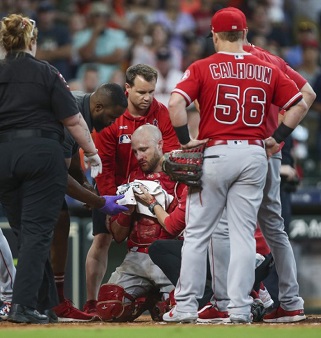
Hours after Francisco Cervelli surrendered the “tools of ignorance” Sunday, Angels catcher Jonathan Lucroy (center, kneeling) was blasted near the plate by Astros baserunner Jake Marisnick. Angels outfielders Kole Calhoun and (hidden, mostly) Mike Trout join team health personnel checking their man . . .

Baseball’s single most dangerous field position is probably behind the plate. Catchers are in on the beginning of each play, receiving the pitcher’s delivery unless its struck by the hitter. But catchers can also be men one minute made mincemeat the next, depending.

They risk being concussed into brain damage by anything from a foul tip, a violent backswing, an unforgiving wall or rail or fence while trying to catch a foul popup, or a baserunner steaming from third base and flying home in a near-perfect impression of a cruise missile. The luckier ones retire from baseball without their bodies becoming their own quislings or their minds lost in the liquefying of their brains.

Their field equipment was nicknamed “the tools of ignorance” by ancient catcher Muddy Ruel, who hoped to highlight the irony, as baseball’s very own Website points out, “that a player with the intelligence needed to be effective behind the plate would be foolish enough to play a position that required so much safety equipment.”

Ruel played generations before catchers took to wearing helmets that are the next best thing to those employed by hockey goalies. Thomas Boswell once called the catcher “half guru, half beast of burden.” It’s the latter that often means a catcher sliced, diced, and pureed, Bigfoot turned to Blue Bonnet margarine.

Baseball changed the rules a few years ago to get catchers a little further out of the line of collision than was reasonably healthy for them to remain. There were those mourning the further snowflaking of the grand old game. But maybe we ought to wonder instead how such men as Hall of Famer Yogi Berra lived as long as they did with their marbles unspilled. (Berra died at 90.)

Nothing specifically says baseball must be excessively dangerous for those who play it or those who watch and love it. Nothing suggests concurrently that even the thinking person’s sport that baseball is must be immune at all times to physical injury. But players have been known to play as though in the youthful and naive belief that they are eternally invulnerable. Until they’re not.

Hall of Fame catcher Roy Campanella once said, famously, that for a man to play baseball well a lot of him had to be a little boy. Boys will be boys, but there’s nothing written or implicit mandating that they absolutely have to destroy themselves or each other to be boys, or young men.

On baseball’s final Sunday before the All-Star break, one major league catcher decided six concussions per twelve major league seasons was quite enough, and it was time to set the so-called tools of ignorance to one side. Francisco Cervelli, Yankee turned Pirate, got number six thanks to a broken bat hitting his chin on 25 May. “That’s enough,” he told DKPittsburghSports.com’s Dejan Kovacevic. “This time is different. I can’t live like this.”

What a difference almost a month and a half makes. When first knocked down and out, Cervelli was determined to get back behind the plate as soon as feasible, which seemed to unnerve Pirates general manager Neal Huntington.

“We care about this man. We care about this person and want him to have a great post-playing career . . . You have to respect the player’s wishes,” Huntington said then. “Francisco has been adamant that he wants to continue to catch. I think he would be quite unhappy if we told him he was never going to catch for us again.”

Kovacevic says Cervelli changed his mind gradually but surely and with no instigation from the Pirates. He talks of switching to the outfield, perhaps. Barring any frequent collisions with fellow outfielders, it’s a far less dangerous place to play, assuming Cervelli can recover his batting stroke enough to justify the Pirates letting him fall in out there.

And lo! Just hours after the news of Cervelli discarding the tools of ignorance came forth, there came a play in Houston that gave his alarm too much credence.

Astros outfielder Jake Marisnick, inserted into the game against the Angels as a pinch runner for left fielder Yordan Alvarez, attempted to come home from third on a long bases-loaded fly to right by Astros center field star George Springer. Angels right fielder Kole Calhoun fired a strike home.

Marisnick came booming down the line as Angels catcher Jonathan Lucroy awaited the Calhoun throw. Mindful of the oncoming Marisnick, Lucroy moved out front and slightly left of the plate, which (read carefully) opened the lane for Marisnick to stay on a straight line, with Lucroy, a well-seasoned catcher, leaving himself concurrent room to apply a tag.

Except that Marisnick jinked left, right into Lucroy, blasting Lucroy into a heap, the impact compelling Marisnick to double back to touch the plate, before he bent over Lucroy in obvious alarm for the veteran’s health as the Angels’ training staff arrived at the plate.

The play was reviewed out of New York and Marisnick was ruled out. He would have scored the go-ahead run in a ten-all tie; the Astros ultimately won the game 11-10 in the tenth inning.

Social media seemed to bristle with Astros fans fuming over the out call, but the call was indeed correct according to the rule that’s been in place since 2014, when the Giants and most of baseball became fed up over how much playing time injuries and plate collisions cost their star catcher Buster Posey:

A runner attempting to score may not deviate from his direct pathway to the plate in order to initiate contact with the catcher (or other player covering home plate). If, in the judgment of the Umpire, a runner attempting to score initiates contact with the catcher (or other player covering home plate) in such a manner, the Umpire shall declare the runner out (even if the player covering home plate loses possession of the ball).

I watched as many replays of the play as I could. My conclusion:

1) Lucroy did indeed move to allow Marisnick a more proper lane, just before Lucroy took Calhoun’s throw to the plate on the short hop about a foot forward left of the plate. (The longtime rule was that catchers were not allowed to block the plate, a rule rarely enforced, but Lucroy acted within the letter of the current rule, too.)

2) Marisnick did indeed move left and into Lucroy’s way in a bid to move him off the play when he was indeed given a clear, straight line to the plate. If you see the play from the camera angle behind the plate, you see Marisnick look as though making a quick turn left, the pivot on his right leg, and into Lucroy.

3) Read this very carefully, too: From all appearances, Marisnick had no intention of relieving Lucroy of his limbs or his brains on the play. He wanted simply to knock Lucroy off the play and relieve him of the ball he speared seconds before impact. The ball was indeed knocked right out of Lucroy’s mitt at the moment Marisnick turned him into the high priced spread.

4) The foregoing said, Marisnick was very remorseful over Lucroy’s injury, as he tweeted subsequently: Through my eyes I thought the play was going to end up on the outside of the plate. I made a split second decision at full speed to slide head first on the inside part of the plate. That decision got another player hurt and I feel awful. I hope nothing but the best for [Lucroy].

5) Properly remorseful but momentarily blinded. Full speed or otherwise he couldn’t possibly miss Lucroy moving forward to allow him a proper lane, which, I repeat, would still give Lucroy a fair shot at tagging him out and Marisnick a fair shot at scoring.

The Angels sent Lucroy to a local hospital for a CT scan and concussion evaluation, not to mention to determine whether his nose was broken on the play. Lucroy’s week already included mourning the unexpected deaths of his Angels teammate Tyler Skaggs and his coach at Louisiana-Lafayette College, Tony Robichaux. Crowning such grief by being blown to smithereens wasn’t exactly on Lucroy’s radar.

It soiled both the Astros’ otherwise splendidly hard earned win and the afternoon on which Mike Trout, the Angels’ and baseball’s Mr. Everything, bombed his way into his team’s record book, his two launches making him the Angel with the most home runs prior to an All-Star break, ever. (The previous record, 26, was shared by Trout, future Hall of Famer Albert Pujols, and former Angels star/World Series hero Garret Anderson.)

It also spoiled such Sunday milestones as Mets rookie Pete Alonso, one of the few bright lights in a Mets season described at best as grotesque, breaking the National League’s record for runs batted in by a rookie before an All-Star break and tying the Mets’ team record for home runs before the All-Star break. (Dave Kingman set it in 1976.)

And it punctuated Francisco Cervelli’s decision with an exclamation point that might as well have been fashioned into a stake.