“Down goes Anderson! Down goes Anderson!”

Tim Anderson

White Sox shortstop Tim Anderson hits the deck after Guardians third baseman José Ramírez (second from left, restrained further by a White Sox player) answered Anderson’s foolish challenge to fight with a flying right cross to the side of his head. White Sox first baseman Andrew Vaughn (25) would ultimately drag Anderson off the field as the two teams scrummed.

Once upon a time, Tim Anderson said he wanted to be today’s Jackie Robinson when it came to putting the fun back into baseball on the field. When the Yankees’ Josh Donaldson greeted him with, “Hi, Jackie,” during a game last year, the White Sox shortstop decided the joke’s shelf life expired not long after Donaldson first dropped it on him a couple of years earlier.

The benches and pens emptied, and Anderson’s White Sox teammates urged and nudged him back to the dugout before any serious damage could be done. The following day, Anderson—hammered with “Jack-ie, Jack-ie!” catcalls most of the day by the Yankee Stadium crowd—smashed a three-run homer that finished a doubleheader sweep, holding an index finger to his lips as a “shush” gesture to the catcallers.

But that was then and this was Saturday in Cleveland against the Guardians. In the sixth inning, Guards’ star José Ramírez went diving into second to beat a throw in from the outfield and finish his stretch into an RBI double. He slid right between Anderson’s legs.

Anderson had infuriated the Guards the night before with a tag knocking rookie Brayan Rocchio off the base, turning a double into an out when the original safe call was reversed rather controversially. Now, he seemed to try dropping a too-hard tag upon Ramírez to no avail. According to Ramírez, Anderson said he wanted to fight.

Ramírez held up his right arm as if hoping Anderson might help him up from the ground. Getting none, Ramírez rose on his own and pointed at Anderson, apparently objecting again to Anderson’s needlessly harsh tagging. Anderson assumed a boxing position as rookie umpire Malachi Moore tried to keep the pair separated.

Oops. Moore decided the better part of valour was to back away. Anderson threw a pair of rights as players on both sides approached. Then, somehow, some way, Ramírez swung a slightly wild right that caught Anderson flush on the left side of his face and knocked him to the ground. It was like Argentine boxing legend Oscar Bonavena’s wild punching style before Muhammad Ali outlasted him in 1970.

Guardians broadcaster Tom Hamilton couldn’t resist referencing another Ali fight when Ramírez connected: “Down goes Anderson! Down goes Anderson!” That went almost as viral as the scrum itself.

This wasn’t the usual bench-clearing incident in which the “brawl” was usually just a lot of hollering, shoving, more hollering, more shoving. This was two players swinging as if they’d mistaken themselves for hockey players. “It’s not funny,” said Guards manager Terry Francona post-game, “but coming [into the clubhouse] and listening to Hammy, it’s hard not to chuckle.”

It might have been Francona’s only chuckle of the evening. Not only did the White Sox finish what they started, a rather rare win, but Francona plus White Sox manager Pedro Grifol and their combatants Ramírex and Anderson were thrown out of the game post haste. So were Guards third-base coach Mike Sarbaugh and relief pitcher Emmanuel Clase.

Anderson wouldn’t talk to the press after the game, but Ramírez had plenty to say. “He’s been disrespecting the game for a while. It’s not from yesterday or from before,” the Cleveland third baseman began.

I even had the chance to tell him during the game, “Don’t do this stuff. That’s disrespectful. Don’t start tagging people like that.” In reality, we’re here trying to find ways to provide for our families. When he does the things he does on the bases, it can get somebody out of the game. So I was telling him to stop doing that and then as soon as the play happened, he tagged me again really hard, more than needed, and then he reacted and said, “I want to fight.” And if you want to fight, I have to defend myself.

Cynics suggest Anderson should get a two-week suspension for starting the fight in the first place. They say, not implausibly, that he shouldn’t exactly protest such a suspension, because his season—injuries contributed to his pre All-Star break .223/.259/.263 deflation, though he was bouncing back after the break—is much like that of the White Sox whole. Lost? Try disappeared.

Anderson has been admirable in the past for wanting baseball to be fun again, on the field and encouraging more black youth to consider the sport as a profession. He’s been capable of big moments, maybe none bigger than the game-winner he drove into the corn field behind the outfield in the first Field of Dreams game.

He wants to be remembered as an impact-delivering player. He overcame a lot to make himself a two-time All-Star. He looked like a classic baseball hero that night in Iowa. He may have thrown too much of that away Saturday night.

White Sox general manager Rick Hahn used the trade deadline to start dismantling the sorry enough team he’d built. Saturday night was actually the first White Sox win since the deadline itself. They’d lost thirteen of their previous seventeen until Saturday night. It’s not implausible to think Hahn will continue the remaking he began come the offseason.

But it’s also not implausible that Anderson, a player who’s meant plenty to the White Sox in the past, might be in his final days in their silks. If this proves the catalyst for that, it would negate enough of what he wants to mean to the team and to the game he loves. Far worse than his face or his ego getting dropped by a flying right in a foolish fight, that would hurt.
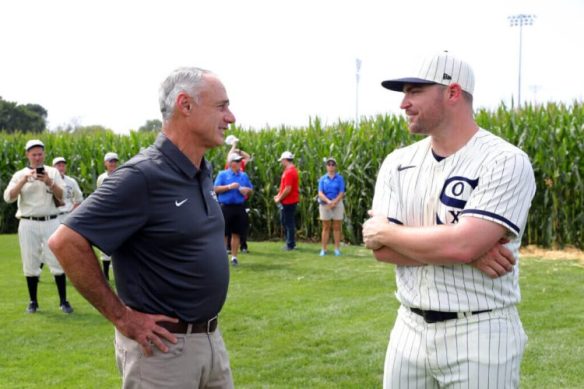
Mr. Commissioner, meet the real faces of the game

Rob Manfred, Liam Hendriks

Commissioner Rob Manfred with White Sox relief pitcher Liam Hendriks before last year’s Field of Dreams game. (The Athletic.)

Having a read of ESPN writer Don Van Natta, Jr.’s profile of commissioner Rob Manfred, I was almost convinced that maybe, just maybe, there really was more to Manfred than met the eye. Or, more than what comes forth in his stiff presence and often clumsy remarks.

Just maybe, the man isn’t the baseball-hating or baseball-illiterate Rube Goldberg-like abecedarian the caricatures so often portray. He did, after all, grow up a Yankee fan in upstate New York and can say proudly enough that he’s the only baseball commissioner ever who played Little League baseball. “All glove, no bat,” he remembers of being a Little League infielder.

My parents received a set of classic Revere copper-bottom cookware as a wedding present eight years before Manfred was born. (I still remember the fragrance of that special powder used to clean the copper bottoms, too.) Who knew Manfred (three years my junior) was the son of Revere’s production supervisor at their home plant in Rome, New York? An hour’s drive from Cooperstown, as it happens.

Born in 1958, Manfred took in his first live major league game at Yankee Stadium with his sports-obssessed father, sitting between the plate and first base on an Old Timers’ Day. Come game time, Hall of Famer Mickey Mantle crashed a pair of home runs and the Yankees beat the Twins, 3-2. When he finally became the game’s commissioner, he handed his father the first baseball with his stamp upon it.

“This is really an unbelievable thing,” Manfred, Sr. told his son. “I can’t say I disagree,” Manfred, Jr. told Van Natta.

A couple of hundred fathoms down, though, Van Natta noted that “more than once” Manfred told him what few baseball commissioners have dared to admit, that being the buffer absorbing the heat that should go to his bosses, the owners, is part of his job. Even if it’s about as pleasant as your private parts being caught in the vacuum cleaner’s handle.

And then it came.

“Every time it’s me, it ain’t one of those 30 guys—that’s good,” Van Natta quoted Manfred as saying. “Look, who the hell am I? I don’t have $2 billion invested in a team. I’m just a guy trying to do a job. I mean it. [The owners] deserve that layer. I believe they deserve that layer of protection. I’m the face of the game, for good or for bad.”

Mr. Manfred, unless it’s to boo and hiss your heads off over this or that piece of mischief, you may rest assured that no baseball fan anywhere in this country is paying his or her hard-earned money to head for the ballpark to see you or your bosses.

But I’m going to do you a small favour, as if you know me from the greenest bat boy on any professional baseball team. I’m going to introduce you to the true faces of the game. The ones whom those fans do pay their hard-earned money to see at the ballpark regardless of the machinations and deceptions of your bosses and theirs.

Mr. Manfred, meet Mike Trout. This is the guy you blamed once upon a time for not being baseball’s face, based upon his committing no crime more grave than letting his play and his clubhouse presence and his agreeability with fans before and after games speak for themselves, with no jive about the magnitude of being him.

Meet Shohei Ohtani. This is the two-way star who lights up the joint just by flashing that thousand-watt grin of his, never mind when he strikes thirteen out on the mound one night and belts baseballs onto the Van Allen Belt the very next. Between himself and Mr. Trout, you should be asking what on earth is wrong with the Angels that they still can’t find quality pitching enough to keep them in a race after they start in one but sputter unconscionably.

Meet Aaron Judge. This is the Leaning Tower of River Avenue who sends baseballs into the Delta Quadrant one moment and then, when made aware, goes out of his way to meet a Canadian kid to whom he’s number one among baseball men and who was handed one of his mammoth home run balls by an adult fan who knew the boy wanted nothing more than to catch one Judge hit out.

Meet Joey Votto. This is the future Hall of Fame first baseman who got himself tossed from a game early last year, but—after he learned his ejection broke the heart of a little California girl to whom he’s a hero above heroes—sent her a ball with his handwritten apology and autograph on it, prompting his team to drop game tickets and a little extra swag upon her the very next day.

Meet Bryce Harper. This is the guy who never apologised for being on board with letting the kids play. The guy now on the injured list with a thumb fracture and surgery to repair it after getting hit by a pitch thrown with one of the baseballs you and yours still can’t see fit to manufacture uniformly and with allowance for fairness on both sides of it, fairness for the pitchers and for the hitters alike.

Meet Vladimir Guerrero, Jr. and Bo Bichette. One is the son of a Hall of Famer who did last season what even his old man never did: led his league in on base percentage, slugging percentage, OPS, and OPS+, and led the entire Show in total bases. The other is the son of a respected major league slugger, has quite a lethal bat in his own right when his swing is right, and currently leads his league in trips to the plate. Together they’ve put some zip back into the Blue Jays.

Meet Oneil Cruz. The bat has yet to come to full life but the footwork, the glove, the throwing arm, have shown so far that you can be as tall as Frank Howard, J.R. Richard, and Randy Johnson and still play shortstop as though the position was created for you and not the Little Rascals in the first place. They’re falling in love with him in Pittsburgh, which needs all the love it can get, but they ought to fall in love with him all around the Show—except when he’s going so deep into the hole grabbing a grounder or a hopper that an enemy batter loses his lunch when he’s had a base hit stolen from him.

Meet Clayton Kershaw. He’s been around the block a few times. He’s a Hall of Fame lock as maybe the best pitcher of his generation. He’s still a quality pitcher and a class act. They still buy tickets on the road when they know he’s going to take the ball for the Dodgers. He’s faced his baseball aging curve with grace under pressure. And, for good measure, he’s the one active player who was seen fit to be part of the ceremony when the Dodgers unveiled that statue of their Hall of Fame legend Sandy Koufax this month, and you know (well, you damn well should know) what a class act Koufax was on the mound and has been in the decades since off it.

(You’re not still P.O.ed that Koufax waxed your Yankees’ tails twice while his Dodgers swept them in the 1963 World Series when you were seven, are you?)

Meet Justin Verlander. Missed a year plus recovering from Tommy John surgery. He has a 2.23 ERA and a 3.53 fielding-independent pitching rate so far this season. For any pitcher that’d be a remarkable return so far. For a future Hall of Famer who’s still suiting up at Jack Benny’s age (that’s a joke, son), it’s off the chart so far.

Meet Verlander’s 25-year-old Astros teammate, Yordan Álvarez. He’s leading the entire Show with his .667 slugging percentage, his 1.081 OPS, and his 206 OPS+. If there’s one untainted Astro who’s must-see viewing whenever he checks in at the plate, it’s him.

Meet Xander Bogaerts and Rafael Devers. The left side of the Red Sox infield is a big reason why the Olde Towne Team yanked themselves back up from the netherworld into second place in that rough and tumble American League East. Did I mention that Devers currently leads the entire Show with 177 total bases?

Meet José Ramírez. The Guardians’ third baseman is giving Devers a run for his money in the All-Star balloting that closes today. That thumb injury has put a crimp into his bat for now, and it’s had its role in the Guardians’ sudden deflation at the plate, but this guy just may be the face of his franchise right now. He ought to be one of the faces of this game.

Meet Mark Appel. This is the guy who went from number one in the draft to injuries as well as pressures and even to an exit from the game only to try giving it one more try—and finally coming up with the Phillies, nine years after that draft, and tossing a scoreless inning . . . at age 30. That’s as feel good a story as it gets for the oldest former number one to make his Show debut, no matter what happens with the rest of what remains of Appel’s career. They don’t all go to hell and back.

Those are only some of baseball’s faces, Mr. Commissioner. They’re the ones the fans want to see and pay through the nose to see. Despite your tinkerings. Despite your often erroneous readings of the room. Despite your inability or unwillingness to demand the same accountability of umpires that you do of players, coaches, and managers.

Despite your inability to let your professed deep love of the game come through without tripping over itself because, as an improvisor, well, if you were a musician the consensus would be that Miles Davis you ain’t.