The All-Scar Game

Austin Riley, Pete Alonso

Austin Riley’s (Braves, left) kneeling throw to kneeling scooper Pete Alonso (Mets, right) ended the bottom of the All-Star Game eighth with a double play . . . (MLB.com photo) . . .

The best thing about Tuesday night’s All-Star Game? Easy. That snappy eighth inning-ending double play into which Athletics outfielder Brent Rooker hit. He shot one up the third base line to Braves third baseman Austin Riley, who picked and threw on one knee across to Mets first baseman Pete Alonso, who scooped on one knee to nail two outs for the price of one, doubling Blue Jays second baseman Whit Merrifield up.

That play preserved what proved the National League’s 3-2 win over the American League in Seattle’s T-Mobile Park. They got the second and third runs in the top of that eighth, when Elias Díaz (Rockies) pinch hit for Jorge Soler (Marlins) with Nick Castellanos (Phillies) aboard after a nine-pitch leadoff walk and nobody out. Díaz sent Orioles righthander Félix Bautista’s 2-2 splitter off a bullpen sidewall, then off an overhang into the left field seats.

It meant the first NL All-Star win since 2012. It also meant Díaz becoming the Rockies’s first-ever All-Star Game Most Valuable Player award winner. Otherwise? It meant almost nothing. Because the worst thing about this year’s All-Scar Game was . . . just about everything else.

Mr. Blackwell, call your office. All-Star Game specific threads have been part of it for long enough. They began ugly and devolved to further states of revulsivity. But Tuesday night took the Ignoble Prize for Extinguished Haberdashery. The only uniforms uglier than this year’s All-Star silks are those hideous City Connect uniforms worn now and then during regular season games. Both should be done away with. Post haste. Let the All-Stars wear their regular team uniforms once again.

Who are those guys? They sort of anticipated long ovations for the hometown Mariners’ All-Star representatives. But they didn’t anticipate they’d be longer than usual. To the point where two Rays All-Stars—shortstop Wander Franco, pitcher Shane McLanahan—weren’t even introduced, when they poured in from center field among all other All-Stars. (Rays third baseman Yandy Díaz, an All-Star starter, did get introduced properly. But still.)

Maybe the two Rays jumped the gun trotting in while the ovation continued, but they should have been announced regardless.

While I’m at it, what was with that nonsense about bringing the All-Stars in from center field instead of having them come out of the dugouts to line up on the opposite base lines? Some traditions do deserve preservation. Not all, but some. What’s next—running the World Series combatants’ members in from the bullpens? (Oops! Don’t give the bastards any more bright ideas!)

Down with the mikes! In-game miking of players has always been ridiculous. But on Tuesday night it went from ridiculous to revolting. When Rangers pitcher Nathan Eovaldi took the mound miked up, the poor guy got into trouble on the mound almost at once. He had to pitch his way out of a two-on, one-out jam in the second inning. He sounded about as thrilled to talk while working his escape act as a schoolboy ordered to explain why he put a girl’s phone number on the boys’ room wall.

What’s the meaning of this? We’ve got regular-season interleague play all year long now. The National League All-Stars broke a ten-season losing streak? Forgive me if hold my applause. So long as the entire season is full of interleague play, the All-Star Game means nothing. Wasn’t it bad enough during those years when the outcome of the All-Star Game determined home field advantage for the World Series?

The road to making the All-Star Game mean something once more is eliminating regular-season interleague play altogether.
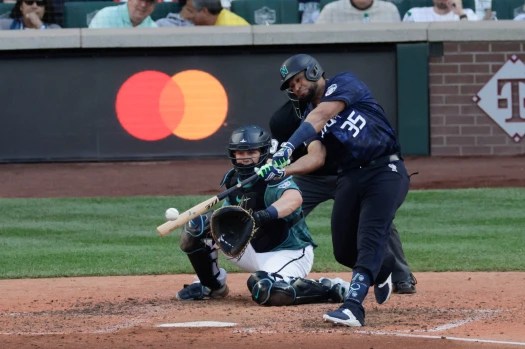
Elias Díaz

. . . saving the lead (and, ultimately, the game) Elias Díaz gave the NL with his two-run homer in the top of the eighth. (And, yes, the All-Star uniforms get uglier every year. Enough!) (AP Photo.)

Tamper bay. Sure it was cute to hear the T-Mobile Park crowd chanting for Angels unicorn star Shohei Ohtani to come to Seattle as a free agent. The problem is, he isn’t a free agent yet. He still has a second half to play for the Angels. I’ll guarantee you that if any team decided to break into a “Come to us!” chant toward Ohtani, they’d be hauled before baseball’s government and disciplined for tampering.

I get practically every fan base in baseball wanting Ohtani in their teams’ fatigues starting next year. If they don’t, they should be questioned by grand juries. But they really should have held their tongues on that one no matter how deeply you think the All-Scar Game has been reduced to farce. Lucky for them the commissioner can’t fine the Mariners for their fans’ tamper chants. (Not unless someone can prove the Mariners put their fans up to it, anyway.)

Crash cart alert. Cardiac Craig Kimbrel (Phillies) was sent out to pitch the ninth. With a one-run lead. The National League should have put the crash carts on double red alert, entrusting a one-run lead to the guy whose six 2018 postseason saves with a 5.90 ERA/6.74 fielding-independent pitching still felt like defeats. The guy who has a lifetime 4.13 ERA/4.84 FIP in postseason play.

Kimbrel got the first two outs (a fly to right, a strikeout), then issued back-to-back walks (six and seven pitches off an even count and a 1-2 count, respectively) before he finally struck Jose Ramirez (Guardians) out—after opening 0-2 but lapsing to 2-2—to end the game. Making the ninth that kind of interesting should not be what the Phillies have to look forward to if they reach the coming postseason.

Sales pitch. How bad is the sorry state of the Athletics and their ten-thumbed owner John Fisher’s shameless moves while trying and failing to extort Oakland but discovering Nevada politicians have cactus juice for brains? It’s this bad—when the T-Mobile crowd wasn’t chanting for Ohtani to cast his free agency eyes upon Seattle, they were chanting “Sell the team!” when Rooker whacked a ground rule double in the fifth.

Can you think of any other All-Star ballpark crowd chanting against another team’s owner in the past? Not even George Steinbrenner’s worst 1980-91 antics inspired that. That’s more on Fisher, of course, but it’s still sad to think that a team reduced to cinder and ashes with malice aforethought captured an All-Star Game crowd’s attention almost equal to the attention they might have paid the game itself.

The Las Vegas Athletics of Oakland

Oakland Athletics

Will the owners do the right thing and block John Fisher’s final betrayal of the fan base he abused?

Now we know Nevada governor Joseph Lombardo lacks either a brain or a veto pen when he needs both. We’re about to discover—or rediscover, as the case probably is—whether major league baseball owners have brains and vetoes enough to do what Nevada’s legislature and governor couldn’t or wouldn’t do.

Lombardo signed off on the state pledge of $380 million tax dollars toward building the Las Vegas Athletics of Oakland a new playpen on the fabled Las Vegas Strip. That, as more than a few social media crawlers have snarked, makes Lombardo the rookie of the year. Not.

The only thing left to plunge the knife all the way into Oakland’s back are the owners. Are they willing to rubber-stamp A’s owner John Fisher and baseball commissioner Rob Manfred’s insistence on finishing Fisher’s betrayal of Oakland and, by the way, waiving the $1 billion dollar relocation fee the A’s would normally have to pay MLB to make the move?

You’d better not ask Manfred about that. All indications are that the commissioner has long surrendered Oakland as a lost cause without bothering himself to ponder that the cause wasn’t lost, it was discarded witlessly. And A’s fans smothered in frustration, rage, and sorrow alike have learned the hard way what Manfred thinks of them after all.

Almost 28,000 fans poured into RingCentral Coliseum Tuesday in a “reverse boycott” aimed at letting the world know the A’s atrocity wasn’t their doing. That they weren’t the ones who let the team and the ballpark—whose usefulness disappeared years if not decades before the A’s might—turn into the city dump.

Manfred himself didn’t see the game. He was occupied with dining with some of the owners after their week of meetings ended in New York. But he did see the game’s coverage. And it impressed him this much: “It’s great to see what is, this year, almost an average Major League Baseball crowd in the facility for one night. That’s a great thing.”

Was Commissioner Nero even mildly aware that Fisher reduced the A’s to rubble while trying and failing to strong-arm Oakland and its home Alameda County into handing the A’s a new home practically on the house? That Oakland called his bluff and compelled Fisher to think about sticking it to Las Vegas and its home Nevada?

“I think if you look at the A’s record over time and the economic circumstances, including the state of the stadium that they’ve operated in for a very long time, they had a very good record up through the pandemic,” he said.

Translation: Oakland wasn’t willing to just build Fisher a delicious real-estate development in Howard Terminal with a new ballpark thrown in for good measure. Except that that wasn’t the only option Fisher blew sky high. “Wasn’t Fisher committed to Fremont not that long ago?” asked The Athletic‘s Tim Kawakami—in April. “Then to San Jose? Then to rebuilding at the Coliseum? Then to the Laney College site? Then to Howard Terminal . . . ? This is the Death Lineup of squandered and blundering stadium efforts.”

Kawakami then was perversely optimistic that Fisher would fall on his face in Las Vegas and thus be compelled to sell the A’s if only because he wouldn’t be able to meet Manfred’s deadline of getting new digs by 2024 or else. Except that Fisher and Manfred and Fisher’s parrot David Kaval picked their Nevada marks well. Nevada’s cactus juice-for-brains lawmakers and governor fell for it hook, line, and stinker.

Oakland itself (the city, that is) isn’t entirely innocent. They were quite prepared to make $375 million worth of commitments to a new A’s stadium if only Fisher and Kaval left it at that. But no. Fisher and Kaval insisted on pushing the $12 billion Howard Terminal development project. That, said mayor Sheng Thao, turned the simple into the too-complex.

“There was a very concrete proposal under discussion,” Thao’s spokeswoman Julie Edwards said in a formal statement, “and Oakland had gone above and beyond to clear hurdles, including securing funding for infrastructure, providing an environmental review and working with other agencies to finalize proposals.

“The reality is the A’s ownership had insisted on a multibillion-dollar, 55-acre project that included a ballpark, residential, commercial and retail space. In Las Vegas, for whatever reason, they seem satisfied with a nine-acre leased ballpark on leased land. If they had proposed a similar project in Oakland, we feel confident a new ballpark would already be under construction.”

If you need me to explain why Fisher and Kaval are settling for just the ballpark in Las Vegas, remember my beach club in Antarctica? You can have it for a song now. Maybe just a short medley.

Thao’s statement said, essentially, spare us the crocodile tears, Mr. Commissioner. “I feel sorry for the fans in Oakland,” Manfred says.

I do not like this outcome. I understand why they feel the way they do. I think the real question is what is it that Oakland was prepared to do? There is no Oakland offer, OK? They never got to the point where they had a plan to build a stadium at any site. It’s not just John Fisher . . . The community has to provide support, and at some point you come to the realization that it’s just not going to happen.

“This,” tweeted retired (and one-time A’s) pitcher Brandon McCarthy, “is [fornicating] pathetic. How is this not disqualifying? This toad is the steward of a glorious sport, dripping with history and he feels entitled to mock fans who are making their voices heard as he sits by and caters to hiding billionaires?”

Why does Manfred think Oakland “has to support” a team reduced to pathos by its owner, in a ballpark allowed to become a dump for too many years, with its host city responsible for building a new ballpark and just handing it to the team on whatever terms the team demands—even and including a $12 billion development where the ballpark would have been oh-by-the-way?

All that was Fisher’s doing. He did his level best to make things unpalatable for A’s fans. Including but not limited to the abject gall of inflating prices after last year’s A’s finished 60-102; two years and more worth of shipping or letting walk any viable A’s players who now perform well for other teams; and, ten years worth of fielding baseball’s 26th highest payroll with only one postseason game win to show for it.

(For the curious, the win was Game Three of the 2000 American League division series against the Astros—when courageous Liam Hendricks was still an Athletic, and kept a late two-run lead intact pitching the final two innings to nail the game.)

“[T]he A’s could have made money in Oakland,” writes Mark Normandin in Baseball Prospectus, using Tuesday night’s “reverse boycott” game as a classic example, “but chose not to.”

They stopped trying a long time ago, and began to try even less after that. No matter how many executive fingers are pointed at the fans in Oakland for not attending games, it doesn’t change that there is money to be made if you simply give the fans a reason to give it to you. Nearly 28,000 people paid an average of $29 just to show up on TV and tell John Fisher he sucks and should sell the team; do you know how much more positive energy and money could be out there for the A’s if they had a team worth paying to see? This is a city that, after all the team has done to them, was still willing to give them hundreds of millions in taxpayer funds to stick around even longer!

All that stands in the way of the A’s hosing Las Vegas and the entire state of Nevada now are the owners. (You think $380 million tax dollars is a fortune? Just wait until the almost-inevitable cost overruns begin to make themselves manifest. Three guesses whom the A’s and MLB will try to stick with those bills.)

I say again: I’d love nothing more than major league baseball in Las Vegas. But not like that. Not by way of a taxpayer hosing. Not a team whose often colourful history was betrayed by an owner who treated the team and its fans who’ve loved them like nuisances. I don’t want major league baseball in Vegas that badly. I’m perfectly happy having the Triple-A Aviators.

An optimist may now be described as someone who thinks enough owners will a) wake up and decide, after all, that there’s something transparently stupid about billionaires unwilling to build their teams’ own digs without a taxpayer soak; and, b) show enough spine, accordingly, to stand athwart Fisher (and Manfred, their hired hand, after all), yelling “Stop!”

Sure. Censor fans. That’s the way to solve the A’s.

RingCentral Coliseum

Ryan Noda’s two-run homer flew to this general location Friday night. MLB.com thought you didn’t need to see the protest banners by frustrated A’s fans when sending it forth as a highlight—until the censored clip went viral and howls forced the site to restore the original.

Not brilliant. MLB.com got caught with its censorship pants down all the way around its ankles Saturday. Apparently, someone at the network was not amused that a) the Athletics actually have fans at all; and, b) fans at Friday’s game against the Reds — all 6,423 of them — were likewise unamused at the condition into which their ten-thumbed owner John Fisher has rendered them.

The live game broadcast Friday had no funny business. When A’s first baseman Ryan Noda smashed a two-run homer in the bottom of the seventh, to shave a Cincinnati lead down to 8-5, the flight of the ball into the right field seats passed very visible protest banners draped from a railing.

The banners demanded Fisher sell the A’s, presumably to interests who’d be reasonable about building the A’s a new, hazard-and-poisons-free ballpark in Oakland rather than failing to strong-arm Oakland into all but handing them a new ballpark on a plate as a kind of by-the-way portion of a ritzy new real estate development.

But MLB.com decided those hunting game highlights didn’t need to see such nonsense. It allowed an awkward-looking edit of Noda’s blast to circulate without so much as a hint of the protest linens in sight. The edit probably made those who hadn’t seen the live broadcast wonder if they’d lost their ball-tracking skills. The edited footage went viral. Only then did MLB.com restore the original footage.

“We were unaware of the edit,” said an unnamed MLB.com spokesman to the San Francisco Chronicle‘s A’s beat writer Matt Kawahara. “When it came to our attention, we corrected it as it isn’t consistent with our policy.” If you buy that, my Antarctican beach club just shaved another couple of thousand off the sale price.

This is hardly the first time baseball’s government or an individual team’s administration has played the censor. Following are just some such examples:

In 1964, the White Sox tried to stick veteran relief pitcher Jim Brosnan with a contract clause prohibiting him from writing for publication without the organization’s prior approval of what he wrote. Brosnan already wrote a pair of somewhat controversial, from-the-inside best-sellers, The Long Season (about his 1959 between the Cardinals and the Reds) and Pennant Race (about the Reds’ surprise pennant), all by his lonesome, even. He’d also written other magazine articles since.

Brosnan essentially told the White Sox where to stick it and retired to a life of writing, advertising, and sportscasting, until his health declined and he died at 84 in 2014.

Censorship in baseball isn’t new by any means. The White Sox wanted Jim Brosnan to submit to team approval before writing for publication; then-commissioner Bowie Kuhn tried to suppress Jim Bouton based on a small magazine excerpt. Both pitchers told both overlords where they could plant it.

In 1970, commissioner Bowie Kuhn tried directly and clumsily to suppress another veteran pitcher’s book, Jim Bouton’s Ball Four, his deep diary of his 1969 between the expansion Seattle Pilots and the Astros to whom he was traded late that August. Having read nothing but a brief magazine excerpt from the book, Kuhn demanded Bouton sign a statement saying it was all the doing of his nefarious editor Leonard Shecter. Undeterred, Bouton all but demanded Kuhn plant it where the sun didn’t have a chance.

The sore-armed right-hander, who’d taken to throwing the knuckleball to keep his career alive, after arm issues began eroding him circa 1965, retired after a send-down to the Astros’ minors. Bouton became a sportscaster for local New York news, tried a comeback in 1977-78 that ended after a few gigs with the Braves, and re-retired to a kind of renaissance life of writing, co-creating Big League Chew gum, restoring an old ballpark here and there, and ballroom dancing with his second wife, before cerebral amyloid angiopathy took hold of him after a 2012 stroke. He died at 80 four years ago.

As the 1980s moved forward, Yankee fans became anywhere between more restless and more revolted over owner George Steinbrenner’s ham-handed rule. The Boss took to ordering Yankee Stadium security to confiscate protest banners for openers and their creators for continuers. And that was only for openers. As a 1989 Banner Day gathering began under the right field stands, it included a fan named Bob DeMartin, dressed in a monk’s robe and a Yankee cap, brown beads and sandals, carrying a Grim Reaper’s scythe from which hung the sign, “Forgive him, Father, for he knows not what he does.”

DeMartin was removed from the House That Ruthless Rebuilt post haste. According to the New York Times sports columnist Dave Anderson (the second sportswriter ever to win the Pulitzer Prize for distinguished commentary, after his colleague Red Smith), Yankee Stadium ops director Bill Squires removed DeMartin because his garb and sign were “sacriligious.”

“Maybe so,” Anderson wrote, “but if God is a Yankee fan, He had to be chuckling at that sign along with all those who saw it. To many, it was more charitable than sacrilegious.”

Early in the 1980s, Karl Ehrhardt, the crafty Mets fan known as the Sign Man for his well-made game-punctuating signs over the previous decade and a half, found himself on the wrong side of the Mets administration. He’d been critical of the Mets’ dissipation in the second half of the 1970s (WELCOME TO GRANT’S TOMB went one of his fabled signs, referring to imperious, patrician front office leader M. Donald Grant), and the Mets quit inviting him to team functions outside Shea Stadium. So Ehrhardt removed himself from the ballpark for most of the rest of his life.

And, when the 2021 American League Championship Series moved to New York, Yankee Stadium security decided a fan named David Taub—showing up for the game dressed as Oscar the Grouch in a trash can, referencing the Astros’ illegal, off-field-based electronic sign-stealing operation of 2017-18—didn’t need to be allowed into the park. The security guard who rousted Taub claimed the Astros complained to baseball government about protest signs and implements on the road. The Astros claimed neither they nor commissioner Rob Manfred were “aware” of any such complaints.

The price for that Antarctican beach club just dropped another couple of thousand.

No fans in baseball are as frustrated as A’s fans. Unless you count Angel fans who only thought they would be done with the Arte Moreno nightmare at last. A’s fans have more than enough reason to be, thanks to their owner willfully breaking the team in half during his tenure while trying and failing to get Oakland to hand him a new ballpark on a plate and casting his none-too-lonely eyes upon Las Vegas.

Las Vegas seems blind enough to go like lambs to the proverbial slaughter handing Fisher what he wants, a new home without it costing him one thin dollar either in its development or the A’s resurrection to competitiveness. And Manfred seems more interested in getting Fisher what he wants, fans and taxpayers be damned, than getting a true reading of the room—or should that be a funeral parlor?—in which A’s fans commiserate and mourn.

But MLB.com’s clumsy bid to censor those A’s fans still willing to come to their sewage mistreatment plant of a stadium shouldn’t go quietly, either.

This essay was written originally for Sports-Central.