Shoh, it wasn’t so

Shohei Ohtani

Ohtani conks one long distance against the Giants earlier this month. His former interpreter has all but taken him off the gambling hook—and is about to plead in a federal case.

Well, now. Shohei Ohtani’s former interpreter is ready to sing. And it won’t be “An Innocent Man,” either. Ippei Mizuhara is ready to serenade the Feds with a guilty plea over stealing millions from the Dodgers star to bet on sports with an illegal bookmaker.

The New York Times said Wednesday night Mizuhara’s ready to plead guilty. The Times and several other media outlets also say the Feds have found evidence that Mizuhara tried to cover his trail by changing Ohtani’s bank account settings to deny Ohtani alerts and notifications whenever his money moved one or another way.

The Athletic reports that Mizuhara swiped more than the originally speculated $4.5. million—about $16 million plus, adding that he’s facing charges of bank fraud emanating from the Fed investigation. For which the maximum sentence is thirty years in the calaboose, though a plea deal may give him less time.

In other words, faced with riot-running speculation that he was betting on sports illegally through a California bookie, Ohtani told the plain truth when he said it wasn’t Shoh last month. That was the simple part. The hard part was acknowledging and saying his longtime friend and interpreter Mizuhara robbed him blind.

This would be the perfect moment for all appropriate social and mainstream media apologies alike for jumping Ohtani out of the gate, demanding his purge, demanding the unraveling of the obvious coverup on behalf of protecting baseball’s arguable biggest star at the moment. It would also be the perfect moment for apologies out of any and every one who said—without a shred of logic, sense, or thought—that the Ohtani case should have been Pete Rose’s get-out-of-baseball-jail-free card.

It’s not the perfect moment, yet? OK, I can wait. But not for very long. Rush to judgment? How about a warp speed to judgment. All there had to be was even one published hint that someone in Ohtani’s circle was betting on sports illegally and crowds of social media troglodytes, plus enough of a pack of mainstream reporters who are supposed to know better, couldn’t decide on the design of the noose or gallows from which Ohtani should hang.

The first such hints, which weren’t exactly hints, emerged while the Dodgers were in South Korea to play the Padres in their regular season-opening series. That’s when Ohtani first learned there was a gambling probe and that his own longtime friend and interpreter was involved.

Days later came Ohtani’s March presser. The one in which he denied flatly that he bet on baseball or any other sport in any way, shape, or form. The one in which he admitted he was now very suspicious that Mizuhara wasn’t exactly straightforward in his original statements about his ties to southern California bookie Matthew Bowyer.

“According to the [federal] complaint,” The Athletic‘s Andy McCullough writes, “Mizuhara manipulated Ohtani’s bank accounts beginning in 2021, around the time Mizuhara began wagering on sports. Mizuhara controlled an account that collected Ohtani’s baseball salary. He shielded access to the account from others in Ohtani’s orbit saying the player wanted the account to be private.

“Mizuhara also impersonated Ohtani in conversations with bank officials, the complaint read.”

Not brilliant, especially since whenever you call a bank on any matter involving an account, the bank usually records such conversations. That’s whether you want to double-check a deposit, a withdrawal, a credit card matter, your checking account, your savings account, your car or home loan, anything.

Just how Mizuhara thought he could get away with portraying Ohtani to the bank long term hasn’t been determined. Yet. If I were him, I wouldn’t think about seeking work as a professional impressionist any time soon.

Unlike Rose’s longtime lies and his sycophancy’s continuing yeah, buts, Ohtani didn’t flinch at that March presser, even if he looked and sounded as though he’d been shot in the back. He could have delivered a mealymouth self-defense, he could have thrown this or that one under the proverbial bus. But he didn’t. He didn’t take questions at the presser, but he didn’t waver from his statement or his position.

The U.S. Attorney in California’s Central District, the IRS, and the Department of Homeland Security are investigating Mizuhara and Bowyer. There was no case against Ohtani. There still isn’t. Even though everything known until now pointed far more directly to Mizuhara than to Ohtani, it didn’t stop take after take from those willing to drink of the full he-must-be-guilty-somehow nectars.

Except that Ohtani himself wasn’t named in the legal probes into Mizuhara and Bowyer. Even Bowyer through his own attorneys said Ohtani never did business with him in one or another way but that Mizuhara did plenty. And we’re probably not done learning just how deeply Mizuhara inserted his siphon into Ohtani’s lucre.

“Ohtani on March 25 said he learned of the issue on March 20–the day the reports from the Los Angeles Times and ESPN would break–after the Dodgers’ first game in South Korea, when the team held a meeting in the clubhouse,” say CNN reporters Joe Sutton and Jason Hanna.

Ohtani said the team meeting was in English and he didn’t have a ‘translator on my side’ but he got a sense that something was wrong.

He said he met one-on-one after with Mizuhara at the club’s hotel. Ohtani said up until then he didn’t know Mizuhara had a gambling problem and was in debt.

“When we talked . . . that was when I found out he had a massive debt,” Ohtani said March 25. “Ippei admitted that he was sending money from my account to the bookmaker.”

The translator had told the media and Ohtani’s representatives the player had paid off gambling debts on behalf of a friend, according to the superstar. Ohtani said he was not aware of the media inquiries.

Mizuhara was fired after the Dodgers beat the Padres in that 20 March game, of course. Another spokesman for Ohtani said the two-way star was indeed the victim of theft. Those running rampant saying there was no way that could have happened betrayed ignorance, willful and otherwise, of how often athletes, entertainers, and others of vast wealth get  fleeced by those close to them, electronically or otherwise.

Just how and why Mizhuhara got in so deep with Bowyer (who’s been reported out of the bookmaking business since last October) despite his not-so-high salary and overall monetary value remains to be seen.

Presumably, too, MLB’s investigation into this mess will wrap up soon enough. It would have to, now that we can determine beyond reasonable doubt that Ohtani was telling the truth when he said he doesn’t bet on any sports, and that Mizuhara told anything but the truth when he first tried claiming he was betting on Ohtani’s behalf. U.S. Attorney Martin Estrada is quoted as saying Mizhuara’s sports betting didn’t involve baseball, anyway.

More important would be MLB’s other teams broadening their vetting processes regarding interpreters for foreign-born players who speak little to no English or who speak the language competently enough to get by at the market or meeting fans but not comfortably enough to speak it during formal press interviews. The next Mizuhara may already be lined up among them.

That’d be the second best outcome of this mess. (The best, of course, is Ohtani’s demonstrable innocence in the matter.) That’d be more important than any social media apologies for trying to find Ohtani’s needle in a mud haystack.
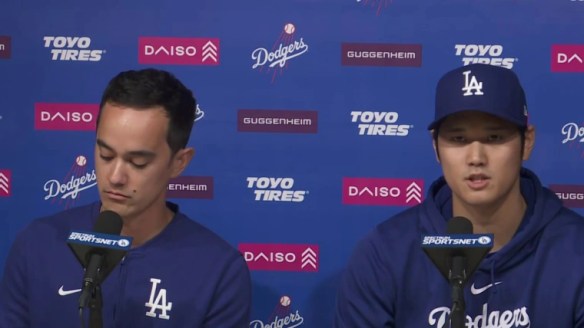
He said it ain’t Shoh

Will Ireton, Shohei Ohtani

“I do want to make it clear that I never bet on sports or have willfully sent money to the bookmaker . . . The season is going to start so I’m going to obviously let my lawyers handle matters from here on out, and I am completely assisting in all investigations that are taking place right now.”—Shohei Ohtani (right), accompanied by new interpreter Will Ireton, Monday afternoon.

Carp all you like about his disinclination to take questions afterward. But don’t ever make the mistake again of mentioning Shohei Ohtani in the same breath, maybe the same pages, as Pete Rose.

However long it took since the uproar first roared, accompanied by his new interpreter, Will Ireton, Ohtani delivered a statement saying no, he didn’t bet on baseball, never has, and by the way isn’t all that much for sports gambling, anyway. That was the easier part for him.

The harder part for him was Ohtani saying he believed his now-former interpeter, Ippei Mizuhara, flat stole from him. For a fleeting few moments, Ohtani looked like the poor soul who came home from work early and discovered his children incinerated his house.

Maybe you don’t remember without the help of assorted books about it or about the man, but Rose wasn’t that candid when he was first put under baseball’s microscope for gambling. Knowing full well that he was guilty of everything the game’s formal investigation was going to expose . . .

He lied through his teeth. He attacked and smeared those who sought the truth, the whole truth, and nothing but. He threw associates under the proverbial bus who’d aided and abetted his longtime bookie gambling up to and including the April-May 1986 period when he began betting on baseball itself and the Reds for whom he still played as well as managed.

That was before the 1989 ruling from commissioner A. Bartlett Giamatti that sent him into baseball’s Phantom Zone on the grounds he’d violated Rule 21(d) up and down.

Ohtani on Monday didn’t try to throw anyone under the proverbial bus. Mizuhara already threw himself there, between his clumsy initial responses when the uproar erupted and the discovery that he’d been anything but entirely honest in the past regarding some of his academic and professional credentials.

But Ohtani didn’t say this was all a figment of somebody’s perverse imagination. He didn’t deflect. He added almost as flatly that he was cooperating with any and all investigations into Mizhuara’s activities, including Mizuhara’s betting on sports through an Orange County, California bookmaker, in violation of California law which doesn’t allow sports betting of any kind in the state.

We still don’t know just how Mizuhara was able to pay off that SoCal bookie. We still don’t know for certain just how he might have lifted over four million of Ohtani’s dollars to do it. Ohtani himself hasn’t suggested how, which may or may not be an indication that he’d sooner run head first into a lava pit than throw Mizuhara all the way under that proverbial bus.

But Ohtani wouldn’t be the first sports or entertainment figure to be fleeced by someone close to him, either. You want to ask how Mizuhara ripped him off? It might prove to be simpler than you suspect.

A few music legends could tell you. Billy Joel sued his former manager (and former brother-in-law) Frank Weber for $90 million in damages in 1989, accusing Weber of diverting millions of Joel’s dollars into his own other interests. Weber filed for bankruptcy and the pair had to settle out of court. The Piano Man reportedly retrieved only $8 million.

Sting was relieved of about $7.4 million (six million British pounds, if you’re scoring) by his longtime advisor Keith Moore—who’s said to have used fake investments abroad to send that money into his own purse.

Alanis Morissette was cleaned out of $4.8 million by her business manager, one Jonathan Schwartz, whom she accused of moving her money straight into his own account. Schwartz landed six years behind bars for such movements.

A few ballplayers could, too. Baseball and other sports were littered long enough before the Ohtani-Mizuhara mess with stories of players robbed almost blind by advisors, by lawyers, even by relatives.

Both the FBI and the IRS are on the trails of Mizhuara and the bookie in question, Mathew Bowyer. “I do want to make it clear,” Ohtani said near the end of his statement, “that I never bet on sports or have willfully sent money to the bookmaker.” If those investigations prove to support Ohtani’s contentions, Mizhuara will be buried alive in federal charges and likely to spend more years that he might like to count behind federal bars.

This entire noise should also prod MLB teams to vet their interpreters even more closely. It’s not impossible that those engaged by other teams for other foreign-born players might also be taking advantage of their proximities to their charges. Or would you like to discover this Yankee or that Astro or that other Cub or that Ranger, Brave, Met, Oriole, or Phillie yonder being ripped off Ohtani-like by their interpreters?

From the moment the hoopla began over the Ohtani-Mizhuara mess, there’s been quite the rush to presume the Dodgers’ $700 million man guilty. The early communication clumsiness of it all didn’t help, but now that Ohtani’s legal beagles have things under reasonable control it should be simpler to say and stand upon: Find and show the evidence if it exists that Ohtani’s anything other than a slightly surrealistic victim.

Until or unless real evidence shows, one and all otherwise should cork it. And, stop raising Pete Rose’s name as if this mess means Rose (against whom there was a convoy worth of evidence) finally gets his get-out-of-baseball-jail-free card.

Ohtani-Mizuhara vs. Rose

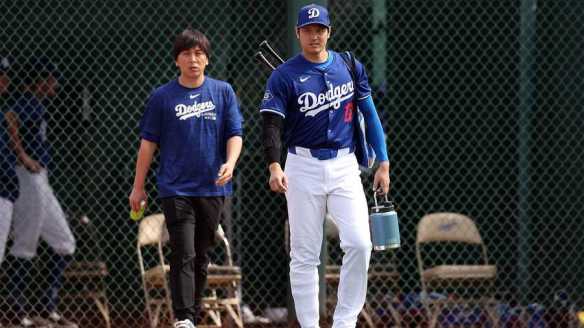
Ippei Mizhuara, Shohei Ohtani

Did Mizuhara steal from Ohtani to cover his gambling debts through an illegal bookie? Did Ohtani naïvely agree to pay Mizhuara’s debts without knowing the legal and MLB trouble he’d see?

Barely a week after I received an advance copy of Keith O’Brien’s Charlie Hustle: The Rise and Fall of Pete Rose, and the Last Glory Days of Baseball, there comes a scandal that provokes yet another round of social media demands that Rose be let off the hook for that which does not yet apply incontrovertibly to baseball’s biggest contemporary star.

Barely did the Dodgers come away from their unusual regular-season opening in Korea with a 5-2 win over the Padres when news exploded that the Dodgers handed a pink slip to Shohei Othani’s longtime friend and interpreter, Ippei Mizuhara, over accusations involving sports gambling.

The least confusing portion is that Mizuhara used Ohtani’s money to cover gambling debts incurred in California, where sports betting remains illegal. But one moment, Mizuhara claimed Ohtani wired the money to cover before. In another moment, Ohtani’s attorneys claimed Mizhuara somehow stole the money from Ohtani’s account.

What seems to be the unspoken-but-agreed-upon point is that, until now, nobody had Othani on any gambling radar. Right there it should drive the Rose case comparisons away. As O’Brien’s book reminds us, Rose had a gambling habit rooted in childhood excursions to race tracks watching his father bet the horses and matured into gambling with street bookmakers. Gambling that was on his team’s and then his entire sport’s radar long before he graduated to the kind of betting that prompted baseball to investigate him formally and banish him permanently.

Mizuhara may face legal penalties for his sports bettings through an Orange County bookie, but nobody’s yet accusing him of betting on baseball itself—either on his own or on behalf of Ohtani—and making it stick. Everything tumbled out both so quickly and so clumsily that building a timeline must be a chore for those who try.

Rose’s remaining partisans aboard social media (and elsewhere, perhaps) seem to think the foregoing alone should mean re-opening the Rose case and ramming him into the Hall of Fame. To many of them, Rose could shoot someone on Cincinnati’s Vine Street and still not lose sycophants. They seem blissfully devoid of accepting that only one man is responsible for Rose’s continuing status.

I don’t know if O’Brien’s book will change the minds of those who insist, despite that mountain range of evidence, that the Rose case deserves a review whenever any scandalous baseball behaviour—gambling or otherwise—comes to light. More’s the pity. A longtime journalist from the Boston Globe to NPR, O’Brien has provided a deeper look into the wherefores of Rose’s life in and out of baseball than just about any previous volume.

O’Brien is a Cincinnatian himself who admits right out of the gate that he, like most Cincinnatians are presumed to do, has “felt every emotion” about Rose: “[P]ride, disgust, frustration, pity, and confusion. Only one thing hasn’t changed over the years: my fascination with his story. He was Icarus in red stirrup socks and cleats. He was the American dream sliding headfirst into third. He was both a miracle and a disaster, and he still is today.”

It’s arguable that no great player of Rose’s time was quite as self-made, quite as bent to play above and beyond his natural endowments. Maybe no great player was as solipsistically reckless, either. The longer Rose proved and re-proved himself at the plate and on the field as the junkyard dog who could hang with and overthrow those snooty Westminster Kennel Club hounds, the deeper became his belief that he was invulnerable to accountability for his risky, rakish, and reckless off-field pursuits.

His own Reds employers feared for his safety once they began catching the winds that Rose’s gambling habits weren’t just limited to the racetracks. Betting with bookies, betting on sports, gradually betting through a Brooklyn bookie named Michael Bertolini who placed Rose’s bets with other New York bookies and kept meticulous notebooks recording Rose’s baseball betting—including on his own team—at least as early as April 1985, when he was the Reds’ player-manager.

“A manager betting on his own team could harm the game—­even if he was bet-
ting on the team to win,” O’Brien writes, well aware that Rule 21(d) does not distinguish between betting on or against one’s team.

He could overuse a pitcher or refuse to rest a starter in pursuit of his own financial gain, and what he ­ wagered—or didn’t wager—­ could move markets in the underworld. Bertolini’s bookies in New York surely noticed when Berto was betting against Pete. Any bookie in that situation would have been justified to wonder if Berto had inside information that would make it worthwhile to go against the Reds that night. The bookies also surely noticed when Pete didn’t bet on the Reds at all. He wasn’t betting against his team; he just wasn’t betting on them. On multiple days, according the notebook, Pete sat it out, not wagering on the Reds after having done it the day before or earlier that week. It was another thing that could move markets in the underworld. And his debts—­ his mounting debts recorded in the notebook—­were especially troubling. An athlete in arrears to a bookie is an athlete in danger of being owned by that bookie, a kept man, beholden. It was the reason why baseball had its rule against gambling in the first place and the reason why that rule—­Rule 21(d)—­was posted in every clubhouse, including the Reds’ clubhouse at Riverfront Stadium.

Independent journalist (and former NBC Sports analyst) Craig Calcaterra says there are three possibilities regarding the Mizuhara-Ohtani situation:

Possibility 1) “Mizuhara is a compulsive gambler who got in way, way over his head with a bookie To pay the bookie off, he effected either one or several massive wire transfers from Ohtani’s account without authorization. He got busted, he got fired, and he’s about to be in a world of federal legal trouble and will almost certainly be permanently banned from holding a job in Major League Baseball.” Which is, Calcaterra acknowledges, is the story Ohtani’s legal team presents.

Possibility 2) “These were Mizuhara’s gambling debts and, as per his and the spokesperson’s comments to ESPN, Ohtani felt bad for him, wanted to help him out, and covered his debts by transferring the money to the bookie . . . If this is what happened, Ohtani will be in pretty big trouble both with the feds and with Major League Baseball.” Rule 21(f) gives baseball’s commissioner discretion in punishing a player, manager, coach, clubhouse worker, front-office person who’s gambled or otherwise associated with illegal bookmakers. (Leo Durocher once learned the hard way, when then-commissioner Happy Chandler suspended him for 1947.)

“A player paying a bookie for a team employee’s illegal gambling debts, and doing so via means that represent federal crimes, creates an astounding amount of risk and would seriously damage the game,” Calcaterra writes. “If this were to be born out and Manfred did nothing, he’d basically be [urinating] all over baseball’s single most important off-the-field rule.”

Possibility 3) “These were Ohtani’s gambling debts and Mizuhara is taking a bullet for his patron . . . If this were the case it would be the biggest baseball scandal since the Black Sox, right? Ohtani would not only be in criminal jeopardy for illegal gambling but he’d probably face a permanent ban from the game. It’d be absolutely massive and would upend professional sports for a very, very long time.”

Having presented those three possiblities, Calcaterra thinks of them thus:

1) Too many assumptions must be made to make stick a thought that Mizuhara managed to mulct Ohtani’s money without a proven say-so.

2) It’s the simplest of the three prospects, not to mention it “flows with what we all want to think about Ohtani being a decent guy and a loyal friend which is something none of us know for a fact, obviously, but we’ve never been given reason to doubt it either, all of my usual ‘we don’t know anyone, not that well’ disclaimers notwithstanding.”

3) Highly doubtful, sans evidence. “Again, I know none of us know anyone,” Calcaterra continues, “but nothing we know about Ohtani suggests that he’s reckless, impulsive, or, frankly, stupid enough for this kind of business. It’d be the biggest heel-turn in the history of sports (non-professional wrestling edition), and it just does not compute for me at all.”

Meanwhile, it’s wise to remember that just because MLB has entered into promotional relationships with legal sports betting outfits on and offline, that doesn’t mean players, managers, coaches, clubhouse workers, or front-office personnel can just bet on baseball any old time they choose it. Fans can bet on baseball to their heart’s content, anywhere and any time they want. Baseball personnel can’t.

They can bet on anything else they want, from March Madness to a college fraternity’s cockroach races. But they can’t do it through unauthorised or illegal bookmakers. And Rule 21(d) hasn’t been and won’t likely be superceded or repealed.

I repeat: Nothing credible has emerged to show Mizuhara or Ohtani betting on baseball, even though Ohtani’s partisans (they, too, are legion) know what a terrible look this week’s eruption holds. But the concurrent noise insisting that this, too, is yet another reason Pete Rose deserves a pardon and his plaque in Cooperstown, is just that. Noise.

If Rule 21(d) plus the Hall of Fame’s block on Hall ballot appearances for anyone on MLB’s permanently-ineligible list can’t quell such noise, you’d like to think Mr. O’Brien’s forthcoming book should. Should, but, alas, probably won’t.