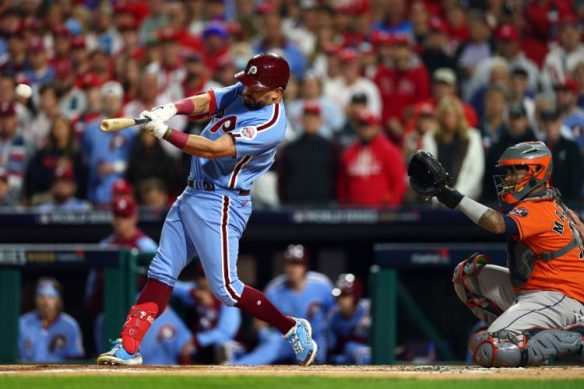
“I was floored. It was a massive story.”

Bang the can slowly!

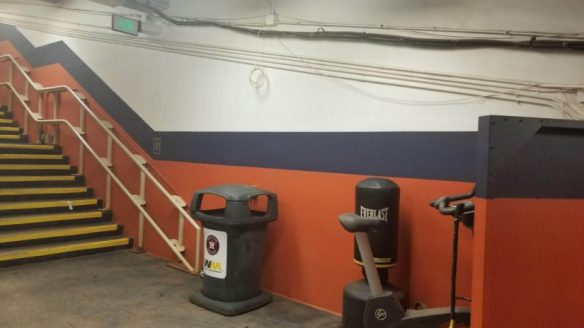
The passage from the Astros’ dugout in Minute Maid Park to the clubhouse. The wires above the trash can connected to a monitor, presumably seated between the can and the Everlast bag, “exactly as the (sign stealing) setup had been described to me.” (2018 photograph by Evan Drellich, published this morning in The Athletic.)

Come Valentine’s Day, baseball will receive a gift that won’t exactly be a love letter, or even a mash note. It’s going to get Athletic reporter Evan Drellich’s account of Astrogate and the broader issues raised and/or revived by the 2017-18 Astros’ above-and-beyond, and very illegal, electronic sign-stealing intelligence operation. At last.

Drellich, of course, is the reporter who teamed with Ken Rosenthal to break the Astrogate story in November 2019, shortly after the Astros fell to the Nationals in the World Series. This morning, The Athletic published an excerpt from Winning Fixes Everything: How Baseball’s Brightest Minds Created Sports’ Biggest Mess. It reveals that what became Astrogate didn’t just arrive to Drellich on a flaming pie over three years ago.

A year before Drellich and Rosenthal dropped the opening shot, Drellich was a Red Sox beat writer NBC Sports Boston, following a tour covering the Astros for the Houston Chronicle. During the 2018 postseason, in which the Red Sox beat the Astros in the American League Championship Series, he found himself speaking to people with first-hand knowledge that the Astros cheated beyond mere replay room reconnaissance on their way to their franchise-first World Series title.

“These were not sources on the outside pointing fingers, but people who knew—who had lived it,” he writes.

I learned how the Astros used a camera in center field to zoom in on the signs the catcher flashed the pitcher before the pitch. How the Astros had set up a television monitor near their dugout, where the players sit during games, to be able to see that video feed, and how they brazenly banged on a garbage can with a baseball bat and other devices to communicate what they gleaned from that screen. It was an advantage, many players felt, to know what was coming, be it a straight fastball or a bending curveball. And to use technology to gain that knowledge was beyond the pale.

This wasn’t just one player breaking the rules, either. This was a World Series–winning team that had collectively cheated, and the public didn’t know it.

I was floored. It was a massive story, the kind, frankly, many reporters dream of, and some might even dread. I was confident in everything I had at the outset—indeed, it all proved to be true. But to get a story done, I would need further corroboration.

One Astros source warned of the context of cheating in the sport, an encouragement that in hindsight could have both been earnest, but also self-serving, meant to deflect attention away from what the Astros had done. Nonetheless, I wanted to learn for myself and include it in my reporting—in what environment did this behavior arise?

Drellich first sought to get an idea from none other than the highest cheating Astrogate mind himself, the Astros’ then general manager Jeff Luhnow, during that ALCS. He spotted Luhnow in the Astros’ Minute Maid Park dugout. “He was the architect of the team,” Drellich writes, “and I tried to get his attention as he was walking away from me. ‘You won’t find anything,’ he said defensively, making clear he wouldn’t talk to me.”

The night the Red Sox won that ALCS, in Houston, Drellich acted upon the aforementioned first-hand knowledge shared with him and walked toward the Astros clubhouse. He even photographed what he saw just past the steps down from the dugout. Oops.

When the Red Sox met the Dodgers in the 2018 World Series, Drellich met with two baseball officials hoping to get a picture of what baseball’s government was or wasn’t doing about electronic sign stealing. One started generalising the suspicions until Drellich broke in to tell him he had sources from within the Astros’ operations telling him about the extent of their Astro Intelligence Agency, so to say.

“‘They have acknowledged that?’ one [official] said. ‘I mean, I can’t speak to that. I mean, to our knowledge—you have your information, and we have ours, and that’s all we can go off. As to whether that has occurred, to our knowledge we are completely unaware. I am confident in the measures that we’ve taken’.”

Drellich wasn’t trying to be a friendly tipster to MLB because he couldn’t. “It’s not a reporter’s job to steer sources to the league,” he writes. But he also saw too clearly that, at that time, MLB wasn’t exactly in that big a hurry to act.  He also knew that, having multiple sources but none willing to go on the public record just yet, he needed to find the one who would.

To get something, anything on the record, Drellich writes, he composed a “general piece on electronic sign-stealing” in November 2018, after the Red Sox beat the Dodgers in five in that World Series. “Very quickly,” he continues, “my doubts about the support I had at NBC Sports Boston proved correct. When they fired me in February 2019, I was blindsided, but perhaps I shouldn’t have been.”

His unemployment didn’t last long. The Athletic hired him, placing him into proximity with Ken Rosenthal: “Together, we would pick up my reporting on the Astros.” Indeed. Rosenthal had the sport-wide cred to make the calls Drellich couldn’t yet make. Such calls as to Danny Farquhar, the White Sox pitcher who heard the Astros banging the can slowly and called his catcher right to the mound to switch up their signs.

Such calls as to Mike Fiers, the pitcher who had something even more precious to offer on the record than an opposing pitcher who had ears to hear and brains to act accordingly: Fiers had been a 2017 Astro. And he was only too willing to go on record now, after assorted failed attempts by himself and others to convince other writers to expose Astrogate.

Drellich writes that Rosenthal asked Fiers if he was comfortable being quoted. “Well, that’s the whole thing about this. I don’t want to be put out there like that,” the pitcher began.

But they already know, so honestly, I don’t really care anymore. I just want the game to be cleaned up a little bit because there are guys who are losing their jobs because they’re going in, they’re not knowing. Young guys getting hit around in the first couple of innings starting a game, and then they get sent down. It’s bullshit on that end. It’s ruining jobs for younger guys. The guys who know are more prepared. But most of the people don’t. That’s why I told my team. We had a lot of young guys with Detroit trying to make a name and establish themselves. I wanted to help them out and say, “Hey, this stuff really does go on. Just be prepared.”

By “they already know,” Fiers indicated the Astros knew he’d tried to warn subsequent teammates on the Tigers and the Athletics. “Fiers, to his immense credit, stood by his words and never tried to back out before the investigation ran,” Drellich writes. “He helped change the sport, and the toll ostensibly has been heavy for him.”

Ostensibly? Fiers hasn’t pitched in the Show since the pan-damn-ically shortened 2020 season. He’s been to the Mexican League and the Chinese Professional Baseball League since, before signing with the Toros del Este of the Dominican Winter League last September. Age to one side (he’s 37), Fiers probably still finds one person denouncing him as a traitorous snitch for every one applauding him as a brave whistleblower.

“Many fringe players train in the Caribbean during the offseason to prepare themselves for the upcoming Major League season in hope of finding a better contract,” wrote Sports Illustrated‘s Ben Silver when Fiers signed that deal. “Fiers, though, may face an uphill battle. He is forever linked with the Houston Astros’ cheating scandal and teams may no longer wish to associate themselves with the weight his name carries.”

“At the time Ken spoke to Fiers, we were preparing to publish our findings without his account,” Drellich continues. “It’s impossible to say exactly how the world would have reacted to the story had Ken not spoken to him—if all the sources had been unnamed. But the facts of the story had already been ascertained, and we had Farquhar’s account.”

The whistleblower’s is often a lonely lot. “Whether Fiers was quoted or not,” Drellich writes, “it seems unlikely to me that MLB would have been able to ignore the general outcry. But our investigation was still in a much better position with Fiers on the record. His name helped validate everything instantly, making it harder for anyone to try to shove the story aside.”

Today’s Astros are the defending 2022 World Series champions, no longer the Luhnow team that cheated from the top down to extents above and beyond mere basepath or even mere replay room reconnaissance. (Only three Astrogate team members remain on the roster; one, Jose Altuve, has been shown conclusively as the one Astro who rejected stolen signs consistently.) Nothing suggests that the 2022 Astros didn’t beat the Phillies straight, no chaser.

But the Astrogate taint remains, at least until the last Astrogate team member no longer wears their uniform. There remain only too many who think the whole thing wasn’t the Astros’ fault for having committed the crimes but Fiers’ fault for having blown the whistle on the record. Today’s excerpt demonstrates that Winning Fixes Everything promises to knock that and other Astrogate canards into the middle of next year.

Keep José Altuve off the Astrogate hook

Jose Altuve

It’s been said before Peter Gammons revived it Friday: José Altuve wanted no part of illegally-stolen signs when he was at the plate. Stop hammering him with the “chea-ter! chea-ter!” chants once and for all.

When the World Series shifted to Philadelphia, after the Phillies and the Astros split the first two games in Houston, the Citizens Bank Park crowd wasn’t shy about letting the Astros have it over You-know-what-gate. The good news was that they saved the chea-ter! chea-ter! chants for the only three position players left on the roster from the forever-tainted 2017-18 team.

The bad news was that one of the three actually spurned taking the illegally stolen signs in the batter’s box. That was second baseman and Astros franchise face José Altuve. It didn’t matter to the chanting Phillies fans. But it should have.

When SNY’s Andy Martino published Cheated: The Inside Story of the Astros Scandal and a Colorful History of Sign Stealing in June 2021, the chapter called “The Scheme Begins” included a revelation that should have jolted anyone hammering the Astros rightfully enough over their Astro Intelligence Agency plot:

Altuve was the most reluctant of the Astros stars. When the option to have a teammate bang the trash can [to relay the signs stolen by way of an illegal off-field-based real-time camera to an illegal additional clubhouse monitor—JK] first arose, he declined.

When Altuve was batting, and there would be a bang, he would glare into the dugout.

“He doesn’t want it,” teammates would say frantically. On more than one occasion, Altuve returned to the dugout after his at-bat and yelled at the others to knock it off.

It jolted me, too. Especially since I’d actually missed the first such revelation, in February 2020, from then-Astros shortstop Carlos Correa, usually the face of the team when it came to defending the 2017 World Series title before he signed with the Twins last winter. (Correa is now a free agent again.) I missed it, and I shouldn’t have.

Commissioner Rob Manfred handed down his Astrogate verdict in January 2020—suspensions for 2017-18 general manager Jeff Luhnow, manager A.J. Hinch, and bench coach Alex Cora (subsequently a World Series-winning manager for the 2018 Red Sox . . . who had their own Rogue Sox replay room reconnaissance ring operating that season and possibly beyond); heavy fine for owner Jim Crane; key draft picks stripped.

The Astros faced the press when spring training opened the next month. Depending upon how you saw and hear, they seemed either unapologetically apologetic or apologetically unapologetic. “Yes, there’s no better way to show good old-fashioned genuine remorse than by refusing to speak the misdeed you committed,” wrote since-retired Thomas Boswell, the longtime Washington Post baseball eminence.

Crane and his team used their showcase to insist they keep their phony title and that Major League Baseball was correct not to fine or suspend any Astros players. Also, we should just trust that they stopped cheating in 2018. Why? No reason at all. Just felt like stopping, even though they, you know, won the previous World Series doing it.

. . .Maybe, with time, some Astros will be more forthcoming with authentic feelings, not practiced phrases, that will show their human dilemma—most of them not $100 million stars or future Hall of Famers, just normal ballplayers caught on a runaway train with, realistically, no emergency brake available for them to pull.

But even Boswell might have missed that Altuve didn’t want any part of the AIA. Before the original coronavirus pan-damn-ic compelled that spring training’s shutdown, Correa talked to The Athletic‘s Ken Rosenthal, one of the two reporters (with Evan Drellich) who first exposed the true depth of scheme. (Former Astros pitcher Mike Fiers had finally agreed to go on the public record in November 2019, following long, futile efforts to get someone/anyone to investigate.)

They talked aboard MLB Network a couple of days after the presser that did the Astros more harm than good. Correa steamed over Dodger outfielder/first baseman Cody Bellinger’s fuming that Altuve cheated Yankee rookie star Aaron Judge out of the 2017 Most Valuable Player award he might have won if not for Altuve’s career year in Houston. “Cody,” Correa began, “you don’t know the facts.”

Nobody wants to talk about this, but I’m going to talk about this. José Altuve was the one guy that didn’t use the trash can.

The few times that the trash can was banged was without his consent, and he would go inside the clubhouse and inside the dugout to whoever was banging the trash can and he would get pissed. He would get mad. He would say, “I don’t want this. I can’t hit like this. Don’t you do that to me.” He played the game clean.

. . . When you look at Altuve’s numbers on the road, he hit .400 on the road (.381, actually, compared to .311 at home). He didn’t cheat nobody of the MVP. He earned that MVP. He’s a six-time All-Star, three-time batting champion, MVP, five-time Silver Slugger. He’s been doing this for a long time.

For [Bellinger] to go out there and defame José Altuve’s name like that, it doesn’t sit right with me. The man plays the game clean. That’s easy to find out. Mike Fiers broke the story. You can go out and ask Mike Fiers: “Did José Altuve use the trash can? Did José Altuve cheat to win the MVP?” Mike Fiers is going to tell you, straight up, he didn’t use it. He was the one player that didn’t use it. (Emphasis added.—JK.)

The foregoing arises again because another Athletic writer, Peter Gammons, the longtime Boston Globe scribe/analyst who’s a Spink Award Hall of Famer, wrote of the Astros’ post-Astrogate manager Dusty Baker and winning team cultures in a piece published Friday—and returned to that 2020 spring training opening. Including the impossible position into which Altuve was pushed.

There he was, sitting at the table, looking as though he’d rather undergo root canal work without an anesthetic. Now we should ask just what the hell Crane was thinking when, seemingly, he insisted Altuve sit at the head table for that 2020 spring presser. The owner with a reputation for rejecting direct accountability forced “the one player that didn’t use” the AIA’s espionage to take it like a man.

Gammons talked to assorted Astros near the end of the opening workout later in the day. “They were subdued, clearly remorseful,” Gammons wrote, “but when I told Altuve that players, coaches and a number of people in the organization had told me that he did not participate in the sign stealing, he politely declined to discuss it, and asked that I didn’t talk about it on television, or write about it. ‘It would be a betrayal of my teammates’.”

Two years later, he still did not want to be singled out. But while he and [third baseman Alex] Bregman were asked by management to speak to the scandal for all the players and he received the most obscene treatment from beered up louts in Boston and New York, he never pointed to 2017 home/road splits that showed a 200-point OPS difference in favor of the road, where there was nary a banging trash can to be heard.

“He is,” Baker said, “the ultimate teammate.” That from a man who played with Henry Aaron and Reggie Smith.

Altuve’s 2017 OPS (on-base percentage plus slugging percentage) was 248 points higher on the road—where the AIA couldn’t operate—than it was at Minute Maid Park. He also hit six more home runs out of town than in Houston. With only four more plate appearances on the road than at home in ’17, his Real Batting Average (my metric: total bases + walks + intentional walks + sacrifice flies + hit by pitches, divided by total plate appearances) was .529 at home . . . but .679 on the road.

The Gammons story seems to have jolted for the Altuve “revelation.” In its email newsletter Morning Bark, offering links to stories based on its choice of a day’s top ten sports stories, Yardbarker linked to it with this teaser, which also headlined a brief news item about the piece: “Insider reveals interesting detail regarding José Altuve and Astros’ cheating scandal.”

It’s only a “revelation” if you missed either Rosenthal’s original or Martino’s book. I missed the former upon its original arrival, but I pounced on the latter when it was published. SNY, after all, stands for the Sports New York regional cable network. And the Yankees, whom Martino’s normal coverage includes, had their own skin in the sign-stealing world.

Theirs wasn’t quite as extensive as the 2017-18 Astros, of course. Neither was anything by any other teams who might have done as the Red Sox did, using their MLB-provided replay rooms for such sign-stealing reconnaissance. (MLB has since tightened up on guarding the replay rooms.) The 2017-18 Astros went far above and far beyond just boys-will-be-boys replay room roguery.

But Martino taking Astrogate book depth had no reason to want Altuve whitewashed. Especially considering Altuve—when Yankee manager Aaron Boone elected to let his faltering closer Aroldis Chapman pitch on to him, with two out in the bottom of the ninth, instead of putting him on at 2-1 with a spaghetti bat on deck—hit the monstrous two-run homer on an up-and-away slider that won the 2019 Astros the pennant.

In fact, Cheated‘s footnotes included the original Correa/Rosenthal revelation. Martino had me convinced before the footnotes section. Reading the Correa/Rosenthal revelation both recently and once again after the Gammons piece Friday, I’m convinced even more.

Saying Astrogate won’t disappear until the last member of the 2017-18 team no longer wears an Astro uniform is one thing. So is saying the 2017-18 cheaters stained baseball almost as deeply as the 1919 Black Sox. But it’s something else to keep including José Altuve among the tainted when he doesn’t deserve to be among them.

The further evidence should be even more clear by now. Altuve wanted no part of the original Astrogate scheming and bawled teammates out when they didn’t respect his wishes. He played the game straight, no chaser, then and now. He’s taken it across the chops unfairly since.

A pitcher’s lament, a manager’s triumph

Dusty Baker

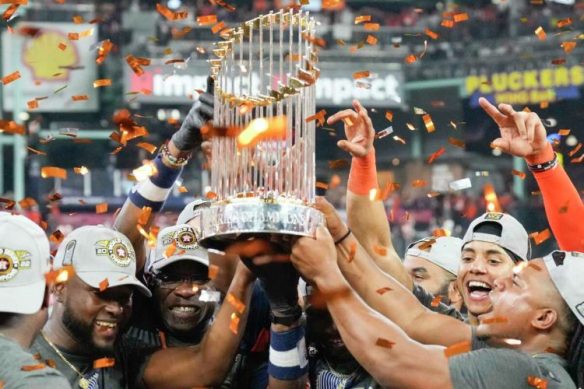
Astros manager Dusty Baker (second from left) joins his players—including Game Six starting pitcher Framber Valdez and World Series MVP Jeremy Peña (second from right), the first rookie to win that prize—hoisting the Series trophy after beating the Phillies 4-1 Saturday night.

If Jose Alvarado wants to find the nearest deep cave into which to make his residence until spring training, nobody should fault him. Not everyone can perform the impossible at will.

The Phillies’ redoubtable lefthanded reliever came into the bottom of the sixth of World Series Game Six with one key mission, take care of the Astros’ lefthanded munitions expert Yordan Alvarez with runners on the corners and one out. It might have been easier for Tom Thumb to scale the Empire State Building with a crosstown bus on his back.

This could have been construed as Phillies manager Rob Thomson believing he was still living a charmed life in his first two-thirds season on the bridge. Believing that a hard-won 1-0 Phillies lead could be kept in place or possibly enlarged the rest of the way.

Believing his righthanded starter Zack Wheeler wasn’t the right matchup for Alvarez looming with two occupied bases. Believing Alvarado would avoid the disaster into which he pitched when brought in for the same matchup in Game Five and hit Alvarez on the first pitch.

All Alvarez did now with a 2-1 pitch was send it over the farthest ledge behind center field, into some seats beneath a Blue Cross/Blue Shield advertising sign. All that did was sink the Phillies and yank the Astros to what they, and their fan base, needed in the worst way possible, a no-questions-asked, untainted World Series conquest.

Alvarado didn’t get beaten doing what he knew he wasn’t supposed to do. He didn’t get beaten serving a meatball without sauce. He got beaten throwing one of his best pitches, a nasty, shivering two-seam fastball, to a bomber who can and often does turn your best pitches into nuclear warheads no matter how they swivel up to the plate.

“Nothing moving. It didn’t move,” Alvarado said postgame. “If it moved, he had no chance. When he hit the ball, the sound says, ‘OK, that’s gone’. Because the guy is a power hitter. I watched it. But, again, sometimes you win, and sometimes you tip your cap.”

But Alvarado was wrong. The pitch moved enough. He got beaten by a hitter who moved his bat more than enough into it. Don’t condemn him. Don’t demand his post-haste measuring for a guillotine brace.

“[Y]ou’ve got Alvarado throwing 99 mph left-on-left sinkers,” Kyle Schwarber said. “And [Alvarez] ran into it and hit it out. Tip your cap. That’s a good hitter over there. I would take [Alvarado] on him any day of the week.”

Embrace Alvarado for having the guts to stare into the belly of the best a second straight World Series game and not run home to Mami at the very thought of it. A man with a regular-season 1.92 fielding-independent pitching rate earns more than a little respect.

Thomson may have some real explaining to do, though, as to why he kept Nick Castellanos—whose bat was as feeble as his glove had become a half-out-of-nowhere defensive weapon during the Series—batting behind Bryce Harper and, essentially, affording Harper as much protection as a tot with a pop gun offers a Brinks truck.

Just don’t be stupid enough to blame Alvarado for the Phillies’ inability to make Schwarber’s leadoff homer in the top of the sixth stick long enough to buy some insurance. Be better than that, this time, Phillie fan.

These upstart, self-resurrecting Phillies finally couldn’t hit what these Astro pitchers served them. They lunged at too many breakers instead of forcing them to come to their wheelhouses, they let too many fastballs elude them, and when they still had three innings left to overthrow the 4-1 Astro lead that stuck, they couldn’t and didn’t summon up enough.

Then give these Astros their due. Give them the credit they deserve for finally overcoming one World Series loss in which they won nothing at home, a second when they ran into a chain saw made in Atlanta, and the single worst cheating scandal in 21st century baseball, if not all baseball history.

Give these Astros the credit for playing untainted, un-sneaky, un-shifty (except on one or the other side of the infield here and there), unapologetically excellent baseball to beat these Phillies in six usually thrilling games.

Give them credit for making hash out of Commissioner Rube Goldberg’s more-cookies-for-everyone, three-wild-cards postseason array, not to mention defying the early-round upsets over the biggest-winning regular season teams, and living up to their 106 game-winning season where the 111 game-winning Dodgers couldn’t.

Give splended Astros rookie shortstop Jeremy Peña his props for earning both the Most Valuable Player Award of the American League Championship Series and the World Series (the first rook ever to win a Series MVP and a Gold Glove for his defense) and for damn near making Houston forget it ever had a fellow named Carlos Correa holding shortstop down.

Give center fielder Chas McCormick his props for running down what would have been J.T. Realmuto’s at-minimum eighth-inning double in Game Five and leaping to catch it before hitting the Citizens Bank Park scoreboard wall and landing in a heap on his back while leaving his imprint on the warning track and holding onto the ball like a life preserver.

Give Game Six starter Framber Valdez and the Astro bullpen their props for keeping the formerly vaunted Phillies offense—capable of turning games around in single swings until running into a no-hit wall in Game Four—from getting any ideas above and beyond The Schwarbinator’s liner into the right field seats.

And then give Astros manager Dusty Baker the biggest hug you’ve got to give for a man who’s been in this game fifty-four years as a player and manager, won a World Series ring as a player, had several postseason heartbreaks including World Series losses as a manager, and finally reached the Promised Land.

Baker really had to do this one the hard way. He took on the uphill job of managing a team riddled by the disgrace of Astrogate and their inability to speak entirely forthrightly about their 2017-18 cheating including about it being part of their 2017 Series triumph. It was comparable to Gerald Ford trying to clean up after the Nixon Administration’s Watergate mess.

But Ford lost the only presidential election for which he stood after that. Baker withstood the Astrogate heat, kept his head as the self-battered organisation turned itself and its Show roster over and away from the Astrogate stench, and brought his Israelites across the Jordan at last.

“Game Six has been my nightmare,” Baker told his team in the clubhouse after this Game Six. “I ain’t lying. I was like, damn that, man. We’re going to win today. I got Game Six off our ass, off my ass. We’ve got (Justin Verlander’s first credited World Series) win off his ass. And I’m telling you, you guys played your asses off. I didn’t have to do [poop].”

Baker and Game Sixes formerly meant disaster. 2002 World Series: he lifted starter Russ Ortiz with his Giants up 5-0 and ostentatiously handed Ortiz the “game ball.” The Angels thrashed back with three runs each in the next two innings, then ran away with Game Seven.

2003 National League Championship Series: Baker’s Cubs were five outs from going to the World Series when a double-play grounder bounded off his shortstop instead of turning two, opening the dam for a five-run Marlins rally and a Game Seven loss.

Game Six, last year’s World Series: Baker’s Astros didn’t incur anything close to those two disasters. The Braves made sure of that by shutting them out 7-0 to win the Series.

Now he couldn’t forget what his father told him after the 2002 deflation: “Man, after the way you lost that one, I don’t know if you’ll ever win another one.” Now, the son could be sanguine about the father’s fatalism.

“I was, like, I didn’t really want to get to Game Six again, but I was like, well, maybe this is how it’s supposed to be,” the son said Saturday night. “My dad didn’t mean anything negative . . . back in the old school, there was such thing as negative motivation. In the new school, negative motivation doesn’t work.”

No team had quite the negative motivation these otherwise filthy-dominant Astros have had since their 2017-18 cheating, which went above and beyond anything else devised and executed by teams past, exposing and staining them in the wake of their 2019 World Series loss.

It’s the black mark on a franchise that’s gone to six straight American League Championship Series and won four of them. A franchise that’s won two World Series titles over six years with a .622 winning percentage over those six regular seasons, something  almost never done, according to Hall of Fame writer Jayson Stark, by the greatest teams.

Not the Oakland Mustache Gang of the early 1970s. Not the Big Red Machine. Not the 1996-2002 Yankees. Not the Aughts’ Red Sox. Not the 2010s Giants. You’d have to go back to the 1953-58 Yankees—those of Hall of Famers Yogi Berra, Whitey Ford, Mickey Mantle, and manager Casey Stengel—to find one from the post-World War II era.

But guess what, ladies and gentlemen? Only three position players remained from the Astrogate teams. And they had almost nothing to do with the biggest of the big Series moments for these Astros and this manager. Air Yordan? Flying Jeremy? Tucker the Man and His Dream? Framber Valdez (is Coming)? Cristian (Soldier) Javier and his no-hit-opening oratorio? Every member of the bullpen that just rolled a Series ERA of 0.83? They didn’t show up until the Astrogate aftermath.

What the Astros needed most, said broadcast legend Bob Costas, himself a Frick Award winner thus enshrined in the Hall of Fame, was “to win outside the shadow of 2017 . . . ”

There will always be skeptics because of ’17. But they have now been a truly excellent team for a sustained period of time. I think fair-minded people already have put this in its proper context and proper proportion. So by winning again, especially with Dusty Baker as one of the faces of it, and five years removed from 2017, I think most people will have a fair sense of it.

Guess what else we can do now? We can put to bed forever all the talk over all the years about the long-suffering Baker’s “entitlement” to win a World Series at last.

It was both annoying as the day was long and absolutely unworthy of the man himself, the man who loved and encouraged all his players, from the last man on the roster to the cock of the walk, to exercise their abilities as they are, rather than as anyone else demanded, and was loved back by anyone who dealt with him over all those seasons.

Baker felt less “entitled” to anything than those who admire him and even criticise him when need be felt for him. Now he can put all that in a trunk, flashing one of his signature toothpick-punctuated grins, and lock it tight.

“After a while,” he said thoughtfully after Game Six, “I quit listening to folks telling me what I can’t do. All that does is motivate me more to do it because I know there’s a bunch of people in this country that are told the same thing, and it’s broken a lot of people. But my faith in God and my mom and dad always talking to me made me persevere even more.”

The 73-year-old man who once took too much blame for a few extraterrestrial calamities now didn’t give himself quite enough credit. There’s only so much Mom, Dad, and even God can do for a man, with a World Series or anything else.

“We’re going to play to the end”

Kyle Schwarber

Kyle Schwarber hitting his first-inning bomb off Justin Verlander in Game Five. “We’re going to play all the outs. We’re going to see where it takes us,” he says approaching Game Six. The “where,” of course, is up to Zack Wheeler and the Phillies against Framber Valdez again.

Approaching World Series Game Six, the Phillies could lean on the experience of one member who’d been there, done that, down 3-2 in a Series, then took the final two and the world championship. That was seven years ago, when he was a Cub, his season began (thanks to injury) in the World Series, and the Cubs finally did what seven-eighths of the earth thought wouldn’t happen in its lifetime.

“We’ve overcome a lot of things throughout the course of this year to be in this position,” said Phillies left fielder/bombardier/periodic base thief Kyle Schwarber as the Phillies traveled to Houston Friday. “I think when we get there, you’re going to see a really resilient club and we’re going to play until the very end and we’re going to see where it takes us.”

Funny, but that’s just about what every 2016 Cub said, too, when the then-Indians had them on the ropes with the Series returning to Cleveland for Games Six and Seven.

That was then: the Cubs pushed, shoved, pitched, and pounded their way through two arduous games. This is now: The Phillies, whose World Series drought is barely an eleventh of those Cubs’, will have to do all that plus rip, snarl, tear, slice, dice, and air fry. Just as when he was a 2016 Cub, the Schwarbinator won’t surrender, to these Astros or anyone else.

“It’s going to take everything,” said Schwarber, who did what he could to keep the Phillies from losing Game Five when he opened with a nasty home run off future Hall of Famer Justin Verlander in what proved a to-the-max 3-2 Phillies loss. “It’s going to take everyone. We’re excited. Trust me. Sure, it’s frustrating, but we’re also very excited.”

The Phillies are in a strange position this postseason. They enter Game Six with their first series deficit since they wrestled their way to the final National League wild card in the first place. Beyond that, they have reason not to fear. They’ve come back several times to get here in the first place.

Game One of the wild card set against the Cardinals? Down 2-0 in the top of the ninth. Then: bases-loaded hit batsman, two-run single, run-scoring infielder’s choice, RBI single, and a sacrifice fly, and two Cardinal runs in the bottom of the inning weren’t enough to deny the first win of a Phillie sweep.

Game Four, National League Championship Series? A four-run Padres first didn’t exactly bury them alive. Bottom of the first: Two-run homer (Rhys Hoskins), RBI double (Bryce Harper). Deficit cut to one. Bottom of the fourth: Tying RBI single. Bottom of the fifth, after Juan Soto put the Padres back up with a homer? Two-run homer (Hoskins, again), RBI double (Harper, again), RBI single, two-run Phillie lead. Bottom of the sixth: Solo bomb (Schwarber), three-run lead. Bottom of the seventh: Solo bomb (J.T. Realmuto), four-run lead, ultimately four-run win.

Game Five, NLCS? Call it the Mud and Guts Game if you must. Bottom of the third: Phillies take a 2-0 lead with another Hoskins two-run thump. Top of the fourth: Soto cuts the San Diego deficit in half with another solo smash. Top of the seventh, with the Citizens Bank Park rain turning the field into a swamp and pitching grips and strides into mush and mire? The Padres take a 3-2 lead with an RBI single and two wild pitches enabling a run. Bottom of the eighth? Harper fights and fouls his way to a dramatic opposite-field two-run homer. Two Phillies relievers make it stick for the pennant.

Game One, World Series? Kyle Tucker’s two bombs help the Astros bushwhack Aaron Nola in the first three innings. So the Phillies return the favour by ripping five out of Verlander—RBI single and immediate two-run double in the top of the fourth; two-run double in the top of the fifth. The score stays tied at five until Realmuto breaks it for keeps with a leadoff bomb in the top of the tenth, and David Robertson survives a double, a walk, a wild pitch for second and third, and gets the game and win-ending ground out.

All the Phillies need to do now is continue overcoming that nasty 0-for-20 with runners in scoring position until Jean Segura slapped an RBI single in the eighth in Game Five. They need Zack Wheeler to be his best self on the Game Six mound. They need to continue overthrowing their earlier reputation for defensive mishaps and cut the Astros off with more of the glovework and derring-do they began flashing during the Philadelphia leg of the Series.

They need, in other words, to be better than the best of their selves that pulled them into the Series and into the 2-1 Series lead the Astros wrested away from them on their own soil. Astros Game Six starter Framber Valdez, who manhandled them in Game Two, also in Houston, intends to let them do nothing of the sort.

“I think I’m just going to try to continue doing what I’ve been doing all season,” Valdez said through an interpreter after Game Five. “Just try and attack hitters early, try to breathe, try to stay calm, try to meditate. It’s something that’s really exciting. I think it’s something that really adds a lot to your career, and I’m really excited for this opportunity.”

It’ll add something to the Astros’ resume, too: their first untainted World Series rings. Not to mention handing their manager Dusty Baker—the man who steadied the Astro starship after it was strafed by the in-house phasers of Astrogate, keeping his gradually turning-over team playing through the aftermath, three seasons following its exposure, despite the organisation’s turmoil and grotesqueries—the first World Series triumph of his long and mostly distinguished managerial career.

The Astros know the Phillies won’t be simple pickings despite shutting them out back-to-back in Philadelphia, once with a combined no-hitter. It’s the Phillies’ job not to make things simple for the Astros.

“What a better storybook ending,” asked Castellanos, whose limp bat is almost forgotten when you’ve seen his defense turning into must-see television all of a sudden, “than if we can go there and win this in Game Seven?”

First things first, Schwarber would remind one and all.

“We’ve got a pretty good pitcher going for us in Game Six,” the Schwarbinator says. “We’ve got to be able to bounce back offensively. I don’t think anyone believes more in this group than we do. That’s going to be a big thing for us. We’ve just got to be able to play all the outs. We’re going to see where it takes us.”

First, it needs to take them past the Astros in Game Six. Then the Phillies can worry about who writes their storybook ending—the team of Roger Towne and Phil Dusenberry (who wrote the screenplay for The Natural); or, any given Astro, plus Jack Benny and Fred Allen, climaxing their long-running mock on-air feud while satirising the notorious weeper quiz show Queen for a Day:

Allen: An expert operating the Hoffman Pressing Machine will press your trousers
Benny: Now wait a minute! (Studio audience laughter and noise.) Now wait a minute, Allen!
Allen: Keep your shirt on, King!
Benny: You bet I’ll keep my shirt on!
Allen: All right, folks, tune in again next—
Benny: Come on, Allen, give me my pants!
Allen: Quiet, King!
Benny: Where are my pants?
Allen: Benny, for fifteen years I’ve been waiting to catch you like this.
Benny: Allen, you haven’t seen the end of me!
Allen: It won’t be long now!

Now they have to do the impossible

Kyle Tucker, Chas McCormick

With Kyle Tucker backing him, Chas McCormick—who grew up a Phillies fan 35 miles away from Citizens Bank Park—made the possible catch of the Series off J.T. Realmuto’s eighth-inning drive to the right center field scoreboard wall in World Series Game Five Thursday night. 

This year’s Phillies, meet the 2019 Nationals. Sort of. Those Nats won every World Series game against that edition of Astros on the road including four in Houston. These Phillies split in Houston, then could win only once in their own cozy, stop-sign-shaped, noisy playpen. Now they have to do the kind of impossible those Nats did. If they can.

They have to win Game Six Saturday and then Game Seven Sunday. And if Game Five is evidence, they won’t get it without putting up a terrific battle. Better than the battle between the two that ended in a squeaker of a 3-2 Astros win Thursday night. Better than they were built to be.

Better than just half a collection of sluggers and a bullpen that can hang with any bullpen in the business. And enough to keep the Astros from saving themselves—until a forgotten Astro at first base and an Astro outfielder who grew up a Phillies fan saved the Astros’ lives in the bottom of the Game Five eighth and ninth, respectively.

Trey Mancini was a trade deadline acquisition from the Orioles but an 0-for-18 afterthought this postseason. Chas McCormick grew up 35 miles from Citizens Bank Park and never forgot the bloody nose then-Phillies outfielder Aaron Rowand incurred making a similar catch against the center field fence.

Mancini now found himself at first base after Astros veteran Yuli Gurriel had to come out a half inning after a collision resulting in a rundown out as he got trapped between third and the plate also resulted in a woozy head. With two out and Astros closer Ryan Pressly asked for an almost unheard-of-for-him five-out save, Kyle Schwarber loomed at the plate.

Schwarber electrified the ballpark in the bottom of the first when, with the Astros up 1-0 already, he drilled an 0-1 pitch from starter Justin Verlander into the right field seats to tie it. Now, with two out, first and third, and the Phillies back to within a run in the bottom of the eighth, Schwarber drilled one up the first base line on a single hop. The shot had extra bases down the line and the tying run home at least stamped on it.

Until it didn’t. Playing practically on the line as it was, Mancini hit his knees like a supplicant in prayer and the ball shot right into his mitt. While he was there, Mancini stepped on the pad. Side retired. In one flash Mancini went from self-made afterthought to the Astros’ man of the hour.

It’d take something even more stupefying to rob Mancini of that status. “That ball gets by him,” Pressly said postgame, “we’re looking at a different game.”

Something even more stupefying came along in the bottom of the ninth. When Phillies catcher J.T. Realmuto sent Pressly’s 1-1 slider high and far toward the right center field scoreboard wall, with at least a double and likely more the likely result, the wall notorious for creating odd rebounds.

Until it wasn’t. Until McCormick ran to his left, took a flying leap, and snapped the ball into his glove a second before he hit the wall and landed on the track, the ball still securely in his glove, and by his own postgame admission stared up at whatever he could see of the Bank crowd he’d just snapped silent.

“I wanted to lay there longer,” he admitted postgame. “If it were the last out, I would have laid there all night.”

Pressly’s jaw fell as he saw McCormick nail the catch. As he remembered after the game, the only thing he could think as his hands clutched his head in wonder was, “Holy [you-know-what].”

Until that moment, the Astros and the Phillies wrestled and tussled like alley cats all Game Five long. The bad news was that the Phillies, the Show’s best on the season with runners in scoring position, extended to a third-longest World Series string of 0-for-20 with men in such position.

“[S]ometimes you go through times when you don’t hit with runners in scoring position,” said Phillies manager Rob Thomson postgame. “Then, three days later, everybody’s getting hits. So we just got to keep battling, that’s all.”

The Phillies can’t wait three days for hits. They have two days before it might be curtains. Three days maximum, after squandering what half the world thought would be the remarkable and ear-splitting home field advantage they’d stolen with a Series-opening split in Houston.

The worse news Thursday began when Astros’ rookie shortstop Jeremy Peña started the scoring when he singled up the pipe to send Jose Altuve (leadoff double, taking third on Phillies center fielder Brandon Marsh’s carom bobble) home in the top of the first.

After Schwarber’s ballpark-jolting bomb leading off the bottom, both sides wrestled each other’s starting pitchers, Verlander and Noah Syndergaard, into and out of a few more dicey jams—especially the Phillies loading the bases on Verlander with two out in the second before the future Hall of Fame righthander struck Rhys Hoskins out swinging rather violently.

Syndergaard settled admirably after the first inning run and retired nine straight from that score forward. Verlander escaped another jam in the third, which might have been another bases-loaded escape but for Peña leaping to steal a base hit off Nick Castellanos’s hard liner, but after Alec Bohm spanked a single past shortstop to follow, Verlander got Phillies shortstop Bryson Stott to pop out to right for the side.

But Syndergaard—no longer the bullet-throwing Thor of old thanks to injuries, illnesses, and finally Tommy John surgery—ran out of luck in the top of the fourth, when Peña sent a 1-2 service into the left field seats. Connor Brogdon relieved him and shook off Alex Bregman’s one-out double while striking out the side.

Verlander pitched as clean a fourth as you could ask of a 39-year-old righthander with or without his particular career resume, then had to perform another escape act in the fifth after striking two out to open. Bryce Harper lined one to deep right that Astros right fielder Kyle Tucker bobbled toward the corner, ensuring Harper’s double. Castellanos wrestled Verlander to a full count before popping out to left center for the side.

From there, the bullpens wrestled each other. Then, top of the seventh, came Gurriel’s leadoff double. One out and a wild pitch later came McCormick with Gurriel on third. McCormick bounced one to third, with the infield in, and beginning with Phillies third baseman Alec Bohm they had Gurriel trapped like the top man on the FBI’s old ten most wanted list.

Bohm threw to Realmuto. Realmuto threw to Stott. Stott threw to first baseman Hoskins joining the party just in case, and Hoskins reached to tag Gurriel while tumbling over the veteran Astro. Gurriel landed awkwardly on his right knee as it was, but Hoskins’s knee on the tumble also jolted Gurriel’s head.

The elder first baseman—whose string of 48 straight postseason plate appearances without striking out ended at Brogdon’s hands in the fourth—managed to play his position in the top of the eighth but that was all he had left after the collision. “A little pain,” the sleepy-eyed first baseman tweeted postgame, A little pain but the win made my knee feel better fast . . . I will get some treatment to get ready for Saturday, thank you for the well wishes.”

But Altuve and Peña partnered on building the third Astro run in the top of the eighth, Altuve with a leadoff walk off Phillies reliever Seranthony Dominguez, and Peña shooting a base hit through the infield the other way to right, Altuve running on the pitch and helping himself to third easily. David Robertson relieved Dominguez but could only watch helplessly as Hoskins knocked Alvarez’s grounder up the line down and tag the Astro left fielder out while Altuve scampered home.

The best Robertston could do in the inning was keep the damage to a single run. He couldn’t stop the Astros’ defensive acrobatics in the bottom of the eighth and ninth. Nobody could. And even after McCormick’s robbery of Realmuto in the bottom of the ninth, the Phillies weren’t dead yet.

Pressly hit Harper in the foot on a 2-1 pitch. Up stepped Castellanos, who’d spent much of the game keeping his free-swinging in check and timing himself to a few hard hit outs and, then, the eighth-inning walk that turned into him scoring the second Phillies run on Jean Segura’s opposite-field base hit.

Now he wrestled Pressly to a full count with the Bank crowd as loud as conceivable. Then he bounced one to shortstop. Peña picked it clean, threw to first even more clean, and the Astros had it in the Bank. And Verlander—whom the Phillies abused in Game One—got credit for his first World Series win. Ever.

He’d sported an 0-6 won-lost record in the Series lifetime until Thursday night. And he  admitted postgame that Schwarber’s leadoff launch—the first such homer ever by a Phillie in postseason play—woke him up post haste.

“[A]s a starting pitcher, been there, done that,” Verlander told reporters after shaking off a particularly profound rookie-style celebratory shower in the clubhouse and savouring every moment of it. “It just sucks because of the moment and obviously all the questions and weight.

“You have to rely on the hundreds of starts and thousands of pitches I’ve thrown before and just kind of say, OK, I’ve given up leadoff home runs before,” the righthander continued. “It’s not going to be indicative of what’s going to happen the rest of this game, by any means. Let’s see what happens.”

What happened from there handed Verlander a win as moral as it was baseball and the Astros a Series return ticket home. And the Phillies—who’d gotten thatclose to fully avenging their having been no-hit in Game Four—another challenge to meet and conquer. If they can.

“What’s a better storybook ending than if we can go there and win this in Game Seven?” Castellanos asked postgame, well aware that the Phillies need to win Game Six first. So did the 2019 Nationals, in a Series in which neither team won at home but the Nats had to win the four they won in the Astros’ noisy-enough cape.

“We’re here, I think, because we trusted ourselves this far,” said Hoskins thoughtfully enough. “I don’t see why there is any reason to change that.”

They’re going to need that if they want just to come out of Game Six alive enough to play one more day. These Astros won’t exactly let them have it without making them work shields up, phasers on stun, for every degree of it.