Approaching the League Championship Series

Houston Astros

The Astros are playing for a piece of history as well as a pennant.

Welcome back to Year Two of Commissioner Pepperwinkle’s postseason format. Brought to you by Jack. The makers of Diddley, America’s number one squat.

In the first episode, act one, three out of six regular season division winners got wild card round byes. The other three had to play wild card teams in round one. Two swept, one got swept, and one other wild card team swept the other one. Those sets played almost faster than the speed of sound, light, and the Road Runner vs. Wile E. Coyote.

Episode one, act two: Two division winners got swept, two more lost in four games. Those sets didn’t quite go beep! beep! but they were played swiftly enough when you look back upon them. And the net result was that the winning teams, collectively, went 20-2. Or, one loss fewer than former major league pitcher David Cone’s 1988 won-lost record.

We pause now for a brief commercial. A lot more brief than the ones which have been, really, the number one culprit in turning baseball games into marathon runs that tried the patience of even those lifetime romantics to whom the lack of a time clock has been one of baseball’s most endearing faculties.

This pause is brought to you by Schtick Razor Blades. No matter how you slice it, Schtick is just too sharp for comfort. Four out of five dermatologists tell you Schtick is several cuts below . . . the surface, and anything else it can reach. Remember, four out of five surveys have been doctored.

Episode two, stage right, begins Sunday night in Houston. Where the numbers one and two finishers in the American League West square off in a contest for not just the American League pennant but Texas bragging rights. Episode two, stage left, begins Monday night in Philadelphia. It’s only a contest for the National League pennant. There’s no intra-division, never mind in-state rivalry at stake there.

What we do have, however, is baseball’s sixth-best regular season team (the Astros) playing its eight-best regular season team (the Rangers) for that American League pennant and that Texas throne. We also have baseball’s seventh-best regular season team (the Phillies) playing its twelfth-best team (the Diamondbacks) for that National League pennant and, maybe, highlight film rights plus a year’s immunity from the sting of the Arizona bark scorpion.

Sunday night, the Astros open at home defiant of the conspiracy theory that the five-day layoff for the bye teams was a killer. They got the same five days off as the Dodgers and the Braves did and they beat the Twins in their division series, 3-1, outscoring the Twins 20-13. They also out-pitched the Twins, 3.25 team ERA to 4.89, with 52 pitching strikeouts to 37.

They weren’t quite as good at avoiding pitching walks as the Twins (16 for the Astros, 9 for the Twins), but they didn’t have to be in the end. The Astros hit for a team .818 OPS to the Twins’s .681. They may not find the Rangers to be ALCS pushovers, either: the Rangers led the American League regular season in hits, runs, home runs, and OPS. The Astros’s formidable pitching might have a war on its hands. But both teams were almost dead even for team fielding-independent pitching: 4.32 for the Rangers, 4.31 for the Astros.

This Texas war has the potential to make the Alamo resemble a ranch barbeque. Especially when each team’s most formidable postseason batter, Rangers shortstop Corey Seager (you know, the guy the Dodgers allowed to escape into free agency) and Astros left fielder Yordan Alvarez, checks in and starts doing damage. When this ALCS ends, Texas will be singing either “Corey, Corey Seager, king of the wild frontier” or “Yordan fit the battle of Jericho.”

The Astros—please, let’s knock it off about Astrogate at last, if only because a) second baseman José Altuve was indeed what his former teammate Carlos Correa said, “the one guy who didn’t use the trash can” and objected loudly when it was used during his plate appearances; and, b) Altuve and third baseman Alex Bregman are the only two remaining position players from the 2017-18 Astrogate teams.

But the Astros are playing for a piece of baseball history. If they turn the Rangers aside, then go on to win the World Series against either the Phillies or the Astros, they’d be the first repeat Series champions since the 1978 Yankees. If they meet and do it to the Phillies, they’d also be the first since 1978 to do it to the guys they beat the year before.

The Rangers are playing their first ALCS since winning back-to-backs in 2010-2011 . . . but losing both those World Series, especially to that staggering Cardinals overthrow in Games Six and Seven in 2011. (David Freese, call your office!) They haven’t even smelled the postseason since losing a division series to the Blue Jays in 2016, never mind gotten far enough to play for the pennant.

So the War for Texas involves one team playing for history and another time trying to augment its own on the positive side of the ledger. They can both hit. They can both pitch, even if some observers wonder just when the Rangers’ ordinarily unsteady bullpen runs out of postseason mojo. They’ll throw out future Hall of Famer Justin Verlander (Astros) against Jordan Montgomery (Rangers—and the guy who runs Yankee fan temperatures up the scales because the Yankees let him escape in 2022) for Game One.

And they’re both managed by men who know how to keep the horses running reasonably while not letting the moments overwhelm them too heavily. Bruce Bochy vs. Dusty Baker. It almost sounds like Casey Stengel (the Yankee version) vs. Joe McCarthy (also the Yankee version). Almost. Though I can’t imagine either man having any kind of flair for Casey’s Stengelese triple-talking wit and wonder.

So on with the show. Brought to you by The Company. Who remind you that sixty-seven years after its birth, it’s now . . . sixty-seven years later.

Pity poor Framber Valdez . . .

Framber Valdez

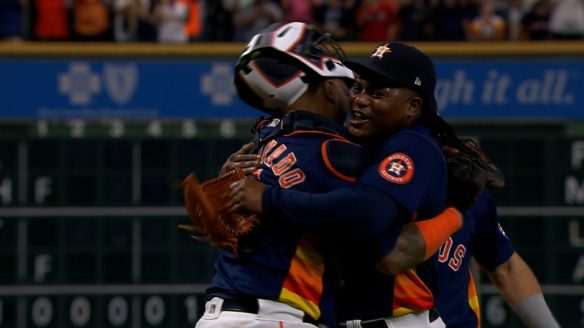
Framber Valdez gets a bear hug from his catcher Martin Maldonado after throwing a no-hitter at the Guardians Tuesday night.

What does it say that, on the day the Astros re-acquired the last man to throw a no-hitter in their silks, their struggling All-Star pitcher shakes off whatever it was prompting him to surrender fifteen earned runs over his past fifteen innings’ work to throw a no-hitter? The Astros may not be the only ones who’d like the answer.

But there it was. One minute, the Astros pulled the proverbial trigger on bringing future Hall of Famer Justin Verlander back. The next, after the trade deadline passed at 6 p.m. Eastern time Tuesday, Framber Valdez kept the Guardians hitless—with more than a little help from his friends—in a 2-0 win both of which Astro runs scored in the bottom of the third.

Verlander came home from the Mets in exchange for a pair of good-looking outfield prospects out of a farm system that was considered more than a little parched by any objective standard. Following their trade of fellow future Hall of Famer (and former Detroit rotation mate) Max Scherzer for a delicious Rangers prospect, the Mets actually looked smart in their unexpected circumstances.

“They did what they had to do, and I’m sure it wasn’t an easy call,” writes Smart Baseball author/Athletic analyst Keith Law, “but the Mets traded away six players from their big-league roster, including three pitchers all age 38 and up who either were heading for free agency or just unlikely to be that much help to the team in 2024 . . . ”

Dealing Justin Verlander and Max Scherzer—while paying enough of their salaries to return three solid prospects in Luisangel Acuña (No. 58 on my midseason top 60), Drew Gilbert (a first-round pick last year), and Ryan Clifford—are the kinds of moves more teams that have spent big only to fall short of contention should be making. And let’s give the Mets some credit for spreading the wealth around by sending one of those starters to Texas and the other to Houston.

I won’t pretend that that’s going to placate today’s generation of Met fans. You know. The generation that pronounces a season lost over one bad inning in early April. But Law is absolutely right. Especially with the coming off-season and, not merely to buy time, the pack of pitching free agents coming to within their glandular budget.

Particularly, a certain unicorn to whom the Angels held on for an (admittedly) outside postseason shot before he enters the market. The unicorn who’s both one of the best pitchers in the American League and a bona fide threat to Aaron Judge’s barely-year-old AL single-season home run record.

The Astros needed Verlander back more than anyone would have predicted when the season began. They’d just won a World Series and looked as though saying goodbye to a (controversial enough) era when they let the freshly-crowned Cy Young Award winner—the only baseball senior citizen ever to land one in his first year back from late-career Tommy John survery—walk into free agency.

But then they lost Lance McCullers, Jr., Luis Garcia, and José Urquidy to the injured list. Then, the Mets’s season went from World Series expectations to the landfill. Even as Verlander shook off early struggles and injury to round back into something resembling his old self (he has a 1.49 ERA over his last seven starts), it wasn’t enough to save this year’s Mets.

So the Mets elected to look 2023 reality in the eye and say time to start repairs. They dealt Scherzer to the Rangers after he delivered seven solid against his old team, the Nationals, en route the Mets taking three of four from the equally moribund Nats. When Scherzer asked the front office what the plan was, and learned it was moving on from deals expiring this year or next, he waived his no-trade clause and let the Mets move him onward.

The Astros are nipping at the Rangers in the AL West. The two teams square off themselves in a three-game set in early September. Tell me you won’t think it must-see television to see JV versus Max the Knife at least once in that set. Even if they’re not exactly young men anymore, they may yet have enough left in their tanks to have the eyes of all baseball upon them, especially with the AL West still at stake there.

It’s kind of a shame that Valdez picked Tuesday to pitch his jewel. Verlander back to Houston; St. Louis’s Jack Flaherty getting a fresh start in AL East-leading Baltimore (where he might get fixed enough to command a nice free agency pay day this coming winter);  the Cardinals otherwise reviving their own testy farm system without surrendering Nolan Arenado or Paul Goldschmidt.

Those were just too big to leave room. As were the Yankees even in inertia. They made no move other than landing middle relief pitcher Kenyan Middletown because they couldn’t realistically do a blessed thing. What they could move was either inconsistent or overpriced; what they could or might have brought in wouldn’t have been enough, even with Gerrit Cole at the head of the AL’s ERA pack and Judge back from his toe fracture.

You think today’s Met fan has the patience of a Nile crocodile? Don’t get me started on Yankee fans. From generation to generation, their credo is that a season lacking a postseason is illegitimate. For the generations since their last World Series win, the merest shortfall is enough to cause them to demand, “What would George do?”

The answer to that question is not what Yankee fan wants to hear anymore. They’d really rather have the late Boss’s tyranny and mutation back than what they have now. Never mind how it turned the 1980s Yankees into a basket case. Peace and quiet isn’t an option if the Yankees aren’t at the top of the AL East. Doesn’t it sound perverse to say a team with a winning record at this writing is also a basket case?

But there Valdez was, on the Minute Maid Park mound, striking seven out, letting his defenders take care of about 81 percent of the outs he needed otherwise, while Kyle Tucker took care of the game’s scoring with a two-run single in the bottom of the third.

Valdez stood at the top of the pitching heap Tuesday, and the trade deadline with all its attendant sidebars left him a hero without decoration. Even if Verlander’s first move on his arrival back with the Astros might be to congratulate him and welcome him to a unique club.

Sixteen no-hitters (four of which were combined, one of which was thrown by Hall of Famer Nolan Ryan) have been thrown by Colt .45s/Astros pitchers since their 1962 birth. From Don Nottebart (vs. the Phillies, 1963) through Valdez. That’s the most of any expansion franchise so far.

Valdez has a unique set of bragging rights while he’s at it. It took 61 years for an Astro  lefthander to do it. He can also say he’s the only man in baseball history, so far as anyone knows, to throw a no-hitter on deadline day, after the deadline hour passed but while the analysis and debates over the deals went hollering apace. The poor guy.

Danny Young, RIP: The hard climb and fall

Danny Young

It took Danny Young just over a decade to make the Show, and a shoulder injury following a harsh cup of coffee to return home.

The 21st Century’s first official grand slam wasn’t hit in the United States. The Mets and the Cubs opened the 2000 season on 30 March in Japan’s Tokyo Dome. The game went to an eleventh inning, and Cubs manager Don Baylor sent a longtime minor leaguer named Danny Young to the mound to pitch the top half.

The first student from Woodbury, Tennessee’s Cannon High School to make the Show in the first place, Young started auspiciously enough, getting two quick outs on a grounder to shortstop by Robin Ventura and a pop fly around the infield by Derek Bell. Then he surrendered a base hit to Todd Zeile before walking the bases loaded by way of Rey Ordóñez and Melvin Mora.

Mets manager Bobby Valentine sent Benny Agbayani out to pinch hit for relief pitcher Dennis Cook. Young’s first pitch to him missed for ball one. Agbayani hammered the lefthander’s second pitch over the center field fence. After Jay Payton’s followup double, Young escaped when Edgardo Alfonso flied out to center field.

“Even though I gave up a grand slam, I still looked around and it’s like, ‘That’s Mark Grace right there. I’ve got Sammy Sosa in the outfield’,” said Young—found dead at home at 51 Sunday—to Fox Sports. “They patted me on the back and let me know it was going to be all right. I had a lot of the guys come to me and say, ‘Welcome to the big leagues.’ They were like, ‘Things like this happen.’ I should have gotten out of the inning. It was just nerves and knowing within myself that something was wrong.”

It took Young long enough to get to the Show in the first place. Drafted by the Astros at nineteen in 1990, he played for nine minor league teams affiliated to three major league franchises over the decade to follow before he finally made the Cubs after the turn of the century. He never complained about being drafted in the 83rd round, either.

“If I was a first-rounder,” he once told Fox Sports writer Sam Gardner, “I might not have made it, because I had a thirst and a hunger to make it because of where I was drafted. If they’d have set a million dollars down in my hand at that time, there’s no telling where I would have ended up. So maybe that was just meant to be my turn.”

He simply didn’t expect to be on the wrong side of history when he finally got his turn in a Cub uniform in Tokyo.

He knew he’d had control issues from the outset—in his first minor league season he struck 41 batters out in 32.2 innings, but he also walked 39—but he also knew he could learn plenty enough about the game he loved but knew too little about. “I struggled just because it was a new process for me,” he told Gardner. “I still had this fear of making a mistake and the coaches just thought, at the time, ‘This guy is just having a hard time picking this stuff up’.”

Before they released him to be picked up by the Pirates organisation, the Astros even tried as radical a class as they could think of: they hired Hall of Fame pitcher Sandy Koufax, then working free-lance as a roving pitching instructor, to work with Young and with a kid named Billy Wagner in spring 1994.

Young had absolutely no idea who his new teacher was.

“Then I come to find out a couple years later,” Young said, “and people are looking at me like, ‘Dude do you know who you were with?’ I just didn’t know baseball, but they didn’t know that I didn’t know baseball. I just went out there and pitched.” Ever the gentleman, Koufax gave Young a signed ball that Young kept in a clear ceramic ball on a pedestal in his home.

“[I]t was overwhelmingly mind-blowing, the things that he knew about the directional part of pitching that I didn’t really grasp at first,” Young told Gardner of his Hall of Fame teacher. “And as I went along, it got better. I was a late bloomer, so I didn’t really understand the concepts that he was teaching me, but he taught me to find a comfort zone and how to tune out the crowd and what’s going on around me.”

The Pirates, too, remained as patient as possible as Young continued to struggle finding the comfort zone Koufax preached. As in the Astros organisation, Young tried everything he could think of, from changing deliveries and arm angles to changing speeds and back. Only when the Cubs picked him in the 1997 Rule 5 draft did Young begin to smell something close enough to success, or at least real major league potential.

He moved up the chain until he made the team in spring 2000. After Agbayani’s Tokyo blast, the Cubs returned Stateside and Young got into the next three straight games against the Cardinals. The first outing: two walks in two-thirds of an inning but no runs allowed. The second: a two-out double by Fernando Tatis, Sr. but another scoreless escape. Maybe Young was getting it at last.

The third: disaster—a pair of two-out walks, leaving a mess for his relief Brian Williams to clean up in the fourth inning, a mess that continued with a bases-loaded walk, a grand slam by J.D. Drew, and three runs charged to Young that he wasn’t on the mound to surrender himself.

The Cubs sent him back to Iowa after that. Young continued struggling until he finally spoke up further about an issue he’d felt in Tokyo, when he first mentioned to Mark Grace—after a pickoff throw that bounced to first—that he felt something wrong with his shoulder. It turned out his rotator cuff required major surgery, the first of five on the shoulder.

After 2000, Young retired from the game he’d never really had the chance to learn even rudimentarily in a Woodbury where baseball wasn’t exactly a well-taught sport. At least, not until Young returned home to spend the rest of his life raising his family and teaching and coaching the game to local kids.

“I played tee-ball, played Babe Ruth, played Dixie Youth Baseball and high school, but there was no real coaching,” he told Gardner. “And for the [coaches], that was no fault of their own. We hauled hay, we fished, we did whatever we did, and then we went out on the field and had fun. We had teams, but it wasn’t competitive. I mean, I ended up being a right-handed hitter because none of the coaches knew how to teach me how to hit left-handed.”

If only the Danny Young who went home to teach the game on his native ground had been available to the Danny Young who originally caught the Astros’ eyes, however deep in that 1999 draft. He might have had more to show for his long slog to the Show, and in the Show itself.

He never struck a major league hitter out, he walked six, he surrendered five hits, but he kept a big league attitude. For himself, and for his wife, Sarah, their six children, and their two grandchildren. The battler who surrendered this century’s first major league grand slam should only know peace and fulfillment in the Elysian Fields to which he was taken—cause unknown at this writing—too soon.

From technocracy to roguery, the path to Astrogate

Winning Fixes Everything

When the Astros’s illegal, off-field-based electronic sign-stealing of 2017-18 was exposed in November 2019, there also unfurled a concurrent portrait of the Astros’s organisational culture as ruthlessness run amok. In Jeff Luhnow’s Astroblanca, human life was cheap and the rules were that there were, mostly, no rules.

As delivered by the Athletic reporter who first unearthed Astrogate, Evan Drellich, Winning Fixes Everything: How Baseball’s Brightest Minds Created Sports’ Biggest Mess is as much a deep dive into a rogue baseball organisation as it is about a team that took a ticking time bomb MLB handed all thirty teams and decided detonating their own similar one just wasn’t enough.

The top rogue was Luhnow, who came to the Astros’ attention after remaking the Cardinals’ player development system successfully. He soon proved a technocrat to whom disagreement equaled treason and human considerations, nuisances, from his calculated tanking rebuild through the swamp of Astrogate staining the franchise’s first World Series title.

“Winning isn’t everything, but wanting to win is,” is what football legend Vince Lombardi really said. Luhnow lacked the moral compass to separate ends from means. Wanting the Astros to get ahead of everyone else on the field and in an analytically reoriented front office was one thing. Losing the plot about human elements and ethics?

“Luhnow was right that change is not easy,” writes Drellich, who’d been an Astros beat writer for the Houston Chronicle before 2017.

But he eliminated most any guardrails along the way. He had pressed forward in the face of pushback for so long, dating back go his time [with the Cardinals] as the maligned outsider. Eventually he was rewarded with the results he sought. But he didn’t do enough to ensure the wrong boundary was never tested . . .

Before hiring Luhnow, Astros owner Jim Crane tried to lure Andrew Friedman from the Rays. Friedman didn’t want to take a rebuild on, having proven he could steer the Rays to winning despite their meager budgets. In due course, Friedman went to the Dodgers, a team fabled for rebuilding on the fly and without fear of either spending or an authoritarian front office.

Astrogate’s exposure in November 2019 opened in turn the slow but sure unfurling of a concurrent Astros portrait in which they were governed by a technocracy that lost the human plot above and beyond mere data driving. No less than baseball commissioner Rob Manfred, handing down his Astrogate report in January 2020, pronounced Luhnow’s Astros organisation as a subhuman disaster:

[W]hile no one can dispute that Luhnow’s baseball operations department is an industry leader in analytics, it is very clear to me that the culture of the baseball operations department, manifesting itself in the way its employees are treated, its relations with other clubs, and its relations with the media and external stakeholders, has been very problematic . . . the baseball operations department’s insular culture—one that valued and rewarded results over other considerations, combined with a staff of individuals who often lacked direction or sufficient oversight, led . . . to an environment that allowed the conduct described in this report to have occurred.

That “conduct,” of course, was the Astros taking mere replay room reconnaissance—decrypting signs between opposition catchers and pitchers, then using the old fashioned transmission of sending the intelligence to live baserunners to signal batters, a system used by more teams than just the Yankees, the Red Sox, and, yes, the Dodgers—and graduating to Astrogate’s espionage level.

Drellich reveals that the Astros began thinking outside the replay room reconnaissance box when they suspected the 2016 Rangers, against whom they’d been futile that season (fifteen losses in nineteen games; surrendering sixteen home runs in ten games at Arlington), had a live spy in the stands.

If they were right, it was also hardly unheard-of in the long log of baseball’s oldest sub-profession. But numerous teams long since shown to have done likewise, from the stands (the 1940 Tigers), the old hand-operated scoreboards (the 1948 Indians, the 1961 Reds), even beyond-center field clubhouses (the 1951 Giants), didn’t provoke aggrieved opponents to think about seeing and raising to the extent the Astros did, either. “[I]t remains the case,” Drellich writes, “that no team has been shown, through firm reporting or accounts, to have done something as blatant as Houston.”

In September 2016, Luhnow hired a Spanish-language translator, Derek Vigoa, who proved to have talents above and beyond language. Vigoa developed a spread sheet algorithm, Codebreaker, used to decipher opposing signs. By itself Codebreaker was neither cryptography (Drellich’s word) nor wrongdoing . . . unless it was used during a live game (the Astros did), not before or after it.

“The rules seemed to be an afterthought in Houston,” Drellich writes, “if they were a thought at all. Innovation, improvement—‘Data efficacy’—that was the mindset Luhnow had long fostered.” It was just such “data efficacy” that provoked Astrogate’s two main operatives, 2017 bench coach Alex Cora and 2017 designated hitter/de facto coach Carlos Beltrán, to conclude mere replay room reconnaissance and a mere spread sheet weren’t good enough.

They married Cora’s fascination with the uber-speed Edgertronic camera and Beltrán’s insistence on an extra monitor adjacent to the dugout to send the Astro Intelligence Agency light years beyond previously known methods of in-game espionage. They went from merely technologically savvy to full, above-and-beyond rogue.

Luhnow was a product of McKinsey & Company, the consulting firm infamous for making corporate cost-cutting and data-orientation into an art dark enough that too often such things as safety and human relationships were compromised, if not obliterated. (McKinsey was once brought in to tighten the ship at Disneyland, a ship-tightening that cut into maintenance costs deeply enough and may have contributed to two fatalities at the fabled theme park.)

When the Astros moved to re-evaluate and trim their scouting system if need be, Luhnow heeded an aide’s advice that they eliminate scouts lacking tech savvy. First, though, he wanted his old employer McKinsey’s endorsement. Then, he wanted the new tech-oriented scouting done by remote, dumping eight traveling scouts in August 2017, just as manager A.J. Hinch—who’d prove weak when it came to stopping Astrogate dead in its tracks—had begun working with them on postseason advance scouting.

Cora and Beltrán were respected as career-long students of the game, including and especially catching onto any small “tell” from an opponent that might give them a slight edge. Catching onto and exploiting such “tells” is part of old-fashioned gamesmanship. Training an illegally-mounted and operated real-time camera and monitor on the opposing battery isn’t even close to it.

That 2017 Astros roster was a roster to die for. But Drellich says Luhnow and his brain trust weren’t all that convinced they could get it done by themselves. “Communication was thin,” Drellich writes, “and relationships were strained. Technology was ubiquitous, and the goal was singularly to win. It’s hard to say the Astros were the most likely team in baseball to start cheating. But there couldn’t have been a team more poorly prepared to stop cheating.”

Especially after Manfred’s late-season memo to all teams, after he slapped the Yankees’ and Red Sox’s wrists over replay room and AppleWatch reconnaissance. Manfred, Drellich writes, made two large mistakes: aiming future punishments at managers and GMs; and, believing he’d just drawn a line in the sand.

Six days after that Manfred memo, the Astros played the White Sox in Chicago—and White Sox pitcher Danny Farquhar smelled, and heard, a trash can rat. And Luhnow, as Manfred noted during his Astrogate report, never passed that 2017 memo down to others on the team.

The Astros and the Dodgers held each other in suspicion as that 2017 World Series began, but the worst the Dodgers might have done was simple replay room reconnaissance with the baserunner as the hitter’s tip. “[T]here is no known evidence,” Drellich writes, “that the Dodgers were doing something as flagrant as the Astros’ trash-can system.”

Manfred’s major Astrogate error was not anticipating “how important it would be to make sure he could confidently punish players, and by not pursuing the topic with the [Major League Baseball Players Association] in advance. Even with his experience with the steroids issue, he didn’t fully grasp how players could try to gain an edge through technology, nor what the reaction would be if he ever had to let players off the hook.”

Drellich cites former commissioner Fay Vincent saying baseball’s real Astrogate mistake was “thinking that the players and the owners don’t have to come together on major issues . . . The union should have been taking a leadership role and saying, ‘We can’t have the game hurt by this kind of cheating’.”

The author also cites former union attorney Gene Orza saying not so fast, Fay: “He doesn’t understand what a union does . . . The union does not have a higher calling for the quote-unquote good of the game . . . [it] is not about, first and foremost, the health of the game. It is about defending the players that are its constituency.”

Luhnow and Hinch, of course, were fired by Astros owner Jim Crane when Manfred’s Astrogate report came down. Cora left the Astros to manage the Red Sox to the 2018 World Series championship. (Those Rogue Sox had their own replay room reconnaissance operation at play, though only their video operator J.T. Watkins was held to account and canned.) But he left the Red Sox before they could fire him upon the Astrogate report. Both Hinch and Cora served their 2020 Astrogate suspensions and returned to the dugout after, Cora to the Red Sox and Hinch to the Tigers.

Hinch, Cora, and Beltrán have since been forthright about their Astrogate roles—or, in Hinch’s case, his failure to stop the AIA beyond smashing a couple of the extra dugout-adjacent monitors. But they’ve done it without giving detailed, play-by-play accounts. “It’s likely,” Drellich writes, “that the finger-pointing nature of any such discussion makes it difficult to go down that road while they still hope to work in baseball.”

Beltrán was hired to manage the Mets after the 2019 World Series but fired upon the Astrogate report without having managed even a spring training game for them. He served his 2020 suspension, became a 2021 analyst for the Yankees’ YES network, and has now returned to the Mets in a front office role. Recalling Beltrán’s admission to YES host Michael Kay—I wish I would have asked more questions about what we were doing—Drellich couldn’t resist: “Beltrán was as powerful a clubhouse presence as there was on the 2017 Astros, begging the question, what was stopping him from asking those questions?”

What overseeing a cultural environment that opened the door to baseball’s worst cheating scandal didn’t do to Luhnow, suing an owner probably did. So did the revelation that, despite orders from MLB investigators not to do so, he wiped much if not most of his cell phone data. Luhnow hasn’t returned to baseball since his suspension ended. (He now co-owns a pair of soccer teams, one in his native Mexico—his parents moved there from New York just before he was born—and one in Spain.)

With only five members of the 2017-18 Astros remaining, and under the combined leadership of manager Dusty Baker and since-departed GM James Click, the Astros beat the upstart Phillies in last year’s World Series. Straight, no chaser. But winning hasn’t yet disintegrated all of the Astrogate taint. Even if the entire team now is no longer held responsible for then, opposing fans still hammer the remaining 2017-18 team members with chea-ter! chea-ter! chants. Even including the unfairly-tainted Jose Altuve.

Luhnow’s data-dominant leadership approach hasn’t left the game, either. Baseball still struggles to balance between the value of analytics and the human men who play and manage the game. But don’t make the mistake of reading Winning Fixes Everything and concluding that analytics qua analytics begets cheating.

Gathering the deepest, above-and-beyond data and applying it to player development and advancement is a virtue. It doesn’t have to leave room for an Astrogate. In the hands of a less tunnel-visioned leader, under a less nerve-exposing atmosphere, it might not have done so.

Without the sort of resolution Vincent suggested, there may yet come something worse. Astrogate has informed us already, and Drellich now reminds us vividly, that it will no longer do to dismiss cheating merely by shrugging that boys will still be boys.

“I was floored. It was a massive story.”

Bang the can slowly!

The passage from the Astros’ dugout in Minute Maid Park to the clubhouse. The wires above the trash can connected to a monitor, presumably seated between the can and the Everlast bag, “exactly as the (sign stealing) setup had been described to me.” (2018 photograph by Evan Drellich, published this morning in The Athletic.)

Come Valentine’s Day, baseball will receive a gift that won’t exactly be a love letter, or even a mash note. It’s going to get Athletic reporter Evan Drellich’s account of Astrogate and the broader issues raised and/or revived by the 2017-18 Astros’ above-and-beyond, and very illegal, electronic sign-stealing intelligence operation. At last.

Drellich, of course, is the reporter who teamed with Ken Rosenthal to break the Astrogate story in November 2019, shortly after the Astros fell to the Nationals in the World Series. This morning, The Athletic published an excerpt from Winning Fixes Everything: How Baseball’s Brightest Minds Created Sports’ Biggest Mess. It reveals that what became Astrogate didn’t just arrive to Drellich on a flaming pie over three years ago.

A year before Drellich and Rosenthal dropped the opening shot, Drellich was a Red Sox beat writer NBC Sports Boston, following a tour covering the Astros for the Houston Chronicle. During the 2018 postseason, in which the Red Sox beat the Astros in the American League Championship Series, he found himself speaking to people with first-hand knowledge that the Astros cheated beyond mere replay room reconnaissance on their way to their franchise-first World Series title.

“These were not sources on the outside pointing fingers, but people who knew—who had lived it,” he writes.

I learned how the Astros used a camera in center field to zoom in on the signs the catcher flashed the pitcher before the pitch. How the Astros had set up a television monitor near their dugout, where the players sit during games, to be able to see that video feed, and how they brazenly banged on a garbage can with a baseball bat and other devices to communicate what they gleaned from that screen. It was an advantage, many players felt, to know what was coming, be it a straight fastball or a bending curveball. And to use technology to gain that knowledge was beyond the pale.

This wasn’t just one player breaking the rules, either. This was a World Series–winning team that had collectively cheated, and the public didn’t know it.

I was floored. It was a massive story, the kind, frankly, many reporters dream of, and some might even dread. I was confident in everything I had at the outset—indeed, it all proved to be true. But to get a story done, I would need further corroboration.

One Astros source warned of the context of cheating in the sport, an encouragement that in hindsight could have both been earnest, but also self-serving, meant to deflect attention away from what the Astros had done. Nonetheless, I wanted to learn for myself and include it in my reporting—in what environment did this behavior arise?

Drellich first sought to get an idea from none other than the highest cheating Astrogate mind himself, the Astros’ then general manager Jeff Luhnow, during that ALCS. He spotted Luhnow in the Astros’ Minute Maid Park dugout. “He was the architect of the team,” Drellich writes, “and I tried to get his attention as he was walking away from me. ‘You won’t find anything,’ he said defensively, making clear he wouldn’t talk to me.”

The night the Red Sox won that ALCS, in Houston, Drellich acted upon the aforementioned first-hand knowledge shared with him and walked toward the Astros clubhouse. He even photographed what he saw just past the steps down from the dugout. Oops.

When the Red Sox met the Dodgers in the 2018 World Series, Drellich met with two baseball officials hoping to get a picture of what baseball’s government was or wasn’t doing about electronic sign stealing. One started generalising the suspicions until Drellich broke in to tell him he had sources from within the Astros’ operations telling him about the extent of their Astro Intelligence Agency, so to say.

“‘They have acknowledged that?’ one [official] said. ‘I mean, I can’t speak to that. I mean, to our knowledge—you have your information, and we have ours, and that’s all we can go off. As to whether that has occurred, to our knowledge we are completely unaware. I am confident in the measures that we’ve taken’.”

Drellich wasn’t trying to be a friendly tipster to MLB because he couldn’t. “It’s not a reporter’s job to steer sources to the league,” he writes. But he also saw too clearly that, at that time, MLB wasn’t exactly in that big a hurry to act.  He also knew that, having multiple sources but none willing to go on the public record just yet, he needed to find the one who would.

To get something, anything on the record, Drellich writes, he composed a “general piece on electronic sign-stealing” in November 2018, after the Red Sox beat the Dodgers in five in that World Series. “Very quickly,” he continues, “my doubts about the support I had at NBC Sports Boston proved correct. When they fired me in February 2019, I was blindsided, but perhaps I shouldn’t have been.”

His unemployment didn’t last long. The Athletic hired him, placing him into proximity with Ken Rosenthal: “Together, we would pick up my reporting on the Astros.” Indeed. Rosenthal had the sport-wide cred to make the calls Drellich couldn’t yet make. Such calls as to Danny Farquhar, the White Sox pitcher who heard the Astros banging the can slowly and called his catcher right to the mound to switch up their signs.

Such calls as to Mike Fiers, the pitcher who had something even more precious to offer on the record than an opposing pitcher who had ears to hear and brains to act accordingly: Fiers had been a 2017 Astro. And he was only too willing to go on record now, after assorted failed attempts by himself and others to convince other writers to expose Astrogate.

Drellich writes that Rosenthal asked Fiers if he was comfortable being quoted. “Well, that’s the whole thing about this. I don’t want to be put out there like that,” the pitcher began.

But they already know, so honestly, I don’t really care anymore. I just want the game to be cleaned up a little bit because there are guys who are losing their jobs because they’re going in, they’re not knowing. Young guys getting hit around in the first couple of innings starting a game, and then they get sent down. It’s bullshit on that end. It’s ruining jobs for younger guys. The guys who know are more prepared. But most of the people don’t. That’s why I told my team. We had a lot of young guys with Detroit trying to make a name and establish themselves. I wanted to help them out and say, “Hey, this stuff really does go on. Just be prepared.”

By “they already know,” Fiers indicated the Astros knew he’d tried to warn subsequent teammates on the Tigers and the Athletics. “Fiers, to his immense credit, stood by his words and never tried to back out before the investigation ran,” Drellich writes. “He helped change the sport, and the toll ostensibly has been heavy for him.”

Ostensibly? Fiers hasn’t pitched in the Show since the pan-damn-ically shortened 2020 season. He’s been to the Mexican League and the Chinese Professional Baseball League since, before signing with the Toros del Este of the Dominican Winter League last September. Age to one side (he’s 37), Fiers probably still finds one person denouncing him as a traitorous snitch for every one applauding him as a brave whistleblower.

“Many fringe players train in the Caribbean during the offseason to prepare themselves for the upcoming Major League season in hope of finding a better contract,” wrote Sports Illustrated‘s Ben Silver when Fiers signed that deal. “Fiers, though, may face an uphill battle. He is forever linked with the Houston Astros’ cheating scandal and teams may no longer wish to associate themselves with the weight his name carries.”

“At the time Ken spoke to Fiers, we were preparing to publish our findings without his account,” Drellich continues. “It’s impossible to say exactly how the world would have reacted to the story had Ken not spoken to him—if all the sources had been unnamed. But the facts of the story had already been ascertained, and we had Farquhar’s account.”

The whistleblower’s is often a lonely lot. “Whether Fiers was quoted or not,” Drellich writes, “it seems unlikely to me that MLB would have been able to ignore the general outcry. But our investigation was still in a much better position with Fiers on the record. His name helped validate everything instantly, making it harder for anyone to try to shove the story aside.”

Today’s Astros are the defending 2022 World Series champions, no longer the Luhnow team that cheated from the top down to extents above and beyond mere basepath or even mere replay room reconnaissance. (Only three Astrogate team members remain on the roster; one, Jose Altuve, has been shown conclusively as the one Astro who rejected stolen signs consistently.) Nothing suggests that the 2022 Astros didn’t beat the Phillies straight, no chaser.

But the Astrogate taint remains, at least until the last Astrogate team member no longer wears their uniform. There remain only too many who think the whole thing wasn’t the Astros’ fault for having committed the crimes but Fiers’ fault for having blown the whistle on the record. Today’s excerpt demonstrates that Winning Fixes Everything promises to knock that and other Astrogate canards into the middle of next year.