The Washington bury-go-round

World Series - Houston Astros v Washington Nationals - Game Five

In his potentially final appearance as an Astro, Gerrit Cole pitched a Game Five masterpiece.

Hours before Game Five, the World Series weight on Nationals manager Dave Martinez’s shoulders went from that of the world to that of the universe. Scheduled starting pitcher Max Scherzer’s Saturday night neck spasms turned into a Sunday wakeup with his neck locked so tight he couldn’t lift his right arm and needed his wife’s help just to wash and dress.

Putting the Game Five fate of the Nats into the hands of Joe Ross. Who pitched a gutsy turn ruined only by a pair of two-run homers en route a 7-1 Astro win. On yet a third straight night in Washington that suggested the Nats left their offense behind in Houston after Games One and Two.

Hadn’t they manhandled Gerrit Cole in Game One? Hadn’t they out-scored the Astros 17-7 in Houston? That was then, this was Sunday night, and the Nats’ futility at the plate since the Series moved to Washington remained chronic enough to consider fitting them with GPSs to find their directions home when they did get men on in Game Five.

Now three games worth of the Astros outscoring the Nats 19-3 in Nationals Park suggests this World Series still has a chance of being only the second Series ever in which no home team wins a single game. Maybe an outside chance, but a chance nevertheless.

Ross brought the house down just walking out of the dugout for a pre-game round of stretches and limberings-up in the outfield. He sent it nuclear when he shook off George Springer’s leadoff walk to lure Jose Altuve into dialing Area Code 6-4-3 in the top of the first.

But after Yuli Gurriel bounced one high off Ross’s own glove for an infield hit leading off the second, Ross couldn’t stop Yordan Alvarez—getting his first start in the Washington leg after sitting two out due to the lack of designated hitter in the National League park—from hitting a 2-1 pitch almost into the middle of the left center field seats.

It was something Alvarez only waited for all Series long. “All my teammates were saying: ‘Today’s your day. Today’s your day’, ” he told reporters after Game Five. “And it happened.” Nobody ever accused his teammates of being dummies.

And in the fourth, with Alvarez aboard on a two-out single, home plate umpire Lance Barksdale called ball on what should have been strike three, outside corner, side retired with Carlos Correa at the plate. Two fouls and a wild pitch later, Correa hammered one into the left field seats.

Barksdale has a reputation as one of the better plate umpires in the business, but on Sunday night he called enough balls strikes and enough strikes balls against both the Nats and the Astros that calls began ringing out of the park and aboard Twitter for everything short of a federal investigation.

Postgame, the calls began ringing forth all over the Web to get the robots perfected, calibrated, and into service as soon as feasible. Who knows whether the Astros will get jobbed on critical calls in Houston? Who wants to take that chance too much longer?

“Just because the game itself is full of errors shouldn’t give leeway to its arbiters to be judged by that standard,” writes ESPN’s Jeff Passan. “Baseball is an extraordinarily fast game—so fast that umpires should have assistance. Technology has made their jobs even more difficult, exposing them when they miss a call and airing their conversations about those missed calls. Automated balls and strikes are their savior, not their enemy.”

With Donald Trump himself in the ballpark watching the game, it was tough to miss the irony when fans began chanting, “Lock him up! Lock him up!” in the bottom of the seventh. Not at President Tweety but at Barksdale.

Juan Soto, the Nats’ young star who’d found the home leg of the Series as trying as he’d found Game One a personal party in Houston, caught hold of enough of a 2-2 Cole service with one out to launch it just past a leaping Jake Marisnick’s reach and over the center field fence in the bottom of the seventh. A ground out later, Ryan Zimmerman worked a walk on a ball four that looked like it should have been an inning-ending strike.

Up stepped Victor Robles, heretofore one of the Nats most prominently seen in Washington with an invisible bat. In a Series full of full counts as it was, Cole and Robles wrestled to yet another full count with Anthony Rendon on deck. Then Cole threw Robles a nasty looking slider. The ball clearly crossed out of the zone off the low outside corner. Barksdale decided ball four was strike three, side retired.

If you were watching the game on television you could hear an extremely audible, “Come on, Lance! It’s the World Series! Wake up!” That was a miked Martinez. Even Astro fans in the stands—and there were many, including one wearing a Nolan Ryan jersey from his tour with the 1980s Astros, when their jerseys looked like striped orange-shaded pajama tops more than baseball uniforms—joined the calls to lock him up.

There wasn’t a Nat in the house who’d accuse Barksdale of costing them Game Five; Cole especially, but with just a little help from his friends Joe Smith and Ryan Pressley in the final two innings, did a splendid enough job of that. The third highest-scoring team in the Show on the regular season looked so lost at the plate in Game Five, with or without men on, that the GPS couldn’t help.

“Lance didn’t lose us the game tonight,” Zimmerman said. “Gerrit Cole beat us.”

The Nats’ bullpen did a splendid job of holding the fort after Martinez decided Ross had had it for the night. In a slightly surprising move, after Tanner Rainey all but zipped through the sixth with three fly outs, Martinez reached for Sean Doolittle, one of his only two reliable back-of-the-game men, for the seventh. And Doolittle coaxed Correa into dialing Area Code 5-4-3 after a leadoff single before shaking off a walk to get the side without damage.

Then Martinez decided Daniel Hudson was good to go for a second inning’s work after Springer’s leadoff double led to taking third on a ground out, an intentional walk to Michael Brantley, and Gurriel punching him home with a single through the right side of the infield. Despite having Wander Suero warm and ready.

A four-run deficit is still manageable after seven and a half. Except that the Nats once again couldn’t do anything with a man on base, this time Yan Gomes leading the bottom of the eighth off with a single. But it’s still manageable in the ninth. Until Martinez sent Hudson back out for the top of that inning.

And after a one-out single and a swinging strikeout, Hudson threw Springer a fastball with plenty of speed but no movement down the middle of the plate. Springer practically had no choice but to send it into the left field seats. Leaving even gimpy-kneed Astro reliever Ryan Pressly to put the Nats out of their miseries in order in the bottom of the ninth.

Forget the home run for a moment. The Nats would surely need Hudson in Games Six and (if the Series gets there) Seven. Suero took over after Springer’s launch and coaxed Altuve into an inning-ending lineout on a measly two pitches. They’d better hope they find their bats in Houston and make Hudson unneeded too soon in Game Six even with Monday’s travel day.

For Astros manager A.J. Hinch, who’s one of the more thoughtful men in his job today, it was simply a question of keeping his and his players’ wits about them no matter how badly they’d been bopped until they dropped in Houston last week.

“We feel like we’re in every game,” Hinch said. “We’ve had games where we’ve come from behind. We’ve had games where we’ve stretched the lead. We’ve had games like today where we just methodically kept going with big swings and we look up and we have a comfortable win.

“We took a pretty heavy punch in the gut when it came to the first two games,” he continued. “The Nats came out hot . . . And when you take a step back, and you’re like, ‘We’re still in the World Series and it’s still a race to four wins.’ You win that first win.” And the second. And the third.

It’s even easier when you have an Altuve hitting .360 in the Series and still threatening to break Darin Erstad’s record for hits in a single postseason. And, when you have Brantley hitting .400. And, when you have super-rook Alvarez and cagey veteran Springer re-discovering their previously missing batting strokes.

And, when you have a Cole—in what was his final performance as an Astro, potentially—who tightens up his case for the largest free-agency contract for a pitcher in the game’s history yet with a masterpiece of a Sunday night soiree.

But it still ain’t that easy, Clyde. “When we won in 2017, and then didn’t win last year, you remember how it feels,” Springer told The Athletic‘s Jayson Stark. “You remember the goodness that comes. The fun. The honor. To celebrate with your teammates and your friends and all that stuff. Once you get a taste of that, you never want it to go away.”

The Astros yanked themselves back to within a game of their second such taste in three years on Sunday night. And there went Martinez’s likely pre-Game Five hope that Ross and/or someone else could or would prove as surprise a World Series hero as had such previous until-then obscurities as Howard Ehmke (1929), Johnny Podres (1955), Don Larsen (1956), and Moe Drabowsky (1966).

No Series record-setting strikeout performance for Ross, as the end-of-the-line Ehmke did in Game One of the 1929 Series for the Philadelphia Athletics. No shutout heroics, as Podres, the number four man in the Brooklyn Dodgers’ rotation, did in Game Seven of the 1955 Series. Don’t even think about a perfect game such as Larsen delivered for the Yankees in Game Five, 1956.

And don’t even think about a Nat reliever, any Nat reliever, delivering what Drabowsky—until that point a veteran relief rat and superior prankster—delivered for the Orioles in relief of Dave McNally: eleven strikeouts, including striking out the side back-to-back in the fourth and fifth innings, in Game One, 1966.

Martinez wasn’t destined to be that fortunate. But now a World Series that went into Game Five at Defcon Three, before Scherzer’s literal pain in the neck bumped it up to Defcon Two-Five, goes to Houston with the Nats at straight Defcon Two. Even with Strasburg, taking a lifetime 1.34 postseason ERA into Game Six, starting the first of two potential elimination games.

As always, history doesn’t always favour one or the other going to Game Six. Ten teams have lost the first two World Series games before winning the next three, and three—the Cardinals (1987), the Braves (1991), and the Yankees (2001)—lost those Series, anyway. The Cardinals’ loss remains unique in World Series lore: every game won by the home team.

But so far so does this Series: it’s only the third time the road team has won the first five games. It last happened in the 1996 Series that the Yankees eventually won in Game Six, when the set moved back to New York. Now, for the fun part, or at least the part the Nats hope to make fun: they’d like to be the first to win a World Series entirely on the road.

The real road. The 1906 Series between the 116 game-winning Cubs and the “Hitless Wonders” White Sox was not only one of the greatest Series upsets of all time, the White Sox winning in six, but almost every game in that Series was won by the visiting team. (The White Sox won Game Six at home.) But let’s be real: it’s not as though the White Sox had to jump anything traveling farther than a crosstown trolley car to get from one ballpark to the other.

So if the Nats find a way to pillage and plunder the Astros in Games Six and Seven the way they did in Games One and Two, they’ll become the first team ever to win a World Series entirely on the bona fide road, with miles and miles between Nationals Park and Minute Maid Field. It ain’t just a trolley hop, kiddies.

But if Strasburg proves too human and the Nats don’t find the bats they left behind on Tuesday night, forget the trolley hop. They’ll go home for the winter in hearses.

The future’s coming in by helicopter

2019-10-27 DaveMartinez

Nationals manager Dave Martinez faces the press and the music after Game Four.

“This ain’t football. We do this every day.” So said the late Earl Weaver. Unfortunately, every day doesn’t last forever. And even with the World Series tied at two games each, it feels a little as though the Nationals are running out of every day.

The truest cliche ever attached to Billy Martin is that he managed a season as though the future didn’t exist. In the regular season that meant pitchers left in ruin before their times. In a short series, though, especially when “World” precedes “Series,” it means the future is now.

Nats manager Dave Martinez’s let’s-go-1-and-0 today philosophy got the Nats to the World Series in the first place. It also got him two devastating wins, outscoring the Astros 17-7, in the Astros’ playpen. But when he needed it the most in Games Three and Four, it didn’t show up.

His batting grinders suddenly forgot how to hit with men on second or better and also with two outs while they were at it. And Martinez forgot the urgency when he needed a stopper like five minutes ago.

Granted Martinez doesn’t have the greatest overall bullpen, but when he needed a stopper drastically in Game Four he was more concerned about having two available for Game Five with Max Scherzer due to start than in stopping the bleeding with a mere three-run deficit on Saturday night.

And Astros manager A.J. Hinch, down 2-0 in the Series, wasn’t afraid to play and think in the absolute moment. Zack Greinke headed for Game Three trouble? Get him out of there before he gets humiliated. The Nats looking ornery at the plate? Wheel in Will Harris, Hinch’s absolute best relief pitcher, and wipe the ornery off their faces before it means disaster. Can’t afford to hold him just for the late hold.

So rookie Tanner Rainey, with the live fastball and the deadly slider but still-lingering command issues, opened the Game Four seventh with back-to-back walks before getting Jose Altuve to fly out? Where was Daniel Hudson? Where was Sean Doolittle? Not like they were overworked; they didn’t even get to poke their noses out of their holes in Game Three.

Where, even, was Wander Suero, who shook away his arson tendencies enough this postseason and who’d gotten rid of Michael Brantley coming up in the only time he’d ever faced the Astro left fielder?

This time, Martinez had to be Santa Claus and send Fernando Rodney out to deal with Brantley, who’d hit .468 lifetime off the old man prior to Game Four. And after Brantley lined a single into short center to load the ducks on the pond, Martinez stuck with the old man anyway. Experience counts, right?

This is Rodney’s lifetime World Series experience: 6.00 ERA. This was Rodney’s 2019 Series experience before Game Four: one clean shutout inning in Game Two; two thirds shutout inning in Game Three, except that it was about as clean as a corpse attacked by rats: entering with a man on, then stolen base and a throwing error, walk, stolen base, rundown force at the plate, intentional walk, inning-ending force out.

That‘s what Martinez sent to the Game Four mound in the top of the seventh with Brantley checking in and first and third. With the game a still-manageable three-run difference. With neither Hudson nor Doolittle anywhere to be seen.

Then Brantley behaved just the way you’d expect as a .468 hitter against that pitcher and lined a bases-loading single up the pipe. And Alex Bregman, going in knowing Rodney still has stuff and it’s best approached prudently, drew a bead on the fastball that didn’t sink the way the MVP candidate usually expects it to sink.

With one swing Bregman sank the Nats into a two-all Series tie and Nationals Park into the Tomb of the Saturday Soldiers Who Wish They Were Unknown.

A Nats fan would love to go back to the end of the sixth and whisper in Martinez’s ear, “Think ahead, Dave. You need a stopper right now. Hudson and Doolittle haven’t had to work since Game One. They ain’t H-D-H of the 2014-15 Royals but they’re as close as you’ve got. And Hudson’s just as much hell on lefties as righties this year if you got Tucker leading off to pinch hit.”

Then, when he or she had Martinez’s ear locked in tight, continue: “You bring in Hudson and you might be out of the inning with nothing more than maybe an excuse-us base hit along the way. Then you bring the old man in since he’s better in a clean inning but when he joins up with men on it’s disaster. And if your bats remember how not to just make traffic but get it home without a pileup, especially with two outs like during that magnificent run from May forward, you still got Doolittle.”

And then, when Martinez really perked up, drive it home straight, no chaser: “You can still go to either one in Game Five if Max the Knife needs help or gets through six or even seven without the sky falling in on him. And you got a travel day back to Houston for Game Six. They won’t be wrung like mops. They’ll be there for the asking and you know you’d better ask if needed. Remember all that and live.”

An Astros fan, of course, would prefer Martinez let himself get out-generaled by Hinch a couple of more times. Preferably in Game Five if the Astros find their way past Max the Knife and send the Series back to Houston needing just one more win to return to the  Promised Land.

Except that Martinez just lost his Knife. On Sunday afternoon the word broke that Scherzer suffered neck spasms late Saturday night and the discomfort was too much worse Sunday to send him to the mound. “For Max to miss a game, especially a significant game like this, he’s got to be really hurting,” Martinez said Sunday.

Indeed it does. And it looks like the Nats now have to try the unthinkable: a bullpen game to open, with righthander Joe Ross. Unless Martinez wants to roll some real dice and hand the ball to Stephen Strasburg in the pinch, since Strasburg would be on regular rest Sunday night.

The time for Martinez to get himself and his Nats back to that go 1-0 today philosophy is now. The future isn’t waiting for Dupont Circle traffic to lighten up. It’s coming in by helicopter.

Santa serves early Christmas salami

2019-10-27 AlexBregman

Santa showed up early for Alex Bregman and the Astros Saturday night.

Did we say World Series Game Four was going to be a bullpen game? Didn’t quite turn out that way. Did we say the Astro pen wasn’t guaranteed to equal bona fide Nationals fourth starter Patrick Corbin? Boy did we get that one wrong.

Not only did the Astros’ rookie designated opener Jose Urquidy pitch the quality start of his young baseball life, he out-pitched both Corbin and his own team’s still formidable but lately vulnerable Justin Verlander and Gerrit Cole.

And he did it on a night the regular season version of the Astros finally, once and for all, turned up. Big. 8-1 big. They finished what they started in Game Three and obliterated any chance of the short series nobody with a brain really thought was likely to happen in the first place.

Michael Brantley with two hits thus far on the night, plus Alex Bregman still trying to shake away an overall postseason hitting funk despite one launch earlier in the set, remembered especially what Nationals manager Dave Martinez forgot in the seventh inning.

He forgot that these Astros are the greediest little suckers in the American League when handed gifts. They don’t stop at “Thank you.” They demand more, help themselves, and make you look like a battered fool before they’re done. Turning the seventh inning stretch into a visit to the urgent care clinic.

Bad enough rookie Nats reliever Tanner Rainey handed the Astros the gifts of back-to-back inning-opening walks before closing the giveaway with Jose Altuve flying out to right. Martinez put on his Santa suit and gave the Astros an extra early merry Christmas.

He reached for ancient Fernando Rodney. Against whom Brantley took a lifetime .462 batting average and 1.038 OPS to the plate. Instead of Wander Suero, who’s almost young enough to be Rodney’s son, and against whom Brantley before Game Four only ever batted once and had nothing to show for it but a measly out.

Respecting your elders goes only so far with a World Series game on the line and the other guys in one of the highest leverages of the night. Brantley’s respect went only far enough to line a base hit up the pipe into short center field that wasn’t quite deep enough for leadoff pinch hitter Kyle Tucker to score.

So the Astros settled for ducks on the pond. And Martinez, who’d managed mostly to turn his infamously shaky bullpen into something resembling a respectable postseason crew, re-learned the hard way about generosity’s limits. Bregman delivered that hard re-education and duck dinner when he sent an 0-1 pitch on a high parabola into the left field seats.

That one re-ignited Bregman’s fire and put the game so far out of reach the Nats couldn’t bring it back with a search party and a band of bloodhounds.

Not on a night when they sent less traffic to the bases than they’d wasted in Game Three and got their only run of the night in the sixth with the bases loaded, one out, and Juan Soto—who doesn’t quite looking so superhuman anymore—grounding out in almost slow motion to Astro first baseman Yuli Gurriel, enough to score Gerardo Parra, before Astro reliever Will Harris struck Howie Kendrick out swinging for the side.

The Nats picked the wrong time to get their shark off. And they may have picked the wrong time to even think about walking Brantley to get to Bregman’s then still-cold postseason bat in Game Three. That proves to have been poking the barracuda.

“In Game Three, we stopped the bleeding,” Bregman told reporters after Game Four. “Then we played well tonight. We want to keep rolling. We’re fired up. It’s really exciting. It’s a great atmosphere here. The fans are into the game, [and] it’s good to know we’re going home.”

Now  Cole and Max Scherzer have a rematch in Game Five to look forward to. And Max the Knife won’t be pitching just to beat the Astros, he’ll be pitching to help save the Nats’ very skins and fins.

Ordinarily, you might be tempted to stop right there and pull out your history book. It would tell you that the 1986 World Series began with the first four games being won in the road ballpark, too. The Red Sox won Games One and Two in Shea Stadium, the Mets won Games Three and Four in Fenway Park.

But those Red Sox won Game Five in the Fens before returning to Shea Stadium, losing Game Six in the second most heartbreaking way in Red Sox history before getting bopped until they dropped by the Mets in Game Seven.

Then in 1996, the Braves won the first pair in Yankee Stadium and the Yankees won the next three in Atlanta Fulton County Stadium. The set moved back to the Bronx and the Yankees won Game Six. Nope, that’s not a reference to encourage the Nats, either. But it sure should have the Astros feeling like early Christmas.

Corbin picked the wrong night to spot the Astros a pair of first inning runs. And, to spot them another pair when Astro catcher Robinson Chirinos, who’d rung the left field foul pole net in Game Three, hit a no-doubt two-run homer halfway up the seats in the top of the fourth.

And Urqiudy picked the right night to take advantage of the Nats’ sudden inability to do what they’d done most of the postseason to date, adjust on the fly to pitchers dialing up the Mixmasters.

“When you go in with a game plan of kind of working off his scouting report and he goes the complete opposite with it,” said Nats right fielder Adam Eaton, whom Urquidy kept to a pair of measly popup outs, “by the time you kind of make the adjustment, it’s too late.”

The husky righthander also picked the perfect night to display a changeup that may yet qualify for designation as a weapon of mass destruction. It’s not that his fastball or his slider were necessarily weakfish, but that changeup was the perfect setup pitch for him on a night the Nats couldn’t and didn’t adjust, kind-of or otherwise.

When he deigned to throw it at all, that is. If the Nats did their homework on Urquidy, knowing he was changeup reliant, Urquidy had them figured almost the way Nimitz had the Japanese navy figured during the Pacific branch of World War II. He was the Astros’ one-man can of shark repellant Saturday night.

If you thought the Nats coming home to bathe in the Washington love became too great a weight to bear in Games Three and Four, a possibility not exactly out of bounds, Urquidy—who’d gone from nothing special up and down the minors before getting his callup to never better as a bona-fide Astro late in the season and now Saturday night—only let the magnitude hit him once.

“Yes, a couple moments, a couple moments I was thinking, ‘Oh, my God, I’m in the World Series pitching’.” the 24-year-old who’s only the third Mexican (behind Jaime Garcia and Fernando Valenzuela) to start a World Series game said after Game Four. “It was awesome.” “It” was nothing compared to him.

Astros manager A.J. Hinch went in hoping Urquidy could give him two, maybe three, please-please-please four innings. He got a performance Verlander and Cole themselves just might have envied. And if Game Four was To Tell the Truth, Hinch’s Bud Collyer got the best surprise of his life when he asked, “Will the real Alex Bregman please stand up?”

Oh, brother, did Bregman stand up. Only nineteen previous players ever hit grand salamis in World Series games. Only three of them were hit by Hall of Famers: Tony Lazzeri (Game Two, 1936), Mickey Mantle (Game Five, 1953), and Yogi Berra (Game Two, 1956). And only two were ever hit in a Game Four: Chuck Hiller (1962) and Ken Boyer (1964).

Boyer hit his two games before talented but troubled young Yankee first baseman Joe Pepitone nailed a salami in the ’64 Series. The Astros actually got gifted a shot at only the second salami in the same inning, when Grandpa Rodney was left in after Bregman launched and re-loaded the bases on a trio of walks interrupted only by a ground ball force out.

Then Martinez reached for Suero, with Tucker coming up for a encore. And Suero struck Tucker out swinging to end the nightmare at last. The rest of the game seemed like a mere formality.

Even when the Nats put first and second aboard in the bottom of the eighth, abetted by a throwing error when Altuve fielded Rendon’s hopper on the far side of second but threw off line. Soto worked out a walk immediately following, but Astro reliever Brad Peacock struck Kendrick out and got Ryan Zimmerman to pop out to George Springer playing right field for the night.

Bregman was rather gracious after the game about his confrontation with Rodney. “He’s really tough to face,” the third baseman told reporters. “He’s got an incredible change-up. His fastball is dirty, has a lot of sink to it. He has another fastball he throws, a four-seamer, that has some jump to it. He’s not an easy at-bat all.”

“He got him 0-1 and the ball just didn’t sink where he wanted it to be,” said Martinez after the game. “But he’s come in two innings and done really well for us.” That he had. “I like Rodney in that spot,” Martinez added. Unfortunately, Bregman liked Rodney in that spot even more.

Indeed, Rodney started Bregman with a changeup that dove right into the low inside corner. Even Bregman wouldn’t have been able to hit it with a five-iron. The next pitch was the four-seamer and it forgot to jump. Bregman didn’t. He jumped it for maybe the single most world-shattering hit of his life.

Did it shatter the world of the Nats who’d gone from the living dead in late May to the live-and-very-well the rest of the season and all the way through Game Two? Who hadn’t lost back-to-back games since 13-14 September? Who had to be taught the hard way all over again how unwise it is to stake the Astros to an early Christmas?

“We’re tied after four games,” shortstop Trea Turner told reporters. “It’s all about perspective and how you perceive it.”

“At this point in time, you literally just live and breathe each and every day,” said Scherzer, into whose hands the Nats place the live-and-breathe ball Sunday night.

“I’ll take it,” said Eaton. “We don’t mind where we’re at—a best-of-three with Scherzer and Stras going the next two days.” Not to mention the Nats’ absolute two best relief options, Daniel Hudson and Sean Doolittle, untroubled in Game Four and well enough rested if needed in Five and Six. If.

On paper that looks like advantage, Nats. Psychologically, this is exactly what Nats fans signed up for. Max the Knife and Not-So-Stoic-Stephen. Just plunge the blade in before it goes back to Houston, Max the Knife. If you do, two nights in hell will be worth it.

There’s just one problem. Namely, an Astro team that knows the differences between paper and performance but marries them effectively until death do they part. And for these Astros, the wedding night is never enough. Maybe even in spite of Scherzer and Stras. Maybe.

D.C. traffic jams don’t jam the Astros

2019-10-26 GeorgeSpringerCarlosCorrea.jpg

George Springer and Carlos Correa celebrate the Astros’ Game Three win Friday night.

The Washington Post‘s nonpareil baseball essayist, Thomas Boswell, couldn’t contain his joy. World Series Game Three loomed in Nationals Park, and Boswell—who never kept quiet about wanting to see baseball back in Washington in all the years it was absent—was almost beside himself.

With every post-season game,” he tweeted, “the Nats crowd arrives earlier & earlier. I just looked up and realized the place is full—FULL—and it’s 30 minutes before first pitch. And I don’t even know how long it’s been that way. Metro stop & Half Street jammed, all red, hours before game.

And well enough before Nats Park jammed full, the word came forth that Donald Trump wouldn’t be invited to throw out a ceremonial first pitch, even though President Tweety planned to attend Game Five if a Game Five proved necessary. The usual suspects on one side hemmed, the usual suspects on the other side hawed, but just because a man is a screwball doesn’t necessarily mean he can throw one.

Finally, both sides came out of their dugouts to line up on the foul lines. The Nats played the gracious hosts and laid the red carpets out from both dugouts for the Astros and the Nats to trod on their way out to the lines. The appropriately named church singer D.C. Washington sang “The Star Spangled Banner.”

Then Astros leadoff hitter George Springer gave Nats catcher Kurt Suzuki a good-luck pat on the chest protector as he checked in at the plate. The two exchanged friendly glances. And from that moment until the final out, we learned that the Astros are less unnerved by Washington traffic jams than Washingtonians are about Dupont Circle rush hours.

It proved easier for the clunkiest SUV to pass through the eye of a pileup than it did for the Nats to cash in all but one of the men they planted on the pillows en route the Astros’ 4-1 Game Three win Friday night. All the adoring home racket in the ballpark couldn’t coax the Nats into cashing in nobody from second base or better all night long, any more than all the adoring racket in Minute Paid Park stopped them from bushwhacking the Astros in Games One and Two.

This time, the Astros’ bats produced a strong enough version of the ones that delivered the American League’s third-most runs in the regular season, even if they weren’t yet total destroyers again. The Astros in the field made it look as though Game Two was just a one-in-a-thousand nightmare. And the Astro bullpen, pressed into service after four and a third innings, actually out-pitched starter Zack Greinke.

In other words, the Astros made this World Series look good, close, and tight all over again, even if the road team is doing the winning so far. And they guaranteed themselves at least a Game Five with Gerrit Cole on the mound. But the better news for the Astros was rediscovering their better selves just in time.

Overcoming 2-0 and now 2-1 posteseason deficits is a lot simpler than being in the hole 3-0. And the Astros have been 2-1 before. They won a World Series two years ago after falling into such a hole. They can afford to get their Alfred E. Neuman on now. What—us worry?

Which is exactly how they came into Game Three after a players’ meeting following the Game Two disaster. But don’t kid yourselves. They didn’t win Game Three because of any sort of rah-rah or black magic, even if they might have been tempted to rock around the cauldron in the clubhouse beforehand. They won Game Three because they’re still one helluva baseball team.

“The key was that we stayed confident,” said Jose Altuve, who wears the sash as the Astros’ true heart and soul, and who continued his own solid hitting pace, told reporters after the game. “We didn’t panic. Yes, the first two games, we didn’t do some things, but we keep believing in us. And guess what? Tonight we went out there and we make it happen.”

They made it happen and the Nats didn’t. The Nats became the first World Series team to go 0-for-10 with men on second or better in a Fall Classic game since the 2008 Phillies and the seventeenth in Series history overall. The good news for the Nats is that those Phillies went on to win the Series, anyway.

They’ve been in worse places this year and lived to tell about them. But they also have to remind themselves that the Astros weren’t going to look like a lost tribe forever. The Astros didn’t put up three straight 100+ win seasons or get to shoot for a second World Series trophy in three years by cowering after any pair of back-to-back losses.

They also loved getting to play what their future Hall of Fame pitcher Justin Verlander called old-time baseball. “Tension, traffic, strategy, decisions,” Verlander told reporters Friday night. “People were standing up most of the time. These are the two best teams in baseball at putting the ball into play. It should be like this.”

Give the Astros gifts, though, and they will say, “Thank you, sir,” before either doing what Astros usually do or making sure the other guys don’t. And Nats manager Dave Martinez gave them a carnation wrapped in a big red bow almost halfway through the game.

The Nats’ Game Three starter Anibal Sanchez gritted and ground his way through four innings, three runs, and no small volume of Astro peskiness, then got a small reward when Ryan Zimmerman led off the bottom of the fourth with a full-count walk and, a strikeout later, Victor Robles shot one fair past third baseman Alex Bregman and down the left field line for an RBI triple.

But Sanchez was due up next with the absence of a designated hitter in the National League park. Perhaps even the Astros couldn’t believe Martinez elected to let Sanchez hit rather than pinch hit for him despite having five serviceable-at-minimum bats on the Game Three bench, namely Matt Adams, Brian Dozier, Yan Gomes, Howie Kendrick, and Mr. Baby Shark himself, Gerardo Parra.

And, despite the fact that, unlike Greinke, who handles a bat very well, Sanchez with a bat is tantamount to having Lucky Luciano heading a task force to battle organised crime. And for all Sanchez’s heroics to open the National League Championship Series, he looked only too human Friday night with the Astros hitting his pitches firmly enough and knowing opponents hit .288 against him the third time around the order all year.

Yet with rookie Tanner Rainey warming in the pen all inning, Martinez let Sanchez hit. Then, he bunted foul for a strikeout and Trea Turner couldn’t push Robles home. And then Sanchez went out to work the top of the fifth, surrendering a run. Then, he went out for the sixth.

With one out Astros catcher Robinson Chirinos swung for the history books with a high liner off the left field foul pole net for what proved the Astros’ insurance run. It made number three in the first World Series ever to feature three catchers hitting bombs while in games as catchers. Suzuki and the Astros’ Martin Maldonado also did it, both in Game Two, and Maldonado after he replaced Chirinos behind the dish late in the game.

For just about the first time in the Series it left Martinez looking foolish. He had a chance to let bigger men do the clutch hitting in the bottom of the fourth, but he may have let his edginess about most of his bullpen not named Fernando Rodney, Daniel Hudson, or Sean Doolittle overcome his need in the moment.

When Grandpa Rodney, forgotten man Joe Ross, and apparent former arsonist Wander Suero pitched three and two thirds’ shutout ball following Sanchez’s evening-ending walk to pinch hitter Kyle Tucker (right after Chirinos’s net shot), it only amplified Martinez’s temporary brain vapor.

Now it almost seemed like a too-distant memory that Robles stole a first-inning run from the Astros when, after Springer opened the game beating out a nubber toward the mound, Altuve sent him to the rear end of the field where he reached up and back and made a twist-and-shout one-handed catch on the track just in front of the fence.

And it wasn’t as though the Astros battered the Nats into submission, Chirinos’s blast to one side. With Carlos Correa aboard on a one-out double down the left field line in the top of the second, Josh Reddick dumped a quail into shallow left that neither Turner out from shortstop nor Juan Soto coming in from left could reach as Correa alertly got his Road Runner on. It didn’t hurt him that Soto’s throw home took off like an airplane and sailed above both his catcher and his pitcher backing the play.

Altuve tore a double down the left field line leading off the top of the third that gave Soto trouble and an error when the ball rolled under the pads on the walls and Soto couldn’t find the handle soon enough to stop Altuve from making third. Then Brantley whacked a grounder that took a classic ricochet off the mound, upside Sanchez’s right side, and let Altuve practically cruise home.

And in the fifth, after Springer opened first pitch, first out on a smash to shortstop, Altuve hit a liner that bounced into left near the line for another double, and Brantley settled for old-fashioned through-the-infield hitting instead of playing Ricochet Rabbit, shooting a clean single through the right side to score the third Astro run.

Sanchez’s grit didn’t stop him from looking nothing like the same junkyard dog who somehow got thatclose to no-hitting the Cardinals in the NLCS. Greinke’s outing wasn’t a lot prettier despite him limiting the Nats to one run, and times enough he looked to be running on wings and prayers.

So let’s count the ways the Nats made a guy who wasn’t having the easiest night of his life, plus the Astro bullpen, feel as though they were just taking leisurely strolls through an overcrowded Union Station:

* Anthony Rendon fought to a seventh pitch and banged a two-out double to left in the bottom of the first, but birthday boy Juan Soto grounded out for the side.

* Asdrubal Cabrera and Zimmerman opened the bottom of the second with back-to-back singles . . . but Suzuki looked at an eighth-pitch third strike after three fouls on 2-2, and Robles dialed Area Code 5-4-3.

* Turner and Adam Eaton with one out in the bottom of the third walked and nailed a base hit to left, respectively, and one out later Soto worked out a walk for ducks on the pond. Then Cabrera struck out on maybe the single filthiest breaking ball Greinke’s thrown all year long.

* Eaton led off the bottom of the fifth with a single and, two outs later, Cabrera lined a double toward the right field corner. That’s when Greinke’s night ended and Astro reliever Josh James’s would begin and end by putting Zimmerman into the 0-2 hole—not to mention spinning hard into a face plant when a fastball up and in got a little too far in, a pitch that wasn’t even close to intentional—letting Zimmerman escape to a full count, then striking him out swinging.

“Sometimes you just have to tip your cap,” Zimmerman said after the game. “3-2 changeup. That’s a pretty good pitch right there.” When Chirinos asked Zimmerman if he was all right after the unexpected spinout, Zimmerman still on the ground simply replied, “Man, that was a close one.”

* Parra pinch hit for Suzuki in the bottom of the sixth—to a rousing chorus of “Baby Shark” and the stands doing the shark clap ravenously—and struck out so furiously he walked back to the dugout fuming. But Astro reliever Brad Peacock walked Robles, and then Martinez sent Adams, a power hitter, up to hit . . . for Rodney. Adams walked, pushing Peacock out and Will Harris into the game. And Harris dispatched Turner—who fouled one off the family jewels and spent a few moments on the ground in less than a fine mood—with a swinging strikeout, before Eaton grounded out for the side.

* And Kendrick finally appeared in the bottom of the eighth to pinch hit . . . for Ross. He shot a one-out single into right center. But Astro reliever Joe Smith caught Robles looking at strike three and got Yan Gomes, who’d taken over for Suzuki in the seventh, to ground out to Bregman on the dead run.

That’s what the Astros call navigating Washington traffic jams. It’s what the Nats ought to call jaywalking. Not the way to see an eight-game postseason winning streak end. Not the most advisable way of transit when the Astros finally get something even mildly resembling their normal Astros on.

The only real Game Three nuisance other than the Nats’ inability to cash in their chips was plate umpire Gary Cederstrom. This was one issue on which both the Astros and the Nats could agree. Cederstrom called too many balls strikes and too many strikes balls against both sides, enough to make them wonder whether the strike zone would finally shrink to the size of a guitar pick before the game ended.

Astro manager A.J. Hinch looked like a genius for setting his table in order that the Nats’ best bats wouldn’t see much more than Greinke and the two best Astro relievers, Harris and closer Roberto Osuna. He’s going to have to look like Casey Stengel in Game Four.

Lacking the viable fourth starter the Nats happen to have in their Game Four starter Patrick Corbin, Hinch is going bullpen Saturday night with Jose Urquidy, a promising rookie, to open. And as solid as the pen was, the Nats did make most of them work a little harder even if they couldn’t get anyone home with a Secret Service escort Friday night.

But yes, folks, we have an honest-to-God World Series again. Anxious enough to prove falling short of the Series last year was a mere aberration, the Astros made sure of it.

They didn’t have to play like their regular-season juggernaut to do it. All they had to do was what anyone who’s ever lived in Washington for any length of time (I have) can tell you has all the simplicity of a spider web—navigate a traffic jam.

Toil and trouble

2019-10-25 NationalsPark

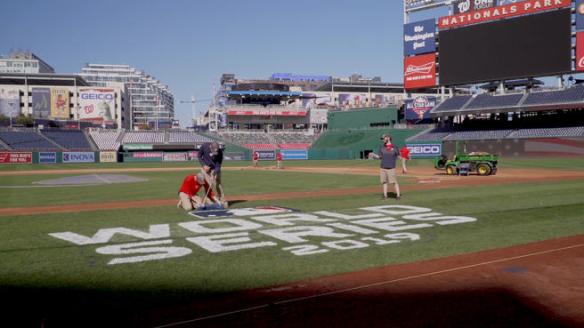
Preparing Nationals Park for the World Series. The Richter scale may not stand a chance against the racket of fans whose city hasn’t seen World Series play in eons.

Believe it. Even if the Astros and Astroworld don’t, quite, yet. These Astros went from 107 regular season wins and the heaviest-favoured World Series team ever to looking as invulnerable as a sand castle. And if Jimi Hendrix was right—And so castles made of  sand/fall into the sea/eventually—then the Astros may be shark bait. May.

The Nationals Park public address system people must be sorely tempted to soundtrack Game Three’s preliminaries, and much of the game itself, with a top ten list including not just “Baby Shark” which became the Nats’ unofficial season theme but “Mack the Knife” (when that shark bites/with his teeth, babe/scarlet billows start to spread) and the theme from Jaws.

Maybe the Astros will look back upon Games One and Two and laugh, one of these days. They’d prefer that laugh to come when they’re hoisting their second World Series trophy in three seasons. But they just might have to wait until the sting of a Nationals World Series conquest wears off.

Because if Justin Verlander is to be believed, and he’s not exactly known as a man who tells it like it isn’t, the Astros are extremely vulnerable no matter what they believe otherwise.

“Lot of baseball left in this series,” said third baseman Alex Bregman, who’d love nothing more than to atone for his feeble Game One bat and his uncharacteristic Game Two fielding mishaps, after Game Two. “We’re going to go to Washington with our heads held high. Ready to go and get after it. We’ve lost two games before. I remember when we lost three in New York and next thing you know we’re in the World Series in ’17. We’ve been here before.”

Except that the Yankees weren’t exactly strangers to them then or last week and weekend. Listen to Verlander and the Astros sound as though they were handed a few very rude surprises.

“I guess I hadn’t really paid that much attention because they’re in the National League, but you start looking at their lineup and kind of prepping for them and I think they’re way better than what people give them credit for,” said the future Hall of Famer. “Obviously those guys in the middle get a lot of headlines, but the rest of that lineup, they can hit. And they work you. They have good approaches, they change their approach. They adjust throughout the middle of the game, at-bat to at-bat. It’s a grind.”

Listen to shortstop Carlos Correa, though, and at first the Astros seem to think it’s just a matter of time before the Nats go under the thunder of the great Houston juggernaut. “We’ve already talked as a team,” he said. “We’ve got to go out there, keep our heads up and play good baseball. Take care of business. We’re such a great team that we’re not going to let a 2-0 deficit get to us.”

Maybe not, but great teams have let 2-0 deficits get to them in the short- or long-run alike.

The 1914 Philadelphia Athletics were a steamroller. But they went from a 2-0 deficit to steamrolled out of that World Series in the Miracle Braves’s sweep. The 1954 Indians destroyed most of the American League (the Yankees won a measly 103) but went from a 2-0 Series-opening deficit to getting destroyed by the Giants. The 1963 Yankees flattened their league and out-won their Series opponent but got flattened in four straight by the Koufax-Drysdale Dodgers. And the 1990 Athletics were supposed to bury that year’s unlikely Reds—until they didn’t, and got buried in four straight.

Of course, the reverse is true, too. The 1986 Mets overthrew a 2-0 Series-opening deficit to win in seven; the 1996 Yankees overthrew one to beat the Braves in six. The Astros aren’t yet dreaming the impossible dream. But the way the Series has gone so far the Nats may be not just dreaming the impossible dream but living it.

And Correa is one Astro who knows it. Because one minute he’ll tell you the Astros are such a great team but the next minute he’ll admit, “I feel like we haven’t been good at all, throughout the whole playoffs. That’s got to change. We’re running out of time. That’s got to change now and we’ve got to go out there and score a lot of runs.”

Which won’t be simple now. Not against these Nats. Not with Patrick Corbin lurking for Game Four in Nationals Park and, if necessary, Max (the Knife) Scherzer for Game Five.

Not with the Nationals bullpen having gone from arsonists to fire department. Not with the Nats having penetrated the reputedly impenetrable Verlander and Gerrit Cole. On the season, as exhumed by ESPN’s David Schoenfield, Verlander fanned 55 percent and Cole 60 percent of batters they took to two strikes. In the Series: the two combined have done it to only 36 percent.

Not with the Nats’ not-so-secret weapon, Game Three starter Anibal Sanchez. The Astros don’t quite have a fourth starter, and their Game Three starter Zack Greinke has been only too vulnerable this postseason. The Nats don’t have to burn some of their bullpen in Game Four when they can send Corbin—who threw one relief inning in Game One and warmed but wasn’t needed in Game Two—against an Astro bullpen game in Game Four on reasonable rest.

And, not with what Astros catcher Martin Maldonado admits, like Verlander, is one of the Nats’ secret weapons: “I would say everything that they’ve hit is a hit.”

Smash hit, so far as Washington’s concerned. And with the Nats playing since late May on the philosophy of going 1-0 day by day, having a ball doing it, and not worrying about tomorrow until tomorrow comes, they went from life support to halfway to the Promised Land.

And Nationals Park, in a city that hasn’t seen a major league World Series since 1933, or a major league World Series-winning team since 1924, or any World Series since the final Negro Leagues World Series (the Washington-based Homestead Grays won it) in 1948, is liable to be making the loudest and most vibrating racket in Washington history.

“Forget the decibel meter,” then-ABC broadcaster Tim McCarver said during a 1988 Series game in the late, unlamented Metrodome in Minneapolis. “Get the Richter scale.” In Nats Park on Friday night the Richter scale may not have a chance.

Baseball fans love to ponder the postseason magic factor and the superstitious natures of a lot of ballplayers. Whatever the mojo is now, the Nats happen to have it working. Just don’t ask relief pitcher Sean Doolittle, as Yahoo! Sports‘s Tim Brown did. “We’re not making live sacrifices or doing anything like that,” Doolittle deadpanned. Not even involving sharks, baby or otherwise.

And even though they’ve made a very public show of wearing their navy alternate jerseys most of the postseason—and are 9-0 doing so—they won’t admit there’s any voodoo, black magic, wizardry, or Grandpa Munster in the dungeon working in the background.

“I’ve been saying for a long time it’s my favorite uniform,” shortstop Trea Turner tells Brown, “but it doesn’t mean we’re going to win or lose in it.” Oho, but you’ve won nine straight in it this postseason and haven’t lost in it yet. Lucy, you got some splainin’ to do. No, she don’t. And the Nats won’t.

Any more than the Astros explained any extraterrestrial mojo they’ve had working from 2017 through now. Like the Nats, the Astros sometimes have a hard enough time explaining that all it takes is a collection of very good baseball players with brains to match their bats and gloves to get to a World Series. They think they don’t have to remind you of Branch Rickey’s Law: Luck is the residue of design.

The Astros might have gone along with the team-of-destiny bit in 2017 but it’s not like it was a spiritual mantra. The Nats have fun with their Baby Sharking and dugout dancing and clubhouse partying, but it’s not as though they’re doing anything deeper with it aside from doing the shark bite gestures with their hands when reaching on extra base hits or—as Juan Soto did after his mammoth Game One homer—crossing the plate.

If you won’t see the Nats performing clubhouse sacrifices, you’re not liable to see the Astros huddled over a cauldron in the clubhouse chanting, “Double, double, toil and trouble/Astros rise and Nats bubble,” either. Even if a 2-0 Series deficit might tempt them to trying to slip a witches’ brew into the Nats’ Gatorade cooler.

The Nats don’t have to be told the Astros have hit into enough moments of just plain horrible luck, like finding a Nat with a glove ready to meet any ball hit by any Astro. The Astros don’t have to be told anymore that the Nats are babies in shark terms only, even if they looked more like Jaws in Game Two.

But God help them if they run into Animal Sanchez Friday night—the junkyard dog who throws slop at any speed and gets away with it, not the old man who actually pondered retirement until he didn’t and the Nats adopted him from the Braves’ shelter.

And, if Greinke doesn’t go deep in Game Three or keep the Nats’ frisky bats out of whack with a good enough brew of off-speed ingredients. And, if key bats like Bregman, Correa, George Springer, and Yuli Gurriel don’t return and stay at the chef’s table. And, if Jose Urquidy—liable to start their bullpen Game Four and showing promise enough so far—falters early enough.

It’ll take a lot more than a baboon’s blood and shark repellent to cool the Nats off, then.