WS Game Five: Winning in a walk

Martin Maldonado

Maldonado, you’re no longer the weakest link. For now.

The good news is, the Braves can win in Houston. They proved it in Game Two. The bad news is, they’ll need to win there to win the World Series now.

The Astros didn’t let a little thing like a four-run hole after a single Game Five inning on a single swing drive them into an early season’s grave Sunday night.

Not with manager Dusty Baker flipping his lineup a little bit. Not with proving there are times a bases-loaded walk and a well-timed single in the middle of a game are more powerful than a grand slam out of the gates.

Not with the Astros’ heretofore, mostly dormant longtime core finding their bats. And, not with the Braves’ heretofore impenetrable bullpen proving they’re only human, after all, while their own usually tenacious bats mostly went askew following their early slicing, slashing, and thundering.

Their early, incendiary Game Five lead turned into a 9-5 loss to the Astros—but doesn’t have them up against the wall just yet.

“When we won [Game Four], it made it easier, I guess, coming into this one — but we knew it was going to be tough,” said Braves manager Brian Snitker postgame. “That’s just a lot of innings to cover (by relievers) against a club like this that swings a bat so well. The good news is we’ll take a day off and be in good shape.”

Meaning, including and especially, a rested bullpen as well as a re-grouping lineup. But it’s the opposite now of where they stood after Game Five of the National League Championship Series, after the Dodgers flattened them 11-2 in Los Angeles and despite still holding a 3-2 lead in the set.

Then, the Braves’ longtime first baseman and leader Freddie Freeman said they were still in good shape, they still led the set, and they liked their chances going back home to Atlanta. Now, Snitker’s putting the Brave face on and saying, “I’ll take it anywhere. If we win the World Series, it doesn’t matter where it is.”

Two years ago the Nationals proved that in abundance against the Astros. The Braves won’t be winning all needed Series games on the road, but with their Series lead now they need to win only once. It sounds simple when you say it. It’ll be anything but simple when they play it starting Tuesday night.

You can’t get any more profound a reminder of how tough a World Series can be than the Braves got when they only thought they had the Astros buried alive in the bottom of the first Sunday night.

They loaded the bases on Astros starter Framber Valdez with a leadoff base hit by Jorge Soler, a two-out single by Austin Riley, and a 3-1 walk to Eddie Rosario. Then Adam Duvall couldn’t wait to drive Valdez’s first service to him into the seats above the right field wall.

Hindsight’s almost as wonderful as foresight. Snitker has both in abundance. This time, though, hindsight was his BFF. “I’d rather we scored those runs in the seventh inning when you don’t have so much time to cover,” the manager said postgame. “We knew we had a long, long way to go in that game and anything could happen.”

Anything did happen, right away.

Heretofore slumber bat Alex Bregman hit with first and second and one out in the second and lined Braves opener Tucker Davidson’s the other way, all the way to the right center field wall, scoring Yuli Gurriel (one-out, one-hop single to center). Heretofore macaroni bat Martin Maldonado sent Kyle Tucker (full-count walk) home with a sacrifice fly cutting the Braves’ lead in half.

The Astros might have gotten one more run home but for the next batter—Valdez himself. Two swinging strikes around a ball in the dirt, then looking frozen at strike three on the inside forner after a ball just low. You still don’t want the designated hitter in the National League’s parks, old farts? Imagine if the Astros didn’t have to bat Valdez there. They might only have had a one-run deficit to end the frame.

No matter. Their unraveling of the Braves began the very next inning, when Dansby Swanson at shortstop misplayed Jose Altuve’s leadoff hopper, bumping the ball from his glove, recovering too late to throw the swift Mighty Mouse out at first. The rest of the Series will prove whether or not that’ll be this postseason’s most egregious Braves mistake of all.

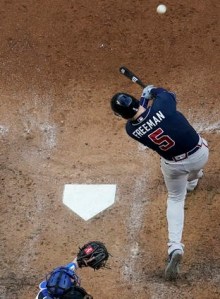
Davidson walked Michael Brantley on a 3-1 count and Carlos Correa—another of the formerly dormant-at-the-plate Astro core—doubled Altuve home. A fly out later, Brantley scored on Gurriel’s ground out to short. Tie game. The tie lasted long enough for Freeman to lead the bottom of the third off with a mammoth full-count, tiebreaking blast half way up the right center field seats.

The 5-4 Braves lead lasted until the bases loaded and two out in the top of the fifth. Checking in at the plate: Maldonado, the Astros catcher still vying for the title of the single most automatic Astro out, after the Braves ordered Bregman walked on the house to load the pads in the first place.

What came next may yet prove one of the ten most powerful walks of all time. Maldonado looked at ball four inside from Braves relief star AJ Minter, sending Correa (leadoff one-hop base hit to center) strolling home with the re-tying run. Martin, you’re no longer the weakest link. For now.

Not only did Maldonado get daring enough to stand right on top of the plate during the entire plate appearance, the better to get an edge against Minter’s cutter, he even showed bunt as ball four sailed in. He didn’t do it for a laugh, either.

“He came back to the dugout yelling at me, ‘You like my Little League bunt?'” said Astros hitting coach Alex Cintron postgame. “He was prepared before he stepped up to the plate. He was ready for that at-bat. That made the difference.”

“I thought of it in the moment,” said a grinning Maldonado. “I wasn’t going to swing until 3-2. Maybe it would throw him off.”

Then Baker sent Marwin Gonzalez—returned to the Astros after a detour through Minnesota and Boston when the Red Sox released him in August—out to pinch hit for Jose Urquidy, whose shutout fourth set him up to get the Game Five “win.” Gonzalez dumped a floating quail into left center that hit the grass with room enough to send Gurriel and Bregman home with a 7-5 Astro lead.

Maldonado lined Tucker home with a base hit off another Braves pen man, Drew Smyly, in the seventh, and Correa—perhaps sensing Smyly was really taking one for the team now—singled Altuve home with the ninth and last run in the eighth.

Baker made a few pre-game moves to shake his lineup a bit, particularly moving the previously slumping Bregman down to bat seventh. The third baseman’s struggles at the plate this postseason became that alarming—to the manager and to Bregman himself.

“I’ve got a really weak top hand right now,” he said. “I’m releasing the bat behind me, which is causing a ton of problems.” He spent pre-game batting practise all but forcing himself into a two-handed swing finish. It helped when he knocked that second-inning RBI double. It damn near helped him hit one out his next time up.

“The second at-bat, I just missed what would have been a three-run homer, just barely missed under it,” Bregman said. “I’ve got to fix a weak top hand. Normally I hold (the bat) tight and squeeze it, kind of. I’m not able to do that right now.” Missing more than two months of the regular season didn’t exactly do him many favours, either.

For Minter’s part, he credited the Astros with finding their swings when they looked pinned otherwise. “I felt my stuff was just as sharp tonight as it was in other outings,” the lefthander said postgame, denying any fatigue factor from his previous prominent presence. “I felt like I was 1-2, 0-2 on every hitter. Those guys made quality swings on two strikes.

“I guess I could have made some better pitches with two strikes,” he continued, “but with Correa, I got him 0-2, left a cutter up, base hit. Got a good strikeout against Alvarez. And then Gurriel — cutter, backdoor cutter. He stuck his bat out there and had a good hit as well.”

Minter and the Braves now have down time enough to regroup and refresh. They still have the Series lead, even if the Astros and their fans might prefer to think the Braves have the Astros right where the Astros want the Braves.

The better news is, at least we’re rid of that infernal, obnoxious, demeaning Tomahawk Chop for the rest of the calendar year and—barring unforeseen wisdom from baseball’s governors—at least until next spring’s exhibition games begin.

Now, if only we could get rid of the Big Ben tolling, bonging chime that rings in both Truist Park and Minute Maid Park for the rest of this Series. Ask not for whom the bell tolls. It tolls too early, too often, and it’s enough to drive a bat in the belfry bats.

Both parks’ public address people have a habit of sounding Big Ben before the home team has the win secured. It’s pretentious and presumptuous. Almost worse than the Truist Park organist’s too-insulting walk-up serenades to some Astro hitters. Good for perverse laughs among the home audience, good for Astro incentive at the plate. Brilliant.

Wise up, Braves and Astros. The Phillies’ people in Citzen’s Bank Park use Big Ben, too. But at least they have the brains to wait until the Phillies can take a win to the bank.

WS Game Two: Hunted, pecked, pricked, poked

Max Fried

Max Fried—getting stung repeatedly in the second hurt almost worse than if he’d been bludgeoned.

If you look purely at the line score of World Series Game Two, you’d think the Braves had their heads handed to them in the bottom of the second. But if you watched the game, you know the Astros dismantled them, almost too simply, and with some inadvertent help from the Braves themselves, to win 7-2 Wednesday night.

As a matter of fact, when the game began you could have been forgiven for thinking it might turn into a bit of a pitching duel despite the teams swapping a run each between the bottom of the first and the top of the second—one on a solo home run, one on a sacrifice fly.

Overall that’s about how the game shook out—if you didn’t include the Astros’ hunt-peck-prick-and-poke of four runs out of Braves starter Max Fried in the bottom of the second, after he fooled Carlos Correa into looking at a particularly nasty third-strike curve ball. Jose Altuve’s eighth-inning home run almost seemed a by-the-way insurance run.

“We didn’t want to go to Atlanta down by two,” Altuve said postgame. “So we left everything we had in there tonight. Obviously, very important win to tie the Series to keep going from there.”

“Obviously, I’m not happy about it.” said Fried. “Playoffs is a big momentum game. You’ve got to do everything you can to keep the crooked number off the scoreboard.”

It might actually have hurt less if he’d been bludgeoned than it did the way he was pecked in the second. And, if Astros starter Jose Urquidy hadn’t brought his A game to the mound, leaving the Braves mostly unable to hit him even if they’d swung warehouse gates.

Fooling Correa into the strikeout must have seemed aberrant even to a pitcher who struck out six in five innings’ work and walked only one batter. The second inning made Fried’s outing look far worse than it was in the long run, but a true shelling it wasn’t. It was like getting stung by angry hornets one after the other a few times before he finally slithered out of it.

It started with Kyle Tucker spanking a base hit up the middle and Yuli Gurriel punching one through the shift-opened right side for a base hit to follow up at once, sending Tucker to third. Fried jammed Jose Siri into a slow tumbling grounder to the far left side of the mound, but Tucker came home when they couldn’t get the swift Siri at first.

Then Martin Maldonado, a catcher so prized for his work behind the plate that Astro manager Dusty Baker bears with his pool noodle of a bat, punched one through the left side for a base hit. The problem now was the Braves’ usually sure-handed, sure-armed defense.

Left fielder Eddie Rosario came up with the ball and threw to third in a bid to stop Siri if they couldn’t stop Gurriel from scoring. Only third baseman Austin Riley came trotting down the line to serve as the cutoff man, and shortstop Dansby Swanson got caught unable to get to third covering in time because he was in short left. Rosario’s throw thus sailed wild and Siri sailed home with the fourth Astro run of the night. Ouch!

Maldonado went to second on that throw and took third when Braves catcher Travis d’Arnaud let one escape with Altuve at the plate in an 0-2 count. Altuve flied out with Maldonado having to hold at third, but Michael Brantley pulled a base hit to right on which Maldonado could have walked home safely, making it 5-1.

Innings like that are as common to the Astros when they’re swinging right as you might think the big bombing innings would be. But they were the best in the game this year at avoiding strikeouts at the plate and hitting in most directions out to the field.

They may also have picked up on Fried tipping pitches. No, they’re not pulling another Astro Intelligence Agency trick or three. The rules since Astrogate’s explosion and aftermath include maximum replay room security. But the Astros were known without and before any Astrogate shenanigans for picking up even the tiniest tells from opposing pitchers and exploiting them mercilessly.

Fried’s habit of wiggling his glove fingers around the ball in his hand rapidly as he prepares to throw to the plate, like an amphetamine-driven lobster clawing its dinner down to manageable bites, may well have handed the Astros inadvertent but invaluable pitch  intelligence. After the second, Fried quit the glove snapping for the most part—and retired the next ten hitters he faced.

When Yordan Alvarez walked and Correa sent a base hit to left opening the bottom of the sixth, Braves manager Brian Snitker hooked Fried in favour of Dylan Lee. After Tucker forced Correa at second with Alvarez taking third, the Braves’ defense faltered into the sixth Astro run.

Gurriel grounded sharply to Swanson at shortstop. He threw to second baseman Ozzie Albies hoping to start an inning-ending double play. Albies lost the ball as he turned to throw on to first. Tucker was ruled safe until a review was called—did Albies have control of the ball to get the out while losing it as he drew the ball out of his glove to throw on?

Several television replays showed Albies lost control of the ball after all, but not by as much as first surmised. The safe call held, and Alvarez scored, but Albies’s throw wasn’t in time to get Gurriel at first. Lee shook off a rather daring double steal to set up second and third by striking Siri out. Snitker brought in Jesse Chavez, and Chavez got Maldonado to fly out for the side.

The Braves got their second run in the top of the fifth when Freddie Freeman singled d’Arnaud home. Other than that, both bullpens kept each side behaving itself except for Altuve sending Drew Smyly’s first pitch of the bottom of the seventh into the Crawford Boxes, before the veteran reliever fell into and squirmed out of his own bases-loaded jam with no further damage.

Maybe the true shock of the evening was the Braves handing the ball to Kyle Wright for the bottom of the eighth. Wright’s a 26-year-old pitcher with a 6.56 fielding-independent pitching rate in four seasons. He had a 9.64 FIP and a 9.95 ERA in two brief starts on the regular season while up and down from the minors.

Throwing that against the Astros was something like offering to assure Hall of Famer Henry Aaron would face nothing but batting practise pitchers by decree, right? Wrong. Wright shocked the entire ballpark by striking the side out in order—including Maldonado and Altuve looking at third strikes after Siri opened with a three-pitch swinging strikeout.

“It was so encouraging to see Kyle tonight,” said Snitker postgame, even if he was thrown up as a sacrificial lamb in a lost game. “Just getting in there for that one inning and getting him out there and experiencing this atmosphere because he could play a huge part going forward. I thought he threw the ball extremely well.”

Wright lived on effective curve balls and sinkers Wednesday night. Snitker was inspired enough to ponder possibilities for Wright to spot start or even open a bullpen game during the Atlanta leg. With Charlie Morton gone thanks to that fibula fracture, Snitker needs to get even more creative with his pitching arrays now. Wright’s surprise may lift some of that burden a hair or two.

“He was locating,” said catcher d’Arnaud postgame. “His sinker was moving a lot. His curveball was moving a lot. He did a tremendous job. When I caught him in a rehab game for me, he looked exactly the same as he did that day. It was fun working with him, and it was great seeing him have the success today, especially in the World Series.”

With the tied Series moving to Atlanta for three possible games, thus switching the Braves to a home field advantage, it’s comforting to know that near the end of a night the Braves were pecked to death they might have found the Wright stuff, for however long.

NLCS Game Six: The Braves’ new world

Eddie Rosario

Eddie Rosario hits the three-run homer that proved the game/set/NLCS winner for the Braves. (TBS screen capture.)

You thought Yordan Alvarez was the force the Red Sox couldn’t stop in the American League Championship Series? Have a good, long look at Eddie Rosario, the force the Dodgers couldn’t stop in the National League Championship Series.

There should be some interesting showdowns in the forthcoming World Series. When each LCS Most Valuable Player threatens to throw every round of ammunition they have, including cruise missiles, at each other’s pitching and defenses. If Alvarez and Rosario stay as they just were, they’ll make World War II resemble a snowball fight.

Rosario’s three-run homer off Walker Buehler in the bottom of the fourth Saturday night, and the Braves bullpen—especially AJ Minter and Tyler Matzek—throwing five one-run, ten-strikeout, one-walk innings, sent the Braves to the World Series with a 4-2 win. The regular season’s least-winning division winner buried the season’s second-winningest team.

Maybe the Astros don’t resemble such overdogs after all? Maybe this year’s Braves resemble not on-paper favourites but a miracle team?

Wrestled by the Dodgers out of last year’s short-season, ghoulash-playoff National League pennant. Buried a game under .500 at this year’s All-Star break. Then spending the second half playing .611 baseball while most of the rest of the National League East—which wasn’t all that powerful in the first place—dissipated. The Astros were .604 at the break but .563 in the second half.

Now the Braves stand as National League champions with a legitimate shot at taking the Astros down. They manhandled the Dodgers when it mattered most Saturday night. They didn’t let a little thing like getting blown out 11-2 in Game Five to lose twice in three games in Dodger Stadium bother them all that much.

“We’re up 3-2, and we’re going home,” said Braves first baseman and franchise face Freddie Freeman after Game Five. “It’s a great position to be in.” The guy whose eighth-inning division series Game Four blast off Brewers relief ace Josh Hader made the NLCS possible for the Braves in the first place sounded like an incurable optimist then. After Game Six, he sounds like a prophet.

But he put any prophetic powers he had to one side in the middle of the Braves’ postgame celebration. “I think this might be the definition of pure joy,” he said. “It really is. I really don’t, it hasn’t hit me at all. I don’t really know how to feel.”

Rosario know exactly how to feel, especially after he caught hold of Buehler’s dangling cutter with Travis d’Arnaud (two-out walk) and pinch hitter Ehire Adrianza (two-out double) on second and lined it a few seats inside the right field foul pole. “It’s truly a great moment,” Rosario said amidst the celebration, “not just in my career, but in my life as well, but I want more. I want to win the World Series.”

He was one of three mid-season trades Braves general manager Alex Anthopoulos delivered when the Braves resembled the walking dead. They’d lost young superman Ronald Acuna, Jr. for the year to a torn ACL. They’d lost young pitching comer Mike Soroka to an Achilles tendon blowout after nine months rehabbing its original tear. They’d lost bombardier Marcell Ozuna to domestic violence issues and administrative leave.

Only one man around or observing the Braves decided there was still something worth saving. Anthopolous brought in Rosario from the Indians plus former Dodger Joc Pederson from the Cubs, Adam Duvall from the Marlins, and Jorge Soler from the Royals.

Pederson made himself enough of a pain in the rump roast casting a string of pearls before swine against his former team with his NLCS heroics at the plate. But even Anthopolous couldn’t have predicted Rosario—traded from the Indians for faded early-season pinch-hitting wonder Pablo Sandoval; the guy who came to the Braves injured and unable to play until 28 August—would steal the show and the set in the end.

“It’s still not lost on any of us that we didn’t accomplish our goal,” said Dodgers manager Dave Roberts postgame. “But for me, I’m giving credit to the Braves, because they outplayed us, plain and simple.”

The Dodgers knew going in that winning Game Six Saturday night would be on wings and prayers almost regardless of the opponent. Especially after Max Scherzer’s wing still remained dead enough to keep him from starting the game. Especially having to put the ball into Buehler’s wing on three days’ rest for only the second time in his young and promising career and this postseason.

They couldn’t afford a bullpen game so close to the one that hoisted them while they blew the Braves out in Game Five. But for three innings Buehler looked more than capable of keeping the Braves at bay, other than Austin Riley’s ground rule RBI double in the bottom of the first.

“I could tell when I was warming up that it was still tired,” Scherzer said after his Game Six scratch. The concern is “arm fatigue.” Historically, “arm fatigue” or “shoulder fatigue” have proven too often that they’re euphemisms for more serious issues. Late Saturday we learned Max the Knife said he’d be good to go for starting Game Seven.

Could it be our boy’d done something rash? The Dodgers still had to get there first. So much for that idea.

Scherzer’s trade deadline acquisition from the Nationals along with shortstop Trea Turner helped secure the Dodgers’ postseason arrival in the first place. Now, no matter what Buehler had starting Saturday night, the Dodgers’ streak of seven straight postseason elimination wins started Game Six close to final jeopardy.

Even allowing their injury quotient, they’d played like minor leaguers in most of the first four NLCS games. Chris Taylor almost singlehandedly yanked them back to the majors with his three-bomb Game Five.

Even if they managed to make the Braves look somewhere between silly and foolish in that game, by way of a bullpen worn down to their own winging prayers, and a jack-of-most-trades who’d hit about half his own weight down the final season stretch but who suddenly resembled what used to be his Hall of Famer-in-waiting teammate Albert Pujols.

These Dodgers couldn’t afford much of anything entering Saturday. They entered the postseason without first baseman Max Muncy thanks to his dislocated elbow and without longtime pitching ace Clayton Kershaw thanks to an elbow strain, and Dustin May to Tommy John surgery.

They’d lost reliever Joe Kelly to an injured bicep and third baseman Justin Turner to a hamstring injury during the NLCS. Both were considered gone for the rest of the postseason, however long it might last for the team that won 106 regular-season games—but still had to win the wild card game before the division series triumph that put them here at all.

Dodger fans approaching Game Six wanted to think, “They have us right where we want them,” even in Atlanta. It turned out the Dodgers had the Braves right where the Braves wanted whatever remained of Los Angeles’s Blue Man Group.

It didn’t have to be a plunge. It had only to be Minter relieving starter Ian Anderson and pitching four-strikeout, three-up/three-down ball in the fifth and the sixth. It had only—and especially—to be Matzek, walking into a second-and-third, nobody-out Dodger fire, after A.J. Pollock doubled the second and final Dodger run home . . . and striking out the side on eleven pitches. Including the Mookie Monster on three straight, ending the last serious Dodger threat of the night.

The night before, Red Sox starter Nathan Eovaldi bulled his way out of a bases-loaded jam in Houston by striking out the side. The difference was that Eovaldi stuck his landing while his offense remained sound asleep. Matzek stuck his landings with a two-run lead to protect and hand off.

He dispatched the Dodgers three-and-three in the eighth, handed Braves reliever Will Smith the two run lead, and watched with a packed Truist Park as Smith struck out the first two before getting Pollock to end it with a ground out to shortstop.

Once upon a time, Matzek was a Rockies washout who had to re-invent his pitching career with the independent leagues’ Texas AirHog. Now he’d blown what air was left out of the Dodgers’ tires. With his room for error about the size of a linen closet.

“My job is simple,” the beefy lefthander said after the game. “It’s go ahead, get out there and just try to strike guys out . . . I can’t let a pop up or a ground ball go through. I am looking to get those guys out and strike them out. It’s a simple job. Just go out there and throw my best stuff and I was lucky that my best stuff worked tonight.”

Just about all the Braves’ best stuff worked Saturday night. Just about none of the Dodgers’ did.

Especially against that mid-season pluck from the Indians who just nailed a 1.647 OPS for the entire NLCS, with a posteason series record-tying fourteen hits, nine runs driven in, three home runs including two in Game Four, two four-hit games, plus the base hit that walked a second straight Braves win off in Game Two.

This is a National League champion who didn’t even reach the .500 level until 6 August. They broke the record for the latest .500 reach by three days. The previous record holder was a team that went on to win the pennant and sweep the World Series. You may have heard of them: the 1914 Miracle Braves.

Sometimes things that happen to be in your franchise DNA take awhile to manifest. For the not-so-miraculous Astros awaiting the World Series showdown, that may not prove to be a good thing. It may well depend upon which half of Yordan and Eddie Tonight proves the bigger performer.

They may not have the Hall of Fame power (pitchers Tom Glavine, Greg Maddux, and John Smoltz; third baseman Chipper Jones) of the last Braves World Series team. But there shouldn’t be anyone calling this year’s Braves flukish now.

Freeman frees the Braves to await their NLCS opponent

Freddie Freeman

Jubilant Freddie Freeman approaches the plate to finish the eighth-inning bomb that held up to win the NLDS for the Braves Tuesday night.

Maybe it didn’t have quite the last-split-second hair raising quotient that the Red Sox’s final two American League division series wins had. But it wasn’t any less dramatic for Freddie Freeman and his Braves in winning their National League division series Tuesday.

Freeman’s eighth-inning tiebreaking home run off Brewers relief ace Josh Hader turned out the finishing blow in a set during which both teams scored as many runs in the first three games as they ended up scoring in Game Four alone.

What made the bomb so luminous, too, was that it was only the second time in the whole 145-year history of the franchise that any Brave delivered what proved a postseason series-winning hit in the eighth or later. It took one season shy of three decades for Freeman’s homer to join Francisco Cabrera’s National League Championship Series-winning base hit. (The fabled Sid Bream mad-broken-bodied-dash.)

“I’ve had a lot of cool moments in my career,” Freeman said postgame, “but so far I think that’s going to top them right there. But hopefully that’s not the last cool one.” Right now, nobody’s willing to bet too heavily against either Freeman or his Braves. Yet.

You heard all season long about this or that team being wracked by injuries and surrealities? Few had to compensate as heavily as the Braves did. Too many teams losing their number-two franchise player, one of their best young pitchers, and a reliable other power bat might have collapsed like a blimp.

The Braves lost Ronald Acuna, Jr. thanks to a torn ACL making a play in center field. They lost Mike Soroko after his Achilles tendon blew out in May—after nine months’ rehab following its initial 2020 tear. They looked as though their season had paid put to hit without once seeing .500.

They lost Marcell Ozuna when the outfielder/bombardier was arrested for domestic violence in July—charged first with felonious aggravated assault and attempted strangulation, charges reduced to misdemeanor simple assault and battery, on administrative leave through the end of the Braves’ season, after he entered a diversion program.

When Acuna went down, and the Braves more or less sputtered into and past the All-Star break, general manager Alex Anthopoulos made his first move, bringing former Dodger Joc Pederson aboard from the Cubs in exchange for a minor league prospect.

That was Pederson pinch hitting for Braves reliever Luke Jackson in the Game One eighth and hitting a solo home run off Brewers reliever Adrian Houser for the only Braves run in the only series loss. That was also Pederson in Game Three, pinch hitting for Braves starter Ian Anderson, facing Houser again, and launching the three-run homer that proved the only Game Three scoring.

Houser may start seeing Pederson in his sleep. The Braves just want to keep seeing him mash. Even if he got the Game Four start as his reward and had to settle for pushing home the first of the two runs that tied things at four with a ground out to second base.

Freeman thinks landing Pederson merely began the Braves’ reversal. “When Alex went out and got Joc,” he said, “it brought a sense of energy that it just showed us that they still believed in us, to go add at the deadline.” Which is exactly what Anthopolous did. He nailed three 30 July trades to bring Jorge Soler from the Royals, Adam Duvall from the Marlins, and Eddie Rosario from the Guardians-to-be.

The NL East wasn’t a powerful division to begin with. But the longtime-leading Mets imploded, the Nationals hit the reset button, and the Phillies proved just short of being able to hold on. In Atlanta, as proverbially and poetically as feasible, that which didn’t destroy the Braves only made them stronger.

They went 36-19 to finish the regular season, including a too-simple-seeming sweep of the Phillies opening the final week to keep them from finishing what they threatened awhile to do and overthrow the Braves. They even shook off Soler’s COVID diagnosis entering the postseason. Now they’ve dispatched a Brewers team that won seven more regular-season games to lead an only slightly stronger NL Central.

They’re waiting to see who’ll be the last men standing between the Dodgers and the Giants, after the Dodgers tied that division series in Los Angeles Tuesday night in an all-Dodgers/all-the-time 7-2 win.

The game was a still-manageable 2-0 Dodger lead, with the Giants compelled to a bullpen game against a short-rested but deadly effective Walker Buehler, when Mookie Betts checked in in the fourth against Jarlin Garcia—after Buehler himself led off by reaching on an infield error.

“It’s not something we want to do all the time,” said Buehler about going on only three days rest, “but I felt that if things didn’t go our way [in the third game], I would feel really weird not pitching a game that we could lose a series.”

He didn’t have to worry. Until he surrendered a leadoff single to Evan Longoria and a one-out walk to Steven Duggar in the fifth, Buehler pitched stoutly and had to shake only one previous first-and-second spot of trouble away in the second. He even had the Giants slightly flummoxed when he went to his changeup a little more often than they were accustomed to seeing from him.

When the Mookie Monster parked an 0-1 pitch into the right center field bleachers, it suddenly seemed a question not of whether but by how big the Dodgers would take the game. An inning later, Betts sent Cody Bellinger home with a sacrifice fly deep to left center field. But Dodger catcher Will Smith—just call him the Fresh Prince of Dodger Stadium—squared off against Giants reliever Jake McGee with Corey Seager aboard (leadoff line single) and hit the first pitch over the left center field fence.

The Giants looked so overmatched in Game Four that their only two runs scored on ground outs, one with the bases loaded. That was Evan Longoria scoring on Darin Ruf’s grounder to second. The other was Brandon Crawford coming home in the eighth when Kris Bryant grounded one to the hole at third.

Buehler’s short-rest deliverance plus the Dodgers’ bats ensured Julio Urias on regular rest starting Game Five against Logan Webb in San Francisco Thursday. For the Braves, that’s going to be very must-see television. Which is what it already was on the left coast and elsewhere.

For the Brewers, it’s a too-early winter vacation after their pitching virtuosity proved futile against the disappearance of their bats. Christian Yelich’s back injury-abetted struggles continued in the division series, and while the Braves didn’t exactly bring the walls crumbling down the Brewers hit a measly .192 in the set—32 points below the Braves.

They did get beaten in the end when the Braves’ best batter launched against their best pitcher in the Game Four eighth. Starting Eric Lauer for Game Four because ace Corbin Burnes said he wasn’t feeling one hundred percent proved a mistake, and so did manager Craig Counsell not bringing Brandon Woodruff in earlier in higher-leverage.

But then here’s where the Brewers’ best bats fell too short. Avisail Garcia? Eight strikeouts, only two hard-hit balls, and two singles in fifteen at-bats. Kolten Wong? Five strikeouts, likewise only two hard-hit balls, and one single in fifteen at-bats. Willy Adames? Five hits in seventeen at-bats—four singles and a double, plus nine strikeouts and only three balls hit hard.

That’s why the Brewers pitched the division series like Hall of Famers—their three starters Burnes, Woodruff, and Luis Peralta showed a collective 1.56 ERA and 0.92 walks/hits per inning pitched rate, not to mention nineteen strikeouts in 17.1 innings pitched—but the Braves still took them out sweeping three after a Game One Brewers win.

“The vibe is the best that we ever had in this series,” Adames said before Game Four. “Today, the guys, I guess they woke up in a great mood. They came with energy. And I feel today we had the best vibe that we’ve had so far this series so far.”

The trouble was that the Brewers went in with the best vibes but the Braves played them as if they were jazz vibes legend Milt Jackson hammering out another virtuoso chorus of “Bags’ Groove.” Now the Braves wait to see who gets bagged in San Francisco Thursday night.

NLCS Game Two: The mighty are falling

For the second NLCS game in a row, Freddie Freeman hits one out to start the Braves’ scoring.

Another entry from our Tales of the Unexpected Dept. The Atlanta Braves have a clean shot at shoving the Los Angeles Dodgers into early winter vacation without seeing Clayton Kershaw poke his nose out of his hole even once.

They were supposed to deal with Kershaw in Game Two of their National League Championship Series, until Kershaw’s back decided not so fast, bub. So there he was confined to leaning on the Dodger dugout rail and watching his mates under the thunder of the Braves’ stellar pitching. Again.

The spasms that scratched him from his scheduled Game Two start were the talk of Tuesday—at least until the Tampa Bay Rays in Game Three of the American League Championship Series pushed the Houston Astros to the elimination brink.

The Dodgers were counting on the resurgent Kershaw, the future Hall of Famer who became their best pitcher again this season and who’d been his future Hall of Fame self in two previous postseason gigs this time around. They needed him take the sting out of their Game One bullpen meltdown.

They needed him to find some way, any way of telling the Braves’ opportunistic and unsinkable hitters it was time to get sunk. When his back spasms told him and the Dodgers not to even think about it, the Braves must have thought Christmas came early and Santa’s sleigh was overloaded.

Dodgers manager Dave Roberts decided Game Two was the perfect time to hand young Tony Gonsolin his first-ever postseason start in Globe Life Park, Arlington, the Texas Rangers’ brand new playpen, the hangar that was supposed to be a hot tub for pitchers.

The Braves decided Game Two was the perfect time to hand young Gonsolin and every Dodger pitcher to follow their heads on plates, while pitching the Dodgers’ ears off the way they’ve been doing to every challenger all postseason long thus far.

Yet again, what the Braves have been doing pretty much all postseason long. Pitching the opposition’s ears off. Hitting the opposition’s pitchers as if discovering new and heretofore untapped human resources for batting practise. And, beating the Dodgers 5-1 in Game One and 8-7 in Game Two.

Freddie Freeman, the Braves’ first baseman who may well be this irregular season’s National League Most Valuable Player in all but the formal announcement and plaque presentation, decided it was too good to resist doing in Game Two what he did in Game One.

Monday—Freeman provided the first Atlanta hit and score when he took Dodger starter Walker Buehler into the right field seats with one out in the top of the first. Tuesday—Freeman provided the first Braves hit and score again, this time with Ronald Acuna, Jr. on board with a leadoff walk ahead of him, ending Gonsolin’s three-inning, three-and-three cruising, with a full-count blast about halfway up the right field seats . . . in the top of the fourth.

The Show’s government decided to let fans into the Globe Life stands on a limited and socially distanced basis for this NLCS. After a half summer of seeing nothing but cutouts in the seats, it was jolting to realise Freeman’s Game One launch was the year’s first live baseball souvenir.

Gonsolin lasted into the top of the fifth Tuesday night. He was lifted after Cristian Pache’s one-out RBI double and a followup walk to Acuna. In came Pedro Baez, the Dodger reliever who often threatens to hijack long-ago Cleveland first baseman Mike Hargrove’s nickname, the Human Rain Delay.

Up came Freeman again. He singled Pache home and set up first and third while he was at it. Baez then walked Marcell Ozuna to load the pads for Travis d’Arnaud, who walked right behind him to push Acuna home. Ozzie Albies then whacked a sacrifice fly to left to push Freeman home.

On a night Braves rookie Ian Anderson did what Max Fried and most company did well enough in Game One, the Braves didn’t have to play long ball to paint the scoreboard. About the longest ball other than Freeman’s fourth-inning flog from there looked to be Dansby Swanson bouncing d’Arnaud home with a ground-rule double in the seventh.

Then the Dodgers finally started making things extremely interesting in the bottom of the seventh. When they set up first and second right out of the tunnel against Braves reliever Darren O’Day and, after O’Day managed somehow to get a swinging strikeout out of Mookie Betts, Corey Seager hit one into the Braves’ bullpen behind the center field fence.

Suddenly the Braves advantage was cut to four runs. No wonder Ozzie Albies decided like State Farm to be the good neighbour in the top of the ninth, sending Adam Kolarek’s 2-1 service into the same bullpen.

Where Braves reliever Mark Melancon made a running catch of the ball, a little fancier than just standing there in Game One when Albies hit a two-run homer for which Melancon had only to raise his glove for the catch. In Game Two, the gags started pouring forth that the Braves could stick Melancon in for late-game defense when he wasn’t going to be a bullpen factor.

As it was, Melancon’s thoughts of a Game Two night off vaporised in the bottom of the ninth. He had an unexpected (we think) Dodger uprising to thank for that, when Seager slashed reliever Josh Tomlin for an RBI double and Max Muncy smashed Tomlin for a two-run homer. Unfortunately, Melancon’s ruined off-night opened in near-ruin in its own right.

An infield error allowed Will Smith aboard before Cody Bellinger sent one to the back of right field to triple him home. Leaving Melancon to deal with A.J. Pollock and lure him into grounding one to the hole at shortstop that Swanson picked off to throw him out and finish it with the Braves escaping to within an inch of their lives.

Melancon was less than thrilled when a Braves beat reporter named David O’Brien faced the righthander as though the team blew a lead. “We didn’t blow the lead,” Melancon said, slightly in shock, knowing the Braves won the game by a single run. “I don’t really understand your question.”

He didn’t really approve of it, either. And you couldn’t blame him.

“Can you still take something positive out of this?” O’Brien promptly asked. When a team survives an eleventh-hour uprising to take a 2-0 NLCS lead, do you expect them to take something negative about it? If I’d asked a question like that in my own newspaper and radio reporting days, I’d have been broiled, basted, and braised—and then my subject and my editors would have gotten mad.

O’Brien’s silliness spoiled Melancon’s jovial mood from talking about his bullpen home run catches, when another reporter reminded him he’d just caught more homers than he’d surrendered all year. “That’s more home runs than I’ve caught in my entire life, never mind  one season,” he said through a mischievous grin.

Don’t go thinking that late uprising means that vaunted Dodger firepower’s about to make mincemeat out of these exuberant, relentless Braves just yet. Four-game LCS winning streaks aren’t exactly easy to deliver against teams that don’t know the meaning of the word “quit.”

Especially when you don’t know for sure whether Kershaw will recover in time for Game Four. And, when you may suspect in your heart of hearts that that late-Game Two uprising came a little too little, a little too late, against the weaker side of a bullpen that’s normally anything but generous with runs.

The Dodgers hit .220 when the Washington Nationals blasted them out of the postseason last year. They hit .180 in the 2018 World Series, .205 in the 2017 Series, and .210 in the 2016 NLCS. They’re hitting .206 in this LCS after hitting .287 to knock San Diego out in the division series.

This has been their burden during their National League West ownership. When the bigger of the big stages invite them, the Dodgers don’t look so fierce at the plate. Good pitching staffs can take them. These Braves, National League East owners, have a terrific pitching staff, and their own hitters don’t wilt on the larger stage. Yet.