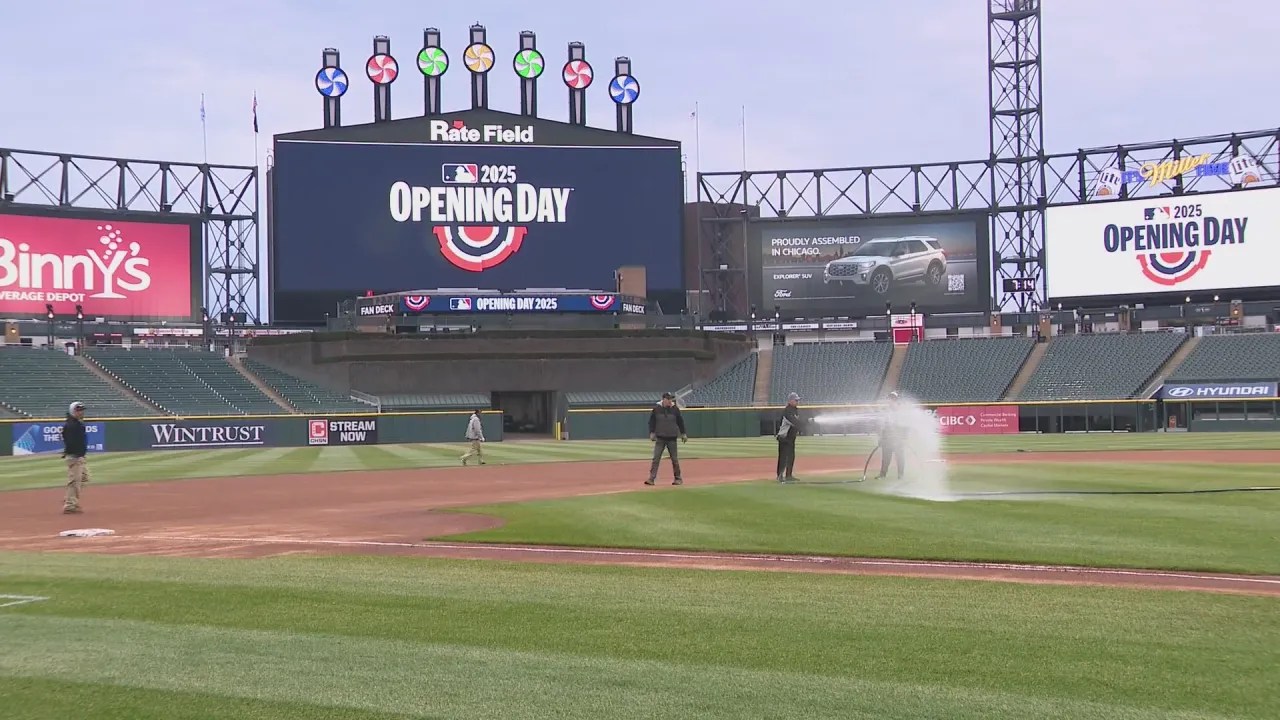
And the season begins in earnest . . .

Rate Field

The grounds crew conditions Rate Field in Chicago for Opening Day. Little did they or those fans who did show up know the White Sox would open with—stop the presses! (as we’d have said in ancient times)—a win.

Opening Day is many things. Boring is never one of them. This year’s Opening Day certainly offered further evidence, including but not limited to . . .

Ice, Ice, Shohei Dept.—First, Ice Cube drove the World Series trophy onto the pre-game Dodger Stadium field. Then, 1988 World Series hero Kirk Gibson threw a ceremonial first pitch to 2024 World Series hero Freddie Freeman. Then, Shohei Ohtani finally ironed up in the seventh and hit one out for the badly-needed insurance, enabling the Dodgers to beat the Tigers, 5-4.

That left the Dodgers 3-0 after MLB’s full Opening Day, and one after they swept the Cubs in the Japan Series. I did hear more than a few “Break up the Dodgers” hollers, didn’t I?

This Time They Spelt It Right Dept.—“Traitor,” that is, when Bryce Harper and his Phillies opened against Harper’s former Nationals in Washington . . . and Harper said welcome to 2025 by stuffing the boo birds’ mouths shut with a blast over the right center field fence in the top of the seventh. That kicked the Phillies into overcoming a 1-0 deficit toward winning, 7-3.

That launch tied Harper for the most Opening Day home runs among active players, with six, but this was the first time he did it in Phillies fatigues.

“I love coming in here and playing in this stadium,” said Harper postgame. “I’ve got a lot of great memories in here, as well. Everywhere I go, it’s exactly like this. Some places are louder than others. It’s all the same.” Except that he left Washington a prodigious but lowballed boy to become man of the Phillies’ house since he signed with them for keeps in 2019.

I Can Get Started Dept.: Tyler O’Neill Display—One of the players Harper’s sixth Opening Day blast tied is Orioles outfielder Tyler O’Neill. That’s where the similarities end between them, for now—in the top of the third against the Jays, O’Neill hammered Jose Berrios’s sinker for a home run to make it six straight Opening Days he’s cleared the fences.

O’Neill hit 31 homers and produced an .847 OPS for last year’s Red Sox, before signing with the Orioles this winter as a free agent.

I Can Get Started Dept.: Paul Skenes Display—The indispensable Sarah Langs pointed out that Pirates sophomore Paul Skenes—fresh off his Rookie of the Year season—became the fastest number one draft pick to get his first Opening Day start yet, getting it just two years after he went number one. That beat Mike Moore (1981 daft; 1984 Opening Day) and Stephen Strasburg (2009 draft; 2012 Opening Day).

The bad news: Skenes had a respectable outing on Thursday, only two earned runs against him, but the Marlins managed to turn a 4-1 deficit into a 5-4 win when their left fielder Kyle Stowers walked it off with an RBI single in the bottom of the ninth.

I Can Get Started Dept.: Spencer Torkelson Display—My baseball analysis/historical crush Jessica Brand informs that Spencer Torkelson, Tiger extraordinaire, is the first since 1901 to draw four walks and hit one out in his team’s first regular season game.

Fallen Angels Dept.—Things aren’t bad enough with the Angels as they are? They not only had to lose on Opening Day to last year’s major league worst, and in the White Sox’s playpen. They needed infielder Nicky Lopez to take the mound in the eighth to land the final out of the inning—after the White Sox dropped a five spot Ryan Johnson in his Angels debut. Lopez walked White Sox catcher Korey Lee but got shortstop Jacob Amaya to fly out for the side.

Jessica Brand also reminded one and all that the last time any team reached for a position player to pitch when behind on Opening Day was in 2017, when the Padres called upon Christian Bethancourt with the Dodgers blowing them out.

South Side Reality Checks Cashed Dept.—The White Sox didn’t exactly fill Rate Field on Thursday. (I’m sure I’m not the only one noticing the Freudian side of “Guaranteed” removed from the name.) But those who did attend weren’t going to let little things like a 121-loss 2024 or nothing much done to improve the team this winter stop them.

“It’s delusion that feeds me,” said a fan named JeanneMarie Mandley to The Athletic‘s Sam Blum. “I don’t care . . . I know we suck. I’m not stupid.”

We’re guessing that a hearty enough share of White Sox fans think Opening Day’s 8-1 win over the Angels was a) an aberration; b) a magic trick; c) a figment of their imaginations; or, d) all the above.

Well, That Took Long Enough Dept.—What do Mickey Cochrane, Gabby Hartnett, Ernie Lombardi, Yogi Berra, Roy Campanella, Johnny Bench, Carlton Fisk, Gary Carter, Ted Simmons, and Ivan Rodriguez have in common other than Hall of Fame plaques?

The answer: They never hit leadoff homers on Opening Day in their major league lives. But Yankee catcher Austin Wells did it, this year, on Thursday, sending a 2-0 service from Brewers starter Freddy Peralta into the right field seats to open the way to a 4-2 Yankee win.

“Why doesn’t it make sense?” asked Yankee manager Aaron Boone postgame. Then, he answered: “Other than he’s a catcher and he’s not fast, although actually he runs pretty well for a catcher . . . I think he’s gonna control the strike zone and get on base, too, and he’s very early in his career. I think when we look up, he’s gonna be an on-base guy that hits for some power.”

We’ll see soon enough, skipper.

Don’t Put a Lid On It Dept.—The umps admitted postgame that they missed completely a flagrant rules violation by Yankee center fielder Trent Grisham in the ninth Come to think of it, it seems both the Brewers and the Yankees missed it, even if Brewers fans didn’t.

With a man on, Devin Williams on the mound for the Yankees, and Isaac Collins at the plate for the Brewers, Collins ripped one into the right centerfield gap. Grisham ran it down, removed his hat, and used the hat to knock the ball down after it caromed off the fence, the better to keep the ball from going away from him.

With one and all missing the rules violation, it left Collins on second with a double and the Brewers with second and third—instead of Collins on third with a ground-rule triple and the run scoring. Had anyone seen Grisham’s move and demanded a review, it might have meant just that and, possibly, the Brewers winning the game in the end. Possibly.

Just Juan Game Dept.—Juan Soto’s regular-season Mets debut was respectable: 1-for-3 with two walks and one strikeout. But he didn’t get to score or drive home a run. The Mets, who still have baseball’s best Opening Day winning percentage, lost to the Astros, 3-1, in Houston.

The only serious problem with Soto’s punchout was Astros closer Josh Hader doing it to him with two on in the ninth. Now, try to remember this about that ninth:

* The Mets entered trailing 3-0.
* Hader surrendered two singles and a bases-loading walk to open.
* Then, he surrendered a sacrifice fly by Francisco Lindor to spoil the shutout.
* Hader fell in the hole 3-0 to Soto first.
* Then, he got Soto to look at a strike, foul one off, then swing and miss on a low slider.

That’s how Hader earned an Opening Day save and a 9.00 season-opening ERA. That’s further evidence—and, from the Craig Kimbrel School of Saviourship, of course—that the save is one of the least useful statistics in baseball.

Or: That kind of save is like handing the keys to the city to the arsonist who set the fire from which he rescued all the occupants in the first place.

Blind Justice Dept.Umpire Auditor reports that Opening Day umpires blew 186 calls. That would average out to about 2.6 blown calls per umpire, I think. Just saying.

Just Wrong Dept.—Is it me, or—aside from the pleasure of only one true blowout (the Orioles flattening the Jays by a ten-run margin)—were there four interleague games on Opening Day?

That’s just plain wrong. It may be an exercise in futility to argue against regular-season interleague play anymore. But the least baseball’s government can do it draw up and enforce a mandate that no interleague games shall be scheduled for Opening Day again. Ever.

Mystique and Aura, kidnapped by the Dodgers

Walker Buehler

Walker Buehler (21, far left) about to be swarmed by fellow Dodgers after he locked the Bronx Bumblers down for keeps to finish World Series Game Five.

Has it really sunk in yet that the Dodgers are full-season, no-doubt, take-no-quarter World Series champions? Has it really sunk in yet that the Yankees aren’t just another group of also-rans but a team as fully able to implode at the wrong time as any team in major league history?

Both teams needed the best they had available for Game Five Wednesday night. The Dodgers to win it, the Yankees to stay alive long enough to force a cross-country trip to Los Angeles for Game Six at minimum. When the Dodgers needed reinforcements, they found them, sometimes in places unexpected outside their portal.

Anyone remember Mystique and Aura? The Dodgers kidnapped them with no known ransom demand turning up at this writing. The Yankees needed Mystique and Aura but they got Wobbly and Rickety.

Just one night after showing serious enough life by blowing the Dodgers out of Game Four, the Bronx Bumblers self-dismantled in ways almost unheard-of by any previous World Series contestant. The Series-clinching, Game Five final was 7-6. It was a close game only if you ignore the way the Yankees helped the Dodgers close an early 5-0 Yankee lead.

The Game Five Dodgers almost didn’t need stout innings from their bullpen, a shutdown ninth from projected Game Seven starter Walker Buehler, and too-timely hits enough to matter. If you didn’t know better, you’d be swearing the Yankees were handing it to the Dodgers on a platinum platter.

The 161st Street Stumblers lost the Series to a Dodger team that found ways not to let little things like too many injured pitchers and a half-effective bullpen keep them down for very long. bullpen half of which would be effective keep them down for very long. But Game Five night just might have been the single most surrealistic game of this Series, if not any Series.

Trust me when I say that that’s saying something.

The top of the fifth challenges such sad Series mishaps past as Fred Snodgrass’s glove turning into a trampoline, Freddie Lindstrom’s pebble, Ernie Lombardi being dismantled at the plate, Mickey Owen’s passed ball, Willie Davis losing two Oriole flies in the sun in the same inning, Curt Flood losing Jim Northrup’s drive in the sun, or Bill Buckner’s horror seeing the slow grounder skip beneath his downstretched mitt.

Does anyone remember that the 11-4 Game Four beatdown the Yankees dropped on the Dodgers actually had people predicting with straight faces that the sleeping giants were awakening enough to do the unheard-of and take the next three straight to teach those ornery louts from Los Angeles a lesson in manners and championship?

There went those ideas. Above and beyond the Yankees waiting fifteen years to get back here only to tumble away this time, above and beyond the Dodgers winning eleven out of twelve National League West titles with only one World Series conquest to show for it until now, this is what everyone will remember about this Series in general and Game Five in particular:

They’ll remember Series MVP Freddie Freeman’s Game One-winning ultimate grand salami as the first salvo toward his reaching the seats in the first four games, which marries to his bombs in Games Five and Six in 2021 (when he was still a Brave) to tie George Springer for the longest Series home run streak (six games).

They’ll even remember Freeman overcoming a balky ankle keeping him somewhat calm in the earlier postseason rounds. Somewhat. Because by the time Freeman got finished with his bombing in Game Four, Yankee fans were holding up signs pleading, “Freddie, Please Stop!” As if Freeman had any intention of obeying.

Aaron Judge

First, Judge was the sleeping giant coming wide awake . . .

They’ll remember Shohei Ohtani jamming his shoulder on a failed Game Two stolen base attempt, leaving himself all but useless for most of the Series, but insisting upon staying in the lineup just in case. If only for the presence.

They’ll remember Dodger starting pitcher Jack Flaherty keeping the Yankees to two runs starting Game One but getting flogged for four before he could get out of the Game Five second—including Aaron Judge, heretofore the Yankees’ first among the sleeping giants, awakening himself and Yankee Stadium with a two-run homer in the bottom of the first, followed immediately by Jazz Chisholm, Jr.’s solo bomb . . . until . . .

They remember the Yankees leading 5-0, and Yankee starter Gerrit Cole striking Gavin Lux and Ohtani out swinging back to back, and not one Dodger hit thus far.

Until . . . come the fifth . . .

* With Kiké Hernandez aboard on a leadoff single, busting any shot Cole had at a no-hitter, Tommy Edman lined one that Judge—who committed only one error all year to that point—normally catches in his sleep. This time, the ball hit the web of Judge’s glove and bounced away.

* Five pitches later, Will Smith grounded one to Yankee shortstop Anthony Volpe’s right. Volpe picked it clean the way a Gold Glover does. Then he threw an awkward short-hopper to Chisholm at third the way a Cold Glover does. Chisholm couldn’t get the handle on that throw. The Dodgers had the bases loaded and nobody out.

* The Mookie Monster singled Hernandez home, on a squibber first baseman Anthony Rizzo had to step back to snag because it was spinning like a gyroscope, practically . . . leaving Cole not covering first because the pitcher took a bad route to the ball, leaving both men resembling raw rookies with signals crossed and knotted.

* Freeman singled Edman and Will Smith home and set up first and third.

* Teoscar Hernández doubled Betts and Freeman home.

* And every last one of those five runs in the Dodger fifth was unearned.

Aaron Judge

. . . but, then, his unlikely error began handing the Dodgers the fifth inning and beyond.

“This is as bad as it gets,” Cole said postgame. “It’s the worst feeling you can have. You have to keep sometimes willing yourself to believe and give yourself a chance. You keep pushing and pushing, and ultimately, you fall short. It’s brutal.”

“You can’t give teams like that extra outs,” said Judge, who’d made what threatened to be the play of the night when he stole an extra-base hit from Freeman by scaling the left center field fence in the fourth. “They’re going to capitalize—their 1-2-3 at the top of the order, they don’t miss. You give them a chance with guys on base, they’re going to capitalize. You gotta limit the mistakes.”

Then, everyone will remember Blake Treinen, the man who usually gets the final three outs of a Dodger win, coming in a little bit sooner than usual to clean up a mess and keep the Yankees at bay from there. As in, the bottom of the sixth, with the Yankees back in the lead 6-5 but threatening to put the game back out of reach with first and second, two out, and Volpe due at the plate.

The same Volpe who really started the Yankees’ Game Four mayhem—when they were down 2-1 in the third thanks to yet another Freeman flog two innings earlier, but with the bases loaded on two out—by hitting Daniel Hudson’s first service into the left field seats.

Treinen got Volpe to ground out to second for the side this time. Then he retired the Yankees in order in the seventh and squirmed out of a first-and-second jam with a fly out by Giancarlo Stanton and a swinging strikeout on Anthony Rizzo.

Somewhere in the middle of all that, Buehler ambled down to the Dodger bullpen. Just call me if you need me, boss. He’d only told any Dodger personnel, from teammates to front office people, that he was available to work in Game Five if need be. He made for the Dodger bullpen after the bottom of the fifth.

Then, Buehler started loosening up. Then, he started warming up in earnest. He may well have thrown the equivalent of the first two and a half innings worth of a quality start by the time he got the call to handle the bottom of the Game Five ninth.

He got Volpe to open with a sharp ground out to third base. He struck Austin Wells out swinging on a full count. He struck former teammate Alex Verdugo out swinging on 1-2. Buehler then spread his arms like an old-time nightclub singer inviting applause for the big finish and his mates began pouring onto the Yankee Stadium infield to start the party.

They survived the early bombs by Judge, Chisholm, and Giancarlo Stanton. They survived their Game Four bullpen game plan getting vapourised, going into sacrificial lamb mode the better to keep their six best relief arms available for Wednesday night. They survived their own recent past of, manager Dave Roberts admitted postgame, losing games that handed them what Game Five had before the fifth inning.

They didn’t stop to ask questions when the Yankees began passing out early Christmas presents one botched out after the other in the top of the fifth. They knew the answers going into the Series.

Their knowledge only began with Betts working on playing caroms off the wall almost as incessantly as he does on his batting swing. It only continued with every Dodger no matter how wounded attacking basepaths rather than just running them. The Dodgers scouted the Yankees and determined they were über talented but fundamentally lacking. They didn’t have to advertise it. They simply exposed it.

The Yankees didn’t pay close enough attention to any reports telling them the Dodgers could match them talent for talent even with their MIAs. The Dodgers, for all their star and firepower, were too grounded fundamentally to let the Yankees treat them like just another poor-relations team.

Freddie Freeman

To absolutely nobody’s surprise, Freddie Freeman was named the Series MVP. (A home run in each of the first four games, plus tying a Series record with twelve RBIs, does that for you.) Now named for the late Willie Mays, the trophy depicts Mays making his fabled 1954 World Series catch against Vic Wertz.

Most of all—unlike the title they won at the end of the surrealistic, pan-damn-ically shortened season and under-isolation postseason—nobody so inclined can hang any kind of asterisk on this one. These Dodgers went the distance no matter whose interpreter swindled him out of millions to cover debts to a bookie, no matter who hit the injured list, no matter who lost a season to an injury. No matter that they tied and took what proved the winning lead on a pair of eighth-inning sacrifice flies.

The last man standing? A pitcher who once resembled a mound terror until two Tommy John surgeries and other ailments kept him limited this regular season, only to show up in October looking as close to his former self as his age and body allowed and hell bent on doing something, anything, to secure his team the Big Prize.

“This is the only reason I play,” Buehler said postgame, “for games like this. The whole year—the offseason, spring training, the regular season—it doesn’t matter. Well, it matters, but not like these games. To win championships is why I play. It’s the best feeling in the world. I live for this.”

He pitched the ninth to prove it. A ground out and back-to-back swinging strikeouts. Followed by stepping down from the rubber, holding his arms out like a vintage nightclub singer delivering the Big Finish, and being mobbed by a swarm of Dodgers. They all lived for this.

WS Game One: “Those are the scenarios you dream about”

Freddie Freeman

Freeman won Game One with an ultimate grand slam Friday night. Eat your heart out, Lady Liberty!

Has anyone noticed that this year’s World Series features the best regular-season team against the third-best regular-season team? It certainly beats hell out of last year’s Series, when the eighth-best regular-season team had the pleasure of beating the eleventh-best regular-season team.

Right away, then, the Yankees vs. the Dodgers has something going for it above and beyond the ultimate outcome. Above and beyond even ankle-challenged Freddie Freeman seeing and raising Kirk Gibson in Dodger and baseball lore when he walked it off with an ultimate grand slam—in the Game One bottom of the tenth.

Already the World Series has everything real baseball fans crave, from comedy to drama and back to the absurd. Even if both teams had to grind their way through a small pack of also-rans to get to where the Dodgers could overtake the Yankees, 6-3, to start their eleventh World Series against each other.

“Never throw a slider to a cripple,” lamented Hall of Fame pitcher Dennis (the Menace) Eckersley after the legless Gibson pinch-hit for Dodger reliever Alejandro Peña in Game One of the 1988 Series. After Friday night’s eleventh-hour dispatch, Yankee manager Aaron Boone might have been tempted to lament, “Never throw a first-pitch fastball to the near-cripple you preferred to face over Mookie Betts.”

“When you’re five years old with your two older brothers and you’re playing whiffle ball in the backyard,” Freeman said postgame, “those are the scenarios you dream about—two outs, bases loaded in a World Series game. For it to actually happen, and get a home run and walk it off to give us a 1-0 lead, that’s as good as it gets right there.”

They plus the Yankees only had to go through the flotsam and jetsam to make this Series possible in the first place. The Dodgers had to get through the fifth-best Padres and then the tenth-best Mets to get here. The Yankees had to get through the twelfth-best Royals and then the sixth-best Guardians to get here. Is that any way to treat the long season’s champions?

Most of the cream rose to the top regardless of the current postseason system; the second-best regular-season team (the Phillies) got dispatched by the Mets early enough. (A 3-1 division series dispatch.) Forget the old and getting-tired cliché about short series and what the lessers can do with them.

Phrase it another way, if you dare: Four division winners were also shoved to one side and sent home for the winter a lot earlier than they hoped to be sent. One was the season’s second-best Phillies, of course. The other three: The season’s fourth-best Brewers, sixth-best Guardians, and eleventh-best Astros.

In a saner time and place, the Astros, the Braves, the Brewers, the Guards, the Mets, Orioles, the Padres, the Royals, and the Tigers would have been told, quote, “Thank you all for helping make the regular season one whale of a great run, but now it’s time to say goodbye and wait till next year, because something’s still bloody wrong with stirring up the thrills, chills, and spills of fighting to the last breath to finish . . . in second or third place.”

That’s just in divisional terms. Now put it in overall terms. There’s something bloody worse with stirring up the thrills, chills, and spills of fighting to the last breath to finish anywhere from fourth to thirteenth place. Bloody worse about the Dodgers and the Yankees being rewarded for their regular-season efforts by being made to get through their far lessers first.

It’s nothing but wonderful that there are going to be baseball stars in abundance for this Series. Betts vs. Juan Soto. Freeman vs. Giancarlo Stanton. Shohei Ohtani vs. Aaron Judge. Even Commissioner Pepperwinkle isn’t unaware that there’s history blowing in the wind here. “Joe DiMaggio and Jackie Robinson played against each other in a Yankee-Dodger World Series,” he’s told The Athletic. “So did Mickey Mantle and Sandy Koufax. This one is a continuation.”

Well. If you’re going that way, so did Yogi Berra and Don Newcombe. So did Whitey Ford and Duke Snider. So did Reggie Jackson and Tommy John. So did Don Mattingly and Fernando Valenzuela. The latter pair were part of the last Series between these two franchises, at the end of a season whose postseason experiment nobody predicted might seed today’s mishmosh.

Dodgers starting pitcher Jack Flaherty and Yankee starter Gerrit Cole matched shutouts, mostly, until the bottom of the fifth, and a one-out triple (Kiké Hernandez) leading directly to a sacrifice fly down the right field line (Will Smith). Then Flaherty made the only bad mistake of an otherwise superb mound outing, with one on (Soto, leadoff single) and one out (Judge, swinging strikeout), feeding Stantion a 1-2 curve that landed in the lower zone region Stanton happens to love. It flew into the left field bleachers before Flaherty could finish thinking, “Oh, you-know-what!”

A 2-1 score wasn’t really liable to remain static between these two. Sure enough, once the sides were into each other’s bullpens, Soto misplayed Ohtani’s eighth-inning double into allowing Ohtani to third, ending one Yankee reliever’s (Tommy Kahnle) outing, and Betts whacked successor bull Luke Weaver’s 1-2 changeup for a game-tying sacrifice fly.

The game went to the tenth and the Yankees managed to pry one out of Dodger reliever Blake Treinen by way of a one-out single (Jazz Chisholm, Jr.), a stolen base (Chisholm, second), a free pass (Anthony Rizzo), another theft (Chisholm stealing third), and a run-scoring forceout (Chisholm home, Rizzo out at second).

Every Yankee fan in the house who thought their heroes had it in the bag with a one-run lead for the bottom of the tenth got disabused soon enough. Jake Cousins might have gotten rid of inning opener Smith with a fly out to right, but then he walked Gavin Lux and surrendered an infield single to Tommy Edman.

Oops. Cousins gave way to Nestor Cortes, a Yankee who hadn’t pitched since September. Lux and Edman took third and second on Ohtani’s long foul fly out, with Alex Verdugo making what might have ended up the play of the night as he lunged for the ball, caught it, then rolled over the fence before his momentum ended, allowing Lux and Edman’s advances.

Still. It put the Yankees an out away from winning it. That’s when Boone decided he was in far safer hands putting the Mookie Monster aboard to load the pads and hope Cortes could get Freeman and his still-ailing ankle to whack a game-ending grounder or swing into a game-ending strikeout.

“I know everybody’s focused on Ohtani, Ohtani, Ohtani,” said Cortes postgame. “We get him out, but Freeman is also a really good hitter. I just couldn’t get the job done today.” Cortes threw Freeman a fastball toward the inside of the zone—exactly where Freeman was looking for the pitch, knowing Cortes’s heater can ride like a horseman when thrown right.

The only place this one rode was into the right field bleachers.

Cortes threw the pitch he wanted to throw but, as he said postgame, didn’t get it elevated enough in the zone to keep Freeman from detonating it. Among other things, it caused a lot of Yankee fans to wonder why Weaver, who’d been rested well enough, didn’t get to work a second inning, or why sidearming lefthander Tim Hill wasn’t even a topic against the lefthanded swinger.

Freeman held his bat like the Statue of Liberty holding her torch straight up, until he was several steps up the first base line, then dropped it to take his trip around the pillows. Give us your tired, your not-so-poor, your not-so-huddled but standing-O Dodger Stadium mass yearning to breathe the World Series championship.

He became the fifth man in Series history to end a Game One with a home run, joining Gibson plus Adolis Garcia (Rangers, last year), Dusty Rhodes (1954 Giants), and Tommy (Ol’ Reliable) Henrich (1949 Yankees). But he’s the only man to end any World Series game with a slice of salami.

“When you get told you do something like that in this game that’s been around a very long time—I love the history of this game, to be a part of it, it’s special,” Freeman added. “I’ve been playing this game a long time, and to come up in those moments, you dream about those moments. Even when you’re 35 and been in the league for fifteen years, you want to be a part of those.”

Even when you’ve had a season pockmarked by injuries (hand, ankle) and compromised by your alarm as your youngest child fights Guillain-Barré syndrome. That was then: Max Freeman’s father admitting, “It just puts everything in perspective . . . I would gladly strike out with the bases loaded in the bottom of the ninth inning in Game Seven of the World Series 300 million times in a row than see that again.”

This was now: Max Freeman on the way to a full recovery according to the family’s doctors, and his father standing top of the heap for World Series Game One home run hitting. And just about everyone around baseball seemed to agree it couldn’t have happened to a nicer guy.

You might care to note, too, that every one of those teams getting a Game One-winning home run went on to win the Series in question. The ’49 Yankees in seven; the ’54 Giants in a four-game sweep; the ’88 Dodgers in five; last year’s Rangers in five. No pressure, you understand.

Little brothers are watching you

San Diego Padres

This Friars roast only roasted the Dodgers out of the postseason and the Padres to a pennant showdown with the likewise underdog Phillies.

“If you don’t win the World Series,” said Freddie Freeman, who won one with the Braves last year before signing with the Dodgers as a free agent following the owners’ lockout, “it’s just disappointment right now.” But you have to get to the Series for a shot at winning it.

The Dodgers won’t get there this time. Hours after the likewise-underdog Phillies shoved the Braves home for the winter to finish National League upset number one, baseball’s winningest regular season team couldn’t get past a National League division series against a band of upstart Padres that finished the furthest back in their division of any of this year’s postseason entrants.

Go ahead and blame manager Dave Roberts, if you must, for failing to do what plain sense instructed but, apparently, his Book instructed not to even think about it just yet. That was his best reliever, Evan Phillips, still sitting in the pen all seventh inning long, instead of being on the mound in the bottom of the seventh when he was needed most.

The Dodgers managed to eke out a 3-0 lead entering the inning, thanks to Freeman’s two-run double in the top of the third and Will Smith’s bases-loaded sacrifice fly in the top of the seventh. When the Padres answered with a leadoff walk, a base hit, and an RBI single without Tommy Kahnle recording a single out, Roberts needed a stopper with the Dodgers’ season squarely on the line.

And, with the Padres hell bent on not letting the set go to a Game Five in which they’d face a Dodgers’ starter, Julio Urias, who held them to three runs in Game One while the Dodgers bushwhacked their starter Mike Clevinger.

Roberts had that stopper in the pen. When Cardiac Craig Kimbrel spun out in the season’s final third and off the postseason roster entirely, Phillips became the Dodger pen committee’s number one arm. He posted the 1.94 fielding-independent pitching rate (FIP), the 1.13 ERA, the 11 strikeouts-per-nine rate, and the 5.54 strikeout-to-walk ratio to prove it.

He was the invisible man in the fateful bottom of the seventh. Roberts lifted Kahnle for Yency Almonte, whose 1.02 ERA and 0.97 walks/hits per inning pitched rate on the season were belied by a 3.17 FIP. Ha-Seong Kim slipped an RBI double past Max Muncy at third and Juan Soto dumped an RBI single into right immediately following. Game tied. Whoops.

Almonte got rid of Manny Machado on a strikeout and Brandon Drury on a foul out. Roberts lifted him for a barely-warm Alex Vesia, and Jake Cronenworth greeted Vesia with a two-run single on 2-2. When Vesia ended the inning a walk later by striking Jurickson Profar out, the Dodgers were sunk.

“I feel like that’s been my lane the last couple days in the series,” Almonte said postgame. “I made the pitches I wanted to make, but they hit the ball and did what they had to do. They get paid as well. I get paid to make pitches, and they went their way.”

Even if they didn’t know it just yet. Even if they’d go down in order against Padres reliever Robert Suarez in the top of the eighth. Then Phillips got the call, for the bottom of the eighth. He struck the side out in order. Normally that might have sent a cross-country sigh of relief forth.

“Tommy, Yency, and Ves, they’ve all been out there,” Phillips said postgame, “and they’ve all competed their butts off this year and gotten big outs for us at times. The game of baseball doesn’t always go your way. Was I anticipating pitching in some sort of situation like that? Sure. But I still consider the three outs I got as just as important. Unfortunately, it didn’t go our way.”

But these Dodgers hit only .227 in this division series. They experienced insult added to injury when Josh Hader, well-revived in San Diego after faltering in Milwaukee at last, struck the side out in order likewise to nail the Padres’ trip to the National League Championship Series.

“I know the job’s not done,” said the Padres’ Game Four starter, Joe Musgrove. “We’ve got a lot of baseball ahead of us still, but this is something that needs to be celebrated. Those guys handed it to us all year long, and when it came down to it and we needed to win ballgames, we found ways to do it.”

Thus did Tyler Anderson’s five scoreless innings in the biggest start of his life, after he’d signed an $8 million 2022 deal with no rotation guarantee attached, go to waste. Thus did a 111-win season go to waste. Thus did the Dodgers become one of three 100+ winning teams to leave this postseason early. Thus do the Padres give San Diego above-and-beyond excitement and further hope.

“They played better than us,” said future Hall of Famer Clayton Kershaw, whose Game Two misery only began when Machado sent a 2-1, two-out pitch over the left field fence in the top of the first. “It’s hard to admit sometimes, but that’s the truth of it. They just beat us.”

The Dodgers helped beat themselves, too. Kershaw might not have had his best night in Game Two, but the Dodgers’ bats, concurrently, went to the plate with men in scoring position eight times and went hitless. They might really have begun beating themselves when Walker Buehler went down to Tommy John surgery and the Dodgers couldn’t find another established starter to fortify the rotation.

We’ll never know for dead last certain. We do know that a crowd of Padres moves that began with signing Machado to that $300 million plus deal, and climaxed with bringing Soto aboard from the remaking/remodeling Nationals at this year’s trade deadline, turned the Padres from the downstate kid brothers into the ones who showed their big brothers how little size matters if and when push comes to shove.

Roberts has taken his lumps from Dodger fans who seem to question every inning, never mind game, in which they fall short and any given move or non-move can be scrutinised to death. It comes with the job. He can say proudly that he’s managed the Dodgers to six NL West titles (including five straight) in seven seasons. Very few skippers can hang that on their shingles.

Now Roberts presides over a group who won more regular season games than any group in the Dodgers’ long and storied history from Brooklyn to Los Angeles. The problem is that he has only one pandamnic-short-season, surrealistically-scheduled World Series title to show for it.

He also got out-generaled and out-played with particular pronouncement by this band of Padres who survived no few lumps of their own to get here at all. Then he picked the wrong time to forget the import of getting your absolute best relief option out there to keep the upstarts from getting particularly frisky when you have them on the brink of forcing one more game, one more chance to send them home for the winter.

It’s not quite as grave as that 2014 night then-Cardinals manager Mike Matheny left his best bullpen option in the pen waiting while sticking with a still-rusty pitcher and watching the pennant fly onto Levi’s Landing aboard Travis Ishikawa’s three-run homer in the bottom of the ninth, of course. But it’s close enough. And the pain of the sting is almost as profound.

Don’t blame Roberts entirely. The man who guaranteed a Dodger World Series in back in May couldn’t have predicted that they wouldn’t be able to hit in this division series almost at all, never mind when it mattered the most, if they weren’t named Freeman and Trea Turner, and Turner did it through a lingering finger issue.

“It’s whoever gets the big hits, and they got the big hits,” said Justin Turner (division series OPS: .466) after the Padres sealed the proverbial deal against himself and his mates. “You can point your fingers to whatever you want, but the bottom line is we didn’t get the job done. We got beat.”

As the Padres now prepare for a pennant showdown with the Phillies, their message for now should be loud enough and clear enough: Little brothers are watching you.

RBA: Judge’s a .764 batter this year.

Aaron Judge

Aaron Judge—Real Batting Average says there was a lot more to his 2022 than yanking Roger Maris to one side.

So Aaron Judge didn’t win the Triple Crown after all? Big deal. He pulled up short of passing Minnesota’s Luis Arraez for the “batting title.” When it comes to the batting number that should matter the absolute most—what I call a Real Batting Average (RBA)—the Leaning Tower of 161st Street did more than just bomb his way to the all-time American League single-season home run championship.

How does Judge being a .764 batter this year sound to you?

Judge bombed, slashed, swatted, and walked his way to an RBA 286 points higher than the Twins’ infielder did. It isn’t even close. He did likewise to the tune of 256 points higher than Jeff McNeil, the Mets’ infielder/outfielder who finished as the National League’s “batting champion.”

“Purists” seeing that and jumping up and down kicking, screaming, and throwing things, sit down and listen up.

I’ve argued this before, and I’ll die upon this hill: The so-called “batting average” is a fraud. It treats all of a player’s hits as equal, and the so-called “batting champion” needs a) a minimum number of plate appearances to qualify for the title despite b) the so-called “batting average” being calculated strictly by hits divided by official at-bats. From this point forward, any reference to it will be called hitting average.

Getting lots of hits is wonderful. Freddie Freeman led this year’s offense-challenged Show with 199. (The Show’s earned run average and fielding-independent pitching were each under four.) He also finished one point below National League hitting average-leading Jeff McNeil (Mets). You’re also going to see Real Batting Average saying Freeman was light years better than McNeil at the plate this year.

Why on earth should you give shrift to a statistic that thinks every hit you got was equal value? There’s only one reason: you think a single is as good as a double, a double’s as good as a triple, a triple’s as good as a home run. You don’t even have to pass third-grade math to see that and know it’s about as credible as a 70-dollar bill.

A few years ago, I reminded myself that total bases treats your hits the way they deserve to be treated—unequally. Let’s use Judge to explain. He had 177 hits this season and they were good for 391 total bases. He had 87 singles, 28 doubles, no triples, and 62 home runs. (Notice that almost exactly half his hits were singles, you who still dismiss him as just another all-or-nothing slugger.)

That’s 87 bases on singles, 56 on doubles, and 248 on his record-smashing home runs. Add them up. It’s 391. It’s a shame that his walks don’t count toward total bases, the way they do toward his on-base percentage (for 2022, it’s .425) because that would make his 2022 total bases 402.

The RBA formula I developed, seeking a way to explain a batter’s value simpler than weighted runs created (wRC), simple enough for a child of five or an old fart of 95 to comprehend, is as follows: Total bases + walks + intentional walks + sacrifice flies + hit by pitches, divided by total plate appearances. If you’d like to see it again in a non-intimidating mathematic formula, here it is:

TB + BB + IBB + SF + HBP
PA

The old/ancient school looked upon walks as either accidents or detriments, not stopping to ponder that a batter working out a walk if he couldn’t find something reasonable on which to swing was actually exercising a skill profound enough. Time was when observers kvetched about even the greatest hitters taking “too many” walks on too many “hittable” pitches, without asking themselves how hittable those pitches really could have been.

But why single intentional walks out, too, when calculating an RBA? Aren’t they part of the walk total for the season? Well, yes, to the latter. To the former, the answer is simple: If you’re at the plate, and the other guys would rather you take your base than their pitcher’s head off, why should you not get credit for it? There’s something they don’t want to deal with when they can deal with a lesser bat behind you to try doing the clutch hitting. To that, RBA says, basically, yay, you.

Yes, sacrifice flies are outs. But unlike sacrifice bunts, they’re not premeditated outs. You didn’t check in at the plate to make a deliberate out, which is the very definition of a sacrifice bunt. (Do I have to say it again? In four out of six “bunt situations” you have less chance of scoring the player you “sacrificed” ahead a base after the bunt than before it; in one, you have an even chance; in only one more—first and second, nobody out—do you have a slightly better chance.)

You checked in at the plate looking for a base hit. You didn’t think to yourself, “Boy, am I gonna put a thrill into those people in the stands by flying out deep.” (Well, you might, if the fly ball carries all the way to the fence.) But your fly out was deep enough to send that man on third home. You get credit for a run batted in but otherwise it’s as though you didn’t exist at the plate, because a sacrifice fly is counted no further as an at-bat than a walk. RBA says to a walk and a sacrifice fly: We know you were at the plate, that wasn’t a figment of our imagination. You’re going to get the credit you deserve for it.

Shohei Othani

Top ten in RBA; sub-3.00 ERA and FIP plus 11.9 K/9 on the mound. At $30 million for next year, Shohei Ohtani might still be underpaid . . .

We also know that, unless you’re Ron Hunt or Hall of Famer Craig Biggio, you weren’t up there looking to get hit by a pitch. But if the other guys’ pitcher is careless enough, control-less enough, or headhunting enough to plunk you, RBA’s going to give you credit for it—because you reached base. That’s another prospective run on the scoreboard. You might have preferred drilling a hole in the infield, putting a dent in the fence, or dialing the Delta Quadrant, but you became a baserunner on their dollar. Let it be to your credit and on their heads.

On the assumption that I haven’t lost you, or prompted you to send the Cuckoo’s Nest Coach to my driveway yet, what follows are this year’s top forty “batting title” qualifiers across the Show board according to Real Batting Average. Those with .300 or better hitting averages are marked with (*). (If you must throw things, please throw them through an open window facing your backyard, not with your spouse, your significant other, your children, or other family or friends in the line of fire.)

Player PA TB BB IBB SF HBP RBA
Aaron Judge (Yankees) * 696 391 111 19 5 6 .764
Starling Marte (Mets) 505 218 97 26 0 13 .701
Yordan Alvarez (Astros) * 561 288 78 9 7 6 .692
Rafael Devers (Red Sox) 555 289 50 11 3 6 .647
Paul Goldschmidt (Cardinals) * 651 324 79 1 4 5 .641
Jose Ramirez (Guardians) 685 309 69 20 9 6 .603
Pete Alonso (Mets) 685 309 67 16 9 12 .603
Shohei Ohtani (Angels) 666 304 72 14 3 5 .598
Jose Altuve (Astros) * 604 281 66 2 1 10 .596
Freddie Freeman (Dodgers) * 708 313 84 12 7 5 .595
Manny Machado (Padres) 644 307 63 10 2 1 .595
Nolan Arenado (Cardinals) 620 297 52 3 4 7 .585
Austin Riley (Braves) 693 325 57 1 4 17 .583
Julio Rodriguez (Mariners) 560 260 40 4 1 8 .559
Vladimir Gurrero, Jr. (Blue Jays) 706 306 58 6 4 6 .538
Taylor Ward (Angels) 564 234 60 0 5 4 .537
Nathaniel Lowe (Rangers) * 645 292 48 2 0 4 .536
J.T. Realmuto (Phillies) 562 241 41 1 5 12 .534
Carlos Correa (Twins) 590 244 61 2 4 3 .532
Andres Gimenez (Guardians) 557 229 34 4 3 25 .530
Xander Bogaerts (Red Sox) * 631 254 57 2 7 10 .523
Yandy Díaz (Rays) 558 200 78 2 1 6 .514
José Abreu (White Sox) * 679 268 62 2 4 12 .513
Jeff McNeil (Mets) * 589 242 40 1 5 11 .508
Justin Turner (Dodgers) 532 205 50 1 8 6 .508
Trea Turner (Dodgers) 708 304 45 1 6 3 .507
Brandon Nimmo (Mets) 673 251 71 0 3 16 .507
J.D. Martinez (Red Sox) 596 239 52 1 5 5 .507
Bo Bichette (Blue Jays) 697 306 41 0 2 2 .504
Ty France (Mariners) 613 241 35 3 5 21 .498
Alejandro Kirk (Blue Jays) 541 195 63 2 4 4 .495
Dansby Swanson (Braves) 696 286 49 0 4 3 .491
Luis Arraez (Twins) * 603 230 50 2 3 3 .478
Steven Kwan (Guardians) 638 225 62 2 4 7 .470
Andrew Benintendi (KC/Yanks) * 521 184 52 0 5 2 .466
Nico Hoerner (Cubs) 517 197 28 4 2 6 .458
Alex Verdugo (Red Sox) 644 240 42 2 6 3 .455
Alec Bohm (Phillies) 631 233 31 1 10 4 .442
Amed Rosario (Guardians) 670 257 25 0 4 4 .433
MLB RBA .456

What probably doesn’t surprise you: the top ten guys for RBA this season. What might come a little more clear to you: just how much the Mets really missed Starling Marte—the National League’s RBA champion this year—in the lineup for most of September and most of this month so far with that finger injury, especially when the Mets couldn’t muster offense enough to overthrow the Braves last weekend.

What might surprise you a little bit: Matt Olson didn’t get anywhere near the top forty for hitting average, but his .548 RBA shakes out as 47 points lower than the guy the Braves let walk as a free agent right before dealing for him. I’m not convinced yet that the Braves got the better end of letting longtime franchise face Freddie Freeman walk into the Dodgers’ arms. (The Braves also won ten fewer than the 111 game-winning Dodgers did.)

What might jolt you a little bit more: The Guardians and the Mets (four each) have more men in that RBA top forty than anyone else this season.

What might jolt you a little bit more than that: A certain unicorn finished in the top ten for RBA in the same season during which he posted an 11.9 strikeout-per-nine rate, a 4.98 strikeout-to-walk ratio, a 2.33 earned run average, and a 2.40 fielding-independent pitching rate. That helped him earn an American League-leading 9.0 total wins above a replacement-level (WAR) player for the year. Across the board, that was second only to Judge’s 10.6.

Shohei Ohtani finished eighth for RBA among the top forty hitting titles and had a pitching season that might be a Cy Young Award season in a different year. He ducked offseason arbitration by signing a one-year 2023 deal for $30 million. He might still be getting underpaid.

And, what of his future Hall of Famer teammate Mike Trout? Well, now. Trout missed a third of the season on the injured list. And he still finished the year with 6.3 WAR (an All-Star-worthy season level), 40 home runs, an OPS one point shy of 1.000 . . . and a .691 RBA. (If he’d qualified in the “batting title” race, Trout would have finished one tick behind Alvarez.)

This ought to tell you why the best news for Angel fans this year—other than Shohtime; other than Trout returning down the stretch of a race out of which the team fell eons earlier—was the news that owner Arte Moreno (who learned and showed all others the hard way that marketing genius doesn’t equal team-building savvy) intends to sell the franchise.

Depending on the eventual buyer, Angel fans may feel the way Met fans did upon the end of the Wilpon Era. It would only begin with those fans singing “Happy Days are Here Again.”

Meanwhile, the Leaning Tower of 161st Street towers over all in this year’s RBA. Judge was so much more than just Roger Maris’s conqueror, but there isn’t a jury on earth who’d rule his 62 home runs anything less than the individual story of the season. With future Hall of Famer Albert Pujols—revived by the advent of the designated hitter in the National League, managed prudently by Oliver Marmol in St. Louis, and finishing the season with 703 home runs lifetime—tied with his former Angel teammate Ohtani for an extremely close second.

If you find a panel that would rule that way, you ought to demand an investigation into jury tampering.