NLCS Game Five: A Mets blowout and a Dodgers gambit

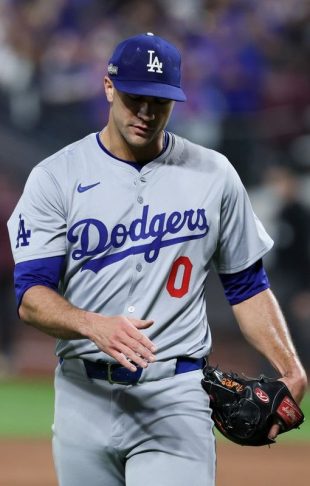
Jack Flaherty

On a day he didn’t have it, Dodgers righthander Jack Flaherty had to take eight (runs in three innings) for the team while the Mets blew them out in NLCS Game Five, so as not to compromise manager Dave Roberts’ Game Six bullpen game plan.

If the Mets deliver what some still think is near impossible, and snatch the National League pennant right out from under the Dodgers, don’t be terribly shocked if the number one question on the lips of Dodger fans and others will be, “Why did Dave Roberts leave Jack Flaherty in to take a three-inning, eight-run beating in Game Five?”

The most likely answer—considering the Mets would go on to finish what they started and blow the Dodgers out 12-6, thus sparing their elimination for another day—is Game Six.

In a National League Championship Series during which each team has won its games by blowout, Game Five may yet secure a place among the least conscionably allowed pitcher abuse by any manager. Ever. Abuse nobody could have seen coming. Could they?

Hadn’t Flaherty, a comeback kid of sorts starting with the Tigers before his trade to the Dodgers at this year’s deadline, pinned the Mets with seven shutout innings in Game One en route the Dodgers finishing with a 9-0 opening thrashing?

Yes, he had. But in Game Five he didn’t have it. His fastball wasn’t terribly fast, his breaking balls could have been court-martialed for insubordination, and the Mets were only too willing to wait him out, wait for the balls coming into the meat of the strike zone or close enough, and pounce.

Now the 29-year-old righthander went from virtuoso extension of Dodger pitching’s consecutive scoreless inning streak this postseason to a piñata in five days. But Roberts didn’t want to reach into his bullpen unless he absolutely had to with a likely bullpen game looming for the Dodgers in Game Six.

Their starting pitching has been so compromised that bullpen games became necessary survival for them. Roberts is counting on his Game Six bullpen game to win the pennant for him. He knows these Mets aren’t quite pushovers, but he has to take the chance that, somehow, his bullpen bulls can help him win a pennant and save Walker Buehler to open a World Series.

The manager had better be right, because what the Mets did to Flaherty Friday could have been called human rights violations. They only began with surrendering a one-out, three-run homer to Pete Alonso in the bottom of the first.

Flaherty shook a leadoff double by Starling Marte off to get three straight second inning outs. But then came the third. Then came back-to-back walks (Alonso, Jesse Winker) to open. Then came Marte doubling into left field to send them both home. Two outs later, Marte came home on Francsco Alvarez’s single, Francisco Lindor tripled Alvarez home, and Brandon Nimmo singled Lindor home.

Leaving things 8-1 Mets—Kiké Hernandez scoring on David Peterson’s wild pitch in the top of the inning seemed almost an excuse-us run for a good while—and leaving Flaherty the fourth pitcher in postseason history to get himself torn for eight or more runs in a game  that would have meant a series clinch for his team. (The others: Hall of Famers Walter Johnson [Game Seven, 1925 World Series] and Tom Glavine [Game Six, 1992 NLCS], and Charles Nagy [Game Five, 1999 American League division series].)

On a day Dodgers center fielder Andy Pages homered twice (solo in the fourth, three-run bomb in the fifth), you could remove Flaherty’s eight-run bequest and the Dodgers would have won the game and clinched the pennant with a 6-4 tally. Flaherty didn’t look like his best self early enough, but this was as unconscionable as it could get.

Roberts even hinted postgame that Flaherty was dealing with a health issue. He didn’t specify what, and Flaherty hadn’t discussed it at this writing. He’s dealt with injuries enough in his career—repeated shoulder injuries, an oblique injury—which helped reduce him from a Cardinals super pitcher to a kind of journeyman who shows flashes of his old mound brio and pitches as much on heart as stuff.

That the Dodgers don’t need. Not after everything else bedeviling their starting pitchers this year.

The Mets, of course, are showing how easy it isn’t to kill them this time around. Even if their bullpen isn’t as strong or consistent as the Dodgers. Blow them out one day, get blown out by them the next. With the set returning to Los Angeles, the Mets face yet another arduous test, even if they do find ways to pick, peck, pounce, and pound the Dodgers’ Game Six bullpen parade.

That test, if they make it, is called Game Seven, in hostile territory.

But wouldn’t it be nice to see one or two NLCS games that won’t become blowouts? They’re fun when the team for whom you root does the blowing out, but a good hair raiser has its place as well. Just so long as the hair isn’t raised because of sloppy or shaky play.
NLCS Game Two: Knuke the Knack

Landon Knack, Mark Vientos

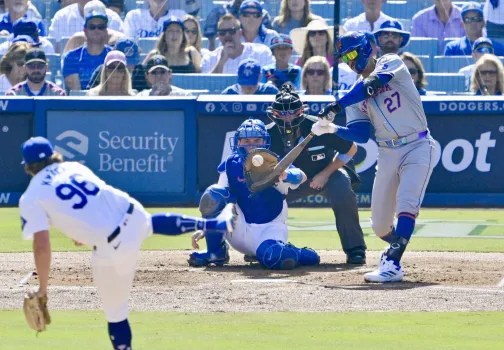
The wrestle between a Dodger reliever and a Met batter insulted by a bases-loading intentional walk ahead of him ends with Mark Vientos knuking the (Landon) Knack . . .

Let’s see. The Mets built a postseason rep for deploying serious weaponry when the games got late. But after a 9-0 blowout loss to the Dodgers in Game One of their National League Championship Series, the Mets struck early enough in Game Two. And, as things turned out, often enough, for a 7-3 series-evening Game Two win.

They struck first with one of their usual late-game demolition experts. This time, Mets shortstop Francisco Lindor wrestled Dodgers opener Ryan Brasier to an eighth pitch on a 2-2 count before sending that pitch into the right field bleachers to open the game. One inning later, with second and third, two outs, a second Met run home (RBI double), and rookie Landon Knack working the second for the Dodgers, they elected to put Lindor on to try their luck with Mark Vientos.

Said a broadcast announcer of Vientos: “As good as he’s been this year, nobody’s Lindor.” Said Vientos to himself, probably, knowing that he’s done damage enough for the Mets cause—he had a measly 1.674 with two home runs against the Phillies in the NLDS—Sure, he’s Francisco Freaking Lindor, but you’re gonna put him on thinking I’m a pushover for a third out? Boy, have I got a surprise for you, gentlemen.

It took Vientos a ninth pitch on a full count, but just like that he knuked the Knack.

Just like that, too, his blast over the center field fence had the Mets up 6-0, and they’d never really look back despite a Dodger run in the fifth and two in the sixth. Not on a night Mets starter Sean Manaea had the Dodgers stone frozen until Max Muncy punctured him for a fifth-inning solo bomb before he ran out of fuel in the sixth.

Two walks to open, a bases-loading fielding error at second base, and Manaea’s night was over. Mets manager Carlos Mendoza brought Phil Maton in to pitch. He got an almost immediate pop out from Will Smith. But he surrendered a two-run single to Tommy Edman, before getting Kiké Hernandez to dial Area Code 5-4-3 for the side and before any further Dodger damage.

The Mets tacked another insurance run on in the ninth with Starling Marte’s RBI single. But their bullpen held the Dodgers off admirably from the seventh forward. Even if Edwin Díaz had to channel his inner Craig Kimbrel in the Dodger ninth with a leadoff single (Andy Pages) and a walk (Shohei Ohtani) before striking the side out swinging to secure it.

All most of the Mets seemed to want to talk up, other than sending the NLCS to New York even-up, was Vientos leaving Dodger manager Dave Roberts with an omelette on his face.

“There’s one thing that Mark doesn’t lack,” chuckled Lindor himself, “and that’s confidence. That’s who he is. I’m glad he took it personal.”

“I didn’t think he was going to give me a fastball,” Vientos said of Knack, who’d fed him a diet of sliders four straight, two of which he let go and two of which he fouled off. “My approach was to see a heater up, but I wasn’t expecting heater. I thought I was going to get a slider and I was just going to poke it in the hole.” But he got the fastball at last. “Yeah, I wasn’t going to miss it,” he said.

The Dodgers did win a bullpen game in their division series conquest of the Padres. But that was before one of their key high leverage men, Alex Vesia, was lost for the rest of the postseason thanks to a side injury. And, before one of their others, veteran Daniel Hudson, let Roberts know he was still sore from a twenty-pitch eighth inning in Game One, available only if a dire emergency presented itself.

Roberts got three innings’ shutout relief from Brent Honeywell, Jr. and two innings’ one-run relief from Edgardo Henríquez Monday night. Second guessers might wonder why he didn’t turn to either of those instead of toward Knack, a 27-year-old rookie with a 3.83 strikeout-to-walk ratio on the regular season but a tendency toward surrendering the long ball, as in fourteen bombs in 69 innings.

Still, Roberts did manage to spare some of his other medium-to-high leverage for the New York leg, where the Mets and the Dodgers pick up after a day’s travel and rest. And, with three of those higher-leverage men, Blake Trienen, Michael Kopech, and Evan Phillips, all on four days rest. Considering the Dodgers’ starting rotation took such big hits this year they that have to think of bullpen games now, they may face another one in a Game Six if the game’s needed.

And, by then, the Mets may have figured enough out about working, hitting, pitching, and sneaking their ways around these Dodgers to make it irrelevant. May. They know the series isn’t won just yet. But they also have the home-field advantage now.

Maybe the Mets won’t get a shot at knuking the Knack again too soon, but don’t dismiss their home audience from their chances, either. Citi Field can make Dodger Stadium resemble a crypt when need be.

Max the Knife vs. the Lindor Rock

Max Scherzer

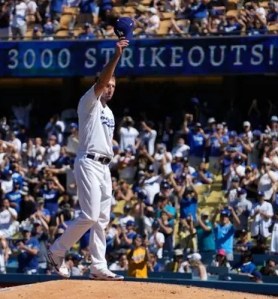
Max the Knife went from immaculate to 3,000 in the same Sunday afternoon game . . .

Who says baseball isn’t good for a little hair raising anymore? If you weren’t paying attention Sunday, you missed some real hair raising in Los Angeles and New York. As a matter of fact, you could feel sorry for Dodger Stadium’s  being upstaged by Citi Field’s.

Even if both hit the history books running.

Max Scherzer took a perfect game into the eighth inning. Along the way he pitched an immaculate inning—the third man ever to do it three times, joining Chris Sale and Hall of Famer Sandy Koufax—and bagged his 3,000th career strikeout. Right there it should have been the biggest story in the game.

Immaculate inning? Three thousand strikeouts? Could that someone be Max the Knife?

Those Big Apple pains in the ass had to horn in on Scherzer’s glory. They had to go from a brothers-in-arms 9/11 twentieth-anniversary hair-raiser to a Sunday night soiree full of chirping, whistling, snarking, bombing, and oh, yes, Francisco Lindor doing what nobody else in the 139-year history of the Subway Series had done before.

It wasn’t enough that Scherzer should have struck San Diego’s Eric Hosmer out swinging on down and in and a full count in the fifth to record the milestone strikeout. It wasn’t enough that Hosmer was sandwiched by Fernando Tatis, Jr. and Tommy Pham in the middle of that immaculate second.

It wasn’t even enough that Hosmer should have been the one to bust Scherzer’s perfect bid with a double deep to right field, a little quiet revenge for having been on the wrong side of Max the Knife’s further burrowing into the history books.

No. Those spoilsport Mets and Yankees had to go out and enable Lindor—the off-season signing splash whose first year as a Met has been a battle at the plate while remaining a study at shortstop (where he’s worth five defensive runs saved about the National League average)—to do the damage that mattered in a 7-6 Met win.

Never in the entire history of New York’s major league teams tangling against each other—we’re talking serious World Series tonnage, plus all those decades when the Dodgers and the Giants turned baseball into total warfare against each other, not to mention the Yankees and the Mets in regular-season interleague play—had any single player hit three home runs in a single contest between them until Sunday night.

In other words, Lindor accomplished what not even a small truckload of Hall of Famers ever did in Big Apple uniforms against each other. Not Home Run Baker or Babe Ruth. Not Lou Gehrig or Mel Ott. Not Joe DiMaggio or Jackie Robinson. Not Yogi Berra or Johnny Mize. Not Mike Piazza or Derek Jeter. Not even Willie, Mickey, and the Duke.

All around the Lindor clock, hey, let’s do the Lindor Rock!

Bottom of the second. Lindor batting lefthanded, squaring off on 1-1 against Clark Schmidt, a Yankee excavated from the farm system to make the start in the first place, and hitting a hanging breaking ball for a three-run homer into the bullpens behind right center field, pulling the Mets from a 2-1 deficit into a 4-2 lead.

“If Francisco Lindor’s first year as a Met could include a signature moment,” called ESPN broadcaster Matt Vasgersian as Lindor came down the third base line and crossed the plate, “we just watched it.” If only his crystal ball had undergone a tuneup.

Bottom of the sixth. One out, Yankee reliever Wandy Peralta throwing his first pitch to Lindor batting righthanded. The changeup arriving down and on the lower outside corner got driven high and into the left center field seats. Fattening a 5-4 Met lead by a run.

Francisco Lindor

“I am the Whistler, and I know many things, for I bomb by night . . .”

On the way home down the third base line, Lindor made a gesture simulating a kid sticking two fingers into his mouth to whistle a huge blast—a zap back at the Yankees over suspicions that Saturday night’s Mets starting pitcher, Taijuan Walker, was caught tipping his pitches with the Yankees whistling the tips to their batters during their five-run second.

Maybe the Yankees did it, maybe they didn’t. It’s not as though the Yankees have been immune to suspicions of on-field chicanery in the recent past, even if they’re not yet suspected or affirmed to have been quite as deep-cover as the 2017-18 Astros were shown to be for espionage aforethought.

But Lindor tripped a Yankee trigger when Giancarlo Stanton smashed a game-tying two-out, two-run homer in the top of the seventh. Stanton and Lindor jawed back and forth while Stanton was still running the homer out, though the Yankees and the Mets were both kind enough to let Stanton cross the plate before the benches and bullpens emptied completely for a little, shall we say, conversation over the matter.

“The last couple nights, we’ve just been loud over there,” said Yankee manager Aaron Boone. “Not doing anything.”

“I’m not accusing them,” Lindor said post-game Sunday night. “I’m not saying they’re doing it 100 percent because I don’t know 100 percent, but it definitely felt that way. And I took that personal. I took that personal and I wanted to put runs on the board to help my team win.”

For his part, Stanton postgame thought Lindor was actually ticked off at Peralta for whistling—not to steal signs but to try putting a little more life into what Stanton suggested had been a sluggish Yankee bench during a sluggish Yankee spell. That, Stanton said, is what he was trying to convey to the Mets’ shortstop en route the plate.

“If you’ve got a problem to Wandy, give it to Wandy,” the left fielder said. “Don’t be talking to multiple people, bringing everybody into it. Running around the bases, that was my thought process. Obviously, I didn’t get all that out running around.”

If anyone had a real complaint about Peralta’s whistling, it was probably Yankee right fielder Joey Gallo. “It’s definitely not for pitch-tipping or anything like that,” Gallo insisted, before complaining  good naturedly. “It’s been hurting my ear, honestly. It’s unbelievable how loud he can whistle.”

Bottom of the eighth, one out, Lindor back batting lefthanded against another Yankee reliever, Chad Green. This time, he hit a 2-0 meatball practically down the chute even higher over the right field fence than his first flog of the night traveled.

It wasn’t as spiritually delicious as Hall of Famer Piazza’s eighth-inning blast in old Shea Stadium, during the Mets’ first home game after the original 9/11 atrocities’ baseball hiatus, but the Citi Field racket as it traveled out of reach was equal in volume to that twenty-year-old cathartic hysteria.

There’s nothing like a three-thump night to make a high-priced shortstop—who’s spent most of his first such high-priced season struggling at the plate if not with the leather—suddenly feel lovable. “It probably helped them believe in me a little bit more,” Lindor said post-game.

Poor Scherzer. The tenacious righthander hit the history books with a flying fist. So he had to be one-upped by those New York yo-yos. Not even Mookie Betts speaking postgame could neutralise things. “He was destined for it,” the Mookie Monster told reporters. “All the work he puts in, everything he does. It kind of sounds weird, but I expect nothing less from him.”

Echoes of Hall of Famer Don Drysdale once saying of his rotation mate and buddy Koufax, “I expect Sandy to pitch a no-hitter every time he takes the mound.”

The bad news in New York was that Met fans have come to expect a discomfiting balance between virtuosity and disaster from reliever Edwin Diaz. And Diaz delivered just what they expected in the ninth Sunday night.

He wasn’t the only bullpen culprit in the hair raising, not after Jeurys Familia threw Gleyber Torres a two-run homer in the sixth, and not after Brad Hand handed Stanton that jaw-inspiring two-run shot in the seventh. But Diaz was the bull most over the edge, almost.

A leadoff strikeout followed by a base hit. A followup walk followed by a swinging strikeout. Then, he had a little help from catcher James McCann, letting a 1-1 pitch to Stanton escape, enabling pinch-runner Tyler Wade and Yankee first baseman Anthony Rizzo to third and second.

Lucky for Diaz and the Mets that Stanton got under the 2-2 fastball and popped it up. To the left side. Where, of all people, Lindor awaited to haul down the game’s final out. Some dared call that one poetic justice.

Entering 9/11’s anniversary losing . . . 9/11

Gary Sanchez, Jonathan Villar

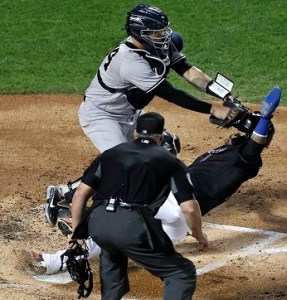
Sanchez’s bail-and-reach tag attempt on Jonathan Villar only started the Mets’ scoring Friday night.

Even if you hate everything Yankee because it’s everything Yankee, this is the kind of cruel symbolism to which the Empire Emeritus didn’t deserve to awaken on the twentieth anniversary of the 9/11 atrocities. Even the Yankees didn’t deserve to awaken on 9/11 having lost . . . 9/11, if you look at it one way.

If all you know of Friday night’s game against the crosstown Mets in Citi Field is the line score, it looks on the surface as though the Mets pasted the Yankees 10-3, even with three errors charged to the visitors.

But if you saw the game itself, you know the Mets did benefit from more than a little inadvertent Yankee generosity.

“Just a poor performance, period,” said Aaron Boone, the Yankee manager for whose head Yankee fans have called since, oh, the first Yankee loss of the season. That’s the painful reality of wearing the fabled Yankee pinstripes.

Of all the cliches around the Yankees and their fans, the truest is that they don’t like to lose. Of all the sub-cliches to that, the truest is, alas, “To err is human; to forgive must not become Yankee policy.” If one loss draws calls for heads to roll, nine losses in eleven games probably calls for public executions.

“It’s a bit of a broken record,” Boone said, speaking of the game itself even though he could have been speaking about Yankee fans and their expectations and demands. “We got to keep grinding at it. We got to keep working at it and we will, and trust that it will turn, but it’s obviously going to take everyone and, obviously, that starts with me and making sure we’re ready to roll.”

The Yankees seemed to get a roll going early Friday night, with Brett Gardner scoring on Aaron Judge’s ground out up the middle to second in the top of the first and Joey Gallo—the trade deadline import from Texas, who walks a ton, hits home runs a ton when he hits them, and does little else otherwise—hitting Mets starter Tylor Megill’s first one-out service into the right center field seats in the second.

In between, in the bottom of the first, the Mets offered up a leadoff single (Jonathan Villar), a one-out single up the pipe (Michael Conforto), and a two-out RBI single (Javier Baez, one of the Thumb Bunch) off Yankee starter Jordan Montgomery. The trouble on that hit was Gallo throwing home almost perfectly from left field but Yankee catcher Gary Sanchez bailing on the throw that had Villar a dead duck twenty feet from the plate.

It took a replay review to confirm it: plate umpire Ted Barrett’s initial out call was overturned. Inexplicably, Sanchez stood, bailed backward just enough, and reached up on the play, letting Villar get his foot on the plate before Sanchez got the tag on his helmet.

“He got in between Gary’s legs,” Montgomery said postgame. “It was unfortunate.” Alas, it’s par for the course for the hapless Sanchez this season. Only Baltimore’s Pedro Severino has been as bad behind the dish as Sanchez—each is worth -8 defensive runs saved, the worst mark in the American League.

Still, Gallo’s go-ahead bomb in the second gave the Yankees every right to think they’d hold the Mets off yet. They just didn’t bargain upon their own further misbehaviour starting in the bottom of the third.

Villar opened again with a base hit. Montgomery walked Thumb Buncher Francisco Lindor to set up first and second, then wild pitched that pair of Mets to third and second before walking Pete Alonso to send Villar home with the tying run. Then Baez whacked a feeble grounder up toward third. Uh, oh. Yankee third baseman Gio Urshela picked the ball slickly enough as he hit the ground sliding, but he threw it past Sanchez enabling Lindor to score.

Then Jeff McNeil, spotting the Yankee infield playing a little too deep, dropped a bunt past the mound on the second base side, catching every Yankee around the infield by surprise enough that Conforto came home unopposed. Kevin Pillar of the Thumb Bunch sent Gallo back to the track to haul down his sacrifice fly making the proceedings 5-2, Mets, and counting.

One busted double-steal bid later, McNeil taking second but Baez thrown out at third, Mets catcher James McCann, not exactly one of their more threatening hitters, sent a line double bouncing into the left field corner to score McNeil with the fifth Met run of the frame. Lucky for Montgomery that his next batter was a guaranteed out—even after opening Magill with two balls before striking him out swinging on three straight to follow.

And if the Yankees weren’t able to find bullpen relief for Montgomery just yet, the Mets thought nothing of making his night miserable even further in the fourth. With one out, Lindor going the other way kind of snuck a home run past the right field foul pole. Then the Yankees went to the pen, but an infield hit and a fly out later off Joely Rodriguez, Baez bounced an RBI double off the right center field fence. Making it 8-2, Mets.

The Yankees were mostly futile against Megill (ten strikeouts in seven innings) and the Mets’ defense from the second forward. But they weren’t finished being generous to the crosstown rivals. With the bases full of Mets in the seventh—after a one-out single (Baez) and back-to-back plunks (on McNeil and Pillar)—Yankee reliever Michael King fed McCann a ball that had inning-ending double play stamped on it.

Uh, oh, again. Yankee second baseman D.J. LeMahieu picked it and shoveled it perfectly to shortstop Gleyber Torres on the run. But Torres threw on about two stories above first baseman Anthony Rizzo’s glove, and home came the two plunk victims unmolested. By the time Rizzo whacked his own leadoff bomb in the top of the ninth, likewise sneaking it inside the foul pole, there were few real thoughts of any Yankee comeback.

Mets reliever Yennsy Diaz made sure those few thoughts disappeared swiftly enough from there with two swift air outs, before Sanchez tried to battle him from an 0-2 count: two balls, a foul, ball three, and then the game-ending fly out to deep right.

“It gives me all the confidence in the world,” Megill said post-game, “just to throw the ball over the plate in a way and attack hitters more confidently knowing I have, I guess, room for mistakes pitching. The offense killed it today. It’s awesome, they’ve been playing really well.” The Empire Emeritus went 0-for-5 with runners in scoring position and stranded four on the night, including Gardner after a two-out single in the third when the Yankees still had that 2-1 lead.

The Mets needed only Diaz and Heath Hembree before him out of the pen Friday night. They’ll need all pen hands on deck the rest of the weekend. Especially if the Yankees are only too conscious of losing 9/11 entering the twentieth anniversary of those atrocities.

Five straight for the Thumb Bunch

Jeurys Familia, Pete Alonso

Jeurys Familia and Pete Alonso have a victory handshake after the Mess (er, Mets) won their fifth straight Friday night—with plenty of help from the Thumb Bunch.

Almost a full week ago, the Mets were likely to be number one on a baseball fan’s hate parade. You know, you can’t have those ornery spoiled brats giving thumbs down when doing things right to the fans who spent most of August booing their heads off during what seemed, once and for all, like a classically surreal Met implosion.

You could only imagine the curses and hexes fans wanted to place on their heads for their dissing the people who pay their goddam salaries. Never mind that fans alone, or even predominantly, haven’t really paid baseball players’ salaries in decades.

But the Mets looked so vividly like 2021 baseball’s biggest self-inflicted trainwreck last month that you could still be forgiven for expecting a complete collapse. Maybe even firing squads in the clubhouse and guillotines outside the ballpark.

The hell with Pete Alonso’s happy talk channeling his inner Tug McGraw. Maybe Alonso didn’t use the specific phrase “ya gotta believe,” and McGraw in 1973 deployed it sarcastically after a lame rah-rah clubhouse speech by then-Mets lord M. Donald Grant. But when he said, “If you don’t believe in yourself, then who else is going to believe,” around 10 August, things only got worse instead of better.

Maybe Alonso really was onto something after all. Because look who’s won five straight including the two games last weekend that brought the thumbs-downing to a boil before the weekend ended. Look who’s even figured out a way to blow a lead in the ninth to force extra innings and then won the game in the extras, anyway.

Never mind that the streak’s come at the expense of two other sputtering teams, the Nationals and the Marlins. The way the Mets looked for most of August, they could have lost handily to a lineup of nine arthritic maids, a pitching staff of five one-armed janitors, a bullpen of seven legless movers, and a bench of six quadriplegics.

But ever since the down-thumbing suddenly caught the attention of the rest of the world, the Mets have outscored the opposition 27-13. And on Friday night, they took a precarious 2-0 lead to the bottom of the ninth, watched Edwin Diaz surrender a leadoff home run (to Juan Soto) and an RBI double (to Riley Adams) to tie . . . and pried four unanswered runs out of the Nats in the top of the tenth to win, 6-4.

Let’s not kid ourselves just yet. The Mets get to abuse the Nats in Washington for four more games this weekend, then they get to fly to Miami to inflict a little more use, misuse, and abuse of the Marlins. After that? They come home to host three clubs who can be called many things without pushovers being one of them: the Yankees, the Cardinals, and the Phillies.

There’s something to be said for gaining momentum even at the expense of the also-rans. And the Mets did claw their way back to .500 and to a mere four games out of first in the National League East.

Sure, they got some help from the Fish flattening the second-place Phillies 10-3 Friday night. Sure, they got some help from the Rockies eking out a 4-3 win over the first-place Braves. But a team that started August leading the division by three, and almost ended the month trailing by eight the night before the current streak began, has a few reasons to be happier.

Happier, but not quite to the delirious level just yet?

But let’s not spoil the fun. OK? Not the day after ancient Rich Hill pitched like a young man over six scoreless innings. Not the day after everyone in the Mets bullpen not named Diaz pitched three innings of one-hit, scoreless baseball.

Not after Diaz shook off those tying runs—and a scary collision between tying runner Andrew Stevenson and Mets catcher Chance Sisco that knocked Sisco out of the game at once—by ironing up and using a strikeout (of Carter Kieboom) and a ground out (by Luis Garcia) to strand the potential winning Nats run.

Not the day after Javier Baez, one of the Thumb Bunch, poked a one-out double down the right field line in the top of the second and came home almost at once when Michael Conforto—who’d gone from extension lock to question mark with a season’s worth of struggling—ricocheted a single off Nats starter Sean Nolin’s shoulder to send him there.

Not the day after Alonso, Mr. Belief, squared Nats starter Sean Nolin up on the first two-out, one-on pitch in the top of the third and yanked it as far down the right field line as he could for the RBI triple.

Not the day after Alonso drove Francisco Lindor—another of the Thumb Bunch, now deployed as the free cookie on second to open the New York tenth—home with a line single into the right center field gap.

Not the day after a third Thumb Buncher, Kevin Pillar, followed a free pass to Conforto by ripping a liner all the way down the left field line, sending Alonso and Conforto home as if they were escaping for their lives, Conforto following Alonso with an Olympic-level dive across the back of the plate.

Not the day after pinch hitter J.D. Davis was handed another free pass and Jonathan Villar cashed in at once by singling Pillar home for the fourth Met run of the tenth.

Not the day after Jeurys Familia returned to a once-familiar role, closing it out with a leadoff punchout and a pair of swift ground outs in the bottom of the tenth.

“As you can imagine,” Alonso the Believer said post-game, “it’s great. It’s awesome to rip off (five) in a row. [But] we just have to win every possible game that we can. Regardless of the standings, we can only control what we can control. There’s ebbs and flows in the season and right now we’re just looking to finish strong.”

“The whole thing is just the creativity as the game is kind of presenting what it is showing you as a pitcher, as a conductor,” Hill said post-game of his own solid outing. “You saw a variation of a lot of different things out of my mechanics tonight. It wasn’t necessarily just a traditional leg lift and a pitch and the timing was all the same. Trying to disrupt the timing is the whole art of pitching.”

So Hill isn’t as succinct as Hall of Famer Warren Spahn. (Hitting is timing, pitching is destroying timing.) But he sure pitched and sounded just as smart. Especially facing the heart of the Nats order three times, bringing them up empty, and surrendering only three hits overall during his six splendid.

Maybe the Nats helped the Mets’ cause by some rather uncharacteristic basepath mistakes. But if pitching is disrupting or destroying timing, then winning in large enough part is making the other guys pay for their mistakes. Usually, this year, the Mets have paid through the nose (and any other orifice) for theirs.

Enjoy it while it lasts. However long it lasts. Seeing the August Mess come back to life for even five games was still a pleasure. They might (underline that) even have a few more surprises in store when they come home from their current trip to the division swamps.

“Every game is really huge at this point of the year,” Alonso said. Stick to that attitude, Mets.