Underhanded Counselling?

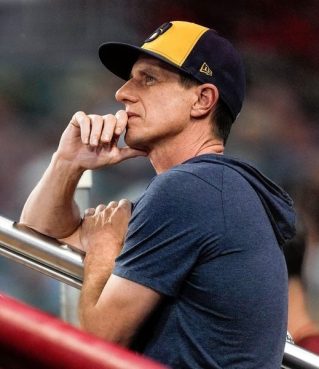
Craig Counsell

No, the Cubs did not poach Counsell from the Brewers. What they did to David Ross, however . . .

Would you blame David Ross if you discover he feels like the husband who was thrown over with little to no warning because the wife decided something better was available? OK, that’s not really a fair analogy. Grandpa Rossy is seven years younger than Craig Counsell. But considering the Cubs’ treatment, he might as well be seven years older.

But something isn’t passing the proverbial smell test about Counsell’s hiring and Ross’s firing.

First, let’s clear this one at once. The Cubs didn’t poach Counsell. Not from the Brewers or from anyone else. Counsell’s contract expired first. He didn’t exactly lack for interest once it became known he intended to test his own managerial market. But test it he did, as a proper free agent.

Now, that said, the manner in which the Ross firing and Counsell hiring were done was a weak look. Team president Jed Hoyer had a deal done with Counsell before flying to Ross’s Florida home to meet and execute Ross, the guy from whom Hoyer said he wasn’t really looking to move on. The headline on The Athletic‘s Patrick Mooney’s take said it with jarring simplicity: “David Ross’s downfall as Cubs manager? He isn’t Craig Counsell.”

Just like Rick Renteria wasn’t Joe Maddon. Just like, as things turned out, Maddon—on whom the Cubs “soured” almost too swiftly when they faded from World Series drought busters to also rans—wasn’t Ross, who’d been one of his more valuable role players for that almost surrealistic 2016 World Series run but received a front-office grooming for the bridge to follow after his retirement.

Maddon also proved not to be Counsell. It was Counsell’s Brewers who chased Maddon’s Cubs down in 2018, possibly putting Maddon onto a very warm seat the heat from which swelled a year later—when the Cubs fell from contention, had a chance to knock the Cardinals out of the races, but got swept by the Cardinals in Wrigley Field in their final home set of the year.

Hopefully, someone in the Cubs’ orbit has tipped Counsell to watch his back in case the Cubs’ administration decides, somewhere along the road, no matter what success that administration allows him to have, that he’s not whomever they’d like to romance and marry in due course.

Especially if, as they did with Ross, the Cubs announce he’s their guy in public only to romance a purported upgrade behind closed doors. Especially if they announce Counsell’s their guy despite a season being ended at the hands of Counsell’s now-former team. With the way the Cubs are administered, nothing’s impossible, including infamy.

This isn’t the single most suspicious fire-and-hire I’ve seen in a lifetime of baseball watching. Nothing compares to the shameful Yankee double switch of 1964. They canned an undermined Yogi Berra the day after the Cardinals beat his Yankees in the World Series. Then, they hired Johnny Keane, the skipper who’d just beaten him in that Series.

We learned only later that then-Yankee GM Ralph Houk had every intention of dumping Yogi after the season, no matter what, even backchanneling during the season to gauge Keane’s interest in the Yankee job, if the Cardinals were ready to let him go before their own pennant race comeback and triumph.

At least Ross didn’t get it the way the Mets once dumped an embattled Willie Randolph, either. Feeling fire under his hindquarters over the Mets’ blowing a seven-game National League East lead in September 2007, Randolph and his Mets opened 2008 34-35 and he was fired—after managing a doubleheader split in New York, then flying coast-to-coast to Anaheim to manage a win over the Angels, and getting fired . . . at 3:11 a.m.

As a manager, Ross was better than some, perhaps not as good as others. He earned his players’ trust even as the Cubs administration allowed a championship team to dissipate and a seeming team of also-rans to replace it. Yet he steered them deftly through the 2020 pan-damn-ic and into that surrealistic postseason. And his Cubs played hard in 2022, especially after the All-Star break, and despite the front office fire-selling at that year’s trade deadline.

In 2023, a Cubs team not supposed to compete competed. They pulled themselves to .500 by 27 July, then to 78-67 on 11 September. But from there they collapsed to going 5-12 to finish the season. They’d ended August taking two of three from Counsell’s Brewers but ended the season losing two of three to them.

Counsell’s NL Central-winning Brewers returned to first in the NL Central to stay on 3 August and probably secured it with a nine-game winning streak during that month’s second half, though going 8-4 to finish the regular season didn’t hurt. Then they got swept right out of the wild card series by the eventual NL pennant-winning Diamondbacks.

Except for pan-damn-ically short 2020, Counsell had only one losing season on the Brewers’ bridge. They reached nine postseasons and one National League Championship Series under his command. And Counsell earned respect for managing those runs despite the Brewers not exactly being or behaving like more than a small-market team.

When his contract with the Brewers expired, many were the speculative stories sending Counsell to a very different Mets organisation, under still-new ownership and now administered by the man who hired him in Milwaukee in the first place, David Stearns. Counsell built a reputation as a communicative players’ manager in tune with the game’s analytic side and in synch with the human side.
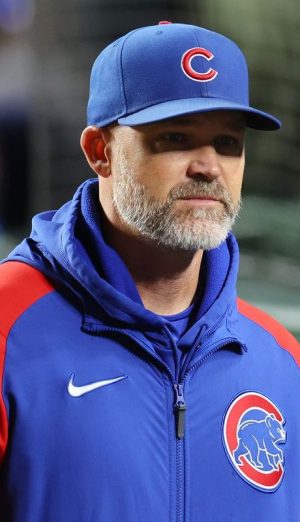
David Ross

So much for being “their guy” . . .

I saw some speculation that Counsell leveraged the apparent Mets interest in him to carve a large contract out of whomever might win his favour at all. But I also saw smarter observations that the Wisconsin-reared and rooted Counsell—the winningest manager in Brewers history—didn’t want to stray far from home in any job change.

He got what he wanted and more, the Cubs signing him for five years and $40 million to steer their Ricketty ship. That alone may do wonders on future markets for steadily successful managers who are usually expected to work for comparative peanuts and be bosses to players who could buy and sell them for the equivalent of a year’s worth of sales taxes.

The Cubs may not fall into big bidding wars for this winter’s free agency class, but they’re expected to be active enough to fortify a team that looked like a rising team often enough in 2023. Cub fans know only too well how swiftly expectations can turn, of course, but let’s leave it be for now.

I would repeat my earlier counsel to Counsell: watch your back—and not just from Brewers crowds ready to hammer you the first time you lead the Cubs to Milwaukee for a series. The next rising managerial star might turn Cub eyes toward him at the first sign of availability, too. And it may not matter whether or not you continue building a resume that might include managing the Cubs to another World Series title, either.

It took Ross—a World Series hero as a role player on the 2016 Cubs, who hit his final major league home run during that staggering Game Seven—several days to speak out about his execution. Telling Talahassee Democrat writer Jim Henry that anger is poison to him, Ross preferred gratitude:

There was a lot of people who worked really hard alongside me. … I am really thankful for the four years I got, coming from zero coaching experience to getting the chance to manage such a great organization that has impacted my life in a great way. There’s great people there. I really don’t have a whole lot negative to say, to be honest.

I get mad from time to time but I have a lot to be thankful for.

Few men and women pick up and dust off from their unexpected purgings with that kind of grace. The Cubs should consider themselves fortunate that Grandpa Rossy didn’t elect to stay away from future team commemorations as long as the incumbent ownership and administration is in place. As with the case of a certain Yankee legend, nobody might blame him if he did.

Gone, Cubs, gone

Anthony Rizzo, Kris Bryant

That was then: Anthony Rizzo clutching and hoisting the off-balance throw Kris Bryant (17) made to end the 2016 World Series as world champions. This is now: They’re not Cubs anymore.

I called it the Code Blue Series when the contestants were confirmed. One team that hadn’t won the World Series since the premieres of cellophane, the Geiger counter, and the Model T Ford. The other, a team that hadn’t won the Series since the threshold of the Berlin Airlift.

“I’m sleeping with this thing tonight,” crowed Anthony Rizzo, speaking post-game, about the double play ball he caught on the relay to start Chicago’s post-National League Championship Series parties. “Are you kidding me?”

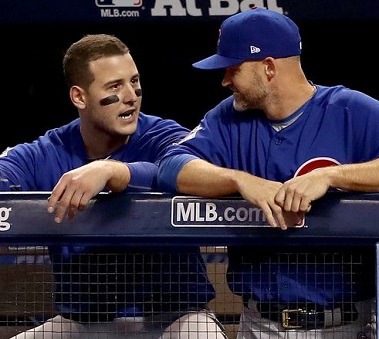
The same Rizzo who clung to the dugout rail in Game Seven of that surreal 2016 World Series, admitting to teammate and eventual manager David Ross that he was on the brink of his nineteenth nervous breakdown.

“I can’t control myself right now. I’m trying my best,” Rizzo said.

“It’s understandably so, buddy,” Ross replied, with a very knowing smile. He’d been there, done that, with the 2013 Red Sox.

“I’m emotional,” Rizzo admitted.

“I hear ya,” Grandpa Rossy replied.

“I’m an emotional wreck.”

“Well, it’s only going to get worse,” Ross advised. “Just continue to breathe. That’s all you can do, buddy. It’s only gonna get worse . . . Wait until the ninth with this three-run lead.”

Once upon a time, possibly thanks to Chicago newspaper legend Mike Royko, the maxim was that the teams with the most ex-Cubs lost. That was then, this was the 2016 Series: The Cubs—the team with the fewest ex-Cubs and the most ex-Red Sox—won. After a couple of that-almost-figures hair-raisers, none raising more hair than Game Seven.

Now, third baseman Kris Bryant—subject to the most trade rumours the past two years—is traded to the National League West-surprising Giants. Shortstop Javy Baez is traded to the National League East-leading-almost-by-default Mets, where he’ll gladly play second base for the chance to hold the keystone with his buddy Francisco Lindor at short. And first baseman Rizzo has become a Yankee.

The 2016 core is gone, Cubs, gone. Four men from that team now remain.

Ross retired as a player after that Series triumph and has managed them since last season, having days enough now when he must think Lucifer’s practical jokers have made him a too-frequent target. Right fielder Jason Heyward’s stellar defense once atoned for his feeble bat, but he isn’t quite the defender he used to be even if he’s still a shade above the league average for run prevention. Catcher Willson Contreras remains a mainstay and leads the team with his 3.2 wins above replacement-level.

And Kyle Hendricks, who pitched magnficently enough in the 2016 Series, leads this year’s Cub rotation with an ERA two ticks from four despite his twelve credited wins.

The Cubs approached Friday’s trade deadline all-in on selling while the selling was good, because their National League Central chances were anything but and the last of the true core was due to hit the open market. And the team administration has a lot to atone for, for having failed to fortify the team viably in the seasons to follow the 2016 heights.

It’s still too telling that the single most fun moment in Cubs baseball this season came from Rizzo, the first baseman taking the mound on the wrong end of a blowout, striking out his Braves buddy Freddie Freeman to laughs all around the park—especially between those two.

If the Dodgers hadn’t swept in and swept the Padres to one side in the Max Scherzer lottery, the Great Cub Fire Sale might have dominated the proceedings entirely.

But it’s hard not to think about that World Series now that Bryant, Rizzo, and Baez are gone at last. Especially after Rizzo made an almost immediate impression with his new team Friday night. (Yankee announcer Michael Kay called Rizzo “the linch pin” of the 2016 Cubs.) He broke a scoreless tie between the Yankees and the Marlins by sending a 1-0 hanging cutter into the second deck behind right field in the top of the sixth. (The Yankees went on to win, 3-1.)

It’s hard not to remember Dexter Fowler’s eighth-inning home run off then-Indians relief ace Andrew Miller in Game Four. Making Fowler the first Cub to hit a World Series homer in Wrigley since Chuck Klein—in 1935. And, making him the first African-American Cub to hit a World Series homer ever.

It’s hard not to remember Bryant—with the Indians six innings from the Promised Land— parking a 1-1 pitch into the left center field bleachers off then-Indian Trevor Bauer to start turning the mostly quiet Confines crowd on the Chicago leg of the Series into a nuclear meltdown of joy in Game Five.

It’s hard not to remember Rizzo and eventual Series MVP Ben Zobrist scoring in the first in Game Six, after Indians outfielders Tyler Naquin and Lonnie Chisenhall misread and misplayed Addison Russell’s shuttlecock fly to right center. Or, after the Cubs loaded the bases to push Indians starter Josh Tomlin out, Indians reliever Dan Otero feeding Russell grand salami with mustard.

It’s hard not to remember Jake Arrieta pitching to Naquin with the bases loaded and two out in the bottom of the fourth, same game, and striking Naquin out on one of the nastiest divers Arrieta ever threw in his life.

It’s hard not to remember Game Seven, especially. When Ross had to atone for a horrible throwing error past Rizzo one inning by smashing a one-out homer the next. When the late rain delay prompted Heyward’s clubhouse pep speech.

When Rizzo took the free pass in the top of the tenth, took third on an RBI double, and scored after another intentional walk and a base hit to left—the base hit being Miguel Montero’s second-most important bases-loaded hit for the Cubs that postseason.

When Bryant picked off Michael Martinez’s short grounder on the dead run, with two out and a run in to close the Cub lead to a single run, then threw a little off balance and herky-jerky at that to first—and Rizzo snapped the ball in his mitt as dearly as he might have clung to the Hope Diamond after a daring heist.

Russell forced himself off the Cubs and out of the Show entirely in due course, after the sick case of his abuse of his wife exploded into headlines and forced his suspension. He played in the Korean Baseball Organisation last year and plays in the Mexican League this year.

Montero talked his way out of Chicago. First, he complained about his loss of 2016 postseason playing time to Ross and Willson Contreras behind the plate. Then, in 2017, he was gone for good after blaming Arrieta publicly for the Nats running wild on his arm on the bases in a June game. Two subsequent hiccups of comeback bids with the Blue Jays and the Nationals—retired.

Zobrist, who came to the 2016 Cubs after winning the 2015 Series with the Royals—a down 2017, a comeback 2018, retired after 2019. Now, he’s undergoing a painfully public divorce in which his wife’s accused of having an affair with the minister they engaged for marital counseling in the first place.

Arrieta—allowed to walk as a free agent after a 2017 that began his still-ongoing decline phase. Jon Lester, who somehow got past his throwing issues to first base and stood tall enough when it counted—now a National-turned-Cardinal. John Lackey, pitching for his third different Series winner—retired after fifteen seasons and a down 2017. Aroldis Chapman, the howitzer relief pitcher but a domestic abuser himself—a Yankee since 2017.

This week? The Cubs’ place in the race was probably sealed for the season when they lost eleven straight from 25 June through 6 July, but seven of the eight players they moved by Friday’s deadline also stand to hit the open market after the season. Resurgent relief pitcher Craig Kimbrel—dealt to the crosstown White Sox and right back into the races—has a 2022 option.

Maybe the real end of this generation of Cub contenders came in 2018, during the second half of which they lost 22 games in which they scored one or none. Including the humiliations of scoring a measly two runs in back-to-back losses that cost them the NL Central title and the NL wild card in one thirtysomething-hour period.

Maybe it was sealed once and for all by 2019, when they lost a pair of humiliating series in the last two regular season weekends and, as ESPN writer Jesse Rogers observed, the Joe Maddon era ended when the skipper “wasn’t able to out-manage the mistakes the front office saddled him with.”

“The Ricketts family had cut back on payroll spending while continuing to use Wrigleyville as a private cash machine,” writes the redoubtable veteran scribe Rick Morrissey of the Chicago Sun-Times. “The franchise didn’t keep up with other contenders in terms of on-field talent. It settled for being very good instead of great. The idea—always—is to win. Cubs fans got that, which is why they were irritated when the club didn’t get a whiff of the World Series again.”

Maybe that was what irritated the remake/remodel/re-conquer mastermind Theo Epstein enough at last to swap the Cubs’ front office for a gig in the commissioner’s office, where he now works helping to get baseball back to where it once belonged, a balance between pitching and hitting. He won’t have his hands tied by ownership caprice anymore. We think.

It stung when Ross kept Bryzzo out of the Thursday lineup at home, denying them a final appearance before the Wrigley faithful. He said Rizzo already had the day off pre-planned and was concerned about giving Bryant’s legs a rest. Cub Country didn’t need anyone to say maybe the front office handed Grandpa Rossy an order the better to keep the deals to come from being wrecked.

We saw Bryant in tears on his cell phone in the Cubs dugout at Nationals Park Friday, receiving the news he was going west. We saw Rizzo taking his young family to walk the Wrigley Field grounds one more time the day before, before he went east. Those sights will linger for Cub Country almost as vividly as Bryan’s off balance pick and throw of Martinez’s grounder to Rizzo to finish 2016 will. (This is gonna be a tough play, Bryant—the Cubs! Win the World Series! hollered announcer Joe Buck.)

President of baseball operations Jed Hoyer says the deals helped the Cubs duck a complete rebuild thanks to the youth the deals bring back. “Was it emotionally difficult? Yes,” he said to Rogers. “Do I think it was absolutely the right thing for the organization? I do.”

Nature of the beast. Hoyer was only too well aware of other teams going all the way to the end of their team control only to require years of rebuilding. Teams like the Phillies, the Tigers, and the Giants, the last of whom have begun making noise that’ll be amplified a bit with Bryant on board.

“They ran to the end of the cliff and fell off and they had to rebuild,” he continued. “We were willing to go to that point if this was a winning team this year, but we weren’t, so with that we were able to speed that process up dramatically.”

But going from “Go, Cubs, Go!” to gone, Cubs, gone, still stings. Even if we’ll always have 2016.

Headhunters ball

Of course our guy didn’t throw at your guy’s attic on purpose. And of course we’ll take that polar beach club off your hands for twice the market value!

A little Saturday rough stuff between the Chicago Cubs and the Cincinnati Reds may or may not be surprising. But is it all that surprising that Angel Hernandez’s umpiring crew sent it near nuclear? Not Hernandez himself, for a change, but still.

The Cubs and the Reds played a doubleheader in Great American Ballpark. Thanks to his performance in the Cubs’ first-game win (3-0), Anthony Rizzo wasn’t exactly the Reds’ favourite person on the day. Neither was Cubs starting pitcher Yu Darvish, who was so effective he could (and did) drop his glove while delivering and still throw a strike.

First, Rizzo wrestled Reds starter Trevor Bauer to a ninth pitch and drilled it down the right field line and out of sight in the top of the third. Then, in the top of the sixth, Rizzo made shorter work of Bauer by hitting a fourth-pitch 1-2 service deeper into the right field seats.

But in the top of the nightcap’s fourth, rookie Cincinnati relief pitcher Tejay Antone greeted Rizzo leading off with a pitch straight over Rizzo’s head. Rookie though he may be, Antone had all the right moves at the ready, looking at his pitching hand immediately as he turned to his right.

Of course the ball just slipped away off course against the guy who took the Reds deep twice in the first game. And of course you can have that Antarctican beach club for twice the market value. Rizzo’s reputation for plate crowding doesn’t fly here, either. If you’re going to push a batter back off the plate, you’re going to throw inside and tight, not upstairs above the attic.

“We’ve played against the Reds a long time and they do like to move my feet,” Rizzo told reporters after Cubs relief pitcher Craig Kimbrel wild-pitched the winning Reds run home in the bottom of the seventh.

It’s just part of their reports–it’s been for years. I don’t think any pitcher would purposefully throw at someone’s head. I give the benefit of the doubt to every pitcher, especially Antone. He’s a rookie. He’s been throwing really well. The pitch inside was definitely for a purpose. It’s just, it’s at the head and that’s scary stuff.

No sale. Both dugouts barked. Hernandez’s ump crew confabbed as Antone stepped into his errant-hand routine around the mound. Home plate umpire Nic Lentz handed warnings to both sides. Cubs manager David Ross, who wouldn’t have paid a wooden nickel for the pitch-slipping plea, was distinctly unamused.

Ross came out of his dugout at first, returned, then came back out after Lentz handed the warnings down. “I thought our dugout got pretty animated and the umpires stepped in and issued warnings, which I didn’t understand,” Grandpa Rossy told reporters later. “We hadn’t done anything from our perspective. A young man tried to take things into his own hands and send a message, and then it kind of escaped from there.”

With the Cubs dugout still bristling over Antone’s attic pitch to Rizzo, not to mention Antone still bristling quietly over having exchanged a few “grunts” with the Cubs previously, Ross and his pitching/catching/strategy coach Mike Borzello were ejected. It’s the first ejection in Ross’s managerial career. Welcome to Angel’s Hell, Gramps. You’re not supposed to say anything but “three bags full, sir” to the crew of the legend in his own mind.

Then the Reds got a taste of both theirs and Hernandez’s own medicine in the bottom of the fourth. Cubs reliever Adbert Adzolay zipped Reds center fielder Shogo Akiyama up, in, and tight. You’d have had to be a U.S. postmaster general not to know that Adzolay wanted to send the Reds a little return message about going upstairs against the guy who took you downtown twice in the first game.

That prompted veteran Reds leader and designated hitter for the game Joey Votto to bark at the Cubs, Kyle Schwarber in particular. Cincinnati skipper David Bell returned to the field for another conversation with the umps, during which Rizzo hollered at him from first base, which lured Votto and Reds outfielder Jesse Winker out to have it out with Rizzo.

First base umpire Dan Bellino tried and failed to convince Votto and Winker to knock it the hell off, then he invited both to kindly remove themselves from the game, at which point—pandemic protocols be damned—both benches and bullpens emptied to the field, although nobody even thought about throwing a punch.

“I went over to get an explanation for what happened,” Bell told reporters afterward. “And then I believe Anthony Rizzo started walking towards me and yelling at me,” Bell said. “I don’t know what he was saying, it didn’t really matter to me. And at that point, a couple of our players jumped over the railing and the umpire just started throwing everybody out of the game. Not everybody, but Jesse Winker, Joey Votto and myself.”

“Having each other’s backs and the Reds and all their guys and David Bell are going to have each other’s backs and we’re going to have our backs,” said Rizzo, who speaks fondly of Bell otherwise from Bell’s days as a Cubs infield coach. “That’s what happens when you’re competing anytime through baseball, but especially this year when it’s all heightened and you can hear every little thing.”

The Twitterverse erupted with a round of brickbats against Hernandez as the leader of the crew, but in absolute fairness this was one time when Hernandez himself didn’t jump the first bullet train to make himself the object of everyone’s attention. That’s about as far as absolute fairness should go, thanks to a time-honoured precept that when you lead you take responsibility for what your subordinates do, for better or worse.

Including making the headhunters captured by the game the story of the day, instead of Darvish’s virtuosity on the mound in the first game. Or even the hapless and once-formidable Kimbrel’s ninth-inning nightcap disaster, when he was brought in to try saving a 5-4 Cubs lead and should-have-been win. Oops.

He walked Reds catcher Curt Casali on 3-1 to open the bottom of the ninth. He struck Votto’s successor Mark Payton out, but he wild-pitched Casali’s pinch runner Freddy Galvis to second before walking Nicholas Castellanos. Winker’s successor Aristedes Aquino singled Galvis home, then Kimbrel wild-pitched Castellanos and Aquino to third and second, respectively, before walking Eugenio Suarez.

The good news: Cardiac Kimbrel struck Mike Moustakas and Jose Garcia swinging, back to back, Garcia especially on one of the filthiest curve balls Kimbrel’s thrown in recent times. The bad news: That strikeout pitch escaped not just Garcia’s bat but one and all around and behind the plate, enabling Castellanos to score the Reds’ winning run.

Too-vivid reminders of how Kimbrel, formerly one of the most automatic closers in the Show, kept the crash carts on red alert during the 2018 Boston Red Sox’s postseason run even when credited with saves. The poor man threw four first-pitch strikes out of his six batters but only three of his eleven total strikes were called and his earned run average now matched a ten-dollar bill.

“We’re behind him every single day,” Rizzo said of Kimbrel. “Every time he comes to the mound, we’re behind him and have full confidence in him. He’s Craig Kimbrel. He has his resume for a reason.” That door swings both ways, unfortunately.

Grandpa Skipper

2019-10-23 DavidRoss

David Ross gets a World Series-winning lift from the Cubs in 2016. Now he gets to manage them.

If you take the word of Chicago Tribune columnist Paul Sullivan, the only successor to Joe Maddon who was ever on Cubs president Theo Epstein’s radar was David Ross. And if you read Epstein’s foreword to Ross’s 2017 memoir, Teammate, in which Epstein described Ross in terms that sounded like a job description for a manager, you probably figured the same thing:

The watchful eye from the dugout to make sure we respected the game and played the Cub Way. Unselfish, team-first, winning baseball. The glare when someone did something that wasn’t Cub. The rare harsh word when it happened again. The high-fives and pats on the rear when it got fixed. The instinct when to know when to create levity and when to get guys locked in. Reminding the young players how good they are. Reminding them they can get better. Words to keep the team grounded when winning seemed easy. Words to lift up the team when losing just one more would end the season.

Sounds a lot like the way Grandpa Rossy was during the Cubs’ run to the 2016 World Series conquest. (Which so wasn’t Cub, right?) Especially when he had to handle his buddy Anthony Rizzo’s Game Seven jitters.

Especially when Ross himself needed a big lift after a horror of a Game Seven throwing error one inning, providing it himself the next when this spaghetti bat whose baseball knowledge was ten times as valuable hit a gassed Andrew Miller’s 2-2 service into the left center field bleachers, for his final major league hit en route the Cubs’ stupefying win.

Found reposing alone with his wife and children in the Progressive Field visitors clubhouse, Ross was asked whether he’d now rethink his intended retirement. “Oh, God, no,” he replied. “How can I top this? If I come back, it’ll be to get my [World Series] ring and maybe yell at [Anthony] Rizzo from the seats.”

Ross picked up his World Series ring the following Opening Day in Wrigley Field. Now, despite the Cubs having to go through the hiring process even as a matter of formality under the rules, Ross will get to yell at Rizzo and any other Cub who might need it now and then from the dugout again. This time, as their skipper.

“[I]f you’re looking for a leader to take the Cubs back to the level they believed they’d be at for years after that ’16 title,” Sullivan writes, “those are exactly the qualities you’re seeking—a motivating, demanding, reassuring and fun-loving guy.”

It could be fun loving for Cub Country, too, especially considering the biggest weakness among several that they had in 2019. This year’s Cubs didn’t intimidate pitchers quite as much as they found pitchers absolutely unconcerned about giving up hits because those pitchers got to see them run into outs as if there were free tickets to the nearest clown show at the end of each out.

He might have earned the nickname Grandpa Rossy for his sanguine style as a team leader, but it doesn’t mean Ross is going to be that indulgent a grandpa now that he has the bridge. He won’t stop the Cubs from having fun again, he’ll probably encourage it, but that doesn’t necessarily mean he’ll forget to break out the bull whip when need be.

Unfortunately, it doesn’t necessarily mean there’ll be a lack of laughter over Ross’s hiring. He’s never managed. And the continuing trend of skippers without the backup experience still draws mixed reviews. For every Aaron Boone there’s a Gabe Kapler.

Stop snarling, Yankee fans. It wasn’t even close to Boone’s fault the Yankees got shoved to one side and away from this World Series, and—contrary to popular belief (namely, yours)—Boone did better in his first two Yankee regular seasons (203 wins) than any manager in Yankee history except Ralph Houk (205 wins). Even Joe McCarthy (201), Casey Stengel (195), Joe Torre (188), and Joe Girardi (192).

So Boone was silly enough to let a faltering Aroldis Chapman finish what he started and refuse to put Jose Altuve aboard with a man on and two out to pitch to a glove-first/ spaghetti-bat on deck? There have been equal or worse mistakes in Yankee history, postseason and otherwise, and by skippers with more time in service than Boone.

In his twelfth Yankee season Stengel forgot to align his World Series rotation to give Hall of Famer Whitey Ford three starts—and cost himself the 1960 World Series. Houk in his third had no answer other than expecting the Dodgers to drop dead at the sight of Yankee uniforms—and got swept in the 1963 Series.

Girardi in his final year failed to demand a review of a hit batsman who actually got hit on the bat knob . . . and watched the next Indian hit a grand slam in a division series to push the Yankees to the brink of a sweep they avoided and beat only to lose that pennant when the Astros out-scored them 11-1 in Games Six and Seven.

Ross should have few problems if the front office gives him even a marginally better bullpen than 2019’s, his hitters actually meet balls with their bats, his defenders tighten up, and his baserunners quit auditioning for the next Three Stooges revival. Not to mention the Cubs overcoming a few years of dubious drafts since Epstein yanked the front office inside out.

And remember: Ex-catchers do rather well as major league managers in any era or game culture. It only began with Connie Mack and two Philadelphia Athletics dynasties.

Al Lopez won pennants managing the Indians and the White Sox. Long the third-string backup to Hall of Famer Yogi Berra and his backup Charlie Silvera, Houk won three pennants and two World Series in his first three seasons on the Yankee bridge. The Yogi himself won a pair of pennants managing the Yankees and the Mets. Gil Hodges converted from catching to first base—and managed the 1969 Miracle Mets.

Johnny Oates won three AL Wests managing the Rangers. Joe Torre won an NL West with the Braves a decade plus before his pocket full of pennants and World Series rings with the Yankees. Mike Scioscia won a World Series behind the plate for the Dodgers and on the bridge for the Angels. Before Mike Matheny married his Book and lost his clubhouse, he took the Cardinals to some postseasons and the 2013 World Series, though he lost to the Red Sox. Girardi won three AL Easts plus a pennant and a World Series with the Yankees.

And that’s a former catcher who managed the first Astros World Series winner two years ago and is trying to win their second in a) franchise history and b) three years right now.

Of course, not all catchers become postseason managers, either. Bob Boone, Del Crandall, Doc Edwards, Herman Franks, Rene Lachemann, Jerry Narron, Tony Pena, Paul Richards, Muddy Ruel, Joe (Ol’ Sh@tf@ck) Schultz, Birdie Tebbetts, Jeff Torborg, and Wes Westrum, among others, call your offices.

Grandpa Rossy has reasonable odds of joining either one or the other group. The bad news is that a lot depends on how reasonable or unreasonable the Cubs are from here. The good news is that you won’t see Ross tearing his hair out over Cub mistakes. He hasn’t got any left to tear out. Almost. A bark under the park should suffice.

He even gets his own unique entry in the land of trivia contests: Name the only manager ever hired for the job two years after he finishes as a runner-up on Dancing with the Stars. Look out, you Dancing Nats, here come the Cha-Cha-Cubs!

Could Ross take the Cubs’ bridge?

2019-09-22 AnthonyRizzoDavidRoss

Keeping Anthony Rizzo (left) steadied in Game Seven of the 2016 World Series is probably only one reason David Ross (right) may be seen as managerial material—and closer to a shot at it than he thinks.

When the Cubs delivered the long unthinkable almost three years ago, about-to-retire veteran catcher David Ross couldn’t be found when the celebration moved to the clubhouse. He’d ducked into the visitors’ weight room in Cleveland’s Progressive Field to repose with his wife and his two children.

A reporter found Ross anyway. And, asked the man known affectionately as Grandpa Rossy whether having been big enough in the Cubs’ century-plus-overdue return to the Promised Land had him re-thinking his intended retirement. “Oh, God, no,” Ross replied. “How can I top this? If I come back, it’ll be to get my [World Series] ring and maybe yell at [Anthony] Rizzo from the seats.”

The storybook Cub season gave Ross his happy ending. As for how he could possibly top that, the former catcher who’s worked since 2017 as an ESPN colour analyst may get his answer, perhaps sooner than he thinks. Perhaps as soon as this off season. If not sooner.

With the Cubs’ continuing collapse ramping up speculation that manager Joe Maddon won’t be offered a new deal to stay with the team he shepherded to that Series triumph and kept in contention since, the list of prospective successors has come to include Ross himself.

September began with the Cubs having a grip on the second National League wild card. A critical four-game set against the National League Central-leading Cardinals in Wrigley Field began with the Cubs a measly three games behind them with an excellent shot at overthrowing them for the division lead. There went that idea.

That series is on the threshold of ending with the Cardinals taking the first three at minimum and the Cubs taking in the possibility that any postseason hope they had this time around is all but over. All three were one-run losses. Two out of three were lost in the ninth inning. Saturday night especially.

After the Cubs had four deficit comebacks they handed an 8-7 lead to Craig Kimbrel. The same Kimbrel who owned one of the game’s most dominant relief resumes before he made closing postseason games for last year’s World Series-winning Red Sox exercises in cardiac crash cart alerts. The Kimbrel who only thought he was going to shoot the moon in free agency last winter anyway, and ended up shooting barely past the antennae atop Willis Tower when he finally signed a three-season deal with the Cubs in June.

The same Kimbrel who returned from the injured list (knee) Thursday and surrendered Matt Carpenter’s tenth-inning bomb that proved the winning run. Saturday night Kimbrel saw and raised. With a lot of help from Cardinals catcher/leader Yadier Molina and shortstop Paul DeJong.

Saturday night he opened against Molina, starting Molina with a climbing four-seam fastball. And, watching it fly into the left field bleachers. Then DeJong checked in at the plate. Kimbrel opened with another four-seamer that didn’t climb quite so high. DeJong had an easier time sending that one over the center field wall. And the Cubs had no answer in the bottom after Kris Bryant opened with a walk off Carlos Martinez.

Thus the first time they’ve lost four straight one-run games since 1947. Overtake the Redbirds for the Central? Second wild card? Not when they’re skidding while the Brewers are on a 13-2 run that began with sweeping the Cubs the weekend of September 6. It put the Brewers three behind St. Louis in the Central and three up on the Cubs for the second wild card.

This is one hell of a way to play the final regular season series at the Confines. Not even Rizzo’s unexpectedly early return from an ankle sprain Thursday—or his opposite field home run in the bottom of the third—proved inspiration enough. And Maddon wasn’t even aware Rizzo would be ready for duty until he heard it from president Theo Epstein after a pre-game press confab.

Which suggests to a lot of observers that Maddon’s days on the Cubs’ bridge really are numbered. No matter that he’s led them on their most successful run since the years of Frank Chance; or, that he kept them in contention, somehow, some way, despite this year’s battle between the injured list and the bullpen over who could do more to sink the Cubs deeper.

And Ross’s name was thrown forth as a prospective successor by none other than USA Today‘s Bob Nightengale, in a column whose headline began by noting not one major league manager was executed yet—four days before Padres skipper Andy Green got pinked after a grotesque 9-0 loss to the Diamondbacks Friday night. “The biggest surprise in Chicago this winter,” Nightengale wrote, “will be if David Ross is not named their next manager by Thanksgiving.”

The Cubs have been preparing Ross, who helped lead them to the 2016 World Series championship and four consecutive division titles, to the heir apparent, and although bench coach Mark Loretta can’t be completely ruled out, they believe Ross will be the perfect fit.

Epstein himself added to the sense of Maddon’s impending non-renewal, never mind that he can be faulted almost as easily for some of this year’s issues by way of a couple of signings here and a dubiously-retooled bullpen there, for openers. “Honestly, we’ve been essentially a .500 team for months now,’’ he’s quoted as having told the Cubs’ flagship radio station. “If you go back twelve, thirteen months, it’s just been marked by underachievement and uninspired play.”

If Grandpa Rossy’s tires are being kicked as a Maddon successor, the “uninspired” portion of Epstein’s comment looms a little more profoundly.

Ross was a journeyman major league catcher respected for his knowledge of the game, his handling of pitchers (some of whom made him their personal catcher, including Jon Lester with the 2013 World Series-winning Red Sox as well as the 2016 Cubs), and his mentoring of younger players. He’d been one of the Cubs’ clubhouse leaders in his two seasons there, and among the more audible whispers coming from the Cubs’ arterials has been how much his leadership has been missed in the Cubs’ clubhouse since his retirement.

The latter came into very close focus during that 2016 Series. When Ross had one horrible moment in the bottom of the fifth, throwing Cleveland’s Jason Kipnis’s squibbler away and into the seats, opening a door for the Indians to shrink the Cub lead to 5-3. And, when he atoned for it in the top of the sixth, hitting a 2-2 service from spent Indians bullpen star Andrew Miller into the left center field bleachers.

Because the television cameras soon enough panned close enough up to Ross and Rizzo at the dugout railing, where Rizzo gripped the rail almost like he was clinging to dear life onto a skyscraper’s fortieth-floor ledge. “I can’t control myself right now,” Rizzo said. “I’m trying my best.”

After Rizzo admitted he was an “emotional wreck,” Ross replied, “Well, it’s it’s only going to get worse. Just continue to breathe. That’s all you can do, buddy. It’s only gonna get worse . . . Wait until the ninth with this three-run lead.” At the Cubs’ championship rally Rizzo’s voice almost cracked a few times while he credited Ross with teaching him how to be a winner.

A lot of speculation has had former Yankee manager (and one-time Cub catcher) Joe Girardi succeeding Maddon if Maddon isn’t offered a new deal. But Girardi’s Yankee exit came under the same circumstances that might block a new Maddon deal. His young Yankee team still underachieved. He, too, lost touch with his front office and clubhouse. And he, too, had a recent run of head-scratchers.

None more head-scratching than his failure to call for a review at once on a hit batsman ruling for Indians outfielder Lonnie Chisenhall with two out in the bottom of the sixth, Game Two, 2017 American League division series. Every television replay showed the pitch hitting the knob of Chisenhall’s bat. A Yankee review would have meant strike three.

Girardi fiddled and got burned. Now the Indians had the bases loaded. And the next batter, Francisco Lindor, hit one off the right field foul pole near the second deck. Turning a potential blowout into a one-run deficit. The Yankees would survive to be pushed home by the eventual World Series-winning Astros in that American League Championship Series, but Girardi’s non-review call still stung.

Reaching for Ross would be the Cubs’ way of gambling as the Yankees did hiring Aaron Boone to succeed Girardi, with a similar lack of managing experience. How has that worked out for the Yankees? Boone’s managed them to back-to-back 100+ win seasons and a division title this year plus a second straight trip to the postseason. Despite leading baseball in the injured list.

He’s not exactly a strategical genius but if managing is 70 percent or more keeping your players on task regardless of onslaughts such as injuries, Boone should be a Manager of the Year candidate. By the Baseball Writers Association of America and the American Red Cross.

When Ross retired, there was speculation enough that managing might be in his future. All other things considered, it might not be that great a shock, even if it might send Cub Country to protracted spasms of joy, if that future proves to be this offseason, if not a little sooner. And if there’s speculation about him taking a team’s bridge, Grandpa Rossy isn’t exactly in a big hurry to shy away from it. He recently admitted as much to FanSided: yes, he’s got the itch to manage.

“That has definitely crossed my mind, with all the rumors that fly around,” he told FanSided‘s Mark Carman last week, referring indirectly to the Cub speculation, though he also said he wasn’t in that big a hurry to see Maddon’s days on the bridge expire. But Ross is still “flattered” by the thought that people think he’s managerial material.

Former catchers are often the first thoughts teams have when it comes time to name a fresh manager. With good enough reason: their game knowledge is often a given, and historically they win often enough.

Four former catchers now managing have division, pennant, and/or World Series rings on their resumes: Maddon, Bruce Bochy, A.J. Hinch, and Ned Yost. Bochy’s retiring from the Giants after this season; Yost is often rumoured departing Kansas City after this season, too. Their predecessors in triumph include Connie Mack, Al Lopez, Ralph Houk, Yogi Berra, Gil Hodges (who converted to first base early in his playing career), Johnny Oates, Joe Torre, Mike Scioscia, and Girardi.

Put Ross on the bridge of the right team and he could join that company. Whether the Cubs prove the right team, however, may not be entirely within his control.

“It’s a huge honor . . . People think that you’re the best guy to run an organization . . . [but it’s] one of those things that it’s gonna have to be the right opportunity to come back,” he continued. Especially if it’s one of the teams for whom he played.

“I’ll tell you, my heart definitely itches to get into the dugout at times and to be part of something special that I’ve been a part of before, so there’s a push/pull for sure,” he said. “It’s gonna have to be a unique opportunity to pull me away from my family and the sacrifices you make to be in the major leagues.”

The Cubs have been accused of many things in their history. Lacking uniqueness isn’t always one of them.