WS Game One: But of course

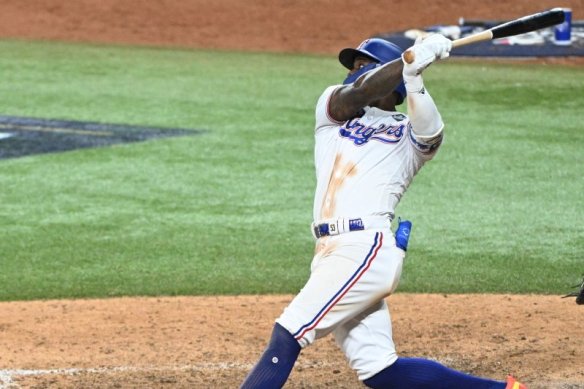
Adolis García

The Cuban defector who rocked a pitcher named Castro for the World Series Game One-winning bomb he’s hitting here . . .

In a more just and far more sane world, this World Series would not feature baseball’s eight-best team (the Rangers) hosting baseball’s twelfth-best (the Diamondbacks). No matter how much fun it was to watch the games by which they got here. This, folks, is Commissioner Pepperwinkle World.

It’s a world where the fun in watching baseball’s Davids slay its Goliaths, as happens often enough, is perverted into a premeditated dilution of the championship race. Where teams who dissipate down the stretch can still sneak into a postseason and trash the joint.

Commissioner Pepperwinkle didn’t create today’s championship dilution, he simply finished and metastasised what his predecessor/former employer began. And while he now says he’s willing to “discuss” this format and that dilution after hearing “enough complaints and chatter” around it, don’t wait in line too long expecting him to heed and adjust.

Unless you count whether their owners voted yay or nay upon Pepperwinkle’s perversion, it’s hardly the Rangers’ or the Diamondbacks’ fault that they could and did ride to this Series while leaving the bigger teams to the winters of their malcontent. “If the die was cast—meaning, that if I win 100 in the regular season, I’m going to win the World Series—I don’t think that’s as interesting as what we have witnessed over the last month,” he added.

Well, just as it couldn’t hurt to watch the earlier wild card, division, and League Championship Series anyhow, it can’t hurt to watch this half-serious World Serious anyhow.

Say what you must about how they got here. These Rangers (who did tie for a division title) and these Diamondbacks (who finished a well-distant second in their division) are having fun while being deadly serious. The Diamondbacks didn’t let bother them that they weren’t supposed to survive the Brewers, the Dodgers, or the Phillies. The Rangers didn’t let bother them that they weren’t supposed to shove their fellow Texans from Houston to one side.

Come Friday night, until Rangers shortstop Corey Seager sent the game to extras with a mammoth two-run homer, it looked as though the Diamondbacks might open by doing to the Rangers what they’d done well enough entering the Series: pitching, pecking, picking, and occasionally pounding their way to a win.

Then a Cuban defector hit a Game One-winning home run off a pitcher named [Miguel] Castro in the bottom of the eleventh.

That won it for the Rangers, 6-5. It also gave Adolis García eight bombs for this postseason and left him one shy of Daniel Murphy’s record of homering in six consecutive postseason games. It should also have sent the Diamondbacks pitching staff a rudely-awakening message: Thou shalt not plunk Adolis García and expect to live.

First, after Seager tied the game off Paul Sewald with Leodys Taveras aboard and a parabola to the rear of the right field seats in the ninth, García was hit on the hand by a Sewald pitch. Late Rangers insertion Austin Hedges struck out for the side. But two innings later, with one out, García hit a 3-1 sinker the opposite way over the right field fence.

Twelve years to the day earlier, the Cardinals’ David Freese wrecked the Rangers when the Rangers were a strike away from winning the 2011 World Series in six games—first with a game-tying triple in the ninth; then, after the game was re-tied in the top of the eleventh, with a full-count leadoff shot over the center field fence.

Figure this if you can: García’s Game One winner Friday night sent him right past Freese himself for the most runs batted in (22) in a single postseason. It might not have happened had García not made a spectacular course correction on Diamondbacks rookie star Corbin Carroll’s two-out, ninth-inning drive to right, overcoming a bad first step to run the ball down and snatch it at the wall.

That might have given these relentless enough Diamondbacks a final lease on Game One life. But no. Then Seager unloaded in the bottom of that inning off Diamondbacks finisher Paul Sewald, the first genuine dent in a Diamondbacks bullpen that was postseason excellent entering the Series and worked three scoreless among three relievers Friday night. Setting the extra-inning stage for García to do what hasn’t been done since Kirk Gibson in the 1988 World Series—win Game One with a walkoff homer.

Maybe doing it on the twelfth anniversary of Freese’s jolts means these Rangers might find the mojo those Rangers lost so horrifically?

In a game where the Rangers took an early 2-0 lead (Evan Carter’s first inning RBI double and García singling him home immediately to follow) but the Diamondbacks bit Rangers starting pitcher Nathan Eovaldi hard for a three-run third and five runs in four and two-thirds innings; where the Rangers went 1-for-7 with men in scoring position to the Snakes going two-for-8; and, where the Ranger bullpen pitched six and a third innings’ two-hit, shutout relief, Seager and García’s late explosions will be what’s remembered the most.

Kind of a shame, too. In the top of the third, Diamondbacks shorstop Geraldo Perdomo finally dropped a bunt you couldn’t call a wasted out. Remember: In six known “bunt situations,” only one leaves you a better chance to score after than before the bunt: first and second, nobody out. That’s what Perdomo had when he dropped one back to the box and pushed Alek Thomas (leadoff infield single) and Evan Longoria (immediate followup single) to third and second, respectively.

Carroll followed and hit a two-strike, two-run triple to the absolute back of center field, then scored the third Snakes run while Ketel Marte grounded out to first base. The Rangers took one back to re-tie in the bottom of the third when Mitch Garver wrung a bases-loaded walk out of Diamondbacks starter Zac Gallen, but Tommy Pham re-snatched the lead when he unloaded on Eovaldi to open the top of the fourth, sending one  over the left field fence. An inning later, Marte sent Perdomo (leadoff single) home with a double, and 5-3 it stayed until Seager in the ninth.

Seager may not mind playing second banana to García even if his handiwork set García’s up. He hollered out uncharacteristically in his joy after he launched his bomb. But after the game, he preferred not to think about that again. “You never think about your own success,” he said. “You think about how that team came together, how that team performed.”

In the American League Championship Series, remember, García unloaded a three-run homer in Game Five and got drilled by a pitch his next time up. All that did was jolt him into the Games Six and Seven bombings that helped yank the Rangers here in the first place. Two batters after Seager unloaded, García was hit by a pitch again, on his hand.

He shook it off. He stole second but was stranded. He bided his time. Then came the eleventh. He didn’t answer the bell, he rang it. Ask him now what the biggest bomb of his life is, and he’ll tell you. “We’re in the World Series,” he said. “I think, honestly, this is the first.”

Unless there’s a more absurdist Elysian Fields script to be delivered later in this Series (put nothing past that heavenly troupe of stinkers), and García finds himself hitting the Series winner, it may yet prove to be the loudest home run in Rangers history.

ALCS Game One: Bad Astro looks, sharp Ranger pitching

Evan Carter

Evan Carter’s running-and-leaping catch of an Alex Bregman drive that had extra bases stamped on it otherwise ended with doubling up José Altuve in the Game One eighth—on Altuve’s own baserunning mistake.

This was not a good look for the Astros. When Justin Verlander keeps the arguable best remaining postseason offense to the weakest postseason game it’s had this time around but the Astros still don’t win, it’s not a good look.

When Jordan Montgomery scatters five hits in six and a third innings with no Astro scoring against him, before handing off to a bullpen whose regular season was an indictment for arson but has been a challenge to pry runs out of this postseason, it’s not a good Astro look.

When José Altuve, one of baseball’s smartest players, makes an eighth-inning baserunning mistake more to be expected of a raw rookie than a thirteen-year veteran with a Most Valuable Player Award in his trophy case, it’s not a good Astro look.

Astroworld should only be grateful that the Rangers didn’t even think about trolling Altuve the way a certain Brave trolled Bryce Harper on a similar but different play in the National League division series out of which the Phillies shoved the Braves.

Harper didn’t miss second scrambling back to first when Nick Castellanos’s long ninth-inning drive in Game Two was caught on the run and leap by Braves center fielder Michael Harris II, but he was thrown out at first by a hair and a half to end the game and the only Braves win of the set.

Altuve didn’t end American League Championship Series Game One Sunday night, but he did put the kibosh on the Astros’s final scoring opportunity in the 2-0 loss. He’d drawn a leadoff walk against Rangers reliever Josh Sborz, who yielded at once to Aroldis Chapman—a relief pitcher whose best fastball can still out-fly a speeding bullet, but who once surrendered a pennant-losing homer to Altuve himself and is still prone to hanging his sliders.

Then, somehow, Astros third baseman Alex Bregman sent a 2-1 slider off the middle of the zone to the rear end of Minute Maid Park, toward the chain-link fence beneath a Bank of America sign. The Rangers’ rookie left fielder Evan Carter ran it down and still had to take a flying leap to catch it one-handed just before it might have hit the fence and spoiled the Ranger shutout.

“Everybody,” said Astros catcher Martín Maldonado, who probably meant both the Astros themselves and the Minute Maid crowd, “thought that ball was going to hit the wall.”

Carter threw in to shortstop Corey Seager, who tossed right to second baseman Marcus Semien with third baseman Josh Jung pointing to the base emphatically. Semien stepped on the base just as emphatically. It took a replay review to affirm what Seager, Semien, and Jung spotted at once. Second base umpire Doug Eddings rung Altuve up. Altuve never touched second en route back to first.

Ouch!

“I didn’t think he was going to make the play he made—it was a great play,” said Altuve, a man who excels at just about everything you can ask of a veteran except baserunning, what with leading the entire Show with sixteen outs on the bases during the regular season. “You just try to come back to first base (and) that’s what I did.”

“That’s a play,” Semien said, “where I always watch to see what the runner does. Sometimes the umpires are looking at the ball, and that’s exactly what (Eddings) told me. He said he was looking at the ball. He didn’t see it. I tried to remind him. He still called it safe, but luckily that’s a play we can review. I’ve made that mistake before on the bases, so it’s one that we kinda go over in spring training, and all of a sudden in the ALCS, it showed up.”

Carter had also run down and caught leaping a Bregman drive down the left field line in the first. Then he himself accounted for the first Rangers run in the second inning, when he shot a base hit right past diving Astros first baseman José Abreu and gunned his way to second ahead of a throw that was dropped almost inexplicably at the base. Rangers catcher Jonah Heim then singled back up the pipe and Carter, reading the ball almost as a Biblical scholar parses the Beatitudes, scored.

“They always preach to us, especially the ones that can run a little bit, just, ‘Hey, it’s a double until it’s not’,” said Carter, who didn’t play his first major league game until 8 September. “So that’s kind of my mindset. I’m going to get a double until the outfielder tells me that I need to stop. I didn’t feel like I was told I needed to stop, so I just kept going.”

Three innings later, the Rangers’ number nine lineup batter, center fielder Leody Taveras, caught hold of a hanging Verlander sinker and lined it right over the right field fence. That was the second and final blemish against Verlander, the veteran who walked to the Mets as a free agent last winter but returned to the Astros in a trade deadline deal in August.

Altuve’s eighth-inning misstep was only the final among several opportunities the Astros missed all game long. They wasted Abreu’s second inning-opening single almost at once when Michael Tucker forced him at second on a followup ground out, then stranded Tucker on a pair of fly outs.

They wasted first and second with two outs in the third when Yordan Alvarez struck out for the second of three times on the night.

They pushed the bases loaded against Montgomery in the fourth, the only inning in which the Rangers’ 6’6″ tall, free agent-to-be lefthander truly struggled, and Montgomery ironed up and struck Maldonado out swinging on 1-2.

It was only when Astros utility player Mauricio Dubón, playing center field for them Sunday night, slammed a hard line out to center field opening the Houston seventh, that Rangers manager Bruce Bochy decided to reach for the bullpen. Now, the Astros had a clean shot at a bullpen that might resemble the Third Army this postseason but blew 33 out of 63 so-called save situations on the regular season.

Altuve’s baserunning mistake still left the Astros four outs to work with yet and the vulnerable Chapman hardly off the hook with Alvarez checking in at the plate: Chapman’s lifetime postseason ERA in Minute Maid Park was 7.53 entering Sunday night. He fell behind Alvarez 2-1. Then, he threw Alvarez a slider that hung up just enough to be sent into orbit, just as Altuve had done winning that 2019 ALCS.

The only place Alvarez sent this one, though, was on the ground toward first base for an inning-ending out. Then Bochy reached for Jose Leclerc to work the ninth. Leclerc landed a hard-enough earned three up, three down; he went to full counts on Abreu and Chas McCormick before getting Abreu to line out to center for the first out and McCormick to strike out swinging, sandwiching Tucker’s 2-2 ground out to second.

“We just found a way to get a couple of runs across the board,” said Bochy after the game ended. “That was the difference in the game, obviously. But our guy was really good, Monty, terrific job he did. And he got in a couple of jams there and found a way to get out of it.”

Verlander didn’t sound discouraged after Game One despite his solid effort coming up just short enough. “We’ve lost Game One of some playoff series before,” said the future Hall of Fame righthander. “And that’s the great thing about this team. Obviously nobody is sitting in the locker room right now happy. But it’s very matter of fact, okay. We just got punched, how do you answer?”

The Astros have Game Two to start answering, of course. But they might have to find a few more ways to keep Carter from running down and killing their better drives.

ALDS Game Two: From blowout to squeaker

Mitch Garver

Mitch Garver’s third-inning grand slam proved the difference maker as the Orioles turned an  early blowout into a squeaker of a win for the Rangers Sunday.

Until this weekend, the last time the Orioles were swept in a series was in May, by the Blue Jays. During the regular season, the Orioles were a .642 team on the road. Now, they’re on the threshold of an American League division series sweep, but they’re counting on that traveling mojo to overthrow a Rangers team that won’t be overthrown without a fight.

Not after the Orioles turned a 9-2 blowout in the making into an 11-8 squeaker in Game Two Sunday. Not after the Orioles couldn’t do better than Aaron Hicks’s three-run homer with one out in the bottom of the ninth. Not after the Rangers battered them for nine runs in the first three innings, including and especially Mitch Garver’s grand slam in the third.

Not after the Oriole bullpen was so deeply deployed following a Game One loss that saw theirs ranks pressed into duty after four and two thirds. Today’s travel day from Baltimore to Arlington may not necessarily give them relief. Not facing a Rangers team that hasn’t played at home in a fortnight but hit 53 home runs more at home than on the road during the season.

“We just came up a little bit short today, but that built a lot of momentum going into the next game,” said Orioles leftfielder Austin Hays after Game Two. “Nobody laid down. We didn’t give away any at-bats. We continued to fight. We were able to get into their bullpen and work on those guys a little bit. I feel good moving forward, but we know we’ve got our work cut out for us.”

That’s a polite way to put it. They played .500 ball against the Rangers in six regular season games, but they blew their home field advantage to open this division series. A team that hasn’t seen home in a fortnight can be presumed hungry to put an end to this set as soon as possible, by any means necessary.

The Rangers proved that when they started Garver, a backup catcher who played in only half the regular season games, and sent him out for his first postseason appearance this time around. In a game the Orioles opened with a 2-0 lead after one full inning, but the Rangers slapped rookie Orioles starting pitcher Grayson Rodriguez silly with a five-run second, Garver checked in at the plate with one out followed by three straight walks.

Orioles reliever Bryan Baker left the pillows loaded for his relief, Jacob Webb. On 3-1 Webb elevated a fastball, and Garver elevated it six rows into the left field seats.

Rangers manager Bruce Bochy—who came out of retirement to shepherd the Rangers after all those years and those three World Series rings managing the Giants—said pregame that it was “just time to get [Garver] out there.” Garver may have given the boss the most expensive thank-you present of the postseason thus far.

“He’s got big power,” Bochy said postgame, “and that’s big at that point in the game. Really was the difference in the game.”

So were the eleven walks handed out by eight Orioles pitchers, including a postseason record five to Rangers shortstop Corey Seager. So were the mere three hits in thirteen Oriole plate appearances with runners in scoring position, which explains a lot about how the Orioles actually out-hit the Rangers (fourteen hits to eleven; .973 to .891 game OPS) but fell three short in the end.

Also in too-vivid contrast were the fruits of each team’s trade deadline moves. Or, in the Orioles’ case, lack thereof. The Rangers moved to bring future Hall of Famer Max Scherzer into the fold but also added starter Jordan Montgomery and reliever Chris Stratton in a deal with the Cardinals.

The Orioles moved to bring another Cardinal pitcher, Jack Flaherty, aboard at the deadline. But Flaherty, once a glittering Cardinal comer, hasn’t been the same pitcher since a 2021 oblique injury and a 2022 shoulder injury. He pitched his way out of the Oriole rotation and now looks to be the long man out of the bullpen.

He got a shot at showing what he could do in that role when it looked as though it would be just mop-up work Sunday. The good news: He surrendered only one run (on Garver’s double play grounder in the fifth) in two innings’ work. The bad news: He contributed to the Oriole walking parade with three of his own, including two in the fifth.

Some say the Orioles standing practically pat at the trade deadline instead of going for any kind of impact deal may yet come back to bite them right out of the postseason, especially after their own pitching depletion (losing top starter John Means and closer Félix Bautista especially) late in the season. Others fear the Orioles were more concerned with their usual penny pinching plus censoring a lead broadcaster over a positive graphic the team itself fashioned for a broadcast.

Montgomery handled the Orioles well following the two-run first, at least until he surrendered a pair in the fourth on an RBI single (Jorge Mateo) and a sacrifice fly (Ryan Mountcastle.) But when Orioles rookie star Gunnar Henderson greeted him with a full-count leadoff home run and Hicks followed with a base hit, Montgomery’s day ended and the ordinarily wobbly Ranger bullpen took over.

That bullpen kept the Orioles quiet until the bottom of the ninth, when Brock Burke handed Henderson a one-out walk and Hays singled him to second. Bochy reached then for José Leclerc, and Hicks—the erstwhile Yankee who never really found his best footing in the Bronx—reached for a one-strike service and drove it into the right field seats.

It was a little vindication for Hicks the day after he blew a hit-and-run sign in the Game One ninth, leaving Henderson a dead duck on the pond when he was thrown out at second, before Leclerc finished the 3-2 Rangers win. After his up-and-down Yankee life, Hicks looked like an Oriole blessing after he signed in May following his Yankee release. After Sunday, he looked like an Oriole hope once again.

An Oriole hope is just what Baltimore needs now. But Ranger hopes won’t exactly play to an empty house come Tuesday. At the end of the former, survival. At the end of the latter, a chance to play for the pennant.

The bullet bites the Dodgers

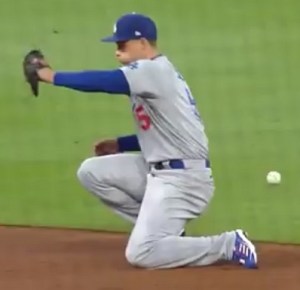
Corey Seager

Seager couldn’t stop the unstoppable smash hit in the bottom of the ninth.

It didn’t cost anyone a World Series they were one strike away from winning. It didn’t cost anyone a pennant. It was only Game Two of the National League Championship Series, and one team has a 2-0 disadvantage that actually can be overcome and overthrown in a best-of-seven set.

Corey Seager’s inability to stop Eddie Rosario’s two-out smash up the pipe in the bottom of the ninth Sunday night, and thus stop Dansby Swanson from scoring the winning Braves run, stands to be a candidate for the worst individual moment in Dodger postseason history. Unless the Dodgers can perform that overthrow.

How many years have you mused how readily one player can go from hero to goat in the same game—if not the same inning? But how often does it happen in a game—and a set so far—in which his team seems to see men in scoring position as allergies above opportunities?

Twice on Sunday, Seager played the hero, once in the top of the first and once in the bottom of the ninth. Within minutes of the second play, he stood shriven and the Dodgers stood halfway toward the end of their season, and all he’d been asked to do in that harrowing moment, in effect, was to try what amounted to catching a speeding bullet with his teeth.

Seager opened the Dodger scoring in the top of the first with Mookie Betts aboard on a jam-shot pop single to shallow left. He turned on Braves starter Ian Anderson’s first service and hammered it over the right center field wall. In two blinks he put Anderson and the Braves into a 2-0 hole.

In a four-all tie in the bottom of the ninth, Seager hustled from defensive shift positioning well behind second base to take Dodger reliever Brusdar Graterol’s slighly offline throw to second to erase pinch-runner Cristian Pache on Swanson’s would-have-been sacrifice bunt. That’s the way to make the Braves waste a precious offensive out even worse.

After Braves center field double-switch insertion Guillermo Heredia grounded out to push Swanson to second, Dodger manager Dave Roberts lifted Graterol for Kenley Jansen, with Rosario checking in at the plate having a 3-for-4 night and counting.

A ground out pushed Swanson to second, Graterol was lifted for Kenley Jansen with Rosario coming up, having gone 3-for-4 thus far—and having scored the Braves’ third run when third base coach Ron Washington waved him home daringly on an eighth-inning Ozzie Albies base hit, diving behind the plate just eluding Dodger catcher Will Smith’s tag.

All Jansen did now was throw Rosario one nice little cutter heading for the inside part of the plate. All Rosario did was fire it right back up the pipe at a reported 105.4 miles per hour. Seager had little choice behind second but to turn down to his right to try backhanding the bullet. It blasted off his downstretched glove and into shallow center field.

Swanson shot home with the winner in a 5-4 Braves win, the second walk-off-winning run in two NLCS games for these Braves, who must be feeling as though they’re living charmed lives so far. The bullet bit Seager and the Dodgers. With 32 teeth.

But if you’re going to pound the goat horns into Seager’s forehead, or even demand Dodger manager Dave Roberts’ immediate execution over one or two of his pitching decisions, you really should consider this:

How come the team that led this year’s National League in runs scored, and had a team .806 OPS with runners in scoring position, couldn’t go better than 2-for-18 with four walks and a hit batsman in 24 chances to get runs home so far in this set?

How come the two hits each came from Chris Taylor, with one of them a Game Two bloop misplayed by Heredia into a tiebreaking two-run double in the top of the seventh? Where have all the other Dodger bats been when they manage to get somebody on second base or beyond?

Go ahead and second-guess Roberts’ pitching moves all day long if you must. Argue as you must how foolish it was to send Max Scherzer out to start when Scherzer by his own postgame admission had a dead arm going in.

When Roberts lifted Scherzer for Alex Vesia in the fifth, this time there was no objection from the gassed marksman. Max the Knife was probably lucky that the worst damage in four and a third innings was former Dodger Joc Pederson—now a Brave, by way of the Cubs’ trade deadline fire sale—hitting a two-run homer well above the Chop Shop behind Truist Park’s right field seats in the third.

Argue as you must, too, that Roberts’ real weakness handling his pitching staff isn’t so much playing it by any analytical script as it is relying far too heavily on the more highly-revered members of his pitching staff, instead of paying close attention to which arms have which hot hands regardless of star power.

This time, it was using his 20 game-winning starter Julio Urias in an oft-familiar role—moving him between postseason starting and relieving, a role he’s normally thrived in performing—only to see it backfire spectacularly enough in the Braves’ two-run, re-tying eighth.

Argue as you must that Roberts could well have Graterol for the seventh—after Joe Kelly got rid of the Braves in order in the sixth—and saved Blake Treinen and Jansen to start clean eighth and ninth innings. Or, that he could have given Graterol the night off and used  Treinen and Jansen over the final three innings to divide the last nine outs between them. Or, that he could have brought lefthanded Justin Bruihl in to handle the lefthanded Braves due to swing in the eighth.

Roberts said postgame that in weighing every option the lefthanded Urias was the best arm he had to bring in for the eighth. There’s nothing but positive when you reach for what you think is the best available arm when there’s a two-run lead to protect. That’s what a smart manager does. But even Urias is only human, not Superman.

Sometimes, even in the worst possible moment, the other guys are just a little bit better. The goat hunters too often like to forget that when they’re prowling for a head onto which to plant the horns.

Roberts is no stranger to calculated gambling. If the Urias gambit worked, he’d have resembled a Stengelian genius. When he said postgame that the postseason is the time of year when “careful” isn’t an option, he was dead right. “Careful” wasn’t exactly an option for the Braves, either, when Washington waved Rosario home and left room for Game One walkoff conqueror Austin Riley to send an RBI double to the back of center field.

Since the Braves managed to stand the Urias gambit onto its own head with a little risk taking of their own, it may force Roberts into even deeper such gambling, since Urias was originally his projected Game Four starter but now may be compromised going into that game if he’s still on the slate.

But offer succor to Seager, not sulfuric acid. The Braves didn’t walk Game Two off because Seager did what he wasn’t supposed to do or what he knew better than to do. He’d done his level best to send his team toward a win as the game opened. He’d done his level best to keep them alive and toward extra innings.

Now, Seager did his level best again to keep his team alive but failed to stop the unstoppable bullet. The Dodgers have nine Game Two goats to hold to account. Those batters who couldn’t and didn’t hit with six more Dodgers in scoring position after Seager’s homer and before Taylor’s double.

There’s a reason a smash hit is called a smash hit. Often as not, it’s just too unstoppable.

The strike heard ’round the world

Don Denkinger, you’re off the hook. Flores checking his swing into the arguable worst blown call in postseason history

Giants manage Gabe Kapler wouldn’t say it, even though anyone with eyes to see would say it for him. Even the Dodger fans among them. Maybe it wouldn’t change the outcome with that wired a Max Scherzer on the mound.

But ending this National League division series with that bad an umpire’s call? For the final out of the season for one team, not the first out of the ninth as was Don Denkinger’s infamous blown call at first in Game Six of the 1985 World Series?

There isn’t a jury in the land that would rule Kapler unjustified if he’d blown his proverbial stack or even demanded an investigation. This tight a Game Five between two of baseball’s most bitter of blood rivals plus the two winningest teams in this year’s Show deserved better than that.

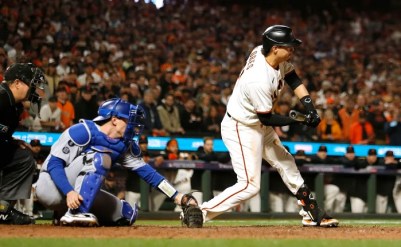
These Dodgers and these Giants deserved better than first base umpire Gabe Morales ruling Wilmer Flores’s checked swing a strike to end it, after home plate umpire Doug Eddings—to his eternal credit—called for Morales’s help. That kind of help neither Eddings nor the Giants needed.

Two teams who’d been even-up in their regular season meetings, had the same number of hits against each other (173), and entered Game Five with each having 109 wins for the year including the postseason thus far, deserved better than a 2-1 Dodger win tainted through no fault of either team’s own.

“There are other reasons we didn’t win today’s baseball game,” Kapler said post-game. “That was just the last call of the game.” That was like a Japanese commander saying Hiroshima and Nagasaki were just the last blows of World War II.

Let’s give Morales a temporary benefit of the doubt. “[C]heck-swings are one of the hardest calls we have,” he said post-game. “I don’t have the benefit of multiple camera angles when I’m watching it live. When it happened live I thought he went, so that’s why I called it a swing.”

But Morales was shown a replay of that final pitch. Then, someone asked if he’d still call it failed check swing. Ted Barrett, the crew chief, answered for him. Sort of. As if Morales was incapable of speaking for himself.

“Yeah, no, we, yeah, yeah, he doesn’t want to say,” Barrett said. If there’s a more mealymouthed response upon a blown call’s questioning on record, I’d love to see it. Even Denkinger wasn’t that foolish when confronted with how badly he’d blown it calling Jorge Orta safe at first despite being out by almost a full step.

“Obviously you don’t want a game to end that way,” Kapler also said. “Obviously it’s going to be frustrating to have a game end like that, but pretty high quality hitter at the plate that can climb back into that count. There’s no guarantee of success in that at-bat. It’s just a tough way to end it.”

Flores checked his swing on an 0-2 pitch that came in just under the low outside corner. All things considered, especially the proliferation of dubious pitch calls all series long against both the Dodgers and the Giants, it wouldn’t have been the worst possible outcome for the plate appearance to continue.

But Flores checked his swing. Eddings called to Morales. Morales rang Flores up for game, set, and match. Sending the Dodgers to a National League Championship Series against the Braves, sending Giants fans reaching for the nearest possible liquid salves, and soiling the Game Five this series deserved otherwise.

They’d gone tooth, fang, claw, and just about anything else not just to get to Game Five in the first place but to get to the bottom of the ninth with only a single run separating them.

The Dodgers had gone to a bullpen game, opening with reliever Corey Knebel, continuing with fellow reliever Brusdar Graterol, then sending starting pitcher Julio Urias out of the pen to pitch a solid enough third through sixth. Then back to the pen men Blake Treinen for the seventh and Kenley Jansen for the eighth.

The thinking was that the Giants—a club full of elders and anonymous role players for the most part—were so deadly in situational play that, as The Athletic‘s Andy McCullough observed, the Dodgers’ best shot at neutralising that advantage by throwing two-thirds of their bullpen at the Giants and returning Urias to the postseason role where he’d been so effective in the recent past while they were at it.

It’s not that teams haven’t gone to bullpen games before. The Rays make about a third of their living doing it. Why, almost a full century ago the Washington Senators (Washington—First in war, first in peace, and last in the American League) won the 1924 World Series going to a bullpen game prototype in Game Seven.

All the Dodgers needed was Urias on board with the idea. “He earned the right to pitch in this game,” said Dodgers pitching coach Mark Prior. “If he said, ‘No, I want it,’ he was going to get it.” They surveyed other Dodgers including starters Scherzer, injured Clayton Kershaw, and Walker Buehler, who’d pitched so effectively in the Dodgers’ Game Four win.

“When they were on board,” Prior said, “it made sense. Everyone is in it to win it. Let’s go.”

That’s how they countered the Giants sending their stout young starter Logan Webb out for Game Five. He gave the Dodgers as good as their pen game gave the Giants. He pitched seven solid innings. The only blemishes on Webb were Mookie Betts delivering three of the four Dodger hits against him, and Corey Seager sending the Mookie Monster home with a double down the left field line in the top of the sixth to deliver the game’s first run.

Until Scherzer came into the game, the only real blemish against the Dodgers’ pitching was Giants left fielder Darin Ruf tying the game at one leading off the bottom of the sixth, by hitting Urias’s full-count fastball over the center field fence.

But until the Flores check swing that should have been, the co-story of the game might have ended up being the Dodgers leaving the Giants behind with yet another Belli-ache plus Max the Knife plunged into their backs in the bottom of the ninth. More’s the pity.

Continuing his re-adjusted postseason revival—after an injury-marred regular season reduced him to terms so low people questioned why Dodger manager Dave Roberts kept running his former MVP out there at all—Cody Bellinger broke the one-all tie in the ninth.

He made the Giants pay after their young relief ace in the making Camilo Doval hit Justin Turner up and in on the first pitch after Will Smith grounded out to shortstop to open the top of the ninth. Gavin Lux snuck a base hit through the right side of the infield to set first and second up.

Then, Bellinger took ball one low, swung through a slider around the middle, bounced a foul ball off to the right, then shot one up the middle and into center field sending Turner home with the tiebreaking run. Which probably amped Scherzer up in the pen even more than he’d already sent himself.

When he wasn’t throwing warmup pitches, Scherzer paced and pranced like a maniac. It was a wonder nobody had to shoot a tranquiliser dart into his rump to make sure he could go in and pitch the bottom of the ninth without dismantling himself.

He all but shot in from the pen to the mound as the sides changed. It was so must-see television that the TBS broadcast obeyed the call, too, not cutting to a commercial break as he made his way to the mound. You’d have thought the back of his uniform carried not his surname and number 31 but Danger! High Explosives! Keep Back 500 Feet!

Pinch hitter Matt Beaty ended the top of the ninth by grounding out to Flores playing first for the Giants. “Flores touched first base,” said Betts with a laugh, “and it felt like Scherz was halfway to the mound.”

This was virgin territory: Scherzer had never recorded a relief save in his entire professional pitching career. Yet he flew in from the pen as though fourteen years’ worth of a Hall of Fame pitching career to date was merely the overture to his kind of Unfinished Symphony.

So, with Bellinger shifted from first base to center field and Billy McKinney out playing first, Max the Knife unsheathed. He got Crawford to line out the other way to left. He shook off Turner bobbling Kris Bryant’s grounder up the third base line enabling Bryant safe on the error to strike out Lamonte Wade, Jr., who’d been making a name for himself with assorted ninth-and-later heroics for the Giants.

Then came Flores, the former Met who’d been part of their 2015 run to the World Series. A slider hitting the middle of the zone for a called strike. A foul off. Then, the fateful slider coming down and just off the corner. The checked swing. Eddings’ appeal to Morales at first. Strike three. Game, and Giants’ season, over.

There are eleven categories of reviewable umpire calls that managers are allowed to challenge. In the postseason, a skipper gets two challenges instead of the one allowed during the regular season. Check swings and pitches aren’t among the eleven. Maybe in the postseason they ought to be.

The “human element” be damned. When Whitey Herzog (Cardinals manager in 1985) called outright for replay in his 1998 memoir You’re Missin’ a Great Game, he had it as right as right can be: “This is for the championship—let’s get it right.” This was toward a potential championship and a win-or-wait-till-next-year game in the bargain. It should have been gotten right.

Seventy years ago, the Giants’ Bobby Thomson hit the Shot Heard ‘Round the World to finish a pennant playoff we’ve long since known, with full proof, was tainted by an off-field-based sign-stealing plot that helped those Giants come from thirteen games back to forcing that playoff in the first place.

Maybe it was tempting the fates a little too flagrantly when it turned out someone with the Giants—not a fan or fans, as I thought when seeing the sign in a flickering moment during the Game One telecast—tacked that “Remember ’51!” up on a deck rim in Oracle Park. Very clever, using a tainted triumph for motivation.

But ’51 was then, and this was Thursday night. Tainted not by cheating but by the kind of malfeasance that’s brought demands for further and fuller umpire accountability and for technology to help get the calls right. I don’t have to be as kind as Gabe Kapler.

Don Denkinger, you’re off the hook for the arguable worst blown call in postseason history. Maybe Scherzer would have retired Flores anyway if the proper call was made; maybe Flores would have kept the inning alive with a base hit. Maybe—unlikely as it might have been, considering his 0-for-17 lifetime jacket against Max the Knife—he might have tied or even won the game with one swing.

Maybe. We’ll never know now.

Until or unless baseball’s government effects real, substantial umpire accountability and stops allowing the “human element” to enable them to get away with murder, this NLDS Game Five’s finish should be known forever as The Strike Heard ‘Round the World.