Davey Johnson, RIP: “Forward thinker with old-school soul”

Davey Johnson

Davey Johnson at a 2016 reunion of his 1986 Mets. L to R: Keith Hernandez (1B), Jesse Orosco (RP), Ray Knight (3B), Lee Mazzilli (OF-PH), Johnson. They made the Deltas of Animal House resemble monks.

In 2012, on the threshold of managing the Nationals to their first National League East title after they moved from Montreal, Davey Johnson had mortality very much on his mind, after his one-time Mets player and lifelong friend Gary Carter lost a battle with brain cancer.

Johnson had seen Carter the previous winter and played golf with him at Carter’s charity event for needy children. When The Kid died, Johnson couldn’t bring himself to attend the funeral. “He would want me to be doing what I loved and not crying over him,” Washington Post writer Adam Kilgore remembers Johnson saying. “I don’t want nobody crying over me, either. It’s that simple. It may be callous, but I don’t look at it that way.”

The man who bookended both Mets World Series championships—he flied out to Cleon Jones to finish the 1969 Miracle Mets triumph, and managed the (shall we say) swashbuckling 1986 Mets to a World Series title—died Friday at 82.

Perhaps former Nats general manager Mike Rizzo described him best, in a Saturday text message to Kilgore: “Davey was a tough guy with a caring heart. One of the great baseball minds of all-time. A forward thinker with an old-school soul.”

During his playing days, Johnson took computer courses as a Johns Hopkins University graduate student and used what he learned to develop best possible baseball lineups. Offering one to his irascible manager Earl Weaver, who spurned it, Johnson said, “I don’t know whether to tell Earl, but the sixth-worst lineup was the one we used most of the time [in 1968].”

When he became a manager in the Mets’ system and then for the Mets themselves, Johnson brought such thinking plus his computer into his clubhouse and dugout. It’s entirely likely that he pushed the door open to sabermetrics as an active game tool and not just a postmortem analysis. He looked for the matchups and took the concurrent measure of his players at once.

But he wouldn’t let you call him one of the smartest of the game’s Smart Guys. “I never thought I was smart,” he said in 2017. “But I love to figure out problems. Through my stubbornness and relentlessness, I get to the end.” Bless him, he had to learn the hard way that the end had more than the meaning he had in mind.

“I treated my players like men,” he once said of his Mets, whom he led out of a dark age through a pair of hard pennant races and second-place finishes before they went the 1986 distance. “As long as they won for me on the field, I didn’t give a flying [fornicate] what they did otherwise.”

Not even when they celebrated a too-hard-won 1986 National League Championship Series by trashing their United Airlines charter DC-10 with partying that made the Gas House Gang and Animal House’s Deltas resemble conclaves of monks.

Maybe Johnson really was a forward thinker with an old-school heart. He treated like men a team with too many players behaving off the field as though their second adolescence came or their first hadn’t ended yet. Such straighter arrows as Hall of Fame catcher Carter plus infielders Howard Johnson, Ray Knight, and Tim Teufel, and outfielder Mookie Wilson, were the exceptions.

“He was just a player’s manager,” said Wilson upon Johnson’s passing. “He made it fun to go to the field. He laid down the law when needed, but other times he just let us play.” Then, and right to the end of his tenure on the Nationals’s bridge, Johnson liked to tell his players, “You win games. I lose them.”

Little by little, general manager Frank Cashen got less enchanted with his team and his laissez-faire manager. No two more opposite minds could ever have come through the Oriole system to bring the Mets to the Promised Land. And almost as swiftly as they got there, Cashen began letting his most characteristic players escape.

“Maybe we’ve made too many trades for guys who are used to getting their asses kicked,” said Dwight Gooden, the pitching star first made human by ill-advised work to fix what wasn’t broken in spring training 1986 and then a long war with substance abuse, to Jeff Pearlman for The Bad Guys Won. The guys who used to snap . . . they’re gone.”

Some also thought Cashen’s gradual dismantling of the team that should have ruled the earth or at least the National League for the rest of the decade took a toll on and the edge off Johnson’s once-formidable in-game cleverness. (He was known to be less than enthusiastic about several trades instigated by either Cashen or his then right-hand man Joe McIlvane.)

Once a second base star with the Orioles who also set a record for home runs in a season by a second baseman as a Brave, Johnson faced the proverbial firing squad in early 1990. It wouldn’t be the last time he brought a team to the Promised Land or its threshold only to be shoved to one side.

He took the Reds to the first-ever National League Central title after the post-1994 strike realignment—despite being told early that season it would be his last on that bridge. Capricious owner Marge Schott apparently didn’t like that he’d lived with his wife before she became his wife.

Then the Orioles made a dream come true and hired Johnson to manage them. Season one: 1996 American League wild card. Season two: The 1997 AL East. Neither brought him a World Series title. The wild card led to an American League Championship Series loss. (The outstanding memory: Jeffrey Maier making sure Derek Jeter’s long drive wouldn’t be caught for a homer-robbing out.) The division title led to another ALCS loss (to the Indians).

Johnson and Orioles owner Peter Angelos weren’t exactly soul mates. Angelos steamed all 1997 when Johnson fined Hall of Fame second baseman Roberto Alomar for missing a team function and ordered the fine to be paid to the charity for which Mrs. Johnson worked as a fundraiser. Johnson admitted soon enough that that was a mistake. (Alomar paid the fine to another charity.) Angelos wanted Johnson to say publicly he’d been “reckless.”

The manager declined, politely but firmly. Then, after the Orioles postseason ended, Johnson waited for Angelos to tell him, ok, you won the division again, that’s enough to let bygones be bygones. “Last week, Johnson called the Oriole owner,” wrote the Washington Post‘s Thomas Boswell, on 6 November 1997.

They talked. And yelled at each other some, too. Aired their differences. Johnson hoped it would help. That’s how it works in the clubhouse. You got a problem with me? Spit it out. Then work it out.

Johnson took a chance on Angelos. When challenged, maybe he’d respond like a big leaguer. Sometimes, after the venting is finished, a friendship develops—even a strong one. Sometimes you just agree to disagree and keep on fussing, like Earl Weaver and Jim Palmer. Either way, you respect each other and pull in the same direction.

Instead, all Johnson heard from Baltimore was silence. So, Johnson had his answer. Angelos wanted Johnson to resign as manager. If the Orioles fired him, they’d have to pay Johnson $750,000 next season . . .

. . . Nobody wants to be where they are not wanted. Especially if they are wanted almost everywhere else. “I’ll make it easy for him,” Johnson said. He wrote to Angelos: “I offer my resignation.”

On the same day Johnson was named American League manager of the year by the baseball writers, his resignation was accepted by Angelos.

Taking the high road helped make sure Angelos wouldn’t try to renege on the $750,000 he still owed Johnson for 1998. You think Angelos appreciated that high road? Not a chance. As with departed Orioles broadcast mainstay Jon Miller, Johnson “asked to be treated with the respect—in contractual terms—that his performance merited.”

In response, Angelos orchestrated the exodus of each. After Miller left, Angelos claimed Miller wanted to leave, contrary to appearances and Miller’s amazed protestations. Yesterday, Angelos said of Johnson, “It seems to me he wanted to move on.” By way of comment, let it be noted that Angelos has one of the rare law firms in which there are no partners. It’s just his name on the door.

Davey Johnson

Once a star second baseman in Baltimore, Johnson presses a point as a successful Orioles manager—who ran afoul of owner Peter Angelos, as Angelos made sure only too many did.

Johnson didn’t remain unemployed for long. (Neither, of course, did Jon Miller.) The Dodgers brought him to the bridge for 1999. He had his first losing season as a manager (though he won his 1,000th game in the job), then turned the Dodgers around in 2000 but fell short of the division title. Back to the firing squad. Again.

He then managed American and (one year) Netherlands teams in international competition before being hired into the Nationals front office. When manager Jim Riggleman decided to quit in June 2011, Johnson was named his eventual successor. He took them to a third-place NL East finish, their best since moving to Washington from Montreal, then led them to the NL East title in 2012 but a division series loss to the defending world champion Cardinals.

That didn’t keep his players from respecting him. Johnson must have come a very long way from the years when a laissez-faire approach to managing men eventually blew up in his face. I could be wrong, but I don’t remember any of his Cincinnati, Baltimore, Los Angeles, or Washington teams accused of trashing jumbo jets, for openers.

“If you come out here and you play hard and really work your tail off,” said his Rookie of the Year winner Bryce Harper during that season, “he’s going to like that. He plays it hard and he plays it right. That’s the type of manager you want.”

“Davey was an unbelievable baseball man but an ever better person,” said longtime Nats mainstay Ryan Zimmerman in a text to Kilgore. “I learned so much from him about how to carry myself on and off the field. No chance my career would have been the same without his guidance. He will be deeply missed by so many.”

On and off the field. Make note.

Johnson did win his second Manager of the Year award guiding the 2012 Nats. He’s one of seven to win it in each league; his distinguished company: Tony La Russa, Lou Piniella,  Buck Showalter, Jim Leyland, Bob Melvin, and Joe Maddon. After a second-place 2013—made slightly worse than it looked when he opened the season saying it looked like a World Series-or-bust year to be—Johnson elected to retire.

“In one respect,” Boswell wrote after his Oriole departure, “he’s different than almost every other manager of his generation. He doesn’t come to ownership with hat in hand. He doesn’t act like he’s lucky to be a big league manager and could never get any other job half so grand. He’s an educated, broadly accomplished man. And he carries himself that way. It has cost him.”

Johnson learned compromise as he aged, both in the game and away from it. So did a few of his former players who once butted heads with him or otherwise made him resemble Emperor Nero fiddling while Flushing flushed. (Darryl Strawberry, with whom Johnson had a relationship often described as “testy,” came to believe Johnson was the greatest manager he ever played for.)

Maybe tragedy had something to do with it, too. Johnson’s daughter, Andrea, once a nationally-ranked surfer but a diagnosed schizophrenic, died of septic shock in 2005; his stepson, Jake, died of pneumonia in 2011. (He also has a stepdaughter, Ellie.) Even the most impregnable man can be wounded. Even men who win two World Series as an Orioles second baseman and one managing the wildest and craziest Mets team of the 1980s.

May the forward-looking old-schooler be escorted to a happy reunion with his daughter, stepson, host of teammates, and Kid Carter in the Elysian Fields.

Dave Parker, RIP: Presence

Dave Parker

The Cobra had a blast playing baseball–and he leveled a few blasts, too . . .

Dave Parker almost lived long enough to take the Cooperstown podium for his Hall of Fame induction. A long-enough battler with Parkinson’s disease, there had been a time when Parker wondered whether it was his own fault he hadn’t or wouldn’t be elected to the Hall.

The Classic Baseball Era Committee elected him last December. The Cobra died at 74 Saturday, 29 days before he’d have been up on that stage. Not fair.

Even before his notoriety during the 1985 Pittsburgh drug trials, Parker could have caused a lot of people to wonder the same thing. Power hitter though he might be, he also played with the attitude of scrappy little middle infielders.

On the bases he thought infielders plus catchers were nothing more than papier mache walls through which to run. not living breathing humans liable to stand just as strong against him as the linebackers against whom he played as a high school running back. Describing him as a Sherman tank running on high test would not have been inaccurate.

Those caused him injuries that got in the way of his performance more often than not as time went on. His admitted cocaine use at the drug trials surely did, too. He might apologise for having been a fool, but Parker never once shied away from taking responsibility for his own self.

That classic prankish-looking face and that classic wisenheimer smile—invariably, Parker resembled a man unable to mask that he’d just detonated a ferocious prank somewhere within the vicinity—married his jaw-dropping power at the plate to make the Cobra look as though he couldn’t wait to carve his autograph into a hapless pitcher’s cranium and make the poor sap laugh his fool head off over it.

His self-worth was bottomless and unapologetic. He wasn’t even close to kidding when he told a fan trying to get the best possible angle for a cell phone camera shot, “It wouldn’t take much to make me look good.” But what made him look better was his reputation for team leadership wherever he played.

In Pittsburgh and in Oakland he was part and parcel of World Series winners. In between, he had a memorable stop in Cincinnati, where his manager was Pete Rose and he sat on deck one fine day in Wrigley Field, about to close a road trip out, awaiting manager Rose’s decision on what player Rose would do at the plate—and whether player Rose would take a final shot at passing Ty Cobb on the all-time hit list in the bargain.

Parker’s presence helped Rose make his decision. Manager Rose knew his Reds had only the slimmest shot at staying in the 1985 pennant race and that nobody batting behind Parker was liable to deliver the clutch hit. A sacrifice bunt would have left first base open and the Cubs liable for malpractise if they pitched to Parker rather than put him on to go for the weaker pickings behind him.

Never mind every Red fan on the planet plus their (shall we say) mercurial owner Marge Schott demanding Rose bunt and save the big hit for the home folks. Manager Rose ordered Player Rose to swing away knowing that would give his team just enough more chance to win—but he struck out. It was the most honourable strikeout of Rose’s life. Maybe the most honourable play of it, too. Imagine if Parker wasn’t on deck.

Once he cleaned up from his cocaine issue, Parker’s clubhouse leadership came back to the fore. Making him the kind of guy who had big value to his team even when he slumped. Your clubhouse might be a lot more fun but it would also become a lot more baloney-proof.

As a matter of fact, that clubhouse value shone brightest when the Cobra left Oakland after their 1989 Series triumph, but the Athletics got swept out of the 1990 Series—by a Reds team picking itself up and dusting itself off after Rose’s violations of Rule 21(d) cost him his professional baseball career.

Stop snarling and let Thomas Boswell (who will be in Cooperstown that July weekend accepting his Career Excellence Award induction) explain, as he did in a sharp post mortem analysing just how those mighty A’s could have been humbled by those underdog but hardly modest Reds:

Where is Dave Parker when you need a clubhouse enforcer? The A’s always knew, sooner or later, they’d need Big Dave to quell a cell-block riot, just as the ’77 Reds desperately missed Tony Perez after they traded him. In ’88 [Jose] Canseco popped off about beating the Dodgers in five games. The Dodgers won in five. In ’89 Parker promised to clean, stuff, and mount Jose if he spoke above a whisper. The A’s swept. Now Dave’s gone, Jose predicted a sweep. General manager Sandy Alderson makes a lot of good moves, but saving money on Parker may have cost him a world title.

Dave Parker

“Where is Dave Parker when you need a clubhouse enforcer?” The A’s missed Parker more than they thought when they let him escape after 1989.

“He’s one of the greatest teammates I’ve ever had,” said Parker’s Oakland teammate, pitcher Dave Stewart, a man who looked like six parts commando and half a dozen parts assassin on the mound. “He had such a presence when he walked into the room.”

“He used to say, ‘When the leaves turn brown, I will be wearing the crown’,” said Keith Hernandez, who played against Parker as a Cardinal and a Met and saw Parker win the National League batting title back to back. “Until I usurped his crown in ’79. He was a better player than me. RIP.”

Until his illness made it difficult if not near impossible, Parker’s post-playing days included working as a special batting instructor for the Pirates. Longtime Pirates star Andrew McCutchen was one of those who learned a few things from the Cobra.

“It was rough to see him go through that,” said McCutchen in a formal statement. “I just hope now he’s in a better place and not having to worry about that stuff anymore . . . He was probably Superman to a lot of people when he played.”

Parker’s kryptonite turned out to be Parkinson’s. “I’m having good days, bad days, just like everybody else,” he told a Pennsylvania radio station four years ago. “My bad days, you just got to play the hand that’s dealt. And I know that it’s something that I got to deal with for the rest of my life.”

One of his ways of dealing with it was setting up the Dave Parker 39 Foundation (39 was his uniform number), raising money to continue research into finding a cure for the disease whose other famed victims have included actor Michael J. Fox, boxing legend Muhammad Ali, singer Linda Ronstadt, and Pope John Paul II.

Pirates middle infielder Nick Gonzales wears Parker’s old number 39. He said Saturday, learning Parker had just passed, “It just meant a little more playing today with that number. Personally, I think it should be retired. I think I should get a new number, honestly.”

That kind of tribute would be one of two Parker might appreciate from his new eternal perch in the Elysian Fields. The other was the Pirates doing just what they did Saturday, thumping the higher-flying Mets 9-2 a day after they thumped them 9-1. And the Cobra didn’t have to promise to clean, stuff, and mount anyone to make it happen, either.

A rainy day memorial for Rose

Pete Rose Memorial

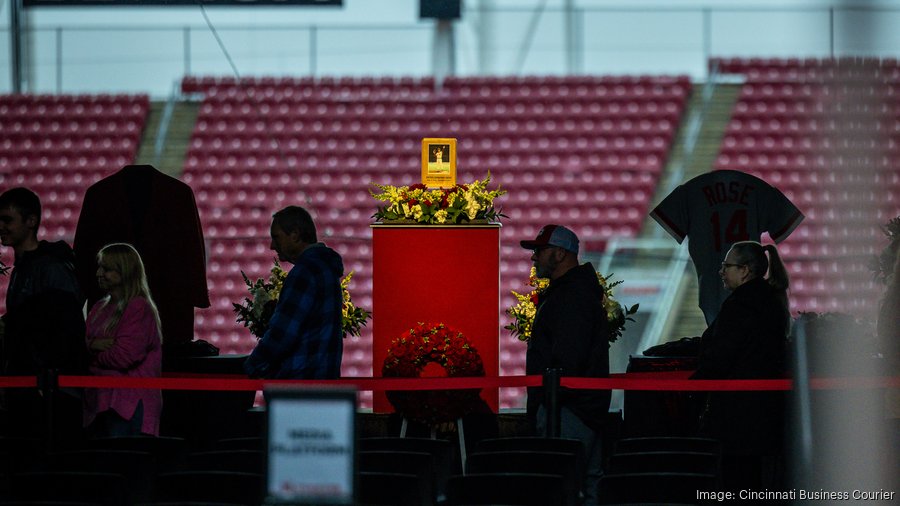
Cincinnatians still mourning the late September death of Pete Rose file past his urn hoisted in Great American Ballpark Sunday. (The photo on top: Rose pointing skyward on first base after breaking Ty Cobb’s career hits record in 1985.) The Reds enabled them to say farewell to the late legend over fourteen hours—in honour of Rose’s uniform number 14. 

From 7 AM through 9 PM Central Standard Time, Cincinnati was handed the chance to visit Great American Ballpark and pay their respects to Pete Rose. Dreary with the rain though it was, several thousand people did just that.

They came to say goodbye to a hometown baseball legend who died September 30 at 83. A hometown legend whose wounding flaws and the sickness that got him banned from baseball and from election to the Hall of Fame many among them still seem to struggle with comprehending.

“As West Siders,” said Molly Good, who teaches at Western Hills High School, which Rose attended, to Cincinnati Enquirer writer Erin Crouch, “we’re like a big family, and he’s one of our family.” (They should have named an alley after me, the way I acted in school, Rose said, memorably, when Cincinnati dedicated Pete Rose Way.)

That wasn’t quite the way a West Sider who contributes to the Enquirer, Jack Greiner, put it the day after Rose’s death. “[M]y sadness is mixed with a heavy dollop of ambivalence,” he began.

I’ve already seen the platitudes from pandering politicians. The theme seems to be that Pete was the living embodiment of Cincinnati’s west side — tough, gritty and hard-working. I can’t argue with that. My ambivalence stems from the fact that in every other facet of his life, Pete in no way embodied the values I consider synonymous with the West Side.

Westsiders are rule followers. With very few questions asked. Pete was not. And while that had its charms, the fact is that he lived his life as though the rules didn’t apply to him. Whether it was gambling on baseball, IRS regulations, or wedding vows, Pete apparently felt unburdened.

The visitation included passing by the urn containing Rose’s ashes, which his family seems not to have finalised concerning burial or scattering. Atop the container sat a copy of the fabled photograph of Rose pointing skyward as he stood on first base, tipping his batting helmet, the night he broke Ty Cobb’s career hits record in 1985 Cincinnati.

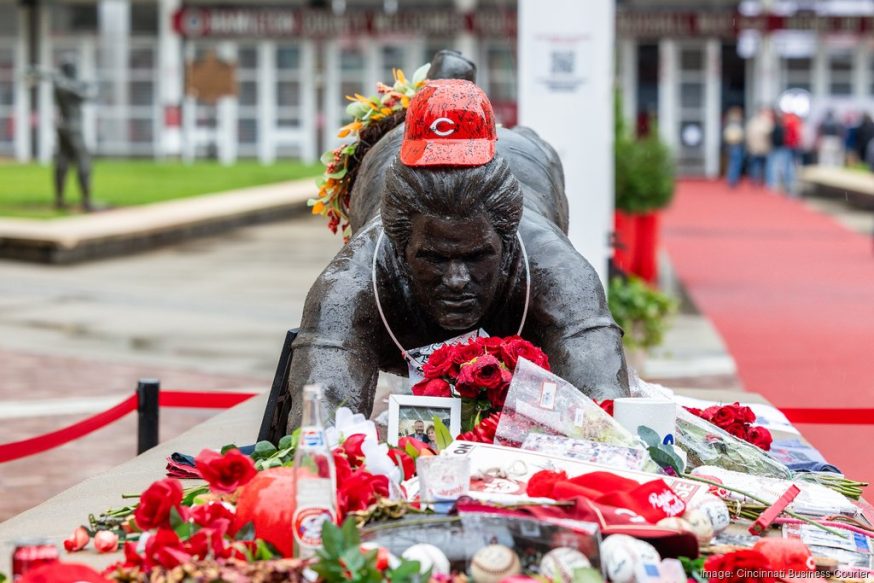
Those attending were clad in one or another red garment, under assorted red or red-and-white umbrellas, including Reds jerseys with Rose’s old uniform number 14. Many stopped by the statue of Rose captured in one of his fabled head-first slides into base outside the ballpark. Within a very short time, the figure of Rose hitting the ground hands first was surrounded by assorted Reds paraphernalia tied to Rose explicitly or other objects expressing feelings about him.

Most of the mourners were older Cincinnatians who grew up watching Rose with the 1963-1978 Reds, including the height of the legendary Big Red Machine teams. Reds officials told the press that at least 1500 people turned out for the visitation over its first seven hours; the visitation was scheduled for fourteen hours as a nod to Rose’s old number. Wreaths of roses appeared at various spots, including at least one displaying his number 14.

Pete Rose statue

Mourning Reds fans didn’t let Sunday rain stop them from surrounding the landing hands on Pete Rose’s statue (he’s captured in one of his fabled headfirst slides into base) with assorted paraphernalia, inscribed baseballs, and roses.

The rainy weather may well have kept more from attending the first half, but those first seven hours may have had more attending than the Reds had counted just yet. As I sat down to write, I had no idea what the final turnout would prove to be. The mourners didn’t just pass by Rose’s ashes, they paid respects personally to Rose’s two daughters, Fawn and Kara, who’d cooperated with the Reds and with the team’s hall of fame to bring the event to pass.

“We wanted to do something like this,” said Reds Hall of Fame executive director Rick Walls. “You could see from the turnout, it means a lot to the people here. It’s a moving experience.”

“He was a guy you thought was going to live forever,” said one longtime Reds fan, Bob Augspurger, to Associated Press writer Jeff Wallner. “When I heard the news, obviously it was sad. Baseball lost its greatest ambassador.”

“Westsiders tell the truth. Pete lied for thirteen years about betting on baseball,” Greiner had written. “He did it so naturally that he seemed to believe the lie. Westsiders are accountable. Pete’s ultimate confession was done in a book from which he reaped profits. He continued to deflect, citing to others who in his mind behaved worse than him.”

Let it be said, then, that Queen City people came out to pay their respects to a native son whose greatness on a baseball field was as impossible to forget as the clay feet on which he walked off the field proved impossible to replace or re-shape. A man whose professional achievement and the penultimate honor it should have received could be and was blocked and soiled by only one man.

Somehow, Sunday’s rain seemed a little more appropriate.

This essay was published originally at Sports Central.

“There’s an end for all athletes”

Joey Votto

Joey Votto, shown batting in a 2019 game. 

Watching a baseball great retire at all is enough. Watching him do it during a season is more of an eye-opener and a mood killer. Hearing him say honestly that he doesn’t have it anymore could very well be baseball’s red badge of courage.

When Joey Votto realized he simply couldn’t will himself to another self-resurrection after a slow start, the way he’d done on more than one occasion during his 17-season major league career, he did the only thing that could be done by a man who said often enough that he’d leave money on the table rather than play poorly.

Realizing his comeback attempt to make it to the Blue Jays wasn’t going to happen, Votto simply retired last week. Just like that. No grand gesture, no grand and often foolish farewell tour. The greatest first baseman in the history of the Reds, bought out by his longtime home after last year, unlikely to turn a minor league contract with the Jays into seeing Jays action unless he was seated in the ballpark, decided enough was more than enough.

The day after Votto made his Instagram announcement, the Reds met the Jays at Rogers Centre and buried the Jays 11-7. Votto was delayed by car trouble and didn’t get to see the game, but he did get to the visitors clubhouse in order to say hello and goodbye to old teammates. Then, as The Athletic‘s Kaitlyn McGrath wrote, he talked to the press.

“I was not waxing and waning,” Votto began, “but I had moments where I was like, ‘Is this the right thing to do? And do I want the organization to tell me that I’m done?’ And I just decided, you’ve played long enough, you can interpret what’s going on. And I was awful. I was awful down there. And the trend was not fast enough, and I didn’t feel at any point in time like I was anywhere near major-league ready. I can say to the very last pitch I was giving my very all. But there’s an end for all athletes. Time is undefeated, as they say.”

Because he never got to suit up for the Jays in regular-season major league play (a longtime dream, since he grew up rooting for the Jays in his native Canada), Votto gets to retire as a single-team player. He also gets to retire as one of the game’s über-mensches, a guy who throve on fan interaction, liked to hang at chess clubs, and spoke out about a battle with protracted anxiety and depression in the wake of his father’s death.

Votto even made time to make it up to a young girl who adored him and the Reds but wept when he was tossed from a game in San Diego in the first inning over arguing balls and strikes. Told that little Abigail Courtney was heartbroken at not being able to see her hero play, Votto sent her a ball signed, “I am sorry I didn’t play the entire game. Joey Votto.” Then, he blew her family to tickets for the next day’s game and made a point of meeting and spending time with the girl, not to mention signing anything she handed him.

Last November, after the Reds declined his option and handed him the buyout, Abigail’s mother, Kristin, Xtweeted her immediate response: “The Reds are a bunch of PUTZES!!!” Mom assured one and all that Abigail (now 9 and playing softball in southern California) used that word only when she’s furious.

You can imagine about three-quarters of Reds Nation reacting comparably. Even if they knew in their hearts of hearts that Father Time caught up to their longtime first base fixture who was an on-base machine to what some critics thought was a fault: they blamed him for refusing to swing at unhittable pitches even with chances for “productive” outs. Please.

Your most precious commodity at the plate for an inning is outs to work with; your second most precious is baserunners. And if you have men on base ahead of you, would you rather see the man at the plate drawing the walk or swinging away for the “productive out” but  landing himself in a rally-altering or killing double play?

Let’s flip that coin and see what the other side says. Oh, yes — Votto swung at only 19 percent of the pitches he saw that didn’t hit the strike zone between 2012-2020; you can presume that, framing that period, Votto’s selectivity rarely wavered otherwise. A guy retiring with a .409 lifetime OBP, who led his league in that stat seven times and the entire Show three, doesn’t get there by swinging at practically anything. Nor does he create runs, which Votto did quite splendidly, retiring thus with a +145 wRC.

That and far more are why Votto will end up with a plaque in Cooperstown in due course. You might care to see how he sits against all post-World War II/post-integration/night-ball era Hall of Fame first basemen according to my Real Batting Average metric. (TB + BB + IBB + SF + HBP / PA.)

First Base PA TB BB IBB SF HBP RBA
Jim Thome 10313 4667 1747 173 74 69 .653
Jeff Bagwell 9431 4213 1401 155 102 128 .636
Willie McCovey 9692 4219 1345 260 70 69 .615
Joey Votto 8746 3706 1365 147 48 81 .611
Harmon Killebrew 9833 4143 1559 160 77 48 .609
Orlando Cepeda 8698 3959 588 154 74 102 .561
Gil Hodges 8104 3422 943 109 50 25 .561
Eddie Murray 12817 5397 1333 222 128 18 .554
Tony Perez 10861 4532 925 150 106 43 .526
HOF AVG .592

But Votto also joins a small roll of players who saw the end before it showed itself to them. Dearly though he wanted one final major league turn, in and for the city where he grew up, Votto didn’t want a free ride or a legacy call-up. If he didn’t earn his way, he didn’t want to be there. Out of respect for the Jays and the fans.

“This isn’t my organization, so how can I show up and make it my day, my moment?” he said. “Here’s an at-bat, here’s a game, here’s a stretch of time. To me, it’s disrespectful to the game. I also think it’s disrespectful to paying fans that want to see a high-end performance, and I would have given them an awful performance. So truly, I can say that I tried my very best and I just came up short. And I’ve had 22 years of not coming up short, so I guess I’m due.”

If that resembles an echo of another city’s baseball past, it should. Votto faced Father Time slightly over 35 years after the arguable greatest player in Phillies history called it a career — in a season’s second month, no less.

“I could ask the Phillies to keep me on to add to my statistics,” said Hall of Famer Mike Schmidt through tears at a press conference, “but my love for the game won’t let me do that.” He did, Thomas Boswell wrote, “what so many great athletes have failed to do; he left us wanting more.”

So did Joey Votto.

This essay was published in slightly different form at Sports Central.

“A miracle and a disaster.”

Pete Rose’s longtime Reds manager was almost as incessantly quotable as Rose. “We try every way we can think of to kill this game,” Sparky Anderson once said, “but for some reason nothing nobody does never hurts it.” The Hall of Fame manager wasn’t necessarily talking about Rose. But he could have been.
When Rose became the first back-to-back National League batting champion in a Reds uniform, Ohio governor James Allen Rhodes declared Pete Rose Day in the state and Cincinnati elected to re-name his favourite childhood park, Bold Face Park, as Pete Rose Playground. Five hundred citizens signed a petition opposing the name change.

“They didn’t think Pete Rose was worthy of a local landmark,” writes Rose’s newest biographer, Boston Globe writer turned NPR contributor Keith O’Brien, “perhaps because there were growing questions and rumors about him—questions and rumors that even West Siders couldn’t ignore. One of the rumors circulating about Pete concerned gambling. He seemed to do a lot of it.”

Indeed. He was about to graduate from merely spending a lot of time at the race tracks to befriending and betting through bookies. Violating a lesser-known clause of baseball’s Rule 21 long enough before he began betting on the game itself. “I was raised, but I never grew up,” was one of Rose’s most widely-disseminated quotes. That was probably the root of the problems that finally steered him toward that which got him a permanent ban from baseball and a concurrent ban from appearing on a Hall of Fame ballot.

Maybe no book heretofore written about Rose goes quite as deep into his self-making and his self-unmaking as O’Brien’s Charlie Hustle: The Rise and Fall of Pete Rose, and the Last Glory Days of Baseball does now. But this fresh excursion into Rose’s life and legacy leaves little room to conclude other than what O’Brien himself writes almost at the outset:

He was Icarus in red stirrup socks and cleats. He was the American dream sliding headfirst into third. He was both a miracle and a disaster, and he still is today.

O’Brien didn’t build his work idly or incompletely. A Cincinnatian himself, he plunged as fully into Rose’s world as possible, from talking to former teammates, former baseball commissioners, former Rose investigators, family, friends, adversaries, to talking to Rose himself—twenty-seven hours worth with Rose, “before he stopped calling back, before he shut down.” The author also plowed through scores of federal court documents and even FBI files as well as ages of published articles as well as the Dowd report that first put paid to Rose’s baseball life.

Charlie Hustle is a long, page-turning, heartbreaking re-examination of the Rose who willed himself into becoming a baseball symbol and sank himself into becoming a baseball pariah. Maybe it’ll convince his most stubborn apologists that their hero was his own destroyer. Maybe it’ll convince his most stubborn critics that being right about him doesn’t equal being proud of that.

To those who loved him, and even to more than a few who thought he was excessive at minimum, Rose the player was like the junkyard dog deciding he’d hang with those Westminster dandies any old time he chose, no matter what he lacked. To the same people, Rose was just a particularly extreme manchild. One remembers Thomas Boswell quoting then-Orioles general manager Hank Peters not long after the end of Rose’s fabled 44-game hitting streak: “The Reds have covered up scrapes for Pete his whole career. He’s always been in some little jam . . . but people never seem to hold it against him.”

Maybe that perception took hold because nobody in the sports press then really wanted to risk losing one of the best and most available quotes in the game. Not to mention a star player whose generous side—welcoming rookies and newly-acquired veterans enthusiastically, helping them remake or remodel their approaches, joining them in business ventures, standing by them against bigots—was almost as talked up as his bull-headed playing style and his gift of gab.

Nobody then wanted to expose the Rose who ran around on his first wife, often flagrantly, with younger women, one a teenager Rose swore was sixteen (Ohio’s legal age of consent) but who later said she’d been fifteen at the start. Or, the Rose whose taste for sports betting began to look like more than just simple, occasional recreation. It took over a decade to follow before Rose’s rough-hewn mythology began to implode and the sports press that once adored him began to comprehend that this wasn’t just a more coarse boys-will-be-boys type.

Headlines in early 1979 about Rose being sued by the extramarital mother of a baby girl by him exposed him publicly as an adulterer and deadbeat (she sued after Rose stopped sending her payments for the baby) long before his exposure for not paying many of his gambling debts. So did first wife Karolyn divorcing him in 1980. (As earthy as her husband, Karolyn also confronted the mistress who’d become Rose’s second wife, whom she spotted driving her Porsche—and opened the door to punch her out.)

When did this scrappy, witty rogue, who could and did will himself into Everymanperson’s Hero, really begin crossing the line from mere recklessness to self-immolation? Some time in the early 1970s, as he began to graduate from mostly a Cincinnati star to a national baseball figure, Rose became friendly with Alphonse Esselman, a bookmaker freshly released from federal prison, now using a used car lot as a front, and first meeting Rose at the River Downs track.

Esselman’s initial appeal for Rose was an ability to speak of sports equal to Rose’s own, which must have been formidable enough. Rose also began betting on football and college basketball games through Esselman, “almost every night and certainly on Saturdays and Sundays in the fall, after baseball season was over,” O’Brien writes.

At home, especially on big football weekends, Pete disappeared into a room and watched games all day. Karolyn saw him when he emerged for snacks from time to time or for dinner, and throughout the day, she could hear him in there, shouting. “Plenty of time,” he’d say, figuring spreads and probabilities in his mind. But it was almost as if he were gone, lost inside a world of his own making, a world that could destroy him. By consorting with Al Esselman and placing bets with him, Pete was violating a rule of baseball known by every player.

Had it stayed purely with that, Rose at worst might have faced a discretionary punishment from baseball’s commissioner, not necessarily one that got him his permanent banishment. Maybe something similar to the one Happy Chandler inflicted upon Dodgers manager Leo Durocher in 1947 (a full season) for hanging with bookies. Maybe something similar to what Bowie Kuhn inflicted upon Tigers pitcher Denny McLain (indefinite but reduced to ninety days) for becoming one, involving non-baseball games.

“By 1984, Pete had graduated from placing bets with friendly West Side bookies like Al Esselman to hanging around shady, small-­time mobsters and established East Coast criminals,” O’Brien writes, referencing the time before the Reds dealt to bring Rose back from the Montreal Expos, where he played after his term with the Phillies.

Pete had reportedly started placing bets with a syndicate run out of Dayton by Dick Skinner, an old-­school bookie and convicted felon known to authorities as “the Skin Man.” Skinner was believed to be the largest bookmaker in southeast Ohio, and to Skinner’s dismay Pete fell thousands of dollars behind on his payments. Skinner was soon
complaining about Pete all over Dayton and Cincinnati. Then, in early 1984, Pete made a new gambling connection: Joe Cambra, a man on the fringes of the Rhode Island mob with dark eyes, dark hair, a home in southern Massachusetts just across the Rhode Island
border, and a winter retreat in West Palm Beach not far from the Expos’ spring training facility.

. . . Unaware that anyone was watching, Pete paid off his debts to Cambra on July 5, 1984, with two checks—­one from his personal account in Ohio for just over $10,000 and a second from the Royal Bank of Canada for $9,000. Pete then had a great week at the plate.

Pete Rose

“He was Icarus in red stirrup socks and cleats.”—Keith O’Brien.

That August, prodigal Reds general manager Bob Howsam decided to bring Rose home to Cincinnati as their player-manager, “despite all the warning signs and things he knew to be true.” One of Rose’s first doings after returning to Cincinnati was joining a Gold’s Gym there, one known as a clearinghouse of sorts for illegal performance substances, and where Rose and his youthful baseball protegé Tommy Gioisia met one Paul Janszen, who’d join with Gioisia in placing Rose’s bets with bookies. Including one Ron Peters.

Rose’s eventual success in breaking Ty Cobb’s lifetime hits record was the opposite of his success as a gambler. He was into enough bookies for enough money by March 1986 that, according to the Michael Bertolini notebooks revealed in full in 2015, O’Brien writes: “Pete was gambling on baseball by at least April and May 1986—­with a handful of bets on the Yankees, Mets, Phillies, Braves, and his own team, the Reds. To crawl out of the hole he had dug for himself that March, Pete had apparently started wagering on the thing he knew best: baseball.”

In time, and with the feds investigating Rose’s gambling associates and connections, Sports Illustrated went digging and intended to run with what they discovered about Rose’s betting. Not so fast, determined baseball commissioner Peter Ueberroth, in February 1989, calling Rose to New York to meet with him and National League president A. Bartlett Giamatti, we can’t afford to wait for that magazine to run with it.

O’Brien reminds us Ueberroth didn’t want to just hand this off to Giamatti and hoped against hope that Rose would come clean, admit he’d made a phenomenal mistake, and save himself. “But Pete couldn’t do it. He wouldn’t do it.”

The same qualities that made him a successful baseball player—­and one of the greatest hitters of all time—­ensured his failure now. Pete wasn’t going to let Paul Janszen win, if that’s what this was about. He wasn’t going to admit to anything in that room on Park Avenue filled with polished men wearing the right kinds of suits. He was going to fight his fight . . . He was going to listen to his late father. “Hustle, Pete. . . . ​ Keep up the hustle.” He was going to foul off the fastball on the outside corner to see another pitch. He was going to bunt the ball down the line to win the batting title, and he was going to take out the catcher at home plate in a meaningless game, breaking his shoulder at the joint.

Pete Rose was going to lie.

Sure, Pete admitted in the room in New York, he was a gambler and he bet on lots of things: the horses, the dogs, even football games. But no, he said that day. He did not bet on baseball.

“I’m not that stupid,” [Giamatti’s aide Fay] Vincent recalled him saying.

Exit Ueberroth, enter Giamatti as his successor, enter John Dowd leading baseball’s official investigation, and exit Rose to baseball’s Phantom Zone, soon enough. Enter, too, the Hall of Fame, entirely on its own (one more time: it’s not governed by MLB itself), electing quite reasonably to bar those considered persona non grata by baseball from appearing on any Hall of Fame ballot.

Let’s reiterate yet again that baseball’s Rule 21(d)’s mandate of permanent banishment for betting on one’s own team (O’Brien reminds us that days Rose didn’t bet on the Reds one or another way were still signals to other gamblers regarding the Reds) doesn’t make exemptions a) for a player who broke a once-thought-impossible-to-break record; b) for a player with Hall of Fame credentials; or, c) for a player-manager who claimed only to have bet on his team to win.

Let’s reiterate, further, that the firestorm over Shohei Ohtani’s now-former interpreter Ippei Mizuhara and the latter’s gambling through an Orange County bookie (sports betting remains illegal in California) doesn’t take Rose off the hook. Nor do baseball’s promotional deals with legal sports betting Websites and companies.

Fans can bet on baseball whenever they like. Players, managers, coaches, trainers, clubhouse workers, front office people, can bet on any sports they like—except baseball. They can play fantasy football, bet on the Final Four, bet the horses or NASCAR, round up high-stakes poker or pinochle games. Anything that catches their competitive eyes. Except baseball.

If Rose as a player-manager and then manager alone had never crossed the line into betting on baseball itself, his story would have had a very different turn in 1989. He might still have graduated from a mere visceral rogue to a scoundrel with an addiction, but he might have been elected to the Hall of Fame regardless.

Rose’s Hall of Fame teammate Johnny Bench was once asked when he thought Rose—who triumphed under baseball’s most heated lights, and fell under the detonations of his own explosives—should be brought back in from baseball’s cold. Bench’s answer: “As soon as he’s innocent.”  Charlie Hustle says, in essence, that’s not happening.