Danny Young, RIP: The hard climb and fall

Danny Young

It took Danny Young just over a decade to make the Show, and a shoulder injury following a harsh cup of coffee to return home.

The 21st Century’s first official grand slam wasn’t hit in the United States. The Mets and the Cubs opened the 2000 season on 30 March in Japan’s Tokyo Dome. The game went to an eleventh inning, and Cubs manager Don Baylor sent a longtime minor leaguer named Danny Young to the mound to pitch the top half.

The first student from Woodbury, Tennessee’s Cannon High School to make the Show in the first place, Young started auspiciously enough, getting two quick outs on a grounder to shortstop by Robin Ventura and a pop fly around the infield by Derek Bell. Then he surrendered a base hit to Todd Zeile before walking the bases loaded by way of Rey Ordóñez and Melvin Mora.

Mets manager Bobby Valentine sent Benny Agbayani out to pinch hit for relief pitcher Dennis Cook. Young’s first pitch to him missed for ball one. Agbayani hammered the lefthander’s second pitch over the center field fence. After Jay Payton’s followup double, Young escaped when Edgardo Alfonso flied out to center field.

“Even though I gave up a grand slam, I still looked around and it’s like, ‘That’s Mark Grace right there. I’ve got Sammy Sosa in the outfield’,” said Young—found dead at home at 51 Sunday—to Fox Sports. “They patted me on the back and let me know it was going to be all right. I had a lot of the guys come to me and say, ‘Welcome to the big leagues.’ They were like, ‘Things like this happen.’ I should have gotten out of the inning. It was just nerves and knowing within myself that something was wrong.”

It took Young long enough to get to the Show in the first place. Drafted by the Astros at nineteen in 1990, he played for nine minor league teams affiliated to three major league franchises over the decade to follow before he finally made the Cubs after the turn of the century. He never complained about being drafted in the 83rd round, either.

“If I was a first-rounder,” he once told Fox Sports writer Sam Gardner, “I might not have made it, because I had a thirst and a hunger to make it because of where I was drafted. If they’d have set a million dollars down in my hand at that time, there’s no telling where I would have ended up. So maybe that was just meant to be my turn.”

He simply didn’t expect to be on the wrong side of history when he finally got his turn in a Cub uniform in Tokyo.

He knew he’d had control issues from the outset—in his first minor league season he struck 41 batters out in 32.2 innings, but he also walked 39—but he also knew he could learn plenty enough about the game he loved but knew too little about. “I struggled just because it was a new process for me,” he told Gardner. “I still had this fear of making a mistake and the coaches just thought, at the time, ‘This guy is just having a hard time picking this stuff up’.”

Before they released him to be picked up by the Pirates organisation, the Astros even tried as radical a class as they could think of: they hired Hall of Fame pitcher Sandy Koufax, then working free-lance as a roving pitching instructor, to work with Young and with a kid named Billy Wagner in spring 1994.

Young had absolutely no idea who his new teacher was.

“Then I come to find out a couple years later,” Young said, “and people are looking at me like, ‘Dude do you know who you were with?’ I just didn’t know baseball, but they didn’t know that I didn’t know baseball. I just went out there and pitched.” Ever the gentleman, Koufax gave Young a signed ball that Young kept in a clear ceramic ball on a pedestal in his home.

“[I]t was overwhelmingly mind-blowing, the things that he knew about the directional part of pitching that I didn’t really grasp at first,” Young told Gardner of his Hall of Fame teacher. “And as I went along, it got better. I was a late bloomer, so I didn’t really understand the concepts that he was teaching me, but he taught me to find a comfort zone and how to tune out the crowd and what’s going on around me.”

The Pirates, too, remained as patient as possible as Young continued to struggle finding the comfort zone Koufax preached. As in the Astros organisation, Young tried everything he could think of, from changing deliveries and arm angles to changing speeds and back. Only when the Cubs picked him in the 1997 Rule 5 draft did Young begin to smell something close enough to success, or at least real major league potential.

He moved up the chain until he made the team in spring 2000. After Agbayani’s Tokyo blast, the Cubs returned Stateside and Young got into the next three straight games against the Cardinals. The first outing: two walks in two-thirds of an inning but no runs allowed. The second: a two-out double by Fernando Tatis, Sr. but another scoreless escape. Maybe Young was getting it at last.

The third: disaster—a pair of two-out walks, leaving a mess for his relief Brian Williams to clean up in the fourth inning, a mess that continued with a bases-loaded walk, a grand slam by J.D. Drew, and three runs charged to Young that he wasn’t on the mound to surrender himself.

The Cubs sent him back to Iowa after that. Young continued struggling until he finally spoke up further about an issue he’d felt in Tokyo, when he first mentioned to Mark Grace—after a pickoff throw that bounced to first—that he felt something wrong with his shoulder. It turned out his rotator cuff required major surgery, the first of five on the shoulder.

After 2000, Young retired from the game he’d never really had the chance to learn even rudimentarily in a Woodbury where baseball wasn’t exactly a well-taught sport. At least, not until Young returned home to spend the rest of his life raising his family and teaching and coaching the game to local kids.

“I played tee-ball, played Babe Ruth, played Dixie Youth Baseball and high school, but there was no real coaching,” he told Gardner. “And for the [coaches], that was no fault of their own. We hauled hay, we fished, we did whatever we did, and then we went out on the field and had fun. We had teams, but it wasn’t competitive. I mean, I ended up being a right-handed hitter because none of the coaches knew how to teach me how to hit left-handed.”

If only the Danny Young who went home to teach the game on his native ground had been available to the Danny Young who originally caught the Astros’ eyes, however deep in that 1999 draft. He might have had more to show for his long slog to the Show, and in the Show itself.

He never struck a major league hitter out, he walked six, he surrendered five hits, but he kept a big league attitude. For himself, and for his wife, Sarah, their six children, and their two grandchildren. The battler who surrendered this century’s first major league grand slam should only know peace and fulfillment in the Elysian Fields to which he was taken—cause unknown at this writing—too soon.

Bruce Sutter, RIP: Like skipping a rock

Hall of Fame relief pitcher Bruce Sutter with the Cardinals en route their 1982 World Series winner.

“It’s unhittable,” said Hall of Fame manager Dick Williams about Hall of Fame relief pitcher Bruce Sutter’s split-finger fastball, “unless he hangs it, and he never does. It’s worse than trying to hit a knuckleball.” Another Hall of Fame manager, Whitey Herzog, has said that Sutter would never have become injured if he’d remained a Cardinal.

Sutter, who died of cancer Thursday at 69, became a Cardinal in the first place, in 1980, because the Cubs with whom he’d arisen to become a groundbreaking relief pitcher in the first place got caught flatfoot, when the combination of salary arbitration and free agency smashed into a grave if unintended error by longtime owner Phil Wrigley.

The elder Wrigley’s mistake, according to Peter Golenbock in Wrigleyville: A Magical History Tour of the Chicago Cubs, was leaving half his estate to his wife, Helen, whose own death meant the Wrigley estate being taxed heavily twice and leaving son William III, who’d inherited the Cubs, strapped for running the team until or unless he could sell it.

In due course, Bill Wrigley’s financial picture would wreak havoc enough on the Cubs. Sutter himself would remember (to Golenbock) the Cubs having a good team or two followed by a disgruntled team full of veterans who came over from established winners and not liking the Cubs’ post-’79 decline.

About 1979, too, the husky righthander remembered, “That was the year . . . we lost a game to the [Phillies], 23-22. You’re going to ask who gave up the last run, aren’t you? It was a Mike Schmidt home run—off me.” Hitting his second bomb of the day, the Hall of Fame third baseman conked one off Sutter and up the left center field bleachers with two out in the top of the ninth. The Cubs—whose own bombardier Dave Kingman hit three out (one onto a Waveland Avenue porch while he was at it)—went down in order in the bottom against former Big Red Machine relief star Rawly Eastwick.

Sutter learned the split-finger fastball from a minor league coach named Fred Martin and rode it to a 2.33 fielding-independent pitching rate, a 3.42 strikeout-to-walk rate, and a 1.05 walks/hits per inning pitched rate as a Cub. He won the National League’s Cy Young Award for 1979 while he was at it. Then he won a $700,000 salary for 1980 in arbitration.

The only relief pitcher never to have started a major league game when inducted into the Hall of Fame in 2006, Sutter found himself one of the 1980 Cubs’ few leading lights, with a 2.64 ERA and a league-leading 28 saves. He also found himself a Cardinal after that season, after the Cubs under Wrigley’s financial distresses couldn’t pull the trigger on a longer-term deal with deferrable money.

Enter Herzog, who’d only coveted Sutter for half the time Sutter pitched for the Cubs. Only too acutely aware of what happens to even great teams without shutdown relief—he’d been purged as the Royals’ manager after front office disputes trying to get them better relief pitching, before All-Star reliever Dan Quisenberry came into his own—the White Rat, doubling as general manager, brought Sutter to St. Louis for Leon Durham and Ken Reitz plus a spare part named Ty Waller.

Sutter delivered in St. Louis—he nailed down Game Seven of the Cardinals’ 1982 World Series triumph— in large part because Herzog and his then-pitching coach Mike Roarke knew even more than the Cubs how to manage a pitcher whose money pitch just so happened to put arms and shoulders in danger if not handled properly. “[N]obody knew [Sutter’s] motion better than Mike Roarke,”  Herzog wrote in You’re Missin’ a Great Game:

I knew Bruce had to come back behind his ear, then straight over the top, with his delivery. He threw that nasty split-finger pitch, which made the ball look like a rock skipping on water—tough to pick up, let alone hit—but it puts a violent torque on the arm. When you think of the guys who live by that pitch . . . how many had a couple of great years, then dropped off the map?

. . . Well . . . Roarke and I were watching Sutter throw in [spring training] and I saw he was coming kind of three-quarters, bringing the ball out to the side and across. I said, “Holy moly, Mike, he’s all out of whack!” We got right on his ass about it, and he straightened it out. No harm, No foul. Bruce saved a lot of games for us; we saved him more damage than anybody knows.

You know what? If he’d stayed with the Cardinals, Bruce would never have gotten hurt.

Sutter left the Cardinals as a free agent after the 1984 season. Owner Gussie Busch decided to share the top decision making with two Anheuser-Busch leaders, Fred Kuhlmann and Lou Sussman, and they weren’t exactly as amenable to Herzog as Busch himself was, according to Golenbock’s The Spirit of St. Louis.

Herzog swore the pair “jerked” Sutter around over a no-trade clause; second baseman Tommy Herr swore Sussman angered Sutter during their talks. “Bruce wanted to stay in St. Louis,” remembered Herr.

I don’t think the money was that big of a deal. It became more of a personality conflict. Lou Sussman was handling the negotiations for the Cardinals. At some point, Lou rubbed Bruce the wrong way, and Bruce just said, “The heck with it. I’m going somewhere else.” Bruce did it just to spite Lou. And that was unfortunate, because we felt Bruce was just such a weapon for us.

Bruce Sutter

Before the beard: a portrait of the artist as a young Cub . . .

Braves owner Ted Turner showed Sutter a pile of money.` (Six years, $10 million, guaranteed contract.) But Turner couldn’t show Sutter a staff that knew how to manage his workload and keep him from letting his delivery and his bullpen warmups (he was warmed up far less judiciously in Atlanta than in St. Louis) wreck his shoulder at last.

He suffered inflammation in the final third of August 1985 plus a pinched nerve, the injury that almost kept him buried in the minors in the beginning, before Martin taught him the splitter. He would never be the same pitcher again. Had he not fallen under the Braves’ then-dubious care, Sutter’s percentage of inherited runs to score would have ended below 30 percent, splendid work for any relief pitcher.

He may have seen his career collapse in Atlanta, but the Pennsylvania native found Georgia life agreeable enough to stay there with his wife, Jayme, and their three sons. He was the only player inducted into the Hall of Fame in 2006 by way of the writers’ vote, an appropriate position considering how he’d helped to change his baseball craft.

His Hall of Fame teammate Ozzie Smith and Hall of Fame Reds catcher Johnny Bench needled him wearing fake, long gray beards as they escorted him to the podium. Sutter made hitters fear the beard from the bullpen long before anyone heard of one-time Giants bullpen stopper Brian Wilson, but he struggled to stay composed addressing and thanking his wife during his acceptance speech.

We were together through the minor leagues, through the major leagues, and now the Hall of Fame. I love you very much, I appreciate everything you have done and continue to do. I wouldn’t be here without you. I know we have some challenges to face in our future, but we’ll do ’em as we always have, together.

Their marriage was a love that endured almost as long as his love for baseball. So did several friendships Sutter made during his career, such as now-Hall of Fame teammate Jim Kaat, who ended his career as a Cardinal while Sutter anchored their bullpen.

“I feel like a brother passed away,” Kaat told a reporter. “I knew Bruce deeper than just about any other teammate. We spent a lot of time together, and as happens when your careers end, you go your separate ways. But we stayed in touch and considered each other great friends.”

The particular challenge didn’t scare Sutter. Whether throwing that rock-skipping splitter past fellow Hall of Famers out of the bullpen (let the record show that except for two homers each, Mike Schmidt and Willie Stargell, to name two, couldn’t hit him with a warehouse door), or making a half-century marriage raising three sons and becoming beloved grandparents to six in an often self-immolating world, there was no challenge to which Sutter seemed  allergic.

“Heaven needed a big time save,” tweeted longtime baseball analyst Dinn Mann. “Marvelous pitcher, even better person,” tweeted USA Today columnist Bob Nightengale. Baseball will miss him on earth only slightly less than his family will.

Some dream

Ken Griffey, Jr.; Ken Griffey, Sr.

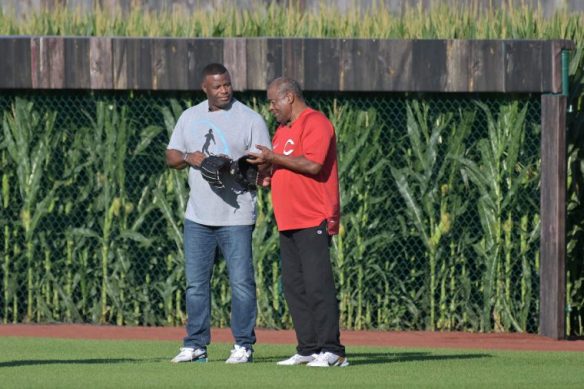
The Griffeys—Hall of Fame outfielder Ken, Jr., respected outfielder Ken, Sr. (right)–after entering through the corn, slip their gloves on for a father-son catch.

Maybe the best part of this year’s Field of Dreams Game was what happened before the game was played. Two generations of outfield-playing Griffeys, Ken Sr. and Hall of Famer Ken Jr., both Reds once upon a time, entered the field through the corn when Junior looked at Senior and said, only partly puckishly, “Hey, Dad, you want to have a catch?”

Dad did. Father and son tossed a ball back and forth in the outfield, joined soon enough by other such parents and children playing catch from center to right field. And, by Reds manager David Bell, himself a third-generation Show player, with Athletic writer C. Trent Rosecrans, a longtime Reds beat writer for the Cincinnati Enquirer.

Rosecrans’s father once longed for a certain nine-dollar baseball glove growing up and finally got it by saving for it. The glove was a model for Bell’s grandfather, 1950s Reds All-Star outfielder Gus Bell. It went in due course to someone else, Rosecrans writes in a lyrical ballad about his own relationship with his late father, but it found its way back to his parents in due course.

In Dyersville, Iowa before Thursday’s game, Rosecrans writes, “Gus’ grandson looked at me and told me he was thinking of me and my dad. I told him I brought my glove. He asked me, ‘Want to have a catch?'”

That was far better to ponder than such doings as commissioner Rob Manfred present, accounted for, and even signing autographs at the fabled field. Or enough of the Twittersphere demanding to know why Pete Rose wasn’t invited for the pregame hoop-de-do. You’d have had a hard time pondering which would have been more absurd.

It could have been Rose’s presence in the immediate wake of his disgraceful dismissal of a Philadelphia reporter’s question about his ancient dalliance as a thirtysomething with a short-of-legal-age girl. Not to mention his well-deserved banishment from the game and from Hall of Fame candidacy for violating the rule written and imposed in the wake of the 1919 World Series gambling scandal tainting that year’s Reds’ Series triumph.

It could have been Manfred, whose love of the game is questioned often enough and with justification enough. Bleacher Nation on Twitter asked respondents, “Fox shows Rob Manfred signing baseball at the Field of Dreams Game. What is he writing as his personalised message? Wrong answers only.” One wag, mindful that Rose’s autographed baseballs often include small gag apologies such as “I’m sorry I shot J.F.K.,” replied, “I’m sorry I shot R.F.K.”

Manfred seems to have done everything except think about the one thing tied to the game that would have made him seem a baseball statesman. Apparently, it never crossed his mind to declare, once and for all, that the 1919 Reds were (are) legitimate World Series champions who could have and just might have beaten the Black Sox if the latter had played the entire set straight, no chaser.

Assorted Reds and Cubs past and present took in the locale, its history, and the penultimate message of the film lending the event its name. (The Cubs’ Hall of Fame pitcher Ferguson Jenkins threw a ceremonial first pitch to the Reds’ Hall of Fame catcher Johnny Bench.) Particularly Reds star Joey Votto, remembering to Rosecrans how the film bonded him to his father even further.

“I wish he was here,” Votto said. “I wish I could bring him to tonight’s game, we go out on the field and do something that we did from when I was eight or nine years old. It’s really eerie how much the movie allowed me to look back on that experience.”

If you build it, he will come, whispered the Voice of the late Ray Liotta’s disgraced-turned-romanticised Shoeless Joe Jackson to Kevin Costner’s Ray Kinsella in the 1989 film. They built it. (Actually, Chris Krug, once a Cubs catcher, built the original, with his Athletic Turf outfit.) But it cost a minimum $501 to be there Thursday. Fans in Iowa and some surrounding areas who couldn’t come couldn’t see the game at all, either, thanks to baseball’s arcane and insane broadcast blackout rules. Some dreams.

Putting the Reds into replicas of their 1919 uniforms should have been cathartic considering the 1919 Reds’ Series triumph was tainted too long by the disgrace of the Black Sox bent on throwing the Series for gamblers’ payoffs. Unfortunately, the catharsis wasn’t to be thanks to what the Reds couldn’t do Thursday evening.

Putting the Cubs into replicas of their 1914 hats and late-1920s uniforms, a mismatch not unlike many a Cub loss from 1909 through 2015, said little more than “That’s just so Cubs” before the game began. So, naturally, they went out and beat the Reds, 4-2. Only the Cubs could display a fashion fail and win regardless.

That was a century plus three years ago: Black Sox pitcher Eddie Cicotte hit Reds second baseman Morrie Rath with Game One’s second pitch to let the gamblers know the Series fix was on. This was Thursday, opening the Field of Dreamers Game: Reds starter Nick Lodolo got two quick enough outs before hitting Cubs third baseman Patrick Wisdom with the fourth pitch on a 1-2 count.

That’d teach him. Neither this year’s Reds nor this year’s Cubs are going to finish the season anyplace near the postseason. But after Wisdom took his base, the Cubs behaved like contenders for a change. Seiya Suzuki whacked an 0-1 pitch to the rear of left field to send Wisdom home, Nico Hoerner singled to more shallow left and took second as the Reds tried futilely to keep Suzuki from scoring, Ian Happ doubled to center to send Hoerner home, and just like that the Cubs had a 3-0 lead that proved just enough to count.

Cubs starter Drew Smyly could have seen and raised when he plunked Reds second baseman Jonathan India on a 2-1 pitch. Instead, he like India shook it off, survived a one-out base hit, then consummated five innings of four-hit, nine-strikeout ball before handing off to his bullpen

“The first couple of innings,” Smyly told reporters after the game, “it took me a little bit to kind of get into, like catch my sights. Just a whole different feel than pitching in your usual major league baseball stadium. But I caught a little groove there at the end and that’s just a lot of fun. It just was so unique and different than what we’re used to.”

These days winning is unique and different for a Cubs team stripped of almost all the last remnants of their 2016 World Series conquest. They may be in third place in the National League Central but they have a 46-65 record after Thursday’s win. The Reds are in the division’s rock bottom at 44-67 with the fans they have left still smarting over last winter’s before-and-after-the-lockout final tear-down.

This game didn’t have a fragment of the pennant race significance last year’s Field of Dreams Game—with the White Sox’s Tim Anderson winning an 8-7 triumph over the Yankees with a bottom of the ninth home run into the corn.

But it couldn’t hurt to watch. Not really. Not even when the Reds got just frisky enough against the Cubs bullpen to open the bottom of the seventh with a double (Jose Barrero), a walk (pinch hitter Jake Fraley), and a two-run double (Mark Reynolds), before Cubs reliever Michael Rucker got the next three Red batters out in order.

Not when the Cubs threatened to actually blow the game wide open in the top of the fourth, with back-to-back inning-opening singles setting first and third up for Nick Madrigal to send Nelson Velazquez home with the fourth Cub run.

Then Willson Contreras—the veteran catcher who may not be a Cub after this off-season, and who had a scare an inning earlier when he dinged his left leg running around second on Wisdom’s base hit, tumbling to the ground as he was thrown out at third—flied into a double play when Reds right fielder Aristides Aquino caught his opposite-field drive and gunned Cubs first baseman P.J. Higgins down as Higgins dove futilely into third.

Meanwhile, somebody had the bright idea to plant a hologram of longtime Cubs broadcaster Harry Caray in the booth for the seventh-inning stretch, from which emanated Caray’s once-familiar bellowing of “Take Me Out to the Ball Game.” The crowd in the stands sang along but they all but ignored Harry the Hologram. Except perhaps to shudder.

“Creepy,” tweeted another Athletic writer, Eno Sarris, uttering perhaps the most polite way to put it. “Please don’t make a hologram out of me when I’m dead.” Sarris probably has no worries on that score. But if anyone gets the bright idea to do a Vin Scully hologram for a future Field of Dreams Game (it won’t be played next year thanks to adjacent youth sports complex construction), there’s liable to be a war broken out.

The squirrel and the blowout

PNC Park squirrel

This little fellow (or gal, who knew?) cops a proud squat on the PNC Park left field grass before leading three groundsmen on a warning track chase in the bottom of the second—and the Pirates into blowing out the Cubs Monday night.

Believe in the power of the Rally Squirrel? After Monday night’s doings, the Pirates may want to think about it. Hard.

The bushy-tailed rodent showed up to run around the PNC Park outfield and warning track as the bottom of the second got under way. After he disappeared at last, the Pirates dropped three in that inning, four the next, five in the seventh, and a 12-1 smothering of the further-sputtering Cubs.

For too long the Pirates have lived in the place where the nuts hunt the squirrels. It was lovely to see them upend things for an evening.

With Daniel Vogelbach on first, nobody out, and a 1-1 count on Michael Chavis against rookie Cubs starter Caleb Kilian, the bushy-tailed rodent scampered out onto the field from somewhere in the region of PNC Park’s third base seats.

The creature galloped toward the left field corner in a jagged route with three grounds crew in hot pursuit. One of the groundsmen carried a large washing bucket. A second carried a net whose weave was big enough to allow a human suspect to escape the moment it might be dropped over him.

The squirrel himself (or herself, who knew?) wasn’t exactly a model of precision running at first. Certainly not as swift or sure as the one who ran down the third base line as if stealing home in Coors Field eight years ago.

“[W]hat was his sprint speed?” Pirates manager Derek Shelton asked of the PNC squirrel  after the game. “We had to get that in the Statcast era. Definitely one of the worst rundowns I’ve seen. And I’ve seen a couple bad ones.”

After the three groundsmen chased him toward the deepest left field corner, the squirrel ran back and forth from the foul line to the mid-left field piece of the warning track, finally making for a passway under the center field seats’ edge and into the Cubs bullpen with the bucket man in hotter pursuit.

The Pirates in their dugout watched with bemusement. The Cubs’ relief corps looked uncertain as to whether the game was going nuts. Little did they know.

Chavis walked on five pitches. Touted Pirates rookie Oneil Cruz, all 6’7″ worth of him,  reached on a fielding error to load the pads. Fellow rookie Bligh Madris ripped a two-run single to right and stole second before Tyler Heineman struck out, but Hoy Park sent Madris home on a long sacrifice fly.

One inning later, the Pirates struck a lot more swiftly, loading the pads on Kilian with nobody out (back to back walks and an infield hit) before Kilian wild-pitched Bryan Reynolds home. Chavis waited out a four-pitch walk before Cruz sent a three-run double to the absolute rear of center field.

That ended Kilian’s evening but not the Cubs’ miseries. After the Cubs managed to sneak a run home in the top of the seventh on back-to-back singles, then an RBI single which followed back-to-back strikeouts, the Pirates got squirrely again in the bottom of the frame: a two-run double (Vogelbach), an RBI single (Cruz), an RBI double (Heineman), and a sacrifice fly (Park again).

Madris swung his way into the Pirates’ history books with his three-hit evening, the first Pirate to do it in his Show debut since Jason Kendall did it in 1996. He also became the first Pirate since Andrew McCutchen (2009) to debut with a hit, a run batted in, and a stolen base in a single game.

“That was a lot of fun and everything I could ask for,” he grinned postgame. “With [batting practice] getting canceled today, when I stepped in the box, it was really my first at-bat in the big leagues. The game threw a little bit of everything at me today. Thankful for the opportunity. It was awesome.”

Cruz, already the tallest shortstop in major league history, and ranked the Pirates’ number three prospect, got called up from Indianapolis (AAA) with Madris Monday. Madris has nothing but good to say about his Indy teammate, who poked his nose out of his hole at last season’s end and hit a home run almost from his knees.

“The guy’s unreal,” Captain Bligh told reporters. “He has tools that come around once every 100 years. He can hit pitches out of the ballpark that some guys are lucky to get out of the infield. Being here now is going to propel him to greater things.”

“What I can promise you,” said Cruz before Monday night’s game, “is you’re going to see it a lot more frequently. You’re going to see a lot of balls hit hard and a lot of balls traveling very far.” He kept the promise, too—his double was estimated to fly 112.9 mph off his bat. But he also has a howitzer of a throwing arm, throwing one grounder over to first at 96.7 mph.

Players like these are what the Pirates need to continue wrenching themselves out of tank mode and navigate the rash of injuries and illness that’s struck them of late. Not just because of their skills and prospective production, but because of . . . shall we say . . . no, let Chavis say it, as he did before Monday’s game.

“The quality guys that we’ve called up has been pretty significant,” the first baseman told reporters. “We’re not having those, um . . . we don’t have those assholes. There’s no better way to say it. You don’t have a guy with an attitude problem. Guys come up, ask questions, try to be good, stay out of the way of the older guys and are just happy to be here. I can’t say enough about all of them.”

For a team that’s just followed a ferocious nine-game losing streak by winning their next three of five including Monday’s massacre, that’s as large a light as you can ask to see facing the still-elongated end of their tunnel.

Just in case, though, the Pirates might not want to let the squirrel escape too soon. If at all.

Miñoso, O’Neil reach Cooperstown, but Allen’s still excluded

Minnie Miñoso, Hall of Famer at long enough last—but posthumously.

There’s a bit of poetic justice in the first black player for the White Sox and the first black coach in the entire Show with the Cubs becoming Hall of Famers together. But only a bit. Minnie Miñoso and Buck O’Neil should have been voted the honour while they were still alive, not posthumously by the Early Baseball Committee.

So should Dick Allen have been voted the honour while he was still alive. But Allen missed out by a single vote with the Golden Days Era Committee on Sunday. The committee elected Allen’s great contemporary Tony Oliva, but Oliva is still alive to accept the honour.

Miñoso died at 89 in 2015; O’Neil, at 94 in 2006; Allen, at 78, almost a year ago. Nobody ever said things were entirely fair even disallowing the races of these three men, but it’s not so simple to say better late than never for Miñoso and O’Neil; or, for Allen, who’ll surely be voted the honour in due course without having lived to accept it.

Cuban-born Saturnino Orestes Arrieta Miñoso didn’t get his chance in the Show until he was 25, thanks to baseball’s segregation until Jackie Robinson emerged. When the seven-time All-Star finally arrived in 1951—eight games with the Indians before his trade to the White Sox—Miñoso posted a season that should have earned him both the league’s Rookie of the Year and Most Valuable Player honours.

Award voters in those years had already come to terms with non-white players, but they were still distant enough from the idea that a league’s most valuable player didn’t necessarily have to be on a pennant winner. Miñoso’s season eclipsed the two Yankees who won those respective awards, Gil McDougald (Rookie of the Year) and Yogi Berra (Most Valuable Player), at least at the plate.

Berra’s award probably came as much for his handling of the Yankee pitching staff as for his team-leading runs scored and runs batted in. McDougald had a solid season, but Miñoso out-hit him, out-scored him, and out-stole him. (Miñoso led the league with 31 stolen bases and could be argued as the real father of the Show’s stolen-base renaissance his eventual Hall of Fame teammate Luis Aparicio kicked off in earnest later in the decade.) He also walked more often, struck out less often, and played more field positions competently than the multi-positional McDougald did.

Miñoso put up a lot of MVP-level seasons without winning the award, even though he might plausibly have won three such awards if voters then looked beyond assuming pennant winners automatically carried the league’s most valuable players. He was also (read very carefully) the first black Latino to crack the Show.

In the years that followed after his career ended, there came a few who looked deeper and concluded that Miñoso might have been the most deserving player not to reach Cooperstown for a very long time. When Allen Barra wrote Clearing the Bases in 2002, he devoted an entire chapter to Miñoso and drew that very conclusion, even if he had Miñoso’s age as a Show rookie wrong. (Barra said 29; Miñoso was 25. But still.)

“His 1951 season,” Barra wrote, “taught a lesson to Latin players for the next forty-odd years: you will have to do better than the non-Latin player just to be noticed, and far better to win an award . . . Minnie Miñoso was a better ballplayer than several white players of his time who are in the Hall of Fame. He was also better than [several] black players from his era that are in the Hall of Fame.”

He was also an effervescent personality who used it to win White Sox World over emphatically, while he played and for decades to follow. Chided once because his English was rather halting, Miñoso is said to have replied, “Ball, bat, glove, she no speak English.” At least as classic as the day black Puerto Rican first baseman Vic Power, told by a Southern server that the restaurant didn’t serve black people, was said to have replied, “That’s ok, I don’t eat black people.”

John Jordan O’Neil won one Negro Leagues batting title, made three Negro Leagues All-Star teams, and was known to be swift and slick at first base, but his stronger metier was as a leader and a manager. In fact, O’Neil managed the legendary Kansas City Monarchs to three pennants before baseball’s integration began to mean the death knell for the Negro Leagues themselves.

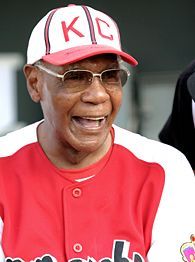
Buck O’Neil—pennant-winning Negro Leagues manager, groundbreaking Cubs coach, nonpareil baseball ambassador—and Hall of Famer at long enough last, albeit posthumously, too.

As a Cubs coach and scout O’Neil was immeaurable in his mentorship of Hall of Famers such as Ernie Banks and Billy Williams. In due course, he discovered Hall of Famer Lou Brock and World Series hero Joe Carter. As a baseball ambassador, both concurrent to his work with the Cubs and beyond it, O’Neil was even more immeasurable for helping to keep the Negro Leagues legacy alive.

This friendly, soulful man who was a people person first and foremost told all who’d listen that, regardless of the disgrace that kept himself and his fellows from their warranted tastes of what was then considered the only major league baseball life, those who played Negro Leagues baseball managed to have fun, live reasonably, and savour the good in life.

I once wrote that getting O’Neil to shut up about baseball would have been like trying to take the alto saxophone out of Charlie Parker’s mouth. “People feel sorry for me,” O’Neil once said. “Man, I heard Charlie Parker!” Referencing, of course, the virtuoso alto saxophonist who helped change jazz irrevocably with his running mates Dizzy Gillespie (trumpet), Thelonious Monk (piano, composer), and Kenny Clarke (drums, the first to shift timekeeping to a ride cymbal away from the bass drum) by inventing the smaller-lineup, freer-wheeling style known as bebop.

O’Neil was a jazz nut who linked the musical art to baseball unapologetically and seamlessly. “Music can’t be racist. I don’t care what,” he told Joe Posnanski for the invaluable The Soul of Baseball: A Road Trip Through Buck O’Neil’s America.

It’s like baseball. Baseball is not racist. Were there racist ballplayers? Of course. The mediocre ones . . . They were worried about their jobs. They knew that when black players started getting into the major leagues, they would go, and they were scared. But we never had any trouble with the real baseball players. The great players. No, to them it was all about one thing. Can he play? That was it. Can he play?

O’Neil made his way into his country’s complete consciousness once and for all time when he factored large in Ken Burns’s 1994 documentary, Baseball. Others of his generation who endured with him made fans, but O’Neil made friends. He became what Pete Rose only claimed himself to be, the single best and most effective ambassador for the game ever seen—and that’s saying a lot.

He missed being elected to the Hall of Fame in 2006, by the Committee on African-American Baseball. There was much speculation that his exclusion then had to do with a dispute between O’Neil and the Negro Leagues Baseball Museum’s original research director, Larry Lester, over policy issues. But I’ve never forgotten the sweet grace with which O’Neil accepted the result.

“I was on the ballot, man! I was on the ballot!” he exclaimed, while saying it showed America itself was growing up and getting better even if the growing pains continued to be  too profound.

God’s been good to me. They didn’t think Buck was good enough to be in the Hall of Fame. That’s the way they thought about it and that’s the way it is, so we’re going to live with that. Now, if I’m a Hall of Famer for you, that’s all right with me. Just keep loving old Buck. Don’t weep for Buck. No, man, be happy, be thankful.

O’Neil accepted when invited to induct the seventeen in Cooperstown. His speech evoked living history, deep love, and concluded when he got the Hall of Famers on the podium and the crowd on the lawns to hold hands and sing a line from his favourite gospel song, “The greatest thing in all my life is loving you.”

Three months later, that irrepressibly active and life-affirming man died under the double blow of bone marrow cancer and heart failure.

Dick Allen, who should have been elected to the Hall while alive, and fell one vote short posthumously by the Golden Days Era Committee Sunday.

I have long argued that Tony Oliva deserved to be elected to the Hall of Fame, and I’ve found no evidence to change that conclusion—but Dick Allen, whose career dovetailed completely to his, was over twice the player Oliva was, especially at the plate.

I saw both of them play while growing up and beyond. Oliva was a smart batsmith and run-preventive right fielder. Allen was a wrecking machine at the plate and a brain on the bases in all regards; his Rookie of the Year season compared favourably to Joe DiMaggio’s and he didn’t just hit home runs, what he hit should have had not meals and stewardesses but astronauts on board.

I once did an analysis that concluded a fully-healthy Allen might have finished his career with about 525 home runs, while a fully-healthy Oliva might have finished his with about 315. Neither man reached the Sacred 3,000 Hit Club; hell, neither of them reached 2,000 lifetime hits. But the Hall of Fame is supposed to be about greatness, not mere longevity or compilation. Allen and Oliva were Hall of Fame-great, but only one is now a Hall of Famer.

Allen’s unwanted war with 1960s Philadelphia’s racial growing pains, the city’s carnivorous sports press, and isolated bigots on his own teams too often eroded the memory of just how great he really was. So did the injuries that kept him (and Oliva, in all fairness) from having a more natural decline phase than he (and Oliva) should have had.

But I’m going there again. Line them up by my Real Batting Average metric—total bases + walks + intentional walks + sacrifice flies + hit by pitches, divided by total plate appearances—and Tony Oliva’s going to be holding Dick Allen’s coat, in peak and career value.

First, their peak values:

Player, peak PA TB BB IBB SF HBP RBA
Dick Allen, 1964-72 5457 2592 685 120 33 11 .631
Tony Oliva, 1964-70 4552 2090 303 82 38 36 .560

Now, their career values:

Player, career PA TB BB IBB SF HBP RBA
Dick Allen, 1963-77 7315 3379 894 138 53 16 .612
Tony Oliva, 1962-76 6880 3002 448 131 57 59 .537

I wrote more extensively about Allen when he lost his battle with cancer last year. And it’s also fair to mention that, in his later years, Allen not only made peace with the Phillies organisation but became one of the most popular members of the team’s speakers’ bureau.

But one more time, here, I’ll hand Jay Jaffe the last word—the best short summary of the hell through which Allen was put so unconscionably in his Philadelphia years by a Philadelphia sports press and population uncertain or unthinking about the city’s racial growing pains, and by some teammates likewise uncertain or unthinking—from The Cooperstown Casebook:

[C]hoosing to vote for him means focusing on that considerable peak while giving him the benefit of the doubt on the factors that shortened his career. From here, the litany is sizable enough to justify that. Allen did nothing to deserve the racism and hatred he battled in Little Rock and Philadelphia, or the condescension of the lily-white media that refused to even call him by his correct name. To underplay the extent to which those forces shaped his conduct and his public persona thereafter is to hold him to an impossibly high standard; not everyone can be Jackie Robinson or Ernie Banks. The distortions that influenced the negative views of him . . . were damaging. To give them the upper hand is to reject honest inquiry into his career.

The next Golden Days Era Committee meeting will be five years from now. Allen waited long enough while he was alive. He damn well deserves a plaque in Cooperstown, even if his family alone can now accept on his behalf.

It’s an absolute wonderful thing to see Minnie Miñoso and Buck O’Neil get their due even posthumously. It’s a wonderful thing to see elected Bud Fowler (arguably the first black professional baseball player); Gil Hodges (the great Brooklyn Dodgers first baseman/Miracle Mets pennant-winning manager); and, Oliva plus his great Twins teammate Jim Kaat, pitcher, whose Hall case is really a) borderline at best and b) could be seen by re-arranging his best seasons. (Kaat tended to pitch his best baseball too often when someone else was having an off-chart career year.)

But Dick Allen’s continuing exclusion remains a disgrace.