Who has the next-to-last-laugh now?

Kyle Tucker

Kyle Tucker’s seventh-inning strikeout seemed to take what remained of the Cubs’ wind away Saturday night. (TBS television capture.)

“It’s really the only inning you could talk about,” lamented Cubs manager Craig Counsell about the top of the sixth, after National League division series Game Five. “We just didn’t do much.

“We had six base runners. You’re going to have to hit homers to have any runs scoring in scenarios like that,” Counsell continued. “They pitched very well. I mean, they pitched super well and we didn’t.”

“They” were the Brewers, whom Counsell used to manage, until he reached managerial free agency and the Cubs decided to dump David Ross for no reason better than that Counsell became available. Cubs president of baseball operations Jed Hoyer admitted as much earlier this month.

Two second-place National League Central finishes and one division series loss later, Cub fans could be forgiven if they think it’s been karma for the manner in which Ross was vaporised. The Brewers won Game Five, 3-1, with 90 percent pitching depth, five percent unusual slugging, and maybe five percent karma-the-bitch.

Until, that is, they review the seventh inning in American Family Field Saturday night. First and second, nobody out, and Kyle Tucker—the man for whom the Cubs traded three to the Astros last December, in perhaps the signature moment that explains why they made that trade—coming to the plate.

He faced Aaron Ashby, the nephew of former major league pitcher Andy Ashby, and possibly the best relief pitcher on the Brewers staff. (Regular season: 2.16 ERA; 2.70 fielding-independent pitching rate.) His Cubs were down only 2-1. He got ahead of Ashby three balls, no strikes. Michael Busch (leadoff single) and Nico Hoerner (hit by a pitch) leaned away from second and first itching for a reason to take off.

The odds were in favour of them getting that reason momentarily. Tucker had spent the first three games of the division series as a singles hitter, but in Game Four he finally unloaded, blasting a leadoff home run in the bottom of the seventh. Maybe, despite an early strikeout and a subsequent ground out Saturday night, Tucker’s power strokes were back from the fixit shop.

Big maybe. Ashby pumped a pair of bullets Nolan Ryan himself might have applauded. Tucker swung through both of them.

Then Brewers manager Pat Murphy brought rookie righthander Chad Patrick into the game. Patrick, a righthander with seven minor league seasons behind him and not one Show appearance until the Brewers called him up from AAA Nashville for this year. He got Seiya Suzuki—who’d tied the game at one in the top of the second, when he answered William Contreras’s first-inning solo home run with a bomb of his own against Jacob Misiorowski—to drive one to left that found Jackson Chourio’s glove. He dropped strike three called in on Ian Happ.

Not one Cub came home in that inning or the rest of the way. The Brewers added one more in the seventh, when Brice Turang took Cub reliever Andrew Kitteredge over the right center field fence.

“I was looking up at the heavens to Bob Uecker,” said Brewers general manager Matt Arnold, referencing the beloved late Hall of Fame broadcaster and wit, who’d become as much a face of the Brewers as any player in their history until his passing last January. “Like, during the game, I’m like, ‘Bob, we need you’.”

“I must be in the front row,” Uecker must have said from his roost in the Elysian Fields.

He must have. This team had baseball’s best regular season record this year but entered the division series with a string of failure to get past their first postseason stages for five out of the previous six seasons. They were still recovering from their former closer Devin Williams, now a reliever and frequent hate object (by their own fans) for the Yankees, serving a pitch Mets first baseman Pete Alonso demolished like a munitions expert in the deciding wild card series game last year.

This time, they had to recover from the Cubs, their next-door-state rivals, coming back from a 2-0 game deficit.

This time, they made it. So far.

They have a National League Championship Series date with the Dodgers. They secured the date doing what enough people thought they couldn’t do if it meant paying the ransoms for their kidnapped families: slug. Contreras and Turang were joined by Andrew Vaughn in the fourth, blasting a full-count service from Collin Rea into the left field seats.

They even did it with men who weren’t even topics on last year’s team. Vaughn and Patrick were joined in that club by Misiorowski, who relieved Game Five’s opening closer Trevor Megill, surrendered only Suzuki’s second-inning smash, but otherwise worked spotlessly for his four innings. In what turned out a bullpen battle, the Brewers pen was just that much more efficient than the Cubs pen, which also deployed one starter (Rea) among a group of bulls.

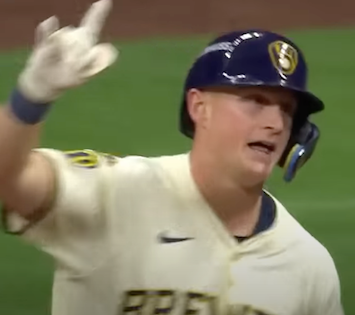
Andrew Vaughn

Vaughn running out his fourth-inning bomb. (TBS television capture.)

And, boy, is the deal that brought Vaughn from the pathetic White Sox to the Brewers looking better every hour. It happened when the Brewers elected to move Aaron Civale from the starting rotation to the bullpen, and Civale responded with a spoken desire to play somewhere else if that was the case. Be careful what you wish for, was the answer . . . and Civale went from a contender to a basement dweller just like that, in early June, with Vaughn—once a first-round draft pick, demoted to the farm a month earlier—coming aboard.

Therein lies a distinction between these Brewers and the Cubs they just turned aside. The Brewers don’t have Cub money, but they don’t let that stop them from constant upgrade searching when necessary. The Cubs have Cub money.  But they’d rather undergo root canal without anesthetic than spend it. And they lack the Brewers’s bargain basement ingenuity. They haven’t yet figured out that you don’t have to shop at the Magnificent Mile all the time. You can find amazing upgrades at Lots 4 Less.

How will these Brewers be perceived going into an NLCS against those Dodgers? Contradictorily, of course. The Brewers swept the Dodgers in their regular-season series, 6-0. But there’ll be more than enough who think the Dodgers will still be the overdogs. Even if the Dodgers’ NLCS ticket was stamped by a horror of a throwing error by Phillies relief pitcher Orion Kerkering in Game Four of their division series.

But how will these Cubs be perceived going into winter vacation? Not too favourably, after all, one fears. The top of their lineup acquitted themselves well enough, particularly Busch with three of his four division series hits clearing the fences and Nico Hoerner with his hits in each game and his team-leading .476 postseason on-base percentage. But the bottom of the lineup disappeared. The collective slash line of the Cubs’ bottom five? .120/.215/.205.

And they’re likely enough to move forward without Tucker, who becomes a free agent and who’s perceived widely enough as thinking about moving on. Even if this usually un-expressive fellow who prefers to let his game do his talking calls it “an honour” to play with this group of Cubs.

That group of Cubs needs a small, not major bullpen remake, and they need to romance and re-sign Tucker, whom they could and should have extended during the second half of the season. But maybe the Cubs need a front-office overhaul, too. The kind that brings in persuaders who can convince the Ricketts family that it’s time to open the purse strings but think about trying Lots 4 Less after that one Magnificent Mile splurge.

Finishing with their best regular-season record since 2018 shouldn’t be enough. Three straight second-place NL Central finishes shouldn’t be enough. But maybe watching the Brewers go forth and tangle honourably with the ogres of the National League West will give these Cubs—and their ownership that’s as endowed as Mercedes-Benz but prefers to drive indiscriminately off the Chicago Auto Warehouse lot—more than a little pause.

The Brewers couldn’t care less for now. They’re enjoying their first postseason series clincher since 2018, the year they shoved the Rockies aside in a division series sweep. And if they wanted any further incentive, they got it from cynics and Cub fans alike who snarked that they hadn’t won a postseason series yet as they took the Cubs on. As if their round-one bye meant squat.

So who has the next-to-last laugh now?

Once upon a time, the early rock and roll era included a novelty hit, “Beep Beep,” in which a little Nash Rambler (I always presumed it to be the anti-classic, two-seat Metropolitan) went tire-to-tire with a Cadillac in a daring little race. The Brewers are the Nash Rambler about to go tire-to-tire with the Dodgers’ Cadillacs.

And, unlike “Beep Beep’s” challenger, they know how to get themselves out of second gear.

Don’t kill the ump, San Diego

Xander Bogaerts, D.J. Rayburn

This is the pitch umpire D.J. Rayburn called strike three (wrongly) instead of ball four. This was not the reason the Padres lost Game Three of their wild card set against the Cubs Friday.

You know something? I’m probably at the front of the line wishing for Robby the Umpbot’s advent at last.  But don’t even think about trying to tell me the Padres getting nudged out of the postseason by the Cubs is plate umpire D.J. Rayburn’s fault.

Yes, Rayburn absolutely blew what should have been ball four to Xander Bogaerts in the top of the ninth of National League wild card Game Three. The pitch was low, with enough clearance between the ball and the strike zone floor to pass a Frisbee through it.

Yes, Bogaerts absolutely should have been on first. No matter how bright it wasn’t that he slammed his bat to the ground, all but forcing Padres manager Mike Schildt out of the dugout in a flash to keep things from getting worse.

Yes, the Padres absolutely should have had the proper chance to keep their late game revival going, after Jackson Merrill led the inning off with a healthy blast into Wrigley Field’s right field bleachers. That looked even more pointed when Cubs reliever Brad Keller hit the next two batters he faced, Ryan O’Hearn and Bryce Johnson, both on 1-2 counts, forcing Cubs manager Craig Counsell to lift Keller for Andrew Kittredge.

It was still first and second and one out. The Padres didn’t have the bases loaded as they probably should have had, but they still had the tying runs on the pads and a potential tie-breaking run or two due at the plate.

But Jake Cronenworth grounded to shortstop making it second and third. And Freddy Fermin flied one to the back of center field but not far enough to escape being the Padres’ third out of the game and last out of the season.

And that, ladies and gentlemen, not D.J. Rayburn, is what cost the Padres the wild card set and sent the Cubs forth to open their NL division series with a 9-3 loss to the Brewers.

Because all game long, the Padres couldn’t cash in their baserunners with the American Express card. They left eight men on base. They batted six times prior to the ninth with men in scoring position and stranded them. They had no solution for the Cubs’ superior fielding and seemed unable to find holes between those fielders to push or shoot too many balls.

They had second and third in the top of the fifth, when Gavin Sheets singled with one out and Fermin doubled him to third an out later . . . but Fernando Tatis, Jr. flied out to right.

They had Bogaerts on second when he stole the pad an out after he opened the top of the seventh with a base hit . . . and stranded him with a line out to second and a fly out to deep center.

They had Fermin on third in the top of the eighth after his leadoff single turned into taking second on a one-out wild pitch, then taking third on an infield ground out . . . and there he was stranded, on another infield ground out.

Meanwhile, the Cubs ended a faltering Yu Darvish’s start in the top of the second with a bases-loaded single, pushing him out and Jameson Tallion in, and Tallion walked the second Cub run home before getting a strikeout and an inning-ending double play.

From their, the teams traded bullpen shutout innings until Michael Busch led the bottom of the seventh off against Robert Suarez with a blast into the right center field bleachers.

The 3-1 Cubs win may well mean the closing of this group of Padres’ window for postseason triumph. They may have been lucky to get to the wild card series with an offense that led the Show in out-wasting sacrifice bunts but came home 28th in home runs. Their hitters sent 77 out at home, but their pitchers surrendered 86 in the same playpen.

Their biggest names weren’t exactly bombardiers, outside Manny Machado hitting 27 or more for the 10th time in his career. Bogaerts and Merrill missed significant time due to injuries; Bogaerts hit only 11 out and Merrill, 16. Tatis, he who proclaimed himself capable of being the best player in the game last February, settled for 25 bombs on the season and one measly single during the wild card set.

Their pitching may be somewhat suspect going forward, with Darvish likely approaching the end of a career often brilliant and sometimes frustrating, Dylan Cease and Michael King possibly departing as free agents, and Joe Musgrove entering 2026 on the comeback trail from Tommy John surgery.

And who knows what the upshots for the clubhouse and the front office will be as a result of the late owner Peter Seidler’s widow Sheel Seidler’s lawsuit to wrest control of the team from her brothers-in-law? Who knows whether A.J. Preller will be allowed to try wringing out one more miracle or handed his head on a plate in a bid to begin fresh blood injections, considering his contract expires after next season and Seidler isn’t here to have his back?

But don’t lay the blame for this early Padres postseason exit on Rayburn. He certainly did blow that crucial ninth-inning call, but he wasn’t the man at the plate turning all those Padre runners into castaways.

Robby the Umpbot wasn’t the end of the world

Robby the Umpbot

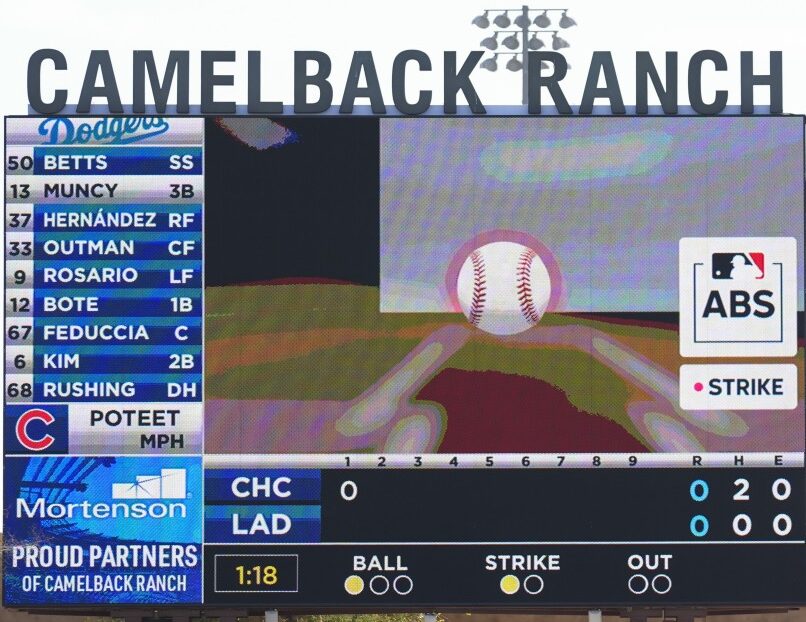
The first MLB deployment of Robby the Umpbot–Cubs pitcher Cody Poteet getting a ball call turned to a strike against the Dodgers’ Max Muncy.

Cody Poteet. Remember the name of this Cubs righthanded pitcher. No, he didn’t surrender three World Series home runs to Babe Ruth in the same game, he didn’t try to start a World Series game the day after pitching four innings in relief, and he didn’t pitch a no-hitter in which he got credit for such a performance despite his defense recording every last out in the game.*

No, Poteet was first on the mound to call for—and win—a ball/strike challenge with aid and comfort from Robby the Umpbot. Even if it was in a spring training exhibition game.

Poteet had Mookie Betts aboard and nobody out in the bottom of the first when he threw Max Muncy a fastball at the knees on 0-1. Home plate umpire Tony Randazzo called it ball one. Poteet said, “Not so fast” . . . and called immediately for Robby the Umpbot’s help. Well, now. The videoboard showed the pitch most certainly did hit the strike zone by the rule book. 0-1 went to 1-1. Muncy ended up looking at strike three not far from the same knee-high location.

Know what happened after that? How about what didn’t happen?

The sky didn’t fall. The earth didn’t move, under their feet or anyone else’s. There were no known tidal waves reported on any world coastline. Donald Trump and his predecessor Joe Biden didn’t suddenly become men of reason and wisdom. The flora and the fauna didn’t make mass entries on the endangered species lists.

About the only unlikely thing to happen from that overturned ball call was the Cubs going forth to batter the world champion Dodgers, 12-4, to open spring exhibition season. They turned a 3-0 Dodger lead after two into a six-run third, added two in the fifth, one in the seventh, and three in the eighth. The only Dodger response was an eighth-inning RBI double.

You might be happy to know that Poteet had an ally on his call for Robby’s review: Muncy himself. “When that ball crossed, I thought it was a strike right away and he balled it,” the Dodger third baseman said postgame. “I look out there and he’s tapping his head and I went, ‘Well, I’m going to be the first one’.”

And, just as with the advent of replay elsewhere, guess what else didn’t happen? The game itself wasn’t delayed unconscionably. Muncy certainly didn’t think so. In fact, he doesn’t mind Robby at all. Neither did Randazzo, seemingly.

“It’s a cool idea,” Muncy said. “It doesn’t slow the game down at all. It moves fast. The longest part was Tony trying to get the microphone to work in the stadium.” Meaning, Randazzo announcing the ruling to the Camelback Ranch crowd.

Come the eighth inning, the Cubs called for another challenge. This time, catcher Pablo Aliendo thought Frankie Scalzo, Jr.’s sweeper nicked the top edge of the zone for strike three with Sean McClain at the plate. Not quite, Robby ruled this time. Ball four.

The rule for deploying the automated ball/strike system (ABS), as it’s called officially, is that only three on the field (pitcher, catcher, or batter) can call for Robby’s opinion and each team gets only two challenges thus far. If the challenging team wins, as the Cubs did, they keep the challenge. When the system was brought online in the minors, the estimates became that the average such challenge was (wait for it!) seventeen seconds.

Neither Poteet nor Muncy were new to Robby, according to The Athletic‘s Fabian Ardaya. Poteet started ten times in the Yankee organisation last year, at Scranton-Wilkes Barre; Muncy saw it while on a rehab assignment off a wrist injury. Muncy’s only issue then was, as he put it to Ardaya, “the technology wasn’t entirely there.”

There’d be certain pitches that you would see and you’d look up on the board and it’d have it in a completely different spot . . . Even the catcher would come back and be like, ‘Yeah, that’s not where that ball was.’ The technology isn’t 100 percent there, but the idea of it’s really cool.

Critics (they were legion) feared Robby the Umpbot would penalise too many solid umpires while punishing not enough errant ones. One conclusion Robby’s early works has stirred is a revelation that might be just as jarring, as The Wall Street Journal‘s Jared Diamond puts it: the players themselves, from the mound to the plate, don’t know the strike zone as well as they think.

“Unlike the replay rules already in place, where managers initiate appeals from the dugout after having time to deliberate,” Diamond writes, “ball-strike challenges have two key differences: They can only come from the pitcher, catcher or batter—and they must happen immediately.

“The result is a format that inserts elements of both strategy and personality into the game even while adding automation. That’s because ultracompetitive, often emotional professional athletes aren’t always particularly good at knowing the right time to ask for a challenge.”

On-field embarrassment comes in infinite forms. Dodgers pitcher Landon Knack, who got knuked by the Mets in last fall’s National League Championship Series, told Diamond of times during his AAA-level days when he challenged pitches from frustration and regretted them at once. “All Knack could do,” Diamond writes, “was stand on the mound and watch the scoreboard animation showing the location of the ball, as everybody in the stadium saw that he was embarrassingly wrong.”

It’s something along the line of the store manager calling la policía after showing up at the bank without the bag full of the day’s cash proceeds, only to double back and realise he or she dropped the bank bag in the parking lot on the way to the car—with the whole thing caught on the store’s security cameras.

Other kinks in the system may well include the choice of players who get to call Robby for help. Diamond says AAA-level managers and players agree on the one who shouldn’t: the pitchers. Knack himself admits, “Pitchers are horrible at it.” Said a Dodgers AAA catcher, Hunter Feduccia, “We probably had a 90 percent miss rate with all the pitchers last year.” Admitted a Royals AAA pitcher, Chandler Champlain, “Being biased as a pitcher, I think anything close is a strike.”

Advises Jayson Stark, The Athletic‘s Hall of Fame writer, “Don’t be That Guy whose heat-of-the-moment challenge decisions leave your teammates shaking their heads and calling you names you won’t want to see displayed above your locker. Be smart. Be cool. Be thoughtful. And control those emotions!”

(Some hitters have been known to have dubious strike zone sense, too. Once upon a time, Hall of Fame catcher Yogi Berra had an impeccable strike zone sense behind the plate . . . and a notorious lack of it at the plate. Maybe the best bad-ball hitter of his time, Berra was questioned postgame about a pitch nowhere near the strike zone or even Yankee Stadium’s postal code that he’d smashed for a home run regardless. Bless his heart, Yogi insisted the pitch was a letter-high strike.)

Relax. Robby’s getting a spring training Show tryout only for now. He’s not expected to spread his wings over the regular season Show until 2026 at minimum.

But if the only kinks in the system other than coordinated calibrations thus far are figuring out who should make the challenges and who shouldn’t, you’d have to say Robby’s going to be in good shape and the umpires are going to be in better shape. (They’ll get immediate reminders of the rule book, as opposed to the “individual” strike zone.) And, the game is going to be in the best shape.

* For the record, the Cub pitchers who delivered those non-feats were, in order, Charlie Root (1932), Hank Borowy (1945), and Ken Holtzman (1969).

This essay was written for and first published by Sports Central.

Ken Holtzman, RIP: The no-no-no song and other things

Ken Holtzman

Ken Holtzman, one of the prime contributors to the Athletics’ legendary (some also say notorious) three straight World Series titles in 1972-74.

Ken Holtzman was a good pitcher with two distinctions above and beyond being credited with more wins than any Jewish pitcher including Hall of Famer Sandy Koufax. He may have been the last major league player to talk to Hall of Famer Jackie Robinson before Robinson’s death. And, he’s the answer to this trivia question: “Name the only two pitchers in major league history to pitch no-hit, no-run games in which they struck nobody out.”

According to Jason Turnbow’s Dynastic, Bombastic, Fantastic, his history of the 1970s “Swingin’ A’s,” Robinson was at Riverfront Stadium for a pre-Game One World Series ceremony in 1972, commemorating 25 years since he broke the disgraceful old colour barrier. Robinson threw a ceremonial first pitch, then departed through the A’s clubhouse, where he happened upon Holtzman finishing his pre-game preparation.

“Nervous?” Robinson asked the lefthander. “Yes, sir, a little bit,” Holtzman admitted. After some small talk, Turnbow recorded, Robinson handed Holtzman an instruction: “Keep your hopes up and the ball down.” Nine days later, the A’s continued celebrating a World Series title but Robinson died of a second heart attack.

“I was probably the last major leaguer to talk to Jackie Robinson,” Holtzman would remember. Robinson’s advice probably did Holtzman a huge favour; he started Game One and, with help from Hall of Famer Rollie Fingers plus Vida Blue in relief, he and the A’s beat the Reds, 3-2.

A good pitcher who brushed against greatness often enough and became something of a rubber-armed workhorse, Holtzman—who died at 78 Sunday after a battle against heart problems—had two no-hitters on his resume from his earlier years with the Cubs. The first one, in 1969, made him that trivia answer. Four years to the day after Cincinnati’s Jim Maloney pitched a no-hitter that’s the arguable sloppiest no-hitter of all time (Maloney struck twelve out but walked ten), Holtzman joined the No-No-No Chorus.

19 August 1969, the Cubs vs. the Atlanta Braves in Wrigley Field, Holtzman vs. Hall of Famer Phil Niekro. While the Cubs got all the runs they’d need when Hall of Famer Ron Santo smashed a three-run homer off Knucksie, Holtzman performed the almost-impossible. He got fifteen air outs (including liners and popouts), thanks in large part to the notorious Wrigley winds blowing in from the outfield. (Hall of Famer Henry Aaron made three of his four outs on the day in the air.) He got twelve ground outs. And he couldn’t ring up a strikeout if he’d bribed home plate umpire Dick Stello begging for even one little break.

It joined Holtzman to Sad Sam Jones of the 1923 Yankees. Jones faced and beat the Philadelphia Athletics in Shibe Park, with both Yankee runs scoring on a two-run single by former Athletic Whitey Witt in the third inning. Jones got fourteen ground outs and thirteen air outs, living only slightly less dangerously than Holtzman did.*

Holtzman took a little more responsibility throwing his second no-hitter, against the Reds on 3 June 1971, the first no-no to be pitched in Riverfront Stadium. This time, he struck six out while walking four, getting ten ground outs and ten air outs each. Clearly he’d learned some things before his Cub days ended.

Ken Holtzman

Holtzman, as a young Cub.

He had no trouble learning off the mound, either, graduating with bachelor’s and master’s degrees from the University of Illinois and mastering French well enough to have read Proust in the language. When he moved from the Cubs to the A’s, he even found a unique way to funnel his competitive side when he didn’t have to be on the mound.

Holtzman drew a few teammates toward his passion for playing bridge, including Hall of Fame relief pitcher Rollie Fingers, infielder Dick Green, and relief pitcher Darold Knowles, according to Turnbow. In time, the Oakland Tribune‘s A’s beat writer Ron Bergman would join Holtzman and Fingers in scouting and finding bridge clubs on the road.

“We’d be the only three guys there,” Holtzman once cracked, “three major leaguers playing against 85-year-old women.”

“It was all gray-haired old ladies,” Fingers said. “We’d beat them during the afternoon, and then we’d go to the ballpark and beat a baseball team.”

On the mound, Holtzman arrived with immediate comparisons to Koufax. Being Jewish and lefthanded and arriving in Koufax’s final season made that possible, and impossible. Nobody could live up to a Koufax comparison at all, never mind by way of sharing the same pitching side and religious heritage.

Holtzman didn’t help relieve himself of those when he faced Koufax himself in Wrigley Field, the day after Yom Kippur 1966, and outlasted Koufax, 2-0, taking a no-hitter into the ninth before veterans Dick Schofield and Maury Wills singled off him. Or, when he pitched 1967 as a 21-year-old phenom with a 9-0 won-lost record around the military reserve obligations many players had in his time.

His Cub career wasn’t always apples and honey, alas. Other than the unrealistic Koufax comparisons, there were the military reserve interruptions (he pitched on weekend passes in 1967) and there was his tendency to speak his mind, which didn’t always sit well no matter how much his teammates liked him personally.

There was also dealing with Leo Durocher managing those Cubs, and especially becoming a Durocher target, burning when Durocher accused him of lack of effort. The Cubs’ Durocher-triggered self-immolation of 1969 didn’t make for better times ahead, for either Holtzman or the team. In fact, Durocher’s Cubs author David Claerbaut recorded a conversation Hall of Famer Ernie Banks had with Holtzman as the collapse approached:

Banks had a few drinks with the young southpaw after a game in Pittsburgh. “Kenny,” he said, “we have a nine-game lead, and we’re not going to win it becsuse we’ve got a manager and three or four players who are out there waiting to get beat.”

For the then 23-year-old hurler, the conversation with Banks was chilling. “He told me right to my face, I’ll never forget it. It was the most serious and sober statement I’d ever heard from Ernie Banks—and he was right.” Holtzman’s take was similar to that of Mr. Cub. “I think that team simply wasn’t ready to win. I’m telling you, there is a feeling about winning. There’s a certain amount of intimidation. It existed between the A’s and the rest of the league . . . In Oakland, when we took the field, we knew we would find a way to win. The Cubs never found that way.

After a struggling 1970 and 1971, Holtzman asked for and got a trade . . . to the Swingin’ A’s, for outfielder Rick Monday. A’s manager Dick Williams took to Holtzman at once. So did pitching coach Wes Stock: “I’ve never seen a pitcher throw as fast as he does who has his control.”

Holtzman learned soon enough how the contradictory ways of A’s owner Charlie Finley would make the A’s baseball’s greatest circus—even while they won three straight World Series in which Holtzman had prominent enough roles (and made his only two All-Star teams) and missed a fourth thanks to being swept by the Red Sox in 1975.

His first Oakland season in 1972 didn’t exclude heartache, alas. With the A’s in Chicago for a set with the White Sox, the Munich Olympic Village massacre happened. Eleven Israeli athletes and coaches were held hostage and killed by the Palestinian group Black September.

Proud but not ostentious about his Jewishness, Holtzman and Jewish teammate Mike Epstein took a long, pensive walk before electing to have the A’s clubhouse manager sew a black armband onto one of their uniform sleeves. The two players were stunned to see Hall of Famer Reggie Jackson wearing such an armband as well.

Epstein objected (he’d had previous tangles with Jackson), but Holtzman accepted. Jackson “had contact with Jewish people growing up and was not entirely unaware of Jewish cultural characteristics,” Holtzman said. “So when I saw Reggie with that armband, I felt that he was understanding what me and Mike were going through. He . . . felt it appropriate to show solidarity not only with his own teammates but with the fact that athletes were getting killed.”

In the wake of the Messersmith decision enabling free agency at last (Holtzman faced Andy Messersmith twice in the 1974 World Series and the A’s won both games), owners and players agreed to suspend arbitration while negotiating a new collective bargaining agreement. Oops. Finley offered nine A’s including Holtzman contracts with the maximum-allowed twenty percent pay cuts. What a guy.

Annoyed increasingly by Finley’s duplicities, Holtzman began 1976 as an unsigned pitcher but was traded to the Orioles on 2 April—in the same blockbuster that made Orioles out of Jackson plus minor league pitcher Bill Von Bommel and A’s out of pitchers Mike Torrez and Paul Mitchell plus outfielder Don Baylor.

Holtzman took a 2.86 ERA for the Orioles into mid-June 1976, then found himself a Yankee. He was part of the ten-player swap that made Yankees out of catcher Elrod Hendricks and pitchers Doyle Alexander, Jimmy Freeman, and Grant Jackson, while making Orioles of catcher Rick Dempsey and pitchers Tippy Martinez, Rudy May, Scott McGregor, and Dave Pagan.

As a Yankee, Holtzman landed a comfy five-year deal but picked the wrong time to begin struggling in 1977. A May outing in which he couldn’t get out of the first inning put him in manager Billy Martin’s somewhat crowded bad books. (He didn’t pitch in that postseason, just as he wasn’t called upon in 1976.) Active in the Major League Baseball Players Association as well, that side of Holtzman may have made Yankee owner George Steinbrenner less than accommodating as well.

In 1978, Holtzman again struggled to reclaim his former form and was dealt back to the Cubs. After struggling further to finish 1978 and for all 1979, Holtzman retired. He returned to his native St. Louis, worked in insurance and stock brokerage (the latter had been his off-season job for much of his pitching career), and did some baseball coaching for the St. Louis Jewish Community Center. He even managed the Petach Tivka Pioneers in the Israel Baseball League briefly, walking away when he disagreed with how the league was administered.

Holtzman might not have been the next Koufax, but the father of three and grandfather of four knew how to build unusual bridges toward triumphs on the field. May the God of Abraham, Isaac, and Jacob have brought Holtzman home to the Elysian Fields for an eternity living in peace.

* St. Louis Browns pitcher Earl Hamilton also threw a no-hit/no-strikeout game, against the Tigers in 1912 . . . but a one-out, third-inning walk preceded an infield error that enabled Hall of Famer Ty Cobb to score in a 4-1 Browns win. Hamilton did as Jones did otherwise: fourteen ground outs, thirteen air outs (including liners and popouts).

The Hawk wants to flip his lid

Andre Dawson

If Andre Dawson has his way, his Hall of Fame plaque will change from showing him as an Expo to showing him as a Cub.

Even before any new Hall of Famers are elected, the question (and controversy?) about hat logos on the plaque portraits has arisen. You can thank Hall of Famer Andre Dawson for that, now that his letter on the subject to the Hall’s chairman of the board Jane Forbes Clark was publicised by the Chicago Tribune.

Dawson asked Clark to compel her board to review his plaque and its hat logo. When he was elected to the Hall’s Class of 2010, the Hall elected to adorn him in a Montreal Expos hat. Dawson wasn’t exactly amused, since his own preference was to be shown in a Cubs hat.

“It’s hard for stuff to bother me, to a degree,” the Hawk told Tribune columnist Paul Sullivan. “But this has toyed with me over the years for the simple reason that I was approached with the (announcement) that was going to be released to the press that I was going to wear an Expos emblem.

“I didn’t agree with it at the time,” he continued. “But for me, getting into the Hall was the most important thing. Over time, I’ve thought about it more and came to the (conclusion) I should have had some say-so.”

No one should be surprised that Dawson would prefer being seen as a Cub. He was a victim of the first 1980s owners’ collusion, the Expos offering him a two-year deal that amounted to an annual pay cut from his 1986 salary of $1.2 million. That’s when his agent, Dick Moss, sold him on the blank-contract idea that drew the Cubs to him.

He went from the blank-contract fill-in of $500,000 from the Cubs for 1987 to win that year’s National League Most Valuable Player award, after leading the league with 49 home runs and 353 total bases. That was despite several players having arguable better seasons, including Hall of Famers Tony Gwynn, Tim Raines (Dawson’s longtime Montreal teammate), and Ozzie Smith, plus Cardinals bomber Jack (The Ripper) Clark.

Dawson parlayed that gambit into five years and $10.6 million, not to mention shaking out as a particular Wrigley Field fan favourite. After finishing his career with two seasons in Boston and two in Miami, Dawson needed nine tries to reach Cooperstown but reach it he did. It came with a price. The artificial turf in Montreal’s Olympic Stadium turned the Hawk’s knees into science experiments; he’d had as many as a reputed ten knee surgeries.

Even the president of Expos Fest, Terry Giannias, whose group celebrates the Expos’ history, gets it. “I’m not going to lie,” Giannias told MSN.com, “it sort of was like a shot in the gut.” But neither would Giannias lie about why he gets Dawson’s feelings:

I just know what everybody else knows, is the way he left the Expos. When you talk about the stars of the Montreal Expos, especially in the ’80s . . . and in the 35 years (of their existence) in general, it’s Andre Dawson, Tim Raines and Gary Carter, right? So, when Carter moved on, when they got rid of him, the prodigal son should have been Andre and the way they treated him during the collusion thing . . . that was really dirty. I don’t know if somebody forgets that. Obviously, that plays a role in it. But I don’t believe it’s got much to do about that anymore, but just his love for Chicago, because Chicago embraced him, like right away and he’s had a great relationship with the city ever since. So I think it’s less of a grudge and more of an appreciation for his adopted city, he’s an ambassador there.

Carter was vocal about his preference to enter the Hall of Fame as a Met; he’d often withstood unjust criticism in Montreal before being traded to the Mets in 1985 and becoming a key to their 1986 triumph while having his last great seasons there. The Hall said, no soap, you’re going in as an Expo.

When did the Hall become that picayune about cap logos on Hall of Famers’ plaques? Hark back to 1999, when then-future Hall of Famer Wade Boggs was winding up his career with the embryonic (Devil) Rays.

Boggs was going to get to Cooperstown on his first try, in 2005. Nobody but a cynic argued otherwise. But some time in 1999, there came reports that the Rays offered to compensate Boggs handsomely if he’d consent to enter the Hall with their logo on his plaque hat. Two years later, the Hall said, well, we’ll just see about that crap. Long since, with exceptions you may be able to count on one hand, the Hall has exercised the final say on who wears which hat on his plaque, even after “consulting” with the player.

Boggs, of course, reposes in bronze in Cooperstown with a Red Sox hat on his head. Appropriately, since he posted the bulk of his credentials with the Olde Towne Team. But he also debunked the reports about the Rays’ compensation offer six years ago. “I think it came from when Jose Canseco said, ‘If I get in the Hall of Fame, I’m going in as a Devil Ray’,” Boggs told WFAN. “And someone probably misconstrued that I said that and that [original Rays owner Vincent] Naimoli offered me a million dollars to be the first Devil Ray to go into the Hall of Fame, and that conversation never took place.”

Last year, the Hall “consulted” with Scott Rolen, then assented to his request to be shown as a Cardinal. Understandably, Rolen preferred to be shown as a member of the team that made him feel both at home and like the World Series champion he became with them in 2006. Not as a member of the Phillies, who’d too often let him become an undeserved fall guy for their organisational failures prior to his departure.

Last year, too, the Hall “consulted” with Fred McGriff, who elected with their blessing to have his hat left blank. He was a frequent-enough traveler, often for reasons not of his own making, and his longest single-team tenures were a dead heat between the Blue Jays (five years) and the Braves (five years). The Crime Dog decided that a man who played for six teams (seven if you include the Yankees who discovered but unloaded him in the first place) simply shouldn’t choose one above the other in the circumstances.

When Mike Mussina was elected at last, he had a pretty pickle to ponder: his career split almost dead even between the Orioles (ten seasons) and the Yankees (eight seasons). Perhaps diplomatically, Mussina, too, elected to be blank on his plaque.

Roy Halladay’s career split twelve seasons in Toronto and four in Philadelphia. He’d posted most of his Hall case with the Blue Jays, but he did win a second Cy Young Award with the Phillies (the fifth pitcher to win one in each league), not to mention pitching that no-hitter in Game One of the 2010 National League division series. The Hall talked to his widow. Brandy Halladay elected to leave her late husband’s hat blank, not wishing to offend either team or its fans.

The rare single-team players have never had an issue, of course. (How rare? 23 percent of 270 players elected to Cooperstown as of this writing have been single-team players.) It was no issue for such men as Luke (Old Aches and Pains) Appling, Jeff Bagwell, Johnny Bench, Craig Biggio, Roberto Clemente, George Brett, Joe DiMaggio, Roy Campanella, Lou Gehrig, Bob Gibson, Tony Gwynn, Derek Jeter, Walter Johnson, Chipper Jones, Al Kaline, Barry Larkin, Mickey Mantle, Edgar Martínez, Stan Musial, Pee Wee Reese, Mariano Rivera, Jackie Robinson, Jim Rice, Mike Schmidt, Ted Williams, and Carl Yastrzemski, among the Hall’s 54 single-team men.

If elected as they should be, Todd Helton and Joe Mauer are also single-team men who would go in as a Rockie and a Twin, respectively. The blank hat makes sense for players with multiple franchises on their resumés if they didn’t spend, say, 65 percent or more of their career with just one. Andruw Jones should go in as a Brave; Chase Utley, a Phillie; Billy Wagner, an Astro.

Adrián Beltré is trickier. He played seven season with the Dodgers and his final eight with the Rangers. (In between, there were five in Seattle and one in Boston.) Under Frank McCourt’s heavily mortgaged and controversial ownership, the Dodgers let him walk as a free agent in 2004, after he led the entire Show with 48 home runs. Considering his relationship with and in Texas, if he doesn’t enter Cooperstown with a Rangers hat on his plaque head there will (should) be protests up and down the Lone Star State.

A player who posted the bulk of his Hall case with one team has a better case to be shown with that team’s hat. Unless, of course, he went from mere Hall of Famer to triple superstar elsewhere. (Think, for example, of Vladimir Guerrero, Sr. as an Angel, Reggie Jackson as a Yankee, and Randy Johnson as a Diamondback.) But then there was Greg Maddux. Born and raised a Cub, but going from mere greatness to off-the-charts as a Brave. He put two more teams on his resumé and elected to be inducted with a blank lid.

The blank might have worked for Dawson, too, until you consider his actual feeling about it. He might have been a star in Montreal, but after the Expos colluded his way out of town he became more than than that in Wrigleyville. That daring blank-contract MVP season turned not just into further riches but a love affair. The North Side embraced him and he returned the embraces.

Even after leaving as a free agent, even though he participates occasionally in Expos-related events, Dawson’s heart probably never truly left Chicago. If the Hall reconsiders and gives the Hawk his heart’s desire here, it would be the first time the Hall ever flipped an inductee’s lid at his request. That assent would not come without complications.