ASG: As (almost) usual, show biz yields to baseball

Jarren Duran

Red Sox center fielder Jarren Duran hoists the clear bat awarded the All-Star Game’s Most Valuable Player. His tiebreaking two-run homer held up to give the AL the 5-3 win.

God help us all, everyone. The All-Star break began with a pre-Home Run Derby singing of “The Star Spangled Banner” Monday night (by country star Ingrid Andress) that made youth cringe and elders think wistful thoughts of Roseanne Barr. It ended with a tenth American League All-Star Game win in eleven seasons.

In between, of course, was much to ponder and much to dismiss as patent nonsense, which seems to be far more the norm than Chicago Tribune sports editor Arch Ward, who initiated the game in 1933, might have imagined.

Phillies third baseman Alec Bohm could be seen having to labour to keep from laughing (presumably, that he might not weep—or wish to commit manslaughter) when Andress tackled “The Star Spangled Banner” as though too well besotted. It turned out that appearance was everything: She copped the following day to being drunk and having enough issue with it to seek rehab and recovery.

Wish her well, but demand to know why nobody in baseball’s administration noticed she was drunk as she took the mike in the first place.

That was then: The Derby rules were, a participant had ten outs to hit as many homers as they could, the hitter with the most such bombs advanced, and that was that. So simple that, in fact, even Mark Belanger (human Electrolux at shortstop, but a spaghetti bat who hit three fewer homers in eighteen major league seasons than the late Hall of Famer Willie Mays hit in the first half of 1965) could have done it.

This is now: Round One—three minutes or forty batted balls, whichever came first, followed by an old-style three outs to hit as many bombs as possible. Round Two—the top four floggers moved to a bracket-like semifinal. Round Three—the two semifinal winners head to head. The net result: Teoscar Hernandez (Dodgers) defeating Bobby Witt, Jr. (Royals), who nearly forced a playoff with a ICBM-like blast stopped only by the left center field fence.

Some of us still wonder why we’re supposed to tolerate three-hour long Home Run Derbies but arise armed against two and a half hour-plus real baseball games. Or, why we had three-minute commercials aboard Fox’s All-Star Game telecast Tuesday before seeing supersonic relief pitchers blowing the side away in order in a minute and a half if that long.

Perhaps commissioner Rob Manfred might have an answer to that one. At least he has a sort-of answer to the question (posed by The Athletic‘s Tyler Kepner) of when the ever-more-hideous generic All-Star Game uniforms of the past several years will be disappeared in favour of returning the fine old tradition of All-Stars wearing their own uniforms and thus representing their teams.

“I am aware of the sentiment and I do know why people kind of like that tradition,” Commissioner Pepperwinkle told Kepner. “There will be conversations about that.” The proper two-word answer to that, of course, is, prove it. About knowing why people (more than kind of) like that tradition and holding serious conversations about it.

Well, take the proverbial pause for the proverbial cause. That very first All-Star Game featured the American League representatives wearing their own teams’ home uniforms with the National League wearing road threads, as modeled below by Hall of Fame catcher Gabby Hartnett:

Gabby Hartnett

Behold now this year’s threads for each league:
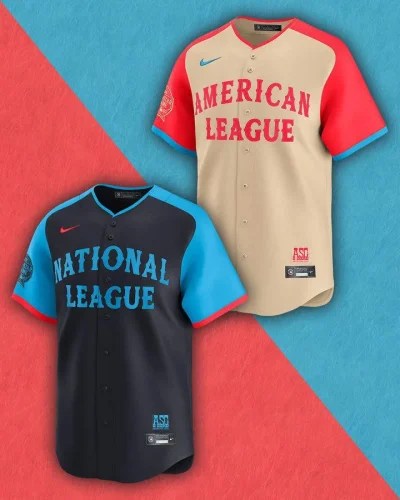
Yes, we have seen far worse for generic All-Star uniforms.

Except for each league’s colour scheme, is it really that radically different from the 1933 NL haberdashery? Now, this year’s threads would look far nicer if the American League jersey was done with red-on-white (the AL was the home team in Globe Life Field) and the National League was done with blue-on-gray (since the NL is the visiting team). And worn over either white (home) or gray (road) pants.

My normal position is to be all-in on returning to the practise of each league’s All-Stars wearing their own teams’ uniforms, representing their teams and fan bases, as their forebears did for so many decades. If Commissioner Pepperwinkle insists ultimately upon keeping generic league uniforms, this year’s style just might be the right way to go, switching the core white and gray each year depending upon which league is the All-Star host.

The wherefores of this year’s uniforms mattered less when the game got underway, and rookie NL starting pitcher Paul Skenes (Pirates) got to face Aaron Judge (Yankees) after all, thanks to Judge’s teammate Juan Soto wringing himself into a walk. The bad news: Judge forcing Soto at second with a grounder to third for the side.

AL manager Bruce Bochy (Rangers) was well aware of the marquee appeal of Skenes versus Judge while penciling Judge into his cleanup slot. But he sent three lefthanded swingers with impeccable on-base credentials up against the righthanded Pirate phenom to open, hoping precisely to get that marquee match without sacrificing his best chances to start winning the game.

Joe and Jane Fan insist, “This is just an exhibition, dammit!” Maybe they’re right. Maybe the metastasis of regular-season interleague play to a full-season thing has left the All-Star Game bereft of meaning, as opposed to such artifices as the period when postseason home field advantage went to the league who won the Game..

But maybe a Hall of Famer in waiting who’s won four World Series as a skipper knows, however the game’s been kicked around like a commissioner’s plaything for too damn long, that himself, his NL counterpart Torey Lovullo (Diamondbacks), and the players on both sides, actually do play this particular game as baseball, not show business.
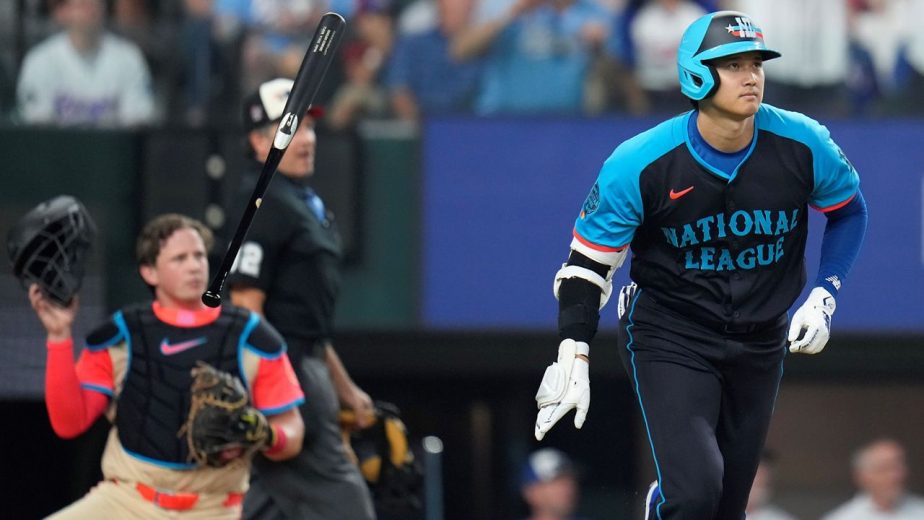
Shohei Ohtani

Shohei Ohtani detonating a three-run homer in the third inning. “To be able to share a dugout with him was surreal.”—Pirates pitcher Paul Skenes. Ohtani is now the only player in Show history to earn a pitching win in one All-Star Game and a home run in another All-Star Game.

So Bochy got Joe and Jane Fan their marquee matchup the old fashioned way, and Skenes came out of it on top, but Bochy’s diligence left him the only manager in major league history to win a World Series and an All-Star Game in each league. And, the first since Hall of Famer Joe McCarthy to manage an All-Star Game at home the season after he won a World Series.

Putting baseball ahead of show biz has enriching payoffs, of which Commissioner Pepperwinkle seemed as unaware as both managers were reminded soon enough en route the American League’s 5-3 win Tuesday.

Lovullo got the first such reminder when Shohei Ohtani (Dodgers) faced Tanner Houck (Red Sox) in the top of the third with nobody out, two men on, and sent a 2-0 splitter a few rows back into the right center field seats. (The last Dodger to hit one out in All-Star competition? Hall of Famer Mike Piazza, 28 years earlier.) Bochy got his in the bottom of that inning, when Soto shot a two-run double to center and David Fry (Guardians) singled him home to tie the game at three after another Judge ground out.

Two innings later, Lovullo got the reminder that ended up counting for the game, when Jarren Duran (Red Sox) batted with two out and one on, took a strike from Hunter Greene (Reds), then caught hold of a Greene splitter and sent his own message into the same region of seats where Ohtani’s blast landed.

“It won’t hit me until I try to go to sleep tonight,” Duran told The Athletic postgame. “Who knows if I’ll be able to sleep tonight.”

A guy in his fourth Show season who entered this All-Star Game leading it with ten triples and the AL with 27 doubles, then detonated what proved the winning bomb Tuesday, deserves to sleep the sleep of the just. So does the rookie whose first two months in Show have made him a name and an arm to reckon with as it was, without giving him the additional gift of being an Ohtani teammate even for just one game—thus far.

“I tried to enjoy the three hours I had on a team with him,” Skenes said postgame, “because that’s probably only going to happen once a year. It was really cool to watch him do that, really cool to watch him go about his business and get to meet him and all that. You know, he’s—I don’t know of any hitters I’ve faced that’s better than him in my career. So, to be able to share a dugout with him was surreal.”

The only thing better for either would have been an NL win, of course. Nobody had to tell Skenes it was neither his nor Ohtani’s fault the NL came up two bucks short Tuesday.

ALCS Game Six: Seriously?

Adolis García

That was Game Five: Adolis García at home, plunked and brawling over it. This was Game Six: García’s grand slam in Houston turning a tight Ranger lead into a blowout win.

Were the Elysian Fields demigods drunk Sunday night? Did Bryan Abreu appealing his two-game suspension, enabling him to pitch if called upon, absolutely have to mean he and Adolis García would square off again, in the top of the eighth, two nights after their confrontation turned into a bench-clearing brawl, three ejections, and the Astros taking a 3-2 American League Championship Series lead?

And did García just have to shake off his fourth swinging strikeout of the Game Six evening at Abreu’s hand only to turn a tight Ranger lead into a 9-2 blowout with a grand slam in the top of the ninth? Seriously?

Of course, to both. Because a) those demigods can rarely resist the opportunity for farce. And, b) because this is baseball, where (said before, saying again) anything can happen—and usually does.

The top of the ninth was absurd enough, with the Rangers loading the pillows on Astro reliever Rafael Montero with a leadoff walk (Josh Jung), a fielding error when José Altuve couldn’t handle Leodys Taveras’s high chopper charging in from second, and Marcus Semien setting García’s moveable feast table with a sharp base hit to left.

This is where you could see those Elysian demigods snickering behind their heavenly brewskis as Astros manager Dusty Baker brought Ryne Stanek in from the bullpen. Stanek got credit for the “win” when the Astros blew the Rangers out in Game Four, and now someone among the demigods had to have had the devil on the horn reminding him to collect his due.

First, Stanek hit Corey Seager with a pitch on 1-0 to send Jung strolling home with the fifth Rangers run. Then, Stanek had García at a 1-1 draw, before throwing him a fastball right atop the bull’s eye of the strike zone. It disappeared midway back into Minute Maid Park’s Crawford Boxes faster than any known American highway speed limit allows.

Thanks, Dev, you could hear the Elysians purring. Eff you, Ol’ Splitfoot, you could hear Astroworld fuming.

Two air outs to follow ended the inning but not García’s glory. On the night Abreu could pitch while appealing his two-game suspension for throwing at García in Game Five, García—who probably should have drawn a similar suspension for starting the brawl to follow when he got into Astro catcher Martín Maldonado’s grille over the driller—made himself the Rangers’ man of the hour.

Maybe even the entire ALCS, too. Even if Rangers starting pitcher Nathan Eovaldi could stake a claim with six and a thirds’ stout two-run, five hit pitching in which he struck out fourr and walked three. But Eovaldi, the solid defenders behind him, and the solid enough bullpen bulls to follow him, made you ponder whether they were merely toying with the Astros allowing a pair of runs on a first-inning RBI single (Yordan Alvarez) and a sixth-inning sacrifice fly (Mauricio Dubón).

Before García unloaded, he’d spent the night striking out swinging twice against Astro starter Framber Valdez, once against Astro reliever Phil Maton, and of course against Abreu. He looked so overmatched in those turns at the plate you could have forgiven him for wondering whether to carry a window, a door, or a great oak tree up to the plate his next time up.

Concurrently, Rangers designated hitter Mitch Garver enhanced one of his finest postseason nights—a game-tying solo bomb in the second; a two-out single telegraphing Josh Heim’s two-run homer in the fourth—by taking out late insurance for his team. After Abreu struck García out, Garver slashed a 3-1 slider on a high line to left that bounced once, ricocheted with a clang off the scoreboard wall, and enabled road-running mid-game Rangers left field insertion Evan Carter (leadoff infield hit; steal of second) to come home in the eighth with the fifth Rangers run.

The Minute Maid audience spent most of the evening booing lustily every time García checked in at the plate and cheering just as lustily every time he struck out. Then he sliced that ninth-inning salami. That was enough to quell the crowd’s appetite and send them starting to strike for the exits before the bottom of the ninth.

And, for Rangers reliever Andrew Heaney to throw four pitches for three ground outs to end the game. If you were an Astro fan still in the ballpark, those four pitches seemed like a mercy killing, no matter that the ALCS was now merely tied at three, but given this year’s Astros’ comparative weakness on the road including a 1-4 postseason record there so far.

Just don’t ask Astros left fielder Michael Brantley. “That doesn’t matter,” he said postgame. “It’s in the past. We need to turn the page and be ready for tomorrow.” They’ll need a lot more than page turning if precedent still matters—including the one saying that no team who lost more at home than on the road in the regular season has yet reached a World Series.

“It’s something you can’t explain,” Dubón said. “We could come tomorrow and win tomorrow and everybody would forget about it. It’s part of baseball. We win on the road. This year, we didn’t win at home and we have one more game to prove it.” Unfortunately, for this year’s Astros, that last remark could be taken two ways.

The Rangers probably couldn’t care less. They were a home powerhouse (.617 percentage) and just under .500 on the road during the season. Three of the four best road teams this year (the Braves, the Orioles, the Dodgers) were punted out of the postseason early.

The Astros, number four on the road overall, might be on the threshold of a postseason exit, but they’re still the Astros, and—in the phrasing of a one-time Astros coach—they’re not out of it until they’re out of it.

And the Rangers know it. Seriously.

Ask them why it’s been the visitors walking into the other guys’ houses and looting and plundering them, and Garver is stuck for an answer. “Seems a little odd nobody is winning at home,” he said postgame. “And I would like for it to stay that way.”

Stuck for an answer, too, is manager Bruce Bochy. “That’s the million dollar question,” said the man who managed the Giants to three World Series-winning games in five years on the road. Including the first of the lot—against a different collection of Rangers, in 2010. This group won’t take the Astros for granted no matter where they’re playing.

“I said it in August, it’s going to be a dogfight all the way to the end,” said Garver. “Really, really good ball club on both sides. They have pitching. They have hitting. But so do we. It’s one game to settle it all, and I think everyone is excited for that.”

Bochy is on record prominently as saying he doesn’t really like a lot of drama. Do you think Game Six changed his mind a little? He’d just been handed the Astros’ heads on a plate courtesy of one of the most dramatic late-game detonations in his team’s history.

“It’s been entertaining with me,” he said postgame. “It’s intense. There’s no getting around it. People ask you, ‘Are you having fun?’ Yeah, it’s fun, you try to enjoy it, but it’s intense out there. That’s what I came back for, to be in this situation. It’s exciting”

Seriously? What happened to the wish for little to no drama? Maybe Bochy knows that wish’s last stand disappeared the moment García’s salami did. Seriously.

ALDS Game Two: From blowout to squeaker

Mitch Garver

Mitch Garver’s third-inning grand slam proved the difference maker as the Orioles turned an  early blowout into a squeaker of a win for the Rangers Sunday.

Until this weekend, the last time the Orioles were swept in a series was in May, by the Blue Jays. During the regular season, the Orioles were a .642 team on the road. Now, they’re on the threshold of an American League division series sweep, but they’re counting on that traveling mojo to overthrow a Rangers team that won’t be overthrown without a fight.

Not after the Orioles turned a 9-2 blowout in the making into an 11-8 squeaker in Game Two Sunday. Not after the Orioles couldn’t do better than Aaron Hicks’s three-run homer with one out in the bottom of the ninth. Not after the Rangers battered them for nine runs in the first three innings, including and especially Mitch Garver’s grand slam in the third.

Not after the Oriole bullpen was so deeply deployed following a Game One loss that saw theirs ranks pressed into duty after four and two thirds. Today’s travel day from Baltimore to Arlington may not necessarily give them relief. Not facing a Rangers team that hasn’t played at home in a fortnight but hit 53 home runs more at home than on the road during the season.

“We just came up a little bit short today, but that built a lot of momentum going into the next game,” said Orioles leftfielder Austin Hays after Game Two. “Nobody laid down. We didn’t give away any at-bats. We continued to fight. We were able to get into their bullpen and work on those guys a little bit. I feel good moving forward, but we know we’ve got our work cut out for us.”

That’s a polite way to put it. They played .500 ball against the Rangers in six regular season games, but they blew their home field advantage to open this division series. A team that hasn’t seen home in a fortnight can be presumed hungry to put an end to this set as soon as possible, by any means necessary.

The Rangers proved that when they started Garver, a backup catcher who played in only half the regular season games, and sent him out for his first postseason appearance this time around. In a game the Orioles opened with a 2-0 lead after one full inning, but the Rangers slapped rookie Orioles starting pitcher Grayson Rodriguez silly with a five-run second, Garver checked in at the plate with one out followed by three straight walks.

Orioles reliever Bryan Baker left the pillows loaded for his relief, Jacob Webb. On 3-1 Webb elevated a fastball, and Garver elevated it six rows into the left field seats.

Rangers manager Bruce Bochy—who came out of retirement to shepherd the Rangers after all those years and those three World Series rings managing the Giants—said pregame that it was “just time to get [Garver] out there.” Garver may have given the boss the most expensive thank-you present of the postseason thus far.

“He’s got big power,” Bochy said postgame, “and that’s big at that point in the game. Really was the difference in the game.”

So were the eleven walks handed out by eight Orioles pitchers, including a postseason record five to Rangers shortstop Corey Seager. So were the mere three hits in thirteen Oriole plate appearances with runners in scoring position, which explains a lot about how the Orioles actually out-hit the Rangers (fourteen hits to eleven; .973 to .891 game OPS) but fell three short in the end.

Also in too-vivid contrast were the fruits of each team’s trade deadline moves. Or, in the Orioles’ case, lack thereof. The Rangers moved to bring future Hall of Famer Max Scherzer into the fold but also added starter Jordan Montgomery and reliever Chris Stratton in a deal with the Cardinals.

The Orioles moved to bring another Cardinal pitcher, Jack Flaherty, aboard at the deadline. But Flaherty, once a glittering Cardinal comer, hasn’t been the same pitcher since a 2021 oblique injury and a 2022 shoulder injury. He pitched his way out of the Oriole rotation and now looks to be the long man out of the bullpen.

He got a shot at showing what he could do in that role when it looked as though it would be just mop-up work Sunday. The good news: He surrendered only one run (on Garver’s double play grounder in the fifth) in two innings’ work. The bad news: He contributed to the Oriole walking parade with three of his own, including two in the fifth.

Some say the Orioles standing practically pat at the trade deadline instead of going for any kind of impact deal may yet come back to bite them right out of the postseason, especially after their own pitching depletion (losing top starter John Means and closer Félix Bautista especially) late in the season. Others fear the Orioles were more concerned with their usual penny pinching plus censoring a lead broadcaster over a positive graphic the team itself fashioned for a broadcast.

Montgomery handled the Orioles well following the two-run first, at least until he surrendered a pair in the fourth on an RBI single (Jorge Mateo) and a sacrifice fly (Ryan Mountcastle.) But when Orioles rookie star Gunnar Henderson greeted him with a full-count leadoff home run and Hicks followed with a base hit, Montgomery’s day ended and the ordinarily wobbly Ranger bullpen took over.

That bullpen kept the Orioles quiet until the bottom of the ninth, when Brock Burke handed Henderson a one-out walk and Hays singled him to second. Bochy reached then for José Leclerc, and Hicks—the erstwhile Yankee who never really found his best footing in the Bronx—reached for a one-strike service and drove it into the right field seats.

It was a little vindication for Hicks the day after he blew a hit-and-run sign in the Game One ninth, leaving Henderson a dead duck on the pond when he was thrown out at second, before Leclerc finished the 3-2 Rangers win. After his up-and-down Yankee life, Hicks looked like an Oriole blessing after he signed in May following his Yankee release. After Sunday, he looked like an Oriole hope once again.

An Oriole hope is just what Baltimore needs now. But Ranger hopes won’t exactly play to an empty house come Tuesday. At the end of the former, survival. At the end of the latter, a chance to play for the pennant.

. . . but the little gulls understand

2019-07-19 AT&TParkSeagulls

A flock of seagulls over AT&T Park’s outfield, not unlike the one Pete Alonso of the Mets scattered in the sixteenth Thursday night.

A pair of National League also-rans meeting to start a four-game set in San Francisco. One managed by a three-time World Series-winning skipper, the other managed by a former pitching coach who’s caught too often unawares but still might break a record for in-season votes of confidence that make his team’s fan base anything but confident.

A pair of starting pitchers whose names appear as often in trade-deadline speculation as Harold Stassen used to run for the presidency. Backed by one bullpen that has three bulls whose names are sometimes whispered in trade talks and another backed by a group that plays with matches a little too often for its own good.

And, a marathon in which both sides’ pitching traded off otherwise lockdown work around twenty hits, ten for each side, with 32 strikeouts between them for fifteen innings, and a flock of seagulls flying above the left side of the AT&T Park outfield in circular patterns that looked taunting one minute and challenging the next.

Thus the Mets and the Giants Thursday night entering the sixteenth inning tied at one. Until Pete Alonso opened the top of the inning almost doing to a seagull with his bat what Hall of Fame pitcher Randy Johnson once actually did to a dove from the mound to break the tie at long enough last.

The Mets entered the bottom of the sixteenth with a 2-1 lead and exited with a 3-2 loss to the Giants in which Mets reliever Chris Mazza, who’d worked a spotless fifteenth, couldn’t get an out if he’d pre-ordered them on Amazon Prime Days just before the Mets hit the Bay Area.

Both teams all but emptied their bullpens, following seven strong innings from Mets starter Noah Syndergaard and nine from the Giants’ Madison Bumgarner, with the Mets’ pen of all people having a little bit of the better of things until the sixteenth. And that was after both Syndergaard and Bumgarner could swap a few jibes about how the single runs each surrendered might look almost like happy accidents in the box score.

Mets rookie Jeff McNeil scored in the top of the first—while Alonso himself dialed Area Code 6-4-3 with nobody out. Giants center fielder Kevin Pillar scored Pablo Sandoval with a sacrifice fly in the bottom of the fourth. And no matter what the Mets and the Giants threw at each other or swung against each other, nobody else came home until the sixteenth.

Bumgarner still felt his oats after the ninth, doing everything he could short of bringing Perry Mason in to plead his case to manager Bruce Bochy to go out for the tenth. “He lobbied, trust me, he did,” Bochy said after it finally ended. “In fact, I came in after the game, he’s still mad at me for not letting him go out there in the 10th.”

“I didn’t try to make it much of a conversation but he wasn’t having it,” the normally ornery Bumgarner said with a few chuckles punctuating his remarks. “Usually if I really want to I can get my way with him, but he wasn’t having it today. How many times do you get to go out for the tenth?”

He struck out six in nine to Syndergaard’s eight in seven. Then came the running of the bulls. The Mets’ pen—in order, Seth Lugo, Luis Avilan, Edwin Diaz, Jeurys Familia, Robert Gsellman (working two innings), and Justin Wilson—scattered three hits and three walks with a combined ten strikeouts (including Gsellman’s three) before manager Mickey Callaway sent Chris Mazza out for the fifteenth.

The Giants’ pen—in order, Will Smith (another trade deadline subject), Reyes Moronta, Tony Watson, Derek Holland, and Trevor Gott—was equally stingy until the sixteenth, scattering four hits and a walk while striking out a collective eight. (Including three each by Smith and Gott.)

Both the Mets and the Giants, riding concurrent hot or semi-hot streaks into Thursday night, might yet be pondering the reset buttons. But several players on both sides made themselves look a little more attractive to prospective contending suitors a fortnight before the new single trade deadline.

The men don’t know, but the little gulls understand.

Then Williams Jerez, who’d shaken off first and second in the top of the fifteenth, went to work in the top of the sixteenth. He had Alonso 0-2 with a foul. Then he hung a changeup, and Alonso hung it into the left field seats, missing one of the circling gulls by inches. Imagine the gulls as they scattered: Incoming! Hit the deck! There is no deck!

Jerez nailed a pair of back-to-back strikeouts before walking Amed Rosario, but he escaped when he picked Rosario off and got him thrown out for attempted grand theft. Then it was Mazza’s turn to work a second inning.

He got that turn because Callaway had no choice: he had nobody left in the pen, it wasn’t their fault the Mets were as futile in getting runs home until Alonso’s blast, and he didn’t want to burn a starting pitcher if he could help it. Callaway admitted after the game that if it went somehow to a seventh inning he would have sent left fielder J.D. Davis to the mound and pitcher Jacob deGrom out to play left field.

Thank God it didn’t quite come to that, except that the Giants made sure it wouldn’t get to that point off Mazza in the bottom of the sixteenth. It’s a luxury the Mets couldn’t have afforded unless they’d gotten more in their half than just Alonso’s almost-seagull shoot.

A leadoff double (Alex Dickerson), RBI double to re-tie (Brandon Crawford), a hit batsman (Austin Slater, who took over for Mike Yastrzemski in right field in the ninth), a bases-loading single (Pillar), and the Mets’ infield in to choke off the run that wouldn’t be choked off when Donovan Solano (who’d replaced Joe Panik at second in the tenth) sort of snuck a base hit into shallow right field.

“Syndergaard did a great job of pitching out of some jams early and their guys did too,” said Callaway after the game. “There were a lot of baserunners at third with less than two outs and nobody got in. It was a tough night to score runs.”

It was for fifteen innings, until the bases-loaded jam the Mets couldn’t escape the way they did in the fourth, when Pillar’s sacrifice fly began life as a potential bases-clearing hit until J.D. Davis ran it to the rear end of left field and made a leaping snatch.

But the Giants finally banked a win to be proud of and the Mets banked a loss they couldn’t really be ashamed of. Even the gulls looked as though they tried congratulating both sides when it finally ended.

For openers, MadBum may be lucky

2019-02-10 MadisonBumgarner

The idea of an opener makes him a very MadBum . . .

Of everything you can say about Madison Bumgarner, dumb isn’t one of them. (Even accounting for the dirt bike accident that took him out for long enough in 2017.) He’s not dumb on the mound, he’s not dumb otherwise.

But then, after new Giants general manager Farhan Zaidi pondered the possibility of some pitchers as openers, at the Giants’ FanFest Saturday, Bumgarner texted manager Bruce Bochy to say, “If you use an opener in my game I’m walking right out of the ballpark,” a text Bochy disclosed to NBC Sports’s Alex Pavlvic.

Time was when a show of defiance such as Bumgarner’s would have gotten him dispatched post haste, on the first rail the Giants could find for him, and never mind that Bochy would probably sooner be tempted to insert himself into the game as a pinch hitter than even think about either using Bumgarner as an opener or bringing him in after an opener’s first and only inning. And if you think I’m writing through my chapeau, you don’t remember Ted Simmons.

Simmons was the Cardinals’ number one catcher in the 1970s and early 1980s, before the Cardinals became winners again and during a long strange drought of their own, a drought Simmons had little enough to do with when it came to the front office’s doings or undoings but enough to do with on the field.

He was a terrific hitter in St. Louis and went to six All-Star teams as a Cardinal. He also came close to being what Dodgers pitcher Andy Messersmith did become, the man who might have forced the end of the reserve era. Simmons refused to sign for 1972 unless he got $30,000 for the season, slightly over twice his 1971 salary. Then-Cardinals GM Bing Devine refused to go past $20,000, thinking Simmons was asking too much, too soon. And he started playing the season without signing, the first time that had ever happened in the majors.

He went on a tear, too; by mid-season, his batting average was .340. And it had the unlikely effect of shifting sympathy away from the Cardinals, especially when Simmons was named to his first All-Star team. The morning of the All-Star Game, Devine called him at his hotel inviting him to the GM’s room to talk. This time, Devine offered him the $30,000 he sought for that season and $75,000 for 1973.

Simmons’s jaw dropped. He called his wife and told her about the two-year deal, with more money than even he imagined coming so swiftly, and elected to sign. And he’d inadvertently showed a rupture in the armour of the Lords of Baseball; they’d rather give a second-year catcher $105,000 over two years than risk any reserve clause test, which they feared Simmons might think about, kid though he was, the longer he played unsigned.

So Simmons wouldn’t be the man to break the reserve clause. But as the seasons went on, his hitting kept him in the number one Cardinals catching job and his personal popularity in St. Louis became such that nobody except opposing teams saw his wounding flaw as a catcher: he had one of the weaker throwing arms in the game. The 3.65 ERA for the pitchers who threw to him speaks well enough of Simmons handling a pitching staff, but Simmons finished his career with enemy baserunners averaging thirty stolen bases a season against him; he had 130 lifetime errors and 62 percent of them were throwing errors.

Hall of Fame manager Whitey Herzog, unfortunately for Simmons, saw the whole picture when he took over as the Cardinals’ manager in 1980. In You’re Missin’ a Great Game, the White Rat wrote:

Ted hit the ball like a sonofagun but when I watched him play, I didn’t see a motor that drove the Cardinals’ boat. He was more like a leak in their hull. Ted Simmons, God bless him, was a fine person who played hard and cared about winning . . . Unfortunately for the Cardinals organisation, that [poor arm strength] was a bigger disaster than anybody around me seemed to realise . . . [I]t’s just as important to stop the other guy from scoring a run as it is to get one home yourself. And your catcher is your most important guy in shutting chances down . . .

Because Ted threw so poorly to second, every team in the world knew they could swipe that base in the late innings. They knew that if they were behind they’d eventually get their . . . shots to score . . . I doubt five fans could have told you about this factor. Announcers never brought it up. It wouldn’t even show up in the [newspaper] box scores. But every manager worth his spikes was clued in. You’d be amazed—amazed—how many games that cost the Cardinals . . . By the standards everybody still uses today, [Simmons] was a star. But again: Everybody doesn’t know baseball. Too many fans, media, and even baseball people get sidetracked by factors that just don’t bear on the big picture. In the Simmons era, the Cards had never finished first.

Herzog first thought about moving Simmons to a position where his weak throwing arm wouldn’t hurt the Cardinals, and Simmons had actually been a better defensive fielder/thrower whenever he played first base, which was often enough to that point. (He’d played 195 games at first as a Cardinal.) The problem was when Herzog or someone made the suggestion. First, Simmons liked the idea—until he didn’t, thinking that first base incumbent Keith Hernandez might be hurt if converted to a left fielder, and asked for a trade.

Wearing both the manager’s and the general manager’s hats, and having also signed free agent catcher Darrell Porter to a five year deal, Herzog had to lose one or the other. Simmons’s arm issues and change in attitude, measured against Porter’s defensive superiority (Darrell’s strong throwing arm, good positioning, and quickness behind the plate shut down the leakage overnight, Herzog would write in due course), made the decision simple.

Herzog was at the beginning of a remake/remodel that would ultimately send 31 Cardinals out and bring in enough to make them World Series winners in 1982 and National League pennant winners in 1985 and 1987. Dealing Simmons, Pete Vukovich, and future Hall of Fame reliever Rollie Fingers (Herzog had just bagged the reliever he really wanted, future Hall of Famer Bruce Sutter) to the Brewers, and the deal helped set the Cardinals and the Brewers up as 1982 World Series opponents.

But he was roasted over trading the still-popular Simmons. “I didn’t want to make it,” the White Rat told The Sporting News. “I was forced to trade him . . . I couldn’t have both him and Porter as catchers. I didn’t have to trade him, but it would have led to a bad situation if he wasn’t happy . . . We’ve improved our defense. We’ve improved our team speed.”  And, in due course, also in You’re Missin’ a Great Game, he’d write of Simmons, “If the National League had had the designated hitter, the man would have gone to his coffin as a Cardinal.”

Herzog might well have kept Simmons if Simmons had accepted the idea of moving to first base, perhaps knowing Hernandez would have found adjusting to an outfield position simple enough. (Hernandez’s feud with Herzog wouldn’t happen until 1983, when Herzog shipped him to the Mets—jump starting their remodeling into a mid-1980s powerhouse.) But when Simmons took a stance that indicated himself instead of team first, Herzog didn’t flinch.

And the Giants shouldn’t.

I get Bumgarner’s alarm over the opener concept. My own take on it is that the opener concept can work—if you need a stopgap when a member of your starting rotation is down with an injury (as Bumgarner has been for parts of the past two seasons) and you don’t have another option to bring you through six or seven innings without throwing your rotation more than slightly out of whack. In that situation why not try a bullpen game?*

At best you win a game, depending on whether your hitters are better than the other guys’ pitchers on the day. At worst, you may lose a game but you don’t have to reshuffle your rotation just yet. And while I certainly get that any manager wants nothing more than to get the best of his pitchers without exhausting them into uselessness when you really need them the most (like down the stretch, or in the postseason), I don’t know that I want the opener to become more than the periodic stopgap I enunciated above.

Bumgarner could and should have found a better or at least less defiant way to express his distaste for the opener concept. He might have said, simply, that it isn’t as healthy for the game, not to mention such established or future starting pitchers as himself, as its supporters think, and those who think he’s too alarmist might have said so and initiated a vigorous but healthy debate. And since when is baseball allergic to vigorous and healthy debate?

But if the Giants decide not to find the nearest available rail on which to run Bumgarner out of town for the text he did send his manager, MadBum should thank God in whichever form the lefthander prays to Him that he’s built enough good will to get away with it.

And, for the fact that this isn’t 1980, and . . . well, try to imagine how Whitey Herzog—who’d have run through a hailstorm of artillery for his players otherwise**—would have answered a text like that.  “Bumgarner to the Mets for three live bodies and a box of balls . . . ” would not have been an unrealistic if slightly surprising headline.


* The bullpenning concept isn’t as recent or radical as you think. The St. Louis Browns actually tried it, first and at its possible greatest extreme, for the final game of a dismal 1949 season. (And weren’t most Browns seasons dismal, anyway?)

For the final game, against the White Sox in St. Louis, Browns starting pitcher Ned Garver pitched the first. Then a different Browns pitcher—including their entire starting rotation otherwise—pitched an inning each: following Garver, it was Joe Ostrowski, Cliff Fannin, Tom Ferrick, Karl Drews, Bill Kennedy, Al Papai, Red Embree, and Dick Starr. The Browns’ pitching that day surrendered four runs only one of which was earned. Kennedy was tagged with the loss after surrendering three in the sixth. The White Sox won, 4-3.

And Garver eventually revealed it was the brainchild of the Browns’ players; considering they’d already lost 100 games, they probably felt they had nothing to lose by trying something out of the left field bullpen.

Not to worry, Garver didn’t have to wait long before making his own kind of baseball history: after the 1951 season, during which he was a 20-game winner for the last-place Browns, Garver would be part of the most unheard-of Most Valuable Player Award vote in the game’s history to that point: he, Hall of Fame Yankee catcher Yogi Berra, and Yankee pitcher Allie Reynolds tied three ways for first-place MVP votes. (Berra won the award by way of earning more votes down the ballot than Garver and Reynolds, the first of Yogi’s three MVPs.)

** Anyone who says a team just can’t remake/remodel itself without downright tanking ought to take a very close look at how Whitey Herzog remade/remodeled the Cardinals into a World Series champion in just one sixteen-month period between 1980 and 1982.