Enjoy the lack of NL DH while you have it, if you must

Charlie Morton

Charlie Morton, a pitcher who thinks his breed at the plate, instead of throwing to it, is a waste of lineup slot.

Guess what you didn’t hear if you watched the World Series on Fox Sports Friday night. You didn’t hear as much about what happened in the bottom of the second as you should have heard. More’s the pity.

Right then, right there, in Truist Park, in Game Three, occurred a textbook example of what can happen when the life of a rally may depend upon a) a pitcher with a pool noodle for a bat looming on deck; or, b) that pitcher having to swing his pool noodle bat when there’s a chance to put runs on the scoreboard.

Braves catcher Travis d’Arnaud was on second with a two-out double. The Astros ordered starting pitcher Luis (Rock-a-Bye Samba) Garcia to signal the intentional walk to Dansby Swanson. (Remember, you don’t have to make the pitcher throw four wide ones for the free pass anymore, which is a good thing for not adding wear on the arm.)

Looming on deck—Braves starter Ian Anderson. Rookie. Promising young pitcher, but swings a bat that might as well have been made by Ronzoni. Hit 54 cents on the regular season, hit zipadee-doodah in the postseason approaching the plate now. The net result? Garcia struck him out to end the threat and the inning.

What a surprise.

Neither Fox broadcaster Joe Buck nor John Smoltz—the Hall of Fame pitcher who pitched many a splendid game for the Braves in his career—spoke much if at all about the deeper significance of Anderson’s wasted plate appearance.

Oh, they’ve mentioned the coming of the universal DH, which is liable to begin next season, but if you were looking for the deep take you didn’t really get it. Especially from Smoltz, a pitcher who finished his career with a .159/.226/.207 slash line at the plate. They spoke more of Anderson having the maturity of a 65-year-old in his demeanor than they spoke of what his second inning plate appearance really indicated.

This year’s pitchers batted a whopping .110 with a .150 on-base percentage. Since the last decade of the dead-ball era, they’ve batted .162. It has been, it is, and it’ll always be the single most guaranteed lineup waste in baseball. It isn’t even close.

“For every Adam Wainwright,” Braves manager Brian Snitker said before Game Three, “there’s ten [pitchers] that can’t hit. They don’t hit anymore at a young age, they’re specializing in pitching or whatever at a young age, so after experiencing it last year, I’m all for the DH.”

Wainwright is the Cardinals’ grand old man who’s actually batted .193 in sixteen seasons to date, including ten home runs and 51 total extra-base hits over the span. For a pitcher, that’s splendid and outlying plate production, in most generations. He’s even managed to knock 75 runs home.

It’s a wonder Wainwright doesn’t threaten first degree murder every time he has to bat—he lost a full season of his career to an Achilles tendon injury incurred . . . running the bases.

You want to ask Smoltz’s longtime, Hall of Fame rotation mate Tom Glavine about it? The New York Times did. “Take the brutality, so to speak, of what pitcher hitting has become, and I still feel like it allows for way more strategy in the National League,” lamented the .203 lifetime-hitting lefthander. “I’m hoping that that part of the argument will certainly be a strong one, but it seems now that there’s more momentum than ever to get rid of it.”

The brutality of what it has become? How about the brutality of what it always was? Then-Pirates owner William Temple Chase wasn’t just talking to hear himself talk when he lamented his five main 1891 Pirates’ pitchers hitting .165 as a group and proposed that off-season that the game should adopt what we know as the designated hitter. (It failed by a single vote.)

“Every patron of the game is conversant with the utter worthlessness of the average pitcher when he goes up to try and hit the ball,” said the ancient paper Sporting Life in agreement with Temple. “It is most invariably a trial, and an unsuccessful one at that. If fortune does favor him with a base hit it is ten to one that he is so winded in getting to first or second base on it that when he goes into the box it is a matter of very little difficulty to pound him all over creation.”

“I’m not going to sit here and tell you I was a great hitter,” Glavine continued, “but as a pitcher, I was certainly a good hitter, and I felt like my ability to do that was an advantage every time I went out on the mound. I wasn’t necessarily going to get an RBI base hit or whatever, but I knew two things: Number one, if I had to bunt, I was going to get the bunt down, and number two, I wasn’t going to be an automatic out.”

Glavine was an out for 80 percent of his lifetime plate appearances. Getting the bunt down simply meant that thirteen percent of the time he was a wasted out while he and his Braves and Mets were at it. How is a pitcher bunting not normally an automatic out, anyway? Beating those bunts out for base hits isn’t exactly a constant thing with them, either.

How about if the National League had taken its head out of its colon in the first place—pitchers wouldn’t have to worry about wasting outs, and managers wouldn’t have to watch helplessly when their pitchers a) ended rallies, or b) injured or winded themselves running the bases on the rare occasions when they picked up base hits.

This time, I won’t apologise for beating a dead horse, because in this case the horse was and remains right, and the bottom of the second in Game Three Friday night proved it.

“It’s fun to see Max Scherzer slap a single to right field and run it out as if he thinks he’s Ty Cobb,” wrote now-retired Thomas Boswell in 2019. “But I’ll sacrifice that pleasure to get rid of the thousands of rallies I’ve seen killed when an inning ends with one pitcher working around a competent No. 8 hitter so he can then strike out the other pitcher. When you get in a jam in the AL, you must pitch your way out of it, not ‘pitch around’ your way out of it.”

If and when he does it, that is. Scherzer was 0-for-2021 at the plate, including four hitless postseason plate appearances and one sacrifice fly that doesn’t count as an “official” at-bat in the scoring. Forget Ty Cobb, Max the Knife didn’t even get to run it out as if he thought he was Ralph Kramden.

The word also is that, when the owners and the players start talking turkey to work out the next collective bargaining agreement, they may consider allowing the universal DH—at a price: the owners and commissioner Rob Manfred may actually demand that a team surrender its DH for the rest of the game unless their starting pitchers go a minimum number of innings.

Brilliant. As if the three-batter minimum for relief pitchers hasn’t screwed things up enough often enough? (Not just because too many managers are leaving them in beyond the third batter with opposing rallies in the making, either.)

Suppose they do impose a six- or seven-inning starters’ minimum in return for the universal DH. What happens to every starting pitcher who has a bad start and gets shot early, often, and full of more holes than a hanging target in a police shooting range?

Forget about blowing the poor sap’s ERA to infinity and beyond. You’re going to force him to stay in for a minimum six- or seven- and maybe sink his team so far that the Navy SEALs couldn’t get them out alive?

Baseball’s the thinking person’s sport. Those who govern and play it should start thinking again. At least one starting pitcher now lost for the rest of the World Series does some thinking.

“I’m always late to the on-deck circle, just because I need to unplug for a minute, and I like to worry about the job that I have to do on the mound,” said Braves pitcher Charlie Morton to the Times. “That’s what I’m paid to do, that’s what I’m prepared to do, spend the vast majority of my time doing. They’re paying guys lots of money and guys are working their tails off trying to be good hitters, and I’m up there taking at-bats.”

They used to say a player’s only as smart as his batting average. Morton’s a Ph.D. better than his lifetime .127 average.

WS Game Three: No history, just a Braves win

Ian Anderson

Ian Anderson—If you can’t do both, what’s your real choice . . . trying to make history, or trying to take a World Series advantage?

Let’s see. Yes, on a cool, mostly misty, on-and-off light rainy night in Truist Park, Ian Anderson took a no-hit bid through five innings of World Series Game Five.

He faced eighteen batters and threw eleven first pitch strikes. He also threw about as many balls as strikes; 39 strikes out of 76 pitches, meaning one more strike than ball Saturday night. While he was at it, he and his batters wrestled to seven full counts.

You still want to yell at Braves manager Brian Snitker for hooking Anderson after a measly five innings? You might actually have ended up yelling at Snitker for leaving Anderson in an inning too long if he waited until Anderson took that kind of balance into the sixth.

You might be flooding social media with demands for Snitker’s summary execution on the spot, instead of celebrating the Braves taking a 2-1 Series lead with a 2-0 combined two-hit shutout during which four innings separated the Braves’ only runs.

You might forget how much you were touched by that sweet pre-game ceremony doing the late Hall of Famer Henry Aaron honour, especially knowing that Astros manager Dusty Baker was mentored and befriended by Aaron when he first arose as a Braves outfielder over four cups of coffee before slotting in full in 1972.

You might forget what sad fun it was to hear the Truist Park audience serenading Astros second baseman Jose Altuve and third baseman Alex Bregman with chants of “cheater! cheater!” when they batted in the top of the first.

Fun because at least the crowd saved it strictly for two of the five remaining Astrogate team members. Sad because nobody’s really processed yet what Andy Martino isolated in Cheated: The Inside Story of the Astros Scandal and a Colorful History of Sign Stealing: Altuve actually spurned the illegally-stolen signs and even demanded whomever transmitted them with the trash can bangs to knock it the hell off when he was batting.

You might forget Anderson and Astros starter Luis Garcia having a fine pitching duel between them, until Braves third baseman Austin Riley—with Eddie Rosario (one-out walk) and Freddie Freeman (base hit lined over unoccupied shortstop defying a defensive overshift) aboard—ripped one inside the third base line, past a diving Bregman, and down the line further for an RBI double in the bottom of the third.

You might forget the Truist Park organist having a little cheerful troll when Garcia batted with one out in the top of the third . . . giving him “Rock-a-Bye Baby” for walkup music—a neat little salute to Garcia’s baby-rocking arms motion before he goes into that little back-and-forth salsa step to deliver to the plate. Garcia’s tiny little grin over the serenade? Priceless.

You might forget that the would-be no-no got broken up in the top of the eighth, with Tyler Matzek on the bump for the Braves, when Rosario scampering in from deep left field positioning and Braves shortstop Dansby Swanson scampering out managed to let pinch hitter Aledmys Diaz’s somewhat shallow pop fly hit the wet grass with a thunk! Most likely, because Swanson didn’t want to plow Rosario even if either one could have caught the ball clean, and Rosario didn’t want to plow Swanson thinking the shortstop couldn’t hear him call for it. Oops.

You might forget Braves catcher Travis d’Arnaud with one out in the bottom of the eighth, turning on Astro reliever Kendall Graveman’s unsinking sinker and sinking it over the center field fence.

You might also forget the Astros living up exactly to one of now-retired Thomas Boswell’s best arguments on behalf of the universal designated hitter, with the Braves at the plate with two out in the bottom of the second, and the DH still unavailable to either side in the National League ballpark.

D’Arnaud smashed Garcia’s full-count fastball high off the right field wall for a double. With Anderson on deck, the Astros handed Swanson an intentional walk and—what do you know—struck Anderson out to end the inning. Now, what was that Boswell wrote in February 2019?

It’s fun to see Max Scherzer slap a single to right field and run it out as if he thinks he’s Ty Cobb. But I’ll sacrifice that pleasure to get rid of the thousands of rallies I’ve seen killed when an inning ends with one pitcher working around a competent No. 8 hitter so he can then strike out the other pitcher. When you get in a jam in the AL, you must pitch your way out of it, not ‘pitch around’ your way out of it.

Travis d'Arnaud

Travis d’Arnaud taking Astros reliever Kendall Graveman over the center field fence in the eighth Friday night.

Swanson’s not exactly tearing it up at the plate in the Series; his .417 Series on-base percentage is the product of three walks to go with his two hits in twelve plate appearances. Would someone care to explain why the Astros pitched around a comparative spaghetti bat with four strikeouts in the Series to get to that dangerous, .054-hitting pitcher looming in the on-deck circle?

You want to yell at either Game Three manager, you might want to bark at Baker. Garcia probably had a great shot at getting rid of Swanson and assuring himself of an easy inning-opening out if Anderson and his pool-noodle bat were due to lead off the bottom of the third.

See the fun you’d have forgotten about if you’d decided putting Snitker on trial for hooking Anderson after five no-hit innings that rank as some of the sloppiest no-hit innings you might ever have seen? That’s assuming you were actually watching the game and paying close attention to the pitches instead of thinking “no-hitter!” without taking your eye and mind deep.

“He walked down and said, ‘That’s it. Heck of a job’,” Anderson said postgame about his removal. “You feel a little bit of, I had more to give, but it’s something that you understand and move forward . . . I knew he wasn’t going to budge. We’re very fortunate to have him, and the way he treats us is phenomenal. He’ll shake your hand after every outing, good or bad, and that goes a long way.”

It’s not as though Snitker made the move purely driven by those pesky (to you) analytics, either. “He was throwing a lot of pitches in the top half of that lineup,” the manager said post-game. “I thought the fourth inning he really had to work hard to get through that. He had a really good fifth inning. And then I told him because he was like, ‘Are you sure? Are you sure?’ But I was just like, ‘Ian, I’m going with my gut right here. Just my eyes, my gut’.”

Oho, but what about those upcoming bullpen games necessitated by the broken leg taking Charlie Morton down when he might have been available to start Game Four or Five without it?

“I just thought at that point in time, in a game of this magnitude and all, that [Anderson] had done his job,” Snitker said. “And we had a bullpen that all the guys we use had two days off, and they were only going to pitch an inning apiece, and that made them available for the next two games after if it went south.”

Four innings of shutout, three-strikeout, no-walk, two-hit relief by Matzek, AJ Minter and Luke Jackson preceding him, and Will Smith following with a three-lineout ninth shaking Bregman’s leadoff single to one side, kept things from going south.

So now Snitker has to crank the mental gears up a little further until he can have Max Fried back for Game Five? He’s probably had to crank them up further for more ticklish situations than this. Like his outfielder Joc Pederson, Snitker prefers to cast pearls before swine—or anyplace else he can think to cast them.

Go ahead. Rant your heads off about hooking Anderson with a freaking no-hitter going after (despite) five sloppy innings’ work. We’d all have loved to see it continue. We’d all have loved to see the Braves finish the combined no-no. Nobody would reject a clean shot at further history made—it would have been the third no-no in postseason history and the first such combined no-no at once.

Anderson made his history as it was. He was the first rook to throw five no-hit World Series innings in 99 years. He can dine out on that for the rest of his life.

But isn’t a Series advantage the better option?

WS Game Two: Hunted, pecked, pricked, poked

Max Fried

Max Fried—getting stung repeatedly in the second hurt almost worse than if he’d been bludgeoned.

If you look purely at the line score of World Series Game Two, you’d think the Braves had their heads handed to them in the bottom of the second. But if you watched the game, you know the Astros dismantled them, almost too simply, and with some inadvertent help from the Braves themselves, to win 7-2 Wednesday night.

As a matter of fact, when the game began you could have been forgiven for thinking it might turn into a bit of a pitching duel despite the teams swapping a run each between the bottom of the first and the top of the second—one on a solo home run, one on a sacrifice fly.

Overall that’s about how the game shook out—if you didn’t include the Astros’ hunt-peck-prick-and-poke of four runs out of Braves starter Max Fried in the bottom of the second, after he fooled Carlos Correa into looking at a particularly nasty third-strike curve ball. Jose Altuve’s eighth-inning home run almost seemed a by-the-way insurance run.

“We didn’t want to go to Atlanta down by two,” Altuve said postgame. “So we left everything we had in there tonight. Obviously, very important win to tie the Series to keep going from there.”

“Obviously, I’m not happy about it.” said Fried. “Playoffs is a big momentum game. You’ve got to do everything you can to keep the crooked number off the scoreboard.”

It might actually have hurt less if he’d been bludgeoned than it did the way he was pecked in the second. And, if Astros starter Jose Urquidy hadn’t brought his A game to the mound, leaving the Braves mostly unable to hit him even if they’d swung warehouse gates.

Fooling Correa into the strikeout must have seemed aberrant even to a pitcher who struck out six in five innings’ work and walked only one batter. The second inning made Fried’s outing look far worse than it was in the long run, but a true shelling it wasn’t. It was like getting stung by angry hornets one after the other a few times before he finally slithered out of it.

It started with Kyle Tucker spanking a base hit up the middle and Yuli Gurriel punching one through the shift-opened right side for a base hit to follow up at once, sending Tucker to third. Fried jammed Jose Siri into a slow tumbling grounder to the far left side of the mound, but Tucker came home when they couldn’t get the swift Siri at first.

Then Martin Maldonado, a catcher so prized for his work behind the plate that Astro manager Dusty Baker bears with his pool noodle of a bat, punched one through the left side for a base hit. The problem now was the Braves’ usually sure-handed, sure-armed defense.

Left fielder Eddie Rosario came up with the ball and threw to third in a bid to stop Siri if they couldn’t stop Gurriel from scoring. Only third baseman Austin Riley came trotting down the line to serve as the cutoff man, and shortstop Dansby Swanson got caught unable to get to third covering in time because he was in short left. Rosario’s throw thus sailed wild and Siri sailed home with the fourth Astro run of the night. Ouch!

Maldonado went to second on that throw and took third when Braves catcher Travis d’Arnaud let one escape with Altuve at the plate in an 0-2 count. Altuve flied out with Maldonado having to hold at third, but Michael Brantley pulled a base hit to right on which Maldonado could have walked home safely, making it 5-1.

Innings like that are as common to the Astros when they’re swinging right as you might think the big bombing innings would be. But they were the best in the game this year at avoiding strikeouts at the plate and hitting in most directions out to the field.

They may also have picked up on Fried tipping pitches. No, they’re not pulling another Astro Intelligence Agency trick or three. The rules since Astrogate’s explosion and aftermath include maximum replay room security. But the Astros were known without and before any Astrogate shenanigans for picking up even the tiniest tells from opposing pitchers and exploiting them mercilessly.

Fried’s habit of wiggling his glove fingers around the ball in his hand rapidly as he prepares to throw to the plate, like an amphetamine-driven lobster clawing its dinner down to manageable bites, may well have handed the Astros inadvertent but invaluable pitch  intelligence. After the second, Fried quit the glove snapping for the most part—and retired the next ten hitters he faced.

When Yordan Alvarez walked and Correa sent a base hit to left opening the bottom of the sixth, Braves manager Brian Snitker hooked Fried in favour of Dylan Lee. After Tucker forced Correa at second with Alvarez taking third, the Braves’ defense faltered into the sixth Astro run.

Gurriel grounded sharply to Swanson at shortstop. He threw to second baseman Ozzie Albies hoping to start an inning-ending double play. Albies lost the ball as he turned to throw on to first. Tucker was ruled safe until a review was called—did Albies have control of the ball to get the out while losing it as he drew the ball out of his glove to throw on?

Several television replays showed Albies lost control of the ball after all, but not by as much as first surmised. The safe call held, and Alvarez scored, but Albies’s throw wasn’t in time to get Gurriel at first. Lee shook off a rather daring double steal to set up second and third by striking Siri out. Snitker brought in Jesse Chavez, and Chavez got Maldonado to fly out for the side.

The Braves got their second run in the top of the fifth when Freddie Freeman singled d’Arnaud home. Other than that, both bullpens kept each side behaving itself except for Altuve sending Drew Smyly’s first pitch of the bottom of the seventh into the Crawford Boxes, before the veteran reliever fell into and squirmed out of his own bases-loaded jam with no further damage.

Maybe the true shock of the evening was the Braves handing the ball to Kyle Wright for the bottom of the eighth. Wright’s a 26-year-old pitcher with a 6.56 fielding-independent pitching rate in four seasons. He had a 9.64 FIP and a 9.95 ERA in two brief starts on the regular season while up and down from the minors.

Throwing that against the Astros was something like offering to assure Hall of Famer Henry Aaron would face nothing but batting practise pitchers by decree, right? Wrong. Wright shocked the entire ballpark by striking the side out in order—including Maldonado and Altuve looking at third strikes after Siri opened with a three-pitch swinging strikeout.

“It was so encouraging to see Kyle tonight,” said Snitker postgame, even if he was thrown up as a sacrificial lamb in a lost game. “Just getting in there for that one inning and getting him out there and experiencing this atmosphere because he could play a huge part going forward. I thought he threw the ball extremely well.”

Wright lived on effective curve balls and sinkers Wednesday night. Snitker was inspired enough to ponder possibilities for Wright to spot start or even open a bullpen game during the Atlanta leg. With Charlie Morton gone thanks to that fibula fracture, Snitker needs to get even more creative with his pitching arrays now. Wright’s surprise may lift some of that burden a hair or two.

“He was locating,” said catcher d’Arnaud postgame. “His sinker was moving a lot. His curveball was moving a lot. He did a tremendous job. When I caught him in a rehab game for me, he looked exactly the same as he did that day. It was fun working with him, and it was great seeing him have the success today, especially in the World Series.”

With the tied Series moving to Atlanta for three possible games, thus switching the Braves to a home field advantage, it’s comforting to know that near the end of a night the Braves were pecked to death they might have found the Wright stuff, for however long.

Brian Snitker hates to bunt. He’s right

This gentleman despises bunting. So should you.

Brian Snitker will not have to worry about putting food on the table for an extra two years. The Braves have extended their manager two more seasons, through the end of 2023, and with an option for 2024. He’s worth it not just because he’s returned the Braves to National League East excellence, but because he hates the bunt.

In 605 opportunities during the pan-damn-ic truncated 2020 season, the Braves tried exactly one sacrifice bunt. Partly because last year the universal designated hitter rendered the bunt superfluous, mostly because a bunt to Snitker is about as useful as a diving board aboard a Boeing 787.

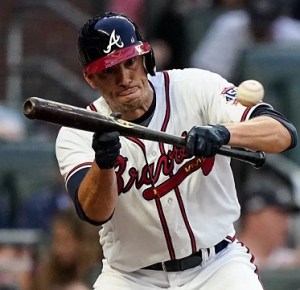
Two seasons ago, Charlie Culberson attempted a bunt against Washington reliever Fernando Rodney. Culberson squared to bunt with his bat up high enough that the foul bunted ball caught him right in the kisser. That may have convinced Snitker even more that bunting should go the way of the streetcar. Though it’d be more fun to see streetcars come back than bunts to metastasise again.

An injury such as happened to Culberson is rather rare. But bunts would be entirely rare if Snitker has anything to say about it. Speaking for myself, I can think of only three times I’d really want a man at the plate dropping a bunt anymore, and I’ll get there in due course.

Essentially, baseball’s bunt is somewhat like football’s punt. Hands up to football fans who think it’s ridiculous for teams to punt on fourth down without at least a cursory stab at going for it when they’re a) inside enemy territory with seven or less to go; b) inside the enemy 33 with ten or less; or, c) fourth and four or less anywhere. (University of California-Berkeley economist David Romer thought of those scenarios, answering “yes.”)

In football—punt ball, surrender ball. In baseball—bunt ball, surrender out. “With even a successful bunt,” wrote Brian Kenny in Ahead of the Curve, his remarkable study of baseball foolishness, “you are giving up an out. It feels good—you can actually see your baserunner move closer to scoring. What you don’t see is that one-third of your resources have been spent.”

Between 1993 and 2010, Kenny observed, you could actually expect less than a run bunting with a man on first and no outs or a man on second with one out. (Man on first, no outs, and a bunt: 0.94 runs expected; man on second, one out, and a bunt: 0.72 runs expected.) In the same time frame, bunting with a man on first and nobody out and bunting with a man on second and one out accounted for less than half of the scoring.

“Even when the bunt moves the runner over,” Kenny wrote, “it lessens your chance of scoring a run. You are working against your own goals.” Managers bunted witlessly for decades, Kenny wrote, because of three benefits: ducking blame for failure, getting credit for success, and looking like geniuses doing it. Even if the next men up couldn’t cash in the run. Even though the manager handed the other team a gift.

That’s bad enough early in the game. In the late innings, if you haven’t emptied your bench yet, and you’ve got a comparative spaghetti bat due up to hit, you’d better pinch hit for that spaghetti bat with someone who isn’t on the payroll to bunt. (Keith Law, in Smart Baseball: “I have yet to meet the fan who bought a ticket to a major league game because she really wants to see guys drop some sac bunts.”)

If you don’t have a spaghetti bat on deck but you’ve got a solid hitter who can do some clutch hitting, you’re not sending him up there to bunt . . . unless you’d like to try the impossible and get yourself beaten senseless by someone with two brain cells for which to arrange a dinner date. Why impossible? Because nobody can be beaten into a pre-existing condition.

If you’re foolish enough to send that solid hitter up with orders to bunt, and you have another solid bat behind him, that solid bat behind your bunter is liable to be put aboard on the house to set up a double play prospect. Unless you have a lineup of nine Mike Trouts, it forces you to hope that the lesser hitter to follow all that gets you the unlikely clutch hit. It’s not unheard of, of course, but it’s usually as likely as Alcoholics Anonymous opening a wet bar after a group meeting.

There are only three times to want anyone up there even thinking about bunting:

1) Against one of those defensive overshifts. Leaving your guy at the plate acres of virgin frontier, why not let him bunt? Hell—why not order him to bunt? Tell him you’ll shoot him doornail if he doesn’t bunt when presented with that.

Show me a bunt onto that delicious wilderness, I’ll show you a man on first at minimum, on the house. If they’re fool enough to open those plains with a man on, it’s first and second or better on the house. Show me enough bunts like those, I’ll show you the pending end of the overshifts.

Don’t be afraid of such a bunt even if the other guys have a no-hitter going in the late innings. They want to give you presents even with a no-hitter, take them. Let it be on their heads. If they want to arrest you for breaking one of the Sacred Unwritten Rules, tell them you’re not above a little Fun Police brutality.

2) Against infielders with weak throwing arms or concrete for hands. If the other guys have such infielders, you should really wonder whether their GM was kidnapped and replaced by Mr. Magoo.

Bunting against them may not be the kindest or gentlest play, and reaching on an error won’t do a thing for a batter’s final seasonal resume, but he’ll reach base of it. If there’s a man on, you’ll get someone closer to home if not coming home without wasting an out.

3) Against the other guys smelling bunt and putting the old wheel play on. Baseline fielders shoot down the lines, middle infielders run away from second base to cover the baseline pillows. If they put it on, show bunt, watch them shoot down and toward the lines—then pull back the minute the pitcher comes to the plate and just put the bat on the ball.

It was just such a fake bunt that Mets relief pitcher Jesse Orosco made into a six or seven hop single up the abandoned pipe to drive a second insurance run home in the bottom of the eighth in Game Seven, 1986 World Series. (Don’t start jumping up and down hollering “let the pitchers hit!”—Orosco was a lifetime .161 hitter who was probably lucky to average 22 plate appearances per 162 games in the first place.)

Now, if only Snitker would start or continue agitating for the universal designated hitter. Once and for all, let’s be done with all those pitchers at the plate making Mario Mendoza resemble Mickey Mantle. Let’s have Snitker and his peers relieved of the burden of watching their rallies getting murdered because their number eight bats got pitched around so the other guys’ pitchers can strike their peers out for side retired.

The Man of Steal flew like Superman on the bases—mostly without bunting his way aboard, either.

Myth busted, by the way: You can have speed on the bases without bunts. You usually try to bat the swiftest you’ve got leadoff, right? You can also have smarts on the bases without bunts. Put the swiftest and smartest man you have in the leadoff spot. Let him swat or walk his way aboard, then turn his tail loose. You don’t have to waste outs to do that.

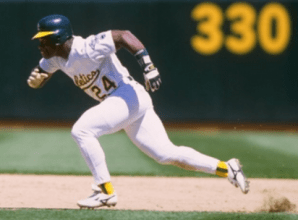
Consider: Rickey Henderson. The arguable greatest leadoff hitter of the post-World War II/post-integration/night-ball era. The greatest speed merchant and larcenist the game may ever have seen. Not exactly one of the world’s most passionate bunters. (I calculated his batting average on bunts—BuBA—by dividing the bunts he beat out for hits by his total bunt attempts.)

Player Bunt Att. Bunts Outs Hits BuBA
Rickey Henderson 49 30 26 4 .082

You’d think a Hall of Famer who could fly like Superman up the line and around the bases might try more, right? Wrong. The Man of Steal wasn’t going to get all that much to bunt with in the first place. A man with 3,055 lifetime hits didn’t earn his bread and butter because he let anyone convince him, “Let’s work on those bunts, brah.”

Let’s not go there about “productive outs,” either. The only true situation where an out’s as good as a hit is a sacrifice fly. No batter’s going up to the plate with a man on third thinking to himself boy, those fools who said I couldn’t hit, I’ll show them—with a nice neat sacrifice fly. No fans pay their way into the ballpark to chant Sac fly! Sac fly! either.

The ground out pushing a runner or two closer to home? Sure, it’s nice. If and when it happens. That, too, gives you one less out to work with, and that wasn’t in your plans. Now tell me you wouldn’t rather have a base hit or a walk. If your answer’s yes, tell me you’d rather have two than three outs to work with in the ninth.

If your answer’s yes to that, you might be one of those thinking baseball was never better than when the ball was dead. Well, now. Let me show you the Show’s all-time bunt leader.  (512 lifetime in 25 MLB seasons.) Let me show you what he did in a verifiable fifteen-year span. And, let me show you what it was really worth with that available record.

Player Bunt Att. Bunts Outs Hits BuBA
Eddie Collins (1916-30) 222 184 168 16 .072

Yep, I threw you a ringer. But bunt lovers deserve it. (Stathead Baseball, my source for Collins and Henderson, goes back only as far as 1916.)

Collins played almost two-thirds of his career in the dead ball era. Maybe from force of habit he kept up his bunt happiness as the live ball era kicked into overdrive, never mind that bunting just might have been more viable and effective in that dead ball time when among other things fielders’ gloves had about as much pocket as a pillow mattress and most pitchers threw about as hard as as bowlers.

Think about it. Collins remains baseball’s all-time volume bunter. With a .914 out percentage on his bunts, bunting with men in scoring position almost half the time he bunted, and an .072 bunt hit average. Want to know how many runs were added to his teams with those 184 bunts?  How does -20 strike you?

This is no spaghetti bat, either. This is a Hall of Fame infielder who was a road runner on the bases, had six top-ten MVP finishes in seven shots (and won an MVP once), was a .333 hitter with a .400+ on-base percentage lifetime, and played on six pennant winners and five World Series winners. It wouldn’t be out of line for you to ask how much better his team’s scoring and chances to win might have been if he’d hit away instead of wasting those outs.

One more time: Outs to work with in baseball are commodities equal in value to jadeite on the mineral exchanges. (Yes, you can look it up: Jadite’s worth $3 million per carat now.) Bunting is waste enough by itself. Bunting in the late innings is worse. Bunting in the ninth inning when the value of outs to work with makes jadeite’s value resemble Reynolds Wrap’s should be cause for psychiatric evaluation.

Casey Stengel used to manage his Yankees according to the philosophy if you have an opening, shove with your shoulder. If you’re given the opening, as in the still-to-be free cookie on second base, you shouldn’t be thinking of nudging the runner along with a dinky,  out-wasting bunt—you should be shoving with your entire body.

Swing away right out of the chute. Get that run home fast as you can. Make the other guys work to re-tie and win if they can. It’s easier to bust a tie than to overthrow even a one-run deficit, kiddies.

If teams do that often enough, maybe the free cookie on second to open the extra half-innings will go where the bunt should be except for the other three instances enunciated above. Into the same place where the Edsel reposes.