The Baltimore rumble

Basebrawl

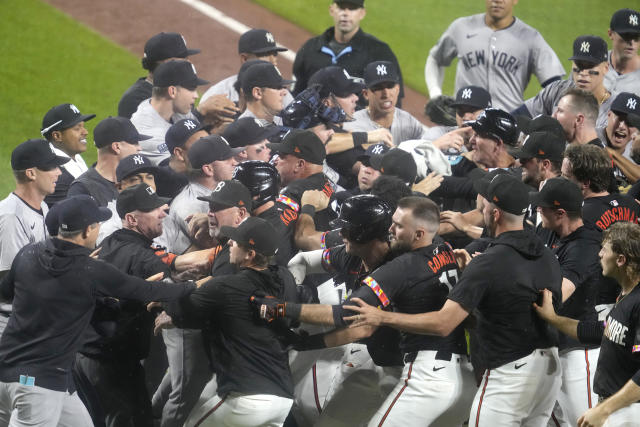
The Orioles and the Yankees rumble in the bottom of the ninth Friday night, after Oriole Heston Kjerstad took one on the side of his head from a Clay Holmes who clearly couldn’t control his pitch grip as the rain kept falling on Camden Yards . . . and after an incensed Oriole manager Brandon Hyde hollered at a Yankee or three to trigger the rumble. Upper right: Aaron Judge (with eye black) about to re-enter the crowd and scatter Orioles as best he could . . .

You could see the rainfall continuing in Camden Yards to the point where Yankee relief pitcher Clay Holmes had few dry spots on his road jersey. You could also imagine gripping and pitching a baseball in that bottom of the ninth moment, the Yankees up 4-1, one out, none on, and an 0-2 count on Orioles center fielder Heston Kjerstad, would be two things: difficult, and impossible.

What you didn’t have to imagine was Kjerstad on the ground in the batter’s box after Holmes’s supposed-to-have-been sinkerball took an ascending flight, instead, crashing into Kjerstad’s head through the right helmet flap, with a crack loud enough that you might have thought for one moment the ball hit Kjerstad’s bat, somehow, and enough force to knock the helmet off Kjerstad’s head as he went down.

What you didn’t want to imagine, if you still had your marble (singular) and weren’t bound to whole servitude by a particular rooting interest, was Holmes wanting to leave Kjerstad with a hole in his head when he was a strike away from putting Kjerstad away for a second out and the Yankees that much closer to sealing a win.

But too many of those bound by Oriole rooting interest decided in the jolt of the moment that Holmes, if not his fellow Yankees, was guilty of attempted murder. I can’t speak for you, but I’m not aware of that many murder attempts that end with the executioner moving and talking toward an apparently genuine concern for the victim’s well-being.

Whatever your position on the Sacred Unwritten Rules, on this much there seems general agreement: It is easier for a fastball to travel through the eye of the needle than for its pitcher to decide with premeditation that two outs short of his team’s victory requires he perform sixty-foot-distance neurosurgery upon the batter in the box

Orioles manager Brandon Hyde thought anything but, seemingly. Almost the split second Kjerstad hit the deck in agony, and Holmes himself tried to make certain he’d be all right, Hyde’s switch flipped. So did his team’s, soon enough, the Orioles pouring out of their dugout and bullpen and the Yankees pouring forth likewise from both directions.

You might understand why when you remember that Yankee pitches have hit Oriole batters up and in with alarming proliferation this season. Yankee pitches have hit a lot of players on several teams with alarming proliferation; the Yankee staff accounted for 62 hit batsmen as of Sunday morning. The Oriole staff? Tied with those of the Padres and the Rangers with 37 each to their discredit.

But Oriole pitchers had hit only three Yankees before Friday night’s blight, compared to Yankee pitchers hitting ten Orioles before that point. It’s one thing to point out that the Yankee strategy against the Orioles’ lefthanded hitters has been to work them inside, inside, and inside, but keeping it that way without resembling headhunters requires control, and lots of it.

Holmes has three hit batsmen thus far this season and has averaged seven per 162 games lifetime. This is not necessarily the resumé of a marauder. But the Orioles had reason enough to find fault that it may have escaped their thinking that the rainy inning affected Holmes’s grip enough to rob him of his control. His attempt to determine Kjerstad’s condition almost at once should have been the clarifier.

Not so fast, Hyde decided. Checking his fallen batter around the plate, Hyde first glared at Holmes; then, as Kjerstad arose from the batter’s box and began to walk around with a trainer’s aid, Hyde looked toward Holmes and hollered a rasping “[fornicate] you!” to the Yankee pitcher. The umpiring crew heard it loud enough and clear enough to converge and keep the Yankees reasonably calm and the Orioles from thinking about a rumble in the Camden jungle.

Hyde sticking up for his player was one thing, as even the Yankees acknowledged after finishing the 4-1 win. “Anybody who was out there knows it was tough to grip the baseball tonight,” said Yankee pitcher Gerrit Cole. “That said, though, the guy got hit in the head. It’s understandable that Brandon’s pissed. He’s defending his players.”

But Hyde hollering vulgarities at the Yankee pitcher who showed some genuine human concern over a serious injury he’d caused without intent was something else. As Kjerstad was escorted to the Oriole clubhouse, a  few Yankees chimed in with a variation on it was an accident, you know it was an accident, look at this rain, brain, and don’t give our guy that crap! 

At which point Hyde turned toward the Yankee dugout, and you didn’t require lip-reading training to see he was hollering back, You talkin’ to me? [Fornicate] you! Don’t [fornicating] talk to me! Then, Hyde confronted and pushed Yankee catcher Austin Wells backward some steps. Whoops.

Out poured the teams into a thick pushing and shoving mob around the innermost infield. Into the scrum walked Aaron Judge, the Leaning Tower of River Avenue, who looked to all the world as though single-handedly bumping this, that, and the other Orioles to one side as best he could.

Somewhere in the middle of the melee Hyde was ejected for the rest of the game. Somewhere else, two fan bases tried their best to urge the Yankees to pull back on the constant up-and-in pitching (down-and-in, we presume, would be less likely to incite on-field riots) and to urge the Orioles, their skipper especially, to take a breath before deciding an opponent who wounded one of theirs without intent should be tried, convicted, sentenced, and executed right then and there.

Both sides picked themselves up, dusted themselves off, and started all over again Saturday, with the Yankees winning again, this time 6-1, ensuring their first series win in what began to seem eons. Not an Oriole or a Yankee got hit by a pitch, either. The temptation was to greet each inning by whispering, “they wouldn’t dare.”

But a few baseballs got rapped or detonated by Yankee bats, especially Judge setting a new team record for most bombs before an All-Star break (the previous record holder: you guessed it—Roger Maris) immediately following Juan Soto’s solo in the fifth, and Wells blasting a three-run homer in the top of the first.

The series wrapped Sunday afternoon with a 6-5 Orioles win that began with their starting pitcher Dean Kremer hitting Judge with the first pitch of the plate appearance in the first. It ended with Yankee left fielder Alex Verdugo misplaying Oriole center fielder Cedric Mullins’s liner into a game-winning two-run double, after Yankee shortstop Anthony Volpe misplayed  what should have been Oriole first baseman Ryan Mountcastle’s game-ending, Yankee win-sealing grounder, allowing the bases to stay loaded for Mullins and the Orioles back within a run.

That left the Orioles in first place in the AL East by a hair entering the All-Star break. It also ended the regular season series between the Yankees and the Orioles. The two American League East beasts don’t have to look at each other the rest of the regular season. While wishing for Kjerstad’s fully restored health, it’s also nice to see that, as of Sunday, the Judge plunk to one side and with no apparent rough stuff as a result, the two really do know how to play nice with and against each other.
The dog ate his homework

Baltimore Orioles

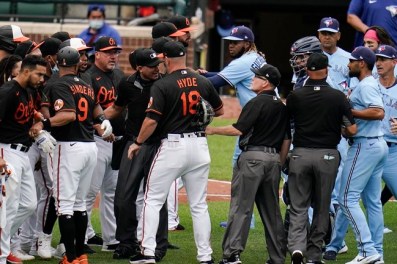
Manager Brandon Hyde and his Orioles after one of their own got drilled following back-to-back bombs in Camden Yards Saturday night. They know damn well Blue Jays pitcher Alek Manoah didn’t just slip a runaway fastball inside.

Here’s the Saturday night scenario in Baltimore: A rookie pitcher surrenders back-to-back home runs. He hits the next man up squarely on the bicep with the first pitch. He gets ejected post haste, then speaks to the press post-game.

“I tried to get that fastball in and it slipped away,” said Alek Manoah, the Blue Jays righthanded rook who drilled the Orioles’ Maikel Franco in the fourth inning, right after Ryan Mountcastle hit the first one-out, one on service over the left field fence and D.J. Stewart hit a 2-1 pitch over the right field fence.

The dog ate his homework.

And the Blue Jays overthrew the 5-2 lead Mountcastle and Stewart provided to gorge on the Orioles with a six-run ninth and a 10-7 win. It’s gotten that bad for this year’s Woe-rioles. They can’t even claim safety in a three, then a four-run lead.

But Franco looked distinctly unamused after he got that very pronounced plunk, and as Manoah stepped down from the mound walking toward the plate area. He looked as though he couldn’t decide whether he’d like to have Manoah for dinner or have him crucified on the warehouse behind the yard.

“I was confused by his reaction,” Manoah said. “I was questioning ‘What’s going on? What’s wrong?’ Those were my hand gestures as I was walking toward him. I didn’t understand the frustration there.”

“Even rookies don’t usually have to be told that a guy who can’t hit with a telephone pole this season doesn’t understand why he’s being made to pay because you just surrendered long distance back-to-back on your dollars,” said my long-distance pitching acquaintance, Sticky Fingers McSpidertack, on the phone this morning.

“So you’re telling me the dog ate his homework?” I asked, without a single thought of being a wisenheimer.

“Dig,” McSpidertack replied. “That Mountcastle guy took him out over the center field fence with one out in the second. And who’s that guy, Cedric Mullins? Took him out over the right field fence with two out in the third.”

“So Manoah’s a little on the frustrated side,” I replied. “Didn’t anybody in the minors teach him even for a few minutes that the best pitchers in the business are going to have days where they’re going to get slapped silly? Happens even to the Hall of Famers, Stick.”

“He spent, what, three games in Triple-A,” McSpidertack answered. “Maybe that’s not long enough to teach a few baseball life lessons, maybe it is. I’m the wrong guy to ask. I didn’t get much past Single A, you know.”

“I know, but you don’t have corn flakes for brains, either. I don’t think I ever saw you try putting a hole in the next guy’s anatomy after you got hit for a skyrocket shot.”

“Of course not,” McSpidertack said. “And Franco’s not the one who hung that slider, kept that fastball’s feet tied at the ankles, or threw him a melon even a guy below the Mendoza Line could have given a ride.”

“A ride? OK, Mountcastle’s shot in the fourth just barely made it out, hit the rail behind the fence or something. Got a fastball to hit for that first shot in the second, this time he gets the breaking ball and breaks it because it didn’t really break.”

“Right”

“Then Stewart turns on 2-1 and hits it right onto the Camden Yard promenade. Maybe it landed a few feet from where Boog Powell used to have and run that great barbeque pit.”

“Oh, yeah. I remember that pit, too. There wasn’t one single healthy thing coming off that pit, thank God.”

“Now it’s Franco. Compared to him this year, Mario Mendoza looks like Monster Mashup. The last guy on the planet, or at least on the Orioles, who’s going to take him into the ether. And Manoah throws one right up and into the poor guys’ upper bicep.”

“Or lower shoulder ball.”

“Well, let’s not get technical.”

“Fair enough,” McSpidertack said. “So when it’s all said and done, what’s the take?”

“What the hell do you think it is, Stick?”

“You’re gonna make me say it, aren’t you.”

“That’s my job, Stick.”

“Yeah, I know. OK, here it is. Manoah was full of manure last night.”

“I had to open my big mouth, didn’t I?”

“Your fault, buddy,” McSpidertack said, laughing. “Now tell me what all that was when skipper Hyde comes out of the dugout looking like he wants to take someone in a Toronto uniform apart but also looks like he doesn’t want his guys to do anything of the kind.”

“You need me to tell you that? I don’t think he wanted to take someone apart himself. I think he just wanted Manure—sorry, Manoah—thrown out of the game post haste. Which is exactly what he got. After he returned a few, shall we say, vulgar mash notes from Charlie Montoyo.”

“The Blue Jays manager.”

“Yeah.”

McSpidertack excused himself a moment to refill his morning coffee. I needed another coffee jolt myself while he was at it. When he came back, I said, “Did you see Manure–sorry, Manoah again—talking to the press after the game?”

“Yeah.”

“Did you hear him say he tried to slip that fastball in and it got away?”

“Yeah,” McSpidertack said. “And if I had a dollar for every time I tried to get a fastball in that got away, I could buy that Antarctican beach club of yours.”

“No you couldn’t, Stick,” I said. “You said yourself your career was over before it really began. You didn’t really have time to learn how to slip runaway fastballs inside. At most you’d have had enough to buy me a new set of guitar strings.”

“Then the dog ate his homework.”

A cry from Chris Davis’s wilderness

2019-08-09 ChrisDavisBrandonHyde

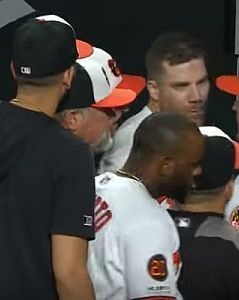
Chris Davis (top right, hatless) had a meltdown with skipper Brandon Hyde (bearded, behind Davis’s shoulder) Wednesday.

Even a single taste of greatness produces a natural high equaled only by any subsequent, equivalent taste of failure producing a natural low that can sting far deeper than the high could elevate. Prolonged greatness shoved aside by prolonged failure lacerates deeper.

And as often as not the ache to reclaim former greatness becomes a burden, if not an addiction, whose lack of consummation harries men and women of all manner of character to the rack of their regrets in a manner as cruel as it can be enduring.

Today’s unexpected champion becomes thrown back tomorrow to the pool of the ordinary, just as readily as today’s unexpected failure or journeyman may be thrown unexpectedly into the pool of the giants. And it’s still rare enough that a man who’s tumbled from particular heights to particular nightmarish depths allows himself the stripping of his professional guard enough to cry out from his unique wilderness.

Chris Davis, the Orioles’ first baseman/designated hitter, became such a man late this week. Davis has fallen from being one of the American League’s marquee sluggers to a man about whom the term “journeyman” can’t begin to describe without injury the depth to which he has fallen so publicly.

He is the Orioles’ highest paid player, based on his former glories and with three years left on his mammoth deal. You would have to presume him inhuman if he didn’t believe to his soul that he wasn’t earning what he’s paid. Yet until this week Davis was also elevated in the minds of fans who appreciate the war within such a man and the courage required to refuse its consumption of his soul.

Earlier this season he ended an unconscionable hitless game streak with the eyes of a nation upon him for the grace he’d exhibited under such futility’s lash, whacking a two-run single that brought loud cheering even in the enemy ballpark in which he drilled the hit. And it was merely the first of three hits he’d collect, and the first two of four runs he’d drive in on the evening.

But Davis since that night has had yet another season in hell parallel to that of his team’s, apparently lost for resolving himself as a player. He’s long past being an everyday player; his season’s salary is a quarter of the Orioles’ season’s payroll; his pride is compromised even deeper than his play.

At long enough last his personal dam yielded to a flood Wednesday night, after he couldn’t perform a somewhat routine scoop of a low infield throw in the fifth inning, in the middle of the Orioles being blown out by the Yankees, 14-2.

When the teams changed sides, there was Davis in a furious verbal showdown with his manager Brandon Hyde, who may have ignited the flood with a remark to Davis and answered his battered first baseman in kind for one and all to see. It was caught on camera and only too widely discussed and disseminated.

Orioles fans knew Hyde in his first season of major league managing had all he could think about trying to foster accountability and navigate the roiled waters of a mediocre team. But if he intended to call Davis out over the error alone, or the full year’s shortfall, Hyde may have underestimated just how painfully self aware Davis must be of his own deflation.

And the day after, Davis was extensively apologetic for having let his season long frustration, interrupted only rarely, and perhaps an extension of two previous years’ unexpected and barely explainable futility, explode as on Wednesday.

I think it’s pretty obvious the offensive struggles I’ve had for quite some time. I feel like night in and night out, I’ve done a real good job of still being there on defense and trying to pick guys up, and at that spot in the game, at that point in the series, that was kind of where it all . . . like I said, I hit a breaking point.

. . . [W]hen you have that much frustration, when you’re constantly having to deal with failure, you’re gonna have episodes where you just have to let it out. Unfortunately, it was in the dugout. I wish it hadn’t been. I wish it had been underneath [in the clubhouse tunnel], but it happened, and I can’t go back and change that.

His temporary fortune was the Orioles having an off-day Thursday, enabling Davis to take succor from his wife and young children, the most immediate and mandatory place for a husband and father to regain comfort after a too-long-protracted bad year on the job.

That’s really the only way that I know kind of how to escape, is just to be a dad, and be a husband. I enjoyed the time with them, but I look forward to coming back in there and getting back to work with these guys.

And when he returned to his place of business Friday, rejoining the Orioles to open a weekend series against the American League West-owning Astros, against whom he won’t play Friday night, Davis approached the boss post haste.

We sat down today and talked, I don’t know, over an hour. That’s just kind of when it all went down, I guess. We both knew that we had an off day. I think it was probably best that we did, just to kind of give us a little bit of time. I didn’t think about it a whole lot. I tried not to. I think he was kind of in the same boat. When we’re not here and we’re not in uniform, we’re not working, we’re just regular human beings. I think he took a little time away from everything just to relax.

Hyde’s own short public remarks immediately after the Wednesday night dam burst offered no indication that he would hold it against Davis, which makes Davis fortunate enough when you allow that in non-public professions such explosions after such protracted internal anguish gain as much unemployment as empathy for the frustrated.

Davis specifies that Wednesday culminated “the last couple of weeks” worth of shortfall and its accompanying discomfort, but you could not blame him if it proved to culminate the last couple of seasons worth. You may consider him fortunate to have tasted greatness at all and remind yourself of those who’ve tasted far more brief such greatness without the prior and subsequent ordinariness or failure breaking them in half.

Stronger men than Davis get crushed beneath the wheel of failure that rolls upon them unexpectedly after they know even a fast flicker of greatness. Weaker men than him triumph on the job yet claim that their only and transient success in a mortal life that does not live by profession alone.

The Baltimore Sun‘s venerable baseball columnist Peter Schmuck suggests Davis’s frustration may prompt him to think of negotiating a buyout of the rest of his contract. It may not be an option to which either Davis or the Orioles are immune.