Two Bs and a Tuck

Alex Bregman

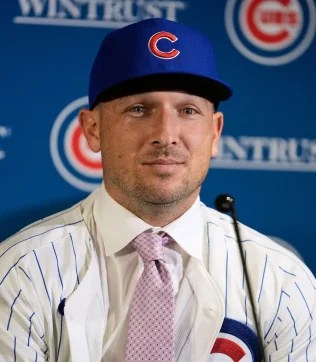
“There’s an excitement in the air about Cubs baseball,” said their new $175 million third baseman Alex Bregman after signing with the team last week.

What a week, right? Just like that, three of the more luminous members of this winter’s free agency class found new homes for varying dollars.

The usual suspects scream blue murder. A few unusual suspects pick up Dodger manager Dave Roberts’s expressed equal adoration for a salary cap and a salary floor. So, who’s coming out how, where, and why? Let’s look with sober eyes.

Da Bear Market Dept.—Think about it: On the same evening the NFL’s Chicago Bears shoved the Green Bay Packers to one side and out of the race for the Super Bowl, in Soldier Field, the Cubs made erstwhile Astro/Red Sox third baseman Alex Bregman a rather wealthy man.

With the Red Sox thought to be pushing a bit extra to bring Bregman back, the Cubs pushed enough to land Bregman on a five-year, $175 million that includes a mutually agreed-upon $70 million worth of deferred money.

You think Bregman’s new teammates weren’t enthused about the deal and their new mate? “I texted him when the news broke: ‘Dude, let’s freaking go’,” said pitcher Jameson Taillon, an Arizona neighbour of Bregman’s according to The Athletic. “He FaceTimed me. He was like, ‘Hey, we’re just finishing up dinner. Can I come over?’”

He wasn’t alone, wrote the journal’s Patrick Mooney: “Pete Crow-Armstrong, the All-Star center fielder, was in attendance at Soldier Field when he found out that Bregman would be a new teammate. Immediately after seeing the reports, Gold Glove shortstop Dansby Swanson called Bregman from a friend’s wedding.”

The Cubs made a run for the postseason last year. After a few years behaving like the big city kid who seemed to be seduced by the outskirts of Four Corners, Nowhere in Particular, they started behaving like the bigger market team they’re supposed to be once the postseason run ended.

“There’s an excitement in the air about Cubs baseball,” said Bregman while he made a bit of a whirl-around Chicago tour last week. “I can’t wait to get after it.” Pause. “After it” means “pennant race” and “World Series trip” for a man who now picked uniform number 3 to indicate he’d like a third World Series ring as well as stability for his family.

He’s known as a student of the game, a disciplined hitter, a sharp-fielding third baseman, and a clubhouse godsend. All Bregman has to do is live up to all that as best a 31-year-old with more than a few miles on him can, as he did when his body allowed in Boston last year. Da Cubs will make sure his appreciation is far, wide, and deep.

Tucker, the Man and His Team Dept.—Meanwhile, an erstwhile Cub lit the fuse on fresh screaming over the big, bad, behemoth Dodgers and their big, bad, behemoth platinum vault. The erstwhile Cub is Kyle Tucker, considered the number one free agent in the winter class by those who thought Bregman was the class’s second banana.

Tucker signed up for four years, $240 million, and opt-outs after years two and three. The deal also includes $30 million in deferred dollars. If Tucker helps the Dodgers to a third straight World Series title, Dodger City will consider it all very wisely spent. If he doesn’t or can’t, well . . .

That screaming won’t be limited to denunciations of the Dodgers as the new Evil Empire. It’ll include audible-in-the-Klingon-Empire demands for explanations as to why a no-doubt talent but with 27.3 wins above replacement-level in eight season is pulling down $17 million a year more than Aaron Judge, Yankee bombardier first class, who earned about 3.0 more WAR just over three of the past four years.

The Dodgers are betting on Tucker’s future coming somewhere near Judge’s present, of course. Aside from the dollars, the Dodgers could offer something far deeper to the low-keyed Tucker. He can do Tucker things without the floodlights baking him too heavily compared to the rest of the Dodgers’ star power.

He might have been the star of this free agency market, when Bregman and Bo Bichette weren’t, but that’s about as far as Tucker seems to care to go when it comes to attracting attention with anything beyond his still-growing bat and his virtuosity playing right field.

What’s Bo Know Dept.—Bo Bichette is a Met. Roll the rhyme around awhile, Metsropolitan New York. Savour the possibilities to come with a healthy Bichette helping the Mets ride all the way to a postseason. (Remember: He came off the injured list to be one of the shining time Blue Jays in last year’s World Series.)

Now, be afraid. Be very afraid. Because the Mets plan for their new $126 million infield toy is to move him from his normal shortstop to third base. Every Met fan since the day they were born will warn you. The Mets don’t have a sterling history of third base conversions. (Mets legend David Wright was born to the position, you may remember.)

Ask what happened when they traded a talented but still-erratic arm named Nolan Ryan to the Angels for a veteran elite shortstop named Jim Fregosi . . . and decided to turn that veteran elite shortstop into a third baseman. Case closed.

Bichette can hit. The only population that doesn’t know that might be a colony of Arctic walruses. But with the glove? He’s 36 defensive zone runs below his league average as a shortstop, and his range factors per game are below the average, too. He played a little second base in the minors but not a lick of third base in the Show.

The Mets turned toward Bichette more seriously (they’d been talking previously) when Tucker went California bound the night before. The Phillies saw the Mets embrace Bichette and elected to reunite with veteran catcher J.T. Realmuto after all.

Now all the Mets have to do is get a read on whether Bichette will be the second coming of poor Jim Fregosi or the first coming of Bo Bichette, third base maven. Not to mention whether Brett Baty, the incumbent third base Met, will have a reasonable future moving to the corner outfield, as some reports speculate.

Well, the Mets have been many things over the decades. Boring has rarely been one of them.
Mr. Commissioner, meet the real faces of the game

Rob Manfred, Liam Hendriks

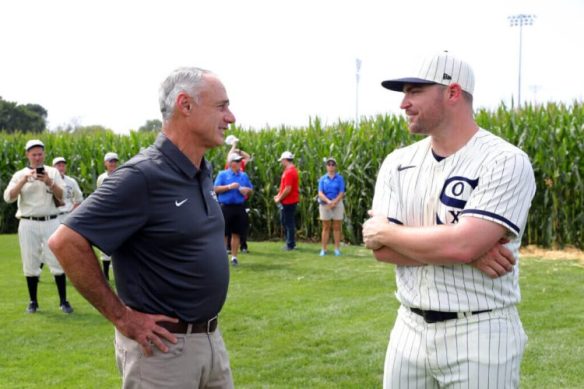
Commissioner Rob Manfred with White Sox relief pitcher Liam Hendriks before last year’s Field of Dreams game. (The Athletic.)

Having a read of ESPN writer Don Van Natta, Jr.’s profile of commissioner Rob Manfred, I was almost convinced that maybe, just maybe, there really was more to Manfred than met the eye. Or, more than what comes forth in his stiff presence and often clumsy remarks.

Just maybe, the man isn’t the baseball-hating or baseball-illiterate Rube Goldberg-like abecedarian the caricatures so often portray. He did, after all, grow up a Yankee fan in upstate New York and can say proudly enough that he’s the only baseball commissioner ever who played Little League baseball. “All glove, no bat,” he remembers of being a Little League infielder.

My parents received a set of classic Revere copper-bottom cookware as a wedding present eight years before Manfred was born. (I still remember the fragrance of that special powder used to clean the copper bottoms, too.) Who knew Manfred (three years my junior) was the son of Revere’s production supervisor at their home plant in Rome, New York? An hour’s drive from Cooperstown, as it happens.

Born in 1958, Manfred took in his first live major league game at Yankee Stadium with his sports-obssessed father, sitting between the plate and first base on an Old Timers’ Day. Come game time, Hall of Famer Mickey Mantle crashed a pair of home runs and the Yankees beat the Twins, 3-2. When he finally became the game’s commissioner, he handed his father the first baseball with his stamp upon it.

“This is really an unbelievable thing,” Manfred, Sr. told his son. “I can’t say I disagree,” Manfred, Jr. told Van Natta.

A couple of hundred fathoms down, though, Van Natta noted that “more than once” Manfred told him what few baseball commissioners have dared to admit, that being the buffer absorbing the heat that should go to his bosses, the owners, is part of his job. Even if it’s about as pleasant as your private parts being caught in the vacuum cleaner’s handle.

And then it came.

“Every time it’s me, it ain’t one of those 30 guys—that’s good,” Van Natta quoted Manfred as saying. “Look, who the hell am I? I don’t have $2 billion invested in a team. I’m just a guy trying to do a job. I mean it. [The owners] deserve that layer. I believe they deserve that layer of protection. I’m the face of the game, for good or for bad.”

Mr. Manfred, unless it’s to boo and hiss your heads off over this or that piece of mischief, you may rest assured that no baseball fan anywhere in this country is paying his or her hard-earned money to head for the ballpark to see you or your bosses.

But I’m going to do you a small favour, as if you know me from the greenest bat boy on any professional baseball team. I’m going to introduce you to the true faces of the game. The ones whom those fans do pay their hard-earned money to see at the ballpark regardless of the machinations and deceptions of your bosses and theirs.

Mr. Manfred, meet Mike Trout. This is the guy you blamed once upon a time for not being baseball’s face, based upon his committing no crime more grave than letting his play and his clubhouse presence and his agreeability with fans before and after games speak for themselves, with no jive about the magnitude of being him.

Meet Shohei Ohtani. This is the two-way star who lights up the joint just by flashing that thousand-watt grin of his, never mind when he strikes thirteen out on the mound one night and belts baseballs onto the Van Allen Belt the very next. Between himself and Mr. Trout, you should be asking what on earth is wrong with the Angels that they still can’t find quality pitching enough to keep them in a race after they start in one but sputter unconscionably.

Meet Aaron Judge. This is the Leaning Tower of River Avenue who sends baseballs into the Delta Quadrant one moment and then, when made aware, goes out of his way to meet a Canadian kid to whom he’s number one among baseball men and who was handed one of his mammoth home run balls by an adult fan who knew the boy wanted nothing more than to catch one Judge hit out.

Meet Joey Votto. This is the future Hall of Fame first baseman who got himself tossed from a game early last year, but—after he learned his ejection broke the heart of a little California girl to whom he’s a hero above heroes—sent her a ball with his handwritten apology and autograph on it, prompting his team to drop game tickets and a little extra swag upon her the very next day.

Meet Bryce Harper. This is the guy who never apologised for being on board with letting the kids play. The guy now on the injured list with a thumb fracture and surgery to repair it after getting hit by a pitch thrown with one of the baseballs you and yours still can’t see fit to manufacture uniformly and with allowance for fairness on both sides of it, fairness for the pitchers and for the hitters alike.

Meet Vladimir Guerrero, Jr. and Bo Bichette. One is the son of a Hall of Famer who did last season what even his old man never did: led his league in on base percentage, slugging percentage, OPS, and OPS+, and led the entire Show in total bases. The other is the son of a respected major league slugger, has quite a lethal bat in his own right when his swing is right, and currently leads his league in trips to the plate. Together they’ve put some zip back into the Blue Jays.

Meet Oneil Cruz. The bat has yet to come to full life but the footwork, the glove, the throwing arm, have shown so far that you can be as tall as Frank Howard, J.R. Richard, and Randy Johnson and still play shortstop as though the position was created for you and not the Little Rascals in the first place. They’re falling in love with him in Pittsburgh, which needs all the love it can get, but they ought to fall in love with him all around the Show—except when he’s going so deep into the hole grabbing a grounder or a hopper that an enemy batter loses his lunch when he’s had a base hit stolen from him.

Meet Clayton Kershaw. He’s been around the block a few times. He’s a Hall of Fame lock as maybe the best pitcher of his generation. He’s still a quality pitcher and a class act. They still buy tickets on the road when they know he’s going to take the ball for the Dodgers. He’s faced his baseball aging curve with grace under pressure. And, for good measure, he’s the one active player who was seen fit to be part of the ceremony when the Dodgers unveiled that statue of their Hall of Fame legend Sandy Koufax this month, and you know (well, you damn well should know) what a class act Koufax was on the mound and has been in the decades since off it.

(You’re not still P.O.ed that Koufax waxed your Yankees’ tails twice while his Dodgers swept them in the 1963 World Series when you were seven, are you?)

Meet Justin Verlander. Missed a year plus recovering from Tommy John surgery. He has a 2.23 ERA and a 3.53 fielding-independent pitching rate so far this season. For any pitcher that’d be a remarkable return so far. For a future Hall of Famer who’s still suiting up at Jack Benny’s age (that’s a joke, son), it’s off the chart so far.

Meet Verlander’s 25-year-old Astros teammate, Yordan Álvarez. He’s leading the entire Show with his .667 slugging percentage, his 1.081 OPS, and his 206 OPS+. If there’s one untainted Astro who’s must-see viewing whenever he checks in at the plate, it’s him.

Meet Xander Bogaerts and Rafael Devers. The left side of the Red Sox infield is a big reason why the Olde Towne Team yanked themselves back up from the netherworld into second place in that rough and tumble American League East. Did I mention that Devers currently leads the entire Show with 177 total bases?

Meet José Ramírez. The Guardians’ third baseman is giving Devers a run for his money in the All-Star balloting that closes today. That thumb injury has put a crimp into his bat for now, and it’s had its role in the Guardians’ sudden deflation at the plate, but this guy just may be the face of his franchise right now. He ought to be one of the faces of this game.

Meet Mark Appel. This is the guy who went from number one in the draft to injuries as well as pressures and even to an exit from the game only to try giving it one more try—and finally coming up with the Phillies, nine years after that draft, and tossing a scoreless inning . . . at age 30. That’s as feel good a story as it gets for the oldest former number one to make his Show debut, no matter what happens with the rest of what remains of Appel’s career. They don’t all go to hell and back.

Those are only some of baseball’s faces, Mr. Commissioner. They’re the ones the fans want to see and pay through the nose to see. Despite your tinkerings. Despite your often erroneous readings of the room. Despite your inability or unwillingness to demand the same accountability of umpires that you do of players, coaches, and managers.

Despite your inability to let your professed deep love of the game come through without tripping over itself because, as an improvisor, well, if you were a musician the consensus would be that Miles Davis you ain’t.

Dante’s Paradiso

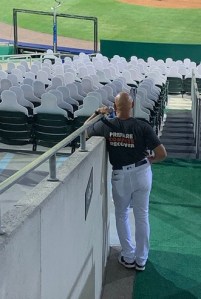
Toronto Blue Jays coach Dante Bichette looking over a sea of cardboard cutouts behnid the plate in the Jays’ temporary Buffalo home.

Whether one of the too-numerous young comers the Los Angeles/California/Anahiem/Los Angeles Angels let get away over the decades, or whether the wizened veteran who called it a career after a season and a half with the Boston Red Sox, one thing stood out especially about Dante Bichette. He looked at times like a mob enforcer.

Wide, wide eyebrows above narrow eyes, plus his muscular 6’3′ physique, often made Bichette look as though he’d break your legs on demand. Until he flashed his boyish, friendly smile. Pitchers who faced him in his prime probably thought they escaped with their lives when he tagged them for one of his 274 home runs.

At 56 today, Bichette remains a muscular specimen whose concurrent sporting of a clean-shaven head makes him resemble Mr. Clean’s tough but tender inner-city nephew. The Florida native also remains one of the friendliest men in the game and, since returning to the profession, one of its most enthusiastically attentive coaches.

The Buffalo Blue Jays of Toronto invited him to spring training as a guest instructor, perhaps because one of his two baseball-playing sons, Bo, has been raising eyebrows among teammates, team officials, and enemy pitchers with his howitzer of a bat. The lad came by it honestly; his father has coached him and his older brother, Dante, Jr. (now a Washington Nationals prospect), since boyhood.

The invitation turned into something the elder Bichette hadn’t felt since he last worked as a Rockies coach. He’d given that up on behalf of not missing valuable time working with his sons. But with Bo helping to make Blue Jays baseball fun again and Dante, Jr. settling into the Nats’ organisational picture (uneasily, with the minor league season mostly cancelled), Dad enjoyed working in the Jays’ “summer camp” so much he got what he called the itch to coach full time again.

Call it Dante’s Paradiso if you must. Even if Bichette wouldn’t necessarily know The Divine Comedy from a double play. “Should I put [my sons] in baseball and put that kind of pressure on them to be like the dad that played in the big leagues?” he once asked his wife, Mariana. “And she said, what else are you gonna teach them? And I was like, yeah, I don’t know anything else.” Then, he laughs.

All that is according to a pleasant profile by The Athletic‘s senior Blue Jays writer, John Lott. “The understanding was, let’s see how it goes, let’s see if I can really help,” Bichette told Lott about joining the Jays.

I was more sensitive with Bo on the team. I didn’t want to make it awkward at all, so I had a long talk with Bo. It was just, let’s try it out first and see how it goes down. Spring training just seemed to work real easy. I helped out where I could and all of a sudden you start to develop relationships with the kids. As a coach, you kind of fall for them. So that’s when I said, yeah, I gotta do this.

Because of the Show’s current pandemic-inspired restriction limiting teams to eight coaches in the dugout, Lott wrote, Bichette had to pick a spot in the ballpark to watch his co-charges (with hitting coach Guillermo Martinez) during Blue Jays games. He likes to station himself atop a section of seats behind and to the first base side of the plate.

From there, he watches to see Jays hitters exercise his counsel. Bichette isn’t big on the mechanics of the swing but he’s huge on encouraging players to step up to the plate with a plan. He teaches or reminds them to take advantage of the reams of information now available about enemy pitchers, and he teaches and reminds them likewise—and especially—to think hard about hitting with two strikes.

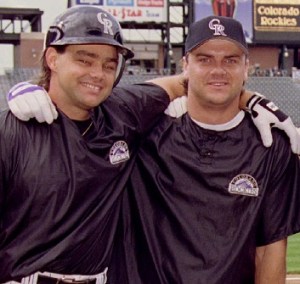
Bichette as a Rockies player with his Hall of Fame teammate Larry Walker. He still has the smile that turns his expression from enforcer to big kid.

Much like the Rockies teams for whom Bichette himself played, these Blue Jays have power to burn, think of bases on balls as castor oil, and love to swing their bats. Bichette tries to get them to swing intelligently especially after that second strike is rung up. Since the Show’s overall batting average on two strikes is about .169, Bichette probably had his work more than cut out for him.

“I also point out that every count without two strikes, the whole league mashes,” he told Lott. “So turn (all) those counts into two different counts, not a bunch of different counts. You have a two-strike count and an I’m-looking-to-do-damage count, period. That’s two approaches.

“When you’re looking to do damage, you’re hunting a certain pitch and you’re committed to that pitch,” he continued. “When you’re hitting with two strikes, you have to handle all the pitches in all the parts of the zone. You have to let the ball get a little deeper, so if you are fooled by an off-speed pitch, then you still have some room for the bat to get through the zone and make contact.”

Bichette’s own idol was Hall of Famer Ted Williams, though he was born three years after Williams’s final major league game. Merely mention Teddy Ballgame, and Bichette will talk your ears off more than a politician given an excuse for a speech, if not a tweetstorm.

When he talks about all parts of the zone, he’ll point out happily enough how he read Williams’s book The Science of Hitting and paid scholarly attention to the charts that showed Williams’s batting averages on every pitch in every nook, cranny, and crevice of the zone.

(Fair disclosure: It’s also personal with Bichette. When he was named 1995’s Players Choice Award winner, he told Lott, Williams himself presented the award at a ceremony, leading to an evening’s discussion of hitting and a breakfast invitation for the following morning. “I’ve got it somewhere at home on a CD, the whole conversation,” Bichette said. “It’s the neatest thing I have.”)

Two-strike hitting is something Bichette learned about the hard way. As a player himself, a second strike usually meant he was dead meat. His OPS on two strikes, lifetime: .587. Once that second strike was on the clock, Bichette—who hit 63 of his lifetime home runs after two strikes—was swim-or-sink. His challenge with the Blue Jays’ hitters was helping their Rockies-like aggressiveness deliver instead of drop the packages.

“[T]o me, letting it get deep and getting on top is kind of an inside-out swing,” he continued. “You know, taking the air out of it. We live in an era of launch angle, but we gotta take the air out of it with two strikes. That’s where the pitchers are taking advantage of hitters with two strikes. The hitters are trying to get air and they throw the fastball over the bat.”

So just how much coaching does Bo Bichette now require from the father who first gave up professional coaching the better to make sure he didn’t lose invaluable time with his sons?

“Bo’s very self-sufficient now,” Dad told Lott, who got one of Dad’s 2013 Rockies charges, Michael Cuddyer, to talk about the kid being so attentive while seeming just to hang at the park with his old man that he’d pepper the Rockies’ hitters with serious questions about serious hitting, then take his own batting practise and hit balls into the mountains. At fifteen.

We talk at-bats. He’ll tell me what he was thinking, and most of the time, we’re so connected now that I can tell when he’s looking for a certain pitch or he’s trying to do a certain thing. So we’re pretty much in tune with each other. Now it’s more game plans. Very little swing stuff. We’ll talk about intent or conviction to the game plan . . .

It’s actually really neat because I feel like Bo is an old soul at this. I feel like I’m talking to a 38-year-old veteran when I talk to him about hitting because I’ve talked to him like that since he was six years old. That’s probably why he’s so advanced at hitting for his age.

So says the former Rockie bombardier who was only half kidding when he told Lott his wife raised two sons and a husband. (And, who was as relieved as the rest of Blue Jays fans and the game itself when Bo’s knee injury proved not terribly serious.)

The man who must have had questions and doubts when the Angels traded him to the Milwaukee Brewers for an ancient Dave Parker. Or, when the Brewers traded him to the Rockies for a fading Kevin Reimer. (Both after he’d been little enough used despite his potential, blooming somewhat late with the Rockies at 26.)

The man who quit after a decade plus as the Rockies’ hitting coach because the idea of missing his sons’ continuing development and learning any more than he already missed worried him. The man who now doesn’t mind when his senior Martinez sends him video at two in the morning asking for his takes on this player’s swing or that pitcher’s factoring in the next day’s game plan.

The man who only looked like a headbreaker at times in his playing youth, but whose geniality and intelligence have married to invite anyone who wants it to take a seminar in smart baseball and more than a few reminders that these Blue Jays made him fall in love with them. Not to mention more than a few recollections and lessons from Ted Williams.