Billy Eppler and the invisible injured list

Billy Eppler

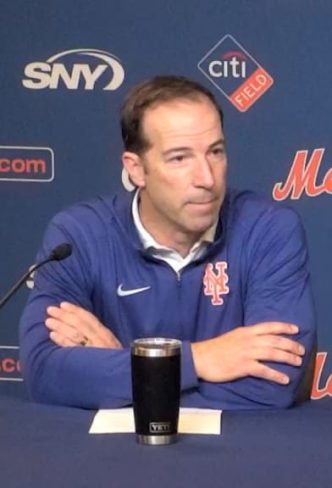
Billy Eppler leaves the Mets to hunt a new GM, while MLB investigates his use/misuse/abuse of the so-called phantom injured list.

Something is further amiss in the milieu of the Mets than just the sunken season that compelled manager Buck Showalter’s scapegoating. It may not be limited to the Mets alone, but with general manager Billy Eppler resigning—possibly before he, too, might have been shown the door—it’s the Mets drawing the headlines on it.

First, it came forth that Eppler all but strong-armed Showalter into continuing to write Daniel Vogelbach’s name into the lineup, against just about every piece of evidence saying Vogelbach didn’t truly belong there. Then, it came forth that Eppler was under baseball government investigation over what’s known as the phantom injured list.

Even with the medical advances of this century, it’s bad enough that (you guessed it) baseball medicine could still be tried by jury for malpractise. The phantom injured list—basically, placing underperforming players on it to keep them out of the lineup, while still paying them and granting their major league service time, though possibly denying them certain incentive-based chances—could be called another kind of malpractise.

That would be the kind that calls honest competition into further question that such things as tanking have it already. The kind that compels some baseball people—former Phillies manager Joe Girardi, notoriously enough—to admit they’re not always forthcoming about real injuries the better to keep valuable intelligence out of opposition sights. Never mind that teams can usually tell when the other guys have a likely wounded warrior.

The Mets had 28 real IL placements in 2023. This didn’t even make the Mets the Show’s worst such infirmary roll: the Giants, who dumped manager Gabe Kapler for being unable to maneuver a dubious roster built by president of baseball operations Farhan Zaidi, had 46 IL members. Right ahead of the Reds’ 45 and the Angels’ 42.

By contrast, the healthiest reported 2023 teams were the postseason-reaching Astros (14), the postseason-missing Guardians (17), the postseason-missing Mariners (18), and the postseason-reaching Diamondbacks (also 18).

Teams are supposed to provide medical documentation and approval when they place players on the injured list. The New York Post broke the news that, when MLB investigators informed the Mets that Eppler was being probed over the phantom IL, Eppler elected to resign rather than “potentially become a distraction” as new PBO David Stearns settles into his new job.

“Stashing healthy players on the IL can aid a team competitively,” the Post said, in an article under the joint bylines of Mike Puma, Joel Sherman, Jon Heyman, and Mark W. Sanchez. “Designating healthy players as injured can enable clubs to keep those players under team control rather than risk losing them to other organizations.”

A day before that story broke, Puma reported that Showalter and Eppler clashed over Vogelbach. Showalter likes to use the DH slot as breathers for his position players but also didn’t like Vogelbach’s skill set limits. None of which seemed to matter to Eppler, who continued insisting that the lefthand-swinging Vogelbach remain the DH against righthanded pitching.

It’s one thing to allow a less than perfect physical specimen a place in the lineup at all, but it’s something else to let him stay there if he can’t deliver. Physically, Vogelbach can be described politely as making Babe Ruth resemble Mike Schmidt. His most apparent skill set, his on-base ability, shown well after the Mets acquired him from the Pirates before 2022’s trade deadline, disappeared drastically enough amidst the 2023 Mets’ dissipation.

But Vogelbach lacked power and didn’t hit consistently enough with or without power to convince Showalter he belonged in the Mets’ lineup, no matter how gifted he is at working out walks. His bulk also made him less than mobile enough that playing him at first base or elsewhere could have been considered giving aid and comfort to the opposing lineup.

Fair disclosure: At 6’4″, I once packed 325 pounds. I’ve since lost in the neighbourhood of fifty pounds, striking to return my weight to 225. I empathise with Vogelbach in that regard. But I haven’t played baseball since age 15, when I discovered the hard way I wasn’t any kind of good at it anymore.* And I’m not the guy a GM forced a manager to put in the lineup.

At points in the season’s first half, where the Mets’ more formidable plate presences struggled, Vogelbach’s presence in the lineup looked even more suspicious. There were thoughts public and private that the Mets might move Vogelbach at the 2023 trade deadline, but Puma says when the move didn’t happen Showalter began “questioning openly” why Vogelbach was still a Met.

“Not only was Vogelbach still on the team,” Puma wrote, “but (a) source indicated the manager was told by Eppler to keep him in the starting lineup.” For what purpose? For Eppler to save face over dealing for Vogelbach in the first place?

Marry that to MLB investigating Eppler’s use, misuse, or abuse of the phantom IL, and maybe, just maybe, you have a prospective case of Eppler resigning before Stearns—who’d first said he looked forward to working with him—might be forced to throw him out on his none-too-ample derriere.

Just what the Mets didn’t need now. They hired Eppler in the first place after interim GM Zack Scott was charged with DUI. Scott replaced Jared Porter, after Porter was exposed as having sent sexually explicit text messages to a female reporter. The Mets have to be hoping Eppler’s eventual successor comes at minimum and remains scandal free.

That may prove child’s play compared to the issue that finally compelled Eppler to show himself the door out. It will not do, either, for anyone to confine their curiosity about phantom IL use and abuse to trying to determine who blew the whistle on Eppler. Maybe it’s time to look at all teams and the phantom IL, not the Mets alone.

Maybe it’s long past time that baseball’s entire medical culture was given a full and proper investigation. For the sake of player health, and for the sake of honest competition. And in that order.

—————————————————————————————————-

* At 15, I discovered I couldn’t hit fair unless the foul line ran perpendicular to the back point of home plate. I’ve had long enough legs but you need more than that to run. Even if I could hit one fair, it would have taken me longer than Bartolo Colon to run the bases if I hit one out. Without hitting one out, I could have been the guy who’d get thrown out at first from the bullpen.
What the Mets should ask if they want Showalter managing

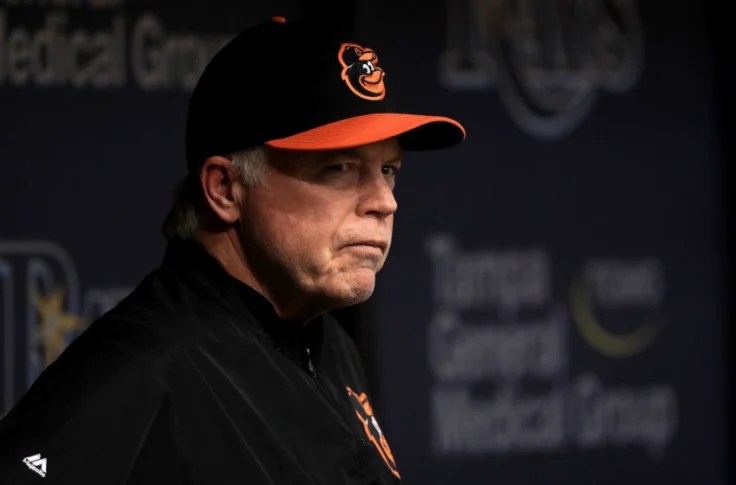
Buck Showalter

Showalter still has some splainin’ to do over Zack Britton’s absence when the 2016 AL wild card game was squarely on the line . . .

If you want to keep your minds off the lockout for awhile, you can find plenty of issues with which to do that. One coming to mind almost at once is New York Post columnist Mike Vaccaro waxing, as his column’s headline said Friday, on why the Mets should hire Buck Showalter as their next manager.

“The truth is,” Vaccaro wrote, “the team [new general manager Billy] Eppler and [owner Steve] Cohen have already cobbled together — and the one that seems destined to emerge from the lockout — is a team custom-designed for Showalter’s particular talents.”

There will be plenty of veterans, and Showalter likes having vets he can trust in his clubhouse. There will be plenty of intriguing players of younger vintage—think Pete Alonso, Jeff McNeil, Brandon Nimmo—whose experiences as major leaguers have largely been shaped by the stone hands of [former manager] Mickey Callaway and the inexperienced ones of [former manager Luis] Rojas . . .

But Showalter’s teams, in addition to almost always being of a superior collective baseball IQ, also take care of their business properly . . . The Mets, under Showalter, would be a Showalter team. That may mean they’re a couple of degrees less flamboyant, maybe a few layers less fun-loving . . .

So far, so good. And Showalter’s supporters include his former Orioles outfielder Adam Jones, who acknowledged Showalter still has to go through “the process,” meaning proper vetting. “[F]olks don’t have any idea of the real impact he can make on a ball club,” Jones tweeted Friday. “And I’m not just talking players. The Franchise. He made everyone better and accountable!”

How about Showalter making Showalter himself accountable? Say, for not making the move he should have made in the bottom of the eleventh of the 2016 wild card game? Vaccaro’s Post colleague Steve Serby tried in a September 2020 interview. And Showalter failed.

“Your Orioles controversy in [that game] when you didn’t call on Zack Britton and lost in the bottom of the eleventh in Toronto,” Serby presented. “You just have to wear some things, and I can sit here and tell you ten things you may not know about that situation, but nobody wants to hear it. I’m at peace with that,” Showalter replied.

The obvious followup—In fact, Buck, people would love to hear about the ten things that stopped you from bringing in your best relief pitcher, who also happened to be the best reliever in baseball that season, despite there not being a quote save situation, unquote, despite the Blue Jays with first and third and one out in a tie ballgame—didn’t come from Serby’s mouth.

Showalter stayed with Ubaldo Jimenez, normally a starter, but working in relief of Brian Dueseng, after Dueseng opened the inning with a strikeout . . . and despite Jimenez’s prompt surrender of a pair of base hits on four pitches. And Edwin Encarnacion hit Jimenez’s first pitch to him for a three-run homer.

It wasn’t as though Showalter didn’t have a very recent precedent by which to go. Just two years earlier, then-Cardinals manager Mike Matheny made the same mistake—with his Cardinals one game from elimination, Matheny left his best relief option, Trevor Rosenthal, in the bullpen in the bottom of the ninth of a tie game . . . because that, too, wasn’t a quote save situation unquote.

The Giants then had first and second and also one out. Matheny left in Michael Wacha, still rusty from late-season injury idling. And Travis Ishikawa hit Wacha’s second pitch to him for a three-run homer. Showalter was luckier—Encarnacion’s blast into the second deck merely sent the Jays to a division series; Ishikawa’s launch to the top of Levi’s Landing had a National League pennant attached to it.

Matheny reminded everyone what Showalter would forget a mere two years later: the time to bring your absolute best relief pitcher into a game is when it’s squarely on the line, previously designated “role” be damned. Especially when postseason advancement or a trip to the World Series depends on it. That’s not purely a thought from the school of analytics. It’s what they taught in Common Sense Elementary School.

If the Mets take Vaccaro’s suggestion seriously, they should be mindful of Jones’s reminder to put Showalter through the full vetting process. That vetting must include Showalter telling them, at least, what he wouldn’t deign to tell Serby over a year ago.

The Mets should damn well want to know why else—beyond no “save situation”—Showalter left his best relief option to rot when that option just might have sent the game to a twelfth inning giving his team one more chance to win at minumum. Accountability neither begins nor ends with the players.

If Showalter says only and again that nobody wants to hear those ten things you may not know about that situation, the one that sent his team home for a winter too soon, the Mets’ proper reply should be, “Way wrong answer! Thanks for coming, Buck, and don’t let the door knob goose you on your way out.”

Will Eppler get to run the Mets unimpeded?

Billy Eppler, Mike Trout

Then-Angels GM Billy Eppler—seen with Mike Trout, whom he signed to a glandular Angel-for-life extension in 2019—now gets to run the Mets without a contradictorily heavy hand above and undermining him.

The good news (yes, it’s good news) is that the Mets finally have a new general manager. The bad news is that an awful lot of people may be shaking their heads and lamenting, “They put on that crazy hunt to end up with this?”

Billy Eppler wasn’t exactly a resounding success when he held the same job with the Angels from 2015-2020. Not overall, anyway. In isolated moments he looked like a budding genius. In the big picture, he looked like another one of Angels owner Arte Moreno’s designated fall guys.

The budding genius side: Eppler did the heavy lifting when it came to making Mike Trout an Angel for life and for making Shohei Ohtani an Angel at all after his Japanese splash. He secured the game’s best all-around position player and his three American League MVPs and landed this year’s two-way sensation who just might shake out as this year’s AL MVP.

The fall guy side: Moreno’s contradictory penchant for splash signings, low enough budgets otherwise, and moves he pushed out of sheer fury after failures to strike  designated targets. Moreno is a lot more like Eppler’s one-time boss George Steinbrenner’s bad side than Angel fans often dare admit outright.

Before Met fans continue shrugging their shoulders and lamenting that this, too, is so Mets, ponder if you will that when the Angels hired Eppler in the first place—after he’d spent copious time as Brian Cashman’s assistant with the Yankees after running their scouting system a few years—Eppler went in with an arm and a half tied behind his back before he could make his first phone call.

Perhaps insanely, Moreno gutted just about his entire scouting system. He made international scouting director Clay Daniels pay with his head after some of Daniels’s subordinates were caught skimming signing bonuses. He pinked his overall scouting chief Eddie Bane over a series of bad drafts and free agency signings, even if one of Bane’s last solid moves was pressing the Angels to sign a kid named Trout in the first place.

Several of Eppler’s moves blew up through no fault of his own. Zack Cozart struggled as a new Angel in 2018 before a torn labrum killed the second half of that season and neck and further shoulder surgery killed much of his 2019 before he was traded away and ultimately retired.

Eppler made a number of reclamation-project free agency signings that failed miserably enough, as in former Met Matt Harvey plus Cody Allen, Trevor Cahill, Tim Lincecum, and Julio Teheran. With the best intentions Eppler looked foolish for those deals, just as he would for extending outfielder Justin Upton.

But Upton points to Eppler’s better side as well. Left to half by Moreno’s big-sign/low-budget-otherwise style, Eppler did what he could with whatever he was left to work with, and it wasn’t exactly his fault that his penchant for sharp trading and a sharp waiver-wire eye was made to look foolish by subsequent events.

Trading for Upton in the first place looked smart at first—before the extension and before the unanticipated injuries that have throttled Upton since 2019. Eppler also made several trades that made useful Angels out of Dylan Bundy (pitcher), Tommy La Stella (middle infield), Andrelton Simmons (shortstop), Felix Pena (pitcher), Patrick Sandoval (pitcher), and Max Stassi (catcher), for short whiles, anyway.

Eppler was also deft enough to land Brian Goodwin, Blake Parker, Noe Ramirez, and Hansel Robles off the waiver wire, getting some success from the group before they, too, petered away.

None of those moves translated into postseason trips for the Angels, of course, but you can look closely at just about all of them and discover the issues and baggage of most of those players didn’t arise until well after they arrived in Anaheim. But just as a manager takes the fall for “underachieving” or “shortfalling” teams, GMs take the fall when their moves turn out disastrous even through no fault of their own.

Essentially, the Mets played that postseason song-and-dance GM hunt to end up with a guy who’s been in and out of the reputed New York incinerator. (Remember Sandy Alderson saying it was just that overwhelming Apple heat that kept the Mets from bringing the best and the brightest aboard?) A guy who may not be cuffed and stuffed by a contradictory owner with a reputation for hard meddling.

It couldn’t have come at a stranger time. This may be so Mets—the former Angels GM taking the Mets’ helm as one of their key pitchers signs with the Angels. All Noah Syndergaard had to do—following his recovery/rehab from Tommy John surgery—was show a little enough of his classic Thor form in a pair of token gigs at season’s end, plus reject a Mets’ qualifying offer after the season, and the Angels take a flyer on his recovered self for a one-year, $21 million deal . . . pending physicals.

So Eppler gets to go to work right away redressing the Mets’ pitching depth issues. With all-world ace Jacob deGrom a question mark until he actually gets back on the mound next year, and their most reliable non-deGrom starter Marcus Stroman now a free agent, the Mets’ starting corps isn’t exactly a finalised 2022 product just yet.

Eppler will also have to step into the Mets’ efforts to convince middle infielder Javier Baez to keep his defensive virtuosity and reviving bat in Queens next to his keystone partner Francisco Lindor. He’ll have to start pondering moves to fortify their outfield. He’ll also have to think swiftly enough before any possibility that, with the current collective bargaining agreement due to expire and the owners threatening a lockout, the game shuts down for enough of a winter chunk.

But you can almost picture Eppler looking back upon his Angels tenure, then looking out now from his new perch with the Mets, and thinking to himself, “Jeez, I thought it was going to be impossible!” He may yet think that, compared to where he was, he’s in the next best thing to a professional jacuzzi now. May.