Censorship, Oriole style

Kevin Brown

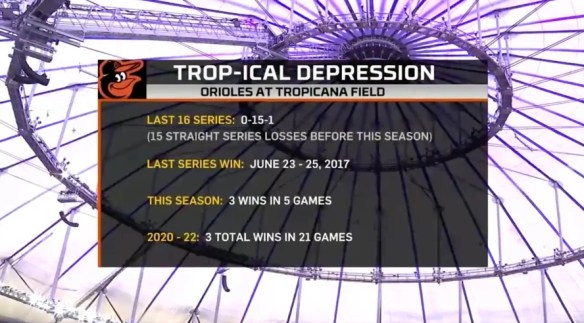
Kevin Brown, discoursing on the Orioles’ previous futility against the Rays in Tampa Bay versus their success there this year through that evening . . . the discourse that got him suspended indefinitely, as things turned out. (NASN screen capture.)

Apparently, all you have to do is speak the truth on the air, and if the baseball team whose games you announce or analyse is owned by people for whom the truth is inconvenient, you can be suspended indefinitely. The MASN’s lead Orioles play-by-play man, Kevin Brown (not the former major league pitcher), has learned the hard way.

All Brown did was say on the air that the Orioles—the American League’s most pleasant surprise of the year, leading the East—had won more games against the Rays in Tampa Bay this year (three out of five) than over the previous three. (Three of 21.) It was the plain truth. No insult intended. It wasn’t even an opinion.

But Brown seems to have been suspended indefinitely since late July, when he made the foregoing observation advancing a series finale between the two teams in Tropicana Field. The jarring scoop belonged to Awful Announcing Monday:

[We’ve] confirmed through multiple sources familiar with the situation that Brown has been suspended indefinitely, that it came after the Rays series, that he only wound up on the radio for the Phillies’ series thanks to another controversy about a different announcer’s apparel, and that the comment here seems to be what’s at issue. The Orioles dispute an official suspension took place, but none the less Brown has been off television since July 26th.

The online outrage only begins with The Cooperstown Casebook author Jay Jaffe: “OMG this is the weakest sauce imaginable by the Orioles.” But this is hardly the first time the owning Angeloses have spread this kind of weak sauce.

The factual graphic behind Brown’s fateful observation.

In 1997, Peter Angelos all but fired his lead radio announcer Jon Miller. The reasons included speculation that Miller’s weekend gig as a lead ESPN baseball announcer (with Hall of Fame second baseman turned colour commentator Joe Morgan) rankled both the Orioles and their radio flagship WBAL. Until they didn’t.

“Orioles officials,” wrote the Washington Post‘s Mark Maske, “said Angelos disliked Miller’s willingness to criticize the team harshly on the air when it wasn’t playing well.” Oops.

Miller, of course, went on to become the voice of the Giants in San Francisco. He probably saw oceans of downs and oceans of ups calling Giants games for what are now 26 years. He’s also accepted the Frick Award as a Hall of Fame broadcaster, in the same season the Giants won the first of three World Series titles in the span of five years.

Nobody seemed to want Miller fired when two Diamondbacks errors but three baserunning mistakes by then-Giants outfielder Ruben Rivera, ending with Rivera thrown out at the plate, prompted Miller to pronounce, “That was the worst baserunning in the history of the game!”

Whether Brown ends up staying with the Orioles on the air or whether he finds himself compelled to move onward (if he does, there should be no shortage of teams ready and willing to bring him to their mikes), this gives a disgraceful look to a baseball team who has gone from notorious tanking to AL East leadership and become must-see television approaching the hard stretch drive.

The Angeloses are hardly pioneers in baseball censorship. When the Yankees ended 1966 in dead last place (this was quite before divisional play), another Hall of Fame voice, Red Barber, committed his own such heinous crime—denied a camera pan of a near-empty Yankee Stadium, Barber intoned, “I don’t know what the paid attendance is today, but whatever it is, it is the smallest crowd in the history of Yankee Stadium, and this crowd’s the story, not the game.”

Oops. Among the reported mere 413 in the stands was Michael Burke, appointed by CBS (who’d bought the Yankees controversially in 1964) to oversee the Yankees. When the season ended officially, so ended Barber’s decade-plus Yankee tenure. The Ole Redhead elected to retire from there, but his purge was as wrong then as is Brown’s suspension now.

“Speak what you perceive as the truth,” said the late Hall of Fame broadcaster Tim McCarver. “If that’s outspokenness, that’s fine.” That was said after the Mets dumped him as a television analyst in 1998, proclaiming outspokenness wasn’t all that fine—and that Hall of Fame pitcher/franchise icon Tom Seaver, a Yankee broadcaster for five years, would do better as a “team player.”

Brown wasn’t even being outspoken, and he’s been put in the deep freeze for who knows how long. It’s difficult not to imagine the Angeloses answering “Honesty is the best policy” with “That’s what you think.”

The former Dark Knight, retiring with grace

Matt Harvey

Matt Harvey, young, a Met, and a Dark Knight.

Few baseball surges of the 2010s were as electrifying as Matt Harvey’s. Few baseball shrinkages were almost that electrifying. And, after a few years of trying and getting not even close to back to where he once belonged, Harvey elected to call it a career Friday.

The former Dark Knight, who’d provoked Mets fans to declare “Happy Harvey Day!” on the days he started, announced his retirement on Instagram. “With all the amazing memories came a lot of injuries and tough times,” the 34-year-old righthander wrote.

The realization that those amazingly powerful moments that make me thrive as a pitcher and help my teammates and city win are no longer possible. Believe me I wish I could have done more and brought more of those amazing moments back to life. I have to say this is my time to say thank you, and goodbye.

Asking Harvey to retire with no regrets would be asking him to be superhuman. That’s an ask he can’t possibly satisfy. He’d tried that earlier and too often in his career, on the mound and off it, and he nearly fried himself alive trying.

In the Show, Harvey was last seen trying a comeback with the Orioles two years ago. He started with three shutout innings followed by a dicey fourth in his first Oriole start. He went on to post for the season a modest 4.60 fielding-independent pitching (FIP) rate, a ghastly 6.27 earned run average, a 2.57 strikeout-to-walk rate, a 1.54 walks/hits-per-inning pitched rate (WHIP), and was hittable for 11.3 hits per nine innings.

That was double the transcontinental distance from his staggering second Mets season, 2013, when he led the Show with a 2.01 FIP, posting an 0.97 WHIP and a 6.16 K/BB rate, good enough to finish fourth in the National League’s Cy Young Award voting.

Those were the days when Harvey embraced New York and its white-hot heat as ardently as the city embraced him. “To the fans, most importantly the NY Mets fans: you made a dream come true for me,” he wrote in his retirement post. “A dream I never could have thought to be true. Who would have thought a kid from Mystic, [Connecticut] would be able to play in the greatest city in the world, his hometown. You are forever embedded in my heart.”

He’s had worse than that embedded in his heart. Harvey’s early ability to pitch like an executioner on the mound was equaled only by his ability to find and dwell among the demimonde as though it had his name on it.

He electrified the country when he started the 2013 All-Star Game and—having to shake off a leadoff double from future Hall of Famer Mike Trout followed by hitting Robinson Canó with a pitch—struck three out in two innings’ work and surrendering not a single run. (The American League went on to win, 3-0.)

He missed 2014 recovering from Tommy John surgery, but he electrified the country further when he all but ordered his manager Terry Collins to leave him in to pitch the ninth in Game Five of the 2015 World Series.

Uh-oh. Collins went with Harvey’s heart while misreading his fuel tank. He walked Kansas City’s Lorenzo Cain to open, then surrendered Eric Hosmer’s RBI double. Then Collins lifted him for Jeurys Familia. Two ground outs, one of which provoked Hosmer’s daring dash home while Mets first baseman Lucas Duda threw what should have been an easy double play ball offline to the plate (Hosmer would have been dead on arrival if the throw was accurate), tied a game the Royals won with a five-run twelfth as the rest of the Mets bullpen lost its wheels.

The Royals had bypassed Harvey in the 2010 draft. The guy they took instead, infielder Christian Colón, sent what proved the Series-winning run home. “I still have nightmares over that,” Harvey would tell the New York Post about the game. “One thing I’m most angry about is not getting it done.”

He’d have better reason to be angry the following season: he was hit with thoracic outlet syndrome in July 2016 and gone for the season. And, never again the same pitcher. TOS occurs when blood vessels and/or nerves between your collarbone and your first rib compress. That causes shoulder and neck pain and finger numbness.

“I had TOS,” Harvey’s former fellow Mets pitcher Dillon Gee once said. “I know how much that sucks. It definitely changes you. You start trying to tinker with things. It’s not natural anymore. You start being robot-ish. You start not trying to hurt one area and totally hurt another area. Your whole body is out of whack.”

Harvey’s body wasn’t the only thing going out of whack. Between TOS and a 2017 season interrupted nastily by another shoulder injury, Harvey melted down almost completely. The mound no longer elevated him; the city’s bright lights and demimonde no longer seemed to comfort him entirely.

Very publicly, he found himself dropped by a Brazilian supermodel with whom he thought a real romance was seeded—until she elected to return to her former beau, an NFL wide receiver, leaving a glittering party with the man. That was the night before he showed up late for a game against the Marlins claiming a migraine that was translated to mean a hangover.

Harvry had had such a big-timing attitude prior that now, when he needed empathy, aid, and comfort most, he had none. A year later, after refusing to try it out of the bullpen, perhaps out of stubborn lingering pride, Harvey’s days as a Met ended in a trade to the Reds. “Besides life on his fastball and bite on his slider, you know what was missing with Matt Harvey?” asked Joel Sherman of the New York Post after the deal. The answer:

Compassion. There was no empathy from a teammate or member of management for Harvey’s plight. They wanted him to rebound and do well, but that was about the team and their own selfish desire for success.

Matt Harvey

Humbled, Harvey pitched respectably for the Reds following his trade from the Mets. But he couldn’t reimagine his form successfully in stops at Anaheim, the Oakland system, Kansas City and Baltimore (above). 

Tom Verducci, the Sports Illustrated writer who first handed Harvey the Dark Knight nickname (picking up on Harvey’s boyhood love of Batman), advised one and all that Harvey’s taste for New York’s night life wasn’t the reason he’d collapsed on the mound. “The truth is, for all the times he wound up in the tabloids other than the sports section, Harvey failed because his arm failed him,” Verducci began.

. . . His arm likely failed him because of how he threw a baseball. And when his arm failed him, he knew no other way. He couldn’t pitch without an A-plus fastball, he couldn’t embrace using a bullpen role as a way back, and he couldn’t believe in himself again.

. . . The Mets cut Harvey because his once-fearsome fastball became the almost exact definition of a mediocre fastball (MLB averages: 92.7 mph, 2,261 rpm). Because he couldn’t find another way to get hitters out, because he could not change his mechanics and because he could not buy into the bullpen, the Mets could not keep sending [him] out to the mound as a starter.

The decline in his stuff was obvious. And there was no way his fastball was coming back with the way he throws.

As a Red, Harvey finished his walk year into free agency with a respectable if unspectacular enough performance that the Angels were willing to take an $11 million flyer on him for 2019. He lasted long enough to be designated for assignment that July. The Athletics signed him but he never saw Show action. The Royals took a chance on him for pan-damn-ically shortened 2020.

A free agent again, the Orioles took a chance on Harvey for 2021. He re-signed with the organisation for 2022 but he spent the season at three minor league levels around a sixty-day suspension after testifying in the Eric Kay trial that he’d used painkillers provided by Kay while with the Angels.

Kay was tried, convicted, and sentenced to 22 years in federal prison, having been the man who provided the drugs that killed popular Angels pitcher Tyler Skaggs. On the stand, Harvey admitted he’d given Skaggs (who was likely addicted to painkillers following early-career Tommy John surgery and subsequent other injuries), a few Percocets, perhaps unaware of the depth of Skaggs’s addiction. He didn’t shrink from it, he didn’t try to excuse it.

Harvey pitched in this year’s World Baseball Classic—for Italy, posting a 1.29 ERA in two starts before Team Italy lost to Japan and eventual WBC most valuable player Shohei Ohtani in the quarterfinals. It tempted him to try one more major league comeback. But it was just a temptation. Maybe the most important temptation Harvey resisted. He got to leave the mound permanently on a very high plane, at any level.

(For the record, his Team Italy manager, Hall of Fame catcher Mike Piazza, saluted Harvey upon his retirement announcement: “Look forward to teeing it up with you man..I want to Thank You for your awesome effort in the @WBCBaseball, You’re a warrior on the bump.”)

Back in 2020, he offered the Post something few who knew him as a Met might have accused him of having: introspection. “There are a lot of things I’d do differently,” he began, “but I don’t like to live with regret.”

There were just things I didn’t know at the time. Now, obviously, I’ve struggled the last few years. And what I know now is how much time and effort it takes to stay at the top of your game. I wouldn’t say my work ethic was bad whatsoever, but when you’re young, it’s not like you feel invincible, but when everything is going so well, you don’t know what it takes to stay on the field. It’s definitely more time consuming and takes more concentration.

Too many sports party boys don’t learn until their sports say goodbye to them first. Harvey learned soon enough, if sadly enough, that the party doesn’t always end on your terms. The Dark Knight who crashed and burned off the mound while his body betrayed him on it became something far more important before he retired: a man.

The Red Sox need to receive, not send messages

Rafael Devers

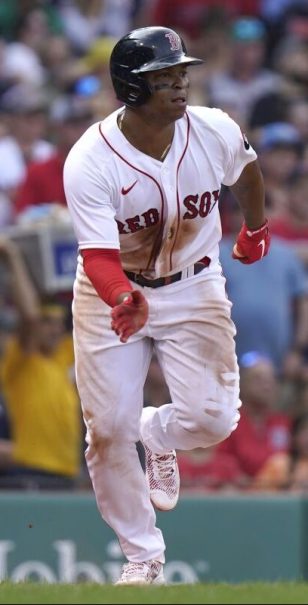
Rafael Devers’s 4-for-6 Sunday—including a two-run single and another RBI single—helped the Red Sox bury the Royals. Where were days like these from others when the Red Sox needed them most?

When the Orioles sent Trey Mancini to the Astros in a three-way deal at the trade deadline, it looked like general manager Mike Elias pushed the plunger on the season despite the team rising back from the dead. No less than Baseball Prospectus described the popular Mancini as “the heart and soul of a franchise long depleted of either.”

Well, Mancini’s now guaranteed a trip to the postseason with the Astros having clinched a postseason berth at minimum (wrapping up the American League West is just a formality waiting to happen for them) . . . and the Orioles remain within sight of a wild card entry, a mere four games back of the Mariners for the league’s fourth wild card.

Nobody really wanted to see Mancini leave Baltimore, not even Elias despite his word-salad explanation of the deal. Not in the Oriole clubhouse, not in the Camden Yards stands. But candor requires us to own up and admit the Mancini deal wasn’t popular but neither did it prove disastrous. It’s been how long since the Orioles finished seasons with winning records?

The Orioles may end up falling short, but they put on a show of self-revival that portends well for their 2023 and shows what teams can do despite losing well loved members to the business’s actualities. There are teams who would do very well to pay attention, listen, and learn.

The team in Boston, for example.

It sent the Red Sox clubhouse into a wrench when backup catcher Kevin Plawecki was designated for assignment late last Friday night and released officially Monday. On Sunday, after the mostly moribund Red Sox ironed up and smothered the Royals 13-3, the players bathed the joint with Plawecki’s walk-up song, “Dancing on My Own.” That’d send the message, right?

What message? The message that it’s not nice to send a popular clubhouse guy packing? The message that it’s not nice to cut a guy loose who kept the club loose amid disaster and started the laundry-cart dugout ride for home runs with them even if he didn’t get to take the ride himself too often? The message that the front office just doesn’t get it?

How about whether the Red Sox didn’t need to be sending but receiving messages? Such messages as yes, the front office Lucys got some splainin’ to do but so do the players. They got some splainin’ to do about what NBC Sports Boston’s John Tomase calls “this undercurrent of victimization and grievance that has left the clubhouse feeling like it plays no part in the results on the field.”

We saw it in the mopey reaction to the trade of catcher Christian Vazquez, whose replacement, Reese McGuire, has significantly outperformed him, it must be noted. We saw it a year earlier when trade deadline reinforcements didn’t arrive quickly enough, even though Kyle Schwarber ended up keying a run to the American League Championship Series. And we’re seeing it now with Plawecki, a fine backup and veteran presence who isn’t the issue here.

The issue is the reaction of players who seem unwilling to accept responsibility for their role in this disappointing campaign. When right-hander Nathan Eovaldi tells WEEI.com’s Rob Bradford the clubhouse misses presences like Schwarber, Plawecki, and Hunter Renfroe, it comes off as a direct dig at Bloom’s priorities. But how about Eovaldi fills that gap? We’re still talking about a veteran-laden roster, after all. From Xander Bogaerts to J.D. Martinez to Rafael Devers to Kiké Hernández to Nick Pivetta to the dearly departed Vazquez, the Red Sox did not lack for experienced, winning players.

So where were they when the season started going south in July? They never stanched the bleeding, even though within their very own division, the Rays survived the loss of burgeoning superstar Wander Franco, Gold Glove center fielder Kevin Kiermaier, All-Star catcher Mike Zunino, ace relievers Andrew Kittredge and J.P. Feyereisen, and potential future ace Shane Baz, among others. They currently trail the Blue Jays by only half a game for the first wild card.

The Rays didn’t give up when injuries hit, but the Red Sox did, rendering the final eight weeks of the season meaningless.

It might now seem an Eighth Amendment violation to remind the Olde Towne Team now. It wasn’t that long ago when their age-old rivals from the south Bronx went to back-to-back postseasons despite being hit with injury bugs so pronounced you’d have thought their games were episodes of Bones, Grey’s Anatomy, and House, and that The New England Journal of Medicine was really the Yankee yearbook.

I get it. Plawecki wasn’t a world beater at the plate or behind it; his usual role seemed to have been as the catcher of choice for starting pitchers Eovaldi and Michael Wacha, their two best starters when they’re not injured. Above and beyond that, Plawecki was one of the cast of Show characters who play roles unseen on the field.

“The Plaweckis of the world,” writes the Boston Globe‘s Jon Couture, “get teams through the grind, help rookies adjust, and are beloved for their conscientiousness and camaraderie. They’re needed. Thus, the pointed reaction for an end-of-the-roster guy.” (Thus, too, the likeliest reason the Rangers are interested in the now-free Plawecki and might even sign him today.)

Tomase gets it, too, but only to a particular valid extent. “Recognizing the temperature of the locker room is a necessary management skill,” he writes, “and at times the Red Sox could do a better job of communicating decisions to the rank and file.”

But we often go too far in castigating this move or that as harmful to the delicate clubhouse ecosystem.

Sometimes the players just need to man up and admit that management doesn’t owe them anything, because they did not honor their half of the bargain. Sometimes their performance leaves the boss no choice but to cut their buddy because he’s not part of the future. Sometimes next year matters more than this one.

Castigate Bloom as you wish for this unmade move or that unmade move or the other move that backfired. Fair enough. But when Tomase says the Red Sox players left Bloom little enough choice this year but to play wait-till-next-year, too (or wait-till-last-year, considering their reinforced run to the ALCS), he’s not just writing through his chapeau.

Lucky for the Red Sox they’ve got more 21st Century World Series rings than anyone else in the Show so far. Before that, a season such as this would have been written off as just another entry in the long log of rotten Red Sox malfortune. Who would have thought that the Orioles of all people would end up better off and with more respect approaching the finish line?

Queen Elizabeth II, RIP: Take her out to the ballgame

Tony La Russa, Queen Elizabeth

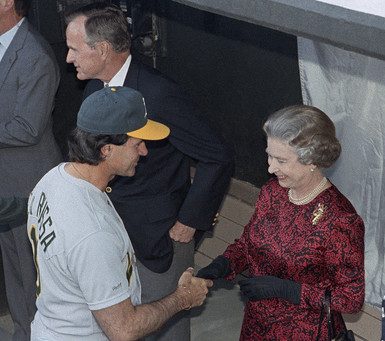
Hall of Fame manager Tony La Russa greeting Queen Elizabeth II in the dugout (with President George H.W. Bush in the background) before the A’s played the Orioles in May 1991, during the queen’s visit to the U.S. On that day, La Russa’s pitcher Dave Stewart threw HRH a nyukleball.

Her late majesty Queen Elizabeth II had something not customarily associated with royalty, namely a fair sense of humour. Dave Stewart, then an  Athletics pitcher, sort of learned when Elizabeth and her husband Prince Phillip visited the United States in 1991 and attended a game between the A’s and the Orioles.

The game was 15 May 1991 at Baltimore’s old Memorial Stadium. Stewart didn’t start the game for the A’s but Bob Welch did. Before the game, the royal couple visited the dugouts and chatted with assorted players, including Stewart, a pitcher whose success on the mound with the A’s was equal only to his countenance taking a sign. The countenance that suggested he might bite your bat barrel or your head off before trying to bust one past you.

Stewart discovered Her Royal Highness’s good humour even if decorum compelled her not to let it loose too readily. “I remember like it was yesterday,” the former righthander whose uniform number 34 becomes a retired number come Sunday told USA Today‘s Bob Nightengale.

We were all lined up to meet her in that procession. So Three Stooges was one my favorite comedies . . . So when she passed (in line), I did like a Three Stooges thing: ‘Queenie, nyuk nyuk.’ She laughed. Well, cracked a smile . . . Put it like that. The rest of the team was cracking up. It was cool for me. I’m sure it was for everybody too, but I had to go act like a god-dang fool.

Let the record show the A’s beat the Orioles 6-3, despite Orioles first baseman Randy Milligan hitting a pair out against Welch, a pair of leadoff blasts in the fourth and sixth innings; and, with a little help from Oriole starter Jeff Ballard picking Hall of Famer Rickey Henderson off second only to see it turn into a run on a dubious fielding error.

Let the record show further that Prince Philip may have had a better time at the game than his wife. Sitting in a luxury box with then-president George H.W. Bush, defense secretary Dick Cheney and then-baseball commissioner Fay Vincent, according to the San Jose Mercury-News, Philip pored through a media guide and kept binoculars in front of his eyes as he scanned the field and the play. Elizabeth “sat primly and looked bored.”

If you’re my age, you may remember enough of the world thought she was kidding around when she named the Beatles as members of the Order of the British Empire in 1965. I can remember enough hoopla indicating enough among the British political and social class objected anywhere from strenuously to amusingly to returning their own M.B.E.s.

My thought approaching age ten was that Her Majesty must have been tempted to breach her well-known composed self and style to slap the twits silly. Ed Sullivan, through whom the Beatles graduated from mere phenomenon to universe shakers in early 1964, did it for her, when he introduced the Beatles at Shea Stadium in August 1965: Honoured by their country . . . decorated by their Queen . . . and loved here in America!

Twelve years after Sullivan’s bouquet came the espionage novel that probably provoked both mirth and melancholia in the former motherland, William F. Buckley, Jr.’s Saving the Queen. His protagonist—a CIA operative on assignment to plug up the Buckingham Palace leaks through which American atomic secrets were being snuck—included in his operation a sexual tryst with a fictitious British queen.

Well, now. I’ll let the late Mr. Buckley himself take it from here, from an essay republished in A Hymnal: The Controversial Arts (1979):

There is something wonderfully American, it struck me, about bedding down a British queen: a kind of arrant but lovable presumption. But always on the understanding that it is done decorously, and that there is no aftertaste of the gigolo in the encounter. I remember, even now with some trepidation, when [Saving the Queen] came out in the British edition. The first questioner at the press conference . . . was, no less, the editor of The Economist, and he said with, I thought, a quite un-British lack of circumspection, “Mr. Buckley, would you like to sleep with the Queen?” Now, such a question poses quite awful responsibilities. There being a most conspicuous incumbent, one could hardly wrinkle up one’s nose as if the question evoked the vision of an evening with Queen Victoria on her Diamond Jubilee. The American with taste has to guard against a lack of gallantry, so that the first order of business becomes the assertion of an emancipating perspective which leads Queen Elizabeth II gently out of the room before she is embarrassed. This was accomplished by saying, just a little sheepishly, as [protagonist] Blackford Oakes would have done, “Which queen?”—and then quickly, before the interrogator could lug his monarch back into the smoker—“Judging from historical experience, I would need to consult my lawyer before risking an affair with just any British queen.”

The reaction of monarch with the subdued but not invisible sense of humour is not on record to the best of my knowledge, though I’d be happy if proven wrong. Especially so considering that in the novel itself the queen is the seductress and the spy the seduced. Elizabeth was known discreetly for playfulness with her husband but not believed to have been anything on the make in her premarital youth.

A consummation even more devoutly to be wished might be her response to Mr. Buckley’s eventual revelation that his friend David Niven, the distinguished British actor, answered his request for a blurb to appear with the novel’s paperback edition: Probably the best novel ever written about fucking the Queen.

Needless to say, the blurb never appeared except in a Buckley recollection or three. I suspect Elizabeth’s good humour might have deflected contortions enough, remembering she probably confronted far more grave lapses of decorum over her unprecedented seventy-year reign.

Including too many among her own offspring, for one of whom it would be high praise if nyuklehead was the worst sobriquet attached to him. The good news is that he’s not the one who ascended the predominantly ceremonial British throne upon his mother’s death. If the sins of the parents be visited not upon their children, surely the sins of the children should not be visited upon their parents.

Which enables Elizabeth to an eternal reward I pray includes frequent escort to the Elysian Fields and an afterlife education telling her that, unlike what she seems to have thought that 1991 day in Baltimore, a queen renowned as something of a thinking person should appreciate the thinking person’s sport.

Beltway bombshells—Soto, Mancini go west

Juan Soto

Juan Soto stole the show in Game One of the 2019 World Series and helped his Nats reach the Promised Land. That was then, this is now, and the still-top-flight Soto is a young man going west to San Diego . . .

The Big One dropped, in both directions on opposite coasts. The Nationals, who’ve gone from surrealistic World Series champion and National League East powerhouse to hell in a little over two and a half years, traded what should have stayed a franchise foundation to the Padres, the National League West contenders who often enough mistake splash for sustenance.

Juan Soto goes West the day after it turned out he’d end his Nats tenure with a bang, throwing Tomas Nido out at the plate to keep the Mets to a mere three-run top of the second, and crunching his former teammate Max Scherzer’s 1-1 fastball for a leadoff home run in the bottom of the fourth en route a 7-3 loss to the Mets. It won’t make it easier for Nats fans to swallow this.

Soto became expendable when he turned down a $440 million extension that looked stupid-fat on paper while packaged to deny him the thing he wanted most. He wanted ten years and got them. He wanted the total dollars and got them. He didn’t get the highest annual average value the way the packaged was packed.

Maybe Soto was foolish taking the all-or-nothing stance. But maybe the Nats were just as foolish, with or without a pending potential ownership change, to decline making even that small enough adjustment. Standing just as all-or-nothing, with Soto not due to hit free agency for the first time until 2025, the Nats decided even the next Ted Williams was expendable.

Stop laughing at the Ted Williams comparisons. Only five hitters through age 23 have higher OPSes than Soto does: Williams, fellow Hall of Famers Ty Cobb and Stan Musial, and Hall of Famers to be Albert Pujols and Mike Trout. The order from the top is Williams, Cobb, Trout, Musial, and Pujols. His June slump leaves his season so far not quite as good as his priors, but rehorsing himself last month restored Soto on the way back where he belongs.

But if he had a fat enough hand in the Nats’ 2019 in-season resurrection from the outhouse to the Promised Land, will it be fat enough to push the Padres to the Promised Land at last? Baseball’s worst kept secret is that Padres general manager A.J. Preller has a genius for trades equal to Soto’s big swings and nothing much to show for them.

Oh, he’s managed to land some of the bigger fish on the trade market in exchange for high-rated prospects who haven’t yet returned to take a big bite out of his hind quarters for the most part—if you don’t count Trea Turner. (Nat turned Dodger.) But there’s always a real first time. Isn’t there?

He’s run the Padres eight seasons, delivered such blockbuster trade acquisitions, at the in-season deadline or the offseason, as Mike Clevinger, Jake Cronenworth, Yu Darvish, Joe Musgrove, Blake Snell, and Fernando Tatis, Jr., the Padres haven’t yet gone to any full-season postseason. (They reached the National League division series during pan-damn-ic short 2020.)

And he may be lucky that his incumbent first baseman Eric Hosmer declining to waive his no-trade clause to move to Washington didn’t kill the Soto deal. Hosmer has declined so precipitously since becoming a Padre as a free agent that, if Preller wants to get the rest of his due salary off the San Diego books, he’ll have to move yet another good prospect to do it if he finds a team willing to take Hosmer on.

Then, again, as USA Today‘s Bob Nightengale notes, Soto locked in through 2025 has another upside: in the unlikely event the Padres still can’t cross the threshold, Preller can still find a way to flip him on behalf of bringing other delicious-looking prospects back for a team and organisational renewal.

If there’s good news for the Nats, it’s getting five prospects in return for Soto and Josh Bell, with all five rated somewhat higher than the haul they took back from the Dodgers in exchange for Max the Knife and Trea Twinkletoes. But if there’s worse news for the Nats, it’s the number one problem with prospects: No matter how highly rated, they’re just prospects who might or might not cut it fully as Show players.

If they do cut it, it’ll take the sting out of losing a bona fide franchise player only if their cutting it turns into another world championship or two. If they don’t, this one’s liable to sting for Nats fans as long and as deep as such historically notorious purgings as Brock for Broglio, Ryan for Fregosi, Seaver for a quartet that sounds more like a law firm—Flynn, Henderson, Norman, and Zachry—than team reinforcements.

This wasn’t even the top deal of the day when it comes to breaking fan hearts. It’s not that Nat fans weren’t wringing hands and drying tears once they first knew Soto became expendable, but Oriole fans in the throes of seeing an unlikely revival enough to put the team right into the wild card hunt from almost out of nowhere hurt even more losing Trey Mancini.

Hours before Soto moved west, Mancini’s ticket to the Astros was punched in a three-way deal sending promising but inconsistent outfielder Jose Siri from the Astros to the Rays, pitcher Chayce McDermott from the Astros to the Orioles, and pitchers Jayden Murray and Seth Johnson from the Rays to the Orioles.

Trey Mancini

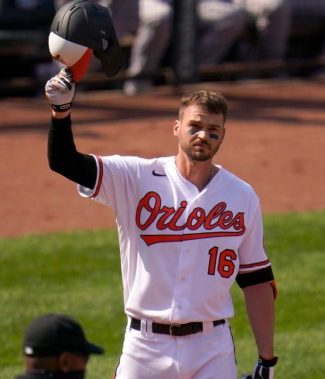
Trey Mancini tipping his cap to Oriole fans after what proved his final home game in Baltimore—he goes somewhat west now, to the Astros.

For Mancini it’s a terribly mixed blessing. One moment he goes from a home ballpark whose left field fence was moved back far enough to cut his power production at home to a ballpark with a short enough porch that he’d have hit over twice the ten bombs he has on the season so far. But he also says goodbye to a mutual love affair between himself and a city starving for the days when the Orioles were consistently great, year-after-year.

His agreeable personality and his courageous fight to beat colon cancer two years ago endeared him even further to Oriole fans than his live bat. As Baseball Prospectus observes, “Mancini . . . was the heart and soul of a franchise long depleted of either.”

The depletion may include Orioles general manager Mike Elias, who offered one of the most cacophonous explanations ever heard after a team struggling to return to greatness unloads a highly popular and franchise-valuable player:

The winning last couple of months that we have, the momentum we have, has made this a much more difficult decision and a much more complicated trade deadline than it would have been or that any of the past ones have been.But ultimately, I have to tether my decisions to the outlook and the probabilities of this year. We have a shot at a wild card right now but it is not a probability that we’re going to win a wild card.

Translation: In one deal and one bowl of word salad whose flavour no dressing on earth could improve, Elias as much as told Oriole fans he’s pushing the proverbial plunger on both this season whole and his team’s gallant, almost-from-nowhere re-entry into the postseason picture, however much distance the Orioles might still have to travel to get there.

Maybe Elias is still building for the nearest future after all. But maybe something could have been done without making the Orioles’ heart and soul the proverbial sacrificial lamb. Could, and should. “He’s the nicest human I’ve ever met,” says Orioles first baseman Ryan Mountcastle, a sentiment that seems to be common in the Oriole clubhouse and Baltimore itself.

Until today, people were even willing to bet on the Orioles having a phenomenal enough shot of reaching in. Now they’re uttering a couple of four letter words, one of which is the vulgar synonym for fornicate and the other a word meaning either a large receptacle for holding gas, an armoured attack vehicle, or taking a dive. Three guesses which meaning Orioles (and Nats) fans think applies.

“Teams liked to claim that captains were no longer necessary because one player shouldn’t be elevated above his teammates,” BP says, “but also, that same force made one player essentially untradable. If someone is designated the heart of a team, you can’t cut him out. Their value might go to waste.”

The region of the nation’s capital has taken enough blows that have knocked the wind out of its belly in the last few years. The Nationals and the Orioles, both of whom enjoy substantial capital followings, have told them, basically, “What’s two more sucker punches among friends?”