The Polar Bear of Baltimore

Pete Alonso

The Polar Bear gets his wings in Baltimore.

Those running baseball front offices will never lack for pressure. But there are always those among them who inflict the pressure upon themselves. Sometimes the intentions are noble. Sometimes the foresight is far. Sometimes the vision is blurry. Sometimes the blur becomes blindness.

Today’s Oriole fans have the unexpected luxury of believing their team’s president Mike Elias means business, when he says he was looking to take the Orioles’s promising lineup over the top and signing Pete Alonso was the means to that end.

Today’s Met fans have what they think is the too-familiar lack of luxury in believing their team’s president David Stearns is either talking through his head gear or blowing smoke, when he says the Mets were wary of going as far ahead in time with Alonso as the Orioles ultimately did.

Those Met fans, who’ve made a dark art out of pronouncing a season lost after a single bad inning on Opening Day, can’t fathom how a first baseman who’s still a young enough man, and has been one of their team’s most consistent power hitters since his 2019 arrival, became un-affordable beyond three years and unworthy of even receiving an offer this time around.

Stearns hasn’t kept his wish to upgrade the Mets defensively a state secret. The unfortunate flip side of Alonso’s batting prowess has been his fielding lack of it. As good as he is on the double play, as excellent as he is at snatching throws in the dirt, Alonso has slightly negative run prevention plus below-league average range factors.

The Orioles seem to be counting on Alonso’s formidable bat making up for the fielding shortfalls. The Mets seemed unwilling to continue taking that chance no matter how many home runs, no matter how many extra base hits, no matter that Alonso nudged Darryl Strawberry to one side as the franchise’s all-time home run hitter.

Alonso wasn’t the first free agent Stearns allowed to change addresses. The day before the Orioles landed him, relief ace Edwin Diaz elected to sign with the Dodgers. Three years and $96 million—and the largest average annual value for a reliever yet—wasn’t a figure the Mets couldn’t equal if they were thinking in three-year increments as seemed to be the case with Alonso.

So what made the bullpen bellwether return west? Part of it might have been Stearns signing bounceback relief candidate Devin Williams, with whom he was familiar from their time in Milwaukee. Part of it, too, and perhaps especially, might have been their coaching overhaul following the season included Jeremy Hefner, a pitching coach Diaz liked and respected.

The 2025 Mets had pitching issues that had nothing much to do with Hefner. But Diaz took his dismissal to mean the Mets suddenly got unserious about something dear to his heart.

“I spent seven years in New York,” the righthander said after he signed with the Dodgers. “They treated me really good. They treated me great. I chose the Dodgers because they are a winning organization. I’m looking to win, and I think they have everything to win. Picking the Dodgers was pretty easy.” Owitch.

And Alonso? He was both a fan favourite and an undisputed team leader, on the field and off it, known as much for his charitable acts as his bat and his fun-loving leadership style. But he spurned a significant extension offer a few years ago, and he re-upped with the Mets last winter in the face of a thinner market, taking two years with an opt-out after 2025. He exercised it after a big bounceback season and found a more accommodating new market.

Never underrate the power of betting on yourself and winning big even if it’s moving from the Grand Central Parkway to Cal Ripken Way.

“I’ve really enjoyed playing in New York,” said the Polar Bear, whose Oriole introduction included a large stuffed white polar bear on the table to his right and a brief struggle to button up his new Orioles jersey properly. He took number 25 only because his long-familiar number 20 has been long, long retired by the Orioles in honour of Hall of Famer Frank Robinson.

“I’m very gracious for that opportunity,” continued Alonso, who may have landed himself the Yogi Berra Malapropriety Award with that phrasing. “There’s some amazing people over there. Whether it be the locker room staff, clubbies, it was phenomenal. I really enjoyed my time. But this right here, this organization, this city, I’m so proud to call it home.” Double owitch.

“Losing franchise stalwarts Díaz and Alonso on back-to-back days is something a Mets fan might have expected from the Wilpon ownership—only with some ridiculous positive spin on how the team will be better for it,” said The Athletic‘s Ken Rosenthal.

Now, fans might wonder if Fred and Jeff Wilpon are practicing voodoo on David Stearns and owner Steve Cohen.

Stearns and Cohen have not said much of anything. That’s to be expected as they start to clean up the mess they’ve created, the baseball equivalent of a flooded kitchen floor. But they had better provide some answers quickly, and with actions, not words.

Maybe reuniting with Stearns gives Williams a clean shot at a big bounceback following a testy 2025 in Yankee pinstripes. Maybe bringing aging, injury-recovering Marcus Semien aboard—at the cost of another fan favourite, Brandon Nimmo, going to the Rangers—helps the Mets begin the defensive remaking Stearns has sung as a mantra. Maybe adding Jorge Polanco on a two-year deal helps likewise, especially since Polanco can play first as well as second with some pop at the plate. (He hit 26 homers last year.)

Alonso solves a huge portion of half the Orioles’s issues. They need pitching upgrades and  the best Alonso can do about that is help give that staff runs to work with. But they’re getting a class act who seems unable to wait to have a clubhouse impact as well as a scoreboard one.

“How I’m going to help is share my experience, and pretty much share whatever has helped me kind of step and rise to the occasion,” said Alonso, who has a sterling postseason resumé including an intergalactic moment or two. “I want to be an open book, pretty much to everyone in the clubhouse. For me, I take pride in that. Not only do I love performing, but ultimately I love forging great relationships and being a great teammate.”

That sounds like just the kind of guy the Mets should have wanted to keep.

Published originally at Sports Central.

Davey Johnson, RIP: “Forward thinker with old-school soul”

Davey Johnson

Davey Johnson at a 2016 reunion of his 1986 Mets. L to R: Keith Hernandez (1B), Jesse Orosco (RP), Ray Knight (3B), Lee Mazzilli (OF-PH), Johnson. They made the Deltas of Animal House resemble monks.

In 2012, on the threshold of managing the Nationals to their first National League East title after they moved from Montreal, Davey Johnson had mortality very much on his mind, after his one-time Mets player and lifelong friend Gary Carter lost a battle with brain cancer.

Johnson had seen Carter the previous winter and played golf with him at Carter’s charity event for needy children. When The Kid died, Johnson couldn’t bring himself to attend the funeral. “He would want me to be doing what I loved and not crying over him,” Washington Post writer Adam Kilgore remembers Johnson saying. “I don’t want nobody crying over me, either. It’s that simple. It may be callous, but I don’t look at it that way.”

The man who bookended both Mets World Series championships—he flied out to Cleon Jones to finish the 1969 Miracle Mets triumph, and managed the (shall we say) swashbuckling 1986 Mets to a World Series title—died Friday at 82.

Perhaps former Nats general manager Mike Rizzo described him best, in a Saturday text message to Kilgore: “Davey was a tough guy with a caring heart. One of the great baseball minds of all-time. A forward thinker with an old-school soul.”

During his playing days, Johnson took computer courses as a Johns Hopkins University graduate student and used what he learned to develop best possible baseball lineups. Offering one to his irascible manager Earl Weaver, who spurned it, Johnson said, “I don’t know whether to tell Earl, but the sixth-worst lineup was the one we used most of the time [in 1968].”

When he became a manager in the Mets’ system and then for the Mets themselves, Johnson brought such thinking plus his computer into his clubhouse and dugout. It’s entirely likely that he pushed the door open to sabermetrics as an active game tool and not just a postmortem analysis. He looked for the matchups and took the concurrent measure of his players at once.

But he wouldn’t let you call him one of the smartest of the game’s Smart Guys. “I never thought I was smart,” he said in 2017. “But I love to figure out problems. Through my stubbornness and relentlessness, I get to the end.” Bless him, he had to learn the hard way that the end had more than the meaning he had in mind.

“I treated my players like men,” he once said of his Mets, whom he led out of a dark age through a pair of hard pennant races and second-place finishes before they went the 1986 distance. “As long as they won for me on the field, I didn’t give a flying [fornicate] what they did otherwise.”

Not even when they celebrated a too-hard-won 1986 National League Championship Series by trashing their United Airlines charter DC-10 with partying that made the Gas House Gang and Animal House’s Deltas resemble conclaves of monks.

Maybe Johnson really was a forward thinker with an old-school heart. He treated like men a team with too many players behaving off the field as though their second adolescence came or their first hadn’t ended yet. Such straighter arrows as Hall of Fame catcher Carter plus infielders Howard Johnson, Ray Knight, and Tim Teufel, and outfielder Mookie Wilson, were the exceptions.

“He was just a player’s manager,” said Wilson upon Johnson’s passing. “He made it fun to go to the field. He laid down the law when needed, but other times he just let us play.” Then, and right to the end of his tenure on the Nationals’s bridge, Johnson liked to tell his players, “You win games. I lose them.”

Little by little, general manager Frank Cashen got less enchanted with his team and his laissez-faire manager. No two more opposite minds could ever have come through the Oriole system to bring the Mets to the Promised Land. And almost as swiftly as they got there, Cashen began letting his most characteristic players escape.

“Maybe we’ve made too many trades for guys who are used to getting their asses kicked,” said Dwight Gooden, the pitching star first made human by ill-advised work to fix what wasn’t broken in spring training 1986 and then a long war with substance abuse, to Jeff Pearlman for The Bad Guys Won. The guys who used to snap . . . they’re gone.”

Some also thought Cashen’s gradual dismantling of the team that should have ruled the earth or at least the National League for the rest of the decade took a toll on and the edge off Johnson’s once-formidable in-game cleverness. (He was known to be less than enthusiastic about several trades instigated by either Cashen or his then right-hand man Joe McIlvane.)

Once a second base star with the Orioles who also set a record for home runs in a season by a second baseman as a Brave, Johnson faced the proverbial firing squad in early 1990. It wouldn’t be the last time he brought a team to the Promised Land or its threshold only to be shoved to one side.

He took the Reds to the first-ever National League Central title after the post-1994 strike realignment—despite being told early that season it would be his last on that bridge. Capricious owner Marge Schott apparently didn’t like that he’d lived with his wife before she became his wife.

Then the Orioles made a dream come true and hired Johnson to manage them. Season one: 1996 American League wild card. Season two: The 1997 AL East. Neither brought him a World Series title. The wild card led to an American League Championship Series loss. (The outstanding memory: Jeffrey Maier making sure Derek Jeter’s long drive wouldn’t be caught for a homer-robbing out.) The division title led to another ALCS loss (to the Indians).

Johnson and Orioles owner Peter Angelos weren’t exactly soul mates. Angelos steamed all 1997 when Johnson fined Hall of Fame second baseman Roberto Alomar for missing a team function and ordered the fine to be paid to the charity for which Mrs. Johnson worked as a fundraiser. Johnson admitted soon enough that that was a mistake. (Alomar paid the fine to another charity.) Angelos wanted Johnson to say publicly he’d been “reckless.”

The manager declined, politely but firmly. Then, after the Orioles postseason ended, Johnson waited for Angelos to tell him, ok, you won the division again, that’s enough to let bygones be bygones. “Last week, Johnson called the Oriole owner,” wrote the Washington Post‘s Thomas Boswell, on 6 November 1997.

They talked. And yelled at each other some, too. Aired their differences. Johnson hoped it would help. That’s how it works in the clubhouse. You got a problem with me? Spit it out. Then work it out.

Johnson took a chance on Angelos. When challenged, maybe he’d respond like a big leaguer. Sometimes, after the venting is finished, a friendship develops—even a strong one. Sometimes you just agree to disagree and keep on fussing, like Earl Weaver and Jim Palmer. Either way, you respect each other and pull in the same direction.

Instead, all Johnson heard from Baltimore was silence. So, Johnson had his answer. Angelos wanted Johnson to resign as manager. If the Orioles fired him, they’d have to pay Johnson $750,000 next season . . .

. . . Nobody wants to be where they are not wanted. Especially if they are wanted almost everywhere else. “I’ll make it easy for him,” Johnson said. He wrote to Angelos: “I offer my resignation.”

On the same day Johnson was named American League manager of the year by the baseball writers, his resignation was accepted by Angelos.

Taking the high road helped make sure Angelos wouldn’t try to renege on the $750,000 he still owed Johnson for 1998. You think Angelos appreciated that high road? Not a chance. As with departed Orioles broadcast mainstay Jon Miller, Johnson “asked to be treated with the respect—in contractual terms—that his performance merited.”

In response, Angelos orchestrated the exodus of each. After Miller left, Angelos claimed Miller wanted to leave, contrary to appearances and Miller’s amazed protestations. Yesterday, Angelos said of Johnson, “It seems to me he wanted to move on.” By way of comment, let it be noted that Angelos has one of the rare law firms in which there are no partners. It’s just his name on the door.

Davey Johnson

Once a star second baseman in Baltimore, Johnson presses a point as a successful Orioles manager—who ran afoul of owner Peter Angelos, as Angelos made sure only too many did.

Johnson didn’t remain unemployed for long. (Neither, of course, did Jon Miller.) The Dodgers brought him to the bridge for 1999. He had his first losing season as a manager (though he won his 1,000th game in the job), then turned the Dodgers around in 2000 but fell short of the division title. Back to the firing squad. Again.

He then managed American and (one year) Netherlands teams in international competition before being hired into the Nationals front office. When manager Jim Riggleman decided to quit in June 2011, Johnson was named his eventual successor. He took them to a third-place NL East finish, their best since moving to Washington from Montreal, then led them to the NL East title in 2012 but a division series loss to the defending world champion Cardinals.

That didn’t keep his players from respecting him. Johnson must have come a very long way from the years when a laissez-faire approach to managing men eventually blew up in his face. I could be wrong, but I don’t remember any of his Cincinnati, Baltimore, Los Angeles, or Washington teams accused of trashing jumbo jets, for openers.

“If you come out here and you play hard and really work your tail off,” said his Rookie of the Year winner Bryce Harper during that season, “he’s going to like that. He plays it hard and he plays it right. That’s the type of manager you want.”

“Davey was an unbelievable baseball man but an ever better person,” said longtime Nats mainstay Ryan Zimmerman in a text to Kilgore. “I learned so much from him about how to carry myself on and off the field. No chance my career would have been the same without his guidance. He will be deeply missed by so many.”

On and off the field. Make note.

Johnson did win his second Manager of the Year award guiding the 2012 Nats. He’s one of seven to win it in each league; his distinguished company: Tony La Russa, Lou Piniella,  Buck Showalter, Jim Leyland, Bob Melvin, and Joe Maddon. After a second-place 2013—made slightly worse than it looked when he opened the season saying it looked like a World Series-or-bust year to be—Johnson elected to retire.

“In one respect,” Boswell wrote after his Oriole departure, “he’s different than almost every other manager of his generation. He doesn’t come to ownership with hat in hand. He doesn’t act like he’s lucky to be a big league manager and could never get any other job half so grand. He’s an educated, broadly accomplished man. And he carries himself that way. It has cost him.”

Johnson learned compromise as he aged, both in the game and away from it. So did a few of his former players who once butted heads with him or otherwise made him resemble Emperor Nero fiddling while Flushing flushed. (Darryl Strawberry, with whom Johnson had a relationship often described as “testy,” came to believe Johnson was the greatest manager he ever played for.)

Maybe tragedy had something to do with it, too. Johnson’s daughter, Andrea, once a nationally-ranked surfer but a diagnosed schizophrenic, died of septic shock in 2005; his stepson, Jake, died of pneumonia in 2011. (He also has a stepdaughter, Ellie.) Even the most impregnable man can be wounded. Even men who win two World Series as an Orioles second baseman and one managing the wildest and craziest Mets team of the 1980s.

May the forward-looking old-schooler be escorted to a happy reunion with his daughter, stepson, host of teammates, and Kid Carter in the Elysian Fields.

The Baltimore rumble

Basebrawl

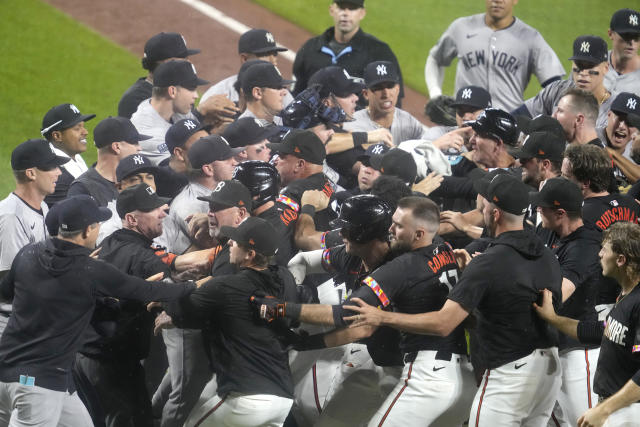
The Orioles and the Yankees rumble in the bottom of the ninth Friday night, after Oriole Heston Kjerstad took one on the side of his head from a Clay Holmes who clearly couldn’t control his pitch grip as the rain kept falling on Camden Yards . . . and after an incensed Oriole manager Brandon Hyde hollered at a Yankee or three to trigger the rumble. Upper right: Aaron Judge (with eye black) about to re-enter the crowd and scatter Orioles as best he could . . .

You could see the rainfall continuing in Camden Yards to the point where Yankee relief pitcher Clay Holmes had few dry spots on his road jersey. You could also imagine gripping and pitching a baseball in that bottom of the ninth moment, the Yankees up 4-1, one out, none on, and an 0-2 count on Orioles center fielder Heston Kjerstad, would be two things: difficult, and impossible.

What you didn’t have to imagine was Kjerstad on the ground in the batter’s box after Holmes’s supposed-to-have-been sinkerball took an ascending flight, instead, crashing into Kjerstad’s head through the right helmet flap, with a crack loud enough that you might have thought for one moment the ball hit Kjerstad’s bat, somehow, and enough force to knock the helmet off Kjerstad’s head as he went down.

What you didn’t want to imagine, if you still had your marble (singular) and weren’t bound to whole servitude by a particular rooting interest, was Holmes wanting to leave Kjerstad with a hole in his head when he was a strike away from putting Kjerstad away for a second out and the Yankees that much closer to sealing a win.

But too many of those bound by Oriole rooting interest decided in the jolt of the moment that Holmes, if not his fellow Yankees, was guilty of attempted murder. I can’t speak for you, but I’m not aware of that many murder attempts that end with the executioner moving and talking toward an apparently genuine concern for the victim’s well-being.

Whatever your position on the Sacred Unwritten Rules, on this much there seems general agreement: It is easier for a fastball to travel through the eye of the needle than for its pitcher to decide with premeditation that two outs short of his team’s victory requires he perform sixty-foot-distance neurosurgery upon the batter in the box

Orioles manager Brandon Hyde thought anything but, seemingly. Almost the split second Kjerstad hit the deck in agony, and Holmes himself tried to make certain he’d be all right, Hyde’s switch flipped. So did his team’s, soon enough, the Orioles pouring out of their dugout and bullpen and the Yankees pouring forth likewise from both directions.

You might understand why when you remember that Yankee pitches have hit Oriole batters up and in with alarming proliferation this season. Yankee pitches have hit a lot of players on several teams with alarming proliferation; the Yankee staff accounted for 62 hit batsmen as of Sunday morning. The Oriole staff? Tied with those of the Padres and the Rangers with 37 each to their discredit.

But Oriole pitchers had hit only three Yankees before Friday night’s blight, compared to Yankee pitchers hitting ten Orioles before that point. It’s one thing to point out that the Yankee strategy against the Orioles’ lefthanded hitters has been to work them inside, inside, and inside, but keeping it that way without resembling headhunters requires control, and lots of it.

Holmes has three hit batsmen thus far this season and has averaged seven per 162 games lifetime. This is not necessarily the resumé of a marauder. But the Orioles had reason enough to find fault that it may have escaped their thinking that the rainy inning affected Holmes’s grip enough to rob him of his control. His attempt to determine Kjerstad’s condition almost at once should have been the clarifier.

Not so fast, Hyde decided. Checking his fallen batter around the plate, Hyde first glared at Holmes; then, as Kjerstad arose from the batter’s box and began to walk around with a trainer’s aid, Hyde looked toward Holmes and hollered a rasping “[fornicate] you!” to the Yankee pitcher. The umpiring crew heard it loud enough and clear enough to converge and keep the Yankees reasonably calm and the Orioles from thinking about a rumble in the Camden jungle.

Hyde sticking up for his player was one thing, as even the Yankees acknowledged after finishing the 4-1 win. “Anybody who was out there knows it was tough to grip the baseball tonight,” said Yankee pitcher Gerrit Cole. “That said, though, the guy got hit in the head. It’s understandable that Brandon’s pissed. He’s defending his players.”

But Hyde hollering vulgarities at the Yankee pitcher who showed some genuine human concern over a serious injury he’d caused without intent was something else. As Kjerstad was escorted to the Oriole clubhouse, a  few Yankees chimed in with a variation on it was an accident, you know it was an accident, look at this rain, brain, and don’t give our guy that crap! 

At which point Hyde turned toward the Yankee dugout, and you didn’t require lip-reading training to see he was hollering back, You talkin’ to me? [Fornicate] you! Don’t [fornicating] talk to me! Then, Hyde confronted and pushed Yankee catcher Austin Wells backward some steps. Whoops.

Out poured the teams into a thick pushing and shoving mob around the innermost infield. Into the scrum walked Aaron Judge, the Leaning Tower of River Avenue, who looked to all the world as though single-handedly bumping this, that, and the other Orioles to one side as best he could.

Somewhere in the middle of the melee Hyde was ejected for the rest of the game. Somewhere else, two fan bases tried their best to urge the Yankees to pull back on the constant up-and-in pitching (down-and-in, we presume, would be less likely to incite on-field riots) and to urge the Orioles, their skipper especially, to take a breath before deciding an opponent who wounded one of theirs without intent should be tried, convicted, sentenced, and executed right then and there.

Both sides picked themselves up, dusted themselves off, and started all over again Saturday, with the Yankees winning again, this time 6-1, ensuring their first series win in what began to seem eons. Not an Oriole or a Yankee got hit by a pitch, either. The temptation was to greet each inning by whispering, “they wouldn’t dare.”

But a few baseballs got rapped or detonated by Yankee bats, especially Judge setting a new team record for most bombs before an All-Star break (the previous record holder: you guessed it—Roger Maris) immediately following Juan Soto’s solo in the fifth, and Wells blasting a three-run homer in the top of the first.

The series wrapped Sunday afternoon with a 6-5 Orioles win that began with their starting pitcher Dean Kremer hitting Judge with the first pitch of the plate appearance in the first. It ended with Yankee left fielder Alex Verdugo misplaying Oriole center fielder Cedric Mullins’s liner into a game-winning two-run double, after Yankee shortstop Anthony Volpe misplayed  what should have been Oriole first baseman Ryan Mountcastle’s game-ending, Yankee win-sealing grounder, allowing the bases to stay loaded for Mullins and the Orioles back within a run.

That left the Orioles in first place in the AL East by a hair entering the All-Star break. It also ended the regular season series between the Yankees and the Orioles. The two American League East beasts don’t have to look at each other the rest of the regular season. While wishing for Kjerstad’s fully restored health, it’s also nice to see that, as of Sunday, the Judge plunk to one side and with no apparent rough stuff as a result, the two really do know how to play nice with and against each other.

Is the Orioles’ reign of error ending?

Is a new day really dawning at Camden Yards?

You thought the National League West ogres in Los Angeles had a long World Series title drought? The Orioles haven’t won a World Series since over a week following the premiere of the first Hooters restaurant. (In Florida.) And, since a decade before Peter Angelos bought the team out of bankruptcy court.

“Bankrupt” has been a polite way to describe the Angelos reign of error. Oriole fans celebrated, then cringed too often for comfort after Angelos bought the team from Eli Jacobs. Now they may have cause to celebrate something sweeter than the Orioles’ slightly unexpected return to competitiveness last year. May.

Once upon a time Angelos swore the Orioles would be pried from his literal cold, dead hands, as in upon his death. Now, his son John, who’s been running the Orioles since his father was diagnosed with dementia, plans to sell to two equity billionaires, David Rubenstein (the Carlyle Group) and Mike Arougheti (Ames Management Corp.). The price: $1.73 billion.

This, writes The Athletic’s Ken Rosenthal, whose career as a baseball writer began by covering the Orioles for the Baltimore Sun, could portend the turn toward a new direction.

The Rubenstein-Arougheti group won’t take complete control of the team right away. They’re beginning with a minority investment but intend to take complete control upon  Peter Angelos’s death, allowing the Angelos family a tax benefit by waiting to give the group full ownership. (Rosenthal observes they’d have faced a capital gains tax levy on the difference between the team’s 1993 and current valuations.)

Rubenstein is known to have Baltimore ties and to be a significan philanthropic presence in the region. His personal worth is said to be $3.8 billion, while Arougheti’s is said to be $1.8 billion. Rosenthal also cites a Baltimore Banner report saying Hall of Fame shortstop and Orioles icon Cal Ripken, Jr. is going to be part of the new ownership group. Could the future look any sunnier for Oriole fans?

Well, they once thought it was sunny days ahead when the elder Angelos bought the team, too.

Two years later, in the wake of (let’s call it as it really was) the owner-provoked and pushed players’ strike, Ripken made it safe to love baseball again when he passed Lou Gehrig for consecutive games played and marked the occasion with a hefty home run off Angels pitcher Shawn Boskie in the fourth inning.

The Orioles have been to a few postseasons and through a lot more losing in the Angelos era. The elder Angelos became too hands-on despite a lack of common baseball sense. Tom Verducci of Sports Illustrated once described his style as slash-and-burn management, as in burning eleven managers in eighteen seasons before the comparative stability of Buck Showalter (8.3 seasons) and incumbent Brandon Hyde (entering season six).

From 1998-2011 the Orioles endured what was once believed unfathomable for a franchise with a history proud enough: a fourteen-season losing streak. The elder Angelos also dithered on creating an international Orioles scouting operation and presence and let his already chaotic front office mistreat valued players.

Things once hit so far bottom that Verducci reported in 2001 that agents with Oriole clients found those clients telling other free agents, “You don’t want to come here.” That sentiment was inconceivable in the era between their first World Series title (1966) and their last.

Last year’s Orioles surprised the world by reaching the postseason at all. They saw enough of their young talent start coming of age, and they saw a farm system looking plenty good enough for the seasons to come. Right?

Oops. Along the way, John Angelos was stupid enough to suspend his lead television broadcaster Kevin Brown over information on a team-provided graphic comparing last year’s O’s against the Rays to previous seasons in which the Rays seemed to own them. Oriole fans can’t be blamed if enough of them think they can’t have nice things without something nasty along with them.

Barely had the news sunk in about the Rubenstein-Arougheti group agreeing to buy the Orioles when bing!the team swung a trade for former Cy Young Award-winning Brewers pitcher Corbin Burnes for a shortstop on the cusp of Show readiness but with a few warning signs, a pitcher who might project as a useful reliever, and the 34th pick in the 2024 draft.

Further warning signs, though: Burnes has lost some hop on his signature sinkerball, his strikeout-to-walk ratio has dipped, and big boppers had a finer time with him last year than two years earlier. (2021: seven homers allowed. Last year: 22 homers allowed.) But he’s still Corbin Burnes and he’s still formidable enough. For a season to come at least. They hope.

Thus far the apparently glandular adulation thrown the new ownership group seems to be precisely what NBC Sports-turned-independent Craig Calcaterra calls it: “he’s not John Angelos, therefore he’s perfect, and if you suggest otherwise, blogger boy, you’re a hater.”

But Oriole Nation has been there/done that in the past, a little too often. The Angelos Era may be over, but then Mets fans threw champagne parties over the end of the Wilpon Era and the advent of Steve Cohen, too.

Cohen has been through more than a few growing pains thus far. Met fans whose patience rivals that of the piranha at mealtime (they are legion) think one bad inning equals grounds for summary executions—in April. Oriole fans may be far more patient, but the Angelos reign of error wore that patience to the thickness of a sheet of paper.

The Rubenstein-Arougheti (-Ripken) Group has quite a job ahead, assuming the rest of baseball’s owners approve their advent and their purchase deal. It’s not simple being viewed en masse (and perhaps prematurely) as saviours. Once upon a time America thought (really) that even Richard Nixon had to be an improvement over Lyndon Johnson. How did that work out?

Oriole fans may (underline that) be wise to consider what investigative journalism giant Sidney Zion used to advise: Trust your mother, but cut the cards.

ALDS Game Three: Baltimore Agonistes

Baltimore Orioles

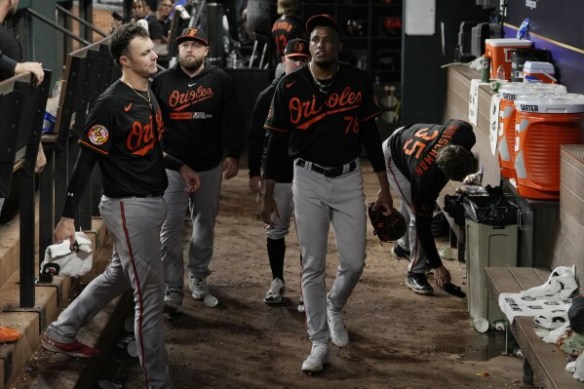
After their surprising and pleasing AL East conquest, the inexperienced, pitching-compromised Orioles found the AL West-winning Rangers too hot to handle.

Maybe it had to be this way, an inexperienced team of Orioles upstarts getting flattened by a better-experienced collection of Rangers in three straight. It might have been the team’s first postseason appearance in seven years, but they brought a collection of men with plenty of postseason time among themselves before becoming Rangers.

Maybe the Orioles were in over their own mostly young, 101 game-winning heads. Maybe the Rangers were too well primed by their Hall of Fame-bound manager who’d skippered three Series winners in five years on the Giants’ bridge.

But as joyous as it was to see the Rangers make too-easy work of the Orioles in this American League division series, it still hurt to see these Orioles swept away like flotsam and jetsam. It was the first time they’d been swept in any series since the May emergence of Adley Rutschman as both their regular catcher and their team leader. The first, and the worst, at once.

No matter how heavily tanking played a role in getting the Orioles to the point of winning the American League East, it hurt. No matter how stupid their administration looked censoring their lead television broadcaster—over a team-generated graphic meant to show a positive portion of their progress—it hurt.

No matter how further stupid that administration looked in doing practically nothing at the trade deadline despite having an upstart group of American League East conquerors on their hands—it hurt.

And, no matter how temporarily stuck Orioles manager Brandon Hyde might have looked  having to start a heavy-hearted pitcher in his fourth major league season but on his first postseason assignment in Game Three—it hurt.

“This is a really good group of guys,” said pitcher Kyle Gibson, a pending free agent, “and I think that adds to the sting of it too, because we knew we had something special. You want to try to capitalize on that whenever you can.”

“There’s no other way to put it,” said outfielder Austin Hays. “They kicked our ass. It sucks. Just couldn’t really get anything going, couldn’t get any momentum on our side to get things going. It hurts. It really hurts.”

The real-world motto of the real-world Texas Rangers: “One riot, one Ranger.” The motto of the American League West winners now could be: “Two postseason sweeps, thirty Rangers.”

The Rangers picked up where they left off Tuesday night against a flock of Orioles lacking veteran presence and, especially, veteran pitching, beating the Orioles, 7-1, in a game that was essentially over after two innings. Manager Bruce Bochy, in the conversation for Manager of the Year as it is, looked even smarter in this AL division series than he looked winning with the Giants in 2010, 2012, and 2014—and he looked like the Yankee version of Casey Stengel then.

Even more so because, until Tuesday night, the AL West-champion Rangers had to to their heaviest labours on the road. “We had our work cut out going on the road against Tampa and Baltimore,” Bochy said after wrapping the division series Tuesday night. “Just shows the toughness with this ballclub and the deal with having to fly to Tampa.”

Now they were home and happy in Globe Life Field, and Rangers shortstop Corey Seager didn’t give Orioles starter Dean Kremer a chance to continue collecting himself after second baseman Marcus Semien fouled out to open the bottom of the first. Seager smashed a 1-1 service 445 feet over the right field fence.

An inning later, it was one-out single (Josh Jung), two-out double (Semien), and an intentional walk to Seager. Kremer and the Orioles weren’t going to give him another chance to mash with first base open if they could help it. They took their chances with Mitch Garver, whose Game Two grand slam broke them almost in half—and Garver thanked them with a two-run double.

Up stepped Adolis García, the Rangers’ right fielder. Kremer had García down 1-2. The next fastball, a little up over the middle of the zone, disappeared over the left center field fence. Just like that, the Orioles were in a 6-1 hole out of which they wouldn’t get to within sight of the earth’s surface if the Rangers could help it.

They could. Their redoubtable starter Nathan Evoaldi, who’s been there and done that in postseasons previous, pinned them for seven innings and seven strikeouts, the only blemish against him an almost excuse-me RBI single by Orioles rookie star Gunnar Henderson in the top of the fifth. As if to drive yet another exclamation point home, Rangers first baseman Nathaniel Lowe greeted Gibson, the third of five Oriole pitchers on the night, with a leadoff homer in the bottom of the sixth.

“You’re not trying to do anything different,” said Seager, whose nine walks are a record for a three-game postseason span, according to MLB analyst Sarah Langs. “You’re just more focused. That’s not the right word, but it’s just more intense. Everything matters. It’s just a different game. It really is. There’s no way around it. So you have to have a different edge, different approach.”

Kremer’s heavy heart was thanks to the atrocity Hamas inflicted upon Israel, to which his parents are native and for which they both served in the Israeli Defense Forces before emigrating to California where their son was born. But he told Hyde when asked—this was discussed often on the game broadcast—that no matter what was in the back of his mind or the front of his heart, he could go for Game Three.

He still has extended family living in Israel. (He’s also said he do as Hall of Famer Sandy Koufax and decline to pitch if an assignment happens to fall on Yom Kippur, the Jewish Day of Atonement.) Anyone who thinks Kremer still didn’t take a heavy heart to the mound with him Tuesday night may be deluding himself or herself.

Perhaps if Hyde had more choices he might have told Kremer to forget the mound for now and focus upon his family. But the Orioles standing pat at the trade deadline, other than adding Cardinals comer-turned-injury-compromised righthander Jack Flaherty, who’d pitched his way out of their rotation to become a bullpen option, came back to haunt them horribly this series.

They were forced to hold veteran ace/post-Tommy John surgery patient John Means out of the division series because of late September elbow soreness—and had no reinforcements. They lost relief ace Felíx Bautista to a torn ulnar colateral ligament that took him to Tommy John surgery on Monday—and rode their bullpen a little too hard compensating for their lack of rotation depth down the stretch and in the division series after the AL East championship bye week off.

So their survival depended upon a young man with a temporarily compromised heart. Kremer went out courageously enough and found the Rangers a little too hot to handle after all. However the Rangers might have empathised with him, that didn’t mean they were going to let him off the hook.

That survival also depended upon an offense that dissipated near season’s end. Even when they awoke well enough in Game Two, turning what began as a 9-2 blowout in the making into an 11-8 squeaker of a loss. “Offensively, we weren’t at our best the last two, three weeks of the season,” Hyde said. “That carried into the postseason where we had guys scuffling. [The Rangers] rolled in with a ton of momentum. I don’t think we rolled in with a ton of momentum offensively.”

The Rangers had to dispatch the Rays in two straight wild card series games before taking the Orioles to school. Eovaldi pitched both series winners.

“I’ve never had a curtain call or anything like that,” said the veteran righthander whose six-inning relief in that eighteen-inning World Series Game Three marathon in 2018 really put him on the baseball map, and who took such a call after his Tuesday night’s work ended. “But our fans were bringing it all night long. When I walked out at 6:30 tonight, they were chanting, the ‘Let’s go Rangers.’ I knew it was going to be a really good night for us.”

He couldn’t have known just how good. For Eovaldi and his Rangers, it’s on to take on whomever wins the Twins-Astros division series in the American League Championship Series.

For these Orioles, it’s on to reflect upon how far they got in the first place despite almost nobody imagining them here when the season began. They have a core that can win again next year. All their administration has to do is refuse to hesitate on opening the trade lines and the checkbooks a little deeper. Knowing this Oriole administration, alas, good luck with that.