NLDS Game Two: Awakening the sleeping Braves

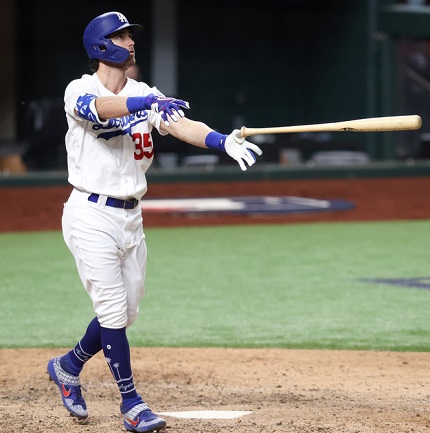
Travis d'Arnaud, Zack Wheeler

Travis d’Arnaud was only too happy to remind people what can happen when a lineup gets a third crack at his old Mets teammate Zack Wheeler . . .

If you expect to keep the Atlanta threshing machine from threshing, you can’t let any of them see Zack Wheeler the third time around. Not even if he’s taking a one-hitter into the seventh. Not even if you’re about to have your next two National League division series games in your own yard. Not even if the lone run out of him to that point scored on a tough fielding mistake.

You just might end up awakening the sleeping Braves.

Which is just what happened Monday night in Atlanta, the Braves overthrowing a 4-1 Phillies lead to win, 5-4. Slamming an exclamation point home with one of the most daring game-ending double plays anyone could hope to see, at any time.

Wheeler lost his no-hit bid and the Phillies’ bid for a second straight shutout in the bottom of the sixth, on Braves shortstop Ozzie Albies’s two-out single, sending Ronald Acuña, Jr. (two-out walk) home after Phillies shortstop Trea Turner misplayed a one-hop throw in from right. Phillies manager Rob Thomson elected to send Wheeler back out for the seventh.

Brain fart. Wheeler lifetime came into Game Two with opposition OPSes that accelerated each time through an opposing lineup: .594 the first time, with 39 home runs; .638 the second time, with 37 home runs; but, .759 with 47 home runs the third time. He was already in his third round with the Braves lineup when he walked Acuña in the sixth.

So with the Phillies leading by three, Wheeler opened with Matt Olson singling up the pipe, Marcel Ozuna striking out swinging, but Travis d’Arnaud—Wheeler’s former Mets teammate in the bargain—hitting the first pitch into the left field seats. As Truist Park went nuts over the first extra-base hit by the Braves all set long, then Thomson lifted Wheeler for Jose Alvarado.

“I wanted him to go back out, and he said he was fine,” Thomson said of Wheeler postgame. “He still looked good, so I was all in.” Three batters in, Wheeler was all out and the Braves were back on the march.

They continued marching with one out in the bottom of the eighth. Alvarado yielded to Jeff Hoffman, who hit Acuña on the left arm with his first pitch before Albies pushed him to second with a ground out. But then Acuña stole third with Austin Riley at the plate, and Riley rewarded Acuña’s larceny with his own drive into those left field seats.

The Phillies hung four on the board in the first five innings against a clearly struggling Braves starter Max Fried and Braves reliever Kirby Yates. Alec Bohm singled Turner (one-out double to the back of center field) home in the first. With Bryce Harper (one-out single) in the third, J.T. Realmuto hit one the other way into the right center-field bullpen.

With one out in the fifth, and Yates on the mound, Nick Castellanos (single) stole second and took third when d’Arnaud’s throw went far enough offline while Bryson Stott waited at the plate. Then Stott lofted a fly to center sending Castellanos home on the sacrifice fly.

d’Arnaud at least got his shot at redemption two innings later. The Phillies might have had a fatter lead for the Braves to overcome but for stranding the bases loaded in the first, stranding Johan Rojas on second (after a one-out walk and an advance on a wild pitch) in the second, and stranding first and second in the fourth and the sixth.

The defending National League champions had one more grand opportunity in the ninth when Harper pried a leadoff walk out of Braves relief ace A.J. Minter, prompting Braves manager Brian Snitker to reach for closer Raisel Iglesias. After Realmuto flied out to center, Castellanos sent one to the rear end of right center. Center fielder Michael Harris II ran it down like a cop chasing a mugger.

“I knew off the bat it was going to be close to the fence,” he said postgame. “I knew once I went back I wasn’t stopping. I was going to do anything I could to get a glove on it. If my body had to go down because of that, I would have done that.” His body didn’t go down despite its rude meeting with the fence, but he caught the drive and winged a throw in that snuck past Albies and meant disaster. For about three seconds.

Riley backed the play alertly, with Harper having rounded second hell bent on getting as close to the plate with the tying run as he could. But Riley fired a strike across the infield to first, making Harper pay for being just a little over-aggressive.

“Usually, you don’t pass the base,” said Thomson postgame. “You stay in front of it, make sure it’s not caught. But he thought the ball was clearly over his head, didn’t think he was going to catch it. And Harris made a heck of a play. Unbelievable.” Heck of a play? The Elias Sports Bureau says it’s the first time a postseason game ever ended on a double play involving any outfielder.

You hate to say a series tied at one game each has become treacherous. But Philadelphia’s Citizens Bank Park is a haven for hitting, and re-awakening the Braves’ threshing machine, after they spent the series’ first fourteen innings scoreless, is not a sound idea. Especially when they hit a record 307 homers on the regular season—including 24 against the Phillies exactly half of which were put in the Bank.

Thomson said the split in Atlanta was disappointing but, what the hey, now the Phillies have the home field advantage. The Braves didn’t put their best 2023 road show on in the Bank. (That honour belonged to Cincinnati’s hitting haven of Great American Ballpark.) But they’re not exactly pushovers in Philadelphia, either.

The All-Scar Game

Austin Riley, Pete Alonso

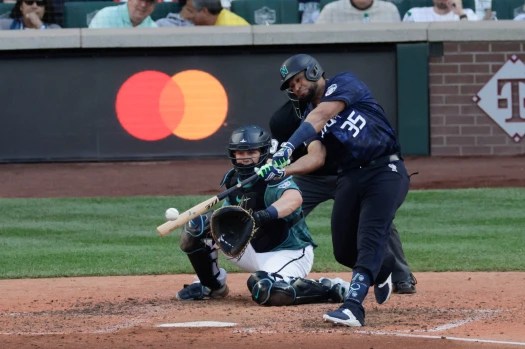
Austin Riley’s (Braves, left) kneeling throw to kneeling scooper Pete Alonso (Mets, right) ended the bottom of the All-Star Game eighth with a double play . . . (MLB.com photo) . . .

The best thing about Tuesday night’s All-Star Game? Easy. That snappy eighth inning-ending double play into which Athletics outfielder Brent Rooker hit. He shot one up the third base line to Braves third baseman Austin Riley, who picked and threw on one knee across to Mets first baseman Pete Alonso, who scooped on one knee to nail two outs for the price of one, doubling Blue Jays second baseman Whit Merrifield up.

That play preserved what proved the National League’s 3-2 win over the American League in Seattle’s T-Mobile Park. They got the second and third runs in the top of that eighth, when Elias Díaz (Rockies) pinch hit for Jorge Soler (Marlins) with Nick Castellanos (Phillies) aboard after a nine-pitch leadoff walk and nobody out. Díaz sent Orioles righthander Félix Bautista’s 2-2 splitter off a bullpen sidewall, then off an overhang into the left field seats.

It meant the first NL All-Star win since 2012. It also meant Díaz becoming the Rockies’s first-ever All-Star Game Most Valuable Player award winner. Otherwise? It meant almost nothing. Because the worst thing about this year’s All-Scar Game was . . . just about everything else.

Mr. Blackwell, call your office. All-Star Game specific threads have been part of it for long enough. They began ugly and devolved to further states of revulsivity. But Tuesday night took the Ignoble Prize for Extinguished Haberdashery. The only uniforms uglier than this year’s All-Star silks are those hideous City Connect uniforms worn now and then during regular season games. Both should be done away with. Post haste. Let the All-Stars wear their regular team uniforms once again.

Who are those guys? They sort of anticipated long ovations for the hometown Mariners’ All-Star representatives. But they didn’t anticipate they’d be longer than usual. To the point where two Rays All-Stars—shortstop Wander Franco, pitcher Shane McLanahan—weren’t even introduced, when they poured in from center field among all other All-Stars. (Rays third baseman Yandy Díaz, an All-Star starter, did get introduced properly. But still.)

Maybe the two Rays jumped the gun trotting in while the ovation continued, but they should have been announced regardless.

While I’m at it, what was with that nonsense about bringing the All-Stars in from center field instead of having them come out of the dugouts to line up on the opposite base lines? Some traditions do deserve preservation. Not all, but some. What’s next—running the World Series combatants’ members in from the bullpens? (Oops! Don’t give the bastards any more bright ideas!)

Down with the mikes! In-game miking of players has always been ridiculous. But on Tuesday night it went from ridiculous to revolting. When Rangers pitcher Nathan Eovaldi took the mound miked up, the poor guy got into trouble on the mound almost at once. He had to pitch his way out of a two-on, one-out jam in the second inning. He sounded about as thrilled to talk while working his escape act as a schoolboy ordered to explain why he put a girl’s phone number on the boys’ room wall.

What’s the meaning of this? We’ve got regular-season interleague play all year long now. The National League All-Stars broke a ten-season losing streak? Forgive me if hold my applause. So long as the entire season is full of interleague play, the All-Star Game means nothing. Wasn’t it bad enough during those years when the outcome of the All-Star Game determined home field advantage for the World Series?

The road to making the All-Star Game mean something once more is eliminating regular-season interleague play altogether.

Elias Díaz

. . . saving the lead (and, ultimately, the game) Elias Díaz gave the NL with his two-run homer in the top of the eighth. (And, yes, the All-Star uniforms get uglier every year. Enough!) (AP Photo.)

Tamper bay. Sure it was cute to hear the T-Mobile Park crowd chanting for Angels unicorn star Shohei Ohtani to come to Seattle as a free agent. The problem is, he isn’t a free agent yet. He still has a second half to play for the Angels. I’ll guarantee you that if any team decided to break into a “Come to us!” chant toward Ohtani, they’d be hauled before baseball’s government and disciplined for tampering.

I get practically every fan base in baseball wanting Ohtani in their teams’ fatigues starting next year. If they don’t, they should be questioned by grand juries. But they really should have held their tongues on that one no matter how deeply you think the All-Scar Game has been reduced to farce. Lucky for them the commissioner can’t fine the Mariners for their fans’ tamper chants. (Not unless someone can prove the Mariners put their fans up to it, anyway.)

Crash cart alert. Cardiac Craig Kimbrel (Phillies) was sent out to pitch the ninth. With a one-run lead. The National League should have put the crash carts on double red alert, entrusting a one-run lead to the guy whose six 2018 postseason saves with a 5.90 ERA/6.74 fielding-independent pitching still felt like defeats. The guy who has a lifetime 4.13 ERA/4.84 FIP in postseason play.

Kimbrel got the first two outs (a fly to right, a strikeout), then issued back-to-back walks (six and seven pitches off an even count and a 1-2 count, respectively) before he finally struck Jose Ramirez (Guardians) out—after opening 0-2 but lapsing to 2-2—to end the game. Making the ninth that kind of interesting should not be what the Phillies have to look forward to if they reach the coming postseason.

Sales pitch. How bad is the sorry state of the Athletics and their ten-thumbed owner John Fisher’s shameless moves while trying and failing to extort Oakland but discovering Nevada politicians have cactus juice for brains? It’s this bad—when the T-Mobile crowd wasn’t chanting for Ohtani to cast his free agency eyes upon Seattle, they were chanting “Sell the team!” when Rooker whacked a ground rule double in the fifth.

Can you think of any other All-Star ballpark crowd chanting against another team’s owner in the past? Not even George Steinbrenner’s worst 1980-91 antics inspired that. That’s more on Fisher, of course, but it’s still sad to think that a team reduced to cinder and ashes with malice aforethought captured an All-Star Game crowd’s attention almost equal to the attention they might have paid the game itself.

Two over the shoulder help tie an NLDS

Dansby Swanson, Austin Riley

Over the shoulders Wednesday night—Dansby Swanson hits the short left field turf to rob a bloop base hit from J.T. Realmuto; Austin Riley one-hands Bryson Stott’s foul over the tarp roll on which he might have turned his ribs to bone meal.

Well, I can’t decide, either. Atop a well-pitched National League division series Game Two, between the Braves and the Phillies, who put on the better defensive show between Braves shortstop Dansby Swanson and third baseman Austin Riley?

Don’t ask either one.

“I give him the credit,” Riley said, after the Braves banked the 3-0, series-tying win. “Just because running straight out, over the head is pretty tough.”

“I didn’t have to dodge a tarp,” Swanson said. “The guy, once again, a very under-appreciated defender, a lot more athletic than people give him credit for. The guy’s a gamer.”

That was like trying to choose between Lux Guardian and Lux Legacy vacuum cleaners. But come on, gentlemen. Quit being coy.

We might hand Swanson the slight advantage, though. With two out in the top of the sixth, Swanson ran out from shortstop into shallow left field chasing J.T. Realmuto’s bloop with center fielder Michael Harris II and left fielder Eddie Rosario pouring in from their positions. One false step or one body bump might have meant a base hit to a club that  isn’t terrible at turning two outs into a run-scoring chance.

Swanson took a small diving leap to nail it just before his glove hit the grass followed by the rest of him. “Play of the game, so far,” my game notes say. But if you press him on it, he’ll tell you he had a slightly unfair advantage going in.

“I should get my parents in here,” he said, “because they threw me a gajillion balls just like that all the time growing up over my head. I was the epitome of the kid that would throw a tennis ball off a wall and ricochet it and run, try to catch it over my shoulder. Probably threw a lot of tennis balls onto the field, too, to disrupt my brother’s baseball games. But I feel like I’ve been doing that since I was five.”

Two innings later, the Phillies had one out and Jean Segura aboard after a long drive to the left field wall that might have been a double was turned into a long single—thanks to Rosario playing the carom as if according to a script. He’s not the best defensive left fielder overall, but he has a powerful enough throwing arm that that kind of carom play keeps the other guy’s slugging percentage from creeping upward.

Then Phillies shortstop Bryson Stott popped a 1-2 service from Atlanta reliever Raisel Iglesias to the left side, beyond third base. Riley kicked his horse, ran it down, and reached to snap the ball into his glove above the Truist Park tarp roll—about a nanosecond before he would have hit that roll with a rib cage-cracking clank allowing Stott a reprieve.

“Couple of crazy catches,” said Braves first baseman Matt Olson. “Dansby going back, I think Rosario was going to have the play at it first. Rosario was pretty deep.”

“For me, that’s my best friend, is a good defense,” said Braves starter Kyle Wright, who kept the Phillies to a pair of hits and a walk while striking out six and turning his breaking balls loose enough to keep them out of balance. His only serious threat came when Bryce Harper, still in the Phillies’ designated hitter role, led off the second with an opposite-field double to left, took third when Nick Castellanos lined out to third, but was stranded by an unassisted ground out to first and a swinging strikeout.

“I try to get guys to put it on the ground. When they make catches like that, that’s good, too. That’s been one of my biggest weapons this year, I believe, is the defense.”

Phillies starter Zack Wheeler was almost as effective until he had two outs in the bottom of the sixth and perhaps got himself a little taken out of his game after his first pitch to Ronald Acuña, Jr. ran in hit the Braves’ right fielder on the inside part of his right elbow. Wheeler looked ashen on the mound as Braves trainers tended Acuña, who shook it off enough after about seven minutes to stay in the game and take first.

Swanson then worked out a full count walk to provide the Braves’ first man in scoring position all night to that point. Then Olson grounded one that took a tweener hop through Phillies first baseman Rhys Hoskins and sent Acuña home. With both starting pitchers working so stingily to that point, a single run must have felt like a three-run homer to the Braves.

Riley batted next. He hit a slow, small bouncer to the third base side of the mound, slow enough that Wheeler running to his right had no play to make when he speared the ball, but Swanson had a second Braves run to score on it. Then Travis d’Arnaud—the Braves catcher who’d caught Wheeler on days enough when the pair were Mets teammates—shot one sharply up the pipe for the single that sent Olson home with run number three.

A.J. Minter, Iglesias (with a little help from Riley), and Kenley Jansen kept the Phillies quiet to finish off. Andrew Bellotti and another former Met, Noah Syndergaard, kept the Braves quiet likewise to finish off. But their shoulders weren’t quite as burdened as those of the two Braves infielders who had to go over theirs to make plays that could have sent either one to the infirmary.

“[Swanson] had to readjust, get back on it and make an over the shoulder catch,” Olson said. “And then Riley going up against the tarp. Weird angle. Couple of great catches, and that’s the kind of game it was tonight.”

Game Three is set for Citizens Bank Park Friday. The Phillies had just played fourteen straight games on the road including the wild card set in which they swept the Cardinals to one side and future Hall of Famer Albert Pujols, plus ancient catcher Yadier Molina, into retirement well short of a shot at one more World Series ring.

“To leave here with a split,” said Phillies manager Rob Thomson, who had the interim tag removed well before the postseason began, “and go back home in front of a packed house of passionate people . . . I think will give our guys a little shot in the arm.”

Unless the Braves keep up the stingy pitching and luminous leather, of course. Then, that Philadelphia house packed with “passionate people” might want to give the Phillies a little shot in the head.

Go easy, Braves Republic

Dansby Swanson, unable to elude Superman in a single step. Swanson tried to correct a mistake on the spot and got tagged and bagged for his trouble.

No sport’s history is as thick and hydra-headed as baseball’s, and that includes its chapters on heart-crashing loss. Few sports fans are as addicted as baseball fans to the idea that the other guys can’t win so much as the teams to which they plight their troths can only choke.

It’s one thing to marry your rooting passion to teams that seem forever mired in mediocrity. It’s one thing to marry that passion to teams that struggled to make the journey, finally got their periodic pass to the October ball, and found the queen of the ball laughing in their faces when they asked her to dance.

But marrying your passion to teams who get to the top of Mount Nebo as regularly as the Atlanta Braves and the Los Angeles Dodgers and get kicked to the rocks below when they thought they’d cross to the Promised Land at last, just as regularly?

The Braves haven’t won the World Series since NASA lost contact with Pioneer 11. The Dodgers haven’t won it since the birth of Donald Trump’s fourth White House communications director (Hope Hicks). For a little perspective, the Milwaukee Brewers, the San Diego Padres, the Seattle Mariners, the Tampa Bay Rays, the Texas Rangers, and the Colorado Rockies have never yet reached the Promised Land.

The Braves have eighteen division titles since 1991, including that staggering (if you disallow the season disruption of the 1994 strike) fourteen straight, with five pennants and that one World Series win. The Dodgers have thirteen division titles since 1988, including the incumbent eight straight, with two pennants (back-to-back) and no World Series wins.

The demigods of the Elysian Fields being who they are, naturally the Braves and the Dodgers played for the pennant in this pandemically arrayed season almost straight out of Bizarro World.

Commissioner Rob Manfred’s pandemic-inspired short irregular season inspired his too-far-expanded postseason experiment that actually allowed two teams with irregular season losing records (the since-vanquished Brewers and the Houston Astros with identical 29-31 records) to enter in the first place. Perhaps with exemplary and extraterrestrial justice, the World Series will feature nobody whose butts weren’t parked in first place at irregular season’s end.

But I digress. Too many teams lose because someone does what he knows is wrong and nobody else has the presence or the authority to stop him. Too many more teams lose because someone doing the right thing has it blow up in his face courtesy of the unexpected countermove or glitch.

Too many fans, too, cling tighter if their teams’ histories feature too deep a canon of falling short when it was time to stand the tallest. It’s never the other guys who were just that much better, it’s their guys who can only and always dissemble. Even if they didn’t dissemble. Even if the parallel to the law that somebody has to lose is that everybody gets to play again tomorrow or next year.

Braves fans are starting the choke memes already, if they didn’t start them right after Dansby Swanson and Austin Riley ran them out of a possible game-out-of-reach rally in the top of the fourth inning in National League Championship Series Game Seven.

Well, maybe they waited until Mookie Betts fleeced Freddie Freeman with a staggering, solo home run-stealing catch that would have fattened a Braves lead back to two runs in the top of the fifth Sunday night. Maybe they waited until pinch hitter Enrique Hernandez tied the game at three with a leadoff solo home run in the bottom of the sixth.

Maybe they waited until Cody Bellinger broke the tie with a solo bomb in the bottom of the seventh and Julio Urias finished what he started, three innings’ shutout relief.

Maybe.

Swanson didn’t cut his Braves off at their own pass by going rogue, exactly. He tried turning a mistake into a virtue and learned the hard way that the other guys administer justice but not mercy.

When Nick Markakis grounded one sharply to Justin Turner right of the third base line, Swanson probably should have stood fast forcing Turner to take the sure out at first keeping two runners in scoring position. But he ran on contact.

Swanson tried for the textbook play when Turner threw home right on the button, getting himself into the rundown starting maybe fifteen feet from the plate, the better to leave Austin Riley—whose RBI single busted the tie to set up first and second, which became second and third on a wild pitch—room to take third and keep at least one insurance run ninety feet from the plate with two on and one out for on-deck batter Cristian Pache.

What Swanson didn’t expect was Riley at second hesitating before breaking for third. Maybe Riley saw no chance to advance at first no matter how well Swanson handled things on the rundown track. When Riley broke for third at last, Turner tagged Swanson with a Superman-like dive and threw from his knees to shortstop (and eventual NLCS MVP) Corey Seager hustling to cover third just before the dive.

Riley dropped into his slide the split second Turner threw. He was D.O.A. It turned out that so were the Braves from there, but they still had five innings to atone. They didn’t bargain on the Dodgers’ relief pitching keeping them to one measly walk the rest of the night.

Neither did they bargain on the Dodgers’ Game Six starter Walker Buehler flicking away the bases loaded and nobody out in the second inning by striking out the next two batters before inducing an inning-ending ground out. Never mind Betts robbing Marcell Ozuna with that likewise back-to-the-wall-scaling, extra base hit-stealing catch in the fifth.

Neither did they bargain on their pitching staff that became a shutout machine in the earlier postseason rounds suddenly proving human, after all. Or, on the Dodgers shaking off manager Dave Roberts’ day-late/dollar-short lift of Clayton Kershaw with Game Four tied at one to win three straight elimination games for the pennant.

It would have been mad fun to see the Braves tangle with the Rays in the World Series. The Scrum of the Southeast. But there wouldn’t necessarily have been a guarantee for the Braves. Not against a team that got out-hit by both the Empire Emeritus and the Houston hulks and still found ways to beat them both. Not against a team that hit .171 with men in scoring position all postseason long—and still won the American League pennant.

But I have a personal message for Braves Republic. Go easy on the choke label. The cumulative differences between the Braves and the Dodgers are half a pencil thin. The Dodgers only out-hit the Braves by nine points and only out-pitched the Braves by 1.26 in the ERA column. Makes perfect sense when you remind yourselves as the broadcasters did too often: including the NLCS, the Dodgers scored exactly one more run than the Braves all year.

Timing often has the bigger hand, unfortunately. That and, as good as you are, the other guys proving to be just that little bit better. It’s not as though the Braves were taken down by a fluke team. They didn’t fall to the 1944 St. Louis Browns, the 1945 and 2006 Detroit Tigers, the 1959 Chicago White Sox, or even the 2002 Anaheim Angels. It’s also not as though the Dodgers had to beat a bunch of pushovers to win the National League pennant.

Think about this, too, Braves Republic. What you have now is a team with at least one potential future Hall of Famer on the assumption that a 30-year-old Freeman isn’t on the threshold of his decline phase, and a lot of good-to-great-looking youth on the mound, at the plate, in the field. You have a steady manager and a smart enough front office.

What those fourteen-straight Braves division winners had was as many as four Hall of Famers at once—three top-of-the-line pitchers (Tom Glavine, Greg Maddux, John Smoltz) and the arguable number five third baseman of all time (Chipper Jones)—and still had only one World Series ring to show for it.

Even as this year’s Braves go home from this season that will be remembered as Alfred Hitchcock Presents The Inner Sanctum of the Outer Limits of the Twilight Zone, well, Lucy, who got more splainin’ to do?

Ask not for whom the Bellinger tolls

You call that a bat flip??

If Cody Bellinger’s going to be the long distance October hero, he’s going to have to work on those bat flips. The billiards cue-like toss he offered up in the bottom of the seventh Sunday night would get him laughed out of the parlours of our Jose Bautistas and Willson Contrerases.

Hit what proves to be the pennant-winning home run in the bottom of the seventh? C’mon, bro, don’t hold back. Give us the real deal. Give us that flip that needs a meal and a stewardess on board. Show Contreras his upper deck-high flip was just a little ring toss by comparison. Trust us, Cody, it won’t hurt.

Especially not after Mookie Betts, who thought nothing of breaking into the happy dance after scaling back-turned up the right field wall to snatch a possible triple from Marcell Ozuna Saturday, forgot to bust a move or ten after he flat robbed Freddie Freeman of a home run with another running, back-scaling, up-the-wall catch in the fifth Sunday night.

It wouldn’t have hurt, annoyed, angered, or outraged anyone any deeper than the Atlanta Braves wounded themselves when they TOOTBLANned* their way out of a fourth-inning rally that might have put them beyond the Los Angeles Dodgers’ reach in National League Championship Series Game Seven.

Bellinger’s eighth-pitch drive into the right field seats off Atlanta reliever Chris Martin was at least as dramatic as the seventh-inning blast he launched in Game Seven of the 2018 NLCS. It won’t supplant Kirk Gibson’s legless Game One-winning launch in the 1988 World Series. Bellinger has an entire World Series to come to show he has that kind of drama in him.

Nobody would put it past him. Yet. He picked the perfect moment to shake off a season during which he waged war with his own plate mechanics and an NLCS during which it looked like he’d spend his entire time running into the same kind of hard outs that drove Houston’s Alex Bregman out of his gourd in the American League Championship Series.

Be very afraid, Tampa Bay Rays. These Dodgers have a few boppers to match your own Randy Arozarena. They hit a staggering sixteen home runs as a team in the entire NLCS. That’s as many as some teams hit in an entire month.

Bellinger was preceded by Enrique Hernandez, pinch hitting for Joc Pederson to lead off the bottom of the sixth, against A.J. Minter, the rookie Brave who opened so magnificently in Game Five (striking out seven of nine batters). Hernandez worked Minter to an eighth pitch and sent it over the left center field fence to tie Game Seven at six.

You Rays may also need all of your band of defensive aerialists, acrobats, high-wire walkers, and human cannonballs to counteract one all-in-one Betts. The Dodgers can slap and flap the leather with the best in the business, but they’re not exactly the Flying Wallendas or even the 1969 Mets. Except for the guy wearing number 50 patrolling right field.

Who will offer absolution to the left side of the Braves infield that got themselves caught on the wrong side of a two-for-the-price-of-one baserunning mishap that may have been Sunday night’s true game-turner?

If it comforts Dansby Swanson and Austin Riley any, their fraternal flop didn’t exactly put paid to this NLCS the way Babe Ruth’s beyond-insane, out-by-five-miles stolen base attempt ended the 1926 World Series in the St. Louis Cardinals’ favour. Close enough but not quite the coffin nailer enough will try to secure it.

Swanson and Riley are the guys you really feel for after the Dodgers’ nerve-exposing 4-3 win. They picked the absolute wrong night to become two Lonnie Smiths for the price of one. No, I rescind that, right here and now.

In that 1991 World Series, inside the Richter-scale-busting racket of the old, gone, distinctly unlamented Metrodome, Smith got fooled just long enough by Minnesota Twins keystone Chuck Knoblauch and Greg Gagne, catching Smith’s sight running from first and performing a pantomime double play . . . when Terry Pendleton ripped a rocket into the left center field gap that should have sent Smith home with a scoreless tie-breaking Game Seven run.

Corey Seager pronounces Austin Riley and the Braves’ fourth-inning rally DOA.

Unfortunately for Swanson, Riley, and the Braves, the Dodgers weren’t trying any trickery Sunday night. They were down 3-2 in the fourth and trying merely to hang in and find a way to revive and prosper. They weren’t even expecting Swanson and Riley to be on second and third in the first place.

They got there because Dodger reliever Blake Treinen—in to clean up a small mess left behind by Tony Gonsolin that resulted in the third Braves run—wild pitched them from their original first and second stations. And they’d gotten those courtesy of Gonsolin serving Ozzie Albies an RBI single.

Now Treinen got Braves left fielder Nick Markakis to ground one to Dodger third baseman Justin Turner playing well enough down the line. Turner fired home and caught Swanson dead about six feet from the plate. Catcher Will Smith threw back to Turner, who took a flying leap like Superman taking off in flight to tag Swanson—with Riley, perhaps insanely, trying for third anyway after initial hesitation.

The problem was Dodger shortstop Corey Seager backing up the Swanson rundown. Trying to take the base under guard that heavy might get you points for chutzpah but DOA otherwise. As Riley was when he got tagged and bagged. As the Braves were from that point forward.

“It was huge,” lamented Braves manager Brian Snitker post-game. “It’s hard to score runs in the postseason. The infield’s back so you see the ball up the middle. That’s where normally we’re a really good baserunning team. We just did the fundamental things wrong.”

How can you say the Braves died with a 3-2 lead? Center fielder Cristian Pache grounded out to shortstop to finish killing that fourth-inning rally. Then Dodger relievers Treinen in the fifth, Brusdar Graterol in the sixth, and Julio Urias in the seventh through ninth kept the Braves to one lonely baserunner (a sixth-inning walk to Albies) the rest of the game.

The Braves will too often note and too long remember that they slapped an early 3-0 lead out of Dodgers opener Dustin May and then Gonsolin. They’ll remember May walking Ronald Acuna, Jr. and Freeman on eight consecutive pitches and Marcell Ozuna singling Acuna home in the top of the first. They’ll remember Swanson greeting Gonsolin rudely by hitting a 1-1 pitch over the left field fence leading off the second.

But they’ll also remember the Dodgers solving starter Ian Anderson’s changeup early enough to lay off it and start hitting some hard balls around, just biding their time until they could pry through. They’ll remember Smith hitting Anderson’s inside curve ball for a two-run single in the third. They’ll never forget Hernandez and Bellinger ringing the bells.

“It’s just the mentality we have,” Seager said postgame. “Show up that day, win that day. This team does a very good job being in the moment. You gotta stay in that moment, be in the moment and let the chips fall where they may. Right now, they’re falling our way.”

Entering Game Seven the Braves scored one less run all irregular year long than the Dodgers scored. Exiting Game Seven and the postseason they still ended up scoring one less run overall—but six less in the NLCS. They may remember trading Game Three and Four blowouts and reaping the sweet fruits of Bryse Wilson shaking off an irregular season’s 4.02 ERA to pitch like a Hall of Famer starting Game Four.

They may also remember they’ve been pushed out of postseasons with far heavier blows than they took Sunday night. But they might also want to remember that they shook off that nasty 13-1 blowout by the Cardinals in last year’s division series to take a second consecutive possession of first place in the National League East, no matter how bizarrely truncated 2020 was.

The Braves will be back. Count on it. They may even have forged the beginnings of a beautiful postseason rivalry with the ogres from the National League West. It’ll just have to keep until next season. Sure it would have been lovely to see the Braves tangle with the Rays in the World Series. Southeast rising.

But won’t it be a little more fun to think that the Tampa Bay Davids might have a shot at taking down the Los Angeles Goliaths? With or without these Dodgers’ recent snakebitten history, that ought to be fun, fun, fun—until or unless Daddy takes the slingshot away.

——————————————————————————

* TOOTBLAN—Thrown out on the bases like a nincompoop. Invented originally for former Chicago Cubs infielder Ryan Theriot, whose baserunning skills were described politely as less than average.