Symphony for shoestrings

Maestro Betts.

This time, Dave Roberts got it right. It didn’t hurt that his Los Angeles Dodgers behaved like Dodgers when they absolutely had to in National League Championship Series Game Five, either.

Meaning they ironed up when they were down in the fourth inning, with eighteen outs between them and yet another winter full of recriminations.

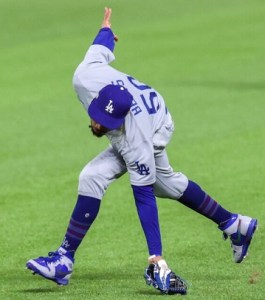
All it took was someone reminding them there come times for the band to break into “Symphony for Shoestrings.” Someone like Mookie Betts in the third inning.

The Atlanta Braves didn’t have a Dodger managerial lapse through which to shove a tank yet. They’d scratched their first two runs out while their youthful opening pitcher, A.J. Minter, setting precedent by making his first major league start in a postseason game, struck out seven in his three innings including the side in the third.

“I surprised myself a little bit,” Minter told the Atlanta Journal-Constitution. “Coming into the game, I just wanted to set the tone, attack one guy at a time and not worry about pitch count. Just come out and be aggressive and get us off to a good start.”

He got them off to a very good start. What happened after he was lifted for Tyler Matzek to start the fourth wasn’t his fault. The Dodgers bumped, ground, and swung their way back to a 7-2 win while their own company of opener Dustin May and six further relievers made sure the Braves couldn’t even think of an overthrow.

Roberts managed his pitching just right all night long and neither pushed a panic button nor fell asleep at any switch. His Dodgers also ran, if you add as you should Betts’s staggering catch and double play in the third to stop a third Braves run. Just don’t ask Betts about it.

If you want him to tell you which moment changed the game in the Dodgers’ favour, it was first baseman Max Muncy hanging in to walk against Braves reliever Will Smith to set up first and second in the sixth—after Betts himself had his leadoff beat-it-out single turned into a one-out force eliminating him at second base—for Dodgers catcher Will Smith.

You read it right. Your eyes didn’t play tricks. Will Smith versus Will Smith. The first time namesakes faced each other in postseason play. The Braves’ Smith and the Dodgers’ Smith wrung their way to a full count, Smith not taking the bat off his shoulder once. Then, Dodger Smith swung on what some umps might have called ball four. And hit it about six or seven rows into the left field seats.

“Last night hurt,” Dodger Smith said post-game, referring to the late-enough Clayton Kershaw hook that opened the gates for the Atlanta tanks to barrel in. “We got back on the same page, a little motivation, I guess. We were coming out tonight hungry and ready to go.”

He didn’t deny that facing his namesake in the postseason was exciting. “I faced him once last year in the regular season,” he told MLB Network’s Harold Reynolds, “but yeah, [this] was a big swing for us.”

“He battled his ass off the whole time,” said Friday night’s two-bomb Dodger shortstop Corey Seager of his and their Smith.

“He put together a really good AB, took some really tough pitches, then put a good swing on a pitch inside and got the head to it and clipped me,” said the Braves’ Smith post-game. “Oh, well.”

“Oh, well” isn’t going to work when the two combatants square off for Game Six. The Braves still have the 3-2 NLCS lead but they’ve been reminded these Dodgers aren’t exactly pushovers just yet. Not even if the Game Six pitching match to begin will be Max Fried against Walker Buehler. The Braves won’t just take for granted that there’s yet another too-classic postseason Dodger dissipation on the horizon.

Sure the Smith smash overthrew what was then a 2-1 Braves lead for keeps, so sure it was one game changer. But Betts doesn’t give himself enough credit. He only stopped any momentum the Braves might have had left for the night three innings earlier with his legs, his glove, and his arm.

He ran in when Braves shortstop Dansby Swanson with second and third and two outs hit a soft sinking liner to shallow right and caught it on the shoestring, firing home in a bid to bag Marcell Ozuna at the plate. Ozuna slid across the plate just as the throw reached Dodger Smith—but oops! Dodger bench coach Bob Geren called for a review. He’d seen Ozuna tag a hair too soon as Swanson’s sinker hit the web of Betts’s glove.

Side retired. Inning-ending double play. “If you’re talking about momentum shifts,” Roberts said post-game, “that’s the play of the year for me. I just thought there was no way he’d make that play. He’s just kind of the straw that stirs us.”

“A big play like that, a big moment, changes everything for you,” Seager said. “You go into the dugout with some energy, you scratch some runs and the whole thing changes.”

Betts isn’t buying it. So far as he’s concerned, it’s everyone with a job to do and he’s just one of the crew. “Our backs are against the wall,” he said. “It’s all hands on deck, and we’re showing emotion and helping each other out.”

Seager didn’t waste any time leading off the bottom of the third against Matzek. He caught hold of a 2-1 fastball and drove it over the center field fence to cut that early, scratchy 2-0 Braves lead in half in the first place. Four innings later, after struggling Chris Taylor doubled with two outs and Betts promptly singled him home against Braves reliever Jacob Webb, Seager turned on the first pitch and yanked it into the right field seats.

“That guy is something else,” marveled Braves manager Brian Snitker. “He’s one of those guys who never gives an at-bat away. It’s very impressive. He’s a dangerous, impressive hitter.”

By the time youthful Braves outfielder Cristian Parche robbed Muncy blind of an eighth-inning home run, it was too little, too late for the Braves in Game Five. Even the much-maligned Dodger bullpen held fort when they absolutely had to hold it. Right down to much-embattled closer Kenley Jansen handed that four-run lead for the ninth and striking out the side to finish.

Sometimes it takes just one gig with a little extra oxygen to hit the reset button the right way. Doesn’t it?

Most eyes will be upon San Diego Saturday night, where the Tampa Bay Rays will learn once and for all whether they can hold the Houston Astros off to go to the World Series or the Astros will finish what they’ve started, becoming the Show’s second team ever to win a pennant after being down 3-0 in their LCS.

NLCS Game Six may seem like a modest afternoon opening matinee by comparison. But the Dodgers and the Braves have no intention of playing it that way.
Misteroberts’ neighbourhood

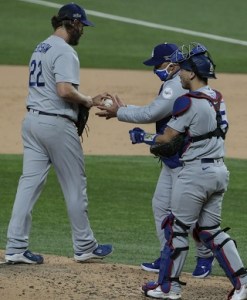
Too little, too late: Dave Roberts (masked) lifts Clayton Kershaw an inning late and what the Braves made ten dollars short.

The roll of managers who got their teams into hot water by doing what they shouldn’t have done, or failing to do what they should have done, is thick enough. Dave Roberts made it thicker after National League Championship Series Game Four Thursday night.

At the worst possible moment for his Los Angeles Dodgers, the day after the Atlanta Braves nuked them in Game Three, Roberts couldn’t bring himself to do what he had to do and get Clayton Kershaw the hell out of there. Fast. Before his lefthander left room for another Braves uprising.

It married Roberts to Charlie Dressen, John McNamara, Grady Little, Mike Matheny, and Buck Showalter on the roll of skippers who overthought, overmanaged, undermanaged, or brain-vapoured their way into big trouble if not big postseason infamy.

Kershaw’s postseason calamities are only too well known. They’re the only blemishes on a certain Hall of Fame career. It won’t make him a Cooperstown outlier—Bob Feller, Willie Mays, Joe Morgan, and Tony Perez don’t have sterling overall postseason resumes, either.

But Game Four is the one into which Kershaw’s manager walked him eyes wide shut and the Braves into the real beginning of a 10-2 triumph and one game from going to the World Series.

For five innings Kershaw stood his ground against Braves starter Bryse Wilson, who had only four more major league starts than Kershaw has Cy Young Awards. Wilson actually out-pitched Kershaw, but at the end of five the game was a one-all tie thanks to Alex Rios hitting one into the right field seats in the third and Marcell Ozuna hitting one into the left field seats in the fourth.

Roberts shouldn’t think about hitting the casinos any time soon. He knew Kershaw’s back might still have been a little balky after spasms forced Kershaw to be scratched from his scheduled Game Two start. He got five solid innings out of Kershaw on Thursday and should have been more than content with that.

But no. Roberts had to send Kershaw out for the sixth. “I just thought Kershaw was throwing the baseball really well,” the skipper told reporters after the game, “and there was no reason [to lift him]. I felt really good about it.”

How good did Roberts feel when Ronald Acuna, Jr. opened the Atlanta sixth with a hopper back to the mound but over Kershaw’s head that the evening’s Dodger second baseman, Kike Hernandez, coming from shortstop in the infield shift, threw past first baseman Max Muncy to allow Acuna to second?

How good did Roberts feel after Freddie Freeman promptly shot one right past first baseman Max Muncy into right for an RBI double?

How good did he feel after Ozuna shot one into the left center field gap for an immediate RBI double?

How good did he feel after relieving Kershaw with Brasor Graterol two hitters two late, seeing Travis d’Arnaud line out to right, but then watching Ozzie Albies single, Dansby Swanson shoot one down the left field line for a two-run double, and Austin Riley cue an RBI single up the middle?

How good did he feel after lifting Graterol for Victor Gonzalez and watching him walk Hector Camargo before Cristian Pache singled Riley home? Not to mention Ozuna leading off the seventh with another solo bomb, this one off Dylan Floro? Freeman and Ozuna whacking back-to-back RBI singles off Jake McGee in the eighth?

With nothing else out of the Dodgers offense but the bases loaded and one out in the seventh and only Rios’s sacrifice fly to show for it?

“I’m not going to take Clayton out after a weak ground ball and another ground ball off the bat of Freeman,” Roberts said. “I felt really good with Clayton at that point in time.”

Once upon a time an ancient Dodger manager named Charlie Dressen felt really good about spurning his curve ball specialist Carl Erskine in favour of fastballer Ralph Branca with Bobby Thomson—still less comfortable facing curve balls—coming to the plate in the bottom of the ninth of a third pennant playoff game.

Thomson and his New York Giants felt great about the Shot Heard ‘Round the World—until the final published evidence affirmed decades later what those Dodgers suspected down the stretch: The Giants stole the pennant! The Giants stole the pennant!

John McNamara felt good about leaving his ankle-vaporised first base warrior Bill Buckner in the field for the bottom of the tenth in Game Six of the 1986 World Series, too. He wanted his shattered soldier out there when the Red Sox finally won the World Series again. How did that work out for him?

Grady Little felt good about taking Pedro Martinez’s heart at its word and ignoring his Hall of Famer’s fuel tank crying “empty!” The Yankees listened to the fuel tank and sent Game Seven of the 2003 ALCS to extra innings—and Aaron Boone’s eventual pennant-winning date with stout Red Sox knuckleballer Tim Wakefield.

Mike Matheny felt great refusing to close The Book in Game Five of the 2014 NLCS and bring his closer Trevor Rosenthal into the bottom of the ninth—because it wasn’t even a St. Louis Cardinals lead, never mind a save situation. Travis Ishikawa felt even better turning on rusty Michael Wacha’s weak fastball and sending it to the top of Levi’s Landing. (This time, the Giants didn’t steal the pennant! The Giants didn’t steal the pennant!)

Buck Showalter felt comfy refusing to reach for his closer Zack Britton—with Britton’s 0.54 ERA/1.94 fielding-independent pitching/0.84 walks/hits per inning pitched—because the bottom of the ninth in the 2016 American League wild card game wasn’t a “save situation,” either. It left Edwin Encarnacion comfy enough to hit the three-run homer that sent Rogers Centre batshit nuts and the Toronto Blue Jays to the division series.

Boone himself felt cozy enough not to put Jose Altuve aboard with a free pass—with two out, George Springer on first, a gassed Aroldis Chapman somehow ahead of Altuve 2-0, and a spaghetti bat named Jake Marisnick on deck.  Altuve felt even cozier, blasting a two-run homer with the pennant attached off the back wall of Minute Maid Park.

Casey Stengel failing to set his 1960 World Series rotation so his Hall of Famer Whitey Ford could pitch three and not just two games? Gene Mauch panicking the Phillies out of the 1964 pennant? Darrell Johnson lifting Jim Willoughby in the 1975 World Series? Don Zimmer doghousing Bill Lee down the 1978 stretch?

Roberts may be paying for all of their sins.

It didn’t begin with Thursday night, unfortunately. He brought badly spent Brandon Morrow into a 2017 World Series game and watched Morrow surrender four runs on six pitches. He brought a previously shellacked Ryan Madson into a third 2018 World Series turn with the Dodgers leading Game Four 4-0—and watched Mitch Moreland hit a three-run homer to start the Red Sox’s comeback win.

And, he forgot 2019’s Joe Kelly was too vulnerable when pitching past a single inning, left Kelly in for a second inning in Game Five of last year’s division series, and watched him  load the pads for Howie Kendrick to slice salami and cut the Dodgers’ season off at the blast.

There was no defense for Dressen’s Dodgers, Little’s Red Sox, Matheny’s Cardinals, or Boone’s Yankees against a pennant winner; or for Showalter’s Orioles against a wild card game winner. The Dodgers haven’t lost the pennant yet, but Misteroberts’ neighbourhood is a nebulous one over which to guide neighbourhood watch.

Maybe we wouldn’t talk this way if Roberts’ Dodgers and those other teams found ways to win despite the mental lapses. Maybe we’ll stop talking this way for awhile if his Dodgers iron up and manage to win this NLCS. Maybe.

Maybe if the Dodgers remember how to hit when it matters in Game Five, we’ll stop talking about Roberts as a compromised bridge commander and the Dodgers as something of a deception. They’re lucre rich, farm-system sound, and as front-office brainy as it gets, but their continuing postseason futilities despite owning the National League West for eight seasons straight makes them resemble paper tigers.

They’ll have to make things happen in Game Five. If these Braves let them, that is. These Braves may seem like nice fellows, but they’re not inclined to be that generous.

NLCS Game Two: The mighty are falling

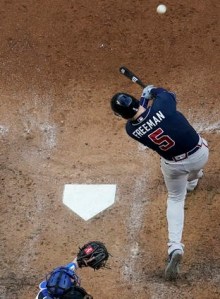
For the second NLCS game in a row, Freddie Freeman hits one out to start the Braves’ scoring.

Another entry from our Tales of the Unexpected Dept. The Atlanta Braves have a clean shot at shoving the Los Angeles Dodgers into early winter vacation without seeing Clayton Kershaw poke his nose out of his hole even once.

They were supposed to deal with Kershaw in Game Two of their National League Championship Series, until Kershaw’s back decided not so fast, bub. So there he was confined to leaning on the Dodger dugout rail and watching his mates under the thunder of the Braves’ stellar pitching. Again.

The spasms that scratched him from his scheduled Game Two start were the talk of Tuesday—at least until the Tampa Bay Rays in Game Three of the American League Championship Series pushed the Houston Astros to the elimination brink.

The Dodgers were counting on the resurgent Kershaw, the future Hall of Famer who became their best pitcher again this season and who’d been his future Hall of Fame self in two previous postseason gigs this time around. They needed him take the sting out of their Game One bullpen meltdown.

They needed him to find some way, any way of telling the Braves’ opportunistic and unsinkable hitters it was time to get sunk. When his back spasms told him and the Dodgers not to even think about it, the Braves must have thought Christmas came early and Santa’s sleigh was overloaded.

Dodgers manager Dave Roberts decided Game Two was the perfect time to hand young Tony Gonsolin his first-ever postseason start in Globe Life Park, Arlington, the Texas Rangers’ brand new playpen, the hangar that was supposed to be a hot tub for pitchers.

The Braves decided Game Two was the perfect time to hand young Gonsolin and every Dodger pitcher to follow their heads on plates, while pitching the Dodgers’ ears off the way they’ve been doing to every challenger all postseason long thus far.

Yet again, what the Braves have been doing pretty much all postseason long. Pitching the opposition’s ears off. Hitting the opposition’s pitchers as if discovering new and heretofore untapped human resources for batting practise. And, beating the Dodgers 5-1 in Game One and 8-7 in Game Two.

Freddie Freeman, the Braves’ first baseman who may well be this irregular season’s National League Most Valuable Player in all but the formal announcement and plaque presentation, decided it was too good to resist doing in Game Two what he did in Game One.

Monday—Freeman provided the first Atlanta hit and score when he took Dodger starter Walker Buehler into the right field seats with one out in the top of the first. Tuesday—Freeman provided the first Braves hit and score again, this time with Ronald Acuna, Jr. on board with a leadoff walk ahead of him, ending Gonsolin’s three-inning, three-and-three cruising, with a full-count blast about halfway up the right field seats . . . in the top of the fourth.

The Show’s government decided to let fans into the Globe Life stands on a limited and socially distanced basis for this NLCS. After a half summer of seeing nothing but cutouts in the seats, it was jolting to realise Freeman’s Game One launch was the year’s first live baseball souvenir.

Gonsolin lasted into the top of the fifth Tuesday night. He was lifted after Cristian Pache’s one-out RBI double and a followup walk to Acuna. In came Pedro Baez, the Dodger reliever who often threatens to hijack long-ago Cleveland first baseman Mike Hargrove’s nickname, the Human Rain Delay.

Up came Freeman again. He singled Pache home and set up first and third while he was at it. Baez then walked Marcell Ozuna to load the pads for Travis d’Arnaud, who walked right behind him to push Acuna home. Ozzie Albies then whacked a sacrifice fly to left to push Freeman home.

On a night Braves rookie Ian Anderson did what Max Fried and most company did well enough in Game One, the Braves didn’t have to play long ball to paint the scoreboard. About the longest ball other than Freeman’s fourth-inning flog from there looked to be Dansby Swanson bouncing d’Arnaud home with a ground-rule double in the seventh.

Then the Dodgers finally started making things extremely interesting in the bottom of the seventh. When they set up first and second right out of the tunnel against Braves reliever Darren O’Day and, after O’Day managed somehow to get a swinging strikeout out of Mookie Betts, Corey Seager hit one into the Braves’ bullpen behind the center field fence.

Suddenly the Braves advantage was cut to four runs. No wonder Ozzie Albies decided like State Farm to be the good neighbour in the top of the ninth, sending Adam Kolarek’s 2-1 service into the same bullpen.

Where Braves reliever Mark Melancon made a running catch of the ball, a little fancier than just standing there in Game One when Albies hit a two-run homer for which Melancon had only to raise his glove for the catch. In Game Two, the gags started pouring forth that the Braves could stick Melancon in for late-game defense when he wasn’t going to be a bullpen factor.

As it was, Melancon’s thoughts of a Game Two night off vaporised in the bottom of the ninth. He had an unexpected (we think) Dodger uprising to thank for that, when Seager slashed reliever Josh Tomlin for an RBI double and Max Muncy smashed Tomlin for a two-run homer. Unfortunately, Melancon’s ruined off-night opened in near-ruin in its own right.

An infield error allowed Will Smith aboard before Cody Bellinger sent one to the back of right field to triple him home. Leaving Melancon to deal with A.J. Pollock and lure him into grounding one to the hole at shortstop that Swanson picked off to throw him out and finish it with the Braves escaping to within an inch of their lives.

Melancon was less than thrilled when a Braves beat reporter named David O’Brien faced the righthander as though the team blew a lead. “We didn’t blow the lead,” Melancon said, slightly in shock, knowing the Braves won the game by a single run. “I don’t really understand your question.”

He didn’t really approve of it, either. And you couldn’t blame him.

“Can you still take something positive out of this?” O’Brien promptly asked. When a team survives an eleventh-hour uprising to take a 2-0 NLCS lead, do you expect them to take something negative about it? If I’d asked a question like that in my own newspaper and radio reporting days, I’d have been broiled, basted, and braised—and then my subject and my editors would have gotten mad.

O’Brien’s silliness spoiled Melancon’s jovial mood from talking about his bullpen home run catches, when another reporter reminded him he’d just caught more homers than he’d surrendered all year. “That’s more home runs than I’ve caught in my entire life, never mind  one season,” he said through a mischievous grin.

Don’t go thinking that late uprising means that vaunted Dodger firepower’s about to make mincemeat out of these exuberant, relentless Braves just yet. Four-game LCS winning streaks aren’t exactly easy to deliver against teams that don’t know the meaning of the word “quit.”

Especially when you don’t know for sure whether Kershaw will recover in time for Game Four. And, when you may suspect in your heart of hearts that that late-Game Two uprising came a little too little, a little too late, against the weaker side of a bullpen that’s normally anything but generous with runs.

The Dodgers hit .220 when the Washington Nationals blasted them out of the postseason last year. They hit .180 in the 2018 World Series, .205 in the 2017 Series, and .210 in the 2016 NLCS. They’re hitting .206 in this LCS after hitting .287 to knock San Diego out in the division series.

This has been their burden during their National League West ownership. When the bigger of the big stages invite them, the Dodgers don’t look so fierce at the plate. Good pitching staffs can take them. These Braves, National League East owners, have a terrific pitching staff, and their own hitters don’t wilt on the larger stage. Yet.

Cut the crap

Sandy Alcantara’s pitch ricochets off Ronald Acuna, Jr. in the third.

So far as the Miami Marlins seem concerned, the heir apparent to Freddie Freeman as the Atlanta Braves’s franchise face doesn’t wear a Braves uniform. He wears a target. Especially after he hits home runs, in the postseason and otherwise.

Here we went again Tuesday afternoon. Game One, National League division series. And, yes, it was weird enough that the Braves and the Marlins played in Houston’s Minute Maid Park, with the Braves as the home team.

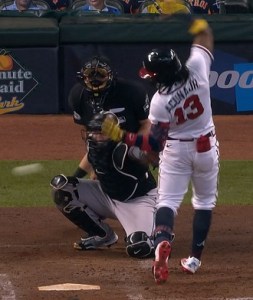
Then Acuna hit the second pitch from Marlins starter Sandy Alcantara over the right field fence opening the bottom of the first. As is characteristic of the ebullient outfielder, he watched for the briefest moment before flipping his bat to one side on his way up the first base line to run it out.

Acuna had reason enough to celebrate even before the Braves demolished the Marlins with a comeback 9-5 win. He became the youngest man in Show history to hit a leadoff bomb in a postseason game. He and the Braves got to enjoy it until the bottom of the third, with the Marlins holding a 4-3 lead and Acuna at the plate with one out.

Alcantara threw at and hit Acuna on an 0-1 count with a 98 mph fastball. At least Alcantara waited until Acuna greeted him again instead of going completely infantile and drilling Freeman following Acuna in the first. That may be the only thing to his credit.

Acuna might have said after the game that he’s kinda, sorta, kinda getting used to being Fish fodder, but that didn’t mean he was necessarily thrilled to be so high on their hit parade when the third-inning pitch struck. He took a few steps forward, toward the mound, holding onto his bat a bit, and both Braves coaches and umpires surrounded him before he entertained any ideas about relieving Alcantara of his head or any other extremities.

“I looked over to their bench,” Acuna said post-game. “I said it’s been five times. At this point, I think we’ve become accustomed to it.” Not necessarily. If that were true, the Braves wouldn’t have engaged in a chirping contest with the Marlins before Acuna finally dropped his bat and took his base.

They also might not have answered the Marlins’ three-run top of the third with Marcell Ozuna doubling Acuna home following Freeman’s followup fly out and Travis d’Arnaud doubling Ozuna home to bring things back to within a run.

And they wouldn’t have bided their time, chased Alcantara out of the game in the seventh with a pair of inning-opening infield singles, one by Acuna himself, before Freeman forced Acuna at second with Yimi Garcia on the mound, Ozuna singled home Austin Riley to tie the game at four, and d’Arnaud hitting a 2-0 grapefruit far enough over the center field fence.

Nor would Ozzie Albies have followed d’Arnaud’s demolition with a base hit to chase Garcia in favour of James Hoyt, whose first service to Dansby Swanson disappeared over the center field fence, too.

That’s where the score stayed other than Matt Joyce’s excuse-me RBI single in the top of the eighth.

“I think it woke us up,” d’Arnaud said of Alcantara drilling Acuna. “And we took advantage of the momentum.” Said Braves manager Brian Snitker, “You better be good at going in and not hitting [Acuna] after a homer.”

Alcantara wasn’t, obviously. Nor was he especially good at covering his tracks after the game. Any expressions of the-ball-got-away-from-him/the-dog-ate-his-homework got vapourised when he added, referencing Acuna’s brief but interrupted advance to the mound, “If he’s ready to fight, I’m ready to fight, too, no matter what happens.”

Cut the crap.There was only one reason Acuna might have been ready to fight, and that was getting drilled his next time up after hitting one out and—oh, the hor-ror!—showing his pleasure over his feat.

Cut the crap. He’s hitting for a .318/.414/.665 slash line against them since he first faced them in 2018. It couldn’t possibly be that the Fish are fed up with Acuna making tuna salad out of them so far in his career.

Cut the crap. It doesn’t matter that has a .182 lifetime batting average against Alcantara into the proceedings. Maybe Acuna also felt like celebrating finally having something more to show than two walks, two strikeouts, and nothing else off the Miami righthander in ten previous plate appearances. Since when does that give Alcantara a license to drill when the first hit he surrenders to Acuna is a parabolic opening launch?

Jose Urena, whose 2018 drilling of Acuna after a bomb-flip got Urena suspended six games, has decent performance papers against Acuna otherwise, if not quite those of Alcantara’s: five strikeouts, three walks, four hits including that lone bomb, and a .235 batting average against him. But Acuna also has a .409 on-base percentage against Urena in 22 plate appearances. And he’s been hit twice in the bargain.

Cut the crap. I’ve said it before, I’ll say it again. You don’t want Acuna turning his bat into a helicopter rotor when he hits one out against you, stop throwing him cantaloupes to hit in the first place. You want to be a Fun Policeman, wear a police uniform and not a Marlins uniform on the mound.

It ruined Alcantara having a solid outing otherwise, until the Marlins bullpen—whose main men are the proud possessors of a 2.72 irregular season ERA—got dismantled in the seventh. It also put a little smudge on the Marlins’ 2020 reputation as a pleasant surprise who missed winning the National League East by finishing four behind these Braves.

But it also reminded close observers that Acuna has been bitten twice as often by the Fish as he’s been by any other major league team. MLB.com’s Mark Bowman was kind enough to point out that Acuna’s been drilled by Miami pitching once every 41.2 plate appearances—and once every 80 plate appearances by everyone else’s pitching staffs.

Acuna answered on social media after the game too. “They have to hit me because they don’t get me out,” he said in one tweet. “I’d like to take this time to apologize to absolutely NOBODY,” he insisted in an Instagram post. I’d like to take this time to say Acuna owes apologies to absolutely nobody.

Waste not, want not

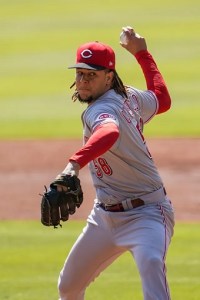
Like Trevor Bauer in Game One, Luis Castillo’s Game Two effort was wasted by the Reds’ absentee bats and futile running.

Joey Votto said going in that his Cincinnati Reds in the postseason, however rough and tumble things had to be to get them there, would be a “[fornicating] nightmare.” He just didn’t bargain on every man in a Red uniform at the plate or on the bases being their own worst nightmares.

If the Reds wish to remain postseason competitive, waste management means waste avoidance. Because if you don’t avoid waste, no matter how efficient your pitching might be, you’ll get wasted the way the Atlanta Braves wasted the Reds late but imperatively Thursday afternoon.

The Reds’ irregular season’s grind just to claim one of this year’s ten wild cards got wasted, too, even worse than Marcell Ozuna and Adam Duvall wasted relief pitcher Raisel Iglesias’s canteloupes.

Nobody wants to take anything away from the National League East-winning Braves. They clung stubbornly in their wild card set, held on to win Thursday, 5-0, and didn’t let the Reds’ stellar starting pitching blow the spirit out of them no matter how long it took. The Reds made it a little too simple for them in the end.

The Reds won’t live this one down too readily. They’re going to have to try explaining how they became the first team in Show history to be shut out for an entire postseason set, 22 innings worth, even if it was a mere best-of-three.

They’re going to have to try explaining how Trevor Bauer in Game One struck out twelve Braves without walking a soul or surrendering a run, without getting credit for a win, but with the Reds losing in the thirteenth inning on the game’s only run—on a measly RBI single by likely National League Most Valuable Player Freddie Freeman.

They’re going to have to explain how Luis Castillo’s first-ever postseason start produced seven strikeouts in five and a third innings, only one run surrendered, only one batter walked, and Iglesias getting blown up in the eighth after Lucas Sims spelled Castillo with an inning and two-thirds of spotless relief.

Ronald Acuna, Jr. doubling home Austin Riley off Castillo with two out in the fifth only made it 1-0. But Iglesias walking Freeman to open the eighth was flirting with death. Death accepted the invitation when Ozuna found a 1-0 meatball so irresistible he yanked it into the empty left center field seats.

Walking Ozzie Alibes after striking Travis d’Arnaud out following that launch wasn’t advisable, either. How inadvisable came too clear when Duvall licked his chops at an even meatier, 0-2 meatball, and sent it out down the left field line.

“Such a professional hitter,” Braves rookie starting pitcher Ian Anderson said of Ozuna after the game, calling Ozuna the life of the club all year long. “Loves the big moment. And I know it was getting to him a little bit, the way his at-bats had unfolded up until that point. Yeah, he couldn’t have been happier, and we couldn’t have been happier for him. That was a huge hit for the team. You could kind of sense that the dugout relaxed then, just a little bit.”

The Braves now wait to see who wins the win-or-be-gone game between the Miami Marlins and the Chicago Cubs in Wrigley Field, which might have been played Thursday but for the rain saying “not so fast.”

The Reds are also going to have to explain why they couldn’t find more than two hits off Anderson but found their way to nine strikeouts against the rook making his first postseason start following six irregular season assignments and a shimmering 1.95 ERA.

Those thirteen runners the Reds stranded need some explaining, too. So does having nothing to show against three Braves relievers from the seventh through the ninth.

They’re also going to have to explain why a team with baseball’s worst collective batting average (.212) despite a few offensive upgrades last winter couldn’t find ways to avoid becoming baseball’s first to be shut out of an entire postseason series.

How many times did the Reds answer opportunity’s knocking with “Go away, we gave at the office?”

When they greeted Max Fried in Game One with back-to-back singles giving them first and third and nobody out, only to see Votto—Mr. On-Base Machine—ground out to first, Eugenio Suarez line a badminton shuttlecock to Ozzie Albies at second base, and Mike Moustakas ground out?

When manager David Bell thought he could get away with a play that even the Little League won’t try all that often, having Kyle Farmer on first and Aristedes Aquino on third try a double steal the Braves could smell from about five minutes prior to attempt, with Aquino bagged in an even more kiddie-looking rundown?

When Bell sent spaghetti-bat veteran Freddy Galvis out to pinch hit for Shogo Akiyama with two out and two on in the top of the twelfth, despite Akiyama hitting well enough down the stretch to earn the opportunity, and Galvis rewarded Bell for his unexpected faith by looking at strike three right down the middle?

When they spent Game Two with no non Venezuelan-born Red getting a single base hit, and no Red from any geography reaching base between Galvis’s walk in the second and his off-the-pillow base hit up the first base line in the fifth? When no Red from there got so much as a hit by pitch to reach base and seven out of the final thirteen Red batters struck out?

Their number one irregular season issue, their inability to hit in multiples in most innings, swallowed them deeper than the Braves’ own pitching turned out to do.

“You can look at the defensive positioning, you can look at hard-hit balls that didn’t go for hits,” Bell said after the Game Two loss. “But, it’s something we have to take a closer look at because all teams are really good at defensive positioning and can hit into bad luck at times. Why did that happen for us? We just have to really take a close look at it. We did all year. Yeah, I say, we absolutely do believe in our guys, we made adjustments as much as we possibly could. But we have to find a way to get better.”

Right he is. Every Reds position player except for three will be back in 2021, and enough of them will be on the far enough side of thirty years old. They’ll still have most of their solid pitching, though the Braves didn’t get to see Sonny Gray this week, but Bauer could walk into the free agency market this year with as many potential suitors as a debutante.

Another, older Ian Anderson, leading a British band known as Jethro Tull, sang the epitaph for this year’s Reds a little over half a century ago: It was a new day yesterday, but it’s an old day now.