NLDS Game One: Fun cops vs. fun cops

2019-10-04 YadierMolinaCarlosMartinez

Was Yadier Molina (left) reminding Carlos Martinez about throwing stones in glass houses Thursday afternoon?

Oh, brother. You knew going in that things between the Braves and the Cardinals in a division series would be interesting, to say the very least. Especially knowing the set pits one precinct of fun police against another. Then you got reminded soon enough about being very careful what you wish for.

The Cardinals and the Braves put on a few shows for the price of one, before the Cardinals hung in to finish a 7-6 win Thursday afternoon. The Comedy of Errors, starring one of this season’s most vaunted defenses. The Late Show, starring both sides’ bombardiers Paul Goldschmidt, Freddie Freeman, and Ronald Acuna, Jr. And Get Off My Lawn, starring Cardinals pitcher Carlos Martinez out of the ninth inning bullpen.

When the Show’s number three team for defense in terms of runs saved (95), the number five team for turning batted balls into outs (.705), and the number thirty team for allowing errors (a mere 66) allows three Game One runs on extremely playable grounders, you try to remind yourself the Elysian Field demigods do have a sense of humour, if you’re a Cardinals fan.

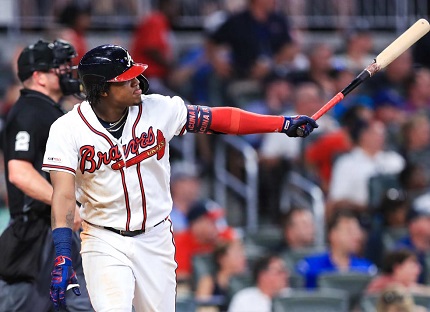
When your franchise youth settles for a long single in the seventh, after taking a leisurely stroll out of the batter’s box, and barely arrives at first when he might have pulled into second when the right fielder turned to throw in after playing the ball off the height of the fence, you try to see it from the youth’s perspective, if you’re a Braves fan.

When Cardinal fan’s relief ace—who’s renowned for making like Tarzan when he nails strikeouts or induces critical outs—calls out the same youth for having a ball when he does hit one that’s no questions asked out in the bottom of the ninth and has a blast running it out, demanding the boy wonder respect him, Cardinal fan has to remind himself or herself that Mama said there’d be moments and brain farts like that.

When Braves fan has to listen to venerable veteran Freddie Freeman call out Ronald Acuna, Jr.’s earlier stroll, he or she needs every ounce of restraint to keep from reminding Freeman—and any other Brave sharing Freeman’s thinking—that, all things considered, being at second where he belonged in the seventh might not have gotten them more in the end.

With all the foregoing and more it almost felt as though the Cardinals hanging tough, coming back, yanking far ahead with a four-run top of the ninth, and still beating the Braves, was a tough loss. And weren’t things weird enough without Braves reliever Chris Martin going down for the rest of the series after straining his oblique . . . while coming in from the pen assigned to work the eighth? Without throwing a single pitch?

“Every out, every pitch is important,” said the Cardinals’ Matt Carpenter, who didn’t start but who pinch hit in the eighth and dumped the quail off Braves reliever Mark Melancon in the eighth to tie things up at three. “There’s a lot of adrenaline involved, but that’s what you play for, that’s why you’re here.”

“We’ve played all season expecting to win those type games. You give up that kind of lead, it’s tough to swallow,” said Freeman, who shot one over the center field wall one out after Acuna yanked a two-run homer into the same real estate in the ninth, then watched Josh Donaldson ground out and Nick Markakis look at strike three to end the Braves’ afternoon a day late and a dollar short.

Those two homers were joined by Golschmidt in the top of the eighth. Off Luke Jackson, who had to go in after Martin’s in-from-the-pen oblique tweak and watch Goldschmidt send his second pitch over the left field wall. They were the only bombs on a day both teams seemed hell bent on proving small ball hadn’t yet gone the way of the Yugo. If you didn’t know better, you’d have sworn some things were supposed to have been outlawed in recent times.

Things like Cardinals center fielder Harrison Bader not just beating out an infield single in the fifth and moving to second on—the horror!—a sacrifice bunt by Cardinals starting pitcher Miles Mikolas, but stealing third for the first such theft in a measly two tries off Braves starter Dallas Keuchel all year long. Not to mention Bader tying the game at one when he scored on Dexter Fowler’s ground out to second.

Things like Donaldson pushing the first run of the game home on what should have been dialing Area Code 4-6-3 in the bottom of the first but for usually easy-handed Cardinals second baseman Kolten Wong blowing his backhand toss to first leaving all hands safe and enabling his Braves counterpart Ozzie Albies—who reached on a walk in the first place—to score.

Things like the Braves taking a 3-1 lead in the bottom of the sixth with only one hit—with Donaldson plunked with one out, Markakis doubling him to third, pinch hitter Adam Duvall handed first on the house, and, a pitching change and a strikeout later, Dansby Swanson motoring to beat an infield RBI single that turned into an extra run home when Cardinals shortstop Paul DeJong’s throw to second bounced off Wong’s glove.

Except that most of the conversation turned around Acuna’s eighth-inning trot. Some of it came from Freeman, who knew how frustrating it was to lose a potential run in a one-run loss with a mistake that wasn’t the first such.

“But I think you have that conversation once,” the well-respected first baseman continued. “It’s kind of beating a dead horse after that if you keep having the same conversation over and over again. You have to know that was a mistake.”

“It could have been a double, but things happen,” was Acuna’s way of explaining it. “I didn’t speak with the manager about it. I just went out to enjoy the game. I always try to give my best, but these are things that sometimes get away from me. They are not things I want to do. As players, we always try to give our best effort, but we make mistakes, we are human.”

He’s right about players being human and making mistakes, of course; in this instance, he’d been there before this year and been benched briefly for it. So is Braves manager Brian Snitker right when he says, “He should have been on second. And we’re kind of shorthanded to do anything about it right there. You hate to see that happen.”

But it’s open to debate whether Alibes is right saying, “He probably scores in that inning if he’s on second base. It’s a big deal. He knows he needs to do better there.” Albies is probably right in his second and third sentences there. About scoring from second, not quite.

Because Albies followed Acuna immediately with a grounder that pushed Acuna to third, but Freeman got hit by a pitch immediately to follow and Donaldson’s immediate bullet liner—with Acuna likely to run on contact—would have been the double play it became regardless.

Then Martinez had to make all that look like the mere warmup for the main attraction, when Acuna had what Martinez believed a little too much of a ball around the bases after depositing a meatball practically down the pipe over the center field wall. “I wanted him to respect the game and respect me as a veteran player,” Martinez fumed afterward. “Just play the game.”

Martinez even had ideas about chirping a lecture or three toward the Braves dugout before his veteran catcher Yadier Molina interceded and nudged him gently but firmly back to the mound. This was almost too rich for words in a game featuring a pair of teams only too notorious around the sport for being fun police units.

You almost can’t wait for the Braves to fume the next time Martinez goes into his Tarzan act if he ends a dicey inning with a nasty strikeout: “We want him to respect us as the National League East champions and not just a bunch of plug-ins who needed all 162 games to get here.”

If that’s the way the Cardinals and the Braves are going to be—as if playing a delicious Game One division series thriller and spiller just wasn’t quite enough—then let them suit up for Game Two in business suits, for crying out loud. Huffing “just play the game” after demanding “respect” tells me (and should tell you) that someone forgot about the “game” part. And, about throwing meatballs to power hitters.
A real Saturday night special

2019-09-08 AaronBarrett

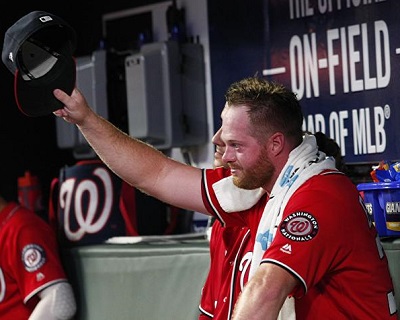
Eyes red after weeping for joy, Nationals reliever Aaron Barrett tips his cap from the dugout Saturday night.

Even down the stretch of the stretch, some things transcend ratings and standings. Aaron Barrett became one of them Saturday night.

When the Nationals righthander was sent out to pitch the bottom of the fifth, it may have been enough that he could be up for the assignment at all, never mind working a scoreless inning in a game that eventually became a ninth-straight Braves win.

And it wasn’t low leverage, either, despite the end of the Braves’s batting order looming. This wasn’t a mop-up assignment on either end of a ferocious blowout or to hold fort in a lost cause. Barrett relieved Nats starter Austin Voth with the Nats down a mere 2-1 and Ronald Acuna, Jr. looming as the third man scheduled to hit.

Maybe Barrett’s kind of comeback was the kind that moves a manager to trust his heart equal to trusting his stuff. It isn’t every major league pitcher who survives Tommy John surgery and a followup broken humerus bone to throw even one pitch, never mind a scoreless inning.

Barrett didn’t exactly start the gig the right way, walking Adeiny Hechevarria on four straight to open the inning. But he made sure Hechevarria was the only Braves runner of the frame. He got Braves starting pitcher Julio Teheran to foul out to first on 1-2. And then came Acuna, who was perfectly capable of spreading the Braves’ lead and the Nats’ concurrent miseries with a single swing.

The husky righthander with the doll-like face under his beard went right back to work. He caught Acuna looking at a strike one two-seam fastball on the upper inside corner. He got Acuna to swing right over a second two-seam fastball that hit the floor of the strike zone. He caught Acuna looking at a sweetly diving slider that landed smack dab on the low outside corner.

It was Barrett’s first major league punchout in 1,499 days, but the way he did it would leave a neurosurgeon envious of that kind of precision.

And when he got Ozzie Albies—who homered in the first—to loft a changeup to moderately short center field for the side, Barrett wiped tears from his eyes with the front of his Nats jersey as he stepped down from the mound toward the dugout. Where manager Dave Martinez and his grinning teammates high-fived and embraced him. Then Barrett took a seat, clutching the towel Martinez handed him, and wept unashamedly into that towel.

A three-run Atlanta sixth, including back-to-back homers by Brian McCann and Matt Joyce, still lurked ahead. So did a Nationals run scoring on a seventh-inning double play, and so did Juan Soto sending a two-run double to the back of center field in the eighth.

So, unfortunately, did the Nats falling ten games behind the Braves in the National League East with the 5-4 loss, while keeping a two-game grip on the league’s first wild card, while the Braves added to a 20-4 string since 11 August and a thirteenth straight home win, the Show’s most since the Indians did it in their pennant-winning 2016.

None of which really overthrew Barrett’s first major league inning in four years. “After the outing was over,” he managed to say after the game, “I’m just walking off and all the emotions just hit me. Just, ‘You did it, man. You did it’.”

He’d been one solid element of the 2014 Nats bullpen with a 2.66 ERA, a 2.59 fielding-independent pitching rate (FIP), a 10.8 strikeouts-per-nine rate, and 49 punchouts in 40 2/3 innings. But he had a rough seventh-inning appearance in Game Four of that year’s division series sweep at the Giants’ hands, walking the bases loaded, then wild-pitching tying run Joe Panik home with Pablo Sandoval at the plate.

He pitched in terrible luck in 2015: a 2.21 FIP against a 4.60 ERA in forty appearances before going down to Tommy John surgery. Then, in his first return, his humerus bone snapped hard enough that those who were there could hear it resemble a gunshot, according to MLB.com’s Nats beat writer Jamal Collier. Thomas Boswell of the Washington Post described it as “look[ing] like his elbow had ‘exploded’.”

Barrett subsequently began the long trek back up from the lowest minor leagues until his 2.75 ERA and 62 strikeouts in 52 1/3 innings at Harrisburg (AA) this year earned him the callup to the Nats. His wife, parents, in-laws, brothers, and physical therapist were at SunTrust Park Saturday. (Barrett lives just outside Atlanta itself.)

They plus thousands of Nats fans hope this is a comeback that sticks, that Barrett even at 31 continues his pitching career at all, never mind in the Show. They surely know others haven’t been that fortunate. Including one whose pitching arm humerus bone betrayed him likewise in 1988.

Dave Dravecky survived cancer in that bone to make a gutsy return to the Giants the following season, beating the Reds with an eight-inning performance. His very next start, against the Expos: the humerus broke while he delivered a pitch to Hall of Famer Tim Raines, sending Dravecky down in a tumbling heap. Season over.

During the subsequent on-field celebration when the Giants beat the Cubs in the 1989 National League Championship Series: arm broken again. X-rays showed the cancer came back as profoundly as Dravecky himself. Career over. Two years later: arm and shoulder amputated. He found a second career as a Christian motivational speaker and writer, often collaborating with his wife, Jan.

Things like that remind you to live in the moment and make it count for as long as you have the moment. Aaron Barrett plans to do just that. Even if he might have a Comeback Player of the Year award in his 2020 to come. With his spirit, don’t rule it out. “You dream about the moment,” Barrett told Collier. “You picture the moment, you try to visualize what it’s going to be like, and you know whatever moment or whatever happens, it’s unlike anything you envisioned.”

He may or may not have envisioned catching Ronald Acuna, Jr. with his pants down for strike three. But doing it only sweetened the rare soils from which Barrett hopes to continue emerging to stay.

“#L[et’s]F[or]G[et]M[ets]?”

2019-08-14 SunTrustPark

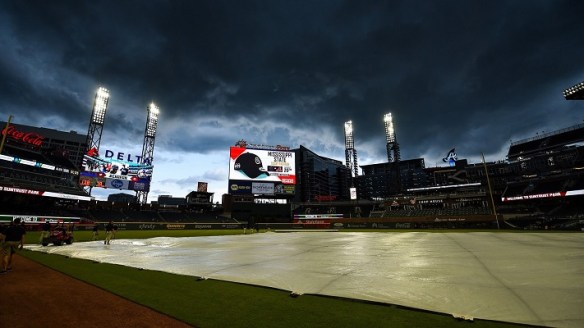
Atlanta’s Sun Trust Park Wednesday night, shortly after scheduled game time–but not a Mets disaster— was delayed.

Rain and the look of a storm of doom over Atlanta’s Sun Trust Park delayed game time between the Mets and the Braves by about an hour and a half Wednesday night. By the time the game ended, traveling Mets fans in the ballpark must have wondered if that storm-of-doom look was really an omen of doom.

For the Mets.

If the Mets’ post All-Star break surge and swath turns into disaster the rest of the way, their faithful are liable to look back to the bottom of the seventh Wednesday night. And ask themselves how often even the most heads-up rookies make the kind of rookie mistakes that prove to deflate the re-aspiring.

The kind that turn a two-all tie early in the bottom of the seventh into the open door through which the Braves finally finished a five-run inning that may have had even them wondering whether they were really there even if they were the beneficiaries.

The kind Pete Alonso, to this point a solid Rookie of the Year candidate, including normally steady and heads-up play at first base, instigated when he ran so wide of first to try for a grounder that had “second baseman” clearly in its destination window that it turned into an RBI single. When nobody was left to cover first on the play on which Alonso should likely have stayed in his proper position.

The kind that serve as a prelude to the Braves gifting the Mets the bases loaded and one out in the top of the ninth, after the Mets scratched their way back to a two-run deficit, and the Mets looking the proverbial gift horse not just in the mouth but all the way down the creature’s throat.

The kind that clear a path to a 6-4 loss that stands an excellent chance of entering Mets lore on the wrong side of the ledger, because it’s the kind of loss that can and often enough does turn what had been baseball’s hottest team until arriving in Atlanta into a collapsing bubble.

Alonso made a plain rookie mistake. It invited more than just a single inning five spot against the Mets. It invited serious thinking as to whether these Mets, as plucky and as willful and as tenacious as they’d been before they arrived in Atlanta this week, played too far over their own heads since the All-Star break to think of any kind of serious contention until next year.

And it was the last thing the Mets needed after learning their top-of-the-order ignition switch, Jeff McNeil, hit the ten day injured list with a left hamstring strain.

With the tying run already home against Mets reliever Seth Lugo and the bases still loaded, Braves catcher Tyler Flowers grounded one toward second. Alonso may have taken a couple of cheat steps to his right at the moment of contact, but the ball headed just too clearly toward Mets second baseman Ruben Tejada.

Alonso still scrambled to his right furiously. And the ball scrambled right past his downstretched glove. And Lugo at the mound may have been caught completely flatfoot by Alonso scrambling for a ball he really had no business trying to play. Tejada would have such a simpler grab that, in proper position, Alonso could have taken the throw for the out at first and thrown home to get Braves left fielder Adam Duvall.

And with Lugo not even close to covering first on a play where he shouldn’t have had to think about it, Tejada did grab the ball after Alonso’s staggering miss. With no place to throw. With Duvall scoring safely and the Atlanta ducks still on the pond.

Then pinch hitter Matt Joyce lined one that Mets right fielder Michael Conforto almost reached before it hit the grass, Conforto having to settle for a sliding short-hop pick and a throw in to get Flowers at second while Johan Camargo scored. And Ronald Acuna, Jr. singled to right center to send Ender Inciarte home and Lugo out of the game in favour of Luis Avilan.

Ozzie Albies greeted him with sixth single of the inning before Avilan got Freddie Freeman to hit into a step-and-throw inning-ending double play.

Too little, too late.

Or was it? After wasting Steven Matz’s solid start against a surprisingly stingy Dallas Keuchel, the Mets found themselves pushing reliever Mark Melancon and the Braves up against the wall in the top of the ninth.

Lagares rapped a one-out single and Joe Panik pinch hitting doubled to shallow left. Amed Rosario singled Lagares home and pinch hitter Luis Guillorme singled Panik home. And up stepped Alonso in desperate need of redeeming himself and his terrible miscue.

He rapped a bouncer toward second, where Albies threw it inside-out to Camargo coming over from shortstop. Camargo caught the ball as Guillorme arrived sliding but—as replays and review showed, strangely enough—Camargo began transferring the ball out of his glove a split moment before his foot touched the base, and he couldn’t hold the ball in his throwing hand, the ball bumping and grinding away from him.

The review overturned the original out call at second. The Mets were just handed the bases loaded and only one out. A base hit was liable to tie the game; an extra-base hit liable to give the Mets a one-run lead at minimum.

But Wilson Ramos struck out swinging on a Melancon curve ball that dove like a fighter plane shot down. And Braves manager Brian Snitker brought in a lefthanded former Met, Jerry Blevins, to work to lefthanded incumbent Met Michael Conforto.

First Conforto missed hammering Blevins’s opening fastball for a grand slam by a couple of feet wide of the right field foul pole. Then, Conforto fouled off a curve ball. Then, he swung on and missed a curve ball.

Even Mets manager Mickey Callaway’s decision to lift Matz when the Mets wrested a 2-1 lead in the top of the seventh—after Matz himself hit a two-out single and scored the first of two tiebreaking runs on J.D. Davis’s single up the pipe—won’t be second guessed as heavily as Alonso might be for hustling himself into such a mishap instead of standing his ground and waiting for the putout that might have changed the inning tone. Might.

It’s hard enough when you run yourself into a fateful fielding mistake while in proper position. It’s worse when it happens as you’re scrambling and rambling too far out of position. And don’t ask about when you subsequently scratch, claw, burrow, and shovel your way back to within a pair of runs and ducks on the pond with one out in the ninth, and come up with the ducks quacking fowl over abandonment.

It’s worse to think that Alonso, the rookie who’s been so magnificent for these Mets all year long, through the worst of times and the better of times alike, may yet be remembered the way Met fans remember David Cone leaving the Dodgers bulletin board fodder in the 1988 National League Championship Series.

Or, Kenny Rogers walking home the pennant-losing run in the 1999 National League Championship Series.

Or, Carlos Beltran frozen by strike three to end the 2006 National League Championship Series.

Or, Hall of Famer Tom Glavine battered on the final day to secure their fall out of the 2007 postseason.

Or, Lucas Duda, with the easiest chance on earth, throwing home offline in the top of the ninth of Game Five, 2015 World Series.

Men who had done well enough or better as Mets only to come up, despite careers ranging from modest to good to great to the Hall of Fame, like enough 20th Century (and one or two 21st Century) Cubs and Red Sox to start writing their own snakebite history.

This year’s Mets continue learning the hard way that they can’t win everything at the last minute, or even the next-to-last minute. Alonso’s own rally hashtag, #LFGM, may have begun turning from “L[et’s]F[ornicating]G[o]M[ets!]!” to “L[et’s]F[or]G[et]M[ets!]”

It may take a radical intervention to get the Mets into crisis addiction recovery, after all. And by that time it may yet be too little, too late, to save a season they looked as though they were turning into surrealistic redemption.


Impatience is no virtue

2019-08-14 RonaldAcunaJr

Ronald Acuna, Jr.’s fourth-inning bomb was almost half as important as bagging Todd Frazier trying to score in the sixth Tuesday night.

Zack Wheeler took the blame himself. The Mets pulled into heat-hammered Atlanta Tuesday and came up short against the National League East-leading Braves. Wheeler simply said he didn’t have it. But he had lots of help along the way to the 5-3 loss.

“It stinks,” Wheeler lamented after the game. “We’re on this run and I really didn’t give us a chance. This one’s on me.” Not entirely. A lot of the help Wheeler got came through the kindness of Braves left fielder Ronald Acuna, Jr.’s heart.

And if there’s justice in baseball world, Acuna should extend that kindness to Mets third base coach Gary DiSarcina and credit him with a major assist.

Because no sooner did Todd Frazier atone for a rally-compromising double play in the top of the sixth, whacking a double to the back of center field off Braves starter Max Fried, than Mets center fielder Juan Lagares lined a single right to Acuna playing in a none-too-deep left field positioning.

Frazier isn’t as swift afoot as he was earlier in his career, but even Hall of Fame road runner Rickey Henderson would have resembled Wile E. Coyote on a hit that shallow against a left fielder with an arm like Acuna’s.

You get why Frazier had eyes on the plate with the Mets down four runs at the moment. But DiSarcina should have thrown up a stop sign post haste. With the pitcher’s spot due to follow Lagares, and Wheeler’s evening over with recent acquisition Brad Brach up and throwing in the pen, the Mets were certain to send up a pinch hitter with Jeff McNeil, their leadoff man, due to follow if the pinch swinger could swing.

The light never even changed to yellow. Frazier rounded third at just about the moment Acuna let fly. Frazier was such a dead pigeon sliding toward the plate you got the impression Braves catcher Brian McCann tagged him out as a mere formality. And a grand chance to close the distance escaped the Mets.

“His arm,” said Acuna’s manager Brian Snitker, “is a weapon.” Disrespecting that weapon equals disaster.

Coming off taking two of three from the Nationals last weekend, winning the two in almost anti-textbook examples of doing things the hard way, the Mets let Fried and the Braves compel them to try doing it the hard way again. I said it before, I’ll say it again: crisis addiction only wins you so many games.

All night long, whenever they swung the bat the Mets swung as if they thought they could hit the ball right out of Fried’s hand. With Fried pitching exactly the way you’d expect a guy with a 1.38 walks/hits per inning pitched rate, patience would have been the Mets’ virtue. Tuesday night they approached Fried as though patience were what you saw in the doctor’s waiting room.

And the Mets better hope they duck another kind of crisis, after McNeil tweaked his left hamstring trying to hustle out a leadoff ground out in the top of the ninth. He flung his helmet to the ground in obvious discomfort, let a trainer escort him back to the dugout, and said after the game he didn’t feel anything pop.

“Just a little snag,” said McNeil, who undergoes an MRI Wednesday. “Nothing crazy.” He and the Mets better hope it’s nothing “crazy.” Things have been crazy enough for them this year.

The Braves are deep enough that they could withstand life without shortstop Dansby Swanson and rookie slugger Austin Riley for a spell, even if they have been only 17-13 since the All-Star break. And they’re deep enough that even that post-break record doesn’t hurt them after spending the first half eluding everyone else in their division at 54-37.

The Mets aren’t that deep no matter how they’ve looked since the break. They can’t afford to lose McNeil for any appreciable time. And they know it.

“It’s tough. He’s a huge part of this team. He brings fire every day to the field,” said Wheeler. “He’s a ballplayer and you need those type of guys on your team and you need them in the lineup. It’s unfortunate that happened, hopefully it’s not too serious and he can get back decently quick. We need his bat, that’s for sure.” His bat, and his passion.

Recently minted Joe Panik’s going to play a lot more second base now, and he can still whip his leather with authority as well as postseason experience. Bringing back prodigal veteran Ruben Tejada—whom the Mets re-signed in March, but who hasn’t played a major league game since he was a 2017 Oriole while hitting .337 at Syracuse this year—is a band-aid.

There wasn’t much Wheeler could do on a night he admits was an off night from keeping the Braves off the bases and the scoreboard. Acuna himself opened the proceedings with a base hit in the bottom of the first and, after Freddie Freeman sent him to third with a one-out single, Josh Donaldson singled him home. A fly out later, Matt Joyce singled to deep enough right to score Freeman.

The Mets were in a 2-0 hole before they got a second crack at Fried. They’d squandered the first one brilliantly. Pete Alonso and J.D. Davis wrung back-to-back walks out of the Braves lefthander, but Ramos with a near-perfect inner zone pitch to handle and pull whacked it instead to Charlie Culberson, the former Dodger now pressed into shortstop service until Swanson returns from the injured list. Culberson tossed to second for the inning-ending force.

They looked like they’d get to Fried in the top of the second when, after two quick enough outs, Lagares singled up the pipe and, of all people, Wheeler himself got plunked to set up first and second. Never one to look a gift horse in the proverbial mouth, McNeil drilled a single deep enough to left to send Lagares home and cut the deficit in half. But Mets shortstop Amed Rosario let Fried fool him with a slider that broke right under his bat for the side-retiring strikeout.

Freeman put things a tick further out of reach in the bottom of the inning with an RBI single. After the Mets wasted two-out baserunners in the third and the fourth, Acuna made it a little more tough to catch up in the bottom of the fourth. With one out and nobody aboard, Acuna wrestled his way back from 0-2, caught Wheeler’s two-seamer traveling right down Main Street, and sent it traveling over the left field wall.

Ender Inciarte turned a three-run Atlanta edge into a four-run distance in the bottom of the fifth, after Wheeler wild-pitched McCann (leadoff single) to second, hitting a double into the right field corner to send McCann home with the fifth and final Braves run.

But come the top of the seventh, it was Sun Trust Park’s scattered audience now in need of oxygen above and beyond the oppressive heat: the Braves went to the bullpen. And in came Luke Jackson, whose recent misadventures may not have spelled final disaster but were misadventures enough to make Braves fans wonder if he hadn’t been taking lessons in pressure pitching from last postseason’s version of Craig Kimbrel.

Now the Mets went to pinch hitter Luis Guillorme in the pitcher’s hole to lead off the seventh. And Jackson gave the home audience a better reason to put the nitro pills under their tongues. He got Guillorme to pop out to Culberson out from shortstop, then caught McNeil and Rosario overanxious enough to strike them out swinging back to back.

But then Snitker went to Shane Greene, the new toy from Detroit who was supposed to step into the lockdown job out of the Braves’ pen but whose ERA since joining the Braves is a ghastly 14.54. If even one fan in the stands pondered thoughts of Snitker taking pity on the Mets with this move, you couldn’t blame him or her.

Right off the bat, Alonso and Davis singled back to back to open the top of the eighth. And after Ramos forced Davis at second, Snitker took no more chances, bringing in former Met Jerry Blevins. Michael Conforto grounded one to first that got rid of Ramos at second but sent Alonso home with the well overdue second Mets run.

Out came Blevins and in came another former Met, Anthony Swarzak. Frazier singled Conforto to second promptly, and Lagares beat out a grounder to the back of first base to score Conforto almost as promptly, pushing Frazier to second, and suddenly the Mets were back to a mere two-run deficit. But pinch-hitter Panik, swinging a little over anxiously himself, grounded out to short for the side.

Drew Gagnon, recalled from Syracuse (AAA) for his third spell with the Mets this year, got rid of pinch hitter Rafael Ortega, Acuna, and Ozzie Albies almost in a blink in the top of the ninth. But after McNeil’s ham snagged, another trade deadline-minted Brave reliever, Mark Melancon, shaking off his Miami disaster admirably, struck out Rosario and Alonso swinging to end it.

There are teams up and down the standings against whom you can go into crisis and come out with your heads intact and triumphant. The Mets were reminded Monday night that the Braves aren’t one of them.

Neither is Acuna’s throwing arm. Give it even a fraction of an inch, and he’ll take as much distance as you let him get away with. Not to mention his trying and having an excellent chance of becoming only the third player 22 or under to hit forty or more into the seats in a season—behind Hall of Famers Mel Ott and Eddie Mathews, the latter a Braves legend in his own right.

If the Mets want to remain baseball’s hottest post-All Star break team and stay in the postseason hunt, they’d better not dismiss that reminder lightly. Especially against these Braves, who almost never show mercy to those asleep at the switch.

Greinke makes the ‘Stros trade winners

2019-08-01 ZackGreinke

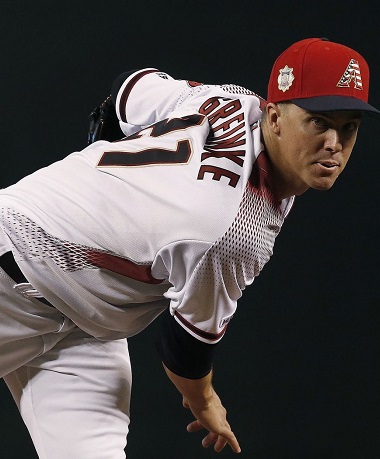
Zack the Knife makes the Astros the big trade winners. Will he help make them World Series winners?

No questions asked. The Astros slipped in at the eleventh minute, practically, and not only stole the new single trade deadline show but they did the absolute most to fortify themselves for the postseason run nobody doubts is theirs this season. Barring unforeseen disaster, of course.

With Gerrit Cole looking at free agency after the season it made sense for the Astros to seek a top-of-the-line starting pitcher with at least another full season of team control to line up with (don’t doubt it) future Hall of Famer Justin Verlander, so far the new ageless wonder of baseball.

So it came forth after the deadline passed that the Astros sent a quartet of prospects—good, promising, but not quite platinum-rated prospects—to the Diamondbacks for Zack Greinke, who isn’t exactly a slouch on the mound and who’s having a solid season in his own right so far.

They’ll get the rest of this season plus the final two seasons on the gigadeal Greinke signed with the Diamondbacks. The Snakes also sent the Astros a reported $24 million to help cover the rest of Greinke’s contract, on which the Astros will be responsible for the other $53 million. They’re not exactly complaining.

General manager Jeff Luhnow knew only two things about Greinke before he pulled the trigger on the big deal of the day: Zack the Knife has been a consistent pitcher who’s on the borderline of a Hall of Fame case; and, the righthander isn’t exactly one of the most combustible personalities in baseball.

“I don’t know him personally,” Luhnow told reporters, “but I think he’s not a guy that seeks the limelight, and that actually works well for us here in Houston. And slotting in with Verlander and Cole, he’s gonna not have to be the guy that’s in front of the camera the whole time.”

The Astros weren’t exactly over-occupied on doing the Greinke deal. Before that deal hit the news running Wednesday, they did a little bullpen fortification, getting Aaron Sanchez and Joe Biagini from the Blue Jays. The Jays also sent the Astros minor league outfielder Cal Stevenson. The Astros sent the Jays outfielder Derek Fisher.

Greinke was last seen striking out seven Yankees in five innings Wednesday. He left the park without talking to reporters, which may or may not have been an indication that he suspected or was told it was time to re-pack his bags.

On the same day, the Astros got flattened by the Indians, 10-4, in Cleveland; they finish with the Tribe Thursday before a weekend hosting the Mariners, but Greinke may not have his first Astros start until the Rockies hit town starting Monday.

“I know he’s really good. I don’t know him personally, but I’m going to get to know him,” said Astros manager A.J. Hinch. “We acquired him because of how good he is. Certainly we expect him to be a big part of our push to win the division and keep winning into October. He’s an incredible pitcher.”

He has been, and he still is when all is said and done. His new teammates won’t disagree. “What a pickup!” Cole himself crowed. Referring to the front office, he added, “They nailed it. They did a fantastic job.”

Landing Greinke shot the Astros into being World Series co-favourites with the Dodgers at Caesar’s Palace Sports Book. But the Astros are smart enough to know Berra’s Law is immutable. Zack the Knife increases their odds of a return to the Series, but so is Andujar’s Law, as uttered by a long-ago Astro, the late Joaquin Andujar: “In baseball, there’s just one word—you never know.”

What we do know, though, is who were really the big winners and the big losers of major league baseball’s first single mid-season trading deadline.

THE WINNERS

Braves—Another starting pitcher wouldn’t have hurt them, necessarily, but what the National League East leaders really needed was a back-of-the-bullpen retooling. And, they got it, in an almost rapid fire series of deals.

They landed Shane Greene from the Tigers. They landed Chris Martin from the Rangers. They landed Mark Melancon from the Giants. As CBS Sports’s Matt Snyder observes, if the prices were too high for such reported availables as Edwin Diaz (Mets) and Felipe Vasquez (Pirates), the Braves did well enough shopping the sale aisle.

None of the new pen trio are anything near the most glittering names in the relief world, but neither are they slouches or pushovers. Changes of scenery from nowhere land to pennant contention do wonders for such pitchers, and it would be absolute gravy if the Braves get something out of Melancon resembling his final years in Pittsburgh and his only spell in Washington.

Greene, of course, was an All-Star this year and was wasted on a Tigers team in the middle of a rebuild. When the Braves can turn to him near the end of a game, either as the sure ninth-inning option or if things get a little dicey in the eighth, the sight of Greene warming up with his 1.18 ERA should be enough to make their division and the rest of the league quake.

Throw in Martin’s 10+ strikeout-to-walk ratio and 10.2 K/9 rate, and all of a sudden the Braves’ bullpen doesn’t look like it’s full of bull anymore.

Indians—So Trevor Bauer turned out to be a bigger pain in the you-know-where than his otherwise solid pitching was worth. Doesn’t mean the Indians dealt from weakness. Not with Corey Kluber on the threshold of returning from the injured list.

And the Tribe managed to address their biggest weakness in the deal: their corner outfielders weren’t hitting anywhere near the same area code as their new toys Yasiel Puig (from the Reds) and Franmil Reyes (from the Padres) put together. Add Puig’s mostly plus throwing arm in right field, and all of a sudden the Indians outfield isn’t just going to roll over and play dead.

The Indians also landed lefthanded pitching youth Logan Allen (also from the Padres), and when you consider how well they develop or re-tool starting pitching this is an upside acquisition for them, too.

But the real key was the impact bats. Puig secures them in right field for the rest of the season, and perhaps if he continues doing well enough the Indians would think of pursuing him when he hits free agency in the fall. Reyes, though, secures a DH spot for them for the foreseeable future while giving them an outfield platoon option in the bargain.

Suddenly it’s not to laugh about the Tribe’s outfield anymore.

Mets—Don’t laugh. Not only are they on a six game winning streak at this writing, the formerly left for dead Mets—and even I thought they were just awaiting the nails to be hammered into their coffin after that terrible weekend in San Francisco—are 12-7 since the All-Star break.

And maybe it’s an illusion since, aside from the Giants, they faced only real contender during the string. But they did take both games against the Twins in Minnesota, including a 14-4 blowout. All of a sudden, these Mets can play as well as they can pitch.

And while the world seemed to be sure only that either Noah Syndergaard or Zack Wheeler would have a change of address after Wednesday’s deadline, it took the Astros landing Greinke to knock the Mets’ landing Marcus Stroman well enough before the deadline out of the park.

Maybe Stroman wasn’t thrilled at first to go to what he thought was a non-contender. And maybe someone ramped up for kicks a rumour that the Mets had ideas about flipping Stroman to the Yankees post haste for some of the Yankees’ top farm produce. But the Mets wasted no time ridding themselves of Jason Vargas—who should have been cashiered over a month earlier—sending him to the Phillies almost as soon as Stroman’s acquisition was a done deal.

The Mets rotation now looks like Jacob deGrom (who pitched brilliantly against the White Sox Wednesday night only to get his almost-usual no-decision, the poor guy), Stroman, Syndergaard, Wheeler, and Steven Matz. And with Matz putting on a deadly off-speed clinic shutting out the Pirates last Saturday night, looking as though he’s finally found the secret to pitching without the power of a deGrom or a more disciplined Syndergaard, it gives the Mets a rotation with two number-ones, a two, and a pair of threes.

Nationals—Like the Mets, the Nats were left for dead a few times before the All-Star break. Like the Mets, too, the Nats are riding resurgent, sort of: 10-9 since the break. And the Nats needed a bullpen remake in the worst way possible.

Not at the absolute rear end, where closer Sean Doolittle remains effective when he has something to save. It’s getting the games to Doolittle that caused one after another National migraine. But then the Nats landed Jays reliever Daniel Hudson and Mariners reliever Roenis Elias.

All of a sudden, the Nats seemed to find relief in the best way possible for that beleaguered bunch of bulls. And then they got really surreal—it turned out that they also got an old buddy (ho ho ho) from the Mariners, Hunter Strickland.

Strickland—who carried an almost three-year grudge over then-Nat Bryce Harper taking him deep twice in a division series, the second time awaiting whether his fresh blast straight over the foul line would leave the yard fair but misinterpreted as admiring the shot. (It flew fair into McCovey Cove.)

Strickland—then a Giant, who somehow hadn’t gotten the chance to face Harper until 2017, then entered a game with Harper leading off an inning and threw the first pitch right into Harper’s hip. Triggering Harper’s charge to the mound and the very delayed Giants pouring out of their dugout, during which pour former Nat Michael Morse’s career ended up being sealed when he collided with Jeff Samardzija and suffered a concussion.

Harper, of course, now wears the Phillies’ silks. But it would have been intriguing if Harper was still a Nat with Strickland coming aboard. Strickland’s coming back from a lat strain that disabled him for almost three months. And the Nats don’t see hide nor hair of the Phillies again until a four-game home set beginning 23 September.

By which time, the Nats may or may not be in the thick of the NL East race (the Braves suddenly started looking human enough the past couple of weeks), securing a wild card berth, or hoping they’ve got a leg up on 2020. A lot rides on the new bulls. But for now, the Nats took their number one need and addressed it respectably enough.

THE LOSERS

Red Sox—Like the Braves and the Nats, the Red Sox needed bullpen help badly. Unlike the Braves and the Nats, the Red Sox landed nothing. Not even a calf, never mind Diaz, whom the Mets were making available and who probably could have been had for a little less than they were said to have demanded for Syndergaard and Wheeler.

The Red Sox bullpen ERA in June: 4.92. The Red Sox bullpen ERA in July: 5.18. Letting some reasonably effective pieces make their ways to Atlanta and Washington instead does not portend well for the Olde Towne Team.

Dodgers—I know, it sounds funny to apply “losers” in any context to the National League’s 2019 threshing machine. But the threshing machine has one monkey wrench looming: the Dodger bullpen isn’t as formidable as it used to be.

Kenley Jansen isn’t really pitching like the Kenley Jansen of old this year. What’s behind him in the pen depends on whose description you read: mess, disaster, toxic waste dump, landfill, take your pick.

If the Mets and the Pirates were asking the moon for Diaz and Vasquez, the Dodgers if anyone had the moon to give in return. They’re loaded with prospects on the farm, and money in the vault, enough to have dealt a package of them for either reliever and still have a bountiful harvest to come.

Good luck holding leads against postseason lineups with that kind of pen. And the Dodgers won’t be able to hit themselves beyond their pen’s capability eternally. They won’t lose the NL West, necessarily, not with a fifteen-game lead at this writing, but their chances at a third consecutive World Series appearance and just one Series ring since 1988 just got a lot more thin.

Brewers—The pre-season favourites to defend their NL Central title aren’t exactly that good anymore. Losing Brandon Woodruff and Jhoulys Chacin to the injured list has left their rotation in tatters, and with the Giants yanking themselves back into the wild card play there went their ideas of maybe adding Madison Bumgarner for a stretch drive.

But they also needed some pen help, and what they brought aboard (Ray Black, Jake Faria, Drew Pomeranz) is serviceable but not quite as serviceable as what the Braves and the Nats brought aboard. The Brew Crew is liable to spend the rest of the season watching the Cardinals’ and the Cubs’ rear ends, but then with the NL Central as it’s been this year there could be a surprise in store. Could. Remotely.

Because the Brewers can’t live by Christian Yelich alone.

Twins—The AL Central leaders have gone from a double-digit division lead to looking only human at three games up on deadline day. They needed a little rotation help and a little bullpen help.

And they got only a little in the pen. Sam Dyson (from the Giants) and Sergio Romo (from the Marlins) are solid but not overwhelming. Maybe not for lack of trying, but the Indians’ blockbuster suddenly puts the Twins close enough to the Tribe’s mercy to make for a too-interesting stretch drive for them when they once looked like the division’s runaway train.

They can hit all the home runs they want, but if their pitching is compromised the Twins have a big problem coming. Like the Yankees, the Twins should have been more aggressive trade deadline players. Like the Yankees, they weren’t, for whatever reasons. And it could come back to haunt them down the stretch.

Yankees—Even Yankee haters won’t understand this one. The number one need for the injury-battered Bombers was rotation help. Especially after they’d just been flattened by the Twins and the otherwise-troubled Red Sox. And they did nothing to fix it.

The question may be why, or why not. If Bumgarner was off the market, they could have played for Stroman or for Mike Minor, even allowing for Minor’s rough July after a sterling June. They didn’t seem to play for any of the above. They didn’t even seem to be a topic if the Diamondbacks—knowing their own chances were still none and none-er—were looking to move Greinke to a contender.

And since their number one American League competition overall did land Greinke, the Yankees may ride a weakening AL East into October but they’re not liable to get past round one again, even if it may not be the Red Sox shoving them to one side this time.