Clueless Crane

2020-08-01 JimCrane

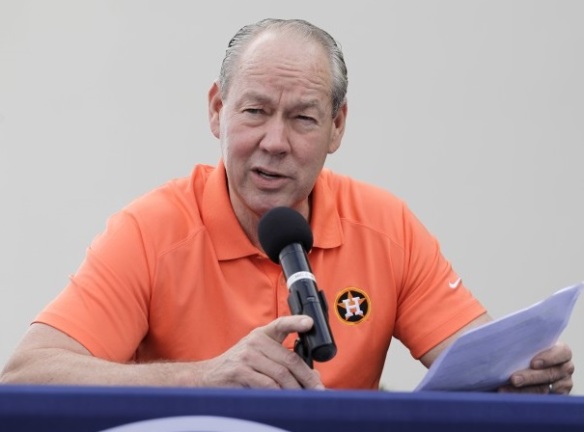
Astros owner Jim Crane—Playing what-about-ism, implying everyone else’s fault, possibly sorry only that his boys got caught, talking to USA Today’s a still-bad look for him.

In a 1964 novel about Navy fliers in World War II, Richard Newhafer’s The Last Tallyho, a fresh group of pilots assigned to a carrier performs a target hop. One of the young men overshoots the tow plane target and hits the plane, instead, flown by their squadron lieutenant. Forcing the lieutenant to a fatal water landing.

The tow pilot happened to be the squadron skipper’s best friend. When the skipper and their air group commander face questioning by the task force commander flying his flag aboard their carrier, the latter asks the skipper why they were called in. “We’re here,” the skipper replies, “because we are responsible for what happened.”

“I don’t see it that way,” the CAG practically snaps. “No matter who did what,” the skipper rejoins, “[CAG] and I are in positions of command. When you command you accept the responsibility for what is done by your subordinates.”

Maybe Houston Astros owner Jim Crane should have read The Last Tallyho. He might have learned something about command responsibility and avoiding mealymouthed avoidance of it, the latter of which he availed himself in an interview with USA Today columnist Bob Nightengale.

Astrogate returned to the otherwise coronavirus-dominant baseball news last week after Los Angeles Dodgers pitcher Joe Kelly threw fastballs twice behind Astros third baseman Alex Bregman and breaking balls twice making their shortstop Carlos Correa skip rope. They got Kelly an eight-game suspension and the Astros on the receiving end of fresh rounds of fury.

Remember: Commissioner Rob Manfred handed Astro players on the 2017-18 teams immunity to spill about the Astro Intelligence Agency’s off-field-based electronic sign stealing those seasons, instead of bringing the powers of his office to bear and ordering one and all to spill or be spilled. Even if the players’ union filed countering grievances, Manfred would have sent a far stronger message than a few brushback pitches.

The outrage over Kelly’s suspension was, basically, “He gets eight games for doing in essence what Manfred wouldn’t, but those guys still get off scot free?” Nobody’s justifying throwing at Bregman’s head, but the outraged are right. As a matter of fact, Nightengale asked Crane the same question, phrased a little differently. The answer may or may not surprise you.

“People are aggravated the players didn’t get suspended,’’ said the owner, “but I didn’t have anything to do with that. That was Rob’s call. Listen, it’s always going to be whatever you want to call it. A black mark. An asterisk. It happened. It’s not good for anybody. It’s not good for the game. We broke the rules. We got penalized. We were punished. There’s no doubt it weighs on all of us every single day.”

Crane seemed to say it as though he hoped that would be the end of the story. Except that it wasn’t, quite. After apologising for sounding like a fool at the infamous February spring training press conference, the subject detoured briefly toward the Boston Red Sox and the New York Yankees, both of whom have been reprimanded for a little espionage of their own, though not quite performed the way the Astros developed it.

“I think (MLB) had a bigger problem than everybody realized,’’ Crane told Nightengale, playing the what-about-ism card. “[The Yankees and the Red Sox] were doing things and got caught, but we’re the ones who took the bullet. That’s the way it works. I’m not trying to blame anyone else. It was our problem. We dealt with it.”

Except that, after a little talk about things such as revelations about the Astros’ less than honourable front office “culture,” Crane tried to blame, well, something close enough to everyone else as well as the Yankees and the Red Sox.

“I just think everybody was paranoid that everybody was doing it,” he said. “The technology was right in front of you. We already know two others teams were doing it and got caught. But the way we were doing it, that was pretty (stupid). I mean, banging on trash cans? You could have found a better way to do it.”

“Crane’s take . . . seems to be that he and the Astros are the real victims here, and everyone else should leave them alone already,” writes NBC Sports’s Craig Calcaterra. “Really. That’s the vibe he gives off on all of this. Crane seems to believe that the Astros sign-stealing fallout is overblown and that the public’s anger mostly has to do with how Crane himself bungled the P.R.”

Crane seems indeed clueless that, except for the Red Sox’s AppleWatch incident late in the 2017 season and an extra Yankee dugout phone the same time, the AIA didn’t stop at just the technology just being “right in front of you.” Not even close.

The Red Sox’s Replay Room Reconnaissance Ring didn’t involve anyone altering a real-time monitor feed to decipher opposing pitch signs to signal to their baserunners who’d then send the pilfered intelligence to their hitters. Needless to say by now, it also didn’t depend upon having a man on base to receive the stolen signs in the first place.

It would have shocked nobody to learn that the Rogue Sox weren’t the only team to operate a similar reconnaissance ring out of the replay room. And, yes, MLB handed them the keys to the hooch hutch with the replay rooms at home and on the road. Boys will be boys, alas, and asking them to resist such temptation would have been like asking Donald Trump to give up Twitter.

But the replay room reconnaissance ringers didn’t alter ballpark cameras off their  mandatory eight-second delays or install second cameras not on the delay to send signs to a clubhouse monitor in front of which someone, several someones perhaps, decoded the signs and then banged the can slowly for the benefit of Astro hitters.

Using what’s there for a little chicanery is one thing. Altering it or supplementing it illegally is something else entirely. When a team as genuinely great as the 2017-18 Astros were takes up such subterfuge—and if you need proof they were great without the AIA (which operated in Minute Paid Park and wasn’t portable), remember that those Astros had better road than home winning percentages in both seasons—it’s well past boys being boys.

Some accuse Kelly of hypocrisy because of his membership on the 2017 AppleWatch Red Sox. Well, now. Their replay room reconnaissance ring apparently began in 2018—after they hired, what do you know, the Astros’ 2017 bench coach and (we’ve known since the Manfred Report on Astrogate) AIA co-mastermind Alex Cora to manage them. All the way to a World Series ring.

Before Manfred released his Rogue Sox findings, Kelly wondered aloud, “Whenever the investigation is done I’m interested in seeing what is in the investigation.”

If there is cheating involved with how good our team was we should have won every single out. We should have not even lost an inning if there was some good cheating involved, which would have been a lot more fun because we would have won in four. We would have swept through the playoffs and made it really, really fast and been able to go to Hawaii or go to Mexico and go on vacation a lot sooner than we did.

Known to be an erratic pitcher who isn’t shy about a little headhunting when he thinks it’s called for, Kelly inverted the old observation, “If you can’t beat them, join them,” and became a Dodger last year.

The Astros’ mealymouthed responses to Astrogate questioning as spring training opened outraged the Dodgers more than most, and enough players around the Show were outraged, because they’d been the team the Astros beat in seven to win the ’17 Series. It’s not impossible that Kelly had in mind both Astrogate and what was subsequently revealed about his former Rogue Sox when he decked Bregman and Correa.

If the Dodgers weren’t playing this year’s pandemic-inspired regional season schedule, they might have faced the Red Sox. And, inspired perhaps by a few revelations in Manfred’s Rogue Sox report and his Dodger teammates, Kelly might have sent a few messages to those 2018 Sox still on the team for tainting those ’18 Series rings.

Astroworld’s been buffeted harshly by Astrogate. It’s still tussling between those of its citizens who think the AIA was a reasonable defense against whomever else was doing illegal sign stealing and those who think their faith in their team’s greatness was misplaced or abused.

Crane hasn’t said much if anything about that yet.

Meanwhile, note once again Crane’s choice of phrasing to Nightengale: [T]he way we were doing it, that was pretty (stupid). I mean, banging on trash cans? You could have found a better way to do it. Is he saying the AIA itself was stupid? Is he saying he’s sorry only that the Astros got caught committing high crime?

“We’re sorry. We apologized. But no matter what happened, it wasn’t going to be enough,” Crane told Nightengale. “People wanted me out of baseball. They wanted players to be suspended. They wanted everything.” Setting aside that those February apologies were as non-apologetic as apologies can get, what did he expect people to want? A whitewash?


Astrogate messages at last?

2020-07-28 JoeKellyCarlosCorrea

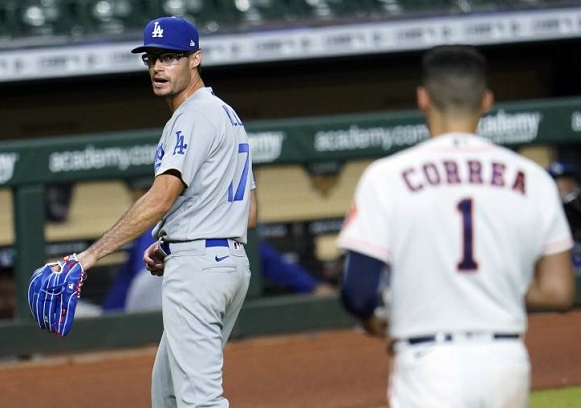
Joe Kelly (left) jawing with Carlos Correa, whom he brushed back twice in the same plate appearance Tuesday night. Should the Astros be shocked that somebody sent them post-Astrogate messages at last?

It’s not that you didn’t expect it to happen, but no matter how you feel about the Houston Astros and their extralegal electronic cheating you merely hoped it might not happen. Even if Tuesday night was the first time the Astros and the Los Angeles Dodgers met since that now-tainted 2017 World Series.

They weren’t expected to meet again unless they might tangle in another World Series. Then, the coronavirus world tour happened. When the Show returned at last, the pandemic and its mandate for extraordinary health and safety protocols prompted its governors to sketch regional scheduling featuring the Dodgers and the Astros in Houston this week, in Los Angeles come September.

You might think things are tough enough playing coronaball (reference, especially, the afflicted and drydocked-for-now Miami Marlnis) without the Dodgers having to face the team now believed to have cheated their way to that World Series title.

You might think things were tough enough without other Astro opponents still thinking in the backs of their minds that the Astros need to be taught a few little lessons in manners and in accepting responsibility in the sometimes-forgotten Astrogate wake.

You might have thought so until Joe Kelly relieved fellow Dodger reliever Brustar Graterol for the bottom of the sixth in Minute Maid Park Tuesday night.

With one out, Kelly had Houston third baseman Alex Bregman 3-0 when he decided ball four should be a fastball sailing up and past Bregman’s shoulders. The next batter, outfielder Michael Brantley, forced Bregman at second on a ground ball but made a point of stepping on Kelly’s foot as the pitcher covered first base on the play.

Kelly lingered just a little bit near the base after Brantley’s step-on and a voice was heard in the empty ballpark. It may or may not have been Astros manager Dusty Baker, but it hollered, “Get back on the mound, [maternal fornicator].” Kelly did return and go back to work.

Known to be erratic at times, and un-allergic to brushback pitches when he thinks they’re mandated, Kelly walked Astros first baseman Yuli Gurriel on four straight pitches, then opened to Astros shortstop Carlos Correa with a breaking ball behind Correa’s head and all the way to the backstop.

Officially, of course, it was ruled a wild pitch. Unofficially, even the cardboard cutouts in the otherwise empty stands knew good and bloody well that Kelly wanted to remind the Astros once again that it wasn’t nice to set up a furtive closed-circuit, off-field-based television network for stealing opposing pitch signs and think they could get away with it.

Commissioner Rob Manfred helped them think they could get away with it. Foolishly or otherwise, Manfred handed all Astro players immunity from discipline in return for spilling about the Astro Intelligence Agency after former Astro/current Oakland Athletics pitcher Mike Fiers finally blew the whistle on the AIA to The Athletic‘s Ken Rosenthal and Evan Drellich last November.

The AIA cost three managers (the Astros’ A.J. Hinch and two 2017 Astros-turned managers, Alex Cora in Boston, Carlos Beltran in New York, before he had a chance to manager even one Mets game) and one general manager (the Astros’ Jeff Luhnow) their jobs. (Any thought of Hinch possibly returning for 2021 was vapourised when the Astros exercised Baker’s 2021 club option.)

Astros owner Jim Crane was asked for no accountability beyond being fined for what amounts to maybe a year’s worth of tip money for him. Called upon to stand when spring training opened, Crane and assorted Astros players weren’t exactly apologetic for the AIA’s operations. Numerous opposing players fumed that, one way or the other, they’d find ways to administer justice, and no official edict was going to stop them.

2020-07-29 AlexBregman

“That’s dirty baseball,” Astros manager Dusty Baker fumed over this pitch to Alex Bregman from Joe Kelly. Would Baker call the Astros’ electronic sign-stealing  good clean baseball?

After Kelly struck Correa out swinging for the side, with a couple of more inside pitches in the mix, Correa was distinctly and, apparently, vocally unamused as Kelly walked off the mound and crossed the third base line to his dugout. Prompting Kelly to shoot a couple of mock crybaby faces and choice words Correa’s way.

That may have been the specific flash point under which both benches emptied and milled around the plate area. They forgot some of the social distance protocols, meaning a fine or three might be forthcoming. The dispute was bark, no bite, unless the Astros and the Dodgers were willing to dissipate the tension with some six-feet-apart pantomime boxing, but neither side was in the mood for comedy.

Baker was quoted by USA Today‘s Bob Nightengale thus: “What really enraged everybody was what he told Carlos when he struck him out, ‘Nice swing bitch!”’ Not nice. Send the message, sure. Taunt them no matter what they did or didn’t jaw your way, not so fast. Naturally, one of the Twitterpated couldn’t resist defending Kelly’s taunts thus: “Should have said something along the lines of ‘hard to hit when you don’t know what’s coming’.”

The warnings were handed to both sides after the second Correa duster. Perhaps naturally, Kelly said of the Bregman shoulder kisser, post-game, “It was a ball, obviously. It wasn’t my best pitch. Ball four, I walked him, never good to put a guy on when you’re leading the game.”

Of the breakers bending Correa, he said, “I guess he didn’t take too kind to a curve ball [inside]. It is what it is. I finally made one good pitch for the punchout . . . I pitch competitively, but with the no fans here it’s easy to hear some stuff.”

You stick to that story, son.

Some observers seemed to think, too, that the Astros were more infuriated by the buzzer  off Bregman’s shoulders than the two breakers dusting the otherwise non-entertained Correa. For his own part, Bregman merely shrugged it off when Kelly’s heat ricocheted off his shoulders and took his base. Almost as if he was well enough prepared for the incoming messages Tuesday and yet to come.

“The history obviously is out there,” said outfielder Joc Pederson before the series began. “Everybody knows what’s at stake and what happened. For being no fans, maybe sometimes the energy could be lacking a little bit. I don’t think that will be the case for this series.”

That doesn’t necessarily mean Pederson urged or condoned any message from any Dodger pitcher to any Astro hitter. Nor does it mean the Astros went into the game expecting nothing more than balls, strikes, hits, and outs, considering the jawing between the two teams before spring training was cut off at the coronavirus pass.

Recall: Dodger center fielder Cody Bellinger saying the Astros cheated for longer than affirmed and that their second baseman Jose Altuve stole the 2017 American League Most Valuable Player award from New York Yankees right fielder Aaron Judge. Recall, too: Correa rejoining that Bellinger thus spoke recklessly.

Just don’t kid yourselves that the Astros forgot for even a moment that a brushback or a knockdown was liable to come from any arm, at any time, in any game, no matter how much it seemed the pandemic pushed the long toxins of Astrogate to one side.

Until Tuesday night, only Gurriel and Correa were hit by pitches, both in the second game of the truncated season, at home against the Seattle Mariners. Until Kelly decided to lay down the law, however, all anyone thinking clearly probably thought was that the Astros were so thoroughly roasted in the immediate public Astrogate wake that throwing brushback or knockdown pitches would be as foolish as it would be unnecessary.

Like the Rogue Sox and their 2018 Replay Room Reconnaissance Ring, the Astro Intelligence Agency wear the stain of their extralegal cheating all season long, however long the season, whenever the season began. There but for the lack of grace of the coronavirus would fans and commentators alike remind both teams, good and strong, that crossing the proper gamesmanship line is filthy pool.

Only three Rogue Sox have been plunked on the truncated season thus far. But don’t fool yourself that they’re immune to thoughts that a little extra payback might be coming, too. It may not be quite as pronounced as any the Asterisks face, since they merely used what was available, predicated it with a man on base to transmit the pilfered intelligence, and didn’t install an illegal camera to begin their dirty work.

Baker himself seemed more enraged at the Kelly bullet that almost grazed the back of Bregman’s shoulders. “You don’t throw at a guy’s head,” the manager said. “That’s playing dirty baseball.” Baker’s in the unenviable position of having to help his team past the  Astrogate mess he wasn’t part or parcel of, but what would he call the AIA—good clean baseball?

Kelly wasn’t a Dodger when the AIA’s espionage operated. But he was one of the 2017 Red Sox downed by the Astros in the American League division series and the 2018 Red Sox who beat the Astros in that ALCS. You bear in mind that neither Astro nor Red Sox pitchers were co-operators of those teams’ Spy vs. Spy operations.

Kelly was also the hapless Dodger who served the pitch Washington Nationals second baseman Howie Kendrick destroyed for a tie-breaking, Dodger-burying, National League division series-winning grand slam in the Game Five top of the tenth. The last thing he needed even in abbreviated spring training was his Dodgers and the Astros getting into an Astrogate-inspired jawing contest.

Otherwise, Kelly was a pitcher in need of some kind of redemption, any kind of redemption in the eyes of Dodger fans in Los Angeles and elsewhere. The taunts were more than a little out of line. Perhaps Kelly didn’t need to send more than one brushback Correa’s way, but those weren’t half as juvenile. Well, boys will be boys, even in a time of pandemic.

Still, somewhere in that fan base they’ll remember the Dodgers beat the Astros, 5-2, to open this series, but it’ll be a by-the-way remembrance. One that has to be rushed into the conversations, swiftly, amidst the hot take that Kelly made himself something nobody in Los Angeles thought he’d become to Dodger fans after last October. A hero.

A scapegoat for the Rogue Sox

2020-04-22 2018RedSox

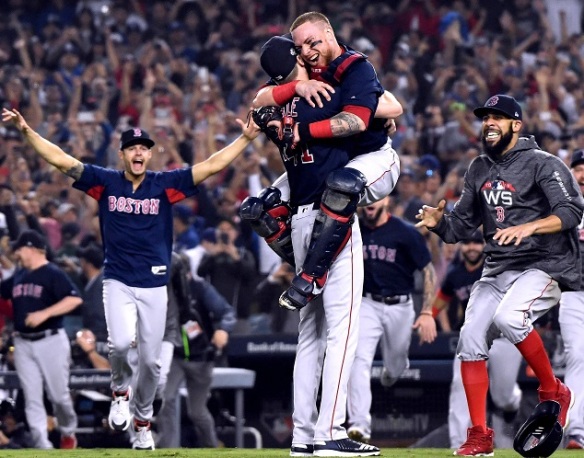
The Red Sox whoop it up after nailing the final out of their 2018 World Series conquest in Los Angeles. Is that title tainted now?

So the Red Sox Replay Room Reconnaissance Ring was the masterwork of a rogue video room operator. Not then-manager Alex Cora, not the front office, and not any of the players who transmitted stolen opposition signs to Red Sox baserunners who’d send them on to Red Sox hitters.

Sure. And the iceberg obstructed the Titanic with malice aforethought. The Hindenburg was a kid playing with matches. World War II was a backyard argument. Apollo 11 was an episode of Star Trek. The renegades working with Richard Nixon’s re-election campaign broke into Dunkin’ Donuts. Bill Clinton perjured himself over an Oval Office quickie with his wife.

After an investigation that included interviews with 65 witnesses including 34 incumbent or former Red Sox players, say The Athletic‘s Ken Rosenthal and Evan Drellich, those plus “scores of e-mails, text messages, video clips, and photographs” led commissioner Rob Manfred in a report issued Wednesday to declare it was all J.T. Watkins’s fault.

Manfred suspended Watkins from baseball without pay for this year and barred from working as a video operator for 2021’s regular season and postseason. The Red Sox got docked a second-round 2020 draft pick. If you even think about trying this kind of espionage again we’re going to be . . . very, very angry at you.

Thanks to the same promises of immunity that Manfred gave the rogue Astros in return for spilling about Astrogate, we may not know for a long time if at all which Red Sox players took Watkins’s stolen signs and ran with them.

The key to the RSRRR was that—unlike the illegally installed or altered real-time center field camera that anchored the Astro Intelligence Agency in Minute Maid Park—the Red Sox’s espionage could be done at home or on the road . . . but it depended entirely on whether the Red Sox had a man on base.

Nobody banged the can slowly to send the pilfered intelligence to the Red Sox hitters availing themselves thereof. Watkins simply let someone, who knows whom, make life a little easier for Rogue Sox baserunners. In Fenway Park and elsewhere.

Usually, if you’re on the bases and of a mind to gamesmanship, you’ve got to decipher and transmit from your own eye and in as quick a blink as possible. Watkins merely allowed the Red Sox to save their baserunners a little extra sight and brain work. How very thoughtful.

The video rooms behind the dugouts were supposed to be helpmates for managers in challenging close or errant umpire calls once replay was introduced in 2014. Hitters also use them for help correcting swing mistakes, pitchers to correct mound mistakes, or both to look again quick at opposing hitters or pitchers to see where they missed unexpected weaknesses or got beaten when they should have known better.

They weren’t installed to enable spy operations on the other guys’ pitch signs or to make life simpler for baserunners who now didn’t have to figure out how to steal signs the old-fashioned way within about a minute’s worth of time. You want to steal signs on base the old-fashioned way? Do your homework. No crib sheets, answers on your wrist, or cameras on the teacher’s answer keys.

Even before Manfred handed down his Soxgate finding and decision, a few 2018 Red Sox were saying, essentially, Who, us? Remember Steve Pearce? 2018 World Series hero, and how. He was practically a one-man demolition derby late in Game Four and through most of Game Five. It landed him the World Series MVP award.

Last week, Pearce decided to call it a career. He also decided to say Who, us? “That’s such a joke to us,” he told WEEI. “When it came out we were all kind of joking about it. We just want this to pass us. We won it fair and square. Whatever they accused us of, we were all kind of like, ‘I can’t believe this is even an issue.’ Once the report comes out we’re all going to be free.”

All but one scapegoat, so far.

“[W]e have this floating over our head when we just had such an unbelievable season,” Pearce continued. “We had the perfect team and great camaraderie with everybody and then this gets thrown out here. We’re just like, ‘What the heck?’ . . . We just want this to pass us. We just want to play some baseball. Another bump in the road, I guess.”

In fairness, one of the key moments that bumped the 108 game-winning Rogue Sox into the 2018 World Series in the first place—left fielder Andrew Benintendi’s man-on-the-flying-trapeze catch of what would have been Astro third baseman Alex Bregman’s game-winning three-run extra-base hit to deny the Astros an American League Championship Series tie at two each—had nothing to do with the RSRRR.

But what about the rest of the set? What about the Series? Not long after Pearce spoke up, Joe Kelly—then a Red Sox relief pitcher, now with the Dodgers in coronavirus limbo with everyone else in baseball—delivered his own who, us? “Whenever the investigation is done, I’m interested in seeing what is in the investigation,” he, too, told WEEI last week. “If there is cheating involved with how good our team was, we should have won every single out.

“We should have not even lost an inning if there was some good cheating involved, which would have been a lot more fun because we would have won in four,” he continued. “We would have swept through the playoffs and made it really, really fast and been able to go to Hawaii or go to Mexico and go on vacation a lot sooner than we did.”

You can almost hear the 1919 White Sox culprits, who won three games during their scandalous World Series loss, thinking, “We should not have even won a single inning if there was some good profitable tanking going on, either.”

Some Red Sox fans hit social media to denounce Kelly’s pompous arrogance or arrogant pomposity, depending upon whom you read where and in which language. The man who surrendered Howie Kendrick’s tenth-inning grand salami to lose Game Five and a trip to the National League Championship Series for his Dodgers knows enough about public humiliation and humility.

In all fairness, baseball government did monitor the replay rooms more arduously to guard against postseason espionage. Baseball’s chief disciplinarian Joe Torre warned both the Red Sox and the Astros before the 2018 ALCS that if they were up to electronic no good it needed to stop tootie-sweet before (are you ready?) the press picked up leaks about it.

Unlike Astrogate, which had a whistleblowing genie named Mike Fiers come out of the bottle last November, Soxgate may not have had a signature whistleblower. Rosenthal and Drellich, the Woodward and Bernstein of Astrogate, reported shortly before Manfred’s Astrogate finding and ruling that the 2018 Red Sox weren’t just ducking into their replay room to fix mistakes, correct batter’s box or mound mechanics, decide on challenging close calls, or watch Cheers reruns.

Rosenthal and Drellich dropped this curlicue into that report:

Three people who were with the Red Sox during their 108-win 2018 season told The Athletic that during that regular season, at least some players visited the video replay room during games to learn the sign sequence opponents were using. The replay room is just steps from the home dugout at Fenway Park, through the same doors that lead to the batting cage. Every team’s replay staff travels to road games, making the system viable in other parks as well.

Red Sox sources said this system did not appear to be effective or even viable during the 2018 postseason, when the Red Sox went on to win the World Series. Opponents were leery enough of sign stealing — and knowledgeable enough about it — to constantly change their sign sequences. And, for the first time in the sport’s history, MLB instituted in-person monitors in the replay rooms, starting in the playoffs. For the entire regular season, those rooms had been left unguarded.

So it’s entirely likely that the Rogue Sox played the 2018 postseason straight, no chaser. But there’ll always be suspicion. Would playing the postseason straight let them off the hook for reconnaissance cheating during the regular season when Watkins’s replay room was about as heavily guarded as an angry drunk?

Give Manfred this much: If he thought Cora had anything to with the RSRRR, would it have been shooting fish in the barrel to discipline him? He suspended Cora for this year—-over his Astrogate co-mastermind role. For which the Red Sox either let him quit, fired him outright, or strong-armed him to quit—never mind how well-liked he remains around the team and organisation—before he could be executed when the Astrogate report came forth.

If Manfred thought Cora was part and parcel of Watkins’s roguery, would he have thrown mercy to the wind and banned Cora for half a decade? Full decade? Life? And does anyone really believe the man who cahooted with Carlos Beltran in the AIA was entirely innocent? Or did he remember his Houston boss, A.J. Hinch, smashing a monitor or two but otherwise fiddling while the AIA turned?

Letting the Rogue Sox escape with nothing more than a docked second-round draft pick and a scapegoat video room operator is at least as bad a look as Astrogate’s been for the Astros. It also contravened Manfred’s threat, when the Red Sox’s AppleWatch and the Yankees’ extra dugout phone inspired it, to fine any team caught playing CIA against the other guys.

So whom among the 2018 Soxgaters will be the first to stand up and own up? You may sooner strike oil with safety pins.

Stolen bases justify electronic cheating?

Henderson Rickey_Ron Vesely-053010-R-Henders-01_HoFUseOnly

I bet you didn’t think the Man of Steal gave the Astro Intelligence Agency legs. (Hall of Fame photo.)

Would you like to know one reason why the courts are often held in contempt? Federal judge Jed Rakoff has just given you one. He thinks Rickey Henderson gave the Astro Intelligence Agency and the Red Sox Replay Room Reconnaissance Ring legs.

Rakoff has proclaimed himself a longtime baseball fan. He has also dismissed a lawsuit by fantasy baseball players against the Astros, the Red Sox, and baseball government over Astrogate/Soxgate espionage, who argued that the Astros and Red Sox shenanigans tainted the games based on which they played theirs.

Arguing as Rakoff does that the evidence on the fantasy players’ behalf is insufficient to proceed is one thing. They probably had less to go on than does Mike Bolsinger, the Blue Jays reliever who was farmed out never to return after he was destroyed by the Astro Intelligence Agency in August 2017 unaware going in that the deck against him was stacked.

But the judge’s opening statement deserves to become at least as infamous as Neville Chamberlain proclaiming peace in his time: “A sport that celebrates ‘stealing,’ even if only of a base, does not provide the perfect encouragement to scrupulous play.” Right then and there you should feel less bothered that the suit was dismissed than about what Rakoff’s choplogic says about his judgment over graver matters than baseball espionage.

“Nor can it be denied that an overweening desire to win may sometimes lead our heroes to employ forbidden substances on their (spit) balls, their (corked) bats, or even their (steroid-consuming) bodies,” he continues. “But as Frank Sinatra famously said to Grace Kelly (in the 1956 movie musical High Society), ‘There are rules about such things’.”

The Chairman of the Board spoke to the future Princess of Monaco about love and war and what’s fair in both, not whether the Man of Steal was really a shameless criminal for stealing as many bases as Robin Yount drove in runs. (1,406.)

Rakoff’s essential view, as translated by Yahoo! Sports writer Chris Cwik, is this: “Bettors should know teams will do anything to win. He cites spitballs, corked bats and steroids to make his argument. By Rakoff’s logic, the sign-stealing scandal is the risk bettors take when they place money on a sport known for cheating scandals.”

In other words, there’s a presumption of guilt.

Uh, no. We may presume baserunners will try stealing signs or pitchers might try getting away with a little ball alteration, but that’s not the same as assuming (as the Astros claim they did) that teams are opening and operating their own off-field-based, extralegal intelligence agencies.

Suppose Rakoff were alive and on the bench in 1919. Would he have ruled that angry fans and double-crossed bettors should have known going in that game fixing was a troublesome enough norm before Eddie Cicotte and Shoeless Joe Jackson confessed to the grand jury?

Or, suppose the plaintiffs could have known in advance (there’s no sign-stealing in the courts, we think) that Rakoff would mention actual or alleged performance-enhancing substances. They could have introduced Dodgers pitcher Alex Wood’s observation that he’d rather face a juicer than a hitter getting signs through espionage, because at least the juicer (assuming he isn’t getting electronically stolen signs) still has to guess and try to hit it.

It might not have helped their case, but it might have kept Rakoff from opening his dismissal with the logic-chopping claim that, essentially, Rickey Henderson justifies Astrogate.

At last, an Astrogate apology

signstealingscandal.com

A video capture made infamous by Jonboy after the first Astrogate revelations: Evan Gattis at the plate in 2017, about to face a pitch from Danny Farquhar just before Farquhar called his catcher to the mound to switch signs . . .

Maybe Evan Gattis felt a little too much heat last week, when he snarked about being the last to land a nasty drinking cup with Mike Fiers’s face and the caption “Snitches Get Stitches.” And, when he hastened to walk it back after his boast got him a small firestorm (including “Cheaters Get Heaters”) of snark-back.

Maybe, too, the former Astros backup catcher was reminded that was him at the plate in a 2017 game against the White Sox, on preserved and notorious video, getting electronically stolen signs banged his way until White Sox pitcher Danny Farquhar smelled the proverbial rat, called his catcher out to the mound, and changed signs posthaste.

Whatever compelled him, the now-retired Gattis isn’t feeling too snarky about Astrogate anymore. He unloaded to The Athletic‘s podcast 755 is Real this week. He unloaded a no-holds-barred apology for the Astro Intelligence Agency’s illegal, off-field-based electronic sign-stealing of 2017-18, even while acknowledging that by now no apology on earth will untaint or restore the Astros’ image.

And he’s also more than willing to give Fiers—the original Astrogate whistleblower, the only one among four 2017 Astros who was willing to put his name on the record to The Athletic‘s Ken Rosenthal and Evan Drellich last November—his props, rather than saluting even a just-kidding threat against the now-Athletics pitcher.

“I don’t think I can win the hearts over of anyone right now at all, or maybe ever,” Gattis told 755 is Real. “I don’t know how to feel yet. I don’t think anybody—we didn’t look at our moral compass and say, ‘Yeah, this is right.’ It was almost like paranoia warfare or something. But what we did was wrong. Like, don’t get it twisted. It was wrong for the nature of competition, not even just baseball. Yeah, that was wrong. I will say that.”

Retired since the end of the 2018 season, Gattis didn’t stop there. “If our punishment is being hated by everybody forever, then (so be it),” he said, after saying he hated to see general manager Jeff Luhnow and manager A.J. Hinch fired almost the moment their suspensions for 2020 were handed down by commissioner Rob Manfred.

“And I don’t know what should have been done, but something had to be [fornicating] done,” the former catcher continued. “And I do agree with that, big time. I do think it’s good for baseball if we clean it up. But I really don’t know to this day, and I’ve thought about it a [spit] ton, know what I mean? And I still don’t know how to feel.

“I’ll get ripped by somebody—‘That’s not an apology’—and if I do apologize, that’s still not going to be good enough. No [spit], it’s not going to be good enough. I understand that it’s not [fornicating] good enough to say, sorry. I get it.”

Luhnow and Hinch may have been suspended from baseball through the end of the 2020 season, whenever the season might be played if it’s played thanks to the coronavirus pandemic, but they’d be free to seek other baseball employment afterward. Even if 2020 ends up canceled entirely. There are those who say nobody should even think about hiring them even as concession hawkers.

Luhnow fostered the victory-uber-alles culture within the Astros organisation that too often operated according to Major Strasser’s law (expressed in a memorable line in Casablanca), “You’ll find that human life is cheap.” A culture that allowed Luhnow to dismiss internal alarm when he dealt for a relief pitcher still under suspension for domestic violence and call for an internally-developed sign-stealing algorithm that paved the way to the AIA.

Hinch didn’t exactly look the other way when he caught onto the AIA, but he did nothing to stop it other than smashing one or two of the monitors in the clubhouse from which the opposing signs picked up by an illegal camera were transmitted for translation to pass on to Astro hitters. He fiddled while the plot apparently led by his then-bench coach Alex Cora and his then-designated hitter Carlos Beltran—both of whom eventually lost managing jobs over their Astrogate culpability—burned opponents with little to no idea they walked into a stacked Astro deck.

“For some players that we faced, that I’d never faced before or something like that, even selfishly we didn’t get to find out how good those people are—and they didn’t either,” said Gattis to 755 is Real. “I think that was the one cool thing about playing in the big leagues, was just to find out how good you are, which I think is valuable. Everybody wants to be the best player in the [fornicating] world, man, and we cheated that, for sure. We obviously cheated baseball and cheated fans. Fans felt duped. I feel bad for fans.”

Gattis may have handed ammunition, inadvertently, to former major league pitcher Mike Bolsinger’s legal team, in Bolsinger’s lawsuit arguing that—when he was trying to hang in as a remade relief pitcher with the 2017 Blue Jays—the Astros’ illegal sign-stealing operation destroyed him in what proved his final major league appearance.

In that game, the Astros got more stolen signs banged on the can to their hitters than in any other game for which banging-the-can-slowly could be determined. They also got more when Bolsinger was on the mound than when they faced any other Blue Jays reliever that day. Bolsinger was torn apart for five runs when he entered with two out in the bottom of the fourth, escaping only when he managed to get Alex Bregman to fly out.

The Blue Jays sent Bolsinger to Triple A right after the game. He might have been a former starter reduced by injuries to a journeyman trying to remake himself as a reliever, and I’ve said this before elsewhere, but it’s worth a reminder: Even a marginal relief pitcher has the right to know that his major league career got torpedoed straight, no chaser.

The Astros have had the original Los Angeles judge in the Bolsinger lawsuit removed for “prejudice,” never mind that the judge was chosen at random. They followed that by filing to have the suit either thrown out or moved to Texas in the name of “fairness.” They also face a lawsuit back east from a group of fantasy baseball players arguing that the AIA tainted the games through which they played their fantasy ball.

Aside from handing both lawsuits’ plaintiffs valuable close air support, Gattis isn’t so willing to be snarky about Fiers anymore, either, if his comments to 755 is Real are any indication.

“With Fiers, he had something to say, dude,” the former catcher continued. “It probably started out with him saying exactly what he said—some of these guys coming into the league, they don’t [fornicating] know yet that this [spit] goes on. And I respect that. And he had something to say. So he had to [fornicating] say it. And then we had to get punished. Because if not, then what? It’ll get even more out of control.”

Gattis acknowledged that previous reports citing an anonymous 2017 Astro had it right that Brian McCann, the longtime Brave who joined the Astros for 2017-2018, who retired after a final tour with the Braves last season, objected to the AIA “and made his feelings known at least a couple of times,” as Athletic writer David O’Brien phrases it.

“I could tell it was eating him up,” Gattis told the podcast. “He didn’t like it one bit . . . He’s played so long, and he just understands what it takes to get to the big leagues, and he’s got a lot of respect for ballplayers. You could just tell.”

But you can also just tell that a man making his objections known at least a couple of times isn’t quite the same thing as a man in McCann’s position—a veteran with respect in the clubhouse, whose voice would be heeded assuming he puts more weight into it than a couple of objections made known—pushing a little further within his particular boundaries to turn mere objections into a needed confrontation.

And Gattis isn’t exactly ready to lay the Astrogate onus as heavily as others upon Beltran, whose standing as so respected a veteran, with a Hall of Fame-worthy playing resume, is said often enough to have felt just a little omnipotent among his younger teammates.

“[N]obody made us do [spit] — you know what I’m saying?” Gattis said. “Like, people saying, ‘This guy made us do this’ . . . That’s not it. But you have to understand, the situation was powerful. Like, you work your whole life to try to hit a ball, and you mean, you can tell me what’s coming? What? Like, it’s a powerful thing. And there’s millions of dollars on the line and shit? And what’s bad is, that’s how people got hurt. That’s not right; that’s not playing the game right.”

The Astros weren’t exactly overcome with remorse when Manfred’s Astrogate report was released in January. They weren’t exactly allergic to (depending on your viewpoint) non-apologetic apologies or apologetic non-apologies when spring training opened. Owner Jim Crane persists in his delusion that the Manfred report “exonerated” him and his ignorance that, when you lead, you assume responsibility for what’s done by your subordinates.

Now it’s only to lament that Gattis couldn’t have said upon his retirement what he finally said to 755 is Real. It might have made a far larger difference. Still, the fact that Gattis was willing to go on the public record as he now has to 755 is Real is staggering enough. Whether he saw the light, felt the heat, or came up somewhere in between.