Anthony Rendon, only human

Anthony Rendon

Rendon admitting he places family and faith ahead of baseball didn’t go over well with those who think nothing’s more important than that big game, that long season.

Let’s admit it. We often wish all baseball players were of the same mind as Hall of Famer Willie Stargell. Asked once during a particularly arduous road trip, Pops replied, “The umpire doesn’t say, ‘Work ball.’ I asked to be a ballplayer.” We often wish every player on the planet was as romantic about the game as us.

We swear we’d be the ones who’d tolerate everything around the game for the privilege of playing it professionally because, you know, if we’re making in even ten years what Donald Trump was fined in his New York fraud case we’d damn well better be ready to tolerate it.

We swear we’d come through in the clutch, we swear we wouldn’t have blown that play, we swear we would put those pain in the you-know-what writers in their place, we swear we would play through injuries and not sit it out when our team needs us to win that big game, we swear we wouldn’t let anything or anyone get in the way of . . .

We are full of it. And most of us won’t admit that we’re full of it.

That’s why so many of us were ready to have Anthony Rendon hung by his shorthairs from the top of southern California’s tallest lamppost for saying outright that baseball doesn’t quite command his priorities ahead of his family and his spiritual faith. You’d think Rendon had just admitted to painting graffiti on the Washington Monument.

The third baseman who once made a pros-and-cons list about playing the game is a decade older now. “It’s a lot different now,” he told The Athletic‘s Sam Blum on Monday.

I’m married. I have four kids. My priorities have changed since I was in my early twenties. So definitely my perspective on baseball has been more skewed . . . It’s never been a top priority for me. This is a job. I do this to make a living. My faith, my family, come first before this job.

If you choose to see him as just expressing some bitterness about the game, Rendon’s certainly earned the right. Since he signed a seven-year, $245 million free-agency contract with the Angels, after he factored big in the Nationals’ first World Series conquest, Rendon’s baseball life has been battered by injuries.

After his first Angel season, in pan-damn-ically truncated 2020, his 2021 only began with a groin strain and a ten-day injured list spell. He incurred a knee contusion and a hamstring strain, and that was before his season ended early thanks to right hip surgery.

His 2022, which featured hitting one out lefthanded for the first time in his Show career (and during Reid Detmers’s no-hitter, yet), ended in June with surgery on his right wrist. 2023? Left leg injury, not to mention a tibia fracture he swore was diagnosed at first as another contusion.

You can rest confident in the knowledge that nobody signs up to play professional baseball looking to spend as much time on the injured list as Rendon has spent since becoming an Angel. But if you’d been paying attention close enough since his Washington years, Monday wasn’t the first time Rendon ever denied baseball über alles, either.

“I want to be known as the Christian baseball player,” he told the Baptist Press in 2018. “I’m still trying to grow into that. But at the end, I want to be more ‘Christian’ than ‘baseball player’.” Nobody was ready to arrange his execution then. Maybe finishing eleventh in that year’s MVP voting and leading the National League with 42 doubles, not to mention posting a .909 OPS and 137 OPS+ had something to do with that.

Guess you’re just not supposed to talk that way after four years of a filthy lucrative seven-year contract have been spent on the injured list and you’ve only been able to play an average 52 games a year over the four.

“[A]ny job, no matter how hard you worked for it, how much you wanted it, how much you love it, is still a job,” writes Deadspin‘s Julie DiCaro. “Baseball is no different.”

Sure, players get winters off, their offices are pastoral cathedrals, and they get paid millions to play a child’s game. But they still have to go (almost) every day from mid-February to September, in nagging injuries and in health, when things are going great and when they aren’t. They have bosses, performance expectations, long stretches away from their families, and, especially on days when things go south, a scrum of reporters standing around their lockers, waiting to ask them exactly why things went so poorly.

. . . [W]hy is it that, in almost any other profession, saying one’s job is their top priority is thought of as cold, heartless, anti-family, and some kind of Cat’s Cradle tragedy, unless the person saying it is a pro-athlete? You’re supposed to say your family is a bigger priority than your job, unless your job is to entertain the masses. Then you’d better kick your wife to the curb during childbirth because we need your bat in the five-hole.

Baseball history should remind us that Yankee legend Thurman Munson died at 32 trying to split the difference. He bought and was learning to fly a Cessna jet that may have been above his pay grade operationally because he wanted to spend more time with his wife and children in their native Ohio during Yankee homestands.

Some ballplayers wouldn’t let themselves think of marriage and family until after their playing careers ended. Some of those, of course, preferred the swinging bachelor’s life, but others sensed that being professional baseball players might not really be conducive to happy home lives. Some marry sports-oriented women, many don’t. It’s not for us to judge what the heart embraces.

I remember a player who learned the hard way. If you’re my age, the name Steve Kemp might register. He was a solid ballplayer, an above-average hitter and a hustling outfielder with the Tigers and the White Sox, who enjoyed his first and only free agency payday when he signed with the Yankees for 1983. Five years, $5.45 million, big money that year.

Whoops. An early shoulder injury on a basepath collision; then, after rebounding following a sluggish first third of the year thanks to the injury, hit in the eye by a line drive during batting practise. Facial fracture, vision and depth perception loss, never the same player again. The Yankees eventually dealt him to the Pirates, willing to take him because of his determination, in a deal making Yankees out of Dale Berra and (especially) Jay Buhner.

Kemp lost more than that, alas. He made a jarring admission to Peter Golenbock, author of The Forever Boys: The Bittersweet World of Major League Baseball as Seen Through the Eyes of the Men Who Played One More Time. He was so single-minded about the game from boyhood forward that it cost him his marriage.

“He learned,” Golenbock wrote of Kemp’s days playing college ball, “that if he selfishly, myopically concentrated on his own needs—excelling at the game—he would succeed in life.” Not quite. “[T]he one part of your life that seems to get cut out is family,” Kemp said. “That’s wrong, totally wrong.”

You’re on the road, and your family wants to come, and you say, ‘Fine, but I’m not going to go out with you. You get up on your own and go. I have to sleep in.’ And I looked at myself as being very selfish. I look back, and I see it cause a lot of problems for me. I learned it, but too late. Baseball was the most important thing.

Steve Kemp

Kemp was so singleminded making baseball his priority that it cost him his family, once upon a time.

When Kemp’s playing career ended in 1988 after spells in the minors (and a fleeting sixteen games with the Rangers), he returned home to California to discover his wife asking for a divorce. The divorce happened in 1989.

“We were the American family with two beautiful, intelligent children,” he said. “It was a very good situation that was thrown out the door. A lot of people were saddened when our family split up. Now I’m saying to myself, I realise there are more important things in life than baseball.”

Kemp went on to play for the St. Petersburg Pelicans in the short-lived Senior Professional Baseball Association (1989-90). He did it for love of the game and to help take the sting out of his divorce, not necessarily in that order. He dealt with injuries, fought his own perfectionism, and mid-season asked for two days off—to take his two visiting children to Disney World. Owner Jim Morley granted them even if manager Bobby Tolan wasn’t thrilled.

“You can be bitter and negative,” he told Golenbock, “or you can try to get the most out of a situation, to learn from your mistakes. I’m trying to change myself so that I can enjoy life. I know that I have a long way to go, but before I never gave. Now I’m trying to give. That’s the important thing.”

“Mindful of how much he lost,” Golenbock wrote, “[Kemp] took his kids to Disney World for two days instead of insisting that baseball come first. He knew that Bobby Tolan would be angry, that his teammates wouldn’t understand, but it didn’t matter anymore. The happiness of his kids, that’s what counted most. The Pelicans would be there when he got back.”

It’s not as unreasonable as Rendon’s critics might think to surmise that he knows already that there are more important things in life than baseball. No matter how much or how deeply anyone loves the game, no matter how much fans who don’t know him as a human being would prefer to incinerate him for admitting it.

Maybe he doesn’t want to let the game consume, fracture, or divorce him, the way it did Steve Kemp and who knows how many other players about whom we know little beyond what they did on the field or said to the press.*

Rendon’s done nothing more evil than admit that baseball players are human beings, after all. Maybe those attacking him since it hit the press running can’t bear that. Because they’re supposed to be infallible, indestructible, dream-affirming, life-denying. That’s their job, the attackers seem to say. We don’t want to know you’re only human.

————————————-

* Steve Kemp ended his professional playing days when the SPBA folded. He returned to southern California and became both a part-time salesman for a golf accessory firm and an annual participant in Tigers fantasy camps. 

The Shoh is on hiatus

Shohei Ohtani, Mike Trout

Ohtani (left) is done for the season, an oblique injury added to his elbow’s now-reinforced UCL tear. He can walk in free agency, but Trout (right) may be entertaining trade thoughts a lot more deeply now . . .

George F. Will once wrote (in Men at Work: The Craft of Baseball) that A. Bartlett Giamatti was to baseball’s commissionership what Sandy Koufax was to the pitcher’s mound, having “the greatest ratio of excellence to longevity.” The Athletic‘s Marc Carig wrote last Satuday of Shohei Ohtani, “singular excellence is no match for collective mediocrity.”

Last Friday, Ohtani’s Angel Stadium locker was empty, and a large duffel containing his equipment and other belongings sat in front of it, after he was placed in the injured list at last—with an oblique strain. “No ceremonial sendoff,” Carig wrote. “No expressions of gratitude. Just a tender oblique and a good old-fashioned Gen Z ghosting. How appropriate. Now the credits roll on a baseball travesty.”

Ohtani has also undergone surgery on his pitching elbow at last. His surgeon, Dr. Neal ElAttrache, the same surgeon who performed Ohtani’s prior Tommy John surgery—called the new procedure “reinforcement” of the torn ulnar collateral ligament, not full Tommy John surgery. It means Ohtani won’t pitch again until 2025, but he will suit up as a DH in 2024. For whom, only time and the off-season free agency market to be will tell.

“Thank you very much for everyone’s prayers and kind words,” Ohtani said on Instagram following the Tuesday procedure. “It was very unfortunate that I couldn’t finish out the year on the field, but I will be rooting on the boys until the end. I will work as hard as I can and do my best to come back on the diamond stronger than ever.”

Note that he didn’t say for whom he expects to come back after signing a new deal this winter.

A baseball travesty? The Angels had the two greatest players of their time together in their fatigues for six years, and they couldn’t support the two with a competent, competitive supporting cast who could pick it up when one or both was injured. It was as if the 1962-66 Dodgers had swapped in the ’62-’66 Mets for everyone except Hall of Famers Koufax and Don Drysdale.

Carig called it “sabotage.” You could think of far worse applications. “They did this through general mismanagement and their own brand of incompetence,” Carig continued. “Those sins endured despite their churn of managers and front-office regimes, only further reinforcing that the full credit for this failure falls at the feet of the constant throughout it all: the owner, Arte Moreno.”

It may be wasting breath and writing space to recycle that Moreno brought a marketer’s mentality to a baseball team, aiming once and forever at what George Steinbrenner used to call “name guys who put fannies in the seats,” without stopping first to ponder whether they’d equal a cohering team on the field and at the plate and whether his true baseball people had other such cohering parts in mind. And, whether it was always good for a player’s health.

Baseball people who did stop to ponder such things didn’t last long under Moreno’s command. Whether by way of the owner’s caprices or by way of their own mistakes turned into impossible-to-ignore disaster, Moreno’s Angels have been the Steinbrenner Yankees of the 1980s as you might have imagined them if The Boss hadn’t been so shamelessly public a nuisance.

Think about this: It took an oblique strain almost four weeks later for the Angels to do what should have been done when Ohtani’s ulnar collateral ligmanent tear took him off the mound but not out of the batter’s box. The adults in the room should have overruled Ohtani’s understandable desire to continue at least with his formidable bat, disabled him entirely, and placed his health at top priority.

You can only imagine the look when last Friday came with Ohtani’s packed duffel in front of his locker. Don’t be shocked at it. If he can’t play the rest of the season, he can come to the park in moral support without having to unpack it or bring it from home.

Someone had to find the adults in the Angel room in the first place. Apparently, there were none to be found. Whether draining the farm at the trade deadline for one more run at it that proved impossible, whether turning right around and waiving most of what they drained the farm for, whether managing the health of their two supermarquee presences, the Angels room remains bereft of adults.

Oft-injured third baseman Anthony Rendon, who’s had little but injury trouble since signing big with the Angels as a free agent, developed a habit of discussing his injuries with a wary sarcasm, until he finally cut the crap and said the shin injury incurred on the Fourth of July wasn’t the mere bone bruise the Angels said it was but, rather, a full-on tibia fracture—and that he only learned it was a fracture in mid-August.

Now, Rendon was asked whether he was actually considering retirement from the game. “I’ve been contemplating it for the last ten years,” he said. If he actually does it, it would give the Angels something other teams would love but might raise fresh alarms in Anaheim: financial flexibility. Just what they need, more room for fannies-in-the-seats guys assembled with no more rhyme, reason, or reality.

Mike Trout, the player of the decade of the 2010s and still formidable when healthy, has been injury riddled the past few seasons. He may not be jeopardising his Hall of Fame resume, but something is badly amiss when he feels compelled to return perhaps a little sooner than he should return, then ends up back in injury drydock yet again after one game.

Once upon a time it was impossible to think of Trout anywhere but Anaheim. But trade speculation and fantasies around him have sprung up now more than in the recent past. Trout himself has dropped hints that he’s exhausted of the team doing either too little or not enough (take your pick) to build a genuinely, sustainingly competitive team around himself and Ohtani.

That’s not what he signed up for when he signed that blockbuster ten-year, $370 million plus extension a year ahead of what would have been his first free agency. That’s not what he signed up for when he showed the world he wasn’t that anxious then to leave the team on which he fashioned and burnished a jaw-dropping Hall of Fame case.

It was Trout, too, who welcomed Ohtani to the Angels with open arms and personal charm, then had to find too many ways to grin and bear it as the pair—when healthy—performed transcendence while surrounded by unimportance. If Trout now questions the Angels’ commitment to competitiveness and their regard for the health of those in their fatigues, pondering himself as well as Ohtani, only fools would blame him.

Most major league teams would kill to have even one such king of kings on their roster. Two of this year’s affirmed division winners (the Braves, the Dodgers) have at least one each. (Ronald Acuna, Jr., Braves; Mookie Betts, Dodgers.) The Angels had the two most singular such kings of kings and blew it higher and wider than the Hiroshima mushroom cloud.

“What remains stunning in all of this,” Carig wrote, “is the level of waste. The Angels have succeeded like nobody else in doing so little with so much.”

Sound organizations create a plan and then follow it. These Angels, not so much. A throughline can be drawn from Albert Pujols to Anthony Rendon, with Ohtani and Trout’s extension in between. What’s clear is that all of these big-ticket transactions weren’t part of some grand plan. Rather, they were the product of a billionaire collecting baubles, just faces to slap on a billboard.

Ohtani’s free agency is still liable to become a bidding war of stakes once thought unfathomable. With or without his recovery time limiting him to a DH role, Ohtani’s going to have suitors unwilling to surrender until he does. Which one will convince him they know what they’re doing to fashion truly competitive teams around him? We’ll know soon enough.

But considering that baseball medicine can still be tried by jury for malpractise, whomever plans to out-romance the Angels for Ohtani and seduce them into a deal for Trout had better come with adults in the room to manage them and their health prudently. There’s no point telling the billionaire with his baubles and billboards to grow up otherwise.

Opening Day: Cross it off the bucket list

Shohei Ohtani

Shohei Ohtani, shown on the Angel Stadium video board during his pre-game warmup as the teams lined up on the foul lines, on Opening Day. He pitched brilliantly but in a lost cause, the Angels losing 3-1.

The owners probably won’t stop by to see what I’m about to write, but their otherwise ill-advised 1 December-10 March lockout did me one solid. But only one.

After the World Series, and as soon as they went on sale, I’d bought tickets for what I thought would be the Angels’ home opener. They were scheduled originally to open the season on the road. But commissioner Rob Manfred’s cancellation of the regular season’s first series, in light of the owners’ further goalpost-moving shenanigans, turned the Angels’ home opener into Opening Day, after all.

It wasn’t enough to turn my thinking toward the owners’ side one iota, but it did enable me to cross something off my bucket list. Despite a lifetime of loving the game and watching countless games in the stands and on television, I’d never actually had the chance to be at the ballpark on Opening Day. Until Thursday evening.

The best part of the evening was that I got to do it with my now 28-year-old son, Bryan. The second-best part was being able to cross another item off the baseball bucket list within half an hour of us getting our pre-game food and drink, after putting replica 1972-1990 Angels hats onto our heads.

The Ball

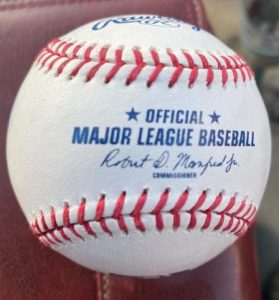
The foul ball, now crossed off my bucket list, sitting atop my notebook, before I handed it to my son.

While the visiting Astros took batting practise, a line drive sailed into our section down the right field line. Adjacent fans made it impossible for me to see just which Astro hit the ball, but the ball bounced around off seats in front of us, then under them, and riocheted off a fan two seats to our right, before rolling on the floor under us to where I could grab the ball before another fan reaching under the seat in front of me did.

I held the ball up to see for myself that I wasn’t seeing or imagining things, then handed it to my son. He’d only been asking to try to catch a ball at Angel Stadium since, oh, the first time I got to take him there—in 2000, when the Angels beat the visiting Yankees one fine evening by prying the winning run out of The Mariano himself. We’d gone to plenty of games since. Thursday night, it was pay dirt at long enough last.

Of course, there was now a game to play, and the Angels lost, 3-1. These are my ten takeaways:

1) Shoh-time! The good news for the Angels was Shohei Ohtani starting on the mound. I’m convinced that what looked to be a lockout-dejected, ho-hum crowd in advance, shot into a near-sellout once Ohtani was announced as the Opening Day pitcher. Lockout after-effect, I suspected: I’d checked the ticketing for the game just prior to the announcement and there were several thousand seats remaining for the taking.

Well, now. The day before I set out for southern California from my home in Las Vegas, I checked the ticketing again. The tickets seemed to have flown off the board once Angel fans knew it would be Shoh-time. And Ohtani didn’t disappoint, much. He pitched four and two-thirds innings of one-run, nine-strikeout, four-hit, one-walk baseball.

The best the Astros could do against him was the third inning, after he caught Martin Maldonado looking at strike three and blew Jose Altuve away with a swinging third strike: Michael Brantley banged a double off the right center field fence and Alex Bregman sent him home promptly with a base hit to left center.

As a matter of fact, when Ohtani wasn’t becoming the first player in Show history to throw his team’s first pitch of the season and make his team’s first plate appearance of the season (the Angels like to bat him leadoff), he manhandled Altuve for three strikeouts on the night, including the nasty slider that shot over Altuve’s hard swing for the third such strikeout in the top of the fiftyh.

2) The bad news: Astros starter Framber Valdez was just as effective in six and two-thirds innings. (The Angels planned to keep their starting pitchers on an 80-pitch limit for the time being, after the lockout-imposed too-short spring training.) He struck six out, walked one, and surrendered two of the Angels’ four hits on the night.

3) The worse news, for the Angels: They came to within inches of taking a 2-1 lead in the seventh. Mike Trout led off by beating out a throw from shortstop that should have been ruled an infield hit but was ruled an error. Then Anthony Rendon hit a high liner that sailed into the left field seats . . . but missed the foul pole on the wrong side by a hair.

“When I saw the ball flying in the air,” Valdez said post-game of his narrow escape, “I got mad with myself that I didn’t make my best pitch. I just took a deep breath and threw my best pitch.” That would be the hard sinkerball on which Rendon promptely dialed Area Code 4-6-3.

Matt Duffy promptly beat out an infield hit to third, which promptly moved Astros manager Dusty Baker to end Valdez’s night and bring Phil Maton in to strike Jo Adell out swinging for the side.

4) Cruising speed: Maton seemed on a bit of a cruise in relief until he hit Brandon Marsh with a pitch with two out in the bottom of the eighth and David Fletcher shot a 1-2 pitch through to the back of left center and gunned it for an RBI triple. That was the Angels’ first and last run of the game, alas.

5) The worse news, for baseball as a whole: That ridiculous three-batter minimum for relief pitchers. Under normal circumstances, if your reliever comes into the game and gets murdered right away—as Angels reliever Ryan Tepera was in the top of the eighth—you’d know he didn’t have it that night, right?

Father and son

Father (right) crossed Opening Day off his bucket list at last—and had the pleasure of doing it with his 28-year-old son.

Oops. Tepera’s first pitch to Alex Bregman sailed into the left field seats. The next Astros batter, Yordan Alvarez, hit a hanging slider on 1-1 over the center field fence. The Angels were lucky to escape with their lives after two prompt deep fly outs (Yuli Gurriel, Kyle Tucker) followed by a sinking liner up the middle (Jeremy Peña) that Trout caught on the dead run in from somewhat deep center to retire the side. (Trout also drew a loud ovation after he turned around and, from half-shallow center, winged the ball to fans halfway up the right center field bleachers.)

6) But there was good news on the relief front. Neither manager burned his relievers in the bullpens. If either Baker or Joe Maddon warmed a pitcher up, he either came into the game as soon as needed or he was handed what amounted to the rest of the night off. No Angels or Astros reliever was called upon to warm up more than once.

I paid as much attention to the relievers in the pen as I could, considering I was seated far opposite the pens behind the left field fence. The Angels used five relievers and the Astros, three. None of those eight pitchers threw any more than maybe 20-25 pitches before they were brought into the game. None of them could be called gassed going in.

Tepera simply didn’t have it Thursday night; Maton got vulnerable after ending one inning and getting two outs to open the next. The rest of the two teams’ bullpen corps (Hector Neris and Ryan Pressly for the Astros; Aaron Loup, Austin Warren, Jose Quijada, and Archie Bradley for the Angels) pitched clean-as-a-hound’s-tooth relief. Would that all major league managers were that judicious handling their pen men.

7) Memo to: Angel fans. Subject: The Wave. The 1980s called. They want their obnoxious, obstructive Wave back. One fan adjacent to our section kept calling for fans to do the Wave. I kept shaking my head, but I did notice that each of about ten attempts at it starting in our part of the park died before flowing to a fourth section of the field-level seats. Maybe there’s hope in such deaths, after all.

8) You were saying? The back-to-back Astro bombs to one side, this game wasn’t exactly the kind to send the old farts screaming to the whiskey shots. The game’s twelve total hits included three Astros doubles, Fletcher’s triple, and six singles. Altuve even stole second in the ninth, for whatever that was worth, since he ended up stranded.

9) Wasted Out Department: Altuve, the Astros’ pint-sized, gallon-hitting second baseman, also dropped a sacrifice bunt to third with one out in the seventh against righthanded reliever Warren, after Chas McCormick opened the inning with a double. Remember: A man on second with one out, and you have less chance of scoring a run after that bunt than you did before the bunt, even if you do exactly what Altuve did pushing McCormick to third.

Just what a man with a lifetime .512 Real Batting Average (total bases + walks + intentional walks + sacrifice flies + hit by pitches, divided by total plate appearances), and a .297 lifetime hitting average with a man on second and one out, is doing thinking sacrifice escapes. With his team leading a mere 1-0 at the time, the Angels brought Quijada in to pitch to Brantley, and Brantley flied out shy of the track in right center for the side.

That’s what a wasted out did. The righthanded-hitting Altuve might have been futile against Ohtani on the night, but he has a lifetime .301 hitting average against righthanded pitchers. The Astros would have had a better chance scoring McCormick if Altuve hit away.

10) When Bregman checked in at the plate in the top of the eighth, the Angel Stadium video boards flashed a graphic with Bregman’s head shot plus this: [He] donated over 200 iPads  w/protective cases and iTunes gift cards to several Houston-area elementary schools that have autistic classrooms. He does that through his Bregman Cares charity, with a particular focus upon autistic children.

It was almost as admirable for the Angels to show Bregman such respectful acknowledgement as it was for Bregman and his wife, Reagan, to take such an interest in lending hands to autistic children. Even if Bregman’s idea of saying thank you for such respect was to smash a leadoff homer in reply.

The Angels bag Tony Two Bags

2019-12-12 AnthonyRendon

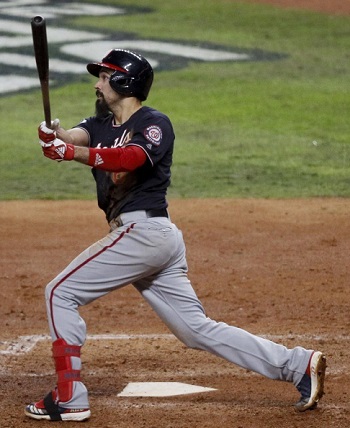
Anthony Rendon hitting the two-run homer that started yanking the Nationals toward winning World Series Game Seven. Tony Two Bags swaps his shark teeth for a halo now.

In need enough of upgrading their starting rotation, the Angels missed their chance to bring either Gerrit Cole or Stephen Strasburg back to their California roots. So they signed Strasburg’s fellow now-ex-National, third baseman Anthony Rendon, for the same time and dollars (seven years, $245 million) it took for the Nats to grant Strasburg’s real wish to stay home in Washington (he’d bought a home there quite recently) for the rest of his baseball life.

Tony Two Bags swaps his shark’s teeth for a halo. And now that they’ve turned third base from a swamp into rolling rapids, the Angels can get right back to the pitching pursuit.

They needed to upgrade at third base almost as badly as they need a pitching upgrade. A trio of third basemen produced a combined 2019 OPS (on-base plus slugging percentage) .359 lower than Rendon’s 1.010. And if nothing else Angel fans should be frothing at the mouth over the prospect of Rendon joining the game’s prize Trout in a tag team that accounted for 14.6 wins above replacement-level last season. That’s a remarkable enough difference if they could have been together then.

Fourteen wins might have meant an 86-76 instead of a 72-90 Angels season. Assuming the Angels don’t stop with Rendon on this winter’s market, free agency or trading alike, they still have room for the pitching upgrade. And to say the Angels require a pitching upgrade is to say Washington, the government and not their world champion baseball team, requires remedial constitutional training.

The entire 2019 Angel staff encouraged walking for sound mind and body; they walked 3.9 batters per nine innings while striking out 8.8 per nine. Their collective earned run average was 5.12 and their collective fielding-independent pitching was 5.04. Collectively they were stingy when it came to surrendering big flies (1.7 average per nine innings) but generous beyond belief when it came to atoning for strikeouts by letting the other guys do the stroll. (2.44 K/BB ratio.)

The bullpen was superior enough to the rotation that you wondered for a few moments why the Angels didn’t go to more bullpen games when feasible than they did. (The crown jewel, of course, was that 13-0 combined no-hitter blowout against the Marines in their first home game following the shocking death of Tyler Skaggs, their best starting pitcher.) The only Angel with an ERA and an FIP below three? Hansel Robles, relief pitcher, the former Met who succeeded where another former Met (Matt Harvey, started) had his moments but collapsed enough to be designated for assignment and released.

What to do this winter, then? At this writing Madison Bumgarner, whose postseason jacket has only Strasburg for a near-equal match, remains on the market and a solid candidate to continue the remaking/remodeling he began in 2019. Also on the market is Hyun-Jin Ryu, the National League’s 2019 ERA leader. Angels owner Arte Moreno is nothing if not a man with stupid money to spend and a reputation for several times spending stupid, but the Angels aren’t exactly hurting for resources and a Rendon signing doesn’t pull them out of the market quite yet.

Bumgarner isn’t likely to cost as much now as he might have a few years ago, and the latest reporting as I write indicate he seeks five years at $100 million, pricey in terms of the average annual value but something of a bargain over the life of the deal. He has a reputation as a Fun Policeman but isn’t otherwise sinister so long as you keep him away from dirt bikes and remember that Angel Stadium’s power alleys don’t point into the Pacific Ocean or any other body of water.

He might find himself having a blast challenging two-way Shohei Ohtani to home run contests in batting practise. And, swapping notes on postseason heroism with Rendon, who landed himself a lifetime of quaffs and steaks on the house or at cut rates with such heroics as Game Five of this year’s division series, Game Seven of the World Series, and a 1.093 OPS toward the Nats’ run to the Promised Land.

Ryu may or may not be a more elusive target, not that he’s seeking stupid money but that there are several teams training their sights upon him, including (it’s said as of this morning) the White Sox, the Twins, and the Dodgers for whom Ryu laboured six seasons. And the White Sox have a kind of incentive with Ryu’s former Dodger catcher Yasmani Grandal having signed with the White Sox for four years and $73 million and said with certainty enough that he’d love to catch Ryu once again.

The better incumbents among the Angels’ starting pitchers, Andrew Heaney and Griffin Canning, are suited better to number three and four positionings pending any adjustments they might begin making come spring. The talent is there for both pitchers but so has been the inconsistency. But the Angels have a concurrent dilemna with teams interested in prying Canning and their plus right field prospect Jo Adell away in any trades the Angels might seek for a starting pitcher. The Angels may have interest in David Price (a trade candidate) and Price might find himself having a bounceback in Angel Stadium, and the Indians’ Corey Kluber, another former Cy Young Award winner and incumbent bounceback candidate, might be another trade target, but general manager Billy Eppler’s challenge would be to bring them aboard without surrendering the family jewels or at least the holiday china.

Still, you have to hand it to the Angels for landing Rendon, the no-questions-asked best regular player on the open market this winter, who’s going to earn more per season than any third baseman in major league history. Just when it looked as though the Rangers had the most solid track to lay down for Rendon, they derailed it when they offered him six years when the third baseman sought the seven to which the Angels agreed. That, and not such silliness as ejaculated by some who think it’s the media’s fault because, you know, the media prefers the Rendons to be in New York or Boston or southern California, not Texas, is why Rendon chose to wear the halo. That and (never discount this car on a baseball player’s train of thought) the challenge of becoming a big enough part of the Angels’ return to contention and, who knows, the postseason soon enough.

Which is no less than the least the Angels could do en route reconstructing themselves into a team their and the game’s best all-around player, the one who made himself an Angel for life last spring, can be proud of. ESPN’s Alden Gonzalez isolates the point: “In short, the Angels want to win, they know there is a sizable gap to make up, and they’re willing to do what it takes to accelerate their timeline. They made a promise to Trout, who eschewed free agency to sign a 12-year, $426.5 million extension, despite barely sniffing October relevance. And the Angels made a promise to [Joe] Maddon, who chose to return to the organization, despite having his pick of managing jobs. The Angels told them they were going to do what it takes to compete. And with the Houston Astros engulfed in a sign-stealing scandal that could yield significant punishment, perhaps now is as good a time as any to take the leap.”

Nationals shortstop Trea Turner only wishes the Angels hadn’t taken the leap at their expense. He got tight enough with Rendon that they had T-shirts made proclaiming each other best friends. When Turner got the news that Rendon has become an Angel, he had shot for himself a video showing him removing his “Anthony Rendon is my favorite player” T from his drawer and kicking it against the wall. Nats reliever Sean Doolittle was a little less, shall we say, demonstrative, posting a GIF of Baby Yoda and a simple, “Goodbye, Tony.”

Maybe the Lerners could have afforded both Strasburg and Rendon. I thought so myself. But then Thomas Boswell knocked me back down to the planet in gentle but firm terms, when he wrote after the Nats re-signed Strasburg, “Before chanting, ‘The Lerners are billionaires, so just pay Rendon his money!’ look ahead just one year. After 2020, the Nats will have to replace or re-sign — in most cases at higher prices — Adam Eaton, Aníbal Sánchez, Sean Doolittle, Kendrick and Kurt Suzuki. Also, Trea Turner and Juan Soto will soon cost much more.” So maybe they couldn’t afford to keep Rendon among the sharks, too.

The champion Nats and affordability

2019-12-06 AnthonyRendonStephenStrasburg

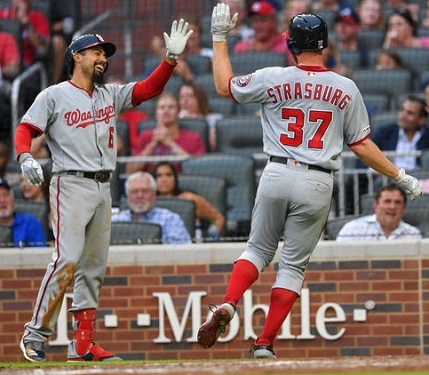
Anthony Rendon and Stephen Strasburg share a high five in Atlanta during 2019. The Nats say they can’t afford to keep both. Depends on how you look at it? (USA Today photo.)

One of the Nationals’ postseason titans will remain a Nat for 2020 at least. Howie Kendrick’s reward for putting paid to the Dodgers’ 2019 and for bombing the Nats ahead to stay in Game Seven of the World Series is a one-year, $6.25 million deal.

That’s the good news. The bad news for Nats fans is that owner Mark Lerner says they can afford to keep only one of their two homegrowns who are now testing their first serious free agency markets.

At minimum, it seems, either Stephen Strasburg or Anthony Rendon is “affordable” even for the team whose ownership—if you include Lerner’s father, Ted, whose fortune anchors in real estate—is baseball’s second richest (net worth $5.3 billion) at this writing, with Giants owner Charles Johnson first richest (net worth $5.1 billion) pending the Mets’ transition to Steve Cohen’s ownership. (Cohen’s net worth: around $15 billion.)

But they can’t afford both.

“We really can only afford to have one of those two guys,” said Lerner about Strasburg and Rendon to NBC Sports Washington Thursday. “They’re huge numbers. We already have a really large payroll to begin with. So we’re pursuing them, we’re pursuing other free agents in case they decide to go elsewhere.”

Kendrick became a Nat in 2018, lost most of the season to a torn Achilles tendon, regrouped in 2019 for a .966 OPS, and became one of the keys to the Nats’ postseason conquest. His National League Championship Series MVP was merely the roast beef between the slices of boutique bread he surrounded it with before and after. Kendrick makes opposing managers look silly.

He took complete advantage of Dodger manager Dave Roberts almost inexplicably leaving Joe Kelly in for a second relief inning and hit a monstrous top of the tenth grand slam to finish the postseason hopes of the team for whom he played in 2015-2016 following nine better than useful seasons as an Angel.

Then Astros manager A.J. Hinch confounded fans and no few analysts alike by reaching for Will Harris instead of Gerrit Cole, as Game Seven starter Zack Greinke’s tank ran past E following a homer to Rendon and a followup walk to Juan Soto. And Kendrick made what Harris himself called “a championship play for a championship team.” It was the right move (Cole never pitched in relief in his life) made wrong.

Harris threw Kendrick a nasty cutter traveling low and away, and Kendrick sent it on a high line the other way until it went bonk! off the right field foul pole. Kendrick’s shot gave the Nats the Game Seven lead they didn’t relinquish and himself the likelihood that he’ll never have to buy his own drinks in Washington again. And it got him his reward for 2020, where he’ll have all season to accept thanks and, just maybe, deliver enough timely swings to send the Nats toward a successful renewal of their lease to the Promised Land.

But what of Strasburg, their World Series MVP, their postseason lancer whose lifetime 1.46 postseason ERA and 2019 1.37 postseason ERA overall hoists as a big-game pitcher the still young man who was their highest-hyped pitching prospect ever? Who survived second-year Tommy John surgery and assorted injuries to come to become first a good, then an above average, and finally a genuinely great pitcher who thrives the best when the moment’s the biggest?

And what of Rendon, their third-place National League MVP finisher in 2019, whose 1.059 postseason OPS and 25 runs postseason runs produced on the way to the Nats’ World Series triumph was at least as valuable to that conquest? Not to mention a third baseman who’s improved in leaps each season at the plate and at the hot corner?

(Rendon’s OPS from 2017-2019: .952; his real batting average [total bases + walks + intentional walks + sacrifices + hit by pitches divided by total plate appearances] over the span: .630. His lifetime RBA so far: .562. Out of eight Hall of Fame third basemen whose careers happened in the post-World War II/post-integration/night ball era, only four are higher than Rendon, in ascending order: George Brett, Eddie Mathews, Chipper Jones, and Mike Schmidt.)

Kendrick threatened to become the face of the postseason early and often, but Strasburg, Rendon, Max Scherzer, Juan Soto, and Ryan Zimmerman are the arguable none-too-small faces of the Nats. They personify the agenda Thomas Boswell says should be the Nats’ pursuit: “preserving the team’s culture.”

Maybe since-departed (for Japan, where he’ll get to play more than part time) Gerardo Parra brought the Nats the Baby Shark and opened their can of fearless fun factor in 2019. Parra may be crossing the Pacific but nobody wants to dispense with the Baby Shark just yet. Maybe not ever.

Boswell says the Nats must weigh such value as Kendrick, Ryan Zimmerman, and “the versatile” Asdrubal Cabrera, Brian Dozier, Matt Adams, “and the modest but must-re-sign [Daniel] Hudson.” Sensibly enough.

But how about weighing the values of Strasburg and Rendon? And how about marrying those and the aforesaid values to an overall Nats culture of winning and having a blast doing it? No team in baseball was more plain fun to watch in 2019 than the Nats. Even the near-stoic Strasburg learned how to loosen up and shake a tail feather in the dugout.

Beware, Lerners. And general manager Mike Rizzo. You may think the Yankees have eyes for Strasburg, you may think the Phillies have likewise (remember what happened when you tried to get cute with Bryce Harper after 2018), but now the Angels may be laying in the weeds for him.

And that would be awfully tempting for Strasburg. Not just because there’d be a challenge for him in yanking their still-in-need-of-remodeling pitching staff into real competitiveness, but because they play an hour’s drive (assuming the traffic is decent, which is never a safe assumption in southern California) from Strasburg’s roots. Often as not in baseball you can go home again.

He’s not the only one with a California team pondering his presence. Rendon may be getting more than glances from the Dodgers he helped destroy in October. In fact, Strasburg and Rendon are both said to be on the Dodger radar, with incumbent Justin Turner willing to move to first base if Rendon becomes his new teammate. Beware, Nats. If you can’t or won’t keep them, the Dodgers might be only too happy to take them.

This would be called joining them if you can’t beat them. It was Strasburg who held down the fort in division series Game Five and didn’t let an early 3-0 Dodger lead knock him out of his zone. And it was Rendon who opened the game-tying top of the eighth, when Roberts gambled on Clayton Kershaw opening the inning, with a yank into the left field bleachers followed immediately by Soto’s yank into the opposite bleachers.

There’s only one thing that might hold the Dodgers back: luxury tax implications. That and that they’ve rarely handed out contracts for more than five years. And Strasburg and Rendon can leverage their southern California overtures when bargaining with other interested teams. (For Rendon, one is thought the Rangers, a homecoming for him as the Angels or Dodgers would be for Strasburg.)

Something to ponder, too, if the Nats let Strasburg and Rendon walk. Cole has suitors to burn, the Yankees in particular, reportedly, but then Scherzer did, too, a few years ago—and the Nats made him an offer he couldn’t refuse.

It’s not unrealistic to think that losing Strasburg and Rendon alike equals gaining Cole on the mound and, maybe, Josh Donaldson for third base. Donaldson’s still better than serviceable at age 33 and he’s a lot less expensive than Rendon, and Boswell notes that Donaldson’s would be a personality fit in the Nats’ clubhouse.

But losing either Strasburg or Rendon, never mind both, would lose a particular degree of Nats gravitas.

“What cannot and need not be lost is the culture that this Finish the Fight team brought to life,” Boswell concludes. “Rosters change. Lucky and luckless seasons both arrive. But once a team sees what values it wants to embody—and what kind of players and people make that possible—then that’s the lodestar to follow.”

Strasburg and Rendon are two of those players and two of those people. The Lerners may want to keep that very much in mind before they decide once and for all that saving a few bucks is just a little more pressing than keeping what’s already proven aboard.

Maybe Cole, Donaldson, and a couple of other imports would fit the Nat culture. Maybe they really won’t. It’s the crapshoot every great team joins every year, similar to reading the size label on the shirt you bought and discovering the label lied in one or another direction. But a good gambler knows the moment when pushing his or her luck means disaster.

It just might be worth every extra dollar for the Lerners not to push their luck this time. Especially with two franchise faces who just so happen to be far more than just a couple of franchise faces, and have been since the days they were baseball born in Nats jumpers. (Not to mention a third, Zimmerman, who’s been a Nat since the day they were re-born in Washington, and would settle for one more year at a reasonable rate for a part-timer who just can’t hang it up quite yet.)

Contrary to what the giddoff-mah-lawn baseball romantics like to think, loyalty was never a prime baseball commodity. Not before the free agency era, not since, and not exclusively on the players’ sides. (Yes, Mr. Thurber, we can look it up.) This time, the Lerners have a splendid chance to show some to two of the guys who stayed the course and finally helped them reach the Promised Land.