What took so long?

Trevor Bauer

Trevor Bauer waited as long to go on administrative leave for abuse as  Hector Santiago waited to get grounded ten days for actual/alleged naughty sauce. What’s wrong with that picture? Plenty.

Get caught with legal rosin mixing with your own natural sweat? You baaaaaad boy! No going out to play for you for ten days, Hector Santiago.

Take rough sex too far and leave a woman bruised, undergoing CT scans, and finally filing a restraining order against you this week, under penalty of perjury? You’re still starting in regular rotation, Trevor Bauer . . . on the Fourth of July. In Washington, yet.

At least, you were, until MLB did Friday what it should have done on Wednesday, when the details came forth, and put you on seven days’ administrative leave.

Until then, it looked as though Santiago took heavier immediate consequences for actual or alleged naughty sauce than Bauer did leaving a woman with head and facial trauma, a partial basilar skull fracture, and blood around where she accuses him of trying a back door slider while she was out cold and in no position to allow it.

You can run the entire history of professional baseball and find players disciplined quickly and heavily for behaviour a lot less grave that what Bauer’s accused of having done to the lady. But then you can also still find too many people learning about Babe Ruth’s penchant for partying with gangsters and hookers and thinking it’s still just part of the big lout’s appeal.

Maybe the Dodgers couldn’t discipline Bauer unilaterally at once, as Sports Illustrated‘s Stephanie Apstein noted Thursday afternoon. But there was no law saying manager Dave Roberts couldn’t decide to hand the ball to another pitcher to start in Bauer’s place, especially on the anniversary of a declaration saying we’re entitled to life, liberty, and the pursuit of happiness.

The pursuit of happiness isn’t supposed to leave a woman’s head resembling a boxing gym’s speed bag. Not even if she was looking for just a little rough and wild sex.

Unless I’ve been led down one or another primrose path, even a little rough and wild sex isn’t supposed to end in head and face trauma, a partial basilar skull fracture, and blood on the seat God provided the human anatomy. Compared to that, The Thrilla in Manila (Muhammad Ali vs. Joe Frazier, the brutal Act III) was a dance contest.

Baseball’s domestic violence policy, Apstein reminded us, includes that baseball’s government can put an accused player on paid administrative leave up to seven days while investigating the accusations. MLB and the Major League Baseball Players Association can extend that period by mutual agreement, she observes.

“Perhaps MLB is waiting until Sunday so as not to start the clock,” she continued. “If they wait, that would keep him out of action until after the All-Star Break. That may make sense legally. It is indefensible morally.”

These people are so consumed with technicalities that they can’t be bothered to do the right thing. “We are not going to start Trevor Bauer on Sunday.” Not “We are going to take away Trevor Bauer’s money.” Not “We are going to suspend him.” Not “We are going to release him.” Not “We are going to throw him in prison.” Just “We are not going to offer this man the privilege of striding out to a mound in front of tens of thousands of people who paid for a nice afternoon.”

Let’s remember the word “privilege.” That’s what playing professional, major league baseball is. It’s not a basic human right. You won’t find any clause in the Supreme Law of the Land declaring you have the absolute right to any particular line of work.

The document over whose anniversary baseball and the nation is about to make a red, white, and blue racket—the like of which probably hasn’t been seen in long enough, after last year’s pan-damn-ic rudely interrupted such things—doesn’t say, “We hold this truth further, that you have the right to your particular chosen job, period, no matter what criminal behaviour you might commit while thus employed.”

Apstein said commissioner Rob Manfred—a man who normally points the way to wisdom by standing athwart it—should have put Bauer on administrative leave immediately. She also said the Dodgers’ administration should have ordered Roberts to hand the Fourth of July ball to anyone but Bauer, instead of Roberts telling reporters he’s still giving Bauer the ball.

While she was at it, she zapped that brass for leaving Roberts out to answer press questions by himself.

“Instead,” Apstein continued, “fans of the Dodgers and of the sport and of civil society have to wait days to learn whether a man accused of breaking a woman’s skull will get to pitch on the Fourth of July in the nation’s capital.”

The Athletic‘s Dodgers reporter Fabian Ardaya tweeted Thursday afternoon that Roberts also said the team’s “direction” was to do nothing “until they get guidance from MLB.” Since when does a team need guidance from baseball’s government to just take the ball from one pitcher and hand it to another?

The Dodgers have their guidance now. It took only two days from The Athletic’s Brittany Ghiroli’s and Katie Strang’s running down the literally gory details in the restraining order filing to get it. It shouldn’t have taken that long.

MLB was still a little too slow on the proverbial uptake. So were the Dodgers. They should have gotten ahead of it and changed Fourth of July pitchers at minimum to open. This is a look about which “ugly” would be an understatement for the team half a game out of first in the National League West.

Why did Manfred and his office wait so long to put Bauer on administrative leave? When former Cubs shortstop Addison Russell was first accused of abuse against his then-wife in 2018, MLB put him on administrative leave at once. When Yankee pitcher Domingo German was accused likewise in 2019, MLB put him on administrative leave likewise.

Both were suspended in due course, but the players’ union approved extensions of the administrative leaves first. What on earth was the hesitation now?

The presumption of innocence? Legally, that’s in a court of law. Morally, you don’t surrender it when you remove a pitcher from duty whose mind is occupied by matters more grave than trying to sneak fastballs or breaking balls past Kyle Schwarber, Trea Turner, and Juan Soto on the Fourth of July.

“Would the union fight a similar extension with Bauer?” another Athletic writer, Ken Rosenthal, asked. Then, he answers at once: “Perhaps, if it believed the league was acting unfairly. The union, after all, exists to defend and assert the rights of the players. But based on the details in the domestic violence restraining order against Bauer, the union also might view a prolonged investigation into his conduct as warranted.”

Somehow, it’s still impossible to believe that a pitcher caught with his sweat mixing to legal rosin and ending up in his glove—which, by the way, MLB turned out not to have inspected—almost faced heavier immediate consequences than a player under legal restraining order over leaving a woman injured, feeling abused, and more than a little afraid.

“[H]ow ridiculous would it look for MLB to dock Santiago and not even buy time with Bauer, whose alleged offense is far more serious?” Rosenthal asked. “What exactly would Manfred’s trepidation be here?”

I’m still a little too trepiditious to ask. A baseball commissioner who’s already threatening to set records for terrible looks took two days to do what he had to do this time. “Terrible” isn’t the word for that look.

Beyond mere misogyny

Trevor Bauer

Somehow it was easier on the insides when Trevor Bauer was a mere misogynist.

Before Trevor Bauer signed with the Dodgers in February, there were signs enough that the Mets might bring him aboard. And alarms enough that Bauer’s penchant for social media misogyny might require extraordinary pre-emptive strikes to contain potential fallout.

That was a month after the Mets fired general manager Jared Porter over sexual texts and images he sent a female reporter while working for the Cubs in 2016. And, around the time former Mets manager Mickey Callaway got suspended—and, eventually, fired as the Angels pitching coach—over several years’ unwanted pursuit of women around baseball.

A New York Post baseball writer, Joel Sherman, thought the last thing the Mets should consider under those circumstances was signing a pitcher to whom mere misogyny seemed second nature to anything longer than a single-year deal:

Bauer’s behavior does not rise near the malfeasance that Porter copped to and is alleged against Callaway. But Sandy Alderson hired both Porter and Callaway. He said in the aftermath of both disturbing revelations that had he known prior, he would not have hired Porter or Callaway. He knows what he knows about Bauer. Now. Today.

The Mets lost out to the Dodgers in the Bauer hunt. In letting Bauer become the Dodgers’ signing splash and migraine, the Mets may not have dodged just a bullet but a nuclear warhead.

On Monday, a 27-year-old woman filed a domestic violence restraining order against the 30-year-old righthander with pitching smarts to burn and a paleozoic personality to match. The Athletic‘s Brittany Ghiroli and Katie Strang got a look at the details inside the 67-page filing.

They almost make the sadomasochistic1963 novel whose title later became the name of a legendary rock band, The Velvet Underground, resemble The Enchanted Cottage. I can only imagine the sickenings to their stomachs Ghiroli and Strang felt.

“The alleged assaults described by the woman, which are extremely graphic in nature, happened during what she said began as consensual sexual encounters between the two,” Ghiroli and Strang wrote Wednesday.

According to the woman’s declaration attached to the request and obtained by The Athletic, she suffered injuries as a result of the second encounter, including two black eyes, a bloodied swollen lip, significant bruising and scratching to one side of her face. In the woman’s declaration, signed under penalty of perjury of California state laws, she said that her medical notes state that she had “significant head and facial trauma” and that there were signs of basilar skull fracture.

She also said that, in one of those incidents, while unconscious, Bauer penetrated her anally, which she did not consent to in advance.

“I agreed to have consensual sex; however, I did not agree or consent to what he did next,” she says. “I did not agree to be sexually assaulted.”

The two Athletic reporters reached out to Bauer’s side and got no comment beyond a statement from Bauer’s agent, Jon Fetterolf. The statement says, essentially, that Bauer and the woman began “a brief and wholly consensual sexual relationship” which she began, meeting twice, with Bauer leaving quietly but the two continuing to message in “friendly and flirtatious banter.”

But Fetterolf also acknowledged she sent Bauer photographs accompanied by a note that she sought medical treatment for a concussion, to which Bauer responded “with concern and confusion” while the woman was “neither angry nor accusatory.”

Mr. Bauer and [the woman] have not corresponded in over a month and have not seen each other in over six weeks. Her basis for filing a protection order is nonexistent, fraudulent, and deliberately omits key facts, information, and her own relevant communications. Any allegations that the pair’s encounters were not 100% consensual are baseless, defamatory, and will be refuted to the fullest extent of the law.

One of the lady’s own attorneys, Bryan Freedman, had a statement of his own to share with Ghiroli and Strang:

Without going into detail for the benefit of both my client and Mr. Bauer, the pictures evidencing the unconsented abuse do not lie. Any suggestion that she was not the victim of assault is not only false and defamatory but, in fact, perpetuates the abuse. Our client truly wants Mr. Bauer to engage in a medically appropriate therapeutic process where he can receive the treatment he needs to never act this way again.

“If he is willing to meaningfully participate in a process directed by appropriate professionals,” Freedman continued, “it will go a long way toward allowing her to feel safe and resolving this matter. But, regardless, she cannot allow this to happen unknowingly to anyone else.”

The woman accuses Bauer of choking her just enough into unconsciousness. She said in the filing that she awoke disoriented but also to him trying to have rough anal sex with her, “which I had never communicated that I wanted, nor did I consent,” and that the morning after he made a little light of the entire thing before he left an hour later.

The pair continued messaging each other, though. They met again in mid-May. That time, the woman’s filing says, instead of trying a little rough sex after choking her unconscious Bauer basically beat her head in for her—and, after she was fully conscious, told her she was safe and he “would never do those things to you if it wasn’t sexually.”

“As part of the request to the court,” Ghiroli and Strang wrote, “the woman also provided text messages and screenshots of voicemails she said Bauer sent to her inquiring about her well being and checking in with her to see what he could do; in one message, Bauer offers to deliver groceries to her.” What a guy.

The filing also mentions the woman went for two medical exams off that second “encounter,” including “rapid CT scans” for face, neck, and brain. She also met San Diego police detectives, downplayed the whole thing as just “rough sex,” and didn’t drop Bauer’s name then for fear of public repercussion.

“I was afraid what Trevor would do if he found out,” Ghiroli and Strang quote her filing. “I remain afraid that Trevor will find me and hurt me for going to the hospital.” They also quote from a conversation between herself and Bauer under the Pasadena Police Department’s direction: “I said, ‘Thank you for acknowledging what you did to me.’ Trevor acknowledged it and asked how we could move forward and asked if he could still reach out.”

The Pasadena PD is still investigating. Another attorney for the lady, Marc Garelick, said in a statement he and his client both expect criminal action against Bauer. MLB is also investigating and may sanction Bauer under the sport’s domestic violence policy.

“Let the balance between Bauer’s talent and his headaches be on the Dodgers’ heads,” I wrote when Bauer signed that three-year, $102 million deal with them. “The Dodgers may be deep enough that Bauer’s headaches wouldn’t make a huge impact, but they could leave the Dodgers with as many migraines off the field as their presence on it will leave for the rest the National League West, at minimum.”

If all Bauer gives the Dodgers now is a mere migraine, it would be a substantial improvement.

Wild rough sex is one thing. Forgive me if I have an impossible time believing that battering a woman like her head is a boxing gym speed bag, or giving her a back-door slider while she’s out cold, is any kind of erotic for either partner.

“One of the last text messages I sent him,” the lady’s filing said, “was, ‘I appreciate all of your offers to help, but the best way you can help me is to never do that to anyone else ever again.’ To this, Trevor responded, ‘I would never do anything to hurt anyone. That includes you’.”

What a guy.

“They want to get to the bottom of it.”

Los Angeles Angels

For their first home game after Tyler Skaggs’s death, the Angels wore his uniform and beat the Mariners in a combined blowout no-hitter, before laying the uniforms around the mound. Skaggs’s widow and parents have now sued the Angels for negligence over the pitcher’s death.

Two days before the second anniversary of his death, Tyler Skaggs’s family struck in court. His widow, Carli, filed suit in the Texas county where Skaggs was found dead of an opioid overdose; his parents filed in Los Angeles. Texas law allows only a spouse to claim damages for wrongful death or negligence.

ESPN writer T.J. Quinn says both Carli Skaggs and her in-laws are suing the Angels’ former communications director Eric Kay, who admitted to buying the drugs for Skaggs, and Kay’s former boss Tim Mead. Skaggs died at 27 1 July 2019 of asphyxiation provoked by fentanyl in his system, on the night the Angels arrived in Texas for a road set with the Rangers.

“The crux of the lawsuit is that the Angels were negligent in allowing Kay, a longtime opioid abuser, to have access to players, and that Mead failed to properly supervise him,” Quinn writes.

Kay told U.S. Drug Enforcement Administration agents that he also had provided oxycodone for five other players at Skaggs’ request. No other players have been publicly identified. The lawsuit claims that the Angels had a culture that pushed players to play through injury and that the club knew or should have known about Skaggs’ use of opioids.

The Angels didn’t respond to Quinn directly when he contacted them, he added. But the team issue a statement saying the suits’ accusations “are entirely without merit . . . baseless and irresponsible,” promising a “vigorous” court defense.

In 2019, Angels Baseball hired a former federal prosecutor to conduct an independent investigation to comprehensively understand the circumstances that led to Tyler’s tragic death. The investigation confirmed that the Organization did not know that Tyler was using opioids, nor was anyone in management aware or informed of any employee providing opioids to any player.

The Angels alone? One of the worst-kept secrets of professional sports for decades, including baseball, has been teams pushing players to play through their injuries before those injuries are healed completely. Who knows how many teams either looked the other way or feigned ignorance when injured players turned or were turned to addictive substances to get back out there faster?

One of the worst-kept companion secrets, of course, is that players smart enough to know when they’re not quite healed up, insisting they’re not going to be fool enough to get back out there before they’re fully healed, often get dismissed as fragile hypochodriacs most politely—and as feline euphemisms for a woman’s vagina most impolitely.

Skaggs underwent Tommy John surgery in 2014. “[O]pioid abuse often begins after surgeries, when the drug may be prescribed to the patient,” wrote Halos Heaven‘s Jessica DeLine three months after Skaggs died. “Per the Mayo Clinic, opioids are highly addictive and your risk of addiction is increased after taking the drug for just a few days. Skaggs had TJ Surgery in 2014 and didn’t pitch at all in the 2015 season.”

DeLine cited an Outside the Lines report suggesting Skaggs and Kay had a shared opioid history of over four years: “Did Skaggs manage to keep this a secret from all his teammates over the years? Was his TJ surgery in 2014 an inciting event for his opiate abuse? That would seem to fit with the timeline Kay provided.”

“As the federal grand jury indictment made plainly and painfully clear, were it not for the fentanyl in the counterfeit pill provided by Angels employee Eric Kay, Tyler would be alive today,” said Skaggs family attorney Rusty Hardin in a statement following the lawsuit filings. “And if the Angels had done a better job of supervising Eric Kay, Tyler would be alive today.”

Maybe. Maybe not. We’ll never know for dead last certain.

What we should know is that this business of dismissing players injured in the line of play as mal-constructed vaginas should have ceased and desisted a very long time ago.

“Leaving it all out on the field” works both ways. Would you like a litany of players from most eras who left it all out on the field and had to leave it before their times thanks to injuries in the line of duty?

Dizzy Dean, Pistol Pete Reiser, Rex Barney, Monte Irvin, Herb Score, Ralph Kiner, Roger Maris, Wally Bunker, Jim Bouton, Sandy Koufax, Tony Conigliaro, Frank Tanana, Mark (The Bird) Fidrych, Pete Vuckovich, Joe Charboneau, the entire Oakland starting rotation of 1981-83, Bo Jackson, Eric Davis, Don Mattingly, Kirby Puckett, Darin Erstad, Nomar Garciaparra, Mo Vaughn, Jason Kendall, Justin Morneau, Grady Sizemore, Ryan Howard, Mark Prior, Kerry Wood, Mark Mulder, David Wright, Prince Fielder, and Jacoby Ellsbury are just a few who should ring a few bells for having gotten their bells rung in various ways.

They didn’t get hurt showing off slam-dunk techniques on the street, hauling a heavy side of deer meat up the stairs, trying to rip Manhattan-thick phone books apart with their bare hands, or staying too long on tanning beds, to name a few examples. (Those really happened. In order, to Cecil Upshaw, Clint Barmes, Steve Sparks, and Marty Cordova.)

Few players in any era took the abuse Ellsbury took for the multiple injuries he incurred playing baseball. As if a nine-figure Yankee payday could turn Clark Kent into Superman. Even before he became so ill-fated a Yankee, Ellsbury finally couldn’t wait to high-tail it out of Boston in free agency, where he’d been an often-injured Red Sox star with two World Series rings on his finger. Too many whisperings that he took too much of his sweet time recovering from injuries.

Thank God they also don’t all get hooked on opioids or other drugs out of surgery or because of doctors administering or prescribing them.

Uh-oh. Remember Denny McLain? Now, forget everything else you know about his post-baseball history, and maybe some of his career history, and think about this. McLain felt something pop in his shoulder during a 1965 start. By 1967-68, he’d hooked himself on cortisone. He used it practically the way most of us drink coffee at the breakfast table. Used to excess—and sound medical opinion has long since determined you should have no more than ten cortisone shots in your entire lifetime—cortisone can weaken the areas where it’s administered.

Now are you surprised that McLain’s shoulder was shot to hell by the time he ended up a very disgruntled Washington Senator in 1971? When, somewhat insanely, he was allowed to start 32 games anyway, and was charged with two more losses in one season (22) than he’d been charged with in his previous three? Or that he only got to pitch in twenty more games the following year before he called it a career?

Or that he eventually said, emphatically, “The name of the game back then was you gotta win one for the Gipper. [Fornicate] the Gipper!”

“The myth that baseball players were tougher and more resilient back in the day, that they were willing to endure anything for the sheer love of the game, is just that—a myth,” wrote Sridhar Pappu in The Year of the Pitcher four years ago. “In truth, they were victims of terrible medical advice, merciless management, and unforgiving fans who believed that a worn-out, hurting arm signaled a kind of moral weakness.”

The grief over Skaggs’s unexpected death was very real. So was the staggering joy when the Angels returned home following his death, memorialised him movingly (including the team all wearing his uniform number 45), and beat the Mariners with a combined no-hitter and a 13-0 final launched when his buddy Mike Trout smashed a two-run homer in the first inning.

But his widow and his parents may be out to prove that he and too many other players are still victims of terrible medical advice or practise, and merciless or at least ignorant management. In more ways than one.

On Hector Santiago’s bust

Hector Santiago

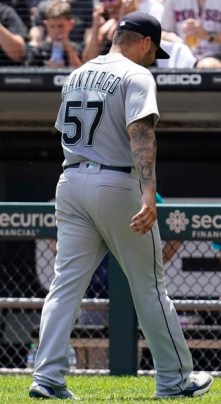
So much for working up a good sweat on the mound. Hector Santiago, Sunday afternoon, sent to the cooler for ten days (with pay, mind you) for sweating into his rosin.

Jacob deGrom had the dubious pleasure of being first-come, first-frisked last Monday, when baseball government’s crackup of a crackdown on naughty sauce began officially. One night later, Sergio Romo became the first to drop trou—under his almost knee-length jersey, so nobody could bark at the moons—under the new stop-and-frisk policy.

Come Sunday, Hector Santiago, Mariners relief pitcher, had the likewise dubious pleasure of being stopped, frisked, and purged. For naughty sauce? Not exactly. The coppers saw something suspicious in what Santiago pleaded, and his team affirmed, was nothing but rosin and sweat.

Foreign substance? Only if you consider Santiago’s sweat to be of foreign origin. He was born in New Jersey. He’s of Puerto Rican descent. That makes him a natural born American.

“Says who?” Carroll O’Connor’s Archie Bunker once asked a Puerto Rican-born janitor with whom he was stuck in an elevator, in season one of All in the Family. Said the janitor, Carlos Mendoza, played by a very young Hector Elizondo, “In 1917, the Congress of the United States, says who. We are very good citizens.”

President Woodrow Wilson made that happen when he signed the Jones-Safroth Act. Therefore, Hector Santiago’s sweat is one hundred percent, bona fide, guaranteed not to rust American sweat.

“Therefore,” said Pistolero Pringole, sub-minors relief pitcher turned police criminologist, “they cannot just bust him for foreign substances. And the last I saw of that memo, rosin’s still allowed. Sunscreen, no. SpiderTack, no. All that medicated goo in a can, no. You cannot roust a man for sweating in the summertime.”

From deGrom last Monday through Santiago come Sunday, there were 668 pitching appearances (you don’t think there are 668 pitchers in the Show this season, do you?) and not one of those pitchers got cuffed and stuffed after being served the search warrant until Santiago was carted off to the holding cell.

Well, maybe commissioner Rob Manfred was right. Maybe things were going smooth and steady most of the time from Monday through Sunday. If you don’t count Romo and Max Scherzer getting tempted to go Chippendales on a couple of stop-and-frisks.

And maybe they’ll solve the pillow case.

The way this crackup of a crackdown is going, so far, don’t be surprised if the next newlywed couple to remove the tag under penalty of law after they bring the new bed home finds itself the subject of a no-knock police raid.

“Never gonna happen,” Pistolero said. “The men and women in my department aren’t that crazy.”

“They’re not, but the people running baseball and enough of the people umpiring it are,” I said.

“Now, what’s so suspicious about Hector’s pitching this year,” Pistolero asked.

I mentioned that Santiago’s ERA in nine gigs since the Mariners exhumed him from the minors in late May is 2.65. And, that his fielding-independent pitching since then is 2.44. The former is 1.47 below his career mark; the latter, 2.43 below.

“And he’s had ERAs and FIPs within that range early in other seasons, too, sometimes even lower,” I said. “Not in the last couple, but it’s in his history.”

“I keep reading about the experiments with the baseball the last few years, “Pistolero said. “They’ve changed it more often than my wife changes her mind.”

“How often does your wife change her mind?”

“Woman’s prerogative to change her mind, right? If my wife goes a day without changing it three times we take her to the urgent care clinic. Lucky for her one of our children’s a doctor there.”

“Listen, Pistol,” I said to get back on message, “I don’t really get this all-of-a-sudden crackup of a crackdown any more than you do. I get people are afraid of cheating. I get that a lot of pitchers got wise to the spinning of their pitches a lot more acutely the last few years. And I get that baseball’s governors can’t figure out either how to make serviceable baseballs or how to come up with a syrup acceptable to both themselves and the pitchers who have to throw the damn balls.”

“What about the hitters who have to hit the ball?” Pistolero asked. He wasn’t trying to be a sabelotodo. I think.

“Well,” I said, “with less fast spin cycles on the pitches, maybe the hitters get a more even shot. Maybe the hitters were going to figure it out anyway by the time this Second Year of the Pitcher ended. If there’s one thing I know for dead last certain, it’s that pitchers and hitters usually figure each other out. Even if it takes awhile.”

“Already you sound like you’re commissioner material,” Pistolero said.

“Remember the last Year of the Pitcher?”

“Before my time.”

“Well, I remember it. By the time the World Series came around, the hitters weren’t looking all that futile even with Bob Gibson pitching three games. So sure they figured it out then. They were liable to figure it out again this time around.”

“Even with all this launch angle mierda?”

“Even with all this launch angle mierda.

“I thought your Spanish was worse than that.”

“It is.”

“Well, how come you can figure out the common sense of it all and this Senor Manfred can’t?” Pistolero asked.

“It’s not exactly forensics,” I said.

Suddenly I remembered “Santiago” in English means St. James. The patron saint of Spain, Nicaragua, Guatemala, and fishermen. Something was certainly fishy enough about umpires cuffing and stuffing a pitcher over a blend made in the U.S. of A.

Santiago’s pitching repertoire includes a decent fastball, breaking balls, changeups, and the occasional screwball. Don’t say it.

“I’m only afraid of one thing, Pistolero,” I said. “The way Manfred’s going, he’s going to try to find a way to make sweating in summer against the rules.”

Picture it. We may go from Hall of Famer Dizzy Dean putting an ice block on home plate “to cool off my fastball” to Rob Manfred ordering pitching on ice blocks to stop the sweat.

“Well, I have one thing to say to this Senor Manfred,” Pistolero said. “Que tenga un hotel con mil habitaciones y la venganza de Moctezuma en cada habitacion.

“What the hell does that mean,” I asked. “Remember, I still know about as much Spanish as you know how to solve the pillow case.”

Pistolero couldn’t help laughing while he translated: “May he have a hotel with a thousand rooms and Montezuma’s revenge in every room.”

It was my turn to laugh. “I thought you were a good American citizen and cop. Don’t you know there’s still such a thing as the Eighth Amendment?”

“Give us better balls”

J.T. Realmuto, Aaron Nola

J.T. Realmuto with Aaron Nola. The catcher says building a better baseball would be the logical thing. Logical? In the Age of Manfred?

If there’s anyone in baseball who should know pitchers and pitching better than the pitchers and their pitching coaches, it’s the catchers. Fellows like the Phillies’ J.T. Realmuto.

The number one job a catcher has is handling his pitching staff. The pitchers who’ve thrown to Realmuto in eight years major league time have a 4.50 ERA with him behind the plate. That’s 4.16 above the league average over those seasons.

But that was also Realmuto behind the dish Friday night, when Aaron Nola struck ten straight Mets out from the first through the fourth, beginning and ending with Mets outfielder Michael Conforto . . . and tying the record set by the Mets’ late Hall of Famer Tom Seaver.

(How Phillies was this—their man breaks a record like that and they still lose the game? That Philadelphia wedding changed from “You may now boo the bride” to the couple reciting their wedding vows—and the minister handing them their divorce decree.)

So presume that Realmuto might be a little better and smarter than his pitchers’ overall ERA indicates. Could also depend on the pitchers, too. Nola’s an established ace, even if he’s not in the deGrom/Scherzer/Kershaw society.

Thus you might listen when Realmuto—who was rather outspoken before baseball’s government decided to enforce a foreign substances law it hadn’t enforced in a couple of generations—admits he can’t figure out what commissioner Rob Manfred was or wasn’t thinking when he decided it was time to stop, frisk, and dock almost midway through the working season.

“The biggest deal was to get guys to stop using the stuff that increased their spin rate the most,” Realmuto told The Athletic‘s Matt Gelb. “Guys have been using sunscreen and rosin forever. Now they’re not letting you do anything. So I really think the best thing they could possibly do, which obviously can’t happen during the season, is to get a better ball. Find a better ball. That’s the logical thing. It would make everybody happy.”

“He’s kidding, right?” said Sticky Fingers McSpidertack when he rang me too early this morning. I hadn’t even finished my first big mug of coffee, and Sticky was already trying to pick my reawakening brain. Remind me to get even some way.

“I don’t think he was kidding, Stick,” I replied. “Bear in mind that I’m still a little groggy. Dogs awakening you prematurely can do that to you.”

“Yeah, I know,” Stick said. “But when he says the best thing to do is to find a better ball, that scares me a little bit.”

“Why?” I asked. “It makes perfect sense, even to my still half-cloudy brain. I’ve said it myself before. Commissioner Nero needs to quit fiddling with the balls the way it’s been done the last few years and get a ball the pitchers can work with and the hitters can still hit.”

“You really need me to tell you?” Stick said. “Look at the past few American generations overall, never mind in baseball. Once upon a time, you built a better mouse trap and got rid of a better class of mice. That was then, this is now. Now, you build a better mouse trap and the cats gang up on you.”

“This is Commissioner Nero we’re talking about,” I said. “When he played the Mouse Trap Game as a kid, the mouse usually escaped.”

“I hear that. Even if you still sound like you’re talking underwater.”

“I still need my second mug of coffee, Stick.”

After I retrieved mug number two, I turned back to Realmuto’s commentary. He knows there were a few guys on the mound using their naughty sauce not to get a grip but to relieve the hitters of their grip—with a spin cycle that could get clothes completely dry as opposed to just damp dry if their pitches were the tumblers inside a front-loading washing machine.

But he also knows that most pitchers, plying their trade like the honest artisans they strive to be, weren’t using that new-fashioned medicated goo just to divide and conquer, either. “[T]hey can’t just not work with pitchers. You can’t throw them out there with these slick balls,” he insisted to Gelb.

It has to be somewhere in between where they can make a ball that has enough grip where guys don’t have to do that to be able to control it, but also a ball that’s not so sticky that it’s increasing spin rate. Which they should be able to do. It’s been different every season for the last four or five years. So it’s like, they can change the ball if they want. They just need to find the ball that works for everyone.

“Sounds so simple a child of five could do it. Now, somebody send the Phillies a child of five,” Stick said, channeling his inner Groucho Marx.

Gelb said, practically, that asking the Phillies themselves about the balls proved to be something like asking Jacques Cousteau about space exploration.

“Hey, I’m sure they’re trying, right? I guess for whatever reason they haven’t been able to find a ball that’s acceptable to everybody, but I know they’re working on it,” said Phillies president of baseball ops Dave Dombrowski. “I’ve been in GM meetings years ago where they passed around the ball with more tack on it, like they use in Japan, and say they were trying to develop something like that. But for whatever reason, we haven’t been able to find it. I hope they do. It would solve a lot.”

The dear boy.

News flash: MLB owns Rawlings, the sporting goods giant charged with making the Show’s balls. And, as Gelb writes, “it has pleaded ignorance to the constant changes in how the ball feels and behaves.”

“That’s the problem,” Stick said. “Commissioner Nero and his minions don’t have to plead ignorance. Their ignorance is the worst kept secret in baseball.”

“It is the single most important element to everything about the sport right now,” Gelb went on. “A consistent baseball. The lower seams and tighter-wound balls, combined with a lax attitude toward how doctoring the ball was policed, compelled pitchers to use sunscreen and stickier substances to better grip it.”

“That’s the other problem,” Stick said. “You don’t need me to tell you that, if you show me twenty pitchers finding solutions to working with these baby-ass-smooth balls, I’ll show you one or two pitchers figuring out they can squat inside hitters’ heads without even signing a lease.”

“I thought your own best pitch was what you called the Irish Spring Slider.”

“It was, until I switched to Ivory. Then every side was the dry side getting clobbered on me.”

Realmuto admitted he’s glad the Nero Regime did “something,” but he also admits he doesn’t know that they did the right thing. “But something had to change.” Something still has to change. If only Realmuto knew something about the art and science of making a baseball. He’d be better running Rawlings than the Nero Regime seems to be.

Since the Nero Regime are that ignorant about how to make baseballs, and that insouciant in their ignorance, how about coming up with a ball gripper both the Show’s government and, you know, the ones who actually go out there and play the game, can live with, without operating the Ball Police or the Stickum Security Service?

“I lost my Internet,” Stick said. “What does Gelb say about that?”

I read the quote back to him: “A mud machine and a rosin swab would be great. Science is amazing, and so is modern technology. Anything is possible — except a more consistent baseball with a transparent process about how it is manufactured.”

Stick pondered that a moment. Then, he said, “How come the country that came up with baseball in the first place can’t build a better baseball?”

“Because,” I said, “the moment someone comes up with that better mouse trap, the cats are liable to gang up on him.”