J.R. Richard, RIP: Redeemed

J.R. Richard

It was easier to square off against a Boeing 747 than to face J.R. Richard at his peak.

You couldn’t resist wondering when you saw him at his peak. Suppose 6’8″ James Rodney Richard’s career began early enough to give him a shot at pitching to 6’8″ Frank Howard. Paul Bunyan at the plate versus the Leaning Tower of Houston on the mound. Accompanying music, John Coltrane’s classic “Giant Steps.”

There might have been one of two outcomes. Either Howard was going to hit Richard for a home run making first contact with the Delta Quadrant, or Richard was going to bust three strikes through Howard as casually as the Lou’siana fisherman Richard loved to be on his free time.

“(I)f you beat me,” J.R. Richard said in 2012, remembering his attitude on the mound, “I’m gonna die trying. I was willing to give my life for it.” He damn near gave his life for it.

What National League hitters couldn’t do once Richard finally harnessed his outsize ability, a stroke did, while he was on the disabled list after he’d started the 1980 All-Star Game by striking out three American League batters including Hall of Famers Reggie Jackson and Carlton Fisk.

It embarrassed everyone in baseball, too many of whom including his own team accused Richard—who died at 71 Wednesday night—of dogging it when he began complaining about feeling excess fatigue in his arm and shoulder areas before the All-Star break.

Not even renowned surgeon Dr. Frank Jobe could pinpoint the sources, after Richard visited him complaining of numbness in his fingers and ringing in his ears. Jobe and other doctors discovered obstructions in his arm and neck arteries—but decided they weren’t serious enough for surgery.

With the Astros on the road Richard gave himself a private workout at the Astrodome on 30 July 1980—and collapsed. The CAT scans to follow showed he’d actually suffered three strokes and also had thoracic outlet syndrome present thanks to his over-developed shoulder muscles. The strokes left his left side useless long enough.

Richard recovered enough to attempt a career comeback or two but it was futile. Now-retired Washington Post writer Thomas Boswell caught up to him during one of those comeback bids. “Richard is more pleasant, more outgoing, more generous with other people than ever before in his life,” Boswell observed.

Once he was the most forbidding Astro. Now he may be the least, signing autographs and seeking out chitchat. After a lifetime as the Goliath overdog, he is now everybody’s underdog, and he enjoys it. Richard may even have become the symbol of a decent, long-out-of-fashion idea: mutual tolerance.

““(W)hen people don’t understand who you are, when people can’t control you,” Richard told radio interviewer Bill Littlefield in 2015, promoting his memoir Still Throwing Heat, “they have a tendency to want to destroy you. But see, you got to realize this: Sports is a business. Nothing more or nothing less.”

Richard had signed a four-year, $3.2 million contract with the Astros the year before the trio of stroke took him down. His career ended for keeps in 1984 and he returned to his native Louisiana. He spent lots of time between there and Galveston fishing as if his life depended on it. He won a $1.2 million malpractise action against the Astros’ medical staff. He sold cars and recreational vehicles for a spell or two.

But then Richard, unlike his television namesake J.R. Ewing, discovered he had as much ability to navigate the oil business as hitters once had navigating his cruise-missile fastballs and his sweeping sliders. He lost $300,000 in what turned out an oil investment scam. Then he lost over $600,000 in his first divorce.

That led to a series of further business problems, a second failed marriage, and the loss of his home, finally bringing Richard so low that he lived homeless under a Houston bridge—until former teammates Jimmy (The Toy Cannon) Wynn and Bob Watson intervened.

Wynn called Watson, then the Astros’ general manager, some time in 1994. They reached out to the Baseball Assistance Team and together helped Richard back onto his feet. So did Richard’s church minister, Rev. Floyd Lewis, helping him stay on his feet and become a minister himself.
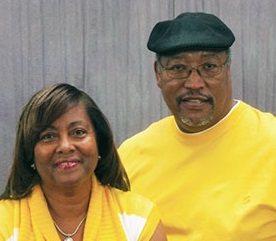
J.R. and Lula Richard

Richard with his wife, Lula: “My life is now better than ever because of the love of my life.”

He drew on his own homeless experience to help the homeless in particular, when not working with Houston donors to set up assorted children’s baseball programs where he’d teach the kids the game and a few hard-earned lessons of life, too.

“You see,” Richard told Littlefield, “a man could eat a whole whale, but it takes one bite at a time. Or he can walk a mile, but it takes one step at a time. So if you’re willing to take that step, [God] will make a way out of no way. See, God is the only one I know who can take a mess, go in a mess, clean up a mess and come back out and don’t be messy. Now you figure that out.”

Health and fate made that harder to figure out than he figured out how to strike fifteen Giants out in his first major league start—tying the rookie record set by Dodger legend Karl Spooner in 1954—or how to smash Hall of Famer Tom Seaver’s single-season National League record for righthanded pitchers.

Richard figured it out enough, too, to remarry happily. He met his third wife, Lula, when they shared a bus on a church trip. Maybe a little impulsively, Richard wrote his telephone number inside the cover of Lula’s Bible, and shared a steak dinner for their first date. They “courted” (Richard’s word) two years before marrying in 2010.

“She helped with a lot of stability, in every way,” Richard once said of her.

The man who once said he was the only man in baseball who could throw a ball through a car wash without the ball getting wet never lost his laconic wit, either, no matter what. Fans meeting him in later years and remembering their shock over his strokes often drew such replies as, “I couldn’t believe it, either.”

The Astros inducted Richard into the team’s Hall of Fame two years ago. They haven’t yet conferred the one thing Richard wanted most dearly when all was said and done, retiring his uniform number 50.

Nobody could believe what might have been the oddest game of Richard’s career. On 19 September 1978—the night he broke Seaver’s record—his mound opponent was Jim Bouton, Ball Four author, one-time Astro, attempting a quixotic comeback with the Braves. “The young flamethrower and the old junkballer,” Bouton described the matchup. Others called it David vs. Goliath.

Richard surrendered two earned run on three hits and three walks in seven inning; his money punchout came at the expense of Braves third baseman Bob Horner. Bouton surrendered two earned runs on five hits, walking five, striking out one. Lopsided as that looks, David and Goliath still fought to a draw. (The Braves won the game in the ninth.)

It wasn’t half as impressive as the battle Richard won after his career, the battle of life, after the kind of buffetings that would send lesser men into the Phantom Zone of walking death. May his beloved Lula, his family, all those who loved him for himself and respected his self resurrection, take comfort that the Lord in whom he devoutly believed welcomes him home with gentleness and kindness.

And, maybe, with a gentle joke Richard himself would appreciate—“About that car wash, J.R. . . . “
Max the Knife comes up aces

Max Scherzer

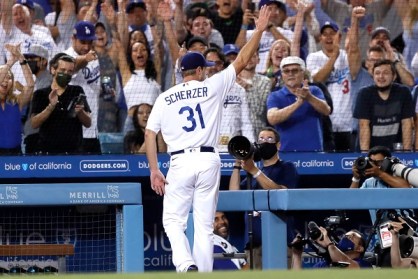
Dodger fans asked Max the Knife for something he’d never had in his career before Wednesday night—a curtain call.

Nothing could spoil Max Scherzer’s mound premiere in a Dodger uniform Wednesday night. And it wasn’t for lack of trying by the Astros. Not even for lack of trying by one particularly brain dead Dodger fan down the right field line.

The Astros made a grand enough effort after Scherzer left the game following seven stellar innings and ten strikeouts marred only by a solo home run and an RBI single. They had to settle for losing by two runs instead of five.

The Dodger bullpen made a grand enough effort, too, letting the Astros pry three runs out of them including a two-run homer in the top of the ninth off Kenley Jansen before he finally struck out the side to end the 7-5 Dodger win without any further self-immolation.

The aforesaid meathead in the stands did his best to contribute to a potential overthrow, too. With two out in the top of the eighth, struggling Cody Bellinger playing right field, and Carlos Correa at the plate against his old buddy Joe Kelly, Correa on 1-0 lifted a long foul down the line. Bellinger had a running bead on the ball and a certain side-retiring catch ready and waiting.

Until he didn’t.

Bellinger jumped just enough to make the catch. Except that the idiot in a Mookie Betts jersey with a glove on his left meathook reached up to snatch the ball right before it would have landed in Bellinger’s glove. Some of the fans surrounding the jerk congratulated him. Others surrounding him looked as though they wanted to brain him.

Technically, the jerk didn’t quite cross the line into obvious fan interference. But you’d think even the most profit-hungering souvenir hunter would be smart enough to back down when the right fielder has a chance to end an inning with a catch just above the edge of the fence padding.

Instead of side retired, Correa got extra life against Kelly. He swung and missed for strike two immediately after the stolen foul out, fouled another off, then turned on a hanging slider and sent it almost halfway up the left field bleachers for the third Astro run of the night.

Dodger Stadium security removed the miscreant after Correa finished his trip around the bases. A few of the fans in the same region let the security people know just how happy they weren’t over that removal. They’d better be grateful that this wasn’t another World Series game.

They’d also better be grateful that not even jerks being jerks could spoil Scherzer’s first outing as a Dodger.

The packed, roaring house just gave Scherzer even more incentive to go forth and do what he tends to do best, refusing to let even Michael Brantley’s one-out bomb in the top of the first, or Kyle Tucker singling Yordan Alvarez home with two outs in the fourth keep him from his appointed ten punchouts thanks to an effective curve ball setting up the fastest fastballs he’s thrown all season.

“You live for this,” Max the Knife said after the game. “You live to pitch in front of 50,000 people going nuts.”

They went nuts enough that still-ailing Clayton Kershaw, his fellow three-time Cy Young Award winner, nudged Scherzer back out of the dugout after his outing ended to take what he’d never taken in his entire career to that point—a curtain call.

“With everything on the line, the way the crowd was, that was a high-adrenaline start, coming here,” the righthander continued. “Try not to do too much. Just pitch my game, go out there and do what I can do, and just try to navigate the lineup. The offense tonight went off.”

“Went off” was a polite way to put it. The Astros barely had time to let their opening 1-0 advantage sink in when Betts turned on Jake Odorizzi’s slider and sent it over the center field fence to lead the bottom of the first off. A walk, a swinging strikeout, and a Jose Altuve throwing error later, Will Smith turned on Odorizzi’s fastball and drove it into the right field bleachers.

One inning and one out after that, Betts struck again, hitting a 3-1 heater into the left field bleachers. An inning, two outs, and a walk after that, A.J. Pollock hit one over the left field fence and Odorizzi must have thought by then that he could have pulled an automatic pistol out of his pocket, fired toward the plate, and still watched the bullet travel out of the yard off the end of a Dodger bat.

The Astro righthander blamed poor mechanics since the All-Star break, but with a 4.95 ERA and a 5.06 fielding-independent pitching rate on the season you could almost wonder whether the Astros threw him up as a sacrificial lamb Wednesday night.

“My fastball has been flat,” Odorizzi said after the game. He could have said “flat-tened” and it wouldn’t have made a difference. “There are a lot of things I am working on between outings, but then I am reverting back to bad form.”

The bad news for the Dodgers was that such reversion threatened to ruin Jansen and them in the top of the ninth. He surrendered a leadoff single to Aledmys Diaz before Tucker sent a hanging cutter into the right field bullpen. Then Jansen re-horsed to strike Robel Garcia, Jason Castro, and pinch-hitter Meyers out swinging.

Nothing, though, could diminish Scherzer’s impact. Especially with the Dodgers in straits desperate enough in the starting pitching department. Walker Buehler and Julio Arias have had to hold fort while Kershaw’s forarm inflammation hasn’t subsided yet, and it’s already kept the lefthander out since early July.

Tony Gonsolin’s shoulder is inflamed likewise. Still-ailing Kansas City import Danny Duffy isn’t likely to be ready before September. And the execrable Trevor Bauer remains on administrative leave while MLB and the Pasadena police continue investigating sexual assault accusations against him.

The Dodgers hogged the headlines on trade deadline day when they swept in and snatched Scherzer (plus star infielder Trea Turner) from the Nationals and right out from under their downstate rival Padres’s noses. Now Scherzer had to live up to the headlines—just the way he forced himself to live up to the biggest noise of 2019 and pitch on nothing but fumes and will to keep the World Series-winning Nats in Game Seven just long enough to give them a chance to win it in the first place.

Manager Dave Roberts almost wasn’t worried. Almost. Buehler and Urias must have felt as though thousand-pound iron blocks were removed from both their shoulders after Scherzer’s evening’s work finished.

“From the moment I got to the ballpark, we got to the ballpark, you could just see that elevation, anticipation from our guys,” Roberts said post-game. “The buzz in the crowd from the first pitch, him taking the mound, donning the [Dodgers’ home uniform] for the first time—he delivered. He delivered. Just the intensity. It was so much fun. And it was just really cool to see the crowd smell it and want him to finish that seventh inning.”

“I mean, it’s Max Scherzer,” the Mookie Monster said post-game. “I think that kind of speaks for itself.” (In case you were curious, Betts had one hit—a double—in six lifetime plate appearances against Scherzer before they became teammates.)

For Scherzer, coming off the only mid-season trade of his distinguished career, and to the team he’d helped beat in the 2019 National League Division Series, the hardest part’s over. For now. “I’m a Dodger,” Max the Knife said. “It feels a lot more normal when you just go out there and pitch and win. Winning kind of cures everything.”

It might even get him the final home address of his career. Might.

If he keeps pitching the way he did Wednesday night, even at age 37, and nobody including Scherzer shouldn’t be shocked if the Dodgers decide to make it worth his while and his bank account to keep him in the family. At least until his arm finally decides to resign its commission a couple of years from now. Maybe with a couple of more World Series triumphs to its credit before he’s done.

Keep it in the stands, Astrogate protestors

Dodger Stadium

This Dodger ball girl is not rushing to take out the trash—she’s disposing of an inflatable trash can thrown on the field Tuesday night when the Astros hit town. (USA Today photo.)

Dodger fans finally had their chance to let the Astros have it over Astrogate Tuesday night. Over the Astro Intelligence Agency very likely remaining in operation during the 2017 World Series. Over the hapless Rob Manfred forced to issue immunity to Astro player culprits in return for their spilling the deets—then having to walk back his temporary-insanity dismissal of the World Series trophy as a hunk of metal.

Over what Mike Fiers finally blew the whistle on about the Jeff Luhnow-era Astros’ systemic, illegal, off-field-based electronic cheating, opening the way to further exposure of Luhnow’s amoral results-before-people operating ways. Over the Astros’ failure to own up at the notorious spring 2020 presser before the pan-damn-ic shut spring training down and delayed what proved the 2020 irregular season.

Over owner Jim Crane putting his foot in his mouth repeatedly. (This didn’t impact the game; we won the World Series; I didn’t say it didn’t impact the game.) Over Astro players doing everything in their power not say flat-out that they and the organisation cheated.(We’re not going into details. Never mind how many details were exposed over almost three months preceding.)

Last year the pan-damn-ically mandated fan-less stands deprived one and all of letting the Astros have it live and in person. They had to settle as Dodger fans did for milling outside the ballparks, social distancing properly enough, but heckling, hollering, and banging when the visiting Astros’ team bus arrived for the games.

This year, different story. The returning fans began making up for lost time. The bad news is that no few of those fans took things a few steps too far. Maybe not as far as the Astros took high-tech sign stealing, but far enough.

For one thing, the Astro roster is whittled down to only five remaining members of the 2017 World Series roster. For another thing, it’s been demonstrated plausibly since that Astros second baseman Jose Altuve, the arguable face of the franchise, objected to the trash can bangings that sent the pilfered intelligence to the batter’s box while he was at the plate.

For a third, protesting fans have crossed the line too often from heckling, booing, and catcalling to throwing things on the field. Things from the harmless enough stuff such as inflatable play trash cans to honest-to-God real trash cans and other none-too-soft projectiles. Astros reliever Ryne Stanek swore that fans near the right field bullpen threw “basically full beers at people for a half an inning” when the game was two-thirds done.

Dodger fans Tuesday night threw down hollers of “cheaters,” rounds of expletives in English and Spanish, and rather impassioned booing when Dodger Stadium’s public address announcer threatened the sellout crowd with ejections for throwing things onto the field, possibly even including any foul balls or home runs the Astros hit into the seats.

Somewhere in the middle of the racket the Astros and the Dodgers played a baseball game. Somewhere in the middle of it, the Astros won, 3-0, despite Dodger starter Walker Buehler pitching six stout innings with only one run against him, courtesy of Michael Brantley’s RBI double in the third.

Somehow, another Astro relief pitcher, Blake Taylor, still thought it took “a special player” to wear an Astro uniform still bearing the taint of the 2017-2018 cheaters.

“If you’re not willing to withstand the criticism you’re gonna get at every stadium we walk into, you can’t handle it — it’s tough. It’s tough thing to ask a lot of guys to do,” he told reporters.

But the crew that we have right now, they’re all in on this. They know that they’re not the only ones going through this. Every single person in this clubhouse gets booed every time we walk on the field and just gets called “cheaters” and things like that. So at the end of the day we’re just one big family and we have each other’s backs, no matter what.

Even leading the American League West by five games, it isn’t always a thrill to be an Astro these days. I say again: Fair or not, the Astros will wear the Astrogate stain until the last member of that tainted 2017-18 team no longer wears the uniform. Even if it’s patent nonsense to hold the entire 2021 roster responsible for what Alex Bregman, Carlos Correa, Yuli Gurriel, and Lance McCullers, Jr. were part of in 2017 and couldn’t own up to in pre pan-damn-ic shutdown spring 2020.

(Why let Altuve off the hook? There also turned out to be not a shred of real evidence, after all, that Altuve wore any kind of wire device under his uniform, as suspected after he ducked the jersey shredding following his pennant-winning walkoff bomb in the 2019 American League Championship Series.)

I say again, further: Go ahead and make all the racket you want denouncing the Astros. Boo them if you must. Insult them if you must. Wear those Oscar the Grouch costumes if you wish. (The independent league St. Paul Saints couldn’t keep up with the demand for “Astro the Grouch” figurines playing recorded trash can bangs last year.) Hoist the inflatable trash cans, bang your plastic ones loud and long if you must, sing anything from “Secret Agent Man” to “The Spy Who Loved Me.”

But keep it in the stands and quit throwing things onto the field. Manfestly, Joe and Jane Jerk-fan, that makes you look at least as bad as the Astros made themselves look when they got exposed as illegal off-field-based electronic-and-algorithmic cheaters and then—given the chance to own up and man up—told the world the dog ate their homework.

Gone, Cubs, gone

Anthony Rizzo, Kris Bryant

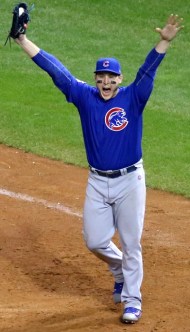
That was then: Anthony Rizzo clutching and hoisting the off-balance throw Kris Bryant (17) made to end the 2016 World Series as world champions. This is now: They’re not Cubs anymore.

I called it the Code Blue Series when the contestants were confirmed. One team that hadn’t won the World Series since the premieres of cellophane, the Geiger counter, and the Model T Ford. The other, a team that hadn’t won the Series since the threshold of the Berlin Airlift.

“I’m sleeping with this thing tonight,” crowed Anthony Rizzo, speaking post-game, about the double play ball he caught on the relay to start Chicago’s post-National League Championship Series parties. “Are you kidding me?”

The same Rizzo who clung to the dugout rail in Game Seven of that surreal 2016 World Series, admitting to teammate and eventual manager David Ross that he was on the brink of his nineteenth nervous breakdown.

“I can’t control myself right now. I’m trying my best,” Rizzo said.

“It’s understandably so, buddy,” Ross replied, with a very knowing smile. He’d been there, done that, with the 2013 Red Sox.

“I’m emotional,” Rizzo admitted.

“I hear ya,” Grandpa Rossy replied.

“I’m an emotional wreck.”

“Well, it’s only going to get worse,” Ross advised. “Just continue to breathe. That’s all you can do, buddy. It’s only gonna get worse . . . Wait until the ninth with this three-run lead.”

Once upon a time, possibly thanks to Chicago newspaper legend Mike Royko, the maxim was that the teams with the most ex-Cubs lost. That was then, this was the 2016 Series: The Cubs—the team with the fewest ex-Cubs and the most ex-Red Sox—won. After a couple of that-almost-figures hair-raisers, none raising more hair than Game Seven.

Now, third baseman Kris Bryant—subject to the most trade rumours the past two years—is traded to the National League West-surprising Giants. Shortstop Javy Baez is traded to the National League East-leading-almost-by-default Mets, where he’ll gladly play second base for the chance to hold the keystone with his buddy Francisco Lindor at short. And first baseman Rizzo has become a Yankee.

The 2016 core is gone, Cubs, gone. Four men from that team now remain.

Ross retired as a player after that Series triumph and has managed them since last season, having days enough now when he must think Lucifer’s practical jokers have made him a too-frequent target. Right fielder Jason Heyward’s stellar defense once atoned for his feeble bat, but he isn’t quite the defender he used to be even if he’s still a shade above the league average for run prevention. Catcher Willson Contreras remains a mainstay and leads the team with his 3.2 wins above replacement-level.

And Kyle Hendricks, who pitched magnficently enough in the 2016 Series, leads this year’s Cub rotation with an ERA two ticks from four despite his twelve credited wins.

The Cubs approached Friday’s trade deadline all-in on selling while the selling was good, because their National League Central chances were anything but and the last of the true core was due to hit the open market. And the team administration has a lot to atone for, for having failed to fortify the team viably in the seasons to follow the 2016 heights.

It’s still too telling that the single most fun moment in Cubs baseball this season came from Rizzo, the first baseman taking the mound on the wrong end of a blowout, striking out his Braves buddy Freddie Freeman to laughs all around the park—especially between those two.

If the Dodgers hadn’t swept in and swept the Padres to one side in the Max Scherzer lottery, the Great Cub Fire Sale might have dominated the proceedings entirely.

But it’s hard not to think about that World Series now that Bryant, Rizzo, and Baez are gone at last. Especially after Rizzo made an almost immediate impression with his new team Friday night. (Yankee announcer Michael Kay called Rizzo “the linch pin” of the 2016 Cubs.) He broke a scoreless tie between the Yankees and the Marlins by sending a 1-0 hanging cutter into the second deck behind right field in the top of the sixth. (The Yankees went on to win, 3-1.)

It’s hard not to remember Dexter Fowler’s eighth-inning home run off then-Indians relief ace Andrew Miller in Game Four. Making Fowler the first Cub to hit a World Series homer in Wrigley since Chuck Klein—in 1935. And, making him the first African-American Cub to hit a World Series homer ever.

It’s hard not to remember Bryant—with the Indians six innings from the Promised Land— parking a 1-1 pitch into the left center field bleachers off then-Indian Trevor Bauer to start turning the mostly quiet Confines crowd on the Chicago leg of the Series into a nuclear meltdown of joy in Game Five.

It’s hard not to remember Rizzo and eventual Series MVP Ben Zobrist scoring in the first in Game Six, after Indians outfielders Tyler Naquin and Lonnie Chisenhall misread and misplayed Addison Russell’s shuttlecock fly to right center. Or, after the Cubs loaded the bases to push Indians starter Josh Tomlin out, Indians reliever Dan Otero feeding Russell grand salami with mustard.

It’s hard not to remember Jake Arrieta pitching to Naquin with the bases loaded and two out in the bottom of the fourth, same game, and striking Naquin out on one of the nastiest divers Arrieta ever threw in his life.

It’s hard not to remember Game Seven, especially. When Ross had to atone for a horrible throwing error past Rizzo one inning by smashing a one-out homer the next. When the late rain delay prompted Heyward’s clubhouse pep speech.

When Rizzo took the free pass in the top of the tenth, took third on an RBI double, and scored after another intentional walk and a base hit to left—the base hit being Miguel Montero’s second-most important bases-loaded hit for the Cubs that postseason.

When Bryant picked off Michael Martinez’s short grounder on the dead run, with two out and a run in to close the Cub lead to a single run, then threw a little off balance and herky-jerky at that to first—and Rizzo snapped the ball in his mitt as dearly as he might have clung to the Hope Diamond after a daring heist.

Russell forced himself off the Cubs and out of the Show entirely in due course, after the sick case of his abuse of his wife exploded into headlines and forced his suspension. He played in the Korean Baseball Organisation last year and plays in the Mexican League this year.

Montero talked his way out of Chicago. First, he complained about his loss of 2016 postseason playing time to Ross and Willson Contreras behind the plate. Then, in 2017, he was gone for good after blaming Arrieta publicly for the Nats running wild on his arm on the bases in a June game. Two subsequent hiccups of comeback bids with the Blue Jays and the Nationals—retired.

Zobrist, who came to the 2016 Cubs after winning the 2015 Series with the Royals—a down 2017, a comeback 2018, retired after 2019. Now, he’s undergoing a painfully public divorce in which his wife’s accused of having an affair with the minister they engaged for marital counseling in the first place.

Arrieta—allowed to walk as a free agent after a 2017 that began his still-ongoing decline phase. Jon Lester, who somehow got past his throwing issues to first base and stood tall enough when it counted—now a National-turned-Cardinal. John Lackey, pitching for his third different Series winner—retired after fifteen seasons and a down 2017. Aroldis Chapman, the howitzer relief pitcher but a domestic abuser himself—a Yankee since 2017.

This week? The Cubs’ place in the race was probably sealed for the season when they lost eleven straight from 25 June through 6 July, but seven of the eight players they moved by Friday’s deadline also stand to hit the open market after the season. Resurgent relief pitcher Craig Kimbrel—dealt to the crosstown White Sox and right back into the races—has a 2022 option.

Maybe the real end of this generation of Cub contenders came in 2018, during the second half of which they lost 22 games in which they scored one or none. Including the humiliations of scoring a measly two runs in back-to-back losses that cost them the NL Central title and the NL wild card in one thirtysomething-hour period.

Maybe it was sealed once and for all by 2019, when they lost a pair of humiliating series in the last two regular season weekends and, as ESPN writer Jesse Rogers observed, the Joe Maddon era ended when the skipper “wasn’t able to out-manage the mistakes the front office saddled him with.”

“The Ricketts family had cut back on payroll spending while continuing to use Wrigleyville as a private cash machine,” writes the redoubtable veteran scribe Rick Morrissey of the Chicago Sun-Times. “The franchise didn’t keep up with other contenders in terms of on-field talent. It settled for being very good instead of great. The idea—always—is to win. Cubs fans got that, which is why they were irritated when the club didn’t get a whiff of the World Series again.”

Maybe that was what irritated the remake/remodel/re-conquer mastermind Theo Epstein enough at last to swap the Cubs’ front office for a gig in the commissioner’s office, where he now works helping to get baseball back to where it once belonged, a balance between pitching and hitting. He won’t have his hands tied by ownership caprice anymore. We think.

It stung when Ross kept Bryzzo out of the Thursday lineup at home, denying them a final appearance before the Wrigley faithful. He said Rizzo already had the day off pre-planned and was concerned about giving Bryant’s legs a rest. Cub Country didn’t need anyone to say maybe the front office handed Grandpa Rossy an order the better to keep the deals to come from being wrecked.

We saw Bryant in tears on his cell phone in the Cubs dugout at Nationals Park Friday, receiving the news he was going west. We saw Rizzo taking his young family to walk the Wrigley Field grounds one more time the day before, before he went east. Those sights will linger for Cub Country almost as vividly as Bryan’s off balance pick and throw of Martinez’s grounder to Rizzo to finish 2016 will. (This is gonna be a tough play, Bryant—the Cubs! Win the World Series! hollered announcer Joe Buck.)

President of baseball operations Jed Hoyer says the deals helped the Cubs duck a complete rebuild thanks to the youth the deals bring back. “Was it emotionally difficult? Yes,” he said to Rogers. “Do I think it was absolutely the right thing for the organization? I do.”

Nature of the beast. Hoyer was only too well aware of other teams going all the way to the end of their team control only to require years of rebuilding. Teams like the Phillies, the Tigers, and the Giants, the last of whom have begun making noise that’ll be amplified a bit with Bryant on board.

“They ran to the end of the cliff and fell off and they had to rebuild,” he continued. “We were willing to go to that point if this was a winning team this year, but we weren’t, so with that we were able to speed that process up dramatically.”

But going from “Go, Cubs, Go!” to gone, Cubs, gone, still stings. Even if we’ll always have 2016.

Two champion Series finishers move on

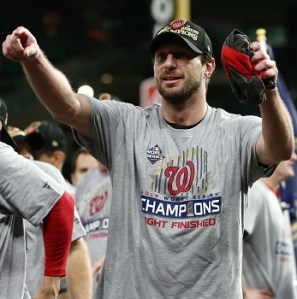
Max Scherzer

Max the Knife celebrates the World Series triumph he helped author with his on-fumes Game Seven start. Can he help the Dodgers go back to the Series?

The author of maybe the single most uplifting game in Nationals history is a Nat no more. The fellow with one blue and one brown eye who forced his way past a neck issue to keep the Nationals in line to win their first World Series has gone west.

That was hours after the Cubs finally said goodbye to the man who snapped into his mitt the final out of their first World Series win since the premieres of cellophane, the Geiger counter, and the Model T Ford.

Trade deadlines don’t often feature two or more signatures of two off-the-charts World Series champions changing addresses and wardrobes. When they’re men identified that tightly with their teams, even those with no rooting skin in their games can’t help thinking that the world just got knocked more out of order than it seemed going in.

This year’s Nats don’t have a staggering rise from the dead in them just yet, if at all. This year’s Cubs were bent on selling while the selling was good, with their National League Central chances this year anything but. “Go Cubs Go,” that rollicking anthem of the 2016 conquerors, now has another meaning.

Max Scherzer goes west for a better chance at a postseason return with the Dodgers. That was just moments, seemingly, after the entire world thought the splash-happy Padres had him all but loaded on the plane west. Ouch.

Anthony Rizzo goes east in a Yankee hope that a couple of heretofore missing lefthanded bats—they’d landed all-or-nothing portside slugger Joey Gallo from the Rangers just prior—might turn their season from somewhat lost to yet another shot at the Promised Land.

The Nats hope the package of prospects Scherzer and shortstop Trea Turner brought back from Los Angeles mean this season proves a hiccup on their way back to the races to come. The Cubs hope the pair Rizzo brought back from the Bronx means likewise, especially depending on what they can bring back in any deal for Rizzo’s partner in 2016 World Series crime, third baseman Kris Bryant.

But ending eras is never pleasant. And these two deals ended a pair of eras that’ll live as long as Washington and Chicago live. The Rizz speared Bryant’s herky-jerky on-the-move throw over to secure the Cubs’ World Series winner. Max the Knife’s empty-tank performance of sheer will kept the Nats alive enough to pull just enough lingering rabbits out of their hats to nail Game Seven in 2019.

Chicago and Washington won’t forget as long as those cities and those men live. The feeling is very mutual with the players involved.

“This city,” Rizzo said when the deal to the Yankees was done, “will be ingrained in my heart for the rest of my life.” Told he was as transformational a figure in Wrigley Field as anyone who ever wore a Cub uniform, Rizzo accepted the idea with no small pride. “That’s what matters most—leaving this place better than when I found it. I can say the mission was accomplished.”

Scherzer still wasn’t sure whether he’d still be a Nat after he pitched Thursday and threw three-hit, one-run ball at the Phillies, in a start that was as much a showcase for his renewed health (he’d missed a start with a triceps strain a few days earlier) as for the trading floor. But he wanted to think about what Washington meant to him from the moment he’d signed that mammoth seven-year deal due to expire after this season.

Anthony Rizzo

Nobody beats The Rizz: Clutching the final out of the Cubs’ 2016 World Series conquest.

First, there were the purely baseball considerations. “I signed a seven-year deal here and we won a World Series. That’s the first thing I said when I signed, that I was here to win. And we won. We won a World Series,” he said. “That’s a lifelong dream come true and something I’ll always be proud of with these guys here, to be part of a championship team, looking forward to reunions and stuff like that.”

Then, there came the familial and community considerations. Scherzer arrived childless in Washington with his college-sweetheart wife, Erica. They’re going to Los Angeles with two of Scherzer’s three Cy Young Awards and three daughters.

“I’ve watched my girls grow up here,” Max the Knife said. “Living in Virginia in the DMV area, I’ve really gotten used to it, all the politics that are going around. Being in the nation’s capital has been kind of fun as well, driving by the monuments every day . . . What can you say about the fans? That championship will always mean something to all of us and we’ll always have that flag.”

Parting with uber prospects Keibert Ruiz (catcher), Josiah gray (righthanded pitcher), Gerardo Carillo (righthanded pitcher), and Donovan Casey (outfielder) made sense only if the Dodgers were going to bring in something well above average. They brought in the best pitcher and the best position player—a still-young shortstop with a live bat—on the trading floor.

If the Dodgers want to close the brief distance between themselves and the uber-surprising Giants in this year’s National League West, they couldn’t have done better if they’d gone to the lab and mixed the right ingredients in the test tubes and beakers.

The Nats aren’t exactly leaving themselves helpless. They have have pushed the plunger on this year, but with Juan Soto around whom to remodel they’re looking at 2022 and beyond. Particularly with a returning Stephen Strasburg and who knows what off-season deals or signings to come.

Mostly, Scherzer relieves the pressures on the Dodger starting rotation, what with Dustin May lost for the season recovering from Tommy John surgery and Trevor Bauer persona non grata when all is said and done, in the wake of a police investigation into a couple of turns of rough sex crossing the line from consensual to downright unwanted sexual assault.

Whether he proves a rental or whether the Dodgers want to keep him for the rest of his baseball life remains to be seen. Don’t bet against the Dodgers deciding to make the latter happen.

The Yankees should be so lucky with Rizzo and Gallo. Yes, they sent out a lineup full of raw power until those deals, but that lineup lacked consistency and lefthanded hitting, the long-traditional fuel of that long-vaunted, long-legendary Yankee power.

Rizzo is the far more balanced hitter between the two newcomers as well as a multiple Gold Glover at third base. Gallo is so all-or-nothing despite his ability to work walks that he actually lets you imagine Mario Mendoza as a power hitter, but he is a solid defensive outfielder with range and arm enough to maybe make the Yankees forget about Brett Gardner at long enough last. Maybe.

So where was the pitching help the Yankees really needed? Why weren’t they all-in yet on someone like Scherzer? Despite his expressed preference for going west, the Yankees have been nothing if not able to persuade such determined men otherwise in the past.

Why not all-in on resurgent and available Cubs closer Craig Kimbrel? Especially with other teams trailing him including now the Rays, rumoured to be pondering a package of Kimbrel and Bryant coming aboard? Or resurgent and available reliever Daniel Hudson, the 2019 World Series finisher whom the Nats dealt to Seattle before the trading floor really began bristling with prize packages?

Or Jose Berrios, the formidable Twins starter whom the Blue Jays have snapped up for a pair of prospects and who’ll have him through the end of 2022 at minimum pending their ability to sign him longer-term from there?

The Yankees are still in the race, technically. The problem is, they’re three games plus behind the Athletics in the American League wild card picture and eight and a half games behind the Red Sox in the American League East.

And while Dodgers mastermind Andrew Friedman may be taking bows enough for Max the Knife and Trea Chic, Yankee general manager Brian Cashman—whose questionable at minimum construction of the current Yankee roster should take the heat Yankee fans heap upon hapless manager Aaron Boone—may yet have some very serious splainin’ to do.