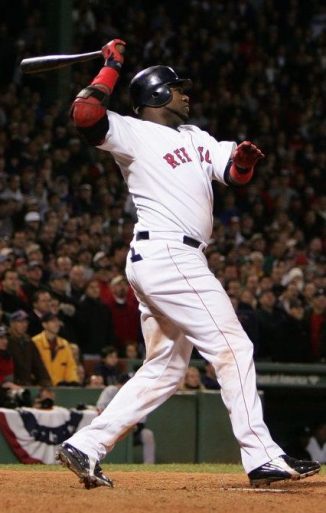
Ortiz in Cooperstown: Now, about that (ahem) other stuff

David Ortiz

Boston’s 21st Century king of swing wasn’t as tainted as you still might think.

It almost figured that I’d see at least one person only start reminding us of now-Hall of Famer David Ortiz’s “taint” by noticing he’d hit only 20 home runs in his final Minnesota season, 2002, then 37 in his first Boston season, 2003. Heaven forbid such people do their homework. So I did it for him, and for anyone else who cares.

As a Twin in 2002, Ortiz hit fifteen home runs on the road but only five in the Metrodome, which was still the Twins’ home playpen. (Calling the Metrodome a park is like calling Itzhak Perlman a fiddler.) As a Red Sox in 2003, Ortiz hit fourteen homers on the road and seventeen in Fenway Park.

In other words, Ortiz—who signed with the Red Sox as a free agent after the Twins released him—went from a home stadium that was killing him to a home park that was great for him at the plate. He didn’t need actual/alleged performance-enhancing substances for that.

Now, about that 2003 positive for actual/alleged performance-enhancing substances? The one that marks Ortiz as a “steroid cheat” for life, in the eyes of only too many? Can we shoot that one down once and for all?

1) Those 2003 tests were supposed to be anonymous, done to determine whether the problem of actual/alleged PEDs was indeed rampant enough to begin mandatory testing. Well, they were anonymous . . . until somebody leaked the results to the New York Times six years later.

2) The 2003 tests turned out to be very problematic and even tainted. (Not to mention seized improperly by the federal government.) Even Rob Manfred himself has said of them, “it was hard to distinguish between certain substances that were legal, available over the counter, and not banned under our program.”

Ortiz was never even told the substance in question. Not even the Major League Baseball Players Association would tell him what it was. The last I looked, if you were accused of something horrible but never once told just what you were accused of doing, you’d have grounds to dismiss your accusers as bloody fools at minimum—and targets of defamation suits at maximum.

Manfred even said it couldn’t be confirmed for dead last certain that Ortiz actually did test positive for such a substance. That may have been the case with several other players testing positive in that supposed-to-be-anonymous test.

3) Mandatory testing for actual/alleged performance-enhancing substances began in MLB in 2004. Ortiz was tested regularly, several times a year, over the final thirteen years of his career . . . and never. once. tested. dirty.

4) By contrast, of course, Barry Bonds and Roger Clemens were suspect prior to the mandatory testing era and starting around 1999-2000. They’ve fallen off the BBWAA ballot now, after failing to be elected in their tenth and final tries and despite getting their highest vote percentages yet. (Bonds: 66 percent; Clemens: 65.2 percent.) Yes, their records prior to 1999-2000 said Hall of Famers both. Hall of Fame writer Jayson Stark says, simply, “They just ran out of minds to change.”

Maybe not quite. Both their cases, the good, bad, and ugly, go to the Era Committees. The Today’s Game Committee could take them both up as soon as next fall. That’ll be small comfort to those excoriating the Baseball Writers Association of America for saying OK to some who’ve been suspected but never proven and no to others suspected and suspected and suspected again.

Saying no to those absolutely affirmed is different. Manny Ramírez tested dirty twice during the mandatory-testing era and put paid to himself. He didn’t help his own cause, either, by having been one of baseball’s biggest pains in the rump roast. What they used to call “Manny Being Manny” was Manny graduating from a fun-loving nutbag to a self-centered jerk who often wounded his teams with his antics.

Aléx Rodríguez, who was a first-timer on this year’s BBWAA ballot as well, got nailed stone cold in the Biogenesis probe, of course. That probe had its own issues, unfortunately, but A-Rod’s self-immolating bid to sue his way out of that jam until he was forced to sit an entire season out under suspension took care of him.

My own ambivalence about the actual/alleged PED question comes down as well to the following: It was and remains genuinely impossible to prove for dead last certain that using them did or didn’t give someone a performance or statistical edge. You can even look at a considerable majority of such suspects and discover their stats actually dipped, not rose, during the periods they were believed to indulge. (Jason Giambi was one such candidate, in fact.)

You can also find considerable research to suggest very plausibly that the substances which inflated arm and shoulder strength weren’t really going to help for one good reason: nearly all power hitters generate their power from the lower body, from the torso and thighs.

There were enough players, too, who dipped into the actual/alleged PED well not because they thought it would give them an edge at the plate or on the mound but because they thought—foolishly enough—that they could recover from injuries quicker and without consequences. If they learned the hard way about the consequences, could you blame them for trying? Really?

Baseball doctors aren’t exactly chock full of Nobel Prize for Medicine candidates. In enough cases they could be tried by jury for malpractise, if not quackery. You can remember how many players with careers compromised or ended for rushing it back, being rushed back, or playing foolishly through injuries?

And don’t get me started on how many injured players were denounced as “quitters” for not wanting to risk the long term and play through injuries that might have become worse. (Were, and still are. Carl Crawford had Hall of Fame talent but was sapped by injuries—including one or two he was foolish enough to try playing through, for fear that his manager might call him a quitter, too.)

As a member of the Internet Baseball Writers Association of America, I participate in an annual vote for the Hall of Fame. Symbolic regarding the real Hall of Fame, of course. But we elected Bonds and Clemens a couple of years ago. I’d like to think we, not just me,  knew Bonds and Clemens were Hall of Fame worthy by their careers before they were suspect.

(We also figured, I’m sure, Clemens having been acquitted of lying to Congress’s Committee for the Dissemination of Great Messages to Kids [thank you again, Mr. Will] when he denied using actual/alleged PEDs.)

I’d like to think we also knew the tainted 2003 anonymous test shouldn’t taint a David Ortiz who burned to play in the biggest of the big, shone in the biggest of the big, and has three World Series rings to show for it, but never tested dirty in thirteen seasons to follow of playing in the mandatory testing era.

But it’s easier to clean up an oil spill than it is to change minds made up before or despite the real evidence coming before it. That’s something that even ironclad evidence has a tough time overcoming.

This is his [bleeping] Hall of Fame

David Ortiz, Pedro Martinez

David Ortiz (left) with an arm around buddy Pedro Martinez after Martinez’s Hall of Fame induction. Martinez returned the favour, being there when Big Papi got the call he was a Hall of Famer on Tuesday evening.

In the end, the big man with the garrulous personality was the boy in the toy store handed carte blanche to help himself. With Hall of Fame Red Sox teammate Pedro Martinez’s arm around him and his cell phone on speaker, David Ortiz got the call he finally suspected would come—but not necessarily on his first try.

The man whose real coming-out party was a mammoth game-winning home run to finish what the Red Sox started improbably enough, in Game Four of the 2004 American League Championship Series, stopping a Yankee sweep and launching the Red Sox to four straight wins, a pennant, and a World Series sweep, was overwhelmed at last.

Before Ortiz was elected, twelve Latino men were elected to the Hall of Fame by the Baseball Writers Association of America, and three who played in the Negro Leagues before the Show colour line was broken were chosen by committees designated to consider Negro Leagues greats. The most recent Era Committee votes elected Tony Oliva and Minnie Miñoso, too.

Ortiz now makes eighteen Latinos in the Hall of Fame and four from the Dominican Republic. His fellow Dominican Hall of Famers are Martinez, Juan Marichal, and Vladimir Guerrero. Guerrero told the Cooperstown gathering in 2018 that he was aware his election could open a door for other Dominican-born greats to follow. Big Papi probably gave the door a blast open comparable to any he’d hit in the biggest of his big moments in a Red Sox uniform.

He’s also the first full-time designated hitter to reach the Hall of Fame on his first BBWAA ballot. It took Edgar Martinez ten tries to make it, before he finally and deservedly punctured any longtime bias against full-time DHs. (Frank Thomas didn’t become primarily a DH until the tenth of his nineteen-season career; Harold Baines—the most mistaken Hall pick of the past decade—didn’t get to primarily DH service until his eighth of 22 seasons.)

But if Martinez should have ended up failing and gone to an Era Committee for second and third looks, Ortiz would likely have blown the bias away. It doesn’t denigrate Martinez to say that, between the Hall’s now two fullest-time DHs, Big Papi has a big advantage on the depth and height charts, according to my Real Batting Average metric:

Hall of Fame DH PA TB BB IBB SF HBP RBA
David Ortiz 10,091 4765 1319 209 92 38 .637
Edgar Martinez 8674 3718 1283 113 77 89 .609

Among the four Hall of Famers recognised as designated hitters first, the average RBA is the same as Martinez’s. (Baines, in case you were curious, has an RBA 71 points below that average.) Ortiz’s 28 points above the average is topped among the Hall DHs only by Thomas’s +45 points. (Thomas’s RBA: .654.)

David Ortiz

Big Papi’s real coming-out party—the game-winning bomb in Game Four, 2004 ALCS.

It’s not their fault that their teams didn’t deliver unto them as many chances for the big moments that Ortiz’s Red Sox delivered unto him. It’s certainly not fair that we’ll never know how they would have acquitted themselves if they had been. Ortiz’s postseason RBA is sixteen points higher than his regular-season career RBA, and he was even more of a one-man highlight show in the postseason than he was in the regular season, which was often enough and then some.

“It’s a next-level type of thing,” Ortiz said after getting The Call. “You don’t see this every day. You don’t receive this phone call every day . . . I have so many great and wonderful times while I played, but this one, it’s the type of baby that you just want to hold onto it and never let go.”

Just the way those who knew and played with and even against him hold onto and never let go of their encounters with him. Short-time Red Sox teammate and now Cubs manager David Ross is one. Grandpa Rossy will tell you one minute that Ortiz was a mentor who counseled him to hit according to your nature (If you’re a fastball hitter, don’t miss the fastball; if you hit breaking balls, crush the breaking ball) and the next that there might not have been a body big enough to contain his heart.

“The heart was as big as the baseball skills,” Ross says. “He had parties after every playoff win. Everyone was invited. Ownership, his pastor. He’s a special human being. When he stepped out of the dugout, everyone knew he was there to put on a show. Pretty special presence that he brought.”

“He treated everybody with a high level of respect,” says his former Red Sox teammate Gabe Kapler, currently the manager of the National League West-defending Giants. “He was a very normal guy who reached a high level of performance and superstardom that nobody expected . . . A moment was never too big for him. He was never too wound up . . . He was a very in-control man, a very thoughtful man. Very measured. That measured, calm heart rate helped him succeed in those moments.”

Not even when it came time to put an entire city on his back in the immediate wake of the terrorist act the Boston Marathon bombing was in 2013. But I say again: beware the odds that Big Papi won’t be able to resist the temptation to holler from the Cooperstown podium, This is our [fornicating] Hall of Fame! If he can’t, who could blame him?

My Louisville Slugger: the fountain pen

Mont Blanc 221P

The author’s Mont Blanc 221, extra fine point, the perfect bat to swing away from home.

My way of life is simple enough. The only implement I use that is at least as mighty as the sword (which I don’t use, although some might suggest my chef’s knife comes close), the guitar (which I do play), or the baseball bat (which I haven’t swung since helping my son learn to play) is the fountain pen.

Well, if you want me to get technical, you can call it a cartridge pen, since the five fountain pens I own and use are filled with cartridges. I confess to a fear of the piston filler into which you vacuum a full tank of ink from a bottle. More to the point, I fear being just clumsy enough that half the ink in a fill might end up on my fingers.

A pen to a writer is as a bat to a ballplayer. We writers only hope that the lines we write endure as long as the joy, the artistry, the memories of a particular hit, a particular pitch, a particular game. Today those joys, artistries, and memories are preserved aboard YouTube to be cherished and shared. Our words, we hope, remain in print as well as on the paper aboard which we write, those of us who still write with pen to paper first.

But “cartridge pen” simply doesn’t suggest the romance of real writing with pen to paper. Of course, when receiving my first such pen as a fifth grader in 1965, there wasn’t much romantic about it. You didn’t think of the spiritual flow of words from your mind and heart through the pen to paper when taking classroom notes, you thought of surviving the day’s lectures until the final dismissal bell.

A friend of my parents who worked in the stationery business seemed to have a tireless supply of Sheaffer pens (lucky for him, with three children of his own), and was kind enough to present me with a pair of them. One was a ballpoint, the other a fountain pen. In those years, Sheaffer called their ink cartridges Skrip. Skrip for script. The ballpoint soon went the way of the St. Louis Browns but the fountain pen stayed.

And stayed. And stayed. Whenever I might lose one or one might exhaust its usefulness, I simply bought another one. Sheaffer “school pens” featured coloured, translucent barrels. Upon any need for a fresh one, I’d pick a different such colour each time out. I used them for years enough, until my Air Force days in the 1980s.

By then, the Sheaffer school pen had a flaw I couldn’t overcome: the nib was hard enough to leave the ball of my left thumb in discomfort. I switched to a Parker Vector model. Nice pen. Nice enough to attract the eye of an Air Force officer with whom I worked in the ancient Strategic Air Command headquarters, and who was well prepared to recommend a fine instrument to one of the only airmen she might have seen using any fountain pen.

She purred the words: Mont Blanc. To my guitar playing heart, she said them much the way a guitarist would say the words of a certain model of Gibson guitar: Les Paul.

She swore the Mont Blanc nib would be the single most comfortable with which I’d ever write, since its resin material around the gold point would contour to my grip in time and out of view of the naked eye. I admired her pitch and pondered it a week, then decided she’d talked me into it. I took a little money I’d tucked away and visited a stationer in the shopping mall a mile from my home.

Yes, there was a Mont Blanc for sale, in a charming, simple box, the nib tapered perfectly downward to the point, and well enough within my senior airman’s pay grade. Black, with gold trim and point. Understated elegance. The writing equivalent of sinking into a warm jacuzzi or timing up one hanging breaking ball too many to send over the left field fence.

Around the same time, George F. Will—professional philosopher-polemicist, with a Pulitzer Prize on his resume, but a man who only thinks he loves baseball as deeply as I— wrote a mash note to the fountain pen. From that I learned of its invention, by an insurance salesman who’d blown a significant commission because his pen leaked and told himself, “Well, we’ll see about that!”

Unfortunately, for both Mr. Will and myself, that particular story has been debunked. The gentleman in question did invent the modern fountain pen, but not necessarily because of a blown insurance commission. Who cares? Well, I kind of do. It turns out he was working for a New York pen maker named Holland who abandoned his enterprise after a mere six weeks. Our hero simplified the ink feed with U.S. Patent No. 293,545 in 1884.

Lewis Waterman also changed the company name. (No, old-time radio fans, Mr. Waterman was no known relation to Willard Waterman, the actor who eventually succeeded Harold Peary as The Great Gildersleeve.) That was then: the Waterman Pen Company introduced the disposable ink cartridge in 1953. This is now: The company is owned by Newell Brands, which bought Waterman’s eventual parent Gillette. Yes, the shaving supply company.

Once upon a time, Waterman was owned by Bic, the makers of cheap ballpoint pens and face-slicing disposable shaving razors. That’d teach them. My boyhood includes many a hearing and reading about the miracles ballpoint pens wrought. With miracles such as those, we didn’t need pestilence.

Writing under water? Marvelous—if you were held hostage by a great white shark forcing you to write your own ransom note. Writing through butter? Perfect—if you planned to write your answer to  “Casey at the Bat” on a pancake. The outlook wasn’t brilliant for the IHOP nine that day/The score stood four to two with but more syrup left to play.

Sheaffer School Pen

The birth of the affair: a 1960s Sheaffer fountain pen for school students.

One Bic commercial of the 1960s involved firing a Bic pen from a high-powered rifle through a wood board, then writing with the point while holding the board. Imagine Lord Chesterfield amending his rule for raising a son properly: All a gentleman can teach his son is to ride, to shoot, to tell the truth, and to write after blowing his pen through an oak plank.

The problem with fountain pens today isn’t that they still exist, it’s that enough have become even more now what Mr. Will noticed in 1985:

When civilization is in steep decline, even good things, like today’s increasing sales of fountain pens, happen for dismal reasons. The Mont Blanc Diplomat, an exquisite instrument, suddenly is, like the BMW automobile, another adults’ toy from Germany. A salesman at a tony Fifth Avenue shop explains why the shop sells pens but not ink: “Our customers aren’t interested in ink.”

In the immortal words of Washington Nationals manager Dave Martinez to a particularly recalcitrant umpire, Horseshit! Horse [fornicating] shit! Didya hear me?

Mont Blanc no longer brands the top of its Meisterstuck (German for “masterpiece”) fountain pen line the Diplomat; it’s now simply the Meisterstuck 149. The series has been Mont Blanc’s most famous series since the Washington Senators won their only World Series championship. The 149 costs $960 new. The Meisterstuck 145, $635 new. And that may be Mont Blanc’s entry-level series today.

The company has fallen prey to the same syndrome the guitar making business has, the signature model, whose extremes can take you to your financial Waterloo faster than Napoleon took himself to his. Don’t laugh. Mont Blanc’s Napoleon Bonaparte Limited Edition 92 fountain pen costs $38,500. You can buy his and her Hyundai Elantra sedans for the same dollars.

There are fountain pens aplenty affordable, for those still new to the fountain pen’s finery. Sheaffer’s VFM series costs between $10 and $20. (I own two.) The Waterman Kultur, which has a somewhat vague, somewhat satirical  resemblance to the classic Diplomat, is a mere $19. Perhaps surprisingly, Parker still makes the aforesaid Vector model, with the prices varying between $13 and $20 depending on the colour you prefer, from red to blue to gold to stainless steel. Beiluner, Dryden, Lamy, Pilot, Scrivener,  and more make comparably affordable fountain pens. Several make higher-end pens as well; one or two even make disposables, for those still in thrall to disposable technology.

I’ve re-acquired the humble Mont Blanc 221, the model I first bought in 1985 for a mere $160. A California dealer offered a 221 on eBay, all but (miraculously) new old stock, for a comparative song, and I pounced. In 1985, it was considered one of Mont Blanc’s starter pens. It wouldn’t kill Mont Blanc to re-introduce a similar model at a similar price. Perhaps my old, kind Air Force colleague, wherever she is, would care to purr in their ears now?

You see where baseball’s owners lockout has brought me? The absence of substantial movement toward a new collective bargaining agreement that addresses the game’s economics reasonably, and eliminates the worst of the game’s Goldbergisms, has left me to scribble about the Louisville Slugger of my profession.

What I write on paper may well survive in full hue the way plentiful good music, no few truly classic films, and no few baseball games survive on the aforesaid YouTube. In that instance, YouTube is the Mont Blanc-on-paper of the high-tech world. When preserving boorish balderdash and brain damage, alas, YouTube is concurrently the high-tech generations’ version of the Bic ballpoints shot through planks and drilled into walls. With the same spiritual holes in the same arguments.

Postseason expansion: Strike this mother-of-bad-ideas out

Atlanta Braves

Freddie Freeman, Series MVP Jorge Soler, and William Contreras in the celebration crowd after the Braves downed the Astros last October.

You can point to any number of issues animating the current lockout that portend calamity, of course. But you can count on half your hand how many would bypass calamity into downright disaster. Expanding the postseason even further than it has been already is the big one.

As Deadspin analyst Sam Fels knows only too well, the fourteen-team postseason proposal is bad enough in and of itself, with the players “very hesitant, but mostly because they know it’s the biggest matzo ball they have to lob to the owners in order to get what they want in another area.”

That plus suggestions of tying the overdue and very needed universal designated hitter to other things either side wants are the skunks awaiting their invitation into the room. The universal DH should be made so with no strings attached. The further-expanded postseason should be rejected likewise.

“The players know that the more playoff teams there are, the more teams will be aiming for the middle and the bottom seeds rather than going all out to win divisions and top seeds which deflates salaries,” Fels writes. “But the players might want whatever they can get in return for expanded playoffs.”

Players, don’t do it. You’ll live to regret it. You’re under no obligation to validate the owners’ tunnel vision. You’re under every obligation to take up your share in reminding one and all that the common good of baseball isn’t the same thing as making money for it, or trying to inflate the profits that the owners will likely do all in their power to keep you from enjoying your reasonable share of it.

The incumbent postseason structure has already diluted both the meaning of the regular season and the depth of a real championship. Someone, anyone, needs to remind his fellow players, competitors that they are, that there’s no genuine competition or metaphysical engagement in playing or watching the battle and the chills, spills, and thrills of fighting to the final breaths to finish . . . in second place, or even further back.

Baseball’s three-division leagues need to go. Proposals that should be heard include making each league a four-team, four-division, two-conference league, which would require expansion of one new team in each league to even things out. While we’re at it, let’s do away with regular-season interleague play once and for all except the two occasions on which it’s supposed to mean anything substantial: the All-Star Game, and the World Series.

And I’m prepared to get even more outlandish, if that’s the way you think of that basic idea. But hear me out. In two-conference leagues, assuming interleague play goes the way of the Louisville Grays*, the regular season scheduling should be strictly intra-conference.

You still want a none-too-short postseason, then? There’s a right way to do it, and that’s the sort of thing that will facilitate it, without further fostering the oversaturation that’s been the real killer of postseason interest.

That, and eliminating the wild cards entirely. There should be no postseason reward for finishing in second place or further back. (You say you want to put the brakes on tanking teams? There you have it. They shouldn’t be that willing to tank if they know it’s either finish in first place or wait till next year. ) Everybody with me? Good. Now here ’tis.

The two division winners in each league’s conferences can play a best-of-five division series. That’s eight teams, ladies and gentlemen, with a maximum possible ten games. Then, the two conference winners in each league can play a best-of-five League Championship Series. Five more games maximum. (Which is the way the LCS was played from its 1969 birth through 1985.) Then, your league champions would still meet in a still best-of-seven World Series.

That’s 22 games maximum possible as opposed to today’s maximum possible 43 postseason games. With such prospectively reduced postseason saturation, think of the broadcast dollars baseball and the broadcasters can still mulct from advertisers. They’d still be glandular enough. And championship legitimacy would be restored at long enough last.

A splendid time should be had by one and all watching the regular season mean something once again, the broadcast ratings return, the interest never flagging, and the bank accounts still swelling. (Not to mention reminding one and all, the owners especially, that fans don’t buy tickets, or tune in, because they want to watch the owners.) It would be depth triumphant over mere width.

Would that help begin settling such issues as service time manipulation or owners’ continuing bids to suppress player earnings? Would it help get out of Commissioner Nero’s head such nebulous things as three-batter minimums for relief pitchers and into his head that umpires require true accountability at long enough last?

Would it help awaken both the commissioner and his paymasters that the real cause of game delaying is the two minutes or more of broadcast commercials not just between innings but with every pitching change?

Would it help get into the thick skulls of today’s organisations that if they’re that dismayed with one-dimensional offenses they ought to seek the next prospective Henry Aarons and bypass the next prospective Adam Dunns? That they ought to demand a universal, no monkeying around baseball that gives the pitchers and the hitters at least the appearance of an even battle? (Remember: Good pitching is still going to beat good hitting—and vice versa.)

Those are questions for which the answers now remain undetermined. But that realignment toward the greater and more meaningful postseason might be a start. Take me out to the real World Series again.

What should be the proverbial absolute no-brainer is the universal DH. The evidence is established long enough. Pitchers as a class can’t hit and never could. It’s not worth the periodic thrills from the outliers among them to continue perpetuating the farce (not to mention the dangers) of pitchers at the plate.

It’s not. worth. it. to continue seeing rallies ending when pitchers on the mound pitch around their ways out of jams (thank you again, Mr. Boswell) by handing the batters ahead of them passes so they can rid themselves cheaply of that pitcher coming up to the plate swinging a Ronzoni Slugger.

And it shouldn’t be tied to any other issue. Especially not to the postseason that requires rethinking back to the point where a championship means something genuinely substantial.

————————————————————————————————–

* The Louisville Grays were charter members of the National League in 1876. They lived long enough to be undone by major league baseball’s first known gambling scandal in 1877.

Pitcher Jim Devlin, left fielder George Hall, and utilityman Al Nichols were caught throwing games for payoffs and banned from baseball for life. Shortstop Bill Craver was banned for life for refusing to cooperate with the investigation that unearthed the scandal.

Manfred must go. How and from whom to choose his successor?

Thomas Boswell

Should this man be baseball’s next commissioner—and none too soon?

Major league baseball’s lockout continues apace. So does the egg on commissioner Rob Manfred’s face, even if Manfred doesn’t acknowledge it.

Bad enough: Few involved in the lockout directly, and few observing it closely, comprehend what Steven Goldman, a Baseball Prospectus writer and (in Forging Genius) the most incisive analyst of Casey Stengel’s success as a Yankee manager, comprehends with little effort and lots of sense:

If one feels the owners have somehow been shortchanged by the players in the past or would be unfairly impacted by the players’ proposals, among them a shortening of the paths to arbitration and free agency, make an objective argument for why this is so. Similarly, if one believes the players do not currently receive their fair share of baseball’s revenues, then prove it as best one is able. Failing to do either is to admit to being a kneejerk partisan. Telling other people that they’re wrong and deserve less money than they’re asking for isn’t just something you can have an opinion on, like whether or not you like creamed spinach . . .

. . . As has been related here and elsewhere, the players’ share of revenue has been falling as owners emphasize younger players. The value of free agency has resultantly been diminished, and whereas some players are still cleaning up, there is an increasing number of players who don’t last long enough to escape Pittsburgh and get some of that sweet Dodgers swag. Simultaneously, not only do the owners not open their books to the players, many of them are clearly not trying. We know that without seeing the books because we as fans can see the teams, see the minimal payroll, note the revenue-sharing payments vanishing without a trace, not to mention the increasing amounts of online and non-baseball revenue that teams now collect. We have to be fair, but we don’t have to be stupid.

Worse: Major League Baseball-owned MLB Network’s summary dismissal of longtime baseball writer/television analyst Ken Rosenthal, over comparatively benign critiques of Manfred published elsewhere eighteen months earlier, has brought corresponding questions to a boil. None seems more glaring than the one asking not whether Manfred’s competent to continue, but whether baseball needs an entirely new way to choose his successors.

The owners hire a commissioner. They can fire him any old time they please, so long as they pay him over the remaining time for which his contract calls. But nobody else in the game has a vote on the hiring. This can and has created a few, shall we say, problems in the past. With the game in Manfred’s hands, it’s made those problems seem like brief if rude interruptions.

Manfred’s current contract expires in 2024. So long as the owners continue to believe he operates by the maxim that the good of the game equals making money for them, his job is safe. Never mind suppressing free agency’s cumulative value; never mind treating the play of the game as a perverse Rube Goldberg experiment to be bent toward the attention-and-thought-challenged; never mind monkeying around with basic equipment such as the baseballs themselves; never mind its owned-and-operated media franchise strong-arming a reporter daring to question Manfred’s competence.

The players have no say in choosing the game’s maximum steward and administrator. Neither do those who manage and coach them. Neither do those charged with keeping the games honest, the umpires, never mind that the umpires have their own issues that Manfred has proven distinctly disinterested in addressing too often. Hands up to everyone who thinks there’s something very wrong with that.

Very well, you holdouts. Allow me to ask you two questions I’ve raised or addressed in the past. 1) Do you buy tickets to baseball games for the distinct pleasure of seeing your team’s owner(s)? (You Yankee fans of the 1980s fed up with George Steinbrenner’s act and hoping to let him have it, sit down, you’re outliers.) 2) Do you believe the commissioner should quit trying to fix what isn’t broken but leave what is broken alone to fix itself?

If you answered no to both, good. Now, hear me out further.

There’s no valid reason on earth why the commissioner should be chosen among the owners alone. Imagine if the president of the United States could be elected solely by the nation’s state governors. That would be seen, rightly enough, as an abomination. Now, if you agree the presidency should be filled by the people acting through the electors chosen based upon the people’s votes, why would you agree that baseball’s commissioner should be chosen solely by the designated voters from thirty ownerships?

Major league baseball has not just thirty owners but approximately 1,200 players, based upon the 40-man rosters. It also has thirty managers overseeing their players and their coaching staffs, and 76 umpires spread among nineteen umpiring crews. There is no sensible reason anyone can exhume why voting for the commissioner shouldn’t include the player representatives for all thirty major league teams, their managers, and the nineteen chiefs representing their crews.

Perhaps, then, a commmissioner elected thus would be inclined better to see the complete picture and not just the portions that equal maximum revenues on which to base future owner shenanigans. And that provokes the next but just as critical question: from among whom should the game’s next commissioner be chosen?

The Selig-to-Manfred era has made plain enough that the next commissioner shouldn’t come from among the owners. Neither should the next commissioner come from among anyone who’s worked in a front office. Nor should the next commissioner come from among the players, the managers/coaches, or the umpires. The perception of certain preternatural biases would be overwhelming enough from among them, even to those who tend to forget those attached to those chosen by the owners alone.

Prior to the Selig-Manfred era, commissioners were a federal judge (Kenesaw Mountain Landis), a former governor and U.S. senator (Happy Chandler), a sportswriter turned president of the National League (Ford Frick), a retired Air Force general (Spike Eckert), a lawyer who’d been the National League’s attorney (Bowie Kuhn), a travel executive turned U.S. Olympics organiser (Peter Ueberroth), a Yale scholar-turned-president-turned National League president (A. Bartlett Giamatti), and an entertainment attorney turned president of Columbia Pictures (Fay Vincent).

Setting aside issues that may or may not have soiled those commissionerships, the deep record shows that only one of those pre-Selig-Manfred commissioners had little enough knowledge or even love of the game: The retired Air Force general (his hiring provoked a sportswriting wag to dub him the Unknown Soldier) played a very little baseball in his youth and was known otherwise to prefer squash, tennis, golf, polo and horse jumping.

The best you could say of him is that he hired the first African-American to hold a major job in the commissioner’s office. To his eternal credit, Eckert broke the colour line in baseball’s administration when he hired Hall of Famer Monte Irvin as assistant director of public relations and promotion operations. Eckert’s successor Kuhn put Irvin in full charge of it, a job Irvin did until he resigned when Kuhn did in 1984.

Since it’s not unprecedented to have a sportswriter/broadcaster become baseball’s commissioner when he grew up, never mind his inability a) to shake the presence of the man (Babe Ruth) for whom he once ghost-wrote or b) to act decisively as commissioner unless it threatened a) (Ford Frick might as well have been nicknamed “It’s a League Matter”), I can think of a very solid candidate.

No, silly, not Bob Costas, whom two-thirds of the world (including me, once upon a time) thought as strongly that he should have the job as Costas thought he shouldn’t, often vociferously. But the candidate I have in mind is a retired longtime baseball writer of impeccable talent, established insight, and genuine love of the game. (Why he hasn’t been elected to the writers’ wing of the Hall of Fame remains a mystery to me, too.)

He has a concurrent love for golf but is not otherwise sinister. He is known to have walked a very even line between the self-imploding fooleries of the owners and the sometimes self-defeating strategems of the players. He has been known to suffer neither fools nor malcompetent umpires gladly. His knowledge and love of the game is rivaled only by that of the commissioner least apologetic about expressing it ostentatiously if lyrically, the ill-fated Giamatti.

There are five books collecting his best work to present as evidence so far; God and an insightful publishing house willing, there’ll come a sixth. Commissioner Thomas Boswell, anyone?