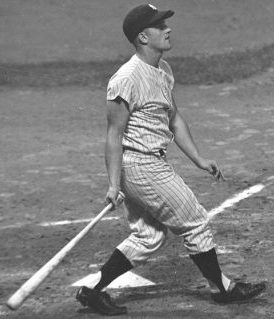
What really kept Maris from Cooperstown?

Roger Maris

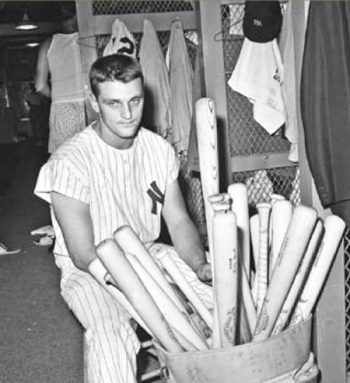
Roger Maris in the Yankee clubhouse, 30 September 1961—the day before he swung his way into history.

Bad enough when I spot those in the baseball press I don’t know personally but perpetuate mythology over factuality. But now my editor at the Internet Baseball Writers Association of America’s Here’s the Pitch newsletter, a man who’s become a friend in the bargain, does it.

Pondering Aaron Judge’s choice of number 99 on his Yankee uniform, Dan Schlossberg writes in today’s HTP, “Perhaps he knew he would become twice as good as [Roger] Maris? Certainly, Maris never chased a Triple Crown. In fact, his .260 lifetime batting average is the leading negative whenever his Hall of Fame candidacy is considered.”

Not even close, my good friend.

Mike Schmidt hit only seven points higher than Maris lifetime and that didn’t stop his election to the Hall of Fame. OK, that’s a ringer. Schmidt is the arguable greatest all-around third baseman ever to play the game. But his lifetime .267 hitting average didn’t exactly block him from Cooperstown, either.

There are lots of Hall of Fame players who hit in the .260-.269 range lifetime. Those modest hitting averages didn’t block them, either. They had other factors in their favour. And so might have Roger Maris except for one pair of problems.

Problem one: Maris was so badly seared by his pursuit and breaking of ruthsrecord in 1961 that there were times too many writers of the time believed he began to shy away from perpetuating the greatness that was his for the taking. Never permitted to enjoy truly the blessings of having cracked baseball’s single most prestigious record, Maris looked from there like a man to whom greatness was an intruder, not a companion.

Problem two: After a solid 1962 season, the injury bug began to hit Maris. Back trouble  limited him to ninety games in 1963. He had a bounceback 1964, with 26 home runs, despite missing twenty games with assorted leg injuries. Then came 1965 and the injury that should have proved scandalous for the manner in which the Yankees handled it.

First, Maris suffered a pulled hamstring that kept him out 26 games after the first three weeks of the 1965 season. Then, come 20 June, Maris jammed his hand against the plate umpire’s shin guard while sliding home. He tried playing a few after that, but the injury was severe enough to take him out of the second game of a doubleheader against the Kansas City Athletics and out of the Yankee lineup after 28 June.

Finally the hand injury was diagnosed as bone chips for which he underwent offseason surgery. It turned out to be far worse. The hand continued to bother him as he started 1966. At last he complained about the problem, and all that did was crank the New York sports press that never truly accepted him and the Yankees themselves into harrumphing that he had no business complaining.

The hand injury turned out to have been a misdiagnosed fracture. Whatever remained of his once-formidable home run power was gone. So was Maris’s desire to continue playing. He’d played through enough injuries as it was and felt unappreciated for the effort.  The Yankees aged profoundly during and after 1964, the final pennant winner of the old Yankee guard, but the Yankees needed the Maris, Mickey Mantle, and Whitey Ford box office more than they needed them properly healthy, so it seemed in retrospect.

The writers chose Maris as the primary culprit, often accusing him of loafing, as some teammates did, both of whose sides were unaware of the true severity of the hand injury. If you’re looking for evidence as to why other players become either paranoid or hypochondriacal about their physical health, Maris was key evidence on their behalf.

“For those who had refused to appreciate Maris in the early 1960s,” wrote his Society for American Baseball Research biographer Bill Pruden, “his injury-plagued performance in the middle part of the decade, coming when the Yankees as a team were faltering, only seemed to confirm their views.”

For a man who had never placed any individual accomplishment above winning, it was a difficult time. Indeed, tired of battling injuries, of trying to play, even when hurt, but never seeming to be appreciated for the effort regardless, Maris gave much thought to retirement. However, before that decision could be made, the struggling Yankees traded Maris to the St. Louis Cardinals for third baseman Charley Smith.

Maris continued to play a solid right field in St. Louis for two consecutive pennant winners and their 1967 World Series champions (he also had the best Series of his career individually), before retiring at last and accepting Cardinal owner Gussie Busch’s offer to operate a Budweiser beer distributorship in southern Florida. He throve in the business with his brother Rudy as his partner, until he succumbed to lymphoma at 51 in 1985.

Injuries, not indifference or loafing, put paid to Maris’s Hall of Fame case before he had the chance to solidify one following his Hall-caliber 1960-62 seasons. Meanwhile, my friend Schlossberg went on to write, “Maris batted just .269 [in 1961] against expansion-diluted pitching.” Halt right there, Daniel.

The fear of diluted pitching when the American League expanded for the first time was probably one of the factors animating commissioner Ford Frick’s scurrilous conflict-of-interest bid to deny anyone, Maris or otherwise, legitimacy in pursuing ruthsrecord in 1961. Well, now. Would you like to know how “diluted” the league’s pitching actually became?

I know I sure did. And I found out. Pay very close attention to the following table, showing the league’s 1960 and 1961 earned run averages, fielding-independent pitching rates, walks and hits per inning pitched, strikeouts per nine innings, and walks per nine.

AL Pitching ERA FIP WHIP K/9 BB/9
1960 3.87 4.00 1.37 4.9 3.6
1961 4.53 4.09 1.38 5.2 3.7

There was a 66 point jump in the league’s ERA for 1961, well enough shy of a full run’s difference. But look further and closer. That’s not the place you end pondering the difference in the league’s pitching from ’60 to ’61, it’s the place where you only begin.

The league’s FIP—measuring that for which pitchers alone are responsible (you can call it their ERA without their fielders’ performances factored in) remained practically the same, unless you think a mere nine-point rise is equivalent to scaling the Empire State Building.

AL pitchers also averaged a lousy single point more walks and hits per inning pitched (WHIP) in ’61 than in ’60. They struck out practically the same average per nine innings and walked almost exactly the same per nine. If that’s drastically “diluted” pitching, I’m a dead bolt.

If anything, Maris had a tougher time hitting 61 in ’61 than the Sacred Babe had in 1927. I’ve noted it before but it’s worth nothing again here: The advent of relief pitching above and beyond being the final repose of pitchers who couldn’t cut it as starters had a big say in it.

Ruth in ’27 faced 67 pitchers all season long, while Maris in ’61 faced 101. Ruth got to face pitchers a third time around in games 35 percent of the time in ’27; Maris enjoyed that privilege only 30 percent. He faced more fresh arms in games than Ruth did.

Did I mention again, too, that this year Aaron Judge faced 232 pitchers by the end of the doubleheader during which he hit his 55th home run of the year? That he faced pitchers a third time around in only seventeen percent of his games as of the end of that twin bill?

The myth of diluted AL pitching in 1961 isn’t quite as grave as the truly unconscionable myth of The Asterisk, of course. But it has in common with that disgrace that it never truly existed in the first place.

You’re welcome, Dan.
Just . . . no*

Aaron Judge

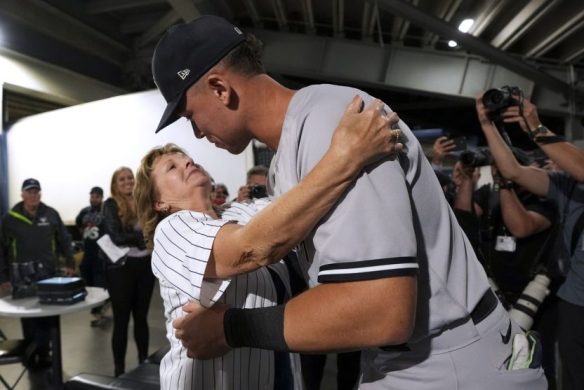
Aaron Judge has an embrace with his mother, Patty, after the game during which he hit his 61st home run of the season. (Mom now has the ball her son launched.) And there’s nothing wrong with calling him tied as just the American League’s single-season home run record holder now, either.

I had better things to ponder approaching this weekend. Things such as the showdown between the National League East-leading Mets and the second-place, defending World Series champion Braves entering the weekend a game behind the Mets.

Things such as the Triple-A championship game being played in Las Vegas Ballpark Sunday starting at 4 P.M. Pacific time, which I plan to watch in person from a choice field-level seat several rows up behind home plate.

But no. I had to bump into yet another analysis of Aaron Judge meeting Roger Maris as the American League’s single-season home run champion. That wouldn’t be a terrible collision by itself, if not for the fact of the Associated Press writer offering it, David Brandt, joined Roger Maris, Jr. wading into waters that never really existed in the first place.

Maris, Jr., intends to be there when Judge passes his father before the regular season expires. He inserted the ginger into the tails in the first place, when he opined that Judge should be branded, hallowed, and hosannaed as the actual, no-questions-asked, all-time, across-the-board single-season home run champion when he hits 62 or more.

A few sentences after citing that, Brandt saw and raised, sort of, after nodding toward the debate over whether National League bombardiers Mark McGwire (who broke Maris’s Show record in that memorable 1998 chase), Sammy Sosa (who settled for three 60+ home run seasons including ’98 yet didn’t win home run championships in those years), and Barry Bonds (whose 73 in ’01 yanked McGwire to one side) remain tainted because of their actual/alleged ties to actual/alleged performance-enhancing substances.

“For its part, MLB doesn’t appear eager to embrace the use of asterisks,” Brandt writes. “Neither does the National Baseball Hall of Fame in Cooperstown, New York.” Uh-oh.

MLB has been down that road before. Maris’ record had an asterisk attached to it for 30 years because he played a 162-game schedule instead of 154 like Babe Ruth did when he hit 60. It remained until Sept. 4, 1991, when a committee on statistical accuracy chaired by former commissioner Fay Vincent voted unanimously to recognize Maris as the record-holder.

Maris’s record had nothing of the sort. Once and for all. It had controversy. It had a country arguing passionately over whether the plainspoken, media-shy Dakotan “deserved” to even think about chasing ruthsrecord (once again, that’s the way they said it then) when his matinee-idol Hall of Fame teammate Mickey Mantle was the “rightful” aspirant if anybody was.

But it had an asterisk only in the public imagination, stoked by a baseball commissioner laden with a fat conflict of interest, and a sportswriter about whom “instigator” is one of the more polite epithets attached to his name and memory.

Ford Frick, remember, was once a Ruth ghostwriter. He also loved to engage dinner crowds with stories about how he’d been at Ruth’s bedside the day before Ruth finally lost his battle with throat cancer. Frick would sooner have been caught selling nuclear secrets to the Soviet Empire than abiding anyone, no matter whom, pushing the Sacred Babe to one side in the records.

New York Daily News writer Dick Young was only too willing to abet Frick when he called a press conference midway through that 1961 season to expose himself as feeling just that. Together the compromised commissioner and the irascible columnist made poisoned applesauce of a singular achievement.

With the American League’s first expansion and a schedule change from 154 to 162 games, Frick cringed at the thought that somebody, Yankee or otherwise, would knock Ruth’s hallowed 60-bomb season in 1927 out of the record books at once. As recounted by Allen Barra in his 2002 book Clearing the Bases: The Greatest Baseball Debates of the Century, Frick proclaimed:

Any player who has hit more than 60 home runs during his club’s first 154 games would be recognized as having established a new record. However, if the player does not hit more than 60 until after this club has played 154 games, there would have to be some distinctive mark on the record books to show that Babe Ruth’s record was set under a 154-game schedule.

At which point Young piped up and all but hollered, “Maybe you should use an asterisk on the new record. Everybody does that when there’s a difference of opinion.”

Revisiting the controversy in the Village Voice in 2011, after another Daily News writer (Phil Pepe) published a book reviewing the 1961 home run chase, Barra told it as it actually was: Frick did nothing more than put on a show on behalf of his old benefactor. “Frick had no power whatsoever to make a ruling on the subject,” Barra began.

To put it simply, he was grandstanding. What escaped most baseball writers present at Frick’s press conference, and what continues to escape the sports media today, is that major league baseball had no “official” record book and didn’t have one until Total Baseball got the job in the late 1990s. So, in essence, Frick was trying to pressure publishers over whom he had no authority to print his version of the Maris/Ruth home run chase.

Over a decade later, Frick published his memoir, Games, Asterisks, and People. (The front jacket featured a photograph of Frick side by side with Ruth.) The title to one side, Frick himself declared the asterisk on Maris’s record didn’t really exist, Dick Young notwithstanding: “No asterisk has appeared in the official record in connection for that accomplishment . . . ,” Frick wrote in that book. “[Maris’s] record was set in a 162-game season. The Ruth record of 60 home runs was set in 1927 in a 154-game season.” 

Around the time Total Baseball finally got the official record book designation, another commissioner, Fay Vincent, appointed a Committee on Statistical Accuracy. They voted to purge any asterisk from Maris’s record, never mind that no asterisk existed lawfully in the first place. Not for the first time and hardly for the last, baseball’s government sold the nation a bill of goods about as valid as a 27-cent piece.

“Thus,” Barra observed, “a commissioner of baseball voiced his support for removing an asterisk that a previous commissioner denied every having put there in the first place. Probably nothing did more to enhance the myth of the existence of the asterisk as Vincent’s ‘removal’ of it.”

Along came Maris’s son, after his father was met by Judge Wednesday night, to plead for something about as close to a bona-fide asterisk as possible:

[Judge]’s clean, he’s a Yankee, he plays the game the right way and I think it gives people a chance to look at somebody who should be revered for hitting 62 home runs and not just a guy who did it in the American League. He should be revered for being the actual single-season home-run champ. That’s really who he is if he hits 62. I think that’s what needs to happen. I think (the MLB) needs to look at the records and I think baseball should do something.

Well, Judge is “clean”; major league players face mandatory drug testing and Judge hasn’t flunked once. But does it really matter that Judge is a Yankee? Since when was the single-season home run record ruled to be exclusive Yankee property? Would Judge be any less legitimate tying Maris if he’d been a Met? A Brave? A Cardinal? A Guardian? A Dodger? An Astro?

Then a Cardinal, McGwire embraced the Maris family publicly when it looked as though he had a shot at meeting and passing Maris in 1998. (Maris, Sr. finished his major league career with two seasons as a Cardinal.) They returned the embrace just as publicly. It was one of the signature embraces in the year once thought to have been the year that saved baseball, after the lingering clouds of the 1994 owners-provoked players’ strike.

If you saw Billy Crystal’s film 61*, you couldn’t forget the voice of Bob Sheppard, the longtime Yankee Stadium announcer, over a fading image of Barry Pepper as Maris hitting the money shot at film’s end, by referencing the Vincent committee and finishing with, “Roger Maris died six years earlier . . . never knowing . . . that the record . . . belonged . . . to him.”

Crystal and his staffers must not have read Edward Kiersh’s Where Have You Gone, Vince DiMaggio, a 1983 catch-up with a host of former players—including Maris. “I know I have the record,” Maris told Kiersh, “and that’s what counts.” Unconscionably, he just wasn’t allowed to enjoy having achieved it in the first place. From the best of intentions Crystal perpetuated Frick’s and Young’s asterisk fraud.

But only one man could have pushed Ruth to one side in the single-season record book. (It took that man five fewer plate appearances and 34 more pitchers faced on the year to do it.) Only one man going from there could push Maris to one side. Tainted or no, McGwire was the one. Only one man going from there could push McGwire to one side. Tainted or no, Bonds was the one.

You might wish to remind yourself, too—aside from baseball taking no formal action against actual/alleged PEDs until after the Mitchell Report and that parade before what George F. Will called the House Committee for the Dissemination of Great Messages to Kids—that, if the only thing you needed to hit baseballs over fences was a chemical cocktail, any behemoth in the NFL, the WWF, the alphabet boxing councils, or on the bodybuilding circuit could have broken Maris’s record.

When McGwire eventually faced that House committee (don’t kid yourself that they cared more for the health of the game than for making suspect players do a perp walk to public humiliation), he was blocked by his legal team from owning up. (“I’m not here to discuss the past,” he said to the panel infamously.)

When he returned to baseball as a Cardinals batting coach in 2010, McGwire owned up in full.  He said publicly he dipped into the PED waters in a bid to continue playing through frequent injuries, not to enhance what he could do already. However late, his confession was true enough. He could hit a ball of weeds 450 feet whether as a 1987 Rookie of the Year or an injury-wrecked hulk (he doesn’t dismiss that PEDs also instigated a few final injuries) in what proved his 2001 farewell season.

McGwire even apologised to Maris’s widow, Patricia, after his public admission. “My mom was very touched by his call,” said another Maris son, Richard. “She felt sorry for Mark—that he’s going through this. She conveyed that we all make mistakes and move on from there.” Richard’s brother says, retroactively, “Not so fast, Mom.”

Maris, Jr. wants baseball to do something about that post haste. Preferably the split second it appears Judge’s 62nd home run will reach the seats, if not the Sea of Tranquility. You understand his position, too, but good luck with that.

Despise the Sosas and Bondses all you wish. (McGwire accepts that he’ll never reach the Hall of Fame, but his public admission whenever it came bought a lot of good will, regardless of who denies it.) But you can’t just erase the statistics arbitrarily. Any more than Elmer Fudd Frick and Dick Young could impose an asterisk the commissioner himself had no real power to impose.

Pace Brandt, calling Judge the American League’s single-season home run co-champion with Roger Maris isn’t just a euphemism for calling them the “real” single-season home run champions. Judge won’t get beyond the AL record unless he can find a way to send thirteen more baseballs out of the ballparks’ ZIP codes over his next and final eight regular-season games. Settling for being the AL’s single-season bomb king is far from the worst fate he can face.

Well-understood Judge meets misunderstood Maris

Aaron Judge

Aaron Judge hitting his 61st home run of the season, tying Roger Maris’s league record and keeping it in the Yankee family.

Reaching a milestone is both tough enough and impressive enough in its own right. When your reaching it busts a tie and puts your team ahead to stay, as it turns out, the satisfaction multiplies exponentially.

Roger Maris blasted his 61st home run of 1961 on the season’s final day, cracking a scoreless tie and proving to be the game’s only run. Aaron Judge met his tortured Yankee forebear Wednesday night, cracking a three-all tie and pushing his American League East champion Yankees past the Blue Jays to stay.

Maris drove a one-out Tracy Stallard fastball into the right field seats and Babe Ruth to one side before a Yankee Stadium audience a little over a third of the old ballpark’s capacity. Judge checked in with Aaron Hicks aboard on a leadoff single, caught hold of Blue Jays reliever Tim Mayza’s hanging full count sinker, and drove it off the edge of the stands and into the Rogers Centre left field bullpen.

Thanks in large part to a capricious, conflict-of-interest commissioner’s foolish edicts, a hostile press, and his own unadorned personality, Maris endured a season in hell at home and on the road from fans hell bent on seeing anyone but the plain Dakotan take the Sacred Babe’s place in the hallowed single-season homer record book.

Judge has known the opposite all season long. At home, he’s been a Yankee matinee idol since he set the since-broken record for home runs in a season by a rookie. On the road, he’s a respected and even well-liked opponent. Even fans jaded by the bazillionaires playing the game don’t quake when pondering not whether but how much of a payday Judge will receive during his first free agency in the off-season to come.

In Toronto, Judge may be more than all that. He may be the one Yankee above all that even Blue Jays fans actually root for. For thanks he has only to remember an early May game and its day-after aftermath.

That was the day Blue Jays fan Mike Lanzillotta got hold of a home run Judge drove into the Rogers Centre upper deck . . . and handed the ball to nine-year-old Derek Rodriguez, wearing a T-shirt done into a Yankee jersey with Judge’s name and number 99 on the back, whom Lanzillotta knew prayed to get a ball hit by Judge.

The moment was caught on video and went viral at once, and it got to Judge’s attention after the game. The Leaning Tower of 161st Street saw it and arranged to meet the boy, his family, and the beneficient fan before the next day’s game.

When Judge hit the line running after hitting Number 61, it ended a streak of 34 plate appearances without hitting one out since he matched Ruth’s 60 of 1927. Rogers Centre bathed him in a loud ovation. Rising from their seats behind the Yankee dugout, Judge’s mother shared an embrace with Roger Maris, Jr. The Yankees swarmed him in hugs. The Blue Jays’ bullpen coach, Matt Buschmann, retrieved the landmark ball and made sure the Yankees got hold of it.

Judge even got a present from home plate umpire Brian O’Nora after the game. O’Nora congratulated Judge outside the Yankee dugout and handed him the game’s official lineup card.

“It’s an incredible honor, getting a chance to be associated with one of the Yankee greats, one of baseball’s greats, words can’t describe it,” Judge said postgame. So, perhaps naturally, he tried to make words do just that.

“That’s one thing so special about the Yankees organization,” he continued, “is all the guys that came before us and kind of paved the way and played the game the right way, did things the right way, did a lot of great things in this game and getting a chance to be mentioned with those guys now is, I can’t even describe it, it’s an incredible honor, that’s for sure.”

Roger Maris

Roger Maris, hitting the home run it often seemed nobody wanted him to hit, 1 October 1961.

He also made bloody well certain to give props directly to Maris, who died of lymphoma at 51 in 1985. “Getting a chance to tie Roger Maris, you dream about that kind of stuff,” he said. “It’s unreal.” So is the point that Judge still has eight games left to break the tie with Maris, never mind put a little more distance between them.

Maris, Jr. intends to be there when Judge passes his father. “I don’t think it’s going to take very long,” he told reporters. “I think he’s loose. I think the party last night, the celebration, loosened him up . . . You can tell that he’s back, and he’s ready to go now.” If only things were that simple for his father.

This is now: Nobody has thundered against Judge even thinking about equaling, never mind passing, either Ruth or Maris, Sr. That was then: The elder Maris was never allowed to enjoy even the simple fact of his feat, never mind its magnitude. “Do you know what I have to show for 61 home runs? Nothing,” he said at the All-Star Game in 1980. “Exactly nothing.”

“Heaven protect us from achieving a greatness that the world decides we do not deserve,” wrote Thomas Boswell of the Washington Post upon Maris’s too-early death. “Mortal men can be crushed by immortal deeds. Wasn’t that the moral of Roger Maris’s career?”

A compact, wiry six feet tall, Maris was unprepared and unwilling to make himself a star as the true media age began. Judge, a 6’7” galoot with a still-boyish, snaggle-tooth grin, who looks at times as if he could get from first to second in two strides on a home run circuit, accommodates the public and the media without letting either control or demean him.

What Judge has in common with Maris, aside from a place in the record book he still might claim as his own, is an easy manner with children. Father of four Maris came to quit reading his fan mail unless he was sure it came from kids. As Derek Rodriguez got to prove, Judge savours encounters with kids when they come.

“Maris,” Boswell continued, “was in all ways pronounced deficient. With his flattop haircut, he looked more Hessian than handsome. At twenty-six, the introverted, proud young man from Fargo, North Dakota, did not have a fraction of the charm, sophistication, or patience to deal with becoming one of the most famous and controversial figures in America.

“It might help our sleep to believe Maris was a reclusive oddball figure, uniquely ill-suited to fame. For years he was portrayed as an antisocial grouch. With time, a contrary profile emerged. Now, as eulogies roll in, he’s painted as a family man, a loyal friend, a modest down-to-earth guy proud of his unselfishness as an all-around ballplayer.”

That family man, loyal friend, and modest down-to-earth guy must have savoured and applauded Wednesday night’s doing from his repose in the Elysian Fields. Even if he also expressed just a flickering wish that he could have known even a fragment of the respect, if not adulation, that Judge receives. You can’t blame Maris for either.

The kids are alright, the postseason isn’t

Steven Kwan

Steven Kwan’s grand salami slammed an exclamation point on the young Guardians’ AL Central division clinch last weekend. But the postseason to come has exposed, yet again, a flaw too many in baseball government’s current (lack of) thinking about the current (lack of) true pennant race and championship meaning . . .

Considering what most seemed to think going into this season, you could be forgiven if you thought the Guardians might dig deep enough into music history to declare their team song the Who’s rock and roll chestnut, “The Kids Are Alright.” They might also reach further for Nat King Cole crooning “They tried to tell us we’re too young . . . ”

They may keep trying to tell them, now that the young Guards are the American League Central champions. Maybe the division wasn’t exactly the strongest in the league. The Guards still had to prove that their actual foray into the past—going as old-school on the field and at the plate as they could get away with—would still work.

It may (underline that, ladies and gentlemen) be the only thing old school about the postseason to come.

Less than three decades ago baseball’s postseason was the nation’s most meaningful because it remained the most exclusive in professional team sports. Even with divisional play then, you finished your season with your cans parked in first place or you waited until next year. Well, let’s look at three decades ago precisely.

There were a mere four divisions. East and West, each league. Their champions were the Blue Jays, the Athletics, the Pirates, and the Braves. The Blue Jays and the Braves went to the World Series; the Braves, of course, got there on Sid Bream’s impossibly dead legged dash home. The Blue Jays won the Series in six; Pat Borders (1.250 OPS in all six games) was the Series MVP.

Come 1995, the World Series restored after its cancellation due to the owner-provoked players’ strike, baseball accepted three divisions and a wild card team in each league. This didn’t dilute the season’s competition so much as people feared, even if there was something disconcerting in watching a couple of teams fighting to the last breath to finish in second place.

That was also the year the classic Braves teams of 1991 through the mid-Aughts won their only World Series, against a club of the Guardians’ Indians ancestors. (Hall of Famer Tom Glavine through eight plus Mark Wohlers in the ninth shut the Indians out, 1-0.) Both the Braves and the Indians finished the season as division leaders. All remained reasonable.

Next month, baseball will see what the NFL, the NBA, and the NHL have known for a few decades—forty percent of its teams going to the postseason. This month, we’ve seen the result of the Manfred Administration’s propaganda that a more deeply expanded postseason entry field would surely guarantee more exciting pennant races.

It’s been exposed as a factual and shameless lie. A lie even more egregious than the lie that the pitch clock will shorten the times of games while the continuing proliferation of broadcast commercials between each half inning and during pitching changes actually does elongate them.

Deadspin‘s Sam Fels has observed just how much more “exciting” it’s been, if you define “exciting” as putting fannies in the seats. He couldn’t help noticing that, last week:

* The Phillies, hanging by a thread in the National League race, hosted the Jays, hanging in for a home-field wild card advantage. Citizens Bank Park holds 42,792 people. Both those Phillies-Jays games, postseason-critical games, barely drew half for each.

* The Milwaukee ballpark formerly known as Miller Field can hold 41,900, but held barely half when the wild card-contending Brewers hosted the National League East-leading Mets for three games. The Brewers drew slightly more than half the park’s capacity and still about a grand less than their 2022 average thus far.

“Those aren’t bad crowds,” Fels writes, “but at the end of September against a well-known and good team . . . wasn’t the point of all this that September attendances would be juiced?”

 . . . That doesn’t mean there aren’t teams drawing well. They’re the names you’d expect–the Dodgers, Yankees, Padres, Braves, Cardinals, Astros. And the overall economy has many factors that don’t Uleave a whole throng of people with the disposable income to attend a ton of games. Except, again, we were told that more teams vying for more playoff spots were supposed to punch through these kinds of factors. It’s what they’ve been telling us for nearly 30 years.

It may just be that fans actually recognize when the regular season is devalued, and the dangling carrot of just two or three wildcard games doesn’t really get the loins tingling. Or that teams that have playoff spots locked up for months can’t really generate excitement until those playoffs actually arrive, unless you’re the Dodgers. Playoff expansion was supposed to bring anticipation and excitement to places it doesn’t normally live. Look at the numbers and tell us.

I looked at the same numbers as Fels. Then I caught hold of the Mets hosting the Marlins in Citi Field Tuesday night, a game that’ll be remembered if at all for a) the Mets losing 6-4, to fall into a tie with the Braves atop the NL East; but, b) Marlins pitcher Richard Bleier  becoming the first pitcher since the birth of the American League to balk three times against . . . the same batter, enabling the Mets’ Jeff McNeil to score without stealing a base or a ball in play after he reached himself on an infield hit.

Citi Field can hold 41,922 in the seats. Tuesday’s game drew 69 percent of that. The game was meaningless (other than the spoiler role) to the eliminated Marlins but critical to the Mets, especially since the NL East is the only remaining division race yet to be resolved, and the formidable, defending World Series champion Braves refuse to go gently into that not-so-good gray night. (Hurricane Ian may have more than a little something to say about the two combatants’ coming weekend set in Atlanta.)

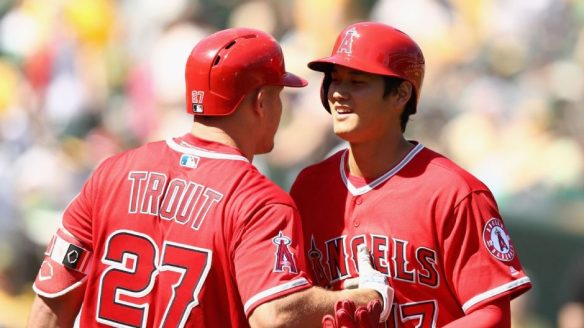
Mike Trout, Shohei Ohtani

Trout and Ohtani, plus the Yankees’ Aaron Judge, are almost all that’s left to root for thanks to baseball’s postseason race competition dilution.

All of that tells us playoff expansion does no favours to the game or its fans, but it does plenty of favours for that which is nearest and dearest to Commissioner Nero’s and his employers’ hearts. Well. They may remain the gang that believes the common good of the game equals making money for it, but they can’t (or won’t) answer what good 40-60 percent full houses do for those cherished coffers.

The expanded pelf for the playoffs goes to all teams regardless of whether they become postseason teams. “This only softens that lack of additional fans attending games that they’ve come to realize doesn’t really mean anything,” Fels writes. “MLB can shrug off the lack of heightened ratings or attendance with the bigger checks from TBS, FOX, and ESPN.”

Almost the only things left for which to root are Yankee outfielder Aaron Judge, Angels outfielder Mike Trout, and Angels unicorn (pitcher/designated hitter) Shohei Ohtani. Hall of Famer-in-waiting Albert Pujols reached his lifetime 700 home run milestone in his homecoming finale with the NL Central-champion Cardinals, but Judge, Trout, and Ohtani still have long distance achievements to achieve.

The Yankees are the official AL East champions, and on Wednesday Judge met Roger Maris at last as the AL’s single-season home run champion. Pressing perhaps understandably since he matched Babe Ruth’s 1927 output, Judge has eight games left to pass Maris. Few are willing to bet against him still.

The Angels go nowhere (again) through no fault of Trout’s or Ohtani’s own. But with eight games left to play on the season future Hall of Famer Trout still has a shot at a 40th home run or more despite missing 31 percent of the season on the injured list. (He had 37 after Tuesday.) It’s to wonder what he might have hit if he hadn’t missed that time. Would 60+ have been out of the question? We’ll never know now.

Ohtani has a shot at a 40th home run, too. (He has 34 at this writing.) He can also become the only man in Show history to have a 40 home run season at the plate and finish on the mound with an ERA and a fielding-independent pitching rate below 3.00. At this writing, Ohtani sits with 34 home runs, a 2.47 ERA, and a 2.52 FIP. Not to mention 203 pitching strikeouts and counting. Say good night, Babe.

But how long can Commissioner Nero and company shrug off the further dilution of real pennant race competition? The kind that would compel owners in all baseball cities and not just the big boys to make substantial investments in their teams, from the ground up, year in and year out? Whoops. Better not go there. We may be striking toward 21st century schizoid heresy.

Paid in full to Club 700

Albert Pujols

Could you blame Albert Pujols for spreading his wings with the biggest grin on the planet after number 700 flew out?

It took Albert Pujols 98 home runs before he finally caught hold of one in Dodger Stadium the first time, off a sophomore Dodger import from Japan named Kaz Ishii. Ishii spent four years in the Show before returning to pitch again in the Japanese leagues until age 39. He retired as he began, the walk (almost six per nine innings) being his wounding flaw.

Pujols at age 39 had 656 major league home runs on his resume and would meet and pass Hall of Famer Willie Mays on the all-time bomb list, before his injury-laden decline as an Angel finally finished with a brief but memorable tenure in a Dodger uniform last year. He couldn’t possibly imagine then that his final major league wish, a 700th home run, might come in the Dodgers’ venerable venue.

But the designated hitter, the only slot available to enable Pujols to play major league baseball one more season, finally became universal this year. And the Cardinals, the team with whom Pujols arose, starred, and became a baseball immortal in the first place, were more than willing to bring La Máquina home to try. Not just because they respected what he did, but because they genuinely believed in whatever he had left in the tank.

He wasn’t going to win a National League home run title. There wasn’t that much left of his power stroke. But whatever he had to give, the NL Central leaders would accept gladly. It turned out he had just enough to give until Friday night. Not just some key hits and key big blows, but history. And key stretch drive wins.

Pujols had only six home runs before the All-Star break but thirteen from then until he checked in at the plate the first time Friday night. All of a sudden, it didn’t seem just a dream that he could get to within two freeway exits worth of sight of 700.

The Cardinals couldn’t have scripted this one better if they had Paddy Chayevsky, Budd Schulberg, and Ring Lardner, Jr. collaborating on it.

In the top of a scoreless third, with Tommy Edman aboard on a one-out walk, Pujols fell behind to his lefthanded former Angel teammate Andrew Heaney 1-2 before catching hold of a fastball practically down the pipe and drove it almost to the rear end of the left center field bleachers. Appreciating his effort in his brief time in their team’s silks, the Dodger Stadium crowd exploded.

When the Cardinals put first and second aboard after two quick outs in the top of the next inning, with Pujols about to check in at the plate, Dodger manager Dave Roberts decided not to let Pujols get a second shot at making Heaney’s night any more miserable. Roberts brought righthander Phil Bickford in. With La Máquina sitting one blast from history, the manager wasn’t going to let him have a lefthanded treat.

He was going to make Pujols earn it the hard way. Except that Bickford has a 4.26 fielding-independent pitching rate this year, and Pujols lifetime has been almost as solid against righthanders (.295/.372/.532) as he’s been against lefthanders (.301/.381/.574). On the other hand, Pujols against righthanders this year has looked like the old man he is in baseball terms.

Roberts had to know Pujols’s .209/.297/.384 against the starboard siders made it the safest bet on the planet to bring in a Bickford. When Bickford had Pujols even at 1-1, Roberts could be forgiven if he signed in contentment knowing history wasn’t going to be made on his dollar. Then Bickford threw a third straight slider just a shade down and a shade in.

Pujols may be a living ghost of his old self no matter how much history he chased this year, but he still knows what he’s doing at the plate. The mind and the eye remain intact even if the body might still be hurling obscenities toward him. He swung at Bickford’s gift right as it knocked on his door.

This one only cleared about four rows of the same left center field bleachers. But it didn’t matter how far it traveled, just that it traveled to the right place in the first place. He joined the 700 Club at last. And there wasn’t a teammate, opponent, or fan in the house who’d have denied him his right to spread his wings and grin all the way around the bases.

As he’d done so often during the peak of his Hall of Fame-in-waiting career, Pujols singlehandedly handed the Cardinals a lead, 5-0 if you’re scoring at home, and it turned into an 11-0 demolition of the ogres of the NL West.

The fun continued in the top of the fifth when—abetted by Juan Yepez with one out reaching second on a Max Muncy throwing error across the infield—Dylan Carlson smacked an RBI double, and Lars (Sometimes You Feel Like a) Nootbaar followed Carlson with a two-run homer a third of the way up the right field bleachers.

Yepez thanked the Dodgers for that fifth-inning present with a one-out blast of his own over the left field fence in the seventh, after which Carlson doubled again but Nootbaar had to settle for sending Carlson home with a mere single. Then, come the top of the eighth, Alec Burleson pinch-hitting for Pujols thanked La Máquina for the memories with a leadoff blast off Dodger reliever Hanser Alberto to finish the Cardinals’ demolition.

But this was still Pujols’s night. Lots of former teammates and opponents and watchers have been remembering some of his biggest blasts of the past.

Mike Trout, his longtime Angel teammate and a future Hall of Famer himself, can’t forget how Pujols joined the 600 Club. “The grand slam, when he hit 600,” says Trout.

Just the situation. I mean it was a big spot in the game, and everyone was thinking the same thing. “This is for 600. This is gonna be sick right here.” And then he hit it. He loves the moment. And that’s the thing—people kept asking me, “Hey, do you think he’s going to get it [700]?” For sure. The way Albert prepares himself—he doesn’t change his approach, doesn’t try to hit a homer. He’s just trying to put a good swing on the ball. That’s big.

Manny Machado was a year away from first wearing an Oriole uniform when he saw his signature Pujols attack: Game Three, 2011 World Series, when Pujols wrecked the Rangers with three homers—all starting in the sixth inning. “That,” the Padres’ gazillion-dollar third baseman says, “was just incredible.”

I mean, he was not missing. You could throw him whatever and he was going to hit it. You could even throw the rosin bag and he was probably going to hit it out. Just that sweet swing. Even all his homers, going back—his first home run. I just admire that swing, how smooth it is, how long it stays in the path. It’s impressive.

Just don’t ask former Astros reliever Brad Lidge. When the Astros were still in the National League and playing the Cardinals for a trip to the 2005 World Series, Lidge got the worst possible taste of Pujols. It only proved to delay the Astros’ sweep out of the Series by that year’s White Sox, but Lidge still can’t forget.

“I made a mistake,” Lidge says now of the hanging ninth-inning slider Pujols demolished so thoroughly that only the roof braces of Minute Maid Park kept the ball from landing in the streets behind the building. “And it wasn’t super-surprising that he didn’t make a mistake.”

With a little help from his Astros pitching staffmate Roy Oswalt, Lidge by then knew that Pujols had evolved into a Ph.D. student of the game and its pitchers. “All of a sudden,” he says, “t started to feel like he knew what you were going to throw before you did. You felt like you had to be perfect . . . He had so much plate coverage, whether you’re throwing a 97 mph fastball or a slider down and away, you had to be perfect.”

“My game plan for him,” says Hall of Fame pitcher Greg Maddux, who once threw Professor Pujols a repeat changeup and saw it fly onto Chicago’s Waveland Avenue, “was to give up a single or less.”

But that was then. This is now. The greats normally approach such milestones in decline as it is. Pujols’s injury-smashed decline was a shock long before he rejoined the Cardinals. His Angel tenure started well enough. Then the body regions below his hips began attacking him like fresh meat under attack from the wolves past which he once hit lamb chops almost at will.

None of that matters now. Baseball players don’t always get to make their dreams, never mind their final wishes, come true. The only thing better than the 700 Club for Pujols now would be the Cardinals going all the way to the World Series and coming out with what would be his third lifetime Series ring. Just ask La Máquina himself.

“[D]on’t get me wrong,” he begins. “I know what my place is in this game.”

But since Day One, when I made my debut, it was never about numbers, it was never about chasing numbers. It was always about winning championships and trying to get better in this game. And I had so many people that taught me the right way early in my career, and that’s how I’ve carried myself for 22 years that I’ve been in the big leagues. That’s why I really don’t focus on the numbers. I will one day, but not right now.

“He talks the talk and walks the walk with saying those things,” says his Cardinals teammate Nolan Arenado. “And I really believe him.”

On Friday night, making history with a two-bomb evening, Pujols made believers all over again as he joined the club heretofore populated only by Barry Bonds, Henry Aaron, and Babe Ruth. Even for one night, nobody could take that resurrected belief away.