Nuke box music

Yordan Alvarez home run

Artist’s rendition of the nuke Yordan Alvarez dropped—covering Texas, half of Oklahoma, and a third of the Gulf of Mexico; and, enabling the Astros to take ALDS Game One. (Kidding . . . kind of . . .)

The one man in Astros silks nobody wants to face in the bottom of the ninth with men on base stepped in with two out in the bottom of the ninth in Minute Maid Park Tuesday afternoon. This lefthanded swinger had first and second and one out. He had a lefthanded pitcher to face on the mound.

It didn’t matter to Yordan Alvarez. But it came to matter phenomenally to the Mariners, who came into the half inning having seen an early 7-3 lead cut down to 7-5. And it came to matter even more to Robbie Ray, the defending Cy Young Award winner who usually starts but was brought in now for the lefty-lefty gambit.

First, Alvarez fouled off a sinker that arrived a little outside and just under the middle of the plate. Then, Ray threw him a second sinker, just under the middle of the plate but a little inside. In other words, right into one of Alvarez’s wheelhouse spots.

The two-out mushroom cloud from the warhead that won American League division series Game One for the Astros spread its umbrella over all Texas, half of Oklahoma, and maybe a third of the Gulf of Mexico. The Mariners might have sung a sailor’s lament, but the Astros probably thought it was the sweetest nuke box music this side of heaven.

We fear no team, the Mariners all but said entering this set, after a regular season surprise of finishing second to the Astros in the American League West, then sweeping the  Blue Jays out in a wild card series. They may fear no team, but they wouldn’t be the only ones to determine a little fear of Alvarez might be gentler upon their health. Short and long term.

Mariners manager Scott Servais had no reason to fear Ray faltering against a lefthanded hitter, since he kept them to a .212/.260/.347 slash line and a .647 OPS on the regular season. When his ninth-inning man Paul Sewald got a quick ground out to open but plunked rookie pinch-hitter David Hensley on a full count, then struck Jose Altuve out before Jeremy Peña singled, Servais went to the percentages.

He wasn’t going to let his righthander who’d already been bopped for the two-run homer by Alex Bregman that pulled the Astros back to within a pair an inning earlier stick around to incur further disaster. But as the mushroom cloud dissipated, the skipper was left to shake it off, remind himself it’s a best-of-five, and wait till Game Two for vengeance.

Servais may have forgotten the percentage that might have reminded him Alvarez is almost as deadly against lefthanded pitching as he is against righthanded pitching. He might have hit 17 more home runs against the starboard side, but his OPS against the port side is a deadly enough .947, and his on-base percentage is eight points higher.

Not to mention his Real Batting Average (total bases + walks + intentional walks + sacrifice flies + hit by pitches, divided by total plate appearances) against the port side (.651) is only 62 points lower than against the starboard—and would be a career year for a lot of batters no matter what side.

The data tells you what’s been. It only suggests what might be. But Alvarez’s data suggestion should have alerted Servais that, as tenacious a competitor as Ray is—and this was only the seventh relief appearance of Ray’s major league career—there was at least a 50-50 chance that Ray confronting Alvarez might not end well for his team.

Alvarez also started the Houston scoring with a two-run double in the third, cutting the early 4-0 Seattle lead exactly in half. Only nobody’s going to remember that cruise missile as vividly as they’re going to remember that ninth-inning hydrogen bomb.

Yordan Alvarez

Very well, this is the real look of Alvarez bombing the Mariners away Tuesday . . .

He didn’t just nuke the Mariners at Game One’s eleventh hour. He bombed his way into the history books. He’s only the second man in postseason history—after Kirk Gibson (Game One, 1988 World Series)—to walk it off with a home run when his team was down to their final out of the game. It was also the first postseason game-ending bomb hit with the bombardier’s team in a multiple-run deficit.

Alvarez also reminded the Mariners it’s not wise to assume that getting the early drop on a future Hall of Famer means it’s going to finish in their favour. The Mariners thumped Justin Verlander—who’d pitched a comeback season that has him in the Cy Young Award conversation—for six runs on ten hits in the first four innings, including a two-run double by Julio Rodríguez in the second and a solo blast by J.P. Crawford in the fourth.

Verlander’s final four batters faced, in fact, hit for the reverse cycle: Crawford’s homer plus Rodríguez’s immediate triple, Ty France’s immediate RBI double, and Eugenio Suárez’s single—that might have been an RBI job itself but for France being thrown out at the plate.

Yuli Gurriel cut another Mariners lead in half with his fourth inning solo launch, leaving the score 6-3, before Eugenio Suárez made it 7-3 with his own solo but Bregman—with Alvarez aboard on a one-out single— took hold of a Sewald sinker that didn’t sink quite far enough down and sent it over the left center field fence in the bottom of the eighth.

One inning later, Alvarez trained his bomb sight, pushed the button, and put a finish to one of the Astros’ more dubious streaks: until Tuesday, they’d been 0-48 in postseason play when they entered the ninth trailling by two runs or more.

It didn’t necessarily have to take the most monstrous home run hit in Minute Maid Park since now-retired, Hall of Famer-in-waiting Albert Pujols’s ICBM in the 2005 National League Championship Series. (The ancient days, before the Astros were the team to be named later in the deal making a National League franchise out of the Brewers.)

But it didn’t exactly hurt, unless you wore a Mariners uniform. And in that moment the number on Alvarez’s Astros uniform looked huge considering a little piece of baseball history involving that number. 44.

Two relief tales from . . .

Two relief pitchers will miss postseason time thanks to circumstances unrelated to play on the field. One will miss the rest of his team’s postseason, however long it lasts, thanks to a self-inflicted injury. The other will miss his team’s postseason and say goodbye to that team. Neither man’s postseason had to end this way.

Astros reliever Phil Maton broke a bone in his right pinkie after his appearance in the team’s final regular season game. He’d surrendered two hits plus the only two runs the Phillies scored in that finale, and he was unamused, understandably. What wasn’t so understandable was Maton punching his locker in frustration.

Lockers aren’t any more forgiving that outfield walls or pitchers’ mounds when it comes to human flesh and bone piledriving into them. It doesn’t matter whether the flesh and bone combination is 20, 22, or 29 years old, the latter being Maton’s age. Those stiff, hard, stationary structures can do more damage to their attackers than Muhammad Ali did to his when answering a right cross.

Yankees reliever Aroldis Chapman had annoyed his team already with an injury from a tattoo he acquired, costing him almost a month’s worth of time over August and September, never mind that prudence and his team overseers probably couldn’t convince him to wait until winter vacation to think about another work of body art.

But Chapman’s decline this season prompted his replacement as the Yankees’ closer and, apparently, didn’t sit well with the howitzer, either. Thus did he fume about his demotion until Friday last, when the Yankees conducted a team workout preparing for the division series with what proved to be the Guardians. (Their first place finish rewarded the Yankees with a wild card series bye under the new, dubious postseason system.)

Chapman had told the team he’d be there. Until he wasn’t. To put things kindly, Yankee general manager Brian Cashman was far less amused than was Maton to have handed the Phillies a pair of hits and runs:

It was surprising at first, a little shocking, but after the shock wore off, when you add everything up, it’s not surprising. There’s some questions about whether he’s been in all-in or not for a little while. He’s maintained verbally that he’s in, but at times, actions don’t match those words.

Maton knew at once he’d been a damn fool. “It was a short-sighted move,” he told the press after that game, “and, ultimately, it was selfish. It’s one of those things that I hope doesn’t affect our team moving forward.”

He may be fortunate that the Astros have someone to step in. The Astros may be more fortunate. Bryan Abreu’s fielding-independent pitching rate for 2022 is 2.12, against Maton’s 4.33 FIP. It won’t parole Maton from the Dumbass Zone just because his absence may actually have done the Astros a small favour.

Cashman merely fined Chapman for his absence. He left the roster decision up to manager Aaron Boone. Boone wasted very little time in removing Chapman, despite the Yankee bullpen overall being in questionable enough shape as it was before it lost stretch-drive comer Scott Effross to forthcoming Tommy John surgery.

“I think he questioned whether or not he was going to be on the roster or not,” the manager told a reporter. “But he needed to be here . . . I think there’s a chance he absolutely could have been [on the roster]. We’re still actually getting ready to start those conversations now. He may have been. It’s a moot point now.”

The Yankees told Chapman—whose once-vaunted fastball still had the speed of light but wasn’t exactly invulnerable any longer, not with his 2022 marks of a 4.46 ERA and a 4.57 FIP—to go home to Florida for the division series.

That’s the official word. Unofficially, the word comes forth that, in effect, they’ve told him they’re not terribly inclined to think about bringing him back after he hits free agency this winter. Not with Clay Holmes having emerged as an All-Star reliever and the Yankees’ number one closing option.

It may be lucky for Maton that the Astros may not be injured (oops) by his absence as their postseason gets underway. (The AL West ogres, too, earned a round-one bye under the new system and will tangle with the pleasantly surprising Mariners in their division series.) They can absorb his D.Z. moment and hope he’s learned or re-learned something about self-control.

It’s anything but lucky for Chapman that the Yankees would have needed him to stay all in and step up as big as he could with most of the Yankee pen now in shambles. Holmes (shoulder strain) and Wandy Peralta (a back issues) are back for the division series, but Zack Britton (arm fatigue), Chad Green (Tommy John surgery), Michael King (elbow fracture), and Ron Marinaccio (shin injury) aren’t.

Chapman isn’t any D.Z. non-entity, of course. Not with his domestic violence history that caused enough people to question why the Yankees traded for him (from the Reds), traded him away (to the Cubs, for key contributor Gleyber Torres), then re-signed him in the first place, all within the same year.

When a howitzer that can fire 100+ mph shells gets a pass from domestic violence but finally runs around over an injury from an elective act and, then, shenks a team workout atop a questionable attitude as they prepare for a postseason, something seems badly imbalanced there. It might begin with a 34-year-old who still displays often enough the mind of a four-year-old.

Stick this!

Joe Musgrove

Lend Me Your Ear Dept.: Having the umps check Joe Musgrove (second from left) for new old-fashioned medicated goo on his ears and elsewhere looked like desperation from Buck Showalter as Musgrove and the Padres bumped the Mets to an early winter vacation Sunday night.

Few things in this world are as profound as the wrench that happens when an individual resembles a genius one night and a fool the next. Unless it’s when a team resembles a well-lubricated Porsche one night and a two-stroke Trabant the next.

That wrench sent Buck Showalter and his Mets home for the winter after they played a Saturday and Sunday that put their entire season into microcosm. Including the re-exposure of the lacking that turned them from National League East dominators to division sliders finally settling for second best after a self-deflating previous weekend in Atlanta.

It also sent Showalter from being the skipper with the nerve to throw The Book to one side, and his best relief pitcher into the game when its “save situation” presented itself earlier than the ninth inning, to the one who thought a too-little/too-late gamesmanship exercise might knock the Padres off their game slightly more than mid-way through.

That was when the Padres didn’t expose it for them. The Mets’ few lackings this year included offensive depth past the middle of the batting order. The Padres out-lasted them in this wild card series when the lower end of their order suddenly figured out how to hunt, peck, hector, pester, and puncture.

The Padres didn’t lack for issues all year, either, but they rode Joe Musgrove and two relievers to a 6-0 Game Three one-hit shutout, on a night Musgrove simply fed the Mets things they could only hit with moderate contact to Padre defenders on red alert. The nearest Musgrove came to disaster was when Mark Canha sent one deep enough to right center field to send Trent Grisham crashing into the wall after he caught the drive with only inches to spare.

The Mets might have loved nothing more than the crash actually yanking Grisham out of the game. All series long he’d gone from the nothing-special regular season element, whose seventeen home runs didn’t negate puny plate performance papers otherwise, into a 1.917 wild card series OPS. His Real Batting Average on the season: .422. His RBA in the wild card set: 1.167.

The only thing better than moving Grisham to one side for the Mets would have been ridding themselves of Musgrove, who pitched the first no-hitter in Padres history in April and pitched Sunday night as though he’d made the Mets into the classic cartoon volunteers for a cartoon magician’s guaranteed-to-embarrass magic tricks.

Showalter thought he might do what his batters couldn’t entering the bottom of the sixth. He ambled out of the Mets dugout and asked Alfonso Marquez’s umpiring crew to check Musgrove for, shall we say, that new good-old-fashioned medicated goo. Marquez delivered the message to a slightly flustered Musgrove promptly.

“He said, ‘Buck wants to take a look at your glove, your face, your hat, all that stuff’. I said: ‘You take what you want, man’,” Musgrove said postgame. The umpires took looks at all that stuff, including an almost comical-looking inspection of Musgrove’s admittedly shining ears and lobes.

What irked Showalter was information handed him that indicated the spinning rate on Musgrove’s pitches were higher Sunday evening than they were all season long. Baseball government’s obsession with foreign substances (Spider-Tack, et. al.) and lack of apparent concern for consistently made and grippable baseballs was bound to yield oddities but nothing quite like this until that moment.

“When you see something that jumps out at you . . . I get a lot of information in the dugout,” Showalter said postgame. “We certainly weren’t having much luck the way it was going. That’s for sure. But I’m charged with doing what’s best for the New York Mets. And however it might make me look or whatever, I’m gonna do that every time.”

“Was that what he did?” asked Padres third baseman Manny Machado, who had a respectable if not spectacular wild card series himself, who happened to be a measly three feet from Musgrove while the pitcher was being frisked, and who knows Showalter from playing for him as an Oriole. “I wasn’t sure. I mean, how many hits did Joe give up? He gave up one hit? That’s pretty smart by them.”

Maybe not as smart as Machado charitably allowed. Showalter’s shortstop Francisco Lindor seemed uncertain himself. “There were some talks in the dugout,” he told reporters. “Buck made the decision to go check him. I respect that. I respect his decision. At the end of the day, hats off to Musgrove. He flat-out beat us.”

Padres manager Bob Melvin didn’t find it that amusing. If anything, he found it a character assassination attempt. “The problem I have is that Joe Musgrove is a man of character,” he fumed. “Questioning his character, that’s the part I have a problem with and I’m here to tell everybody that Joe Musgrove is above board as any pitcher I know, any player I know, and unfortunately the reception he got after that was not warranted.”

That’s a reference to the Citi Field crowd chanting “Cheater, cheater!” at Musgrove post-check. Maybe the crowd became as desperate as Showalter’s sticky-stuff gambit made him look. Maybe they remembered Musgrove was a member of the 2017 Astros whose sign-stealing operation leaves that triumph suspect for all time, even though the pitchers had nothing to do with it. Maybe they forgot Musgrove admits to being embarrased to wear his ’17 Series ring because of his then-team’s shenanigans.

They certainly didn’t consider that the guy from El Cajon which is a very brief commute from San Diego, the guy who grew up rooting for the Padres, was a guy who took the mound amped up with thoughts that he really was living the dream, handed the ball in a Padres uniform on the most important night of his life to date.

“I dove into the fact that we got all the fans in San Diego waiting for this moment,” Musgrove said. “The girlfriends and wives here. The fan base that followed us from San Diego, and I tried to put that on my shoulders and carry.” That fan base had a contingency enough in Citi Field Sunday night that you could hear the “Beat L.A.!” chants as the game neared the finish.

The only question for these Padres now is whether they can and will beat the ogres of the National League West awaiting them in a division series come Tuesday night. They survived the loss of Fernando Tatis, Jr. to a shoulder injury and then a suspension over actual/alleged performance-enhancing substances. It doesn’t mean they’ll survive the Dodgers. But they may not make it that simple, either.

There’s no “only” question for these Mets entering their long winter.

Sunday starter Chris Bassitt embarrassed himself. It only began when Bassitt loaded the bases with two outs in the top of the second before another of the Padres’ final third in the order, catcher Austin Nola, swatted a two-run single . . . on 0-2.

“I was just beating myself,” he said honestly of his four-inning performance. “Looking back at the Atlanta start, I’m not sure how many runs they scored on walks, and then tonight I know they scored two guys on walks. Not too proud of that.”

It was the last thing Bassitt needed with free agency looming for him. He’s not the only one in that position. Saturday’s pitching heroes, starter Jacob deGrom and reliever Edwin Díaz, face free agency, too: deGrom by way of exercising his contract opt-out, Díaz by the expiration of a deal that once looked like a franchise embarrassment before he corrected himself and went from nothing like Seattle to this season’s never-better performance papers.

Brandon Nimmo, one of three Mets to acquit himself series-long at the plate, also faces free agency, as do pitchers Carlos Carrasco, Taijuan Walker and Trevor Williams. General manager Billy Eppler, who looked like a genius last winter in signing or acquiring Max Scherzer, Starling Marte, Eduardor Escobar, Bassitt, and Canha, doesn’t look so sharp for not having made a trade deadline fortification move even rummaging an admittedly thin trading floor.

And the Mets don’t look so smart for having built themselves so surely around deGrom and Scherzer they failed to have a consistent rotation behind that pair when their health faltered. Scherzer still looked ailing from his season-long oblique trouble when he was battered in the first wild card set game. DeGrom pitched just enough to his standard to give the Mets room for their Saturday night special.

But the lack of offensive depth behind Marte, Pete Alonso, Nimmo, and NL batting average champ Jeff McNeil burned them, too. When Marte was lost from earliest September through the start of the wild card set with a finger fracture, that lack behind the remaining three bit the Mets where it really hurt. The team on-base percentage for the set was a weak .283.

And with Max the Knifed on Friday, plus Marte playing the wild card set despite the lingering finger issue, the Mets’ health maintenance may need yet another review and remake.

None of which will dissolve the sting of their Sunday embarrassment. The Padres didn’t bomb the Mets into submission Sunday night, they just pecked, poked, prodded, and pushed on a night the Mets had no answer for Musgrove other than one desperation gambit.

The night before, Showalter resembled a prudent man who learned a hard lesson for bringing in Díaz—his and the league’s best closer on the season—in the seventh when the save situation was then and not the ninth. Sunday night, Showalter resembled a flailing  man overboard who’d take an anchor for a life preserver.

“Let me phrase this the right way,” said Mets broadcaster Gary Cohen, not doing these games since ESPN carried them but appearing on an SNY postgame show.

Buck Showalter is completely in his rights to ask the umpires to check a pitcher for foreign substances. It’s up to umpires then to decide whether it’s an appropriate thing to do. I thought that considering the circumstances, 4-0, sixth inning, season on the line, it smacked of desperation and it was fairly embarrassing I thought for Buck to do that in that spot. It was not necessary. As it turned out, Musgrove was not cheating. If you’re going to pull a stunt like that, you better be right and Buck wasn’t right.

Lucky for Showalter that he doesn’t believe he’s too old to learn. We’ll to learn soon enough what he learned from this weekend that might do him right in managing a team that may yet have a different enough look next year than the one he almost led deeper into this postseason.

Who says the old can’t learn?

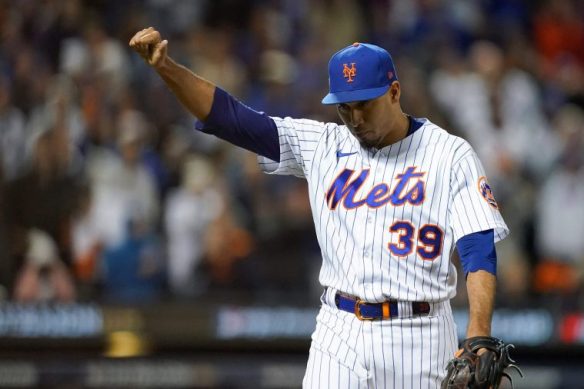
Edwin Díaz

Edwin Díaz did exactly what Buck Showalter brought him in to do . . . in a true “save situation—in the seventh, not the ninth Saturday night. For Showalter it was once bitten, twice bitter old lesson learned deeply enough.

The next time you see or hear any baseball elder tell you he or she is too “old” to bother learning something new, just show them Buck Showalter. He’s the Mets manager who learned one of the hardest lessons in baseball history and finally got to prove it when he absolutely had to prove it on Saturday night.

It kept his Mets and their skipper from an early winter and eons of second-guessing while they banked a 7-3 Game Two win. In the bottom of the inning in which Showalter showed at last that he really did learn something from the worst disaster of his managing career.

When they still played a one-or-done wild card game, in 2016, Showalter wouldn’t even think of his Orioles’ (and baseball’s, then) nuclear-hot relief option Zack Britton in the bottom of the eleventh. He stayed with faltering Ubaldo Jiménez because it wasn’t a “save situation” in a two-all tie, after all, despite the Blue Jays having first and third with one out.

Edwin Encarnación’s monstrous three-run homer into the Rogers Centre second deck told Showalter and the world that managing to one of baseball’s most nebulous statistics can be suicidal. It also told reminded a stubborn world that “save situations” aren’t strictly ninth-inning lead protection.

Showalter’s been second, third, fourth, and fifth guessed over that one ever since. When asked directly, he could never bring himself to re-open his mind from that moment. Either he’d say, “You just have to wear some things“; or, as he did immediately in that interview, “I can sit here and tell you ten things you may not know about that situation, but nobody wants to hear it.”

Except everybody wanted to hear it. Come the top of the seventh inning in Citi Field Saturday night, with a hard-held two-all tie but the Mets’ season in danger of ending in a wild card series sweep, Showalter found himself in a save situation in the truest sense of the phrase.

This time, Showalter planned for just this possibility. Once bitten, twice lesson learned. This time—just like his Saturday night starter Jacob deGrom pitching six innings of stout, eight-strikeout, two-run ball; just like his bombardier Pete Alonso breaking a two-all tie with a leadoff homer—the manager rose to the occasion.

No “closer” was deadlier than Edwin Díaz on the regular season. (1.31 ERA; 0.90 fielding-independent pitching; 118 strikeouts in 62 innings’ work.) And there Díaz was, up and throwing in the sixth, while deGrom retired the side on a strikeout, a fly to deep enough right, and a ground out.

Social media went half berserk just seeing Díaz warming up, never mind thinking Showalter would be insane enough (their words) to “burn” his closer that early. Except that a one-run lead, in a low-scoring game, for these Mets who sputtered their way toward finishing a 101-win season, after owning the National League East most of the season, qualified as the single most important save situation of their year.

“Buck bringing in Edwin Díaz in the 7th,” tweeted The Cooperstown Casebook author Jay Jaffe, “but only to underscore the fact that he’s still not bringing in Zack Britton.”

So Showalter went to Díaz Saturday night the way he didn’t even think about Britton in 2016. Díaz got Trent Grisham, who’d helped wreck Max Scherzer and the Mets in Game One with the long ball, to bounce out right back to the box, surrendered a four-pitch walk to Josh Bell, but then got back to back ground outs. And the Mets’ previously slumbering bats accepted that awakening happily.

They’d already chased Padres starter Blake Snell after Brandon Nimmo broke a one-all tie with an RBI single in the fourth. They withstood Jurickson Profar’s re-tying RBI single off deGrom in the top of the fifth before Alonso greeted reliever Nick Martinez as rudely as he knew how, sending the inning’s first pitch into the left field seats.

Now they had Adrían Morejón to handle out of the San Diego pen. Their manhandling of him only began with Francisco Lindor—who started the evening’s scoring with a first inning home run, after a leadoff single was wiped immediately by a double play—hitting a line single to open, and taking second on a wild pitch before Morejón walked Alonso and Mark Canha on tenth-pitch full counts.

Up stepped Jeff McNeil, the National League’s “batting champion.” Through the infield into right went his two-run double and out of the game went Morejón in favour of Pierce Johnson. Johnson had Eduardo Escobar pinned at 0-2, but Escobar un-pinned himself with an RBI single, then had pinch-hitter Daniel Vogelbach at 2-2 when Vogelbach lofted a sacrifice fly to deep right center.

Just like that the Mets broke the game open enough. Then Johnson struck out a pair following Tomas Nido’s base hit. Now what would Showalter do? Would he dare to leave Díaz in for a second go-round in the eighth and risk his unavailability for Game Three? Especially with about a 45-minute layoff while the Mets rolled up that four-run bottom of the seventh?

He dared. Díaz got Manny Machado to ground out back to the box to open. After walking Bell he struck Jake Cronenworth out on three straight pitches. Then Showalter made sure he wouldn’t lose Díaz for Game Three if needed, lifting him for Adam Ottavino, who caught Brandon Drury looking on 2-2 for the side.

“I was feeling great,” Díaz said postgame. “I thought I could get Drury out, but [Showalter]  told me that he needed me tomorrow and this was enough for today. So, I said let’s win the game tomorrow.”

It was a bloody good thing the Mets seventh made the Showalter/Díaz pay off, because Ottavino in the ninth worked like anyone but the owner of a 2.06 ERA and 0.97 WHIP on the regular season: leadoff walk, a hit batsman, a fly out, a pair of walks including to Machado pushing the third Padres run home.

Showalter went to Seth Lugo, and Lugo lured Bell into grounding out right back to the box for the side and the game. Leave it to the Mets to salute their skipper’s gambit—the absolute right move to have made, with the game and the season that squarely on the line—with a four-run inning and still have to perform another high-wire act to escape with the win, anyway. That’s still so Mets, right?

Maybe this will be the beginning of the final end of the dubious “closer” and “save” things. Maybe this, at last, will lock down once and for all that you don’t save your best relief option purely for the final inning, because a real save situation presents itself any time at all during a game.

That was then: “This is simple: Showalter screwed up,” ESPN’s David Schoenfield harrumphed. “Even the smartest men are capable of ineffable stupidity,” harrumphed Jeff Passan, then with Yahoo! Sports but now with ESPN. Keith Law began an entire chapter arguing against the save statistic in Smart Baseball with that sad 2016 brain freeze.

This is now, apparently: Too much of baseball world talking about Showalter’s “unusual” or “unconventional” move. But a one-run lead against a tenacious Padres team that’s survived a few blows of their own to get here in the first place, too, can blow any time in the final three innings.

The Mets were very much in a real, not an artificially-contrived-by-nebulous-rule, save situation in the seventh Saturday night. This time, the Buck didn’t stop, blink, flinch, or shrivel. Neither did his team.

A 66-year-old skipper made liars out of the old fart contingency that insists they’re “too old” to learn new if should-be obvious lessons. Showalter proved you don’t get old on earth until you get dead on earth. And dead is what the Mets might have ended up without that proof.

The Guards win an Óscar

Óscar González

Óscar Gonzáles about to send the Guardians to an AL division series . . . but did it have to be against a former Cleveland pitcher who’d served them long and well?

A Guardian kid leading off the longest scoreless game in the bottom of the fifteenth. Facing a former Guardian pitcher. The second pitch of the plate appearance disappearing and taking the Rays’ season with it.

One of seventeen to make major league debuts with the Guards this season, Óscar González hit eleven home runs on the way here. Now, he hit the most important one of his 24-year-old life Saturday afternoon to finish the Guardians’ shove of the Rays to one side in a two-game American League wild card sweep of opposites.

The whippersnappers upended their elders (the Rays’ average starting lineup age : 27; the Guards: 24) without caring how long it might take. If they could do it in a comparative Game One blink, sure. If they needed fifteen innings and shy of five hours to do it, neither they nor the sellout Progressive Field home crowd cared, either.

They made very short work (as in two hours and change) of the Rays in Game One. Then, they and the Rays threw the pitching kitchen sink at each other, just about, before Game Two reached the bottom of the fifteenth and Corey Kluber, former Guardian when they were still the Indians, went to work for a second inning’s relief.

It was his first relief gig in nine years. It turned out to be his last, thus far. And it wouldn’t be unfair to ponder whether Kluber might be beginning to think that someone, somewhere, placed a postseason hex upon his 36-year-old head. This was his fourth postseason tour that ended with him on the wrong side in elimination games in which he either started or appeared at all.

The last time Kluber turned up in the postseason, he wore Cleveland fatigues in 2018 and was bushwhacked by the Astros in the first of a three-game Houston division series sweep then, thanks to a fourth-inning leadoff bomb (Alex Bregman) and an RBI single, then back-to-back fifth inning-opening bombs (George Springer, Jose Altuve).

A year before that, Kluber faced the Yankees to decide another AL division series. The Yankees made shorter work of him then, with a third-inning two-run homer (Didi Gregorius) and four straight singles the final two of which plated a run each with one out in the fifth, en route the Yankees taking it in five.

A year before that, Kluber’s and the Indians’ World Series ended dramatically in that 8-7, late-rain disrupted Cubs win after a back and forth that might have tempted God Himself to proclaim a tie for the two then-longest World Series title droughts in the Show. And yet again Kluber started but was stripped of four runs that only began with Dexter Fowler sending the first-ever Game Seven-opening home run over the center field fence.

The two-time American League Cy Young Award winner has since struggled through injury-disrupted seasons in stops with the Rangers and the Yankees before spending 2022 working his way back to respectability with a respectable-enough 3.57 fielding-independent pitching rate.

But with one swing on a slightly-hanging cutter on 1-0, González sent Kluber’s newfound respectability and the end of the Rays’ fourth annual postseason trip in a row into the left field seats. He also sent Progressive Field nuclear while sending his young Guards to a division series date with the Yankees.

All season long the Guards’ rookie guard lifted heaviest carrying them to the American League Central title. The only question entering the wild card set was whether it’d be one of the kids or one of the few elders who’d get the big job done for them. Not that manager Terry Francona cared less, of courseI don’t think by that point we cared,” manager Terry Francona said.

“It could have been one of the old guys,” Francona said postgame after González’s blast. “We didn’t care. We’re not biased. I was happy that he hit it.”

“I flipped on the Guardians and game,” tweeted MLB Network researche Jessica Brand, “and first pitch Óscar González goes deep. I’m not sure I want that kind of power. Was kind of secretly relishing the goose egg farm.”

Well, somebody had to scramble those eggs sooner or later. For the longest time it looked as though neither side was necessarily that anxious to do anything other than pin the opposing lineups’ ears behind their heads and become human Electroluxes in the field.

Guardians pitching kept the Rays to six hits and Rays pitching kept the Guards to five. The Rays and the Guards used eight pitchers each, and the Guards blew a shot at smashing the scoreless tie a full game’s worth before González finally struck.

Myles Straw (who promptly stole second) and Rookie of the Year candidate Steven Kwan were handed back-to-back walks by Rays reliever Pete Fairbanks—relieving starter Tyler Glasnow—to open the bottom of the sixth. Somewhat tough on the Guards this year, Fairbanks unintentionally handed them a break when he called Rays manager Kevin Cash and a team trainer out to the mound.

“I can’t feel my hand,” Fairbanks is said to have told Cash. The team subsequently said the righthander’s index finger went numb for unknown reasons in the moment. Exit Fairbanks, enter Jason Adam, and ducks on the pond at once when Adam plunked last year’s Atlanta postseason hero Eddie Rosario on the first pitch.

Enter José Ramírez, the Guards’ All-Star third baseman. Exit Ramírez on strikes almost at once. And exit the Guards for the side when Josh Naylor grounded into a step-and-throw double play.

Ramirez more than made up for it in the twelfth, when he backhanded Manuel Margot’s hard hopper behind the pad, the momentum pulling him into foul territory, then whipped a long, low throw for which Naylor at first had to stretch to scoop, and he kept just enough of his foot on the pad to secure the out. The Rays challenged the play but lost.

Heavy sigh of relief from one end of Progressive to the other.

González might have had the most privately embarrassing moment of the night when his belt broke while sliding in the seventh. Lucky for him that first base coach Sandy Alomar, Jr. had a belt to spare. And lucky for the Guardians that González had a belt to spare opening the fifteenth inning.

But did it have to be against a Kluber who’d pitched long enough and well enough for Cleveland and its long-enough-deprived fans? A Kluber who’d given them everything he’d had, came up short, then came up injured enough to put paid to his Lake Erie days?

This is the guy who missed all 2019 after an arm fracture plus an abdomninal injury, had his 2020 option exercised by the then-Indians on Halloween 2019, then was traded to the Rangers a month and a half later in a delayed but somewhat shameful trick-or-treat. Then, Kluber returned in July 2020 as the pan-damn-ically delayed season began and lasted on inning before shoulder tightness proved a torn teres major muscle.

That sent him to the injured list and, in due course, to free agency, where he signed for a year with the Yankees for 2021, started a return to respectability including a no-hitter against the Rangers themselves, then lost another two months with another shoulder injury.

Kluber became a free agent again, signed with the Rays this year, and all seemed as right in his 36-year-old pitching world as he and anyone had a right to expect. He’s hardly the first to return to a postseason against one of his former teams, but he may be close to the top three for heartbreaks in such returns.

Those two Cy Young awards can’t help heal this one. And Cleveland cynics might amuse themselves thinking Kluber sent their team forward in their first year under a new name.

To such cynics, say only, “Don’t go there.” A franchise riddled with its own actual or alleged curses doesn’t need a Kluber Curse to throttle their exuberant and talented kid corps now. It would only destroy the magnitude of what González did Saturday afternoon, whether he did it against Corey Kluber or Clark Kent.