Censorship, Oriole style

Kevin Brown

Kevin Brown, discoursing on the Orioles’ previous futility against the Rays in Tampa Bay versus their success there this year through that evening . . . the discourse that got him suspended indefinitely, as things turned out. (NASN screen capture.)

Apparently, all you have to do is speak the truth on the air, and if the baseball team whose games you announce or analyse is owned by people for whom the truth is inconvenient, you can be suspended indefinitely. The MASN’s lead Orioles play-by-play man, Kevin Brown (not the former major league pitcher), has learned the hard way.

All Brown did was say on the air that the Orioles—the American League’s most pleasant surprise of the year, leading the East—had won more games against the Rays in Tampa Bay this year (three out of five) than over the previous three. (Three of 21.) It was the plain truth. No insult intended. It wasn’t even an opinion.

But Brown seems to have been suspended indefinitely since late July, when he made the foregoing observation advancing a series finale between the two teams in Tropicana Field. The jarring scoop belonged to Awful Announcing Monday:

[We’ve] confirmed through multiple sources familiar with the situation that Brown has been suspended indefinitely, that it came after the Rays series, that he only wound up on the radio for the Phillies’ series thanks to another controversy about a different announcer’s apparel, and that the comment here seems to be what’s at issue. The Orioles dispute an official suspension took place, but none the less Brown has been off television since July 26th.

The online outrage only begins with The Cooperstown Casebook author Jay Jaffe: “OMG this is the weakest sauce imaginable by the Orioles.” But this is hardly the first time the owning Angeloses have spread this kind of weak sauce.
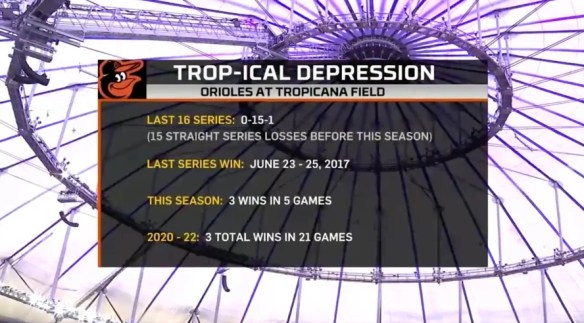
The factual graphic behind Brown’s fateful observation.

In 1997, Peter Angelos all but fired his lead radio announcer Jon Miller. The reasons included speculation that Miller’s weekend gig as a lead ESPN baseball announcer (with Hall of Fame second baseman turned colour commentator Joe Morgan) rankled both the Orioles and their radio flagship WBAL. Until they didn’t.

“Orioles officials,” wrote the Washington Post‘s Mark Maske, “said Angelos disliked Miller’s willingness to criticize the team harshly on the air when it wasn’t playing well.” Oops.

Miller, of course, went on to become the voice of the Giants in San Francisco. He probably saw oceans of downs and oceans of ups calling Giants games for what are now 26 years. He’s also accepted the Frick Award as a Hall of Fame broadcaster, in the same season the Giants won the first of three World Series titles in the span of five years.

Nobody seemed to want Miller fired when two Diamondbacks errors but three baserunning mistakes by then-Giants outfielder Ruben Rivera, ending with Rivera thrown out at the plate, prompted Miller to pronounce, “That was the worst baserunning in the history of the game!”

Whether Brown ends up staying with the Orioles on the air or whether he finds himself compelled to move onward (if he does, there should be no shortage of teams ready and willing to bring him to their mikes), this gives a disgraceful look to a baseball team who has gone from notorious tanking to AL East leadership and become must-see television approaching the hard stretch drive.

The Angeloses are hardly pioneers in baseball censorship. When the Yankees ended 1966 in dead last place (this was quite before divisional play), another Hall of Fame voice, Red Barber, committed his own such heinous crime—denied a camera pan of a near-empty Yankee Stadium, Barber intoned, “I don’t know what the paid attendance is today, but whatever it is, it is the smallest crowd in the history of Yankee Stadium, and this crowd’s the story, not the game.”

Oops. Among the reported mere 413 in the stands was Michael Burke, appointed by CBS (who’d bought the Yankees controversially in 1964) to oversee the Yankees. When the season ended officially, so ended Barber’s decade-plus Yankee tenure. The Ole Redhead elected to retire from there, but his purge was as wrong then as is Brown’s suspension now.

“Speak what you perceive as the truth,” said the late Hall of Fame broadcaster Tim McCarver. “If that’s outspokenness, that’s fine.” That was said after the Mets dumped him as a television analyst in 1998, proclaiming outspokenness wasn’t all that fine—and that Hall of Fame pitcher/franchise icon Tom Seaver, a Yankee broadcaster for five years, would do better as a “team player.”

Brown wasn’t even being outspoken, and he’s been put in the deep freeze for who knows how long. It’s difficult not to imagine the Angeloses answering “Honesty is the best policy” with “That’s what you think.”

“Down goes Anderson! Down goes Anderson!”

Tim Anderson

White Sox shortstop Tim Anderson hits the deck after Guardians third baseman José Ramírez (second from left, restrained further by a White Sox player) answered Anderson’s foolish challenge to fight with a flying right cross to the side of his head. White Sox first baseman Andrew Vaughn (25) would ultimately drag Anderson off the field as the two teams scrummed.

Once upon a time, Tim Anderson said he wanted to be today’s Jackie Robinson when it came to putting the fun back into baseball on the field. When the Yankees’ Josh Donaldson greeted him with, “Hi, Jackie,” during a game last year, the White Sox shortstop decided the joke’s shelf life expired not long after Donaldson first dropped it on him a couple of years earlier.

The benches and pens emptied, and Anderson’s White Sox teammates urged and nudged him back to the dugout before any serious damage could be done. The following day, Anderson—hammered with “Jack-ie, Jack-ie!” catcalls most of the day by the Yankee Stadium crowd—smashed a three-run homer that finished a doubleheader sweep, holding an index finger to his lips as a “shush” gesture to the catcallers.

But that was then and this was Saturday in Cleveland against the Guardians. In the sixth inning, Guards’ star José Ramírez went diving into second to beat a throw in from the outfield and finish his stretch into an RBI double. He slid right between Anderson’s legs.

Anderson had infuriated the Guards the night before with a tag knocking rookie Brayan Rocchio off the base, turning a double into an out when the original safe call was reversed rather controversially. Now, he seemed to try dropping a too-hard tag upon Ramírez to no avail. According to Ramírez, Anderson said he wanted to fight.

Ramírez held up his right arm as if hoping Anderson might help him up from the ground. Getting none, Ramírez rose on his own and pointed at Anderson, apparently objecting again to Anderson’s needlessly harsh tagging. Anderson assumed a boxing position as rookie umpire Malachi Moore tried to keep the pair separated.

Oops. Moore decided the better part of valour was to back away. Anderson threw a pair of rights as players on both sides approached. Then, somehow, some way, Ramírez swung a slightly wild right that caught Anderson flush on the left side of his face and knocked him to the ground. It was like Argentine boxing legend Oscar Bonavena’s wild punching style before Muhammad Ali outlasted him in 1970.

Guardians broadcaster Tom Hamilton couldn’t resist referencing another Ali fight when Ramírez connected: “Down goes Anderson! Down goes Anderson!” That went almost as viral as the scrum itself.

This wasn’t the usual bench-clearing incident in which the “brawl” was usually just a lot of hollering, shoving, more hollering, more shoving. This was two players swinging as if they’d mistaken themselves for hockey players. “It’s not funny,” said Guards manager Terry Francona post-game, “but coming [into the clubhouse] and listening to Hammy, it’s hard not to chuckle.”

It might have been Francona’s only chuckle of the evening. Not only did the White Sox finish what they started, a rather rare win, but Francona plus White Sox manager Pedro Grifol and their combatants Ramírex and Anderson were thrown out of the game post haste. So were Guards third-base coach Mike Sarbaugh and relief pitcher Emmanuel Clase.

Anderson wouldn’t talk to the press after the game, but Ramírez had plenty to say. “He’s been disrespecting the game for a while. It’s not from yesterday or from before,” the Cleveland third baseman began.

I even had the chance to tell him during the game, “Don’t do this stuff. That’s disrespectful. Don’t start tagging people like that.” In reality, we’re here trying to find ways to provide for our families. When he does the things he does on the bases, it can get somebody out of the game. So I was telling him to stop doing that and then as soon as the play happened, he tagged me again really hard, more than needed, and then he reacted and said, “I want to fight.” And if you want to fight, I have to defend myself.

Cynics suggest Anderson should get a two-week suspension for starting the fight in the first place. They say, not implausibly, that he shouldn’t exactly protest such a suspension, because his season—injuries contributed to his pre All-Star break .223/.259/.263 deflation, though he was bouncing back after the break—is much like that of the White Sox whole. Lost? Try disappeared.

Anderson has been admirable in the past for wanting baseball to be fun again, on the field and encouraging more black youth to consider the sport as a profession. He’s been capable of big moments, maybe none bigger than the game-winner he drove into the corn field behind the outfield in the first Field of Dreams game.

He wants to be remembered as an impact-delivering player. He overcame a lot to make himself a two-time All-Star. He looked like a classic baseball hero that night in Iowa. He may have thrown too much of that away Saturday night.

White Sox general manager Rick Hahn used the trade deadline to start dismantling the sorry enough team he’d built. Saturday night was actually the first White Sox win since the deadline itself. They’d lost thirteen of their previous seventeen until Saturday night. It’s not implausible to think Hahn will continue the remaking he began come the offseason.

But it’s also not implausible that Anderson, a player who’s meant plenty to the White Sox in the past, might be in his final days in their silks. If this proves the catalyst for that, it would negate enough of what he wants to mean to the team and to the game he loves. Far worse than his face or his ego getting dropped by a flying right in a foolish fight, that would hurt.

It really was in Rizzo’s head, after all . . .

Anthony Rizzo, Fernando Tatis Jr.

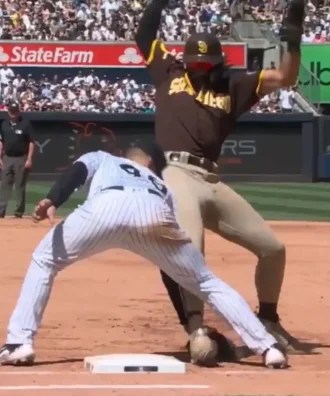
This is the 28 May collision—on a strike-’em’out/throw-’em-out double play—that turned Anthony Rizzo’s season into disaster whose cause nobody could figure out until this week.

Yankee and other fans now have the answer to what compelled a veteran first baseman with a jeweler’s eye for the strike zone to drop from an .880 OPS on 28 May to the arguable worst hitter in the game since. They should not like that nobody in his organisation could catch on sooner.

On that day, Anthony Rizzo took a bump on his head from the hip of the Padres’ Fernando Tatis, Jr., who was scrambling back to first on a strike-’em-out/throw-’em-out double play that ended the top of the sixth in Yankee Stadium. Watch the play from any angle you wish.

Yankee starting pitcher Gerrit Cole struck Xander Bogaerts out swinging, with Tatis well off the pad at first. A very alert Yankee catcher Kyle Higashioka whipped a throw up the first base line to an equally alert Rizzo. The throw went up the line low but Rizzo speared it cleanly to tag Tatis out on his lower right leg.

You should see clearly that, without intent, Tatis’s right hip caught the right side of Rizzo’s head hard as Rizzo bent down to apply that tag. Rizzo lost his hat, stood up as the ball fell from his mitt, then walked several steps toward second base before collapsing.

The Yankees thought it was a neck injury at first. They got Rizzo out of the game post haste, moving D.J. LeMahieu from third to first and Isiah Kiner-Falefa from left field to third, sending Greg Allen out to play left and to bat in Rizzo’s lineup slot. (The Yankees hung in to win the game, 10-7; Rizzo himself had pitched in with an RBI single prior to the fateful collision.)

Rizzo didn’t return to the lineup until the Yankees played the Dodgers on 2 June. In the interim, according to most reporting, he passed official concussion protocols. Yet, come Thursday, the Yankees let it be known that Rizzo was indeed dealing with post-concussion syndrome and that it was no questions asked traceable back to that 28 May play.

Nobody caught on after the original protocols passage. Rizzo himself says he began noticing “fogginess” last weekend, against the American League East-leading Orioles, where he’d previously couldn’t figure out how he dropped so far off the batting table.

“I remember talking to someone and they said, ‘Do you feel like you’re coming out of this soon?’” the first baseman finally told reporters. “I answered honestly that no I don’t because I couldn’t feel what you’re trying to feel as a hitter.”

I guess now we can link two and two together. Over the last few weeks, you just start going to different checklists of mechanics, timing, consistently being late. Why am I being consistently late? I’ve made these adjustments plenty of times in my career. I just didn’t forget how to do this all of a sudden. Everything (the doctors and I) talked about and everything they came back with basically came back on a silver lining of I’m not crazy for walking back to the dugout consistently thinking how I missed that pitch because I usually don’t miss that pitch.

The Yankees should be thinking about how they could have missed Rizzo dealing with and playing through both a concussion and its following syndrome for almost two months. They should be demanding answers from their own medical people and from baseball’s government itself.

All advanced knowledge coming forth over the last few decades doesn’t quite mitigate that baseball medicine is still not exactly sport’s equivalent to the Mayo Clinic. It still remains rare that a baseball team’s medical staff gets to the deepest heart of an injury issue before a career is compromised or ended.

And it still takes something such as Rizzo’s case to shake Joe and Jane Fan out of their smug dismissiveness toward slumping players to acknowledge that maybe, just maybe, there was a physical or neurological cause for the slump, as we now know was Rizzo’s case.

Ask Met fans who still dismiss Jason Bay as a mere bust. Signed to a four-year free agency deal, Bay was one of the game’s better outfielders and run producers . . . before he incurred two concussions as a Met, one hitting the outfield wall in 2010 and the second  hitting one in 2012.

Never mind teammates and his manager praising his work ethic, nobody put two and two together and figured two concussions might have had something to do with his dying bat. Bay and the Mets parted under mutually acceptable terms; he signed with Seattle, was given a clean bill of health, but after one horrid season called it a career.

Last winter, Twins fans inexplicably poured phlegm, bile, and acid over the very idea that Joe Mauer should be on the next Hall of Fame ballot. Their rage was over that fat contract extension Mauer signed when he was still the best catcher in the American League . . . and before he suffered the first of two concussions when he took a hard foul tip off his mask behind the plate.

Those fools called Mauer a thief because the concussions wouldn’t let him play to his previous level. Never mind the Twins yanking him out from behind the plate after that hard foul tip. They weren’t taking chances, especially after seeing what concussions did to their former first base star Justin Morneau.

Does the name Pete Reiser ring any bells? It should. That Brooklyn Dodgers legend with Hall of Fame talent ended up a Hall of Fame might-have-been, thanks to an insane playing style that caused him one too many concussions when he still couldn’t learn a concrete outfield wall—like the one they had in Ebbets Field—didn’t suffer fools gladly and he couldn’t make them collapse on contact.

Pistol Pete may have been lucky that he ended up with a somewhat long post-playing life as a minor league manager and major league coach. He also had an impact on the game beyond his own self: the Dodgers made Ebbets Field the Show’s first ballpark to feature padded walls after they traded him to the Boston Braves following the 1948 season.

Ryan Freel had it even worse. That cheerful character of an outfielder got blasted into a concussion on a collision with both an outfield teammate and the warning track in 2007; then, a second one in 2009, when he was hit flush on the head by a pickoff throw. Career over a year later.

Baseball began its concussion protocols in 2011. A year later, troubled by assorted mental issues and possibly remaining aftereffects of his two concussions, Freel committed suicide. Knowing what he’d been through playing baseball, his family donated his brain to Boston University—for research into chronic traumatic encephalopathy (CTE). In due course, it was determined Freel had Stage 2 CTE.

It’s bad enough that too many fans and too many sportswriters who ought to know better continue to dismiss the injured as malfeasant, especially when the injured take what those people believe to be longer than needed to recover. Too many sports teams behave likewise even today, too.

And too many fans still can’t draw the proper line between hard nosed and bullheaded, any better than Pete Reiser and others did. Baseball players shouldn’t have to blast themselves to smithereens to prove they’re delivering maximum effort.

Even the Yankees couldn’t figure out how Rizzo cratered after that 28 May game. They thought he was fine physically. They knew he wasn’t laying down on the job. Manager Aaron Boone kept insisting his man was going through a particularly protracted patch of slumping.

Rizzo himself didn’t think about further testing even though he’s admitted to feeling foggy and having days where he felt he’d been “waking up feeling hung over and you didn’t drink at all.” He also has to figure out how to balance his health to his itch to compete. He’s only too well aware that too many people, including those with and against whom he plays the game, still think injuries and their impact are mere excuses for poor play.

“[W]hen people come up and (are) like, ‘You haven’t been the same since the collision,’ I want to go tell people off because that’s not who we are as competitors,” he admits.

Even still, I feel like being injured or playing through a back injury or ankle injury in the past, you just adapt. Your body adapts. Obviously with this, I did everything I could and it’s unfortunate. The hardest part is missing time because I want to be out there. I want to be playing, but also to the level that I know I’m capable of playing at.

Easier said than done, alas. Even in today’s advanced medical atmosphere, professional athletes still can’t let themselves have the time they absolutely require to return to complete health. Often as not, their teams can’t. More often than that, Joe and Jane Fan don’t want to hear it. More often than that, Joe and Jane Sportswriter whip them into that froth.

Maybe the Rizzo case will start waking them up at long enough last. Maybe.

Pity poor Framber Valdez . . .

Framber Valdez

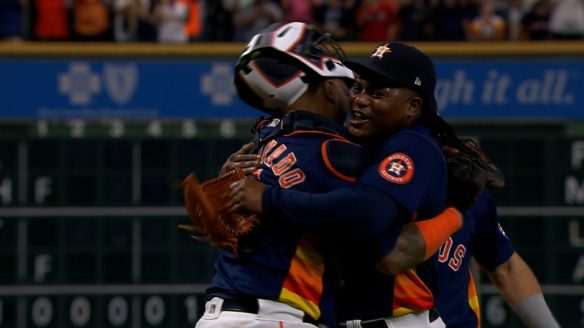
Framber Valdez gets a bear hug from his catcher Martin Maldonado after throwing a no-hitter at the Guardians Tuesday night.

What does it say that, on the day the Astros re-acquired the last man to throw a no-hitter in their silks, their struggling All-Star pitcher shakes off whatever it was prompting him to surrender fifteen earned runs over his past fifteen innings’ work to throw a no-hitter? The Astros may not be the only ones who’d like the answer.

But there it was. One minute, the Astros pulled the proverbial trigger on bringing future Hall of Famer Justin Verlander back. The next, after the trade deadline passed at 6 p.m. Eastern time Tuesday, Framber Valdez kept the Guardians hitless—with more than a little help from his friends—in a 2-0 win both of which Astro runs scored in the bottom of the third.

Verlander came home from the Mets in exchange for a pair of good-looking outfield prospects out of a farm system that was considered more than a little parched by any objective standard. Following their trade of fellow future Hall of Famer (and former Detroit rotation mate) Max Scherzer for a delicious Rangers prospect, the Mets actually looked smart in their unexpected circumstances.

“They did what they had to do, and I’m sure it wasn’t an easy call,” writes Smart Baseball author/Athletic analyst Keith Law, “but the Mets traded away six players from their big-league roster, including three pitchers all age 38 and up who either were heading for free agency or just unlikely to be that much help to the team in 2024 . . . ”

Dealing Justin Verlander and Max Scherzer—while paying enough of their salaries to return three solid prospects in Luisangel Acuña (No. 58 on my midseason top 60), Drew Gilbert (a first-round pick last year), and Ryan Clifford—are the kinds of moves more teams that have spent big only to fall short of contention should be making. And let’s give the Mets some credit for spreading the wealth around by sending one of those starters to Texas and the other to Houston.

I won’t pretend that that’s going to placate today’s generation of Met fans. You know. The generation that pronounces a season lost over one bad inning in early April. But Law is absolutely right. Especially with the coming off-season and, not merely to buy time, the pack of pitching free agents coming to within their glandular budget.

Particularly, a certain unicorn to whom the Angels held on for an (admittedly) outside postseason shot before he enters the market. The unicorn who’s both one of the best pitchers in the American League and a bona fide threat to Aaron Judge’s barely-year-old AL single-season home run record.

The Astros needed Verlander back more than anyone would have predicted when the season began. They’d just won a World Series and looked as though saying goodbye to a (controversial enough) era when they let the freshly-crowned Cy Young Award winner—the only baseball senior citizen ever to land one in his first year back from late-career Tommy John survery—walk into free agency.

But then they lost Lance McCullers, Jr., Luis Garcia, and José Urquidy to the injured list. Then, the Mets’s season went from World Series expectations to the landfill. Even as Verlander shook off early struggles and injury to round back into something resembling his old self (he has a 1.49 ERA over his last seven starts), it wasn’t enough to save this year’s Mets.

So the Mets elected to look 2023 reality in the eye and say time to start repairs. They dealt Scherzer to the Rangers after he delivered seven solid against his old team, the Nationals, en route the Mets taking three of four from the equally moribund Nats. When Scherzer asked the front office what the plan was, and learned it was moving on from deals expiring this year or next, he waived his no-trade clause and let the Mets move him onward.

The Astros are nipping at the Rangers in the AL West. The two teams square off themselves in a three-game set in early September. Tell me you won’t think it must-see television to see JV versus Max the Knife at least once in that set. Even if they’re not exactly young men anymore, they may yet have enough left in their tanks to have the eyes of all baseball upon them, especially with the AL West still at stake there.

It’s kind of a shame that Valdez picked Tuesday to pitch his jewel. Verlander back to Houston; St. Louis’s Jack Flaherty getting a fresh start in AL East-leading Baltimore (where he might get fixed enough to command a nice free agency pay day this coming winter);  the Cardinals otherwise reviving their own testy farm system without surrendering Nolan Arenado or Paul Goldschmidt.

Those were just too big to leave room. As were the Yankees even in inertia. They made no move other than landing middle relief pitcher Kenyan Middletown because they couldn’t realistically do a blessed thing. What they could move was either inconsistent or overpriced; what they could or might have brought in wouldn’t have been enough, even with Gerrit Cole at the head of the AL’s ERA pack and Judge back from his toe fracture.

You think today’s Met fan has the patience of a Nile crocodile? Don’t get me started on Yankee fans. From generation to generation, their credo is that a season lacking a postseason is illegitimate. For the generations since their last World Series win, the merest shortfall is enough to cause them to demand, “What would George do?”

The answer to that question is not what Yankee fan wants to hear anymore. They’d really rather have the late Boss’s tyranny and mutation back than what they have now. Never mind how it turned the 1980s Yankees into a basket case. Peace and quiet isn’t an option if the Yankees aren’t at the top of the AL East. Doesn’t it sound perverse to say a team with a winning record at this writing is also a basket case?

But there Valdez was, on the Minute Maid Park mound, striking seven out, letting his defenders take care of about 81 percent of the outs he needed otherwise, while Kyle Tucker took care of the game’s scoring with a two-run single in the bottom of the third.

Valdez stood at the top of the pitching heap Tuesday, and the trade deadline with all its attendant sidebars left him a hero without decoration. Even if Verlander’s first move on his arrival back with the Astros might be to congratulate him and welcome him to a unique club.

Sixteen no-hitters (four of which were combined, one of which was thrown by Hall of Famer Nolan Ryan) have been thrown by Colt .45s/Astros pitchers since their 1962 birth. From Don Nottebart (vs. the Phillies, 1963) through Valdez. That’s the most of any expansion franchise so far.

Valdez has a unique set of bragging rights while he’s at it. It took 61 years for an Astro  lefthander to do it. He can also say he’s the only man in baseball history, so far as anyone knows, to throw a no-hitter on deadline day, after the deadline hour passed but while the analysis and debates over the deals went hollering apace. The poor guy.

Doing right by minor leaguers, but not by pre-1980 short-career Showmen

Larry Yellen

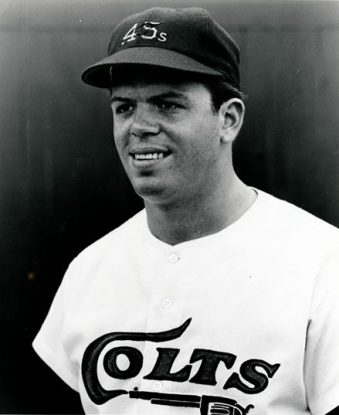
Larry Yellen–He shared a rookie card with eventual Miracle Met Jerry Grote . . . and had to miss being part of an all-rookie Colts starting lineup because the game would happen on Yom Kippur. (Photo from Jewish Baseball Museum.)

With the eyes of baseball world upon Tuesday’s trading deadline, and upon whom among the big enchiladas might be moving where, something happened almost too quietly to notice. Baseball’s government paid $185 million to settle litigation with minor league players who sued on grounds that minimum wage laws were violated.

According to the Associated Press, it’s going to work this way: 24,000 players from 2009 through last year are eligible to share the money. The estimated payments will range between $5,000 and $5,500. The money’s been transferred to JND Legal Administration. The AP says they plan to make the payments by 14 August.

The settlement covers all players with minor league contracts who played in the California League for at least seven straight days starting on Feb. 7, 2010, through the settlement’s preliminary approval last Aug. 26; players who participated in spring training, extended spring training or instructional leagues in Florida from Feb. 7, 2009, through last Aug. 26; and players who participated in spring training, extended spring training or instructional leagues in Arizona from Feb. 7, 2011, through last Aug. 26.

The original plaintiffs filing in 2014 were Aaron Senne (1B/OF, Marlins system), Michael Liberto (IF, Royals system), and Oliver Odle (P, Giants system.) Senne retired before the suit was filed; Liberto and Odle have retired long since.

Last fall, of course, minor league ballplayers joined the Major League Baseball Players Association. This past spring, the minor league faction agreed to a five-year contract doubling all minor league player salaries, the AP said. That was nothing but good for the players, the union, and the game itself.

But you have to wonder. If the players’ union was willing to welcome minor leaguers into their ranks and back them on a five-year deal that jumped all their salaries, why can’t the union find a way to welcome and redress the issue of pensions denied what are now 500+ short-career major leaguers whose time in the Show came prior to the 1980 pension re-alignment?

At this writing, they haven’t, and it still looks as though they won’t. It also sounds as though they’ll continue to say what they’ve said too long about that pension redress: nothing.

The 1980 re-alignment started handing pensions to major leaguers who had 43 verified days on major league rosters and health benefits to those who had one verified day there. The kicker was that it went to major leaguers whose careers ended after 1980. Those who had 43 verified major league roster days before 1980? Oops.

Double oops: The union’s line then was that the majority of those pre-1980 short-career major leaguers were measly September call-ups. Not that that should matter a damn, but not so fast. Peruse the records of the 500+ and you should discover that the majority of them saw major league time:

* Prior to any September in any year.
* As early as April of any year.
* Making major league rosters out of spring training even once.

Allow me to mention a few of those pre-1980 players who have passed on to the Elysian Fields this year.

Larry Yellen (pitcher, Colt .45s: the Astros-to-be)—He was a September call-up in 1963 . . . but he appeared in thirteen games (twelve in relief) between 21 April and 3 October. He was sent back to the minors for August, brought back in September, then played one more season in the Houston system before leaving the game.

According to the Jewish Baseball Museum, Yellen nearly helped make a little history during September 1963: He would have been the starting pitcher late that month when the Colts elected to send an all-rookie lineup out against the Mets—until he made his debut the day before, thanks to the Mets game being scheduled on Yom Kippur.

Yellen’s post-baseball life proved a solid one. Though eventually divorced from his first wife, Yellen graduated from Fredonia State University in 1987, took up a life in sales and marketing, remarried happily, and eventually worked for a tutoring company until his retirement. He died at 80 on 18 July.

Yellen has another intriguing element in his baseball past: he shared a 1964 Topps rookie card with future Miracle Mets catching mainstay Jerry Grote.

Mike Baxes (middle infielder, Kansas City Athletics)—After seven prior minor league seasons, he looked promising when he came up to the Athletics in 1956, even as a classic good-field/little-hit middle infielder. But after a solid April 1957 followed by a regression at the plate, Baxes looked to be getting his swing back when he suffered an ankle fracture trying to turn a double play.

Traded to the Yankees, Baxes wasn’t likely to endure with established middle infielders Bobby Richardson and Tony Kubek nailing it down shut. He bounced around the PCL until the Buffalo Bisons—for whom he’d been a fan favourite before going up to Kansas City—took a chance on him. The injury drained more than anyone thought, and Baxes left the game in 1961.

His older brother, Jim, may have had a more lasting major league impression, alas: the elder Baxes hit his first home run off a Cardinals pitcher surrendering his first major league home run: Hall of Famer Bob Gibson. The elder Baxes died in 1996; the younger, at 92 on 13 April.

Pete Koegel (catcher/first baseman, Brewers, Phillies)—The first major league player from Long Island’s Seaford High School, Koegel is sort of a Ball Four footnote. He was one of a pair of minor leaguers traded out of the Athletics organisation to the Seattle Pilots—after the 1969 season ended, and before their move to Milwaukee to become the Brewers—for former Athletics pitcher and noted Jim Bouton nemesis Fred Talbot. (Talbot got into one game with the A’s before he called it a career.)

As a high school athlete, Koegel was named the MVP of the New York Journal-American‘s high school All-Star game—and was presented the award by no less than Hall of Famer Lou Gehrig’s widow, Eleanor. After his brief stints with the Brewers and the Phillies, Koegel played a few more years in the minor leagues (including the Mexican league) before calling it a career after 1977.

One of three 6’6″ catchers ever to see major league time, Koegel saw major league time in April 1971 before returning to the minors and being traded to the Phillies; and, for most of the season with the 1972 Phillies. He moved to Saugerties in upstate New York after leaving baseball, and spent the rest of his life in that region. He died at 75 on 4 February.

Ron Campbell (infielder, Cubs)—He was a September call-up in 1964 and 1965, but he appeared in June-July and then mid-August through the end of the season in 1966. His first major league hit (off Cincinnati’s mercurial John Tsitouris) drove a run home; his final day in the Show saw him have the second of a pair of lifetime three-hit games (against the Mets).

He spent four more years entirely in the minors before leaving baseball after 1970. He’d been a natural third baseman blocked by Hall of Famer Ron Santo, but he’d also been a highly regarded high school football and basketball player in his native Tennessee. In fact, he was inducted into the Chattanooga, Bradley County, and Tennessee Wesleyan Halls of Fame. He died at 82 on 2 February.

Those men died without seeing any full major league pension thanks to their 1980 re-alignment freezeout. The only thing they saw was a stipend arranged in a deal between then-Commissioner Bud Selig and then-players union executive director Michael Weiner: $625 per quarter for every 43 days’ worth of MLB time, up to four years’ worth. The stipend was hiked by fifteen percent in the settlement of the 2022-23 lockout.

But it still wasn’t a full pension. And Yellen, Baxes, Koegel, Campbell, and the remaining 500+ pre-1980 short-career major leagues couldn’t and still can’t pass the money on to their families upon their deaths.

The union’s first executive director, Marvin Miller, said originally, and perhaps accurately, that the union then didn’t have the money available. But he also said subsequently—and I’ve been told this by several of those pre-1980 players whom I’ve interviewed (and, in a few cases, befriended)—that a) when the money was there, they wouldn’t be forgotten; and, b) the union’s failure to re-visit the issue substantially was his biggest regret.

You might think that, if baseball’s government, presiding over a sport worth billions, could find $185 million to settle with minor leaguers, the players’ union—likewise said to have $56.8 billion in revenues—could find a way to do right by pre-1980 short-career major leaguers.

But you might first have to convince more than just a tiny handful of sportswriters to give the issue the airing it deserves. And that’s proven, thus far, to be about as simple as trying to sneak one past Shohei Ohtani.