That was the wild card week that shouldn’t have been

Bryson Stott

Bryson Stott’s grand slam Wednesday, and Royce Lewis’s two bombs Tuesday, were the most fun of this week’s less-than-fun wild card games.

Well, that was fast. Four wild card series, four sweeps. A grand total of two runs scored by both the American League’s losing teams. The National League’s managed to score sixteen between them, but the winners scored 22 between them to the AL winners’ 16. Lovely.

Except for a very few moments among two wild card series winners, saying those winners shot the proverbial fish in the proverbial barrel is something like saying the sun arose, the sky’s blue, the tide’s rushing in, and the television cash kept pouring into MLB’s kitty, properly competitive baseball be damned.

The wild card idea for baseball was dubious from its birth, of course. But the arrival of three wild cards per league has now hit rock bottom. And don’t ask if baseball’s postseason could possibly become any weaker. Someone in the commissioner’s office might hear you and plant the appropriate seed in Rob Manfred’s garden of weeds

Bad enough that the race for the wild cards is a house of cards where legitimate pennant race competition is concerned. Go ahead and say it, go ahead and say you find nothing wrong with the thrills and chills and spills of teams fighting to the last breath to finish . . . well enough in second or even third place to qualify for championship play.

Go ahead and tell me the Rays looked like a fourth-best-regular-season-record team in getting thumped and stumped by the eighth-best Rangers in their own sorry excuse for a ballpark. Go ahead and tell me the ninth-best Blue Jays looked like a worthy postseason team after getting shoved aside by the AL Central champion Twins—the Show’s eleventh-best team on the season.

Go ahead and tell me the thirteenth-best team on the season, the Marlins, had any business being in the postseason with key pitchers injured after getting destroyed by the Phillies. Tell me the NL Central-winning Brewers looked like baseball’s fifth-best regular season team when they got dumped by the twelfth-best Diamondbacks, who may yet receive their own come-uppance from the NL West beasts out of Los Angeles.

The most excitement these wild card games delivered was the Twins’ Royce Lewis becoming the first number one draft pick ever to clear the fences in his first two postseason plate appearances ever, and Phillies second baseman Bryson Stott putting a still-reachable Game Two out of reach with a sixth-inning grand slam to the rear end of the lower right center field seats.

The most ginned up controversy came in Game Two of one of the American League sets, when Blue Jays manager John Schneider lifted his seemingly cruising starting pitcher José Berríos after three shutout innings. Schneider had only been very public saying he was going all pitching hands on deck (minus Game One starter Kevin Gausman) for a game he had to win to stay alive. You expected him to think of less when he’s facing win-or-be-gone that early?

How many stopped to ponder that the Blue Jays bats going missing in action did more damage—well, far more lack of damage—than Schneider lifting a pitcher who might have had maybe two more innings in him during which there was a reasonable chance of him showing how he gets torched as soon as the opposing order’s third time around arrives?

And what about Vladimir Guerrero, Jr., coming off a fine if not superstar regular season, getting careless on second with two out in the top of the fifth and Twins starter Sonny Gray finishing his fifth shutout inning by picking Guerrero’s tail feathers off second cleanly with second and third and Bo Bichette at the plate?

The Twins weren’t exactly causing traffic jams at the plate themselves, not with five runs scored across the set and three courtesy of Lewis. But the Blue Jays’ offensive inertia did far more to cost them than lifting Berríos could have done. This was baseball’s ninth-best regular season team getting pushed, shoved, and bumped home by baseball’s eleventh-best team.

That’s also why the Brewers are going home for the winter sooner than they planned. They needed far more than Christian Yelich and Willy Adames to swing and didn’t get it. And they have other issues to face, too. Their manager becomes a free agent and their two best pitchers—both under one final coming year of team control—may not be getting paid what their worth if they stay in Milwaukee. There may have gone the Brewers’ window for awhile, after winning an NL Central that some say nobody else really wanted to win.

Maybe it’s finally time for the Show’s government to start thinking of four-division leagues, and thus a postseason in which nobody gets to the dance unless their butts were parked in first place when the regular season ended. Maybe it’s time that, once agreeing upon that, each league’s divisions are placed into a pair of conferences with regular-season interleague play sent the way of stone bases once and for bloody all.

Maybe it’s time for best-of-three division series, best-of-five conference series, and the return of the best-of-five League Championship Series. Keeping the World Series prime at a best-of-seven.

Think about it. Commissioner Pepperwinkle and his minions will still get all the postseason games and postseason television money they could fantasise about. But this time, it’d be on behalf of far more honest competition, far more honest pennant races, and nobody on the edges of their seats waiting to see who finishes . . . second and even below.

When the best news of wild card week proved to be Mets general manager Billy Eppler resigning—maybe to duck being canned over forcing now-former manager Buck Showalter to use still-struggling, still-portly Daniel Vogelbach in the 2023 Mets’ lineups, despite his bat proving he didn’t deserve to be there so often, maybe out of Eppler’s need to justify the 2022 deal that brought him aboard in the first place—you know this year’s wild card sets were flushed.

Because we baseball fans, even those attention-deficit fans to whom Commissioner Pepperwinkle seems to pay the most attention anymore, didn’t sign up to see what we saw this week. Not even Lewis and Stott could acquit that.
Starting postseason life with two bangs

Royce Lewis

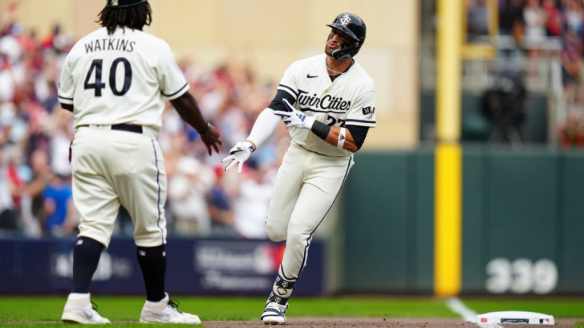
Sometimes things line up too perfectly to pass up on those opportunities.—Royce Lewis, here rounding third off the second of his AL wild card series-opening home runs Tuesday.

Children who grow up with dreams of baseball have numerous supporting fantasies. Rest assured, once they realise they can play the game well, they dream of making the Show. Many of them then dream of going number one in the draft, with or without the glandular signing bonus. Many of those dream of going number one, making the Show, then making the postseason for the first time and making . . .

Waves? Big splashes? Broken precedents? All the above? Ask Royce Lewis, the Twins’ infielder who slotted as the team’s designated hitter for Game One of their wild card set against the Blue Jays Tuesday. The same guy who hit grand slams in back-to-back games against the Guardians in July.

He faced formidable Blue Jays starter Kevin Gausman in the bottom of the first with one out and Edouard Julien aboard (leadoff walk). He worked the count full. Then, he turned on a pitch in the middle of the inside part of the plate, and it sailed on a high line into the left field seats. Game One wasn’t ten minutes old, and Lewis put the Twins up 2-0.

Two somewhat quiet innings later, Lewis checked in against Gausman again. This time, he opened the inning. This time, he didn’t wait for the count to get full. This time, Gausman’s 3-1 service came right down the pipe. This time, the ball took a flight the opposite way, banging off the top of the right field wall, making it 3-0, Twins, turning Target Field temporarily into the world’s largest outdoor nuthouse.

Two plate appearances. Two swings. Two bombs. There have been 58 number-one draft picks since Rick Monday went number one to the then-Kansas City Athletics in 1965. There have been a number of big boppers among them. Only three of those number-ones became Hall of Famers. (Harold Baines, Ken Griffey, Jr., Chipper Jones.) Four, if you count Hall of Famer-in-waiting Joe Mauer.

Not a one of them began any postseason life they had with even one home run, never mind two, never mind hitting the first bomb of any postseason, never mind being responsible for every run scored in their team’s postseason series-opening win, which the Twins won 3-1. The lone Toronto run: Kevin Kiermaier singling Bo Bichette home in the top of the sixth.

“That’s a God thing,” Lewis said postgame. “I’m just blessed to be part of it. It felt like I was blacked out the whole game. My heart was racing.” He keeps blacking out like that and the Twins have an excellent chance of going places other than home prematurely this postseason.

Wherever Lewis’s career goes from here, he’s got bragging rights forever on every fellow member of the Number One Club. He also has the honour of being the man most responsible for ending the Twins’ most peculiar negative achievement, stopping their postseason game losing streak at eighteen. Not to mention only the third player ever, regardless of draft position, to open his postseason life with a first-inning home run, joining Evan Longoria (Rays, 2008) and one-time Twins favourite Gary Gaetti (the eventual 1987 World Series winners).

Eighteen straight postseason games lost over nineteen years, under three different managers and with several franchise icons in the mix, from Mauer to Johan Santana to Torii Hunter to Byron Buxton. It took a guy whose first couple of seasons in the Twins’ fatigues have been disrupted rudely by injuries and who was freshly recovered from a hamstring injury to step up Tuesday and bring his demolition kit to the park with him.

“We just wanted to put an end to something that was very unfortunate to our beloved fans,” said Twins starting pitcher Pablo Lopez, who pitched five and two-thirds strong innings before Kiermaier’s steak single ended his day. “Our fans have been so great to us—they support us, they root for us no matter the situation. It felt right. The way I see it now, we have a new streak going.”

“I thought the place was going to split open and melt,” said Twins manager Rocco Baldelli—who has a pair of postseason home runs on his own resumé, including in the 2008 World Series for the Rays. “Honestly. It was out of this universe out there on the field. The fans took over the game. They helped us win today.”

The Twins’ fielders took over when the fans didn’t. There was center fielder Michael Taylor stealing a prospective game-tying double from Matt Chapman with a flying leap against the fence in the top of the second. There was, especially, Kiermaier’s chopper in the fourth, sneaking away from onrushing Twins third baseman Jorge Polanco.

Bichette on the run from second thought he had a shot at scoring. Plantaar fasciitis-addled shortstop Carlos Correa thought otherwise. He yanked himself running to his right, picked the ball barehand as Bichette headed down the third base line, threw off balance, and managed somehow to get the diving Bichette out by about the full length of a catcher.

“If you like watching the biggest players making the biggest plays in the biggest games,” Baldelli said, “then you should go watch that play. It was fantastic.”

Lewis had the fantastic franchise wrapped up in the first and the third, though.

“Some people believe in fate,” he said. “Some people believe that the things we do today drive what we do tomorrow. But sometimes things line up too perfectly to pass up on those opportunities.”

He had two pitches line up just that perfectly as ironclad evidence.

Tim Wakefield, RIP: Decency

Tim Wakefield

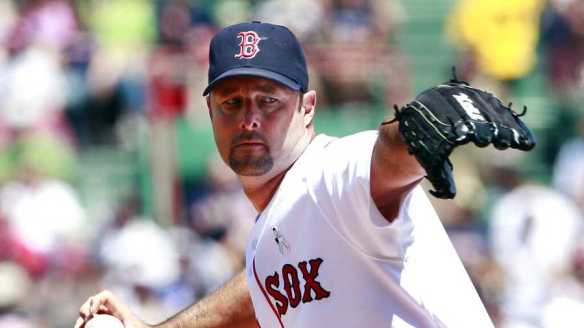
Armed with a decent if tough to handle knuckleball, Tim Wakefield was a good pitcher and a better man. He spent the most time of any pitcher with the Red Sox—seventeen seasons.

Tim Wakefield’s death at 57 struck more than a few chords around baseball Sunday. Not just because a decent man with a decent knuckleball and a philanthropic heart was taken too soon. Not just because he and his wife were robbed by a narcissistic old teammate of their right to fight two insidious diseases with dignity and courage and out of the public eye.

How decent was Wakefield? Decent enough that—when his 2004 Red Sox overthrew the Yankees in that staggering American League Championship Series run after being down to the last couple of outs in a prospective four-game sweep—Yankee manager Joe Torre called Wakefield before he called anyone else in his dark hour.

A year earlier, Torre showed him empathy after the first pitch he threw to Aaron Boone in the ALCS Game Seven bottom of the eleventh flew into the left field seats with a meal, a stewardess, and the American League pennant aboard: He had done nothing but get us out in that series, and, all of a sudden, he’s got to walk off to that.

Now, wrote the New York Times‘s Jack Curry, “Torre was alone with his disappointment. He could have called his wife for comfort or he could have called George Steinbrenner, the principal owner, for discomfort. He lifted the receiver and, surprise, called Boston pitcher Tim Wakefield instead. ‘I just told him I wasn’t happy,’ Torre said, ‘but I was happy for him’.”

Few baseball goats get to redeem themselves as swiftly as Wakefield did. He went from surrendering a pennant-losing home run one year to standing on the mound as a pennant- and World Series-winning pitcher the next. Not to mention a pennant- and World Series-winning pitcher three years after that.

It wasn’t exactly pretty—he threw threw shutout relief innings in 2004 ALCS Game Five but surrendered five earned without harm in Game One of that World Series. Then, he pitched four and two-thirds surrendering five earned in Game Four of the 2007 ALCS but didn’t appear in the Red Sox World Series conquest to follow.

Wakefield was a competitor who never refused the ball, taking a reasonable knuckleball and a quiet but powerful will to the mound. Reasonable, but hard to handle: one of his catchers, Victor Martinez, actually used a first baseman’s mitt behind the plate when catching him. Wakefield did the best he could with it for a long career including those two World Series rings, and earned nothing but respect and affection for his effort.

He could have shriveled after Game Seven of the 2003 ALCS, when he pitched a shutout bottom of the tenth inning in relief of Mike Timlin but saw his first pitch to Boone disappear to open that bottom eleventh and close out that ALCS. But like his fellow Red Sox, he simply picked up, dusted off, and started all over again. All the way to the Promised Land no Red Sox team had seen since the end of both World War I and the Austrio-Hungarian Empire.

Perhaps, as I once wrote, arguing that the sports goat business should have gone out of business long enough ago, Wakefield having been to four postseasons prior to 2003 built a survival mechanism in him to call upon when Boone swung.

It might also have helped that Red Sox Nation heaped its scorn upon manager Grady Little misreading Hall of Famer Pedro Martinez’s emptied fuel tank and leaving him aboard a Yankee or two too many to send Game Seven to the extras in the first place.

Wakefield’s steadiness probably had as much influence as any of the freewheeling, fun-loving Idiots as the 2004 Red Sox called themselves. (“We’re just a bunch of idiots who love playing baseball”—center fielder Johnny Damon, who swore it also meant they weren’t going to let the Red Sox’s star-crossed history to that point get to them.)

It wasn’t enough to enable him to overcome the brain cancer he and his family hoped to keep out of the public view before his Red Sox teammate Curt Schilling outed him last week. Schilling took an appropriate beating all over social media for revealing what Wakefield and his family hadn’t permitted him to do, and the Red Sox issued a public statement of empathy without saying outright what Wakefield fought.

We just didn’t think the battle would end so soon after Schilling’s idiotic doing.

The eulogies speak more about Wakefield the man than Wakefield the good if not quite great pitcher who was good enough to pitch nineteen major league seasons, seventeen with the Red Sox. “I only knew him off the field,” Xtweeted former Red Sox outfield star Fred Lynn, whose career beginning predated Wakefield’s by a couple of decades, “but he was a very good guy. Class act. Gentleman.”

Wakefield was a 2010 Roberto Clemente Award winner for his community and charity work off the field in Boston. (He was nominated eight times for that award.) He was the charitable Red Sox Foundation’s honourary chairman as well as being heavily involved with the New England Pitching for Kids group that aims to improve children’s lives. He also became a well-liked Red Sox broadcaster after he stepped off the mound for the final time, and habitually asked fans who met him about their own lives and doings first.

“The best guy you could want to be your friend,” Xtweeted former Pirates manager Clint Hurdle, who managed the team long after Wakefield began his career with them. “The baseball player was a great teammate and competitor. Another true ambassador of our game. The husband, father and friend cannot be replaced. He cared and he loved.”

He loved only three people above and beyond baseball. He loved his wife, Stacy, who’s reportedly battling pancreatic cancer herself, and his two children, Trevor and Brianna. May the Lord in whom he devoutly believed have welcomed him home happily, while lending His love and strength to his family.

And, perhaps, more than a few hard raps across the mouth of the teammate who saw fit to deny him and his family the dignity of their final hours together without publicity’s prurient blare.

Party hearty, Baltimore, but . . .

Baltimore Orioles

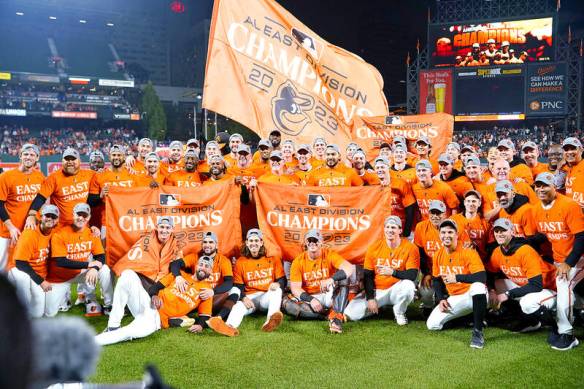
Your American League East champions, who got here the hard, disgraceful way.

You hate to dump rain upon the Oriole parade just yet. But their clinch of both the American League East and home field advantage through the end of the American League Championship Series (if they get that far in the first place) isn’t exactly the early climax of a simon-pure story.

Of course it’s wonderful to see the Orioles at the top of their division heap and Baltimore going berserk in celebration. Of course it’s wonderful to see the first team in Show history ever to lose 100+ in a season flip the script and win 100 within three years.

Of course it’s wonderful that the Orioles are going to stay in Camden Yards for three more decades at least, an announcement that came in the third inning Thursday. It sent the audience almost as berserk as they’d go when Orioles third baseman Ramón Urias threw the Red Sox’s Trevor Story out off a tapper to secure the clinch.

Of course it’s wonderful that we don’t get to call them the Woe-rioles, or the Zer-Os anymore. And of course it’s going to feel like mad fun rooting for the Orioles to go deep in the postseason to come, even one that remains compromised by too many wild cards and too many fan bases thus lost in the thrills and chills of their teams fighting to the last breath to finish . . . in second place or even beyond for a nip at the October ciders.

Unfortunately, it’s not easy to forget how the Orioles got to this point in the first place. In plain language, they tanked their way here. There’s no way to sugarcoat it.

However marvelous and resilient they were all season, however much of a pleasure it’s been to see this year’s Orioles behaving like their illustrious predecessors of 1966, 1970, 1983, and numerous other division champions and pennant winners, they got here via tanking. That should never be forgotten. It should never happen again. To the Orioles or any other conscientious major league team.

It started after their 2016 season ended too dramatically. When then-manager Buck Showalter kept to his Book and his Role Assignments, declined to have his best relief pitcher Zack Britton ready and out there, because it wasn’t a quote save situation. Leaving faltering Ubaldo Jimenez on the mound to face Toronto’s Edwin Encarnación. Baltimore still won’t forget the three-run homer Encarnación parked in the second deck of Rogers Centre with the Blue Jays’ ticket to the division series attached.

They tanked from there forward, picking up from where they left off after 1988-2015. They finished dead. last. in the AL East in three of the four seasons to follow. (A fourth-place finish broke the monotony.) As of a hot August 2021 day when the Angels (of all people) bludgeoned them 14-8, including thirteen runs over three straight innings, they were 201-345—after having been the American League’s winningest regular-season team from 2012-2016.

Before the 2021-2022 owners lockout ended and spring training began, The Athletic‘s Dan Connolly came right out and said it, even though he admitted it didn’t really bother him: rebuilding the entire organisation, ground up, and giving almost all attention to the minors and the world baseball resources but so little to the parent club, “produces a tank job in the majors.”

They weren’t the only tankers in the Show by any means. Famously, or perhaps infamously, the Astros tanked their way to the 2017 World Series—which turned out to be tainted thanks to the eventual revelations that the 2017-18 Astros operated baseball’s most notorious illegal, off-field-based, electronic sign-stealing scheme.

They were preceded by the 2016 Cubs, who tanked their way to that staggering World Series conquest. Like the Astros, the Cubs came right out and said it: they were going into the tank in order to win in due course. The 2016 Cubs don’t have the 2017-18 Astros’ baggage, and their conquest was mad fun, but their fans endured a few seasons of deliberate abuse to get there.

Yes. I said it again. Just like Thomas Boswell did in July 2019. “It’s dumb enough to tear down a roster that is already rotten or old or both,” he wrote.

But it’s idiotic to rip up a team that has a chance to make the playoffs, even as a wild card, especially in the first era in MLB history when six teams already are trying to race to the bottom. With more to come? What is this, the shameless NBA, where tanking has been the dirty big lie for years?

. . . With the Orioles (on pace for 111 loses), Tigers (111), Royals (103), Blue Jays (101), Marlins (101) and Mariners (98) all in the same mud hole wrestling to get the same No. 1 draft pick next season, we’re watching a bull market in stupidity. And cupidity, too, since all those teams think they can still make a safe cynical profit, thanks to revenue sharing, no matter how bad they are . . .

. . . In the past 50 years, losing usually leads to more losing — a lot more losing. I’ve watched it up close too often in Baltimore. In 1987-88, the Birds lost 202 games. Full rebuild mode. In the 31 seasons since, the Orioles have won 90 games just three times. At one point, they had 14 straight losing seasons. Why did D.C. get a team? Because the Orioles devalued their brand so much that there was nothing for MLB’s other 29 owners to protect by keeping a team off Baltimore’s doorstep.

Baseball has seldom seen a darker hour for its core concept of maintaining the integrity of the game. Commissioner Rob Manfred is either asleep or complicit.

Too many teams are now breaking their implicit vows to the public. They’re making a profit through the back door as money gushes into the game from revenue streams, many of them generated over the Internet, which are divided 30 ways. For generations, fans have believed that they were “in it together” with their teams. Bad times made everybody miserable — fans, players and owners alike. Now, only the fans take it in the neck.

And in the back.

So this year’s Orioles, a genuinely fun and engaging team, with a lot of genuinely fun and engaging players, have won 100 games for the sixth time in their franchise history. They have the home field postseason advantage for as long as they endure through the end of the American League Championship Series. They’re liable to make things interesting for any team looking to dethrone them this postseason. Just like their former glory days.

It’s wonderful to see Camden Yards party like it’s 1969 again. Or 1970-71. Or 1979-80. Or the scattered good seasons between then and now. But it should be miserable to think of how they got here in the first place. It should be something no Oriole fan, no baseball fan, really, should wish to see again.

Tanking is fan abuse, plain and simple. It also abuses the game’s integrity. That integrity has taken more than enough shots in the head from other disgraces perpetuated by its lordships. Don’t pretend otherwise.

But now that we’ve got that out of our system, for the time being, let’s celebrate. The once-proud organisation that gave us the Brooks-and-Frank-Family Robinson era, The Oriole Way, and the era of Steady Eddie and Iron Man Cal (though beating the 1983 Philadelphia Wheeze Kids could have been called shooting fish in a barrel), is going back to the postseason at last.

And, this time, let’s pray, that when a true as opposed to a Role-or-Book “save situation” crops up in the most need-to-win postseason game, manager Brandon Hyde won’t leave his absolute best relief option in the pen—a dicey question, considering they’ve lost closer Félix Bautista (now to Tommy John surgery), even with Yennier Cano emerging to look like a grand candidate—waiting while a misplaced, faltering arm surrenders a season-ending three-run homer before their time.

Maybe these guys have what it takes to wrestle their way to a World Series showdown with that threshing machine out of Atlanta. Maybe they won’t just yet. Let’s let Baltimore and ourselves alike enjoy the Orioles’ October ride while it lasts, however long it lasts. The loveliest ballpark in the Show has baseball to match its beauty once again.

Grand opening of the 40/70 Club

Ronald Acuña, Jr.

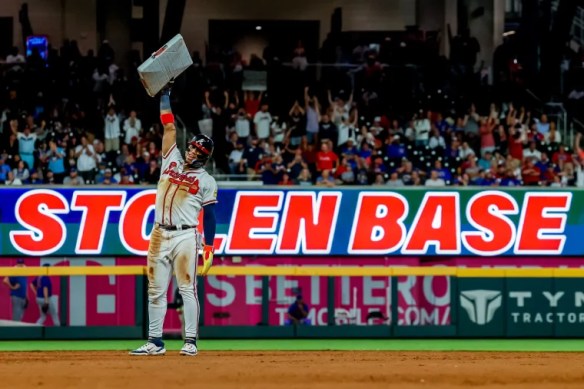
Ronald Acuña, Jr. channeled his inner Rickey Henderson after stealing the base that opened the 40/70 club Wednesday night. Some social media scolds plus a Cub broadcaster or two were not amused.

When A. Bartlett Giamatti died unexpectedly in 1989, eight days after pronouncing Pete Rose persona non grata from baseball, the New York Times columnist George Vecsey observed that investigating the Rose case kept the commissioner—a lifelong baseball fan—from sitting in the stands too often.

But Giamatti was there when Hall of Famer Nolan Ryan nailed career strikeout five thousand, Vecsey remembered in his sweet, sad elegy, “ticking off least one Oakland player who thought he detected Giamatti rooting for Ryan.”

Giamatti knew that baseball is about rooting, about caring. Let us envision him on the edge of his seat, a smile softening his gray beard and somber eyes, his fists itching to pump the air as Ryan blew his heater past Rickey Henderson.

The milestone strikeout happened 22 August 1989, in the top of the fifth, during a stretch drive game in Arlington. The Express was already the first man to strike four thousand batters out in his career, never mind even thinking of five thousand, before he opened the inning dispatching the Man of Steal after a full count.

Surely Giamatti appreciated that he was seeing two sides of baseball history in that moment, one Hall of Famer-to-be going where no pitcher had ever gone before, and doing it at the expense of another Hall of Famer-to-be while he was at it. In a pennant race, yet.

Henderson’s Athletics beat Ryan’s Rangers, 2-0, that day, keeping the Rangers ten back in the American League West while keeping a two-game lead over the Angels. But the ovation in Arlington Stadium for Ryan’s milestone drowned out the Rangers’ broadcasters on television and the stadium’s P.A. announcer.

There may have been an A’s player ticked to think Giamatti was rooting for Ryan to land the milestone, but I don’t recall anyone else complaining about the broken flow of the game while Rangers fans cheered Ryan loudly enough to be heard across the Rio Grande.

There was also no social media as we know it today to allow such complaints then. Thus did Ronald Acuña, Jr. break a precedent Wednesday night in his home ballpark in Atlanta and incur some social media heat the following day over the on-the-spot celebration breaking the flow of the Braves’ contest against the Cubs.

Just as Ryan was the first man to strike five thousand batters out, Acuña became the first Showman to hit forty home runs or more in a season and steal seventy bases in the same season. The founding father of the 40/70 club, who’d also founded the 40/50 and 40/60 clubs.

With Ozzie Albies at the plate for the Braves, after Acuña opened the bottom of the tenth with a base hit to send free inning-opening second base cookie Kevin Pillar home with the re-tying fifth Braves run. Acuña took off on Daniel Palencia’s first pitch and dove into second under catcher Yan Gomes’s throw.

Acuña raised his arms acknowledging the Truist Park crowd going berserk in celebration. Then, Acuña wrested the base out of the dirt and hoisted it above his head. Just the way Henderson did in his 1991 moment when he passed fellow Hall of Famer Lou Brock, stealing third as baseball’s all-time theft champion.

“That’s about as good as it gets,” said Braves manager Brian Snitker, ejected from the game in the second when he argued that the Cubs’ Jeimer Candelario fouled a pitch that was ruled a checked swing. (Television replays showed Snitker had the blown call right.) “I thought it was great when he picked up the bag. The fans had to love that. We all did because it was a special moment.”

Maybe the fact that Acuña opened the 40/70 club in the bottom of an extra inning, instead of midway through a game, as Ryan and Henderson had done previously, had an impact on the social media scolds wanting to spank the Braves’ center fielder for taking time to bask in smashing another precedent. (He’s already gone where no leadoff man has gone before, hitting 41 home runs in the number one lineup slot, eight of which were hit when he was the first batter of a game, and eighteen of which were hit when he opened an inning.)

But the Braves, already the NL East champions, had something significant to play for as well, the top seed in the coming postseason, giving them home field advantage through the entire National League Championship Series if they make it there. Once the theft celebration ended, Albies rapped the next pitch down the right field line to send Acuña home with the winning Braves run.

Had Acuña not stolen second in the first place, he wouldn’t have been likely to get past third since the ball was hit sharply enough and fielded swiftly enough.

“It’s crazy what he’s done,” said Albies post-game. “I told myself I need to come through right here. Whatever it takes. I’m happy I came through in that spot and we won that game.”

“It’s one of those numbers that wasn’t impossible but seemed impossible,” said Acuña, referencing that a player could hit forty bombs or steal seventy bases but good luck finding the one man who could do both. Until Wednesday night.

Maybe some of the scolds were Cub fans anxious that the game proceed apace, knowing the Cubs hung by the thinnest thread in the NL wild card race. It would be neither impossible nor incomprehensible. Cubs broadcasters Boog Sciambi and Jim Deshaies were unamused at both Acuña removing the base and the Truist Park scoreboard people showing a quick montage of Acuña’s run to the milestone. Which, in turn, incurred some social media heat sent Sciambi’s way.

Somehow, one couldn’t shake the thought that, if it was a Cub swiping a base in Wrigley Field to establish a new club, that Cub would have given in and done precisely as Acuña did to celebrate the milestone. And no Cub broadcaster would have dared to scold him for breaking the game flow, regardless of inning.

Baseball is indeed about rooting and caring. That includes individual milestones regardless of the hour, day, week, or month. From wherever he happened to be in the Elysian Fields, rest assured A. Bartlett Giamatti gave in and pumped his fist the moment Acuña arrived safe at second. Good for him. Good for baseball.