Snakes alive!

Arizona Diamondbacks

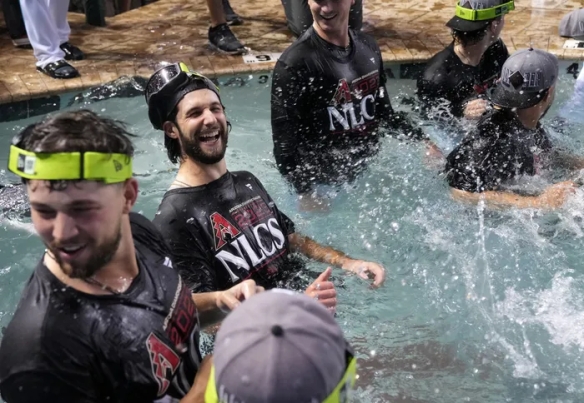
Assorted Diamondbacks take a victory dip in the Chase Field pool after they swept the Dodgers in their NLDS Wednesday.

This may actually be the worst Dodger takedown of all time. They’ve suffered legendary takedowns as much as legendary triumphs in their storied history, but this one may actually out-rank all the others.

Worse than the day the Philadelphia Whiz Kids’ veteran Dick Sisler ruined them on the season’s final day after Cal Abrams couldn’t score from first to keep the pennant-losing game out of an extra inning.

Worse than the day Bobby Thomson ruined Ralph Branca after a second-half Giants surge from thirteen games back through the lens of Leo Durocher’s telescopic from-the-clubhouse sign-stealing.

Worse than the day a still-not-himself Sandy Koufax couldn’t hold the Giants off in another pre-division play, three-game pennant playoff deciding game. Worse than the week the Orioles swept them in a World Series.

Worse than the day Tommy Lasorda let Tom Niedenfuer pitch to Jack (the Ripper) Clark with first base open and the Dodgers an out from forcing a seventh National League Championship Series game. Worse than back-to-back World Series losses in 2017-2018.

Never before were the Dodgers swept out of a postseason set in which all three Dodgers starting pitchers including a future Hall of Famer combined to pitch four and two thirds innings.

And never before had any team surrendered four postseason home runs in a single inning until Lance Lynn, the husky righthander who was the Dodgers’ key trade deadline pitching pickup, but who surrendered a Show-leading 44 home runs all regular season long, went to work for the third inning of their National League division series Game Three.

Geraldo Perdomo, Diamondbacks shortstop—leadoff home run. Ketel Marte, Diamondbacks second baseman, an out later—home run. Christian Walker, Diamondbacks first baseman, an out after that—home run. Gabriel Moreno, Diamondbacks catcher, following Walker, and after a long drive ruled just foul—home run.

None of baseball’s classic slugging teams ever did in any postseason what the Snakes did in that inning. Not the Ruth-Gehrig Yankees. Not the Foxx-Simmons-Grove Athletics. Not the DiMaggio-Berra-Mantle Yankees. Not the Boys of Summer Dodgers. Not the Mantle-Maris Yankees. Not the Swingin’ As or the Big Red Machine. Not the Pittsburgh Lumber Company, Harvey’s Wallbangers, or the Bash Brothers A’s.

“I’m a fan, too,” said Diamondbacks manager Torey Lovullo, after his Snakes banked the 4-2 win, the division series sweep, and a date with either the Phillies or the Braves in the National League Championship Series, “and I was looking at it thinking, what in the world is happening here?”

So were the Dodgers. Maybe all series long, never mind in the third inning Wednesday night.

“You look at the game, the series, they outplayed us, and there’s no other spin to it,” said manager Dave Roberts. “As far as our clubhouse, it’s just a lot of disappointment.”

As far as the Diamondbacks clubhouse, this team of rising youth, veterans who’ve been called “quirky” among other things, role players, and about as much star power yet as a cactus plant, has arrived. They slipped into the postseason via the wild card system after an 84-win season, swept the Brewers out of the wild card series, then dismantled a Dodger team full of stars who’d usually dismantled them while owning the National League West for most of a previous decade.

And they couldn’t have cared less about the financial power behind that Dodger star power, either. “We shouldn’t be worried about what their payroll is or who they’ve got over there,” said Snakes outfielder Alek Thomas after Game Three. “We’re just worried about what’s right in here in this clubhouse. You saw that this series.”

“They kept punching us in the face,” lamented Dodgers utility man Enrique Hernandez, “and we weren’t able to get back up.”

Just when did the Diamondbacks and their fans really start believing they might have more than a few lessons to teach the pitching-compromised Dodgers (three injured starters, a fourth on administrative leave over domestic violence charges) and the country this time around?

Was it when they bludgeoned six runs out of a possibly still-ailing and finally out of fuel Clayton Kershaw in the Game One first?

Was it when they pried three Game Two first-inning runs out of Bobby Miller, the Dodger rookie who’d looked promising enough over the regular season but now looked as though he was in enough over his 24-year-old head?

Was it after Lynn actually spent the first two Game Three innings on cruise control despite a pair of second-inning hits, before Perdomo hit a 2-1 meatball over the right center field fence, Marte hit a 1-0 service into the right field seats, Walker hit a 3-1 meatball into the left field seats, and Moreno hit a full-count hanging slider into the left center field seats to end Lynn’s night?

Was it when the Diamondbacks’ bullpen, formerly cause for plenty of alarm, left the torches behind long enough to surrender only four of the six series-long Dodger runs?

The Dodger bullpen did what their starters couldn’t do and kept them alive and within reach in the final two games. But their big bats couldn’t do anything, either. Mookie Betts and Freddie Freeman may have posted Most Valuable Player-style regular seasons, but after fueling the Dodgers lineup all year long they went 1-for-21 together in the division series.

“I know for sure I did absolutely nothing to help us win,” Betts acknowledged. It was the first postseason series of his entire career in which the Mookie Monster went hitless.

“It doesn’t feel real,” Diamondbacks rookie star Corbin Carroll said after Game Three ended. This is a team with whom the Dodgers had their regular season way from 2021-2023, the Dodgers going 38-13 against them over the span.

But the division-series beatdown they laid upon the Dodgers was real enough. And it’ll feel even more real to the Dodgers as they face a winter whose number one mandate will be figuring out how to turn their regular-season dominance into anything other than postseason submission.

NLDS Game Three: Poke the Philly bear, pay the penalty

Bryce Harper, Orlando Arcia

“Stare downs aren’t an official stat (yet!), but we’re all in awe of Harper over here.”—The Elias Sports Bureau.

Memo to: Atlanta Braves, particularly shortstop Orlando Arcia. Subject: Poking the Philadelphia bear. Dear Braves; dear Orlando: just. don’t. do it. For real or allegedly.

Because the Philadelphia bear, whose human name is Bryce Harper, is liable to do to you what Yogi Bear only dreamed of doing with the contents of picnic baskets. He’s also liable to inspire similar destruction by his mates while he’s at it. And that Citizens Bank Park crowd in Philadelphia won’t let you live it down.

Whether Arcia really cracked “ha ha, attaboy, Harper” Monday—after Harper was doubled up by a hair to end National League division series Game Two, having rounded second on a long fly that looked as much like an extra base hit as an out before Michael Harris II’s stupefying catch—might have been speculative alone.

But it appeared in print, as you might expect when there might be three to five times more reporters in a postseason clubhouse than a regular season one. As Phillies manager Rob Thomson said Wednesday, after Harper and company demolished the Braves, 10-2, “If that adds to his motivation, then thank you.”

Affirming that the Monday mockery did indeed come from his postgame mouth, Arcia told reporters after Game Three, “He wasn’t supposed to hear.” Whether he meant Harper or the reporter(s) who put it into print wasn’t entirely clear, and hardly mattered. It wasn’t wise to poke a bear who had the entire Show’s second highest win probability added factor this year.

Harper swore he heard of Arcia’s trash talking from teammates. “They looked at me,” he said, “and they were like, ‘What are you going to do?’” It wouldn’t take too long before they got their answer.

With the game tied at one following Nick Castellanos’s leadoff bomb in the bottom of the third, Brandon Marsh singled promptly and Trea Turner pushed him to third beating out an infield single against Braves starter Bryce Elder, who can be a good pitcher but who’d spent the season’s second half struggling heavily.

Up stepped Harper. He took two low and away pitches after fouling off the first. Then, he ripped a hanging slider into the second deck behind right field. Rounding second, Harper gave Arcia a stare that would have meant a death sentence had it come from a Mafia caporegime.

“Stare downs aren’t an official stat (yet!),” Xtweeted the Elias Sports Bureau, “but we’re all in awe of Harper over here.”

The demolition that followed—including a second Harper homer—could be considered the Braves’ death sentence, depending upon how well they regroup and recoup behind Game One starter Spencer Strider on Thursday. And, whether Strider himself can handle the Phillies a little better than he had (eight strikeouts but two runs including a Harper smash) in Game One.

After Monday’s Braves one-run win, preserved by Harris’s acrobatic catch and third baseman Austin Riley’s swift throw across to nip Harper by a step and a half to finish the unlikely double play, Castellanos didn’t sound too worried. “We thrive after we get punched in the face,” he said.

Thrive? How about feeding frenzy. Right after Harper unloaded, Alec Bohm shot a base hit into left, Bryson Stott walked, and J.T. Realmuto pumped a two-run double to the back of left field. And every Braves fan in the nation probably asked why manager Brian Snitker—who started Elder with no better options available for this game—didn’t have anyone up in the pen yet.

“I thought maybe he would go five,” Snitker said of Elder, whose first two innings were deceptively masterful with six-up, six-down including four strikeouts, and who had a one-run lead after Ozzie Albies singled Ronald Acuña, Jr. (one-out double) home in the top of the third. “The way Bryce was throwing, I was thinking, ‘Man, he was really good.’ The slider was good. The changeup was good. It was the third inning of the game, with a lot to cover on the back end of it.”

It turned out the Braves had to find ways to cover a five-run Phillies lead after the bottom of the third’s demolition finally ended. But two innings later, leading off against veteran Brad Hand, the third Braves reliever of the day, Harper launched one parabolically over the center field fence. And gave Arcia a second stare down rounding second while he was at it.

Arcia extracted his own ounce of flesh when he singled Marcel Ozuna (one-out single) home against Phillies reliever Matt Strahm with two out in the top of the sixth. That’d teach him further. With two out in the bottom of that inning, Trea Turner shot one over the left center field fence off AJ Smith-Shawver, the fourth Braves pitcher on the night. Smith-Shawver endured long enough for Castellanos and Marsh to greet him rudely opening the bottom of the eighth with back-to-back solo bombs into the real estate Turner had reached.

Nothing—not even Phillies starter Aaron Nola’s nine-strikeout, five-and-two-thirds innings work, which somehow got pushed well into the background thanks to their offensive mayhem—quite equaled the magnitude of Harper’s first blast in the third, but when he hit the second in the fifth, he pushed himself into extremely elite territory—and pushed Hall of Famer in waiting Albert Pujols out of it.

Pujols was fifth in postseason OPS among men with at least 150 postseason plate appearances with .995; Harper shot his way past Pujols with what’s now 1.011. Ahead of him, in ascending order: Carlos Beltrán (1.021) and Hall of Famers George Brett (1.023), Babe Ruth (1.214), and Lou Gehrig (1.214). Harper also has a 1.132 OPS in this postseason alone thus far.

According to the reboutable MLB analyst Sarah Langs, Harper has also homered in eight postseason games since becoming a Phillie—and the team’s 8-0 in those games. Tying Harper with a longtime Brave, Javy Lopez, for the longest such postseason streak ever for a player starting his career with a particular team . . . but the longest for any player with a new team.

And what about this year’s Atlanta threshing machine, the team who smashed a record 307 home runs on the regular season and led the National League in runs, hits, team batting average, team on-base percentage, team slugging, and team OPS? Entering Game Three, the Braves were out-scored 7-5 while posting a team 150/.215/.250 slash line and a .465 OPS.

Now, the Braves are out-scored 15-9 for the set. They’ll need more than Strider being Strider on the mound this time, though the Phillies found ways to beat him in two prior postseason chances. (Last year, they sliced him for four runs in two and a third, charging a fifth to him when Harper—who else?—hit one over the right center field fence off Strider’s relief Dylan Lee with J.T. Realmuto aboard before Strider left the game.)

The Braves need their bats to find ways around scheduled Phillies Game Four starter Ranger Suárez and a better-positioned Phillies bullpen. They need Acuña to hit truly like the 40/70 player he was on the season. They need Snitker to do better in the bullpen management department.

Mostly, they need to find ways to keep Harper from Harpering. They also need to remind themselves that not even Harper takes them for granted.

“We know they’re really good, and they’re not going to fall down or die or anything like that,” Harper said after Game Three. “They’re a really, really good organization, a really good team, and we’ve seen that all year from them. But we have a crowd that’s 45 (thousand) strong, and we’re very excited to go into tomorrow and play a great game.”

If the Phillies are that excited, the Braves might be in more trouble than even Game Three made them look.

ALDS Game Three: Baltimore Agonistes

Baltimore Orioles

After their surprising and pleasing AL East conquest, the inexperienced, pitching-compromised Orioles found the AL West-winning Rangers too hot to handle.

Maybe it had to be this way, an inexperienced team of Orioles upstarts getting flattened by a better-experienced collection of Rangers in three straight. It might have been the team’s first postseason appearance in seven years, but they brought a collection of men with plenty of postseason time among themselves before becoming Rangers.

Maybe the Orioles were in over their own mostly young, 101 game-winning heads. Maybe the Rangers were too well primed by their Hall of Fame-bound manager who’d skippered three Series winners in five years on the Giants’ bridge.

But as joyous as it was to see the Rangers make too-easy work of the Orioles in this American League division series, it still hurt to see these Orioles swept away like flotsam and jetsam. It was the first time they’d been swept in any series since the May emergence of Adley Rutschman as both their regular catcher and their team leader. The first, and the worst, at once.

No matter how heavily tanking played a role in getting the Orioles to the point of winning the American League East, it hurt. No matter how stupid their administration looked censoring their lead television broadcaster—over a team-generated graphic meant to show a positive portion of their progress—it hurt.

No matter how further stupid that administration looked in doing practically nothing at the trade deadline despite having an upstart group of American League East conquerors on their hands—it hurt.

And, no matter how temporarily stuck Orioles manager Brandon Hyde might have looked  having to start a heavy-hearted pitcher in his fourth major league season but on his first postseason assignment in Game Three—it hurt.

“This is a really good group of guys,” said pitcher Kyle Gibson, a pending free agent, “and I think that adds to the sting of it too, because we knew we had something special. You want to try to capitalize on that whenever you can.”

“There’s no other way to put it,” said outfielder Austin Hays. “They kicked our ass. It sucks. Just couldn’t really get anything going, couldn’t get any momentum on our side to get things going. It hurts. It really hurts.”

The real-world motto of the real-world Texas Rangers: “One riot, one Ranger.” The motto of the American League West winners now could be: “Two postseason sweeps, thirty Rangers.”

The Rangers picked up where they left off Tuesday night against a flock of Orioles lacking veteran presence and, especially, veteran pitching, beating the Orioles, 7-1, in a game that was essentially over after two innings. Manager Bruce Bochy, in the conversation for Manager of the Year as it is, looked even smarter in this AL division series than he looked winning with the Giants in 2010, 2012, and 2014—and he looked like the Yankee version of Casey Stengel then.

Even more so because, until Tuesday night, the AL West-champion Rangers had to to their heaviest labours on the road. “We had our work cut out going on the road against Tampa and Baltimore,” Bochy said after wrapping the division series Tuesday night. “Just shows the toughness with this ballclub and the deal with having to fly to Tampa.”

Now they were home and happy in Globe Life Field, and Rangers shortstop Corey Seager didn’t give Orioles starter Dean Kremer a chance to continue collecting himself after second baseman Marcus Semien fouled out to open the bottom of the first. Seager smashed a 1-1 service 445 feet over the right field fence.

An inning later, it was one-out single (Josh Jung), two-out double (Semien), and an intentional walk to Seager. Kremer and the Orioles weren’t going to give him another chance to mash with first base open if they could help it. They took their chances with Mitch Garver, whose Game Two grand slam broke them almost in half—and Garver thanked them with a two-run double.

Up stepped Adolis García, the Rangers’ right fielder. Kremer had García down 1-2. The next fastball, a little up over the middle of the zone, disappeared over the left center field fence. Just like that, the Orioles were in a 6-1 hole out of which they wouldn’t get to within sight of the earth’s surface if the Rangers could help it.

They could. Their redoubtable starter Nathan Evoaldi, who’s been there and done that in postseasons previous, pinned them for seven innings and seven strikeouts, the only blemish against him an almost excuse-me RBI single by Orioles rookie star Gunnar Henderson in the top of the fifth. As if to drive yet another exclamation point home, Rangers first baseman Nathaniel Lowe greeted Gibson, the third of five Oriole pitchers on the night, with a leadoff homer in the bottom of the sixth.

“You’re not trying to do anything different,” said Seager, whose nine walks are a record for a three-game postseason span, according to MLB analyst Sarah Langs. “You’re just more focused. That’s not the right word, but it’s just more intense. Everything matters. It’s just a different game. It really is. There’s no way around it. So you have to have a different edge, different approach.”

Kremer’s heavy heart was thanks to the atrocity Hamas inflicted upon Israel, to which his parents are native and for which they both served in the Israeli Defense Forces before emigrating to California where their son was born. But he told Hyde when asked—this was discussed often on the game broadcast—that no matter what was in the back of his mind or the front of his heart, he could go for Game Three.

He still has extended family living in Israel. (He’s also said he do as Hall of Famer Sandy Koufax and decline to pitch if an assignment happens to fall on Yom Kippur, the Jewish Day of Atonement.) Anyone who thinks Kremer still didn’t take a heavy heart to the mound with him Tuesday night may be deluding himself or herself.

Perhaps if Hyde had more choices he might have told Kremer to forget the mound for now and focus upon his family. But the Orioles standing pat at the trade deadline, other than adding Cardinals comer-turned-injury-compromised righthander Jack Flaherty, who’d pitched his way out of their rotation to become a bullpen option, came back to haunt them horribly this series.

They were forced to hold veteran ace/post-Tommy John surgery patient John Means out of the division series because of late September elbow soreness—and had no reinforcements. They lost relief ace Felíx Bautista to a torn ulnar colateral ligament that took him to Tommy John surgery on Monday—and rode their bullpen a little too hard compensating for their lack of rotation depth down the stretch and in the division series after the AL East championship bye week off.

So their survival depended upon a young man with a temporarily compromised heart. Kremer went out courageously enough and found the Rangers a little too hot to handle after all. However the Rangers might have empathised with him, that didn’t mean they were going to let him off the hook.

That survival also depended upon an offense that dissipated near season’s end. Even when they awoke well enough in Game Two, turning what began as a 9-2 blowout in the making into an 11-8 squeaker of a loss. “Offensively, we weren’t at our best the last two, three weeks of the season,” Hyde said. “That carried into the postseason where we had guys scuffling. [The Rangers] rolled in with a ton of momentum. I don’t think we rolled in with a ton of momentum offensively.”

The Rangers had to dispatch the Rays in two straight wild card series games before taking the Orioles to school. Eovaldi pitched both series winners.

“I’ve never had a curtain call or anything like that,” said the veteran righthander whose six-inning relief in that eighteen-inning World Series Game Three marathon in 2018 really put him on the baseball map, and who took such a call after his Tuesday night’s work ended. “But our fans were bringing it all night long. When I walked out at 6:30 tonight, they were chanting, the ‘Let’s go Rangers.’ I knew it was going to be a really good night for us.”

He couldn’t have known just how good. For Eovaldi and his Rangers, it’s on to take on whomever wins the Twins-Astros division series in the American League Championship Series.

For these Orioles, it’s on to reflect upon how far they got in the first place despite almost nobody imagining them here when the season began. They have a core that can win again next year. All their administration has to do is refuse to hesitate on opening the trade lines and the checkbooks a little deeper. Knowing this Oriole administration, alas, good luck with that.

NLDS Game Two: Awakening the sleeping Braves

Travis d'Arnaud, Zack Wheeler

Travis d’Arnaud was only too happy to remind people what can happen when a lineup gets a third crack at his old Mets teammate Zack Wheeler . . .

If you expect to keep the Atlanta threshing machine from threshing, you can’t let any of them see Zack Wheeler the third time around. Not even if he’s taking a one-hitter into the seventh. Not even if you’re about to have your next two National League division series games in your own yard. Not even if the lone run out of him to that point scored on a tough fielding mistake.

You just might end up awakening the sleeping Braves.

Which is just what happened Monday night in Atlanta, the Braves overthrowing a 4-1 Phillies lead to win, 5-4. Slamming an exclamation point home with one of the most daring game-ending double plays anyone could hope to see, at any time.

Wheeler lost his no-hit bid and the Phillies’ bid for a second straight shutout in the bottom of the sixth, on Braves shortstop Ozzie Albies’s two-out single, sending Ronald Acuña, Jr. (two-out walk) home after Phillies shortstop Trea Turner misplayed a one-hop throw in from right. Phillies manager Rob Thomson elected to send Wheeler back out for the seventh.

Brain fart. Wheeler lifetime came into Game Two with opposition OPSes that accelerated each time through an opposing lineup: .594 the first time, with 39 home runs; .638 the second time, with 37 home runs; but, .759 with 47 home runs the third time. He was already in his third round with the Braves lineup when he walked Acuña in the sixth.

So with the Phillies leading by three, Wheeler opened with Matt Olson singling up the pipe, Marcel Ozuna striking out swinging, but Travis d’Arnaud—Wheeler’s former Mets teammate in the bargain—hitting the first pitch into the left field seats. As Truist Park went nuts over the first extra-base hit by the Braves all set long, then Thomson lifted Wheeler for Jose Alvarado.

“I wanted him to go back out, and he said he was fine,” Thomson said of Wheeler postgame. “He still looked good, so I was all in.” Three batters in, Wheeler was all out and the Braves were back on the march.

They continued marching with one out in the bottom of the eighth. Alvarado yielded to Jeff Hoffman, who hit Acuña on the left arm with his first pitch before Albies pushed him to second with a ground out. But then Acuña stole third with Austin Riley at the plate, and Riley rewarded Acuña’s larceny with his own drive into those left field seats.

The Phillies hung four on the board in the first five innings against a clearly struggling Braves starter Max Fried and Braves reliever Kirby Yates. Alec Bohm singled Turner (one-out double to the back of center field) home in the first. With Bryce Harper (one-out single) in the third, J.T. Realmuto hit one the other way into the right center-field bullpen.

With one out in the fifth, and Yates on the mound, Nick Castellanos (single) stole second and took third when d’Arnaud’s throw went far enough offline while Bryson Stott waited at the plate. Then Stott lofted a fly to center sending Castellanos home on the sacrifice fly.

d’Arnaud at least got his shot at redemption two innings later. The Phillies might have had a fatter lead for the Braves to overcome but for stranding the bases loaded in the first, stranding Johan Rojas on second (after a one-out walk and an advance on a wild pitch) in the second, and stranding first and second in the fourth and the sixth.

The defending National League champions had one more grand opportunity in the ninth when Harper pried a leadoff walk out of Braves relief ace A.J. Minter, prompting Braves manager Brian Snitker to reach for closer Raisel Iglesias. After Realmuto flied out to center, Castellanos sent one to the rear end of right center. Center fielder Michael Harris II ran it down like a cop chasing a mugger.

“I knew off the bat it was going to be close to the fence,” he said postgame. “I knew once I went back I wasn’t stopping. I was going to do anything I could to get a glove on it. If my body had to go down because of that, I would have done that.” His body didn’t go down despite its rude meeting with the fence, but he caught the drive and winged a throw in that snuck past Albies and meant disaster. For about three seconds.

Riley backed the play alertly, with Harper having rounded second hell bent on getting as close to the plate with the tying run as he could. But Riley fired a strike across the infield to first, making Harper pay for being just a little over-aggressive.

“Usually, you don’t pass the base,” said Thomson postgame. “You stay in front of it, make sure it’s not caught. But he thought the ball was clearly over his head, didn’t think he was going to catch it. And Harris made a heck of a play. Unbelievable.” Heck of a play? The Elias Sports Bureau says it’s the first time a postseason game ever ended on a double play involving any outfielder.

You hate to say a series tied at one game each has become treacherous. But Philadelphia’s Citizens Bank Park is a haven for hitting, and re-awakening the Braves’ threshing machine, after they spent the series’ first fourteen innings scoreless, is not a sound idea. Especially when they hit a record 307 homers on the regular season—including 24 against the Phillies exactly half of which were put in the Bank.

Thomson said the split in Atlanta was disappointing but, what the hey, now the Phillies have the home field advantage. The Braves didn’t put their best 2023 road show on in the Bank. (That honour belonged to Cincinnati’s hitting haven of Great American Ballpark.) But they’re not exactly pushovers in Philadelphia, either.

ALDS Game Two: From blowout to squeaker

Mitch Garver

Mitch Garver’s third-inning grand slam proved the difference maker as the Orioles turned an  early blowout into a squeaker of a win for the Rangers Sunday.

Until this weekend, the last time the Orioles were swept in a series was in May, by the Blue Jays. During the regular season, the Orioles were a .642 team on the road. Now, they’re on the threshold of an American League division series sweep, but they’re counting on that traveling mojo to overthrow a Rangers team that won’t be overthrown without a fight.

Not after the Orioles turned a 9-2 blowout in the making into an 11-8 squeaker in Game Two Sunday. Not after the Orioles couldn’t do better than Aaron Hicks’s three-run homer with one out in the bottom of the ninth. Not after the Rangers battered them for nine runs in the first three innings, including and especially Mitch Garver’s grand slam in the third.

Not after the Oriole bullpen was so deeply deployed following a Game One loss that saw theirs ranks pressed into duty after four and two thirds. Today’s travel day from Baltimore to Arlington may not necessarily give them relief. Not facing a Rangers team that hasn’t played at home in a fortnight but hit 53 home runs more at home than on the road during the season.

“We just came up a little bit short today, but that built a lot of momentum going into the next game,” said Orioles leftfielder Austin Hays after Game Two. “Nobody laid down. We didn’t give away any at-bats. We continued to fight. We were able to get into their bullpen and work on those guys a little bit. I feel good moving forward, but we know we’ve got our work cut out for us.”

That’s a polite way to put it. They played .500 ball against the Rangers in six regular season games, but they blew their home field advantage to open this division series. A team that hasn’t seen home in a fortnight can be presumed hungry to put an end to this set as soon as possible, by any means necessary.

The Rangers proved that when they started Garver, a backup catcher who played in only half the regular season games, and sent him out for his first postseason appearance this time around. In a game the Orioles opened with a 2-0 lead after one full inning, but the Rangers slapped rookie Orioles starting pitcher Grayson Rodriguez silly with a five-run second, Garver checked in at the plate with one out followed by three straight walks.

Orioles reliever Bryan Baker left the pillows loaded for his relief, Jacob Webb. On 3-1 Webb elevated a fastball, and Garver elevated it six rows into the left field seats.

Rangers manager Bruce Bochy—who came out of retirement to shepherd the Rangers after all those years and those three World Series rings managing the Giants—said pregame that it was “just time to get [Garver] out there.” Garver may have given the boss the most expensive thank-you present of the postseason thus far.

“He’s got big power,” Bochy said postgame, “and that’s big at that point in the game. Really was the difference in the game.”

So were the eleven walks handed out by eight Orioles pitchers, including a postseason record five to Rangers shortstop Corey Seager. So were the mere three hits in thirteen Oriole plate appearances with runners in scoring position, which explains a lot about how the Orioles actually out-hit the Rangers (fourteen hits to eleven; .973 to .891 game OPS) but fell three short in the end.

Also in too-vivid contrast were the fruits of each team’s trade deadline moves. Or, in the Orioles’ case, lack thereof. The Rangers moved to bring future Hall of Famer Max Scherzer into the fold but also added starter Jordan Montgomery and reliever Chris Stratton in a deal with the Cardinals.

The Orioles moved to bring another Cardinal pitcher, Jack Flaherty, aboard at the deadline. But Flaherty, once a glittering Cardinal comer, hasn’t been the same pitcher since a 2021 oblique injury and a 2022 shoulder injury. He pitched his way out of the Oriole rotation and now looks to be the long man out of the bullpen.

He got a shot at showing what he could do in that role when it looked as though it would be just mop-up work Sunday. The good news: He surrendered only one run (on Garver’s double play grounder in the fifth) in two innings’ work. The bad news: He contributed to the Oriole walking parade with three of his own, including two in the fifth.

Some say the Orioles standing practically pat at the trade deadline instead of going for any kind of impact deal may yet come back to bite them right out of the postseason, especially after their own pitching depletion (losing top starter John Means and closer Félix Bautista especially) late in the season. Others fear the Orioles were more concerned with their usual penny pinching plus censoring a lead broadcaster over a positive graphic the team itself fashioned for a broadcast.

Montgomery handled the Orioles well following the two-run first, at least until he surrendered a pair in the fourth on an RBI single (Jorge Mateo) and a sacrifice fly (Ryan Mountcastle.) But when Orioles rookie star Gunnar Henderson greeted him with a full-count leadoff home run and Hicks followed with a base hit, Montgomery’s day ended and the ordinarily wobbly Ranger bullpen took over.

That bullpen kept the Orioles quiet until the bottom of the ninth, when Brock Burke handed Henderson a one-out walk and Hays singled him to second. Bochy reached then for José Leclerc, and Hicks—the erstwhile Yankee who never really found his best footing in the Bronx—reached for a one-strike service and drove it into the right field seats.

It was a little vindication for Hicks the day after he blew a hit-and-run sign in the Game One ninth, leaving Henderson a dead duck on the pond when he was thrown out at second, before Leclerc finished the 3-2 Rangers win. After his up-and-down Yankee life, Hicks looked like an Oriole blessing after he signed in May following his Yankee release. After Sunday, he looked like an Oriole hope once again.

An Oriole hope is just what Baltimore needs now. But Ranger hopes won’t exactly play to an empty house come Tuesday. At the end of the former, survival. At the end of the latter, a chance to play for the pennant.