The self-made, self-immolating Babe

2019-02-21 JaneLeavyBabeRuthReading of it in any kind of depth, Babe Ruth’s childhood was six parts David Copperfield, half a dozen parts Dead End Kid, and not entirely of his own making. It turned him both larger than life and not quite as large as his legend, one of the unmistakable faces of the Roaring Twenties and one of the most deceptive American myths.

Cast into his home state’s child welfare system by parents about whom cruel would be a perverse compliment, Ruth’s latest and perhaps greatest biographer, Jane Leavy, writes that he couldn’t bear to question the kind of parents who gave up one of their only two surviving children out of several offspring.

Some such children often grow up in spite of their root and sorrow to become self-made successes as adults. Others grow up to become self-immolating. The greatest baseball player of the game’s pre-World War II/pre-integration/pre-night ball era, left at seven years old to a group home for Catholic boys who called themselves its inmates, grew up to become both.

[H]e never shared his first impressions of St. Mary’s [Industrial School, to which his parents exiled the boy] with his family. He never spoke about what it was like to go from being one of two surviving children in a family defined by loss to being one of the many, what it was to go to bed that night wondering when or if he’d see that family again. He never said what it was like to sleep in ordered rows and dress in matching clothes, to share sinks and stalls in a communal washroom, to surrender to a system predicated on uniformity and routine.

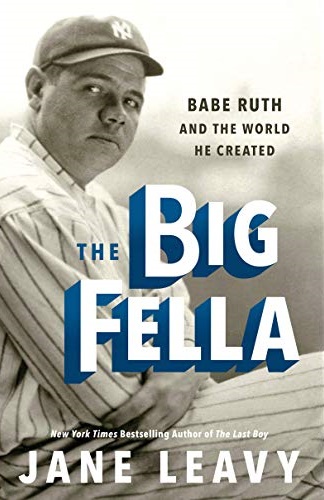
As Leavy paints in detail rich, stark, and almost cinematic at once, in The Big Fella: Babe Ruth and the World He Created (New York: HarperCollins; 620 pages, $32.50), Ruth might have been far more self-immolating had it not been for his manager/syndicator Christy Walsh forging him into outsized marketability, while actively and mostly successfully keeping his client’s least engaging sides from exposure and condemnation.

“If the twenties roared,” Leavy writes, “it was in large part because of new means of amplification: bylined sports columns, screaming tabloid headlines, and radio frequencies that broadcast voices with unforeseen clarity from sea to shining sea, and beyond. Fame got bigger, louder, more personal.”

2019-02-21 BabeRuth

Even when he smiled, Babe Ruth seemed to show what one writer called “a certain pathos in his eyes . . . a child not quite sure that a rebuff is not waiting somewhere.”

Concurrently, she quotes an October 1927 column by the New York Daily News‘s Paul Gallico: “Ruth without temptations might be a pretty ordinary fellow. Part of his charm lies in the manner with which he succumbs to every temptation that comes his way . . . Ruth is either planning to come loose, is cutting loose, or is repenting the last time he cut loose. He is a news story on legs going about looking for a place to happen.”

The Babe was wholly unprecedented for marrying athletic achievement to metastatic mythology, the first man or woman in professional sports to be seen as an entertainer and a product, who “always envisioned for himself a bigger kind of stardom than baseball afforded,” as if being baseball’s first truly unquestioned king of swing in terms of power hitting was simply part time sufficiency.

A classic aphorism Leavy cites is E.B. White’s about the 1920s being a monument to modern man’s creative capacity for mischief, adding that Ruth was his time’s rule breaker in chief.

He never embodied the traditional public virtues that defined ancient celebrity, and he didn’t have to. Instead, he gave the public glimpses of a bad boy having the time of his life. Hadn’t they told him he was a bad boy? He did his adult best to fulfill the mandate: punching out umps, chasing after boobirds in the grandstand . . . sleeping with other men’s wives but ignoring his own. Everybody loved, forgave, and maybe envied the Babe for being himself.

If Hans Gumbrecht (whom Leavy cites deftly) was right when he wrote, in In 1926: Living at the Edge of Time, that Ruth “was an internationally innovative figure in the new twentieth-century stardom precisely because he was never qualified to fulfill the expectation of virtue,” then it must be that such stardom has aged poorly enough that no athlete, entertainer, or other public celebrity can get away now with everything for which Ruth got a pass and often still does. Those few who called it as it actually was about the Babe—as did The New Yorker in dismissing him as unfit “in any way to have a public”—would be ignored.

But even the hagiopgraphers Ruth and Walsh cultivated had limits, as at the end of August 1925, when the Daily News—once described as being Ruth’s personal back page—revealed Ruth’s comely full-time mistress (and second wife-to-be) and exploded the family man portion of the Ruthian myth, including the revelation that the mistress called on Ruth while he was hospitalised for (ahem) the world’s then-most famous stomach ailment, while the then-Mrs. Ruth was also a patient there.

Yet there were such editorials as Frank Wallace’s in the New York Post, pleading that, well, this was Babe Ruth and he kinda sorta was entitled to a more nuanced perspective. There are few such apologies more jarring than Leavy extracts from Wallace’s essay: “His is a big soul made bigger by our applause. And a big soul needs room to roam. Smaller souls might well close their eyes at times like these and let these big souls roam; else they stifle and die and lose the thing that makes them big.”

Leavy’s graces include that she writes soberly and lyrically without wearing a judge’s robe. But it’s tempting to invite you to ponder today’s athletic greats shown behaving with similar depravity while flouting professional protocols, being made not into rakish, quintessentially American big souls, but vermin weeks past the dates on which they should have been run out of town if not country.
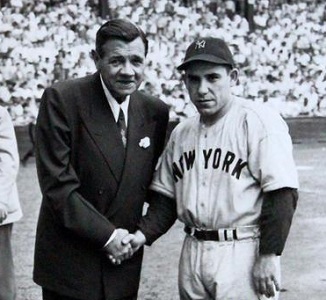
2019-02-21 BabeRuthYogiBerra

The ailing Babe gives a handshake to a nervous Yankee sprout named Yogi Berra.

Ruth lived large and unaccountable, but now, Leavy writes, the Daily News and the tornado-in-a-can it opened “put him on notice: he had to behave, or at least learn how to fake it.” Until his body threatened to go AWOL by 1935, he did just that at and away from the ballpark, somehow. He even allowed Walsh to put all his outside income in trust while limiting him to living and playing on his baseball salaries alone. (His second wife would see and raise, sort of: she limited him to $50 a week in his pockets.)

Leavy weaves the book around a barnstorming tour featuring Ruth and his Hall of Fame teammate Lou Gehrig, leading teams of all stars against each other for fun and profit, Ruth cheerfully thumbing his nose at commissioner Kenesaw Mountain Landis and at times the Yankees themselves for undertaking such tours. Barnstorming for Ruth was income and, in its way, social advancement: he thought nothing of pitting his all stars against teams of Negro Leagues all stars and other black talent. He knew it wasn’t his fault such talent couldn’t yet play “organised baseball” and wouldn’t so long as Landis was alive.

The further bad news is that all those years of behaving as a law unto himself may have cost Ruth a real chance at the one thing wanted most in baseball after his playing days ended. At the end of the 1934 season, his last as a Yankee, Tigers owner Frank Navin wanted to hire him as player-manager, figuring Ruth’s role as a player would end first. Ruth said he’d call Navin back only after finishing a tour of Hawaiian exhibition games. Navin hired Mickey Cochrane instead. The Babe let his faithful man Friday Walsh talk him out of accepting a job managing the Yankees’ Newark farm to gain experience enough that he might take over the parent club in due course.

Ruth fell for it hook, line, and stinker when the Braves, then in Boston, signed him as a part time player for 1935, to goose their weak gate. They also gave him the title of assistant manager, without a single intention of letting him be such or of becoming the woebegone team’s manager at any time. We feel sympathy for Ruth having been treated so shabbily. But we temper it remembering that the very thing for which some editorialists believed he deserved his leeway may also have been the very thing that turned the game’s less capricious overlords against entrusting him with team management.

Leavy’s account of Ruth’s final decade plus of life is as sober as it is touching and revelatory. You’ll wish only that she’d seen fit to include the whole of the Babe’s rasping farewell speech at Yankee Stadium, delivered from his cancer-eroded throat, incumbent Yankees up one foul line and Yankees past up the other, revealing the big kid humbled as a man at last:

Thank you very much, ladies and gentlemen. You know how bad my voice sounds. Well, it feels just as bad. You know, this baseball game of ours comes up from the youth. That means the boys. And after you’re a boy and grow up to know how to play ball, then you come to the boys you see representing themselves today, in your national pastime. 

The only real game, I think, in the world—baseball.

As a rule, some people think if you give them a football, or a baseball, or something like that, naturally they’re athletes right away. But you can’t do that in baseball. You’ve got to start from way down the bottom, when you’re six or seven years of age. You can’t wait until you’re fifteen or sixteen. You’ve got to let it grow up with you. And if you’re successful, and you try hard enough, you’re bound to come out on top, just like these boys have come to the top now.

There’ve been so many lovely things said about me, and I’m glad that I’ve had the opportunity to thank everybody. Thank you.

When Leavy asked Babe Ruth Birthplace and Museum director emeritus Mike Gibbons which book about Ruth he considered definitive, he answered, “It hasn’t been written yet.” If we mean which book about Ruth the abandoned boy and Ruth the self-made/self-immolating man behind the mythology, and not purely the baseball player, it’s been written now.

Baseball wants spyball under arrest

2019-02-20 LeoDurocherBobbyThomson

Leo Durocher (left, with Bobby Thomson)—his spyglass-and-buzzer sign-stealing operation in the 1951 pennant race was a precursor to the high-tech espionage baseball now wants to try stopping.

“This is a simple game,” fictitious Durham Bulls manager Skip Riggins huffs at his stumbling players in Bull Durham, after jolting them following yet another loss by heaving a pile of bats onto the communal team shower floor. “You throw the ball, you hit the ball, you catch the ball.”

It’s so simple that assorted major league people sometimes do everything they can think of to out-wit the other guys, even with complicated gadgetry and a taste for larceny. And we don’t mean the basepath kind of larceny that earned Hall of Famer Rickey Henderson his nickname The Man of Steal.

High technology has its place in baseball, but it should also have its limits. So says commissioner Rob Manfred about new restrictions aimed at taking a big byte out of baseball espionage. Manfred thinks the new rules will help speed up games. They just might, but that’s not half as important as further ensuring games are played with pixelated pilferage kept less than minimal. If only.

Let’s be real. Cheating is probably professional sports’ oldest profession. Performers have sought every last edge about as long as they’ve sought the perfect swing, the best pitch, the most effective slide, the least penetrable game strategy. Enough of them have been willing to cross the line between mere gamesmanship and somewhat organised crime.

Baseball government will now ban non-broadcasting field cameras between the foul poles and squeeze in-house video. Boys will be boys, but Manfred thinks high-tech sign stealing got so prevalent last season that teams worried as much about playing Spy vs. Spy as they worried about playing baseball.

Sports Illustrated‘s Tom Verducci says six teams were believed to be using center field in-house cameras aiming at catchers’ signs while “several other teams were under heavy suspicion. The sign stealing forced most teams to adopt multiple sets of signs even with the bases empty. Those signs were changed often, even within at-bats, which slowed the pace of play.”

Baseball already had a rule that you couldn’t steal signs from the dugout, the bullpens, or anywhere else that didn’t involve second base and a baserunner, or even the coaching lines. The new regs are aimed at cracking down on baseball’s version of cybercrime. Leo Durocher, call your office, wherever you are.

This isn’t the 1950s Phillies grounds crew sculpting the third base line into an incline to keep Hall of Famer Richie Ashburn’s deft bunts from going foul and, ahem, robbing him of infield hits. This isn’t the Giants’ grounds crew re-wetting the infield dirt but turning the first base area into a swamp to keep Maury Wills from stealing more bases than he already was against them. This isn’t even Graig Nettles doctoring a bat by loading the barrel with mini-Super Balls, or Mudcat Grant getting away with a soap ball until he overloaded the stuff inside of his road jersey and the warmth of the sun foamed it too visibly through the gray.

That stuff’s petty larceny. A clever baserunner or baseline coach catching and relaying signs to a hitter is just a clever baserunner or baseline coach. A camera/monitor/ computer/Apple watch/smartphone operation is espionage just short of planting a mole in the other team’s clubhouse.

At the turn of the 20th Century the Phillies were caught red-handed in a sign-stealing operation, or maybe that should be jelly-legged: third base coach Pearce Chiles had a jiggling tic in his leg on the coaching lines that the Reds finally noticed he had only during Phillies home games. Reds shortstop Tommy Corcoran finally couldn’t take it anymore and went to start kicking at the coaching box until he struck a vein—a box full of wires that buzzed Chiles with stolen signs he could relay to his batters.

Durocher saw and raised the Phillies in mid-1951, when he discovered a recent Giants acquisition, reserve infielder Hank Schenz, owned a Wollensak spyglass he’d acquired during his World War II service and once used while perched inside Wrigley Field’s scoreboard behind the bleachers to steal signs for his then-fellow Cubs.

The Lip deployed coach Herman Franks to the offices above the back of the Polo Grounds’ deep center field, between the clubhouses, where Franks would train the Wollensak upon the catcher and then tap a buzzer picked up in the Giants’ bullpen, signaling reserve catcher Sal Yvars the signs to relay to Giants hitters.

2019-02-20 HankSchenz

Hank Schenz, whose Wollensak spyglass handed Leo Durocher a pennant race espionage operation.

That scheme began when the Giants were thirteen games behind the first place Dodgers in the pennant race. Durocher audaciously asked his Giants whom among them wanted some stolen signs. Half the team actually did. (When Hall of Famer Monte Irvin refused to take them, Durocher thought he was out of his mind.) The Giants were a solid team in the first half, going 44-36 before Durocher initiated his espionage plan; they shot the lights out in the second half (54-23), including a sixteen-game winning streak, and their 40-14 record in August and September bested the Dodgers’ 33-26 in those months to force the pennant playoff.

The Dodgers actually smelled the proverbial rat early on. Cookie Lavagetto, a World Series hero turned coach for the Dodgers, later remembered the Dodgers so suspected the Giants were up to no good that they brought binoculars into the dugout to try catching the Giants in the act, until an umpire saw and confiscated them.

“Why, it would be unfair for the victims to use binoculars to expose the telescopic cheaters!” snorted Thomas Boswell, reviewing Joshua Prager’s in-depth exposure of the plot in The Echoing Green: The Untold Story of Ralph Branca, Bobby Thomson, and the Shot Heard ‘Round the World.

Ralph Branca had Durocher’s sign-stealing operation confirmed to him by a former Giant when they ended up teammates with the Tigers later in the 1950s. Carrying the infamy of surrendering Bobby Thomson’s pennant winning home run with uncommon grace, Branca went to his grave unable to bring himself to fault Thomson, who swore he refused to take even one stolen sign during the playoff.

Exposing the plot once and for all soiled the sweet friendship Branca and Thomson built over the years that followed (“I lost a ballgame, but I gained a friend,” Branca often said) in the final decade of Thomson’s life. (Branca died in 2016.) But Branca blamed Durocher and his immediate accomplices, Franks and Yvars, far more directly for the Mugging at Coogan’s Bluff.

As if to prove that crime didn’t pay, after all, the Giants and their soiled pennant lost the World Series to the Yankees in six games, including two losses in the Polo Grounds, one of which was a 13-1 Game Five blowout. Durocher didn’t live to see himself elected to the Hall of Fame. It’s to wonder whether his signature moment as a major league manager (he managed thirty seasons all told, but won only three pennants and one World Series), that 1951 pennant race comeback and playoff triumph, should now argue for his removal.

The new regulations will also restrict live broadcast feeds to those provided each team’s replay official, using specially trained monitors. Verducci also says the new regs will also send game broadcasts to the bullpens and clubhouses on eight-second delays, bar monitors from tunnels and clubhouses, and require teams to audit every in-house camera, its purpose, its wiring, and where it can be viewed. Good luck.

Baseball government expects the new regs to come into final form in time to begin this season, after teams review and offer comments. But the game will always have its Houdinis and gangsters. (Not to mention spies in the seats, wielding anything from binoculars to cell phones.) They may even have to go back to the future, with buzzers and handheld spyglasses and blinkers, to continue their lives of crime.

And maybe Hank Schenz should be awarded a retroactive National League Most Valuable Player award.


Don Newcombe, RIP: The enemy within

2019-02-20 DonNewcombe

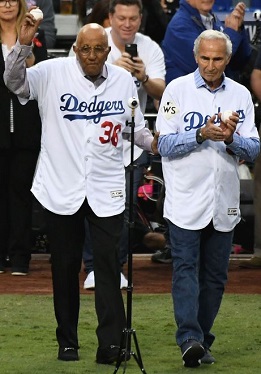
Don Newcombe, the first black pitcher to start Game One of a World Series, who could put racists in their place but couldn’t stop questioning himself.

Brooklyn Dodgers legend Don Newcombe looked and acted gruff on the mound but it masked a genuine sensitivity, to people in general and about his own triumphs and shortfalls. His successes were profound but his failures gnawed at him because, it seemed to him, people were more unwilling to forget them than they were to remember his triumphs.

If people were unwilling to forget, Newcombe himself seemed even less so. He could put baseball racists in their place with a well-timed knockdown pitch, but he couldn’t put himself in his own place comfortably.

He was the National League’s first Rookie of the Year, in 1949, when the award was made into one for each league; he was the first black pitcher to get the start in Game One of a World Series, also in 1949; he was baseball’s first Cy Young Award winner when it was introduced as a one-across-the-board prize for the game’s best pitcher at the end of the 1956 season.

But Newcombe, who died Tuesday at 92, was an intimidating looking 6’4″ who inspired writers to describe him in larger-than-life terms so often that whenever he came up short he was seen and written up as a grave disappointment. A deeply human man who wasn’t allowed to be human; a man too well aware of his flaws who wasn’t allowed to be flawed, who waged a quiet war with himself when he came up short time after time, no matter what, in some of the Dodgers’ biggest games.

“Though his build gave him a great advantage on the mound,” wrote Michael Shapiro in The Last Good Season: Brooklyn, the Dodgers, and Their Final Pennant Race Together,

it put him in that unfortunate position of being the object of unreasonably high expectations: like all big men, he was supposed to beat lesser men. And when he did not his failure could not be dismissed as a physical limitation, say, like Carl Erskine’s chronically sore shoulder. Worse still, Newcombe’s failures—like all pitchers, he did fail to win games his team needed—seemed to come in the big games. That is not to say that he had not won important games, many of them, and that he had been anything other than up to the task. But when the beat fellows broke out their record books and old scorecards it did not take long to notice that Newcombe had never won a game in the World Series.

Newcombe’s first World Series failure wasn’t even close to being for lack of trying. He took the distinction of being the first black man to get a Game One start and used it to fight the Yankees’ Allie Reynolds to a scoreless draw until the bottom of the ninth, with Yankee outfielder Tommy Henrich leading off.

Blessed with a live fastball (and remarkable control of it), Newcombe also owned a curve ball with a break so ferocious that umpire Jocko Conlan once spent an entire game trying to catch Newcombe throwing spitters. Now, on 2-0, Newcombe threw Henrich one of those curve balls. And Henrich drove it over the right field fence. Game over.

“[Hall of Famer Roy] Campanella said, ‘You missed the first two pitches. Let’s give him your best stuff’,” Newcombe remembered to Peter Golenbock for Bums: An Oral History of the Brooklyn Dodgers. “And I threw him a curve ball. I had a good, sharp breaking curve ball. And I’d throw the same pitch to him today and dare him to hit it again. I’d like to see him hit it again. And he hit it over the right field fence. That winter we’d go around speaking, and I asked him if he knew what it was. He said, ‘No. All I knew, I hit what I saw.’ They didn’t call him Old Reliable for nothing.”

Newcombe lost again in Game Four when he couldn’t get out of the fourth alive, Cliff Mapes hitting a one-out two-run double and, a fly out later, Yankee pitcher Eddie Lopat hitting an RBI double. Those were nothing compared to arguably the biggest game of Newcombe’s career, Game Three of the 1951 National League pennant playoff. With a two-run lead, one out, and two on in the bottom of the ninth, Newcombe ran out of gas.

Much later it came forth that Newcombe said he was spent before he went back out to start the inning. Out came Newcombe, in came Ralph Branca (when bullpen coach Clyde Sukeforth panicked over Erskine bouncing a curve ball while warming up), and into the short left field seats went Bobby Thomson’s three-run homer.

We know now that the playoff was made possible in the first place because Giants manager Leo Durocher installed an elaborate sign-stealing scheme that was instrumental in the Giants’ unlikely comeback from thirteen games out of first place. (The Giants stole the pennant! The Giants stole the pennant! Thomas Boswell crowed after reading the Wall Street Journal column that first exposed the scheme, flipping broadcaster Russ Hodges’s famous radio call smack on its head.)

Shapiro recorded “many believed” the first seeds of Newcombe’s choking reputation were sown by Durocher himself, who’d managed Newcombe briefly with the Dodgers before managing the Giants.

[Durocher] possessed a cruel streak that he applied to good effect. It did not much matter whether, in fact, Newcombe choked, only that Newcombe could be made to feel like he did when he pitched against New York. If Durocher was the source, he did his work well because by 1956 the book on Newcombe was that while he possessed terrific stuff he lacked the courage to use it when it most mattered. Durocher knew enough about Newcombe to know that while he blustered, ranted, and postured, he was a sensitive man who looked at the strengths and triumphs of other men as indications of all that he lacked.

2019-02-20 DonNewcombeSandyKoufax

Newcombe steadies himself with Sandy Koufax’s arm as they prepare to throw out ceremonial first pitches before Game Seven of the 2017 World Series.

“[T]he last thing in the world you want when you have a pitcher on the ropes is to give him a chance to compose himself,” Durocher would say in his memoir Nice Guys Finish Last, about that third playoff game, “and so I’m also screaming insults at . . . Don Newcombe . . . The truth is that I had been trying to get into a fight with Newcombe from the time we tied the score in the fourth inning. After every inning, I had waited for him to pass me on his way back to the dugout so that I could let him know what a choke artist he was.”

Newcombe himself once admitted to one of his most wounding flaws, a tendency to get a little careless on the mound when he had a decent-sized lead to protect. He could and would knock down the hottest hitter in the lineup if the opposing team threw nasty racial epithets at Newcombe and the integration-pioneering Dodgers, but he couldn’t or wouldn’t protect himself when a game began to catch up to him.

Hall of Famer Jackie Robinson and other teammates often had to ream him to get him enraged enough to bear down again. They must have had to do it often enough in 1956, when he won a staggering 27 games, showed a 0.99 walks/hits per inning pitched rate, and won all ten first place votes for baseball’s first Cy Young Award. (The award wouldn’t change to one award in each league until another Dodgers 27-game winner, Hall of Famer Sandy Koufax, won his third Cy Young Award for his final season, 1966.)

Yet Newcombe chafed over people crediting May acquisition Sal Maglie—long enough a hated Giant enemy but now purchased by the Dodgers from the Indians—with making the final Brooklyn pennant possible when he posted his final solid season including a no-hitter against the Phillies. Robinson and Newcombe were never particularly close (Newcombe’s best friend on the team was Campanella, with whom he’d played in the Negro Leagues and the minors), but Robinson got Newcombe’s frustration over that, saying as much to sportswriting legend Jimmy Cannon, then with the New York Post, near the end of the season:

He’s a very proud guy. I see where all the credit goes to Sal. Look, I know that without Sal we wouldn’t be where we are. I’m not taking anything away from Sal. But along the way they should have given some credit to Newk. He probably feels this way even though I haven’t spoken to him about it. If I was in his spot, doing what he’s been doing for the ball club and I wasn’t given the credit, I’d be burned up too.

Newcombe missed the 1952 and 1953 Series in military service. He got one start in the 1955 Series, the one that finally made next year this year for Brooklyn, and was handed a 2-0 lead to work with in the top of the second. It didn’t last; the two teams traded leads until the fourth, when Joe Collins homered for a 4-3 lead, then the Yankees went ahead to stay in the sixth, when Collins hit a two-run homer. Two batters and a triple later, Newcombe was out of the game. He didn’t appear in that Series again.

Then Newcombe was beaten twice in the 1956 Series, which also went seven games but also went to the Yankees, thanks in large part to Hall of Famer Yogi Berra hitting a pair of two-run homers off Newcombe in Game Seven. Both on 0-2 counts, both when Campanella called for Newcombe to waste inside deliveries to the notoriously bad ball-hitting Berra. Driven out of the game when Elston Howard homered in the fourth, Newcombe was too humiliated to stay in the clubhouse, showering and walking out to his car, accompanied by his father and by another Post writer, Milton Gross.

As the men climbed into the car, Newcombe apologised to his father. “What do you have to be sorry for?” asked James Newcombe, who worked as a chauffeur to raise three sons and a daughter in New Jersey. On the drive back to Jersey the three men listened as the Yankees finished what they started, a 9-0 blowout to win the Series. As he dropped his father home, Newcombe also apologised to his mother, who replied, “What’s to be sorry?”

Then, after Newcombe called his wife (he would marry three times in his life), he and Gross headed toward Newcombe’s own home. As Gross recorded in a remarkably sensitive column, Newcombe thought aloud about whatever it was he was still doing wrong. “I can’t put my finger on why I do it,” he said. “I was running in the outfield at the stadium the other day and a guy called me a yellow-bellied slob. How do you take things like that?”

I’ve written elsewhere that the sports goat business gets too far out of hand too often. I’ve also written that it usually comes from people who wouldn’t have even an eighth of the guts it takes to go out in front of a packed stadium and maybe millions more on television, next to radios, or listening online, and even try to do what the Don Newcombes did for entire careers.

You’d love to see whom among Joe and Jane Fan would have half the fortitude to even go out to the field, to the mound, to the plate, or into the dugout with the lineup card at all, never mind trying to do such a public job the way baseball’s too-condemned goats did. Like it or not, the one law of sports you can’t overthrow is that somebody has to lose. Like it or not, the best of men get beaten when doing nothing worse than their best just as the most modest of men triumph when least expected.

If Newcombe was too well aware of his flaws, if he was sometimes more bothered by those than comforted by his triumphis, it still speaks well of him that he went out to the mound in some of the biggest pressure games of his life and tried to do his job despite them. And, despite the salve to which he took that nobody on the Dodgers realised until he got momentarily unruly on the team flight to Japan for an exhibition tour following the ’56 Series: alcoholism, which actually began in his childhood when his father actually believed drinking beer would make the boy big and strong.

Newcombe kept another secret during the ’56 Series: he couldn’t throw his curve ball without pain. He’d felt a pop in his arm while pitching the pennant clinching game against the Pirates and started shaking off curve ball signs. On the Japanese tour, Newcombe said, “This choke-up and gutless talk is nonsense. I tried to win a game for them with a bad arm.” Only Campanella knew of the injury, and Newcombe refused to talk about it otherwise.

After a modest 1957 and a slow start in 1958, the latter the team’s first season in Los Angeles, Newcombe was traded to the Reds. By 1960’s end he was out of the majors and, after one season in Japan as an outfielder/first baseman, out of the game. Only in 1965, after he passed out and awoke to see his wife and children packed ready to leave him, did Newcombe finally stop drinking.

After working several years as an alcohol counselor for groups aiming to curb teen drinking, Newcombe rejoined the Dodgers as a community relations director and eventual front office advisor, and thrived on both while also enjoying numerous spring trainings as a special instructor and mentor. (He even helped Bob Welch, a former Dodger who’d earn 27 wins for the 1990 Athletics, recover from alcoholism.) But not long after he got sober to stay, Newcombe helped make Koufax’s final pennant clincher possible. Kind of.

Koufax was pressed into service on two days’ rest for 1966’s final regular season game, the second of a doubleheader in which fellow Hall of Famer Don Drysdale lost. Pitching impressively against the Phillies (plate umpire Doug Harvey would remember it as “the best exhibition of baseball I’ve ever seen in my life, it was privilege to call that game”), Koufax felt something go out of whack high in his back while pitching to the Phillies’ Gary Sutherland.

He ran into the clubhouse and gulped a handful of pain pills. It turned out he suffered a slipped vertebra. Newcombe just so happened to be in the clubhouse when Koufax came in and made for the trainer’s table. Newcombe and trainer Bill Buhler took hold of him on the table at either end, pulling like a tug-o-war until the disc slipped back into proper place, and Koufax finished what he started, a 6-3 win to nail the pennant.

He thanked Newcombe profusely after the game. “Don was a mentor at first,” Koufax said upon Newcombe’s death, referring to their relationship when Koufax was a green bonus baby, “and a friend at the end.”

I saw Newcombe once in my own lifetime. I took my young son to Dodger Stadium on a fan day during which you could meet and get autographs by assorted Dodgers, players and coaches alike by waiting in lines until you reached the next available Dodger. (My son got a ball signed by then-coach Jim Riggleman; he’d hoped for Shawn Green.) Newcombe sat at a table, a straw hat on his head and a Dodger jersey with his old number 36 around his torso. He bantered genially with the fans and seemed completely at peace in Dodgerland and with himself, belying his reputation for generosity and bristling at once.

It was a peace too hard won that didn’t have to be so hard. His number one enemy was the enemy within; the empathy and kindness he needed most was from himself. May the Lord’s angels shepherd him to an eternity of both.

The Padres show Machado the $300 million

2019-02-19 BryceHarperMannyMachado

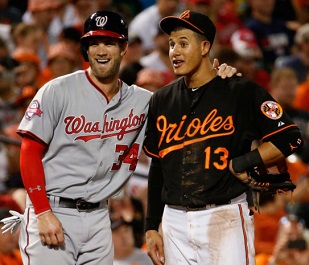
Bryce Harper and Manny Machado—Machado’s signed for 300 million balloons with the Padres. It may mean the beginning of the end of tanking, but now the Harper market becomes a little more intriguing.

Oops. Even as I was writing “Tanks, Damned Tanks, Dollars, and Nonsense,” in which I pondered the pros and cons teams might see in Manny Machado, Machado and the Padres dropped the big one. Ten years, $300 million, with a clause allowing Machado to opt out of the deal after five.

The Padres add a player who’s averaged almost five wins above a replacement level player a season for his first seven seasons and was worth 5.7 WAR in 2018. It’s only his fourth-highest single-season WAR, but it was his best season at the plate: he had his highest-ever single season on-base and slugging percentages, his highest-ever single-season OPS, and his best single season for creating runs with 120. His 191 runs produced in 2018 were ten above his career average per 162 games and tied his career best for a single season.

At age 25, Machado’s a year younger than Mike Trout, generally regarded as baseball’s greatest all-around player today, and a player who’s either going to extend with the Angels or test his own free agency waters after the 2020 season approaching age 28. And, yes, he’s signing the biggest contract ever for a baseball player, bigger than Alex Rodriguez’s $250 million.

But the Padres also add a player who has, like A-Rod though for different reasons, generated a little controversy during his career.

Bryce Harper has a reputation for being superstar caliber and not always fundamentally sound. Machado has one for being superstar caliber and not clean, whether it comes down to hustle or whether he plays the game crossing the line between hard nosed and plain dirty. If it’s not unseemly to crib from something I finished writing not half an hour before I sat down to write this, I’ll do it:

Harper at least has never spoken aloud of being a player who doesn’t always put his best effort forth. Machado has. Notoriously. As in, during the National League Championship Series, when he didn’t run a grounder out in Game Two, and slid so half competently in Game Three that one of the two slides helped make a double play against the Dodgers, then admitted to The Athletic‘s Ken Rosenthal, “Obviously I’m not going to change, I’m not the type of player that’s going to be ‘Johnny Hustle,’ and run down the line and slide to first base and . . . you know, whatever can happen. That’s just not my personality, that’s not my cup of tea, that’s not who I am.”

But Machado went further in the same interview: “Should I have given it a little more effort? One hundred percent. (It’s) my fault like always, I mean that’s just my mentality when I’m in the game. (There are) things that you learn, things that you gotta change. I’ve tried changing it for eight years and I still can’t figure it out but, one of these days I will.” To which Rosenthal added, “Some will see accountability in Machado’s words, viewing him a player who wants to do the right thing, but for whatever reason stumbles at certain times. Others will react to his, ‘I’m not ‘Johnny Hustle’ comment and lambaste him . . . considering anything less than maximum effort unacceptable. Still others might adopt an opinion somewhere in between, appreciating the nuance in Machado’s remarks.”

Those would be legitimate reasons for teams otherwise willing to show them the money to be slow if not hesitant to sign either Harper or Machado . . . And Machado is often seen as a player who crosses lines into dirty play often enough to provoke questions as to how that might translate in a new clubhouse.

Clearly, though, Machado enjoyed his time on the West Coast last season, where he played with the Dodgers and went to the World Series with them, following his mid-season trade from the Orioles. (There were those who thought Machado preferred to play somewhere reasonably closer to his Miami home.) With the Dodgers anticipating the return of shortstop Corey Seager this season, they had little to no place for him if they wanted to sign him on his own.

There were moments when it looked like the Phillies wanted Machado as badly as they’re believed to want Harper. There were moments when it looked like the White Sox wanted Machado badly enough that they sweetened the potential pot by adding his brother-in-law and a close friend or two.

And now comes a wrinkle: Former Yankee star Mark Teixiera, working now as an ESPN analyst, says no big market teams had offers on Machado’s table. Not even the Yankees, who’ve never been afraid to open the vault when there was a chance to land a Machado-type even if they’re not quite as profligate as they used to be when The Boss was still alive. Never mind that the White Sox aren’t a small market team, they only behave like one. And San Diego isn’t Boston, Chicago, Los Angeles, New York, Philadelphia, or San Francisco.

You guessed it. The Padres, the smallish market Padres, whom some people thought were in the tank but who’ve actually been struggling to put a winner on their field, just showed Manny Machado the money you’d have expected only the big market boys and girls to show him. Who says the small market teams don’t have money to spend, stupid or otherwise?

With one stroke of his pen, Machado blows the argument that the smallish market teams don’t have the resources the big boys and girls have in Boston, Chicago, Los Angeles, New York, Philadelphia (where the Phillies’ ownership has said they’re ready to spend “stupid money”—your move, Mr. Harper!), and even San Francisco right out of the ocean. You can just imagine the brass in places like Baltimore, Cincinnati, Cleveland, Detroit, Miami, Oakland, and Tampa Bay ready to measure Padres owner Ron Fowler for a noose, if not a guillotine.

Commissioner Rob Manfred thinks “the notion that payroll is a good measure for how much a team is trying or how successful that team is going to be.” Machado and the Padres say the first four words of the previous sentence are on the wrong side.

There’s no guarantee that spending, stupid money or otherwise, gets you to the Promised Land, if you define the Promised Land as not just playing October baseball but winning the World Series. The Yankees, after all, have gotten back to the Promised Land only once since Y2K, and they’re not exactly baseball’s skinflints. And there have been those who didn’t spend like assorted Congresses or assorted presidents but got to the Promised Land regardless, and more often than you think.

But when it comes to asking, “Do I have a better chance of getting to the Promised Land soon enough with spending big enough,” the Padres and their new have just sent the message that the answer fans of all smallish market teams would most like to hear from their teams is a resounding enough “Yes.”

The Padres weren’t thought to be entering 2019 as a great team or even a minimally good one. But Sam Miller of ESPN thinks they’re going to be better than advertised. “The Padres probably won’t be very good this year, but with the best current farm system in baseball they probably will be quite good in many of the next half-dozen years, and players like Manny Machado aren’t just freely available to pick up when a team decides to flip the switch and compete,” Miller writes. “They just got an MVP candidate for the middle of the lineup and all it cost them was money.”

“This gives San Diego’s entire rebuild a firm foundation,” says Miller’s fellow ESPN scribe Bradford Doolittle. “As big as the contract numbers are, it’s fair value for what Machado is likely to do in the future and because of his age and the length of his track record, the risk is comparatively low for deal this large.”

The deal does a few other favours around baseball. Since Machado isn’t going to the White Sox, the Indians can practically start pacing their players for another October run considering the weakness of the American League Central otherwise. The AL East has one less headache to worry about out of New York now that Machado won’t be wearing those Yankee pinstripes.

It may also do Harper a few favours. With Machado now getting the money he was projected to get when last season ended, and with Harper thought to be in line for similar money, Harper might just get it. Harper has the tools and the upside still, but at the same age with the same seven major league seasons Harper has averaged one less WAR per season. Harper has been more run productive per 162 games by eighteen over their careers, and he created one run less than Machado last year while using a few less outs to do it. Lifetime, Harper has 693 runs created using 2,524 outs to do it and Machado has 586 runs created using 2,845 outs to do it.

Those are striking enough differences in run production and run creation, which are the names of the game when you’re at the plate and on the bases. So what makes Machado the slightly better player? Harper’s defense in the outfield has receded considerably the last couple of years; Machado’s on the left side of the infield has been better. Machado doesn’t cost his teams quite as many runs in the field as Harper does, and Machado plays a tougher pair of defensive positions.

And before you begin to wonder whether Petco Park’s notoriety as a pitcher’s haven will suppress Machado’s bat, be reminded that a) Machado hits high drives when he connects right, which is very often; and, b) Petco Park is actually a lot friendlier to those whose natural high-drive power goes to left field, the seventh best such ballpark in the Show. And, as Eno Sarris of The Atlantic says, “Guess where Machado likes to hit his?”

Sarris also points out that adding Machado now gives the Padres almost the best infield in the league. “The ‘Fans’ projections on FanGraphs are almost always overly optimistic when you’re talking about a one-year projection, but when you’re talking about the upside that an infield like Machado, [Fernando] Tatís, [Jose] Urías and [Eric] Hosmer can produce, they can help. The fans say this group would produce 16+ wins together in full seasons this year. Only the Astros, Dodgers and Cubs are projected to produce more than 16 wins on the infield this year, and we haven’t added in any of the Padres’ depth pieces like [Ian] Kinsler.”

But Machado may have done more now than assure that Harper will be shown the money, give or take a few balloons, or that the Padres will win quite a bit more than projected this season. If the Machado deal begins the end of tanking as we know it, he and the Padres just did baseball and its fans one of the still-new century’s biggest favours yet.

Tanks, damned tanks, dollars, and nonsense

Colorado Rockies v Miami Marlins

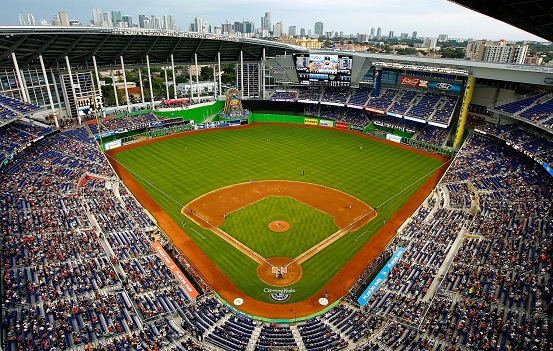
Marlins Park will be one the projected almost half of major league baseball stadiums without hosting even a cursory effort at winning baseball this season.

You don’t have to run numbers through processors to know two things: 1) Mere spending doesn’t always get you to the Promised Land, a.k.a. winning the World Series. 2) Last year, the team that spent the most in baseball on their payroll and their farm system got to the Promised Land. And they beat a team that’s gone to six straight postseasons and won back-to-back pennants and just so happens to be baseball’s richest at this writing.

Sports Illustrated‘s Jon Tayler took Commissioner Rob Manfred’s press conference bull by the proverbial horns Monday morning. Manfred denies there are such things as tanking teams. The players’ union and every baseball fan with the minimum mental capacity knows there are. “I reject the notion that payroll is a good measure for how much a team is trying or how successful that team is going to be,” Manfred told a group of reporters. Tayler knows Manfred isn’t wrong technically, just disingenuous:

The highest payroll doesn’t guarantee a World Series ring, but teams that don’t spend don’t often reach late October . . . The Marlins, Pirates and several other teams, meanwhile, cut payroll and neglected free agents, barely competing last year and not expected to be much better in 2019. Those teams aren’t trying to be good. In the case of Miami or Seattle or Baltimore, a club made the choice to be bad, hope for a top draft pick, and reap the financial benefits of failing.

It’s bad enough to root for a team rich in resources, unafraid to deploy them, and stuck yet again with coming up short enough. (I’m talking about you, Met and Angel fans.) It’s worse to root for a team making a seemingly conscious decision against deploying their resources and making even a semblance of trying to compete reasonably while in favour of pumping up its profits. (I’m talking about you, Mariners, Marlins, Orioles, Pirates, and Royals fans, among others.)

“Why should Marlins fans believe that yet another teardown—apparently two NL MVPs and the game’s best young catcher wasn’t enough to win—will lead anywhere other than yet another rebuild once the new prospects become expensive major leaguers?” Tayler asks, reasonably. “Why should Mariners fans simply trust that better is on the horizon after the front office—owners of the longest playoff drought in professional sports—dumped all the good players for pennies? What do Orioles and Royals and Pirates fans have to look forward to besides the changing of the seasons?”

Last winter players’ union executive director Tony Clark fingered the Athletics, the Marlins, the Pirates, and the Rays for not spending their revenue sharings. Manfred thinks Clark accused them of tanking. Manfred can’t seem to conjugate the distinction between just having a bad season and pocketing money that other teams would have spent on their parent rosters, their farm systems, or both.

The A’s made it to last year’s wild card game; the Pirates and the Rays had +.500 seasons; all four teams had four out of baseball’s five lowest payrolls, and three (the Marlins, the Pirates, and the Rays) cut payroll this winter. Teams may now be wary of handing out deals longer than five years to players past a certain age, and that wariness is not a terrible thing, but if the commissioner thinks there are no such things as consciously tanking teams, he’s blissfully unaware of things like:

* The Cubs and the Astros consciously tanking on behalf of retooling their parent clubs and their systems toward exactly what they achieved in the past few seasons: winning World Series and breaking ages-old Series championship droughts, and continuing competitiveness toward postseasons to follow.

* Fellow tankers using the Cubs and the Astros plans to justify their own tankings without making half the effort the Cubs and the Astros made to return themselves to actual competitiveness. The Cubs and the Astros said from the beginning of their tanks that they had an actual goal. Call it a kind of analogy to Babe Ruth’s actual or alleged called shot: the Cubs and the Astros pointed their bats to the right field seats and hit the balls right there.

* Baseball Prospectus projecting thirteen teams to finish below .500 in 2019, with the Orioles projected to lose 103 without half the style of the 1962-64 Mets; the Tigers to lose 95; the Marlins to lose 94; and, the Rangers to lose 93. Of the sub-.500 finishers projected, they include four out of five American League West teams and three out of five AL  Central teams. They also include two AL East teams (the Woe-rioles and the Rays), one National League East team (three guesses), two NL Central teams (the Pirates and . . . the Cubs, who haven’t been afraid to spend but didn’t lift much of a finger this winter, either), and two NL West teams (the Padres and the Giants). Almost half of major league baseball.

Does Manfred still believe every team is putting their best feet forward? Is that why he’s not willing to try the players’ union’s best idea yet, a tanking tax that would cost teams judged willing to present bad baseball while still making copious money choice draft positions?

Understood: There must be Goliaths for baseball’s Davids to slay. But without the right  slingshot David hasn’t got a prayer. Understood further: Each team in major league baseball is guaranteed $60 million in its hot little hands before the season’s first pitch is thrown. They don’t have to do one blessed thing to get it. And that’s just from shares of national broadcast money and shares from the profits MLBAdvancedMedia generates. Throw in the $20-$30 million each team gets from local/regional broadcast money and we speak now of each team adding $80-$90 million before Opening Day’s first holler of “Play ball!”

And even baseball’s least contentious superstar is not amused by what he sees.

“Everybody sees it. It’s obviously not good for baseball,” says Mike Trout, a player who is compared to the game’s all-time greats over his first eight seasons and looks to qualify as a no-questions-asked Hall of Famer by the time he reaches his first free agency at the end of the 2020 season.

“You got two of the top guys not signed yet. With teams saying they want to rebuild, why not start with one of the top guys?” Trout asks, not unreasonably. “Manny (Machado), Bryce (Harper), look at the pitchers out there. It’s pretty incredible. It’s disappointing for the players.”

Trout plays for a team that evokes the flip side of the tanking issue: his Angels are unafraid to spend, but they spend with unintended consequences (Albert Pujols, ten years and mostly unforeseen physical issues, to name the most notorious) and can’t seem to find ways to keep half their pitching staffs off the disabled list. (The Angels of the past few seasons are not unlike the 1960s Reds who developed sterling pitching only to watch just about all of it come down with arm and shoulder issues that kept them from greatness.) The good news: the Angels, and any other team “saddled” with gigacontracts involving players who can’t avoid injuries, recover the monies guaranteed those players via insurance. They’re not exactly going broke on them.

Harper and Machado have their particular issues. A plumb deeper than the surface of the dollars they’re believed to want reveals that, for all their talents and for all the evidence of their superior play, well, neither of the pair is Mike Trout. They’re both still young men. But Harper is a contradictory player who can be breathtakingly brilliant one week and breathtakingly ordinary the next, who can hustle himself into injuries one minute and give up the ghost running out ground balls the next.

The least problematic portion of Harper’s position now is his 2018 season. Yes, he finished with a modest .247 batting average, which seems to be the number one strike against him in the eyes of those fans who aren’t entirely seduced by him. But he was still the sixth-best in the National League at reaching base and scoring runs last year. And, just before the All-Star break, Harper stopped worrying about his launch angles and, secondarily, overshifts against him, and started thinking just about putting the bat on the ball. He still got his home runs; he still drove 100 runs home on the season; and, he hit .300 in the second half of the season.

The most problematic remained the perception that for all his achievements Harper is still not a completely sound fundamental player. Thomas Boswell isolated the point in the Washington Post Monday: “When the most famous player on the [Nationals] can’t go ten days without failing to run out a ground ball or overthrowing a cutoff man by fifteen feet or throwing to the wrong base or being caught unprepared in the outfield or on the bases, it’s hard to demand total alertness from the other 24.” Yet the Nats were still said to be willing to pay him $300 million for ten years to come, an offer Harper rejected and is now thought off the table entirely.

Harper at least has never spoken aloud of being a player who doesn’t always put his best effort forth. Machado has. Notoriously. As in, during the National League Championship Series, when he didn’t run a grounder out in Game Two, and slid so half competently in Game Three that one of the two slides helped make a double play against the Dodgers, then admitted to The Athletic‘s Ken Rosenthal, “Obviously I’m not going to change, I’m not the type of player that’s going to be ‘Johnny Hustle,’ and run down the line and slide to first base and . . . you know, whatever can happen. That’s just not my personality, that’s not my cup of tea, that’s not who I am.”

But Machado went further in the same interview: “Should I have given it a little more effort? One hundred percent. (It’s) my fault like always, I mean that’s just my mentality when I’m in the game. (There are) things that you learn, things that you gotta change. I’ve tried changing it for eight years and I still can’t figure it out but, one of these days I will.” To which Rosenthal added, “Some will see accountability in Machado’s words, viewing him a player who wants to do the right thing, but for whatever reason stumbles at certain times. Others will react to his, ‘I’m not ‘Johnny Hustle’ comment and lambaste him . . . considering anything less than maximum effort unacceptable. Still others might adopt an opinion somewhere in between, appreciating the nuance in Machado’s remarks.”

Those would be legitimate reasons for teams otherwise willing to show them the money to be slow if not hesitant to sign either Harper or Machado. The classic question of whether their best outweighs their worst. Boswell observes a lessening of tension among the Nats, whose clubhouse wasn’t always a model of stability with unquestioned leadership since Jayson Werth’s departure and whose previous managers “rarely said a discouraging word [about Harper, we presume] and owned no whip.” And Machado is often seen as a player who crosses lines into dirty play often enough to provoke questions as to how that might translate in a new clubhouse.

Two teams some suspect of going into the tank otherwise have shown interest in Machado: the Padres, who actually seem trying to win no matter that Baseball Prospectus projects them a sub-.500 team this season; and, the White Sox, projected to lose 92 this year. The Padres have also shown interest in Harper, as have the Giants. And the talk that it’s still going to end up with Harper in a Phillies’ uniform continues apace, the Phillies being projected as a +.500 team in 2019 even if they’re not predicted to win the NL East just yet. And the talk of “mystery” teams ready to pounce on either continues likewise.

But if either or both players sign right now, wherever, it still leaves a number of free agents unsigned who are either top of the line players or have been there and still have quality enough to offer. There seems no legitimate reason why Dallas Keuchel doesn’t yet have a job with a team who could benefit from a veteran established starting pitcher whose Cy Young season now seems an outlier but who still delivers. Or, why Craig Kimbrel doesn’t yet have a job with a team in need of an established closer, unless his skittish gigs last October have contending teams edgy that he’ll give them a lights out regular season and a nightly angina attack this coming October.

Meanwhile, the Red Sox ponder a contract extension for their starter Chris Sale, and the Mets ponder likewise with their defending Cy Young Award winner Jacob deGrom. Both pitchers, two of the best in the business, seem to want to stay with those teams for a considerable time to come. And Sale’s team’s owner has knocked Manfred’s disingenuity about tanking into the proverbial cocked hat. John Henry says that while there’s no such thing as the perfect correlation between team payroll and winning, “spending money helps.”

Spending wisely helps, and it would be comforting if we could take for granted that all owners really believe in wise over profligate spending. But not spending at all is the wisdom of fools. And there will be too many fools continuing to make money no matter how embarrassing will be the teams they put on the field.

Fans who think all this is nothing more than billionaires refusing to invest in millionaires who just so happen to be the product baseball sells might want to remember two things: You get what you pay for, and you don’t get what you don’t pay for. And a few too many teams are still trying to make money giving you what you don’t pay for—consciously losing baseball.