The Franchise could use a miracle

2019-03-07 TomSeaver02

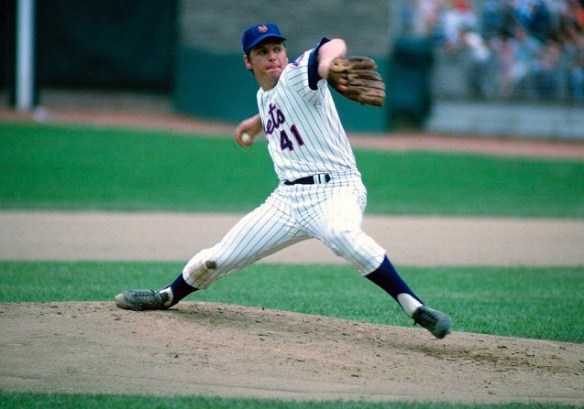
Fifty years later, Met fans still consider stricken Hall of Famer Tom Seaver “The Franchise.”

Writing for Harper‘s in 1977, A. Bartlett Giamatti—a decade before he left the presidency of Yale for that of the National League in a romantic instance of upward mobility—mourned with New York when the impasse between the Mets and Tom Seaver ended with Seaver’s exasperated demand for a trade. And, with the Mets trading him to the Reds. The Saturday Night Massacre.

Giamatti mourned not just the front office foolery that led to the Mets trading The Franchise at all, but the loss to New York of Seaver the young man, recalling a 1971 evening he and his wife got to spend with Seaver and his wife at a then-literary light’s home adjacent to Seaver’s then Connecticut home:

Seaver had . . . dignitas, all the more for never thinking for a moment that he had it at all. A dignity that manifested itself in an air of utter self-possession without any self-regard, it was a quality born of a radical equilibrium. Seaver could never be off balance because he knew what he was doing and why it was valuable . . . With consummate effortlessness, his was the talent that summed up baseball tradition; his was the respect that embodied baseball’s craving for law; his was the personality, intensely competitive, basically decent, with the artisan’s dignity, that amidst the brave but feckless Mets, in a boom time of leisure soured by division and drugs, seemed to recall a cluster of virtues no longer valued . . .

Of course Tom Seaver wanted money, and wanted money spent; he wanted it for itself, but he wanted it because, finally, Tom Seaver felt about the Mets the way the guy from Astoria felt about Seaver—he loved them for what they stood for and he wanted merit rewarded and quality improved. The irony is that Tom Seaver had in abundance precisely the quality that [then-Mets chairman] M. Donald Grant thinks he values most—institutional loyalty, the capacity to be faithful to an idea as well as to individuals . . . The anguish surrounding Seaver’s departure stemmed from the realisation that the chairman of the board and certain newspaper columnists thought money was more important than loyalty, and the fury stemmed from the realization that the chairman and certain writers thought everybody else agreed with them, or ought to agree with them.

That’s still probably as close as anyone has come to distilling both Seaver’s core, on and off the mound, and the fractured Mets’ fan’s heart as expressed by a banner hung from a Shea Stadium rail the day after the trade:

I WAS A
BELIEVER
BUT NOW WE’VE
LOST
SEAVER
2019-03-07 TomSeaverSandyKoufax

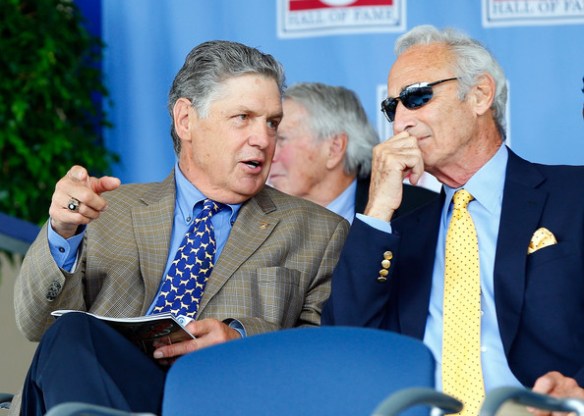
Seaver (left) with fellow Hall of Famer and oenophile Sandy Koufax at a Cooperstown induction ceremony.

Giamatti interpreted it to mean “lost faith in the Mets’ ability to understand a simple, crucial fact: that among all the men who play baseball there is, very occasionally, a man of such qualities of heart and mind and body that he transcends even the great and glorious game, and that such a man is to be cherished, not sold.”

The truly sad news is that even such a man can’t transcend nature’s cruelties.

Tom Seaver has been diagnosed with dementia. His family announced it Thursday, not long after his 1969 Mets teammate Art Shamsky disclosed his struggle with short-term memory loss, in an excerpt from Shamsky’s forthcoming After the Miracle, a chronicle hooked around the 1969 triumph and a final journey to Seaver’s California home and vineyard by Shamsky and other Miracle Mets teammates.

Shamsky already suspected, based on that visit, that Seaver wasn’t likely to be part of commemorations this year for the 1969 Mets. The formal announcement of Seaver’s condition, from his family by way of the Hall of Fame, turned suspicion into sad reality: Tom will continue to work in his beloved vineyard at his California home, but has chosen to completely retire from public life.

The arguable sixth to eighth best starting pitcher ever to play the game, and arguably in a dead heat with Randy Johnson as the best post-World War II starter, Seaver was intelligent and personable and possessed of a fine, dry wit. During the 1969 World Series, when Hall of Famer Sandy Koufax (working as an NBC baseball analyst and commentator) asked him whether God was a Met fan, Seaver said with a slight grin, “I don’t know, Sandy, but I think He’s rented an apartment in New York this week.”

Seaver’s health issues began when he was stricken with Lyme’s disease in 1991, then suffered a recurrence in 2012, leaving him with Bell’s palsy and short-term memory loss. Though he’d enjoyed visitors to his vineyard (including Koufax, himself an oenophile) and always enjoyed seeing former teammates, not to mention appearing at the annual Hall of Fame inductions, Seaver had cut his public appearances back considerably since that 2012 illness.
2019-03-07 TomSeaverAndyWarhol

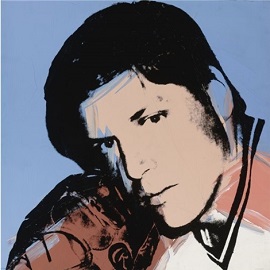
Even Andy Warhol found Seaver one of a kind . . .

The 1977 contract extension rift was compounded by Seaver’s criticism of the reeling Mets’ administration for refusing to invest in both replenishing their farm system and the early free agency market. And, by Grant’s foolish public remark that the Mets had won two pennants “without superstars” and would do it again. (As the Mets continued their mid-to-late 1970s decline, the fabled Shea Stadium Sign Man, Karl Ehrhardt, pricked Grant routinely by hoisting a sign saying WELCOME TO GRANT’S TOMB, which helped the Mets alienate Ehrhardt for decades to follow.)

Then the Mets laid a second screwing upon their three-time Cy Young Award winner. Re-acquired from the Reds for 1983, Seaver was inadvertently left off the protected list, in the short-lived compensation pool allowing teams who’d lost players to free agency to claim another player from anywhere. The White Sox claimed Seaver, who won his 300th career game in their uniform—and in Yankee Stadium.

Those were no ways to treat the Franchise.
2017-03-07 TomSeaverGaryGentry

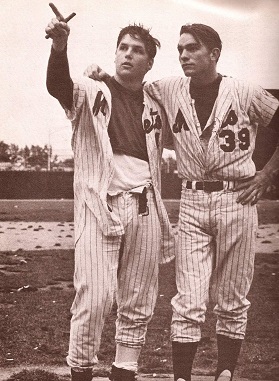
Seaver and rookie pitching star Gary Gentry (39), inspecting the carnage after celebrating Shea Stadium fans decimated the playing field following the ’69 Series triumph.

He finished his career with the 1986 Red Sox, where he was unable to partake in the World Series due to a knee injury, which probably suited New York just fine. They’d already demanded penance from the Mets’ administration for letting Seaver win number 300 in that foreign playpen in the Bronx. Letting him pitch even one inning against the Mets in a World Series would have been worth a public execution.

No genuine Met fan blamed Seaver, of course. And he thought of returning to the Mets in 1987 when they needed pitching help, but a couple of poor gigs at their then-Tidewater AAA farm convinced him to call it a career. A year later, he appeared at Shea Stadium when the Mets retired his number 41; characteristically, Seaver strode to the mound and bowed to the cheering crowd in all directions before leaving.

Seaver made such impressions practically from the beginning. Making his first All-Star team in his rookie season, 1967, Seaver felt compelled to introduce himself to his fellow future Hall of Famer Henry Aaron. “Kid, I know who you are,” Aaron replied, “and before your career is over, I guarantee you everyone in this stadium will, too.”

“Blind people come to the park just to listen to him pitch,” Hall of Famer Reggie Jackson once said. As well they might regarding one of only two pitchers with over 3,000 strikeouts and a lifetime ERA below 3.00 on their resumes. (The other? Hall of Famer Walter Johnson.)

Tug McGraw, the ’69 Mets relief pitcher, about whom Seaver said, “He’s got about forty-eight cards in his deck,” once said that when Apollo 11’s Neil Armstrong and Buzz Aldrin walked on the moon, he knew the Mets had a chance. (McGraw died of brain cancer in 2004.) Seaver saw things a little less esoterically: “There are only two places in the league—first place and no place.”

Wrote Giamatti:

Seaver held up. His character proved as durable and as strong as his arm. He was authentic; neither a goody two-shoes nor a flash-in-the-pan, he matured into the best pitcher in baseball. Character and talent on this scale equaled a unique charisma. He was a national symbol, nowhere more honoured than in New York, and in New York never more loved than the guy who seemed in every other aspect Seaver’s antithesis, the guy who would never give a sucker an even break, who knew how corrupt they all were, who knew it was who you knew that counted, who know how rotten it all really was—this guy loved Seaver because Seaver was a beautiful pitcher, a working guy who got rewarded; Seaver was someone who went by the rules and made it; Seaver carried the whole lousy team, God love ’em, on his back, and never shot his mouth off, and never gave in, and did it right. The guy loved Seaver because Seaver did not have to be street-wise.

In 1977’s Oh, God! John Denver’s earnest supermarket manager asks George Burns’s God about working miracles to send messages. After demurring on grounds of too much flash, Burns/God continues: “Oh, now and then I do one just to keep My hand in. My last miracle was the 1969 Mets. Before that, I think you have to go back to the Red Sea. Aaaaah, that was a beauty!”

It would not be unreasonable for those who love baseball to pray for Seaver to receive a miracle now.
J.R. Richard, from survivor to thriver

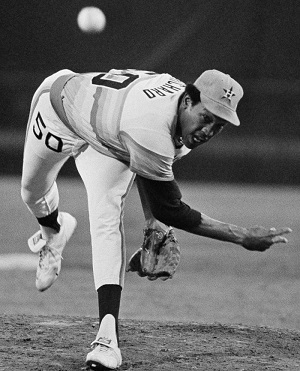
2017-03-07 JRRichardPitching

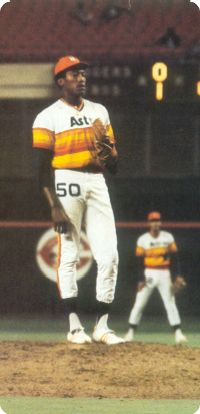
It was once to wonder how it would have looked if 6’8″ J.R. Richard could have pitched to 6’8″ Frank Howard.

A 69th birthday isn’t one of the classic milestone birthdays men and women commemorate, but J.R. Richard—who turned 69 today—isn’t an ordinary 69-year-old. He’s been to the top of the mountain and the to the absolute depth of the deepest valley. And back. “(I)f you beat me I’m gonna die trying,” Richard said in 2012, remembering the attitude he took to the mound. “I was willing to give my life for it.”

He damn near did give his life for it.

The stroke Richard suffered while on the disabled list not long after the 1980 All-Star Game he’d started embarrassed everyone around the Astros, team and press alike, who’d speculated the giant righthander was dogging things. Though many of those doubting writers and broadcasters apologised publicly in the wake of the stroke, it couldn’t help him.

Once one of the two most famous Texas-based men going by his initials, Richard only seemed like a fictional character. J.R. Ewing was a larger-than-life television rogue who wasn’t above practically anything short of murder to get his way. J.R. Richard looked larger than life on the mound in an Astros uniform, threw like it, and sometimes—though not always comfortably—acted like it.

He stood 6’8″ on the mound in a well tapered body and, between pitches, he looked a little like the big shy kid barely aware that the cute girl he crushed on was praying just as hard that he’d ask her to dance as he prayed for the courage to ask.

Then Richard went into his no-windup motion, his high knee-bent kick, and delivered. In that delivery, with his large hand almost covering the ball whole before he threw, the big shy kid turned into a behemoth who looked as though he’d crack your bat in half between two fingers if he wasn’t in the mood to throw you something one blink would make you wonder if it really came your way.

It was enough to make you wonder how it would have looked if Richard could ever have pitched to 6’8″ Frank Howard, who didn’t play in the same circuit. The sight of Richard, looking like he’d piledrive you through the batter’s box, pitching to Howard, who looked like he’d carve his initials into your forehead if he didn’t hit one over the county line? Chuck Jones himself couldn’t design a better baseball exaggeration.

2019-03-07 JRRichard

Richard in prime time . . .

The closest Richard ever got to that was facing 6’6″ Dave Kingman 33 times. The bad news for Richard: Kingman did hit one out off him. The bad news for Kingman: Richard otherwise kept him to a pair of doubles and a pair of walks while striking him out fourteen times and holding him to a .226/.273/.387 slash line.

And if Kingman hadn’t been disabled with a case of appendicitis, Richard would have had to deal with him in his first major league start, 5 September 1971. The start in which Richard tied the major league record for pitchers in their first games with fifteen strikeouts. (He joined Brooklyn Dodger blink-of-a-eye legend Karl Spooner.) The start in which he struck no less than Willie Mays out in the first, third, and fifth innings.

Maybe the strangest game of Richard’s career was 19 September 1978, against the Braves. He faced off against ancient, one-time Astro Jim Bouton, trying a major league comeback and getting his shot with the Braves that month. Bouton must have thought it was the Braves asking David to bring Goliath down without a slingshot. “The young flamethrower and the old junkballer,” Bouton would remember.

Richard spent his seven innings breaking Hall of Famer Tom Seaver’s record for single-season strikeouts by a righthander, the money punchout coming at Bob Horner’s expense, while surrendering two earned runs on three hits and three walks. Bouton spent his seven innings surrendering two earned runs on five hits, striking out one, and walking five. David and Goliath fought to a draw that night.

The Braves would win it after Horner doubled home pinch runner Barry Bonnell in the top of the ninth off Joaquin Andujar but the Astros couldn’t muster more than a strikeout, a ground out, and a fly out against Gene Garber, the Braves reliever who’d also stopped Pete Rose’s 44-game hitting streak.

It took Richard a few seasons of inconsistency, periodic wildness, and a few injuries, before he took complete command of his howitzer fastball and his wide-moving slider and became a full-time National League terror. He was sometimes forbidding and sometimes playful; he spoke in the low drawl of the Louisiana fisherman he loved being off duty and off-season.

MLB Photos Archive

Rotation mates in 1980 before the stroke. Nolan Ryan looks like he doesn’t trust what might be behind Richard’s sneaky-looking grin.

He posted back-to-back 300+ strikeout seasons in 1978 and 1979 (his 313 in ’79 remain the Astros’ single-season strikeout record); he started the 1980 All-Star Game. He finished fourth in the National League’s Cy Young Award voting in 1978 and third in 1979, and he probably should have won the 1979 award: he led the league in strikeout-to-walk rate and the entire Show in strikeouts per nine, lowest hits per nine (and believe it or not he’s still fifth on the all-time list), ERA (2.71) and fielding-independent pitching. (Again: your ERA when the defense behind you is removed from the figuring: 2.21.)

Nobody including Richard himself knows whether his periodic, recreational cocaine indulgence played any role in what happened to him in 1980. He complained of shoulder fatigue well before that 1980 All-Star Game; a small reputation for moodiness led too many to think the behemoth was simply whining when he complained his shoulder and forearm felt fatigued. Some of those dismissals were racist; others, merely ignorant.

Doctors found obstructions in his arm and neck arteries but decided they weren’t serious enough for surgical correction. Then came 30 July 1980, when Richard—staying behind while the team hit the road—had a little workout on an Astrodome sideline. “I would hear a lot of high-pitched ringing in my left ear, which I didn’t think nothing about it at that time,” he remembered to WBUR’s Bill Littlefield in 2015.

I kind of just shook it off and kept on throwing a few more. Then I threw a couple more, then I became real nauseated, and I lay down on the Astrodome floor. And the next thing I remember I was waking up in the hospital. I had been complaining to the Astros for almost a month or two about something was wrong. And if I’m such a valuable asset to the ball club, why wasn’t I immediately rushed to the doctors from Chicago when it first started? Again, if I was such a valuable asset to the company?

Stroke. As it turned out, a subsequent CAT scan showed three separate strokes and a presence of thoracic outlet syndrome that left him with an artery pinch while he pitched. (Richard has said he was also told his shoulder muscles were overdeveloped enough to contribute to the problem.) Small wonder he looked less than himself starting that All-Star Game despite three strikeouts and no runs in his two innings’ work.

Career over, despite a comeback attempt or two to come, during one of which Thomas Boswell observed, “Richard is more pleasant, more outgoing, more generous with other people than ever before in his life. Once he was the most forbidding Astro. Now he may be the least, signing autographs and seeking out chitchat. After a lifetime as the Goliath overdog, he is now everybody’s underdog, and he enjoys it. Richard may even have become the symbol of a decent, long-out-of-fashion idea: mutual tolerance.”

“(W)hen people don’t understand who you are, when people can’t control you, they have a tendency to want to destroy you,” Richard told Littlefield, who interviewed him on the publication of his memoir, Still Throwing Heat: Strikeouts, the Streets, and a Second Chance. “But see, you got to realize this: Sports is a business. Nothing more or nothing less.”

A year before he was felled, Richard signed a four-year contract at $3.2 million. When the Astros and Richard said goodbye for keeps in 1984, he returned to his native Louisiana, spent a lot of time between there and Galveston, Texas fishing as if it was going out of style (as he still loves to do when possible), wringing baseball out of his system, winning a $1.2 million malpractise action against the Astros’ medical staff, and working selling cars and recreational vehicles for a time.

Unlike his television namesake, though, this J.R. wasn’t exactly made for the oil business: he lost $300,000 in an oil investment scam. Then, he lost another $669,000 in his first divorce. Further business problems and a second marital failure wiped him out completely, costing him his home and finally leaving him living under that Houston bridge.

2019-03-07 JRLulaRichard

Richard and his wife, Lula: “She helped with a lot of stability, in every way.”

Until a couple of former Astros teammates including Jimmy Wynn called another ex-teammate, Bob Watson, then the Astros’ general manager, around 1994. They plus the Baseball Assistance Team helped Richard start back to his feet. His minister, Rev. Floyd Lewis, helped him stay there. Most of all, Richard helped himself, largely by abandoning his admitted one-time bull-headedness and letting God take his hand and his spirit.

Richard has long since become a minister at Mt. Pleasant Church, while working with Houston donors to set up children’s baseball programs where he teaches assorted children the game and other hard-learned lessons. He also tries through his faith and his efforts to help the homeless help themselves.

“They’ve got to have a different mindset,” Richard told Littlefield. “You see a man could eat a whole whale, but it takes one bite at a time. Or he can walk a mile, but it takes one step at a time. So if you’re willing to take that step, [God] will make a way out of no way. See, God is the only one I know who can take a mess, go in a mess, clean up a mess and come back out and don’t be messy. Now you figure that out.”

He has even remarried happily. He met his third wife while sharing a bus on a church trip and she was recently widowed; he wrote his phone number inside the cover of her Bible. Their first date was a steak dinner. After they “courted” two years, as he put it in Still Throwing Heat, they married in 2010.

The righthander one writer once described as looking as though he could just reach to shake your hand from the mound before striking you out throws a far different pitch now. And the Astros will induct him into the team’s Hall of Fame come 3 August. Perhaps they’ll surprise the pitcher a former team leadership once doubted gravely enough by finally retiring his uniform number (50), something he admits he’d love dearly.

He hasn’t lost his laconic wit. When fans meet him and remember their shock over his stroke, he’s liable to reply with that half-mischievous grin, “I couldn’t believe it, either.”

Richard still has pride enough in what he did as a pitcher. Now and then, half puckish and half dead serious, he calls himself the only man in the world who could throw a baseball through a car wash and never get the ball wet. It’s not necessarily that much an exaggeration for a pitcher whose fastball often topped out at 100 mph.

But it’s not as important as the comeback he finally made after he got knocked down several times over. From survivor to thriver.

Bombs win wars but not always rings

2019-03-06 AaronJudge

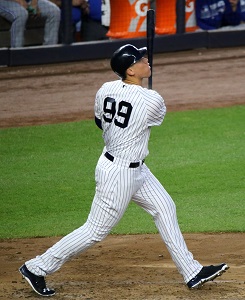
Aaron Judge should be careful what he wishes for . . .

Aaron Judge knows a few things about hitting for distance and does it prodigiously. He would love few things more than his Yankees obliterating the single-season record for team home runs they smashed last year, assuming the team’s health.

Surely, too, Judge wishes his Yankees’ return to the Promised Land occupied at present by the Red Sox, to whom he gave a lot of postseason incentive with his “New York, New York” boombox trolling after they evened the division series out of which the Red Sox went on to shove them in Yankee Stadium.

“We’ve got a good team, a lot of guys that could make a lot of solid contact, and a lot of big boys that when they make contact, man, it goes,” the Leaning Tower of the South Bronx said this week. “We’re a team that’s primed and ready to do that.” And while much of that Yankees’ historical mythology hooks around that famed Yankee power, Yankee fans would probably prefer them primed and ready to return to the Promised Land.

Which isn’t easy to reach in the first place, never mind return, for teams who can out-bop all comers. It was easier to bring Japan to the surrender table in World War II with strategic bombing. Baseball’s most relentless bombers aren’t always baseball’s pennant winners, never mind World Series champions.

The following table shows how that’s gone in each season since division play began. Pennant-winning team home run leaders in italics; World Series winners who also led their leagues in home runs those seasons in bold. (I marked 1994 with asterisks because, of course, there was no postseason that year.)


Season

NL HR

leader

AL HR

leader

NL

Pennant

AL

Pennant

WS

Winner

1969 Reds – 171 Red Sox – 197 Mets Orioles Mets
1970 Reds – 191 Red Sox – 203 Reds Orioles Orioles
1971 Pirates – 171 Tigers – 179 Pirates Orioles Pirates
1972 Giants – 150 Athletics – 134 Reds Athletics Athletics
1973 Braves – 201 Indians – 158 Mets Athletics Athletics
1974 Dodgers – 139 White Sox – 135 Dodgers Athletics Athletics
1975 Pirates – 138 Indians – 153 Reds Red Sox Reds
1976 Reds – 141 Red Sox – 134 Reds Yankees Reds
1977 Dodgers – 191 Red Sox – 213 Dodgers Yankees Yankees
1978 Dodgers – 149 Brewers – 173 Dodgers Yankees Yankees
1979 Dodgers – 183 Red Sox – 194 Pirates Orioles Pirates
1980 Dodgers – 148 Brewers – 203 Phillies Royals Phillies
1981 Dodgers – 82 Athletics – 104 Dodgers Yankees Dodgers
1982 Braves – 142 Brewers – 216 Cardinals Brewers Cardinals
1983 Dodgers – 146 Orioles – 168 Phillies Orioles Orioles
1984 Phillies – 147 Tigers – 187 Padres Tigers Tigers
1985 Cubs – 150 Orioles – 214 Cardinals Royals Royals
1986 Cubs – 155 Tigers – 198 Mets Red Sox Mets
1987 Cubs – 209 Tigers – 225 Cardinals Twins Twins
1988 Mets – 152 Blue Jays – 158 Dodgers Athletics Dodgers
1989 Mets – 147 Angels – 149 Giants Athletics Athletics
1990 Mets – 172 Tigers – 172 Reds Athletics Reds
1991 Reds – 164 Tigers – 209 Braves Twins Twins
1992 Braves – 138 Tigers – 182 Braves Blue Jays Blue Jays
1993 Braves – 169 Rangers – 181 Phillies Blue Jays Blue Jays
1994 Braves – 137 Indians – 167 * * *
1995 Rockies – 200 Indians – 207 Braves Indians Braves
1996 Rockies – 221 Orioles – 257 Braves Yankees Yankees
1997 Rockies – 239 Mariners – 264 Marlins Indians Marlins
1998 Cardinals – 223 Mariners – 234 Padres Yankees Yankees
1999 Rockies – 223 Mariners – 244 Braves Yankees Yankees
2000 Astros – 249 Blue Jays – 244 Mets Yankees Yankees
2001 Giants – 235 Rangers – 246 D’Backs Yankees D’Backs
2002 Cubs – 200 Rangers – 230 Giants Angels Angels
2003 Braves – 235 Rangers – 239 Marlins Yankees Marlins
 

2004


Cubs – 235

White Sox – 242

Yankees – 242


Cardinals


Red Sox


Red Sox

2005 Reds – 222 Rangers – 260 Astros White Sox White Sox
2006 Braves – 222 White Sox – 236 Cardinals Tigers Cardinals
2007 Brewers – 231 Yankees – 201 Rockies Red Sox Red Sox
2008 Phillies – 214 White Sox – 235 Phillies Rays Phillies
2009 Phillies – 224 Yankees – 244 Phillies Yankees Yankees
2010 Reds – 188 Blue Jays – 207 Giants Rangers Giants
2011 Brewers – 185 Yankees – 222 Cardinals Rangers Cardinals
2012 Brewers – 202 Yankees – 245 Giants Tigers Giants
2013 Braves – 181 Orioles – 212 Cardinals Red Sox Red Sox
2014 Rockies – 186 Orioles – 211 Giants Royals Giants
2015 Dodgers – 187 Blue Jays – 232 Mets Royals Royals
2016 Cardinals – 225 Orioles – 253 Cubs Indians Cubs
 

2017

Brewers – 224

Mets – 224


Yankees – 241


Dodgers


Astros


Astros

2018 Dodgers – 235 Yankees – 267 Dodgers Red Sox Red Sox

You may have noticed two things. Thing One: No World Series winner who also led their league in team home runs the same season has done both together more than once. Thing Two: Only once in the divisional play era have both leagues’ team home run kings tangled in a World Series against each other, with the Yankees beating the Phillies in the 2009 Series.

And that was also the only time since 1969 that the Yankees led their league in home runs as a team and even won the pennant, never mind the World Series. They’ve won eleven pennants since 1969 but only in 2009 did they out-bomb the American League and win the pennant and the Promised Land.

The 2009 Yankees are also one of only eight World Series winners in the divisional era to lead their league in long distance the same season. They followed the 1971 Pirates, the 1972 Athletics, the 1976 Reds, the 1981 Dodgers, the 1983 Orioles, the 1984 Tigers, and the 2008 Phillies. Since 1969, nine National League team home run leaders and five American League team home run leaders have won pennants. Chicks may still dig the long ball but it’s not getting as many teams as you think to the Promised Land or even to playing for the lease.

The Dodgers have led the National League in team home runs more often than any other NL team since divisional play began, including last year—nine times. Aside from 1981, they have four more pennants to show for those seasons. Both the Yankees and the Orioles have led the American League in team home runs six times, and 1983 is the only time the Orioles did that plus win the pennant and the Series.

In fifty postseasons starting in 1969 (when the overpowering Orioles neither led the American League in home runs nor overpowered the Miracle Mets), dialing nine (the old euphemism for hitting a home run) hasn’t kept nine home run leaders from dialing 911 when the Series ended with the other guys hoisting the trophy. And teams you remember particularly for collective mayhem at the plate haven’t always gone the distance no matter how often they hit for it.

The Big Red Machine won four pennants and two World Series, but they’re 1-1 in Series in which they entered as their league’s home run leaders. The Pittsburgh Lumber Company led the league in bombing and won the Series in 1971; the Fam-i-Lee Pirates won the Series without being the league’s leading launchers.

The Bronx Zoo won back-to-back Series against the National League’s leading boppers–including Hall of Famer Reggie Jackson’s three bombs on three swings in Game Six, 1977—without leading the American League in the big bang themselves. And the 1982 Brewers led all baseball with 219 bombs, but that was one time the real-life Road Runner beat the real-life Wile E. Coyote’s Acme munitions, Harvey’s Wallbangers losing the Series to the White Rat’s Runnin’ Redbirds—who just so happened to finish dead last for team homers in the entire Show that season. Beep-beep!

In one of the earliest scenes of the Academy Award-winning film Marty, Ernest Borgnine’s Oscar-winning title character, a plain but big-hearted Bronx butcher, ambles into his favourite tavern for a couple of beers following a hard day’s work and asks about that day’s Yankee game. Told the winning score, the first question he asks is, “Any homers?”

My experience with the Yankees is very much like that. Yankee fans always seemed far more enchanted by the bombs than Yankee players did, even when Yankee players seemed concerned enough about them, such as during the Mantle-Maris chase to break ruthsrecord, or Jackson’s unvarnished (and unimpeachable) pride that night in Game Six, or the night three years ago on which Judge himself smashed Joe DiMaggio’s team record for homers on a season by a Yankee rookie.

The same experience tells me Yankee fans consider any season in which they don’t win the World Series a failure, if not a denial of birthright. That may be a little more extreme than the truest cliche about the Yankees being that they simply don’t like to lose. But they could hit 300+ home runs this year and still be failures on their fans’ and their own terms without a return to the Promised Land. Where their eternal rivals to the northeast have been, you know, four times since the century turned.

“Eight million New Yorkers called him Marvelous Marv”

2019-03-05 MarvThroneberry

Marv Throneberry, the patron saint of this journal.

Long enough after his baseball life ended, he carried a distinctive business card at the trucking company where he then worked in his native Tennessee. It was a foldover card, the inside of which showed his name, his contact information, and a once-familiar mug shot of himself in a Mets uniform. The top featured a trimmed oval cutout to show his mug shot, an embossed sentence straight across the bottom saying it simply enough:

EIGHT MILLION NEW YORKERS
CALLED HIM MARVELOUS MARV.

Marv Throneberry was the unlikeliest star on baseball’s unlikeliest team, after the Original Mets acquired him early in the 1962 season. He became  a Met in the first place because beloved Brooklyn veteran Gil Hodges went down with a knee injury, and the Mets were slightly desperate to put someone, anyone, at first base with a blood count and a little long ball power who might be an improvement over anyone else on hand.

They had no clue that this once-glittering-enough Yankee prospect, who’d terrorised the AAA American Association with his home runs but couldn’t crack a Yankee lineup in which incumbent Moose Skowron owned first base with everything short of legal documents, would become so typical an Original Met that he’d replace the boos he got in his early days succeeding Hodges to the kind of cheering the Beatles would inspire two years later.

“(B)ack then we were a more humorous and tolerant people,” wrote the New York Times‘s George Vecsey, upon Throneberry’s death of cancer at 60 in 1994, “and there was room to enjoy a team that couldn’t help doing ghastly things, and the baldish, mournful-looking first baseman who seemed to perform more ghastly deeds than anybody else.” That’s the problem with today’s tankers. They have as much good humour as a tax examiner.

Throneberry was a born Met only if you count the initials of his full name, Marvin Eugene Throneberry. To get him from the Orioles the Mets had to send them the proverbial player to be named later, who turned out to be—in a model of Metsian maladjustment—the actual first Met, catcher Hobie Landrith, whom the Mets took from the Giants with the first pick of the National League expansion draft that formed the team.

“The first thing you have to have is a catcher. Because if you don’t have a catcher, you’re going to have a lot of passed balls and you’re going to be chasing the ball back to the screen all day,” said manager Casey Stengel, explaining the Mets picking first and picking Landrith. “Thirty-one year old catcher who looked twenty-eight and played like forty,” wrote Leonard Shecter, in Once Upon the Polo Grounds. “Hobie always said he was 5’8″. He probably was 5’6″. It wasn’t his fault he wasn’t big enough to play this game.” (Baseball Reference lists Landrith, still alive at 88, as 5’10”.)

Landrith was a perfect Original Met—until he wasn’t. On Opening Day he threw past second base trying to cut down a would-be base thief and committed three passed balls in 21 games. But earlier in May than the deal that brought Throneberry aboard, Landrith hit a game-ending two-run homer off Hall of Famer Warren Spahn. It was the first win in the Mets’ first doubleheader sweep. (The sweep also provided the first and last wins to Mets pitcher Craig Anderson, earning both in relief, before he experienced a streak of sixteen straight losses in sixteen straight decisions the rest of the season.)

Obviously Landrith had to go. He just didn’t have quite what it took to animate the Original Met faithful. “The Mets were different, they were counterculture, they were fun,” Casey Stengel’s biographer Robert W. Creamer would remember. “The worse they were, the more fun they were.”

Elder fans who returned to the Polo Grounds just because the National League was back in business at the Giants’ ancient but legendary wreck were supplanted readily by young fans for whom the Mets seemed far more human than the still-imperial, still-clueless Yankees. For the life of them the Bronx Bombers could never figure out why they almost got out-drawn at their stately coliseum by a newborn team who featured Abbott & Costello as a battery, the Four Marx Brothers covering the infield, the Three Stooges in the outfield, the Harlem Globetrotters on the bench, and the Keystone Kops in the bullpen.

And there was no more human Met than Throneberry, who’d gone from the Yankees to the Kansas City Athletics in the trade that made a Yankee out of Roger Maris. His flair for occasional dramatics showed up there, when he smashed a game-winning, pinch-hit grand slam to beat the Tigers one 1961 day, and drove in all the runs to beat the Twins on another. Except that the A’s had no place to put him regularly, either, and neither would the Orioles who acquired him in a postseason 1961 deal.

By the time the Mets got hold of him Throneberry was damaged goods, gone from a live teenage prospect to a 28-year-old semi-veteran who could swing the bat but whom rust reduced to playing either first base or right field as though he were impersonating a trash truck with two flat inner rear tires. “Marv Throneberry was holding down first base,” Jimmy Breslin wrote, in Can’t Anybody Here Play This Game? The Improbable Saga of the New York Mets’ First Year. “This is like saying Willie Sutton works at your bank.”

Which was probably frustrating to a still-young man who’d once led the American Association in fielding percentage, but destiny had far bigger plans for Throneberry. Somehow, some way, and with more than a little help from his Hall of Fame teammate Richie Ashburn (who first gave him his to-be-famous nickname), and from Shecter (then a writer for the New York Post, who took Ashburn’s sobriquet and ran with it), he became Marvelous Marv.

Ashburn took a special interest in the otherwise earnest Throneberry, using his wicked sense of humour to brace up his clubhouse locker partner. Around the same time, Throneberry began touching a real nerve among the younger Mets fans, the first sign being a literal sign, a banner hung from a Polo Grounds rail chanting, “Cranberry, Strawberry, We Love Throneberry.” Another group of young fans wore T-shirts spelling out “M-A-R-V” with the fifth showing an exclamation point; they once, famously, stood up in the wrong order, spelling out “V-R-A-M-!”

I’ve written and said in the past that where other bad baseball teams merely suck, the Original Mets sucked . . . with style. Throneberry was a style setter. You had only to see him in June 1962, on the same day during which Hall of Famer Lou Brock, then a Cubs rookie, jolted the Polo Grounds and his own teammates by blasting one into the center field bleachers some 465 feet from home plate. (Only two before him had ever hit one there: Joe Adcock with the Braves a decade earlier, and Luke Easter in a late 1940s Negro Leagues game.)

In the same game, Throneberry whacked one down the right field line and well past the bullpen for a standup triple, gunning it around the bases as if he had a subpoena on his trail. Then Hall of Famer Ernie Banks called for the ball and stepped on first, and Marvelous Marv was rung up. Before Stengel could consummate his mission to dismantle the first base umpire, coach Cookie Lavagetto intercepted him: “Forget it, Case, he didn’t touch second either.”

“Well,” Stengel muttered, “I know he touched third because I can damn well see him standing on it.”

The next Met batter, Charley Neal, ripped one off the facade of the upper deck for a home run. Neal wasn’t five steps up the first base line to run it out when Stengel stopped him cold. Then, the manager pointed to first base and stamped his foot. Only then did Neal continue running. Stengel pointed to each base and stamped his foot likewise, until Neal crossed the plate. The Ol’ Perfesser wasn’t taking chances.

Like the character actor lost among a sea of secondary cast who steals the scene and the show right before the final curtain, one day in the following month Throneberry pinch hit against the Cardinals in the bottom of the ninth and won the game with a two-run homer. And in August, he saw and raised in a somewhat surreal game against the Pirates.

Throneberry was actually on the first base coaching line, after third base coach Solly Hemus was ejected during an argument with an ump, Lavagetto was moved to coach third, and another former Yankee, Gene Woodling, also an acquisition from the Orioles, went out to coach first. Until Stengel needed him to pinch hit and sent Throneberry out to the coaching line. (To rapturous cheering, let the record show.)

Then the Mets scored one and had first and second with two out in the bottom of the ninth against the Pirates’ relief legend Elroy Face. The Polo Grounds faithful chanted “We want Marv! We want Marv!” Stengel gave the people what they wanted and Throneberry gave them better than that, hitting one 450 feet into the right center field seats for the game. The Polo Grounds went absolutely nuclear.

There was no less likely star in baseball, in New York or elsewhere, than this guy who looked like your friendly neighbourhood tavern barkeep, but 1962 was his first real and last ever baseball hurrah. After a 1963 contract holdout Throneberry found himself yet again having to buck others at first base, particularly two youths, acquisition Tim Harkness (from the Dodgers) and a teenager named Ed Kranepool, whom the Mets signed with a hefty bonus in 1962 right out of high school.

Marvelous Marv got only fourteen at-bats and two hits when he was sent to the Mets’ then-AAA farm at Buffalo. He stayed there for all 1963 but retired in early 1964—by which time the hundred-plus fan letters he’d once received per day was down to a reported two. (Now and then, during 1963, Polo Grounds fans would hang banners urging, “Bring back Marvelous Marv!”) He returned to his native Tennessee and became a Memphis beer distributor before going into the trucking business, whence the business card described earlier.

2019-03-05 MarvThroneberryMillerLite

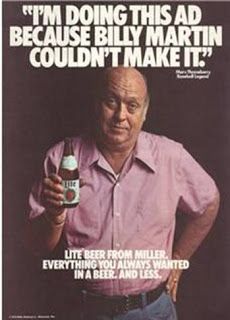
Marvelous Marv, one of the Miller Lite All-Stars.

But somehow, some way, he was unforgotten. In the 1970s he became famous all over again in the fabled Miller Lite commercials featuring former sports stars. Throneberry appeared amidst some of sports’ greats and mere legends, invariably ending his spots with, “I still don’t know why they asked me to do this commercial.”

“At the very least,” Vecsey wrote, “it meant that one of the hip fans from the Polo Grounds had made it to Madison Avenue and was using his 1962 Met-type humor to honor Marvin Eugene Throneberry, who was, in his own weird way, a star.” Marvelous Marv was a star all over again.

Throneberry kept a photograph in his locker, well displayed, of a rather comely young lady in a bikini, and his teammates, including his setup man Ashburn, couldn’t help noticing and ogling, to Throneberry’s quiet amusement. Then, one afternoon, taking pre-game practise, Ashburn saw the woman sitting in the Wrigley Field field boxes. “Marv, you’ve got to see this,” Ashburn hollered to Throneberry.

Throneberry ambled over, and Ashburn pointed the woman out. “That’s the girl in your locker,” Ashburn said.

Throneberry grinned. “That’s my wife,” he said.

Ashburn’s jaw hit the turf promptly.

(Dixie Throneberry died in 2016; the Throneberrys had three daughters and two sons, with eleven grandchildren and fifteen great-grandchildren.)

“Throneberry is the people’s choice,” Ashburn once told Shecter, “and you know why? He typifies the Mets. He’s either great or terrible.” Throneberry happened to be standing next to him. “But you better not get too good,” Ashburn cracked. “Just drop a pop fly once in awhile.”

Throneberry dropped his own jaw twice at season’s end. The first drop was over being given a big cabin-cruising boat because it turned out he hit the O on an outfield fence sign promoting Howard Clothes more than any other Met. It was bad enough that he lived about thirty miles from the nearest river at the time. The second jaw drop came when a Met legal adviser informed Throneberry he had to declare the boat on his income tax—because he’d “earned” the boat.

“You think the fish will come out of the water to boo me this winter?” Throneberry asked.

Not a chance. He had an occasionally powerful bat and a sense of humour about himself, and they took him places enough in life, including the sweet advertising gig where he earned more than baseball, beer distribution, or trucking ever paid him in a year, seemingly. He was a countercultural anti-hero before the counterculture became serious to a dangerous and conformist fault about itself.

“Going to work just two times a month and making a great living,” Throneberry once told the Times of the Miller Lite spots and magazine ads. He’d also moved to the more waters-adjacent Fisherville, where his former major league brother Faye also lived. “I can fish four or five days a week. I’ve got five boats and five motors. I don’t have to worry about things I used to worry about. I wouldn’t trade this for anything.”

Writing his story for the Society for American Baseball Research’s Bio Project, which provided the excuse to write of him now, Alan Raylesberg exhumes a commentary from Throneberry’s oldest son, Jody:

He must have been special to have over 5000 fans wear shirts with VRAM on them. He truly loved his fans. I have watched him sit around hours on end and read fan mail and sign and return them to his fans. In the last days of his life when suffering from terminal cancer he would make it a point to sign as many cards as he could and have them mailed back out. That is the Marvelous Marv we all knew and loved.

And that’s also the Marvelous Marv for whom this journal happens to be named.

It’s about winning, stupid

2019-03-03 PhilliePhanaticBryceHarper.jpg

Sharing a high fist with the Phillie Phanatic—it was about a lot more than the money for Bryce Harper. 

For those who think about actual or alleged free agency market tightening and tanking teams, Phillies owner John Middleton has the answer every baseball fan of every team should wish their teams’ owners have every season. It turned out to be a key reason why he was willing to spend for Bryce Harper—and on terms that might surprise you.

It’s about winning, stupid.

At Saturday’s press conference introducing Harper as a Phillie officially, his uber agent Scott Boras told the story, quoting Middleton himself:

Scott, I want to tell you something, I’m not interested in talking about marketing dollars, ticket sales, billboards, concessions. There’s only one reason I’m talking to you, and that’s because I believe this guy can help us win. I’ve made enough money in my life, I don’t need to make more. My franchise value has risen dramatically over the last 25 years. I don’t need it to rise more. If it does, fine. I’m here to win, and I think your guy can help me win.

“He was emphatic on that,” Boras said. “I saw the passion,” Harper said about his own meetings with Middleton. “I saw the fire.”

But Middleton saw such fire in Harper, too. And that’s why Harper now wears the Phillies’ red pinstripes with number 3 on his left shoulder and his back. Among other reasons aside from the fact that he’s a paid-in-full (and how!) member of Millionaire Acres 333 times over.

And that’s why all you tankers pocketing your up to $90 million a year before a season’s first pitch is even thrown, before the first umpire on Opening Day hollers “Play ball,” have just been left with eggs benedict on your faces.

Last year’s mostly young and mostly talented and mostly not-quite-experienced Phillies surprised the game and the National League East until their inexperience caught up to them, perhaps with a little exhaustion thrown in. The Baby Braves snatched the division but the Phillies left an indelible imprint on the race, anyway.

And Middleton—who bought into the Phillies with a fifteen-percent stake in in 1994 and became its principal owner by late 2016—liked the taste of winning after the last great Phillies teams finished their injury-and-aging dissipation.

He had two targets to help kick the new Phillies up a few notches and maybe into the serious championship hunt. Both young, both gifted, both considered mercurial and usually by people who don’t know them, and both worth the equivalent of a Pacific archipelago nation’s economy.

Harper wasn’t likely to become a Yankee no matter how much he rooted for them growing up; the Yankees’ offseason priorities were pitching and a little infield help. Other prospective suitors were more interested in infielders than outfielders. Especially a young power-hitting outfielder whose defense—which was compromised often enough by over-aggressive mistakes and injuries—took a dive in 2018.

Forgotten, formerly: Harper learned to play the outfield only after he signed his first professional baseball contract. He’d been a catcher in his once-celebrated schoolboy youth. He incurred a hyperextended knee on a baserunning play late in 2017, hitting a wet base, and the injury cost him a second National League MVP, most likely. Then he spent the first half of last year trying to shake its lingering effects.

The knee was his left knee. The one from which he drives his swing at the plate. Marry that to his early-season concern with his launch angles and with pulling the ball, and you find the real source of his horrid first half. Then he adjusted right before the All-Star break. And he hit an even .300 the second half while still reaching base and slugging.

If you consider a real batting average (RBA)—the sum of your total bases, walks, intentional walks, sacrifices, and the times you were hit by a pitch, divided by your plate appearances (not your official at-bats)—Harper’s for all 2018 was .429. That was higher than a) all top ten MVP vote-getting position players in the league including winner Christian Yelich, and b) the guy who signed with the Padres, not the Phillies who also wanted him, for ten years and 300 million balloons.

It was also higher than all top ten MVP vote-getting position players in the American League except three: J.D. Martinez, winner Mookie Betts, and Mike Trout, whose .507 RBA beat the whole pack of them.

And as things turned out, Manny Machado himself made sure he wouldn’t be a Phillie from the moment his sit-downs with Middleton began. According to Sports Illustrated‘s Tom Verducci, Machado made a big mistake—he let his agent from the MVP Sports Group do most of the talking. Then Middleton met Harper and Boras together for the first time. And Harper went the opposite way.

Harper did his own talking. About the Phillies’ 2008 World Series conquest, which he’d seen while he was still a high school comer. About how pitchers approach and attack him, and how he approaches and attacks them back. Machado deferred to a mouthpiece; Harper practically taped Boras’s mouth shut. And talked the game as much as himself. Maybe more.

“I’ve been around a lot of professional players,” Middleton says, “but I’ve never seen a player who could talk about the game with such specific recall. This guy is different.”

About the only thing Boras pitched in with at that first confab was on whether Harper would hold up for the ten years he first sought. According to Verducci, Boras then pitched Harper’s core personality, the non-drinking, non-smoking Mormon, who learned what even his critics acknowledge is a strong work ethic from his iron-worker father, whose third home, behind the one he makes with his wife and the one he makes at the ballpark, is the gym.

The third tripped Phillies manager Gabe Kapler’s trigger. For all the (false) speculation that Harper wasn’t exactly a big fan of Kapler’s, it turned out Kapler’s the kind of fitness nut that appeals to Harper. They yakked it up about training, fitness, nutrition, and if Kapler had an intensity about that Harper apparently saw and raised it.

2019-03-03 BryceHarper

Wearing his new number 3 for the first time. Harper refused 34 out of deference to the late Hall of Famer Roy Halladay.

Middleton even made a point of taking no one but his wife, Leigh, to meet Harper and his wife, Kayla, in Las Vegas near February’s end. (The Harpers married near the end of 2016.) “We’re going on 41 years of marriage,” the owner said, “and they were kind of curious as to how that career marriage arc works. We talked about the ups and downs that you face and how you work through those kinds of issues. It was a really personal conversation.”

So the Phillies also brought out a side of Harper unsuspected through all the mohawk flapping when his cap fell off, the legendary “That’s a clown question, bro,” even his “Make Baseball Fun Again,” even the actual or alleged cockiness. Maybe the boy’s growing up faster than we thought.

Whatever you do or don’t think about Boras, this much turned out to be true when it came to Harper this winter: Harper called the dance. Even if it meant calling for things contrary to Boras’s preferences for his clients.

It was Harper who wanted to stay put for the rest of his career; Boras usually prefers to put his clients on the market at least once more before they call it a career. It was Harper who didn’t care about the average annual value of his deal as long as it was more dollars in the long run than Giancarlo Stanton; Boras usually prefers his clients go for the fattest possible yearly salary.

And it was Harper who insisted: no opting out. He wanted a baseball home, preferably with a team either built to win or approaching the winning threshold and committed to staying there.

Put all that together and you not only have Harper as a Phillie but the Phillies with plenty of room to move below the luxury tax—room enough to retool on the fly while playing to win (no tanking here, folks); room enough, even, to think about reeling in Mike Trout, unless the Angels decide they can’t afford to lose him in two years.

The right fielder who’d hoped until the end of last season, and maybe a little beyond, that he’d see that in the Nationals, with whom he actually wanted to stay, didn’t see it in the team that nurtured, raised, and mostly shone with him. When he slipped during his Saturday presser remarks and reference bringing a championship “back to D.C.,” some thought it was a little too telling.

But not the way they think. “I’ve always said: If I’m in [the Nationals’] plans, I’d absolutely love to be here,”  he told the Washington Post in September. “But if I’m not, there’s nothing I can do about it. There’s nothing I can do. I would love to play next to [Victor] Robles or [Juan] Soto or [Adam] Eaton. I’d love to. But am I in those plans? I have no idea.”

He learned soon enough. The Nats wanted him, but on terms that included deferred money that might have shrunk the real value of the ten year/$300 million deal they offered. Not even when Harper and Boras, out of deference to the Lerners who own the Nats, met on their turf instead of Harper awaiting suitors to come to his Las Vegas home.

Now the Nats can think about making Anthony Rendon their long-haul anchor. He’s in his walk year this year, and Harper not returning gives the Nats room to burn to make him that long-term anchor. Harper inadvertently gave Rendon leverage that he himself didn’t quite have no matter how he once thought he’d be a Nat for life.

“For me, it was all about the long haul,” the new Phillie said emphatically. “It was about being able to dig my roots, being able to plant somewhere I wanted to be for a long time. I said that in D.C. when I was there, as well. I said I wanted to be somewhere for a long period of time, and we went through that whole process, and it just didn’t work out. It didn’t happen.”

Middleton and Harper made it happen with the Phillies. In one dramatic swoop, the owner and the player threw a gauntlet down to every major league organisation in thrall to the idea of tearing down, rebuilding slowly, pinching dollars while making them regardless, and barely caring whether anyone cares what’s on the field now.

Middleton cares. In a city where it’s heaven to be a winner but hell resembles a tropical vacation when you lose. So does Harper. “I want to be part of this organization, I don’t want to go anywhere else,” he said Saturday as he slid into a Phillies cap and jersey. “I want to be part of this family, this Phillie nation. Through the bumps, the bruises, the good the bad, I want to be here.”

Harper is also calmly aware that baseball no matter what is a very rich business with or without his own Millionaire Acreage.

“I think baseball is worth about 11.5 billion dollars, so I think some of it should go back to the players, as well,” he said. Citing his annual salary to come, knowing it’s not even close to pulling the Phillies into luxury tax territory, he added, “I think that’s going to be able to bring some other guys in, as well as be able to help this organization win. I know there’s another guy in about two years that comes up off the books, we’ll see what happens then.”

Translation: He’ll like the Phillies continuing to build the farm but he also wouldn’t mind if a certain Angel should happen to become a Phillie in two years. He’d have only about 1.6 million people in Philadelphia agreeing with him both ways. Especially if that certain Angel isn’t made an Angel for life before then.

Harper even refused to wear his old number 34—out of deference to a new Hall of Famer. “I thought Roy Halladay should be the last one to wear it,” he said, perhaps unaware that two others have since the late Halladay’s retirement.

“He’s somebody in this game that, you know, is greater than a lot of guys who have ever played it,” he continued. “A Hall of Famer. Somebody who played the game the right way. Was a great person and was one of the nicest people I’ve ever met, being able to play across from him in 2012. So, for me, it’s Roy Halladay. He’s number 34 and he’s what represents that number in Philly. And when you go in there and see his name on that flagpole in center field, it’s something that he should be remembered for.”

Life as a Phillie wasn’t even a week old and Harper made a pitch for the Phillies’ next uniform number retirement. But he couldn’t resist offering one more good reason to become a Phillie: “I don’t have to face Aaron Nola anymore.”

Harper’s lifetime slash against Nola is .303/.333/.576. despite thirteen strikeouts, and including three home runs and seven steaks. I think it’s probably Nola thinking, instead, “I don’t have to face Bryce Harper anymore.”