If you can’t beat the Phun Phillies, drill them

2019-04-01 RhysHoskinsBryceHarper

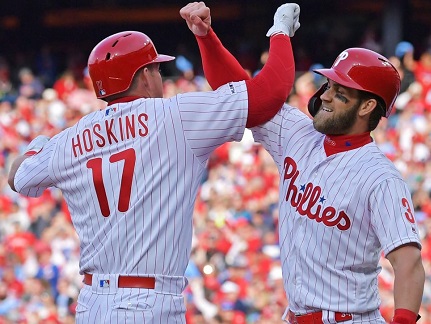
Moments after he celebrated Bryce Harper’s (right) Sunday afternoon ICBM, Rhys Hoskins (left) took one for the team en route the Phillies’ opening weekend sweep.

“It really pisses me off,” Phillies manager Gabe Kapler said Sunday afternoon, “when balls go underneath Rhys Hoskins’s chin.” Especially when the only thing Hoskins did to deserve one was to bat in the Phillies’ lineup behind Bryce Harper.

Harper’s mammoth home run in the bottom of the seventh off Braves reliever Shane Carle, after he’d spent the earlier part of Sunday’s 5-1 conquest of the Braves walking twice and doubling once, got Hoskins drilled after he’d fouled off the first pitch from Carle.

That first pitch was down the pipe. The second pitch crossed the plate head high and nailed Hoskins in the shoulder after he turned to avoid having his head torn off. Even on a sub-50 degree evening when, as Phillies pitcher Jake Arrieta said, it was like trying to grip a cue ball, a batter getting drilled almost immediately after another batter goes long distance is suspect.

All Harper did was linger just a few seconds after he swung before running out the leadoff blast that landed almost in the rear end of the lower right field seats. Maybe what happened after he crossed the plate stuck a bug in the Braves.

These Phillies are an exuberant bunch. They take Harper’s mantra from 2016, “Make Baseball Fun Again,” seriously. They don’t just shake hands or bump or lock elbows when celebrating a buddy’s big hit, they have routines that include comic pantomimes.

Including but not limited to Harper and Andrew McCutchen buttoning up imaginary suits. Or Harper and Mikael Franco channeling their inner Usain Bolts and shooting imaginary arrows in the sky. Or assorted nutty handshakes. Or Harper and Hoskins’ elbow lock after Harper’s Sunday ICBM.

They’re baseball’s version of An Evening at the Improv when life is good and the Phun Phillies win. And if the other guys think it’s about as funny as a screen door on a submarine? Hoskins himself had one answer: “Don’t give up the home run, then.”

The good news is that Carle’s would-have-been decapitation wasn’t a three-season-delayed response to a postseason home run. Hunter Strickland, then with the Giants but now with the Mariners, thought of that when he drilled Harper in the hip in a May 2017 game—over a pair of blasts Harper’d hit off Strickland in the 2014 National League division series.

The second of those blasts sailed so straight above the foul line that Harper waited until he was dead last certain it would be called fair. It was—and it landed in McCovey’s Cove behind Oracle Park. (Oops—it was called AT&T Park then.) No matter. The only thing more astonishing than the blast itself was Strickland not facing Harper again until three seasons later and letting him have it.

The bad news is that nobody can prove for dead last certain whether Carle was trying to assassinate Hoskins but everyone can agree on one thing: it’s terrible optics when you’ve been taken to the last station on the downtown subway and you drill the next man up in the lineup. Especially at the end of a set in which Hoskins was brushed back a few times.

That’s probably what hit the mind of plate umpire Rob Drake when he tossed Carle without hesitation after Hoskins took it off the left shoulder. Brian McCann, the veteran catcher who’s returned to the Braves this season, pleaded in vain for his man. Considering McCann’s history of lecturing players on the spot about the Sacred Unwritten Rules, this was like Bonnie and Clyde acting as character witnesses for Ma Barker.

On the other hand, this might have been slightly out of character for the Braves. As Atlanta Journal-Constitution writer Mark Bradley observes, “[S]eeing Harper do anything good really irks the Braves. Usually, though, they just throw at him.”

But then there was Braves manager Brian Snitker. “He lost the ball, and unfortunately it hit him. I hate that,” Snitker said of Carle. “Umpire had to do what he thought he had to do, but there’s no way in hell that he’s trying to send a message or anything like that. The ball just got away.”

So, apparently, did the optics. And watching a replay of the pitch several times, Carle was trying to throw up to the attic and into it if Hoskins hadn’t done the twist upon final approach.

The National League East was supposed to be a dogfight this season, right? Well, the four top dogs squared off among themselves to open the season. And one of them is undefeated so far while the other is the Show’s only club without a win to open their season.

The Mets took two out of three from the Nationals, and the Nats at least showed some life after a few Opening Day malpractises to win Sunday with a little help from a pocketful of Met mistakes. The Phillies swept the Braves and, as good as you suspected the Phillies would really be, this sweep felt almost like watching an F-22 shoot down a Douglas DC-3.

The Phillies out-scored the Braves 23-11 on the set. The bullpen was a collection of calves with Carle himself appearing twice and showing a 27.00 ERA for his effort; they haven’t blown any saves but, as Bradley rather cruelly noted, “They haven’t had a save to blow.”

Julio Teheran started Opening Day and surrendered “his usual” (Bradley’s term) first inning bomb, this one to the Phillies’ freshly imported Andrew McCutchen batting leadoff. The Braves’ import Josh Donaldson, on the comeback trail, spent the opening set going 1-for-11.

Harper, the Phillies’ $335 million dollar man, and one who’s going to become a father for the first time in August, spent the opening set going 3-for-9 with all three of his hits for extra bases while taking three walks, one intentional. And every Phillies regular except for catcher Odubel Herrera had at least two hits to open the season. Not to mention Aaron Nola pitching like Aaron Nola on Opening Day and Arrieta, despite not having quite his best, having enough to make it count Sunday night.

The Braves? Only four of their regulars have more than a single hit to open the season. They have only five extra base hits so far, and while seven RBI might impressive any other series those came against those score-happy Phillies. The Braves’ pitching finished the weekend with an 8.63 team ERA next to the Phillies’ 3.67. The Braves surrendered eight home runs; the Phillies, in the National League’s arguable friendliest hitters’ park this side of Wrigley Field, three.

Now of course one weekend doesn’t make a full season, and the other big fish in baseball’s river didn’t look too good opening weekend either. We have the Red Sox, the Cubs, the Indians, the Astros, the Yankees, the Cardinals, and the Nats sitting 1-2. If you’re handing out the prize for the most embarrassing 1-2 of the lot, hand it to the Empire Emeritus: they went 1-2 against the Orioles—the Orioles.

But last year’s Braves never saw a single day below .500. This year’s opened the season under it. Last year’s Mariners never saw a single day below .500, either. This year’s opened their season 5-1 beginning with that jaunt to Japan. (Want some real embarrassment? The Marlins, of all people, opened the season at .500.)

The Mariners didn’t sit on their third-place, never-below-.500 laurels. The Braves couldn’t really afford to sit on their surprise NL East title laurels, but now they need to spend a little more time solving the problems that came in the wake of general manager Alex Anthopolous’s less-than-stellar off-season and a little less time avenging mammoth home runs by punishing the innocent next up.

Because the Phillies are a solid team. They finished opening weekend as the Show’s only undefeated team so far. And they have fun being a team. The Braves aren’t a disaster waiting to happen just yet, but opening weekend wasn’t exactly a rescue attempt. And, yes, this game’s supposed to be fun, the unwritten rules be damned.

But even the most fun fellow on the field will grant that the Braves won’t have an awful lot of fun if they don’t solidify. And soon. The season is long, but it often has a way of turning into a bullet train if your eyes are wide shut.

And guess who play each other sixteen more times the rest of the season? Don’t think for one minute that the Phillies won’t be watching very carefully. “If it happens, it happens,” Hoskins said about further reprises of Sunday’s rough stuff. “It will get taken care of.” Just as long as the NL East dogfight doesn’t turn into gang war.
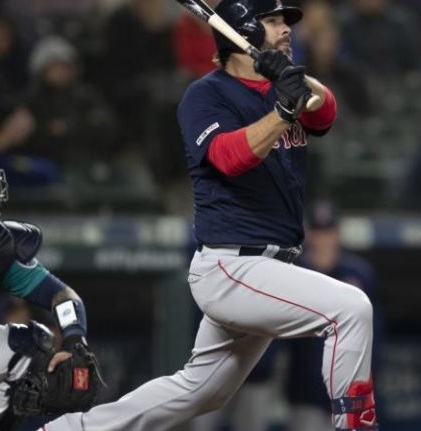
Swing along with Mitch

2019-03-30 MitchMoreland.jpg

Mitch Moreland—two three-run homers in back-to-back pinch hitting assignments a mere five months apart.

Before Friday night, Mitch Moreland was last seen pinch hitting in Game Four of the World Series. With his Red Sox down 4-0 in the top of the seventh in Dodger Stadium, pinch hitting for Matt Barnes. And, hitting a three-run homer about half way up the right field bleachers off Ryan Madson, pulling the Red Sox to within a run in a game they’d end up winning, 9-6.

After Friday night, you might be forgiven if you think team advance scouts begin re-editing their books to advise pitching staffs not to even think about letting the Red Sox land in a position to pinch hit with Moreland with two on. If any teams are still running kangaroo courts in their clubhouses, the fines may go up if Moreland’s allowed to keep this up.

Because there he was in Safeco Field, facing Hunter Strickland, a newly minted Mariner who’s been known to surrender a long ball or three since his years with the Giants. Pinch hitting in the top of the ninth for Christian Vasquez, who’d struck long in the top of the eighth, pulling the Red Sox to within two of tying. After spending the previous three innings in the tunnels loosening up just in case, since he doesn’t start against lefthanded pitchers.

Strickland already looked shaky as it was. He fought shoulder tightness during his turn, surrendering a leadoff double to Rafael Devers and watching Devers take third when Mariners catcher Omar Narvaez lost the handle on a fastball, before hitting pinch hitter Blake Swihart with a pitch but escaping disaster temporarily when Jackie Bradley, Jr.’s grounder to first was thrown home to nail Devers at the plate.

Out to the plate came Moreland with first and second. Two balls later, down the pipe came Strickland’s two-seamer and over the right field fence Moreland hit it on a high line. Making it 7-6, Red Sox, which held for the win when Barnes, for whom Moreland hit so memorably in Game Four, rid himself of the Mariners quickly on an inning-opening ground out and back-to-back strikeouts.

“When you get to that situation or think you might be in it,” said Moreland to reporters after the game, “you try to prepare the best you can and be ready for it when it comes.” Yeah, nothing to it, folks. So what’s with this coming off the bench late and hitting them out with men on base anyway, Mitch? “Yeah, I hit it pretty hard. It felt pretty good.”

C’mon, Mitch. You know how many guys who pinch-hit three-run homers back-to-back five months apart with the first one starting a World Series comeback?

“Yeah, that always helps, I guess, to be in that situation,” Moreland said. “The more preparation you can get and experience you’ve gotten with it, the better you can prepare. Obviously it’s a little bit different. But yeah, still, all the same, you’re trying to go up there and do your job.” Right. Just another night at the office.

Moreland would rather talk about the Red Sox bullpen, which has looked better than their starters over their season’s first two games. “The bullpen did a great job,” he told the Boston Herald. “The offense kept scratching back and creating opportunities. It gave us that chance to win. We’re feeling good right now ready to go tomorrow.”

Red Sox manager Alex Cora still isn’t going to name an official closer from most indications. Done walking the tightropes with Craig Kimbrel, who still hasn’t found a new employer, the Red Sox decided to try the committee approach without quite calling it that. Barnes’s finish followed perfect innings from Brandon Workman in the seventh and, striking out the side, Brian Johnson in the eighth.

The Mariners led 6-1 at one point and had their sharp-looking rookie starter Yusei Kikuchi primed for the win, striking out five and keeping any Red Sox damage to a pair of earned runs on four hits, two of which happened to be home runs from Xander Bogaerts and J.D. Martinez.

But after being destroyed by the Mariners in the Red Sox’s season opener in Seattle, the Olde Towne Team and defending world champions for the fourth time this century had no intention of letting the Mariners drop another safe on them from the twelfth floor.

The Mariners threw the dice and sent their excellent closer Edwin Diaz to the Mets in the deal that also took second baseman Robinson Cano’s contract off their hands and freed up some much needed financial room. But after sweeping the Athletics in the season-opening set in Japan and burying the Red Sox Thursday, the Mariners pen looks like a big question mark.

Zac Rosscup, a lefthander who spent most of 2018 on the shelf with finger and calf injuries, escaped disaster in the seventh when he relieved Festa with one on and two out, overcoming a wild pitch allowing Travis to second by striking Bradley out swinging. But he opened the top of the eighth 2-0 on Vasquez before feeding the Red Sox catcher a fastball so well placed in the middle of the plate Vasquez would have faced a kangaroo court fine if he didn’t send it over the left field fence.

All this on a night the Mariners first looked like they’d have a re-run of Thursday night at Nathan Eovaldi’s expense. The postseason hero whose magnificent turn in the eighteen-inning Game Three marathon probably saved the Series by saving the bullpen for the Red Sox, despite losing on Max Muncy’s game-ending eighteenth-inning homer, picked the wrong night to show up only human and prone to multiple long distance charges.

Eovaldi surrendered solo bombs over the first three innings, to Mallex Smith and Domingo Santana in the first and to Narvaez in the third, before being dismantled in the fourth on an RBI double and back-to-back sacrifice flies. He eked his way through five innings but turned it over to the Red Sox pen in the hole, 6-3.

Then Vasquez closed the deficit to two, Moreland came up from the tunnels to strike, the first Red Sox pinch hitter to hit a go-ahead bomb in the ninth or later since Mike Carp in 2013, and the twelfth in team history to do it. And just like that the Red Sox were back to .500. With a long road to travel yet.

And if you think the Red Sox will avoid weirdness, you didn’t see what happened in the eighth after Vasquez’s bomb. One out, the bases loaded, and Eduardo Nunez at the plate. Nunez hit one rolling slowly up the first base line. Mariners reliever Cory Gearrin, who’d taken over for Rosscup, ran and grabbed the ball on the line and fired home to bag Andrew Benintendi at the plate.

Nunez froze and ducked in front of Gearrin, perhaps thinking the last thing he needed was to have his head taken off by the throw, though Gearrin didn’t quite have to throw it through Nunez. Nunez rejecting potential decapitation enabled Narvaez to throw on to first to finish the jam-escaping double play.

“It’s such a freak play. I’ve never seen it in my life,” Cora said after the game. “It just happened to look that way. It looked bad and probably people are talking about it, tweeting about it, but I bet anybody who’s here would have done the same thing.”

No worries. Nunez and Cora kept their heads. Leaving room for Moreland  and Barnes to make it all freakishly elementary in the end, anyway.

Goldstrike

2019-03-29 PaulGoldschmidt

Paul Goldschmidt hitting the second of his three Friday night bombs . . .

Going 0-for-3 on Opening Day embarrasses lesser players than Paul Goldschmidt. But not many of them atone for it the way Goldschmidt did Friday night.

There’s nothing like a three-bomb night to make a newly-minted, newly-extended, $130 million Cardinal feel as though he’s right where he belongs after all those years it was sworn he was wedded to Phoenix for life.

The franchise face the Diamondbacks could no longer afford became a Cardinal in a December trade that cost the Cardinals Luke Weaver, Carson Kelly, Andy Young, and a competitive-balance pick. Goldschmidt premiered with three strikeouts and a walk against the defending National League Central champion Brewers. Not exactly the way even the modest Goldschmidt wanted to take his bow.

So naturally he faced Freddy Peralta with one aboard and nobody out in the top of the first, wrestled to a tenth pitch, then drove the down-and-in fastball off the rim of the middle level behind the left field bullpen. Then, after the Cardinals and the Brewers took turns abusing each other’s starting pitchers, Peralta and Joe Flaherty, Goldschmidt opened the top of the sixth against reliever Taylor Williams. This time he only needed eight pitches to send a full-count slider that climbed over the middle of the plate into those middle level seats.

That one broke a four-all tie. And to think Goldschmidt wasn’t even close to finished. Top of the seventh, Matt Carpenter singling home Kolten Wong with two out, and up stepped Goldschmidt again, this time against Jacob Barnes. And into the seats behind the Club Goodwill sign above the left center field fence went the sixth-pitch slider behaving very close to the one Williams threw Goldschmidt.

Guess the man was just a little impatient to make it 8-4.

Maybe the least surprising part of the night was Goldschmidt batting in the top of the eighth and Brewers manager Craig Counsell taking no chances with first base open and a leadoff double from pinch-hitter Tyler O’Neill. Counsell ordered Brewers reliever Chase Anderson to yield the free pass. And Anderson managed to strike out the side around the threat.

Then Jordan Hicks got rid of the Brewers in a hurry in the bottom of the ninth, with two swinging strikeouts and a fly out to center that wasn’t dispatched quite so electrically as the Brewers’ Lorenzo Cain stole a homer from Jose Martinez in the first game of the set. And the Cardinals banked a 9-5 win with a gold gilt edge.

Goldschmidt entering Friday night’s game had 42 percent of his hits go for extra bases lifetime, and he took a lifetime .595 real batting average (total bases, walks, and sacrifices divided by plate appearances) into the game. Friday was the second time in his career he cleared the fences three times in a game. As if that wasn’t enough, Goldschmidt beat out an infield hit with two out in the second but found himself stranded.

Clearly he wasn’t going to let that happen again if he could help it.

“There are times when you’re going to struggle,” said Goldschmidt when it was all over, referring partially to his Opening Day collar. “Sometimes you have success. I can’t really explain it. I pretty much try to do the same thing every day. Sometimes it works out, sometimes it doesn’t.”

That’s like saying sometimes you make a killing drilling oil and sometimes you take a dry bath. But when it’s come to hitting in Miller Park, Goldschmidt is an oil baron. In 22 games there before this season, Goldschmidt’s slash line is .407/.491/.780. (1.271 OPS.) By about a hundred nautical miles that’s his best performance in any road park in which he’s played 20 games or more.

Don’t ask him to explain it. He can’t. “I’m not sure,” he replied when asked about it. “I just try to have good at-bats. I don’t really have an answer for you. If the at-bats are good, you can have success. But that can change pretty quickly.”

The arguable best first baseman in the National League made the Miller Park audience anything but appreciative of him fattening his percentages at their defending division champs’ expense. They’d probably want to measure him for a noose if told about his career papers in the park before Friday night.

They also had even less appreciation for Goldschmidt’s defense, since he started a nasty double play end the sixth by smothering Yasmani Grandal’s rip up the line, throwing on to second swiftly for an out and then taking the return throw just in time for the side.

Even if defending National League Most Valuable Player Christian Yelich ruined Andrew Miller’s Cardinals debut with a leadoff bomb in the bottom of the eighth. Even if they had the pleasure of former MVP Ryan Braun tying things at three in the third when, after Flaherty faltered enough to let Lorenzo Cain beat out a base hit back to the box and walk Yelich on four straight pitches, the Cardinal starter threw Braun a slider catching too much of the middle of the plate and Braun sent it over the left center field fence.

For the Brewers the loss amounted to making a bad situation worse: earlier Friday they learned relief ace Corey Knebel would be gone for the season, undergoing Tommy John surgery to repair a torn ulnar ligament—after hearing every medical opinion he could solicit tell him better to get the procedure than take the chance of rehabbing without it.

Goldschmidt missed becoming the nineteenth player to hit four out in a game, but it didn’t stop him from entering the history books. He’s the first in the Show ever to hit three bombs in either his first or his second game with a team. And he hit the first two on the night on full counts while not letting the count get quite that far when teeing off the third time.

He’s not normally a great full-count hitter—he took a lifetime .239 batting average on full counts into this season—but he’s made it count when connecting in one, since he also took an .896 OPS on full counts into Friday night’s game.

On Friday night, that was destruction just a little too full for the Brewers, who must be thinking that the NL Central’s road may go through them this year but the others won’t be that easy to leave behind. The new Cardinal made sure they got the message that his new mates don’t plan on being left behind, either.


Ah, this was Opening Day . . .

LDN-L-DODGER-OPENER-0329-DC

The pre-game Opening Day fireworks at Dodger Stadium were nothing compared to the ones the Dodgers would explode at the expense of old buddy Zack Greinke and the Diamondbacks.

Baseball kicked off in full Thursday after a winter and spring of free agency discontent, a rash of lucrative contract extensions for still-under-control players, and a few controversies involving service-time manipulations. Not to mention an experiment with several proposed rule changes through an independent league, some of which may enhance the game and some of which may compromise it.

And all of that fell out of a lot of minds on Opening Day thanks to a lot of things happening on the fields, including but not limited to:

* The Dodgers, smashing five home runs in the first six innings then three in the seventh, including Enrique Hernandez and Joc Pederson homering twice, former Dodger Zack Greinke getting chased in the fourth inning, and the Dodger homers setting a major league record for Opening Day formerly held by the Mets (six in 1988) and the White Sox (six last year).

And that was on the first Opening Day without Clayton Kershaw on the mound since 2010. Oh, yes—they beat the Diamondbacks, 12-5. The other Dodger destroyers: Corey Seager, Austin Barnes, Max Muncy (he who ended the World Series’ Game Three marathon with an eighteenth-inning blast), and Cody Bellinger.

* The duel of the Cy Young Award winners in Washington—defending incumbent Jacob deGrom and previous three-time winner Max Scherzer. DeGrom punched out ten in six innings’ work; Scherzer punched out twelve in seven and two-thirds. The problem turned out to be newly-installed Met Robinson Cano: he hit one out in his first Met at-bat, consummated an unusual 5-4-2-5 double play when he threw home as Nats rook Victor Robles tried to score after hesitating and ended up tagged out, and rapped an RBI single off Nats reliever Justin Miller thought the run was hung onto Scherzer’s jacket.

Cano was all the run production the Mets needed. “That’s what happens,” said the Nats’s Adam Eaton, “when two Cy Young winners go head-to-head.” Opening Day wasn’t even two hours and forty-four minutes long and already the National League East started looking like a dogfight.

* The Phillies and the Braves did their part to show it, even if the Phillies’ brand new, $330 million dollar former Nat didn’t have that big a hand in it. Bryce Harper struck out twice and walked twice, but the second walk ended up hitting where it hurt—the Braves put him on to load the bases for Rhys Hoskins after a pair of Atlanta errors set up second and third and left a base open in the bottom of the seventh. And Hoskins hit one over the left field fence.

The Phillies banked a 10-4 win in which they showed themselves dangerous as a whole team. Even veteran Andrew McCutchen, whom they signed to a three-year deal as a free agent, pitched in when he opened the bottom of the first with a 2-0 launch over the center field fence off the Braves’ starter Julio Tehran. This was on a day when Aaron Nola was walking a little on the wild side—as in, five walks in six innings, which was one more than he walked in any 2018 start.

* Another Cy Young Award duel happened in Florida, between last year’s winner and runner-up in the American League, the runner-up just so happening to have a Cy Young Award (2011) in his trophy case as it was. This time, Justin Verlander shook off a leadoff bomb by Austin Meadows, battened down the hatches, and flattened Blake Snell and the Rays on three hits total to help the Astros beat them, 5-1.

George Springer really flattened Snell with a three-run homer in the third, but Verlander wasn’t going to let Meadows knock him out. “I just hit the reset button real quick,” Verlander said. “It’s not something you want to do, to lead off the year with a homer. But I’ve done it before, so it was let’s go turn the page and try to find it.” When you been-there/done-that, it’s an awful lot easier to shake away such leadoff rudeness.

2019-03-29 FrankRobinson

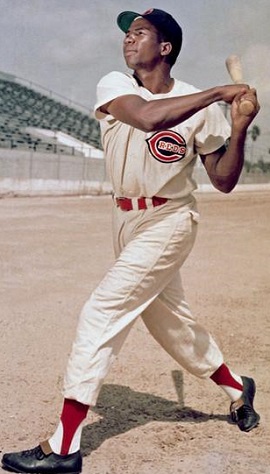
The Reds paid a pre-game video tribute to Hall of Famer Frank Robinson, who died in February and remains the Reds’ all-time greatest position player.

* The Padres rolled against the trend and put touted Fernando Tatis, Jr. on their roster instead of forcing him into yet another service-time manipulation. Their reward was Tatis having a 2-for-3 day including a base hit in his first Show at-bat, making him the youngest to have an Opening Day multihit game since Hall of Famer Robin Yount—in 1975.

His reward was the Padres beating Madison Bumgarner and the Giants, 2-0, even without their own new $300 million man Manny Machado wielding the big bat. That belonged to Wil Myers doing his own Robinson Cano: a two-out bomb off Bumgarner in the third, and an RBI single in the sixth. Good enough to put the Padres above .500 for the first time since 2015.

* Mike Trout, the Angels’ $426 million franchise face, had the best day of any of the half-billionaires with a 1-for-3 with a walk while managing to scare the hell out of Angel fans when he turned up with a leg cramp after a hard slide into second base in the eighth, that following a fourth-inning slide into the same base following a leadoff walk.

The good news: Trout says he’s not seriously hurt despite the “raspberry” he incurred on one of the slides. The bad news, for Angel fans: Khris Davis homering twice, Marcus Semien homering once, and the Athletics beating the Angels 4-0 to shake off the pair they lost to the Mariners in Japan.

* The Mariners may want to open seasons in Japan for a long time to come. Not only did they sweep the A’s in that set, they came home to tear the defending World Series champion Red Sox apart, 12-4—destroying Chris Sale in three innings while they were at it, including three home runs, two by Tim Beckham breaking a personal 0-for-15 lifetime against Sale before teeing off.

And that was after Sale struck out the side in the first before starting the second with a 2-0 lead. “I’m going out there in the second inning, and I pretty much deflated us,” said the man who struck out the side to finish the Red Sox’s fourth World Series triumph of the century. “Three runs, it’s a one-run ballgame, anything can happen and I just go out there and stink the place up. That’s not what I needed to do.”

The Red Sox probably didn’t need to rest Sale for just about all spring training, either.

* 12-4 was also the way the Cubs destroyed the Rangers Thursday. And moving to shortstop (until suspended Addison Russell returns) while hitting cleanup didn’t exactly seem to bother Javier Baez, either: he smashed a pair of home runs including a three-run blast on the first pitch of the fifth from Rangers reliever Jesse Chavez and a solo shot off Mike Minor an inning earlier.

It was all good enough to give Cubs starter Jon Lester his first Opening Day win since he was a Red Sox in 2013—and the Red Sox won the World Series that year. As for the Rangers, Elvis Andrus and Nomar Mazara each hit a two-run homer to account for all the Ranger scoring on the day. It wasn’t enough on a day the Cubs got at least one hit from everyone in the lineup except Willson Contreras and pinch-hitter Daniel Descalso and had thirteen hits on the day.

* One game went to extra innings and, believe it or not, the otherwise hapless Tigers won it, 2-0. On a day Jordan Zimmermann took a perfect game into the seventh—the longest Opening Day perfect game bid since Hall of Famer Lefty Grove threw seven perfect for the Red Sox against the Washington Senators. And that was the same day fellow Hall of Famer Bob Feller threw baseball’s only Opening Day no-hitter at the White Sox.

The perfecto was ruined when Teoscar Hernandez beat out a grounder to the left side of second base and Tigers second baseman Josh Harrison had to slide to stop it before throwing. But on a day three Blue Jays pitchers struck out seven straight Tigers at one point—starter Marcus Stroman (one) to end the seventh, then relievers Joe Biagini and Ken Giles striking out the side in the eighth and the ninth—the game was sealed when Christin Stewart smashed a two-run homer in the tenth to hand the win to Victor Alcantara and the save to Shane Greene.

It was the Tigers’ seventh Opening Day win in eight seasons and the Blue Jays’ eighth straight Opening Day loss.

* Wait till next year? The Jays can take heart: they’re not liable to have the kind of season the Orioles are, after last year’s disaster and an Opening Day 7-2 loss to the Yankees. Or the Marlins, who lost 6-3 to the Rockies. Maybe for the Orioles and the Marlins this year is next year.

* They talked a lot this spring about the new-look Reds after several rather gutsy off-season moves. The talk may ramp up a bit after the Reds knocked off the Pirates, 5-3, and the major damage was done by the reserves: Jose Iglesias doubling twice and driving one in, and pinch-hitting Derek Dietrich hitting a three-run homer in the seventh after Jose Peraza homered.

It kicked off the 150th anniversary of the Reds as a franchise, the 100th anniversary of their first World Series triumph, and it began with a sober tribute to Hall of Famer Frank Robinson, who began his career with the Reds (and remains their all-time greatest position player) and died at 83 in February.

Somewhere from the Elysian Fields where he now reposes (and probably presides over a kangaroo court), Robinson must have smiled on the largest regular-season crowd in the history of the Reds’ Great American Ballpark.

Rants and ruin for the ’69 Cubs

2019-03-27 DonYoung

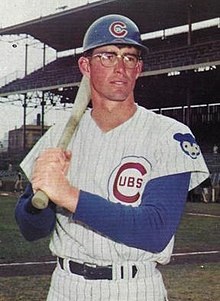
Don Young—two misplayed balls on 8 July 1969 triggered the postgame tirades that may have begun wrecking the 1969 Cubs.

While reading Wayne Coffey’s They Said It Couldn’t Be Done, the best book you’ll ever read about the 1969 Mets, I bumped into a jarring quote from 1969 Cubs relief ace Phil (The Vulture) Regan. It may—underline that—hold the opening key to how those Cubs, who looked at first like a National League East runaway, ended up collapsing as the Miracle Mets re-heated in earnest to reach the Promised Land.

On 8 July the Cubs tangled with the Mets in Shea Stadium to open a series and lost a game they led until the ninth inning. How the game was lost, and what two key Cubs said after the game, may have opened disaster’s door. It helped ruin the baseball life of the Cubs’ center fielder on the day, a rookie named Don Young who had an early reputation for being a promising defender with a fine arm. And it may have helped cost the Cubs the postseason.

Young committed two misplays in the bottom of the ninth. Cubs manager Leo Durocher and Hall of Fame third baseman Ron Santo tore into Young in the press after the game. Young himself said, simply, “I lost the game for us. That’s all.” The Vulture was appalled—especially at Santo.

“Don Young was never the same after that,” said Regan, in remarks Coffey reprinted in full in his book. “He showered and left the ballpark as soon as he could get out of there. To this day, you never hear from him. Santo was the captain and a veteran. He apologised later, but it was done. You can’t do that. That hurt us.”

Hall of Famer Ferguson Jenkins got the start against the Mets’ redoubtable lefthander Jerry Koosman. They both went the distance until Koosman was lifted for a pinch hitter to open the bottom of the ninth with the Cubs ahead, 3-1. Jenkins and Koosman first swapped home runs, Ed Kranepool hitting one out in the bottom of the fifth and Hall of Famer Ernie Banks hitting out out in the top of the sixth. But Glenn Beckert drove a run home with a seventh-inning single and former Met Jim Hickman hit a two-out shot in the top of the eighth.

Mets second baseman Ken Boswell, who hadn’t started that day against Jenkins, now pinch hit for Koosman at a point where Jenkins had erased nine consecutive Mets. Boswell skied one to short center field. Young misread the ball at first but rehorsed in a split second and sprinted in, diving and missing as the ball landed in front of him and just away from onrushing Cub middle infielders Beckert and Don Kessinger.

Despite running full tilt on contact, Boswell was surprised to find himself on second with a double. Tommie Agee batted next and fouled out near first base, bringing up another pinch-hitter, Donn Clendenon. The veteran whom the Mets picked up in a deal with the infant Montreal Expos almost a full month earlier drilled one toward the left center field fence. Young turned, gunned it to the warning track, nailed the ball with a staggering on-the-run backhanded snap of his glove . . . and the ball dropped right before Young’s momentum crashed him into the fence with a thud. Leaving the Mets with second and third and one out.

2019-03-27 LeoDurocher

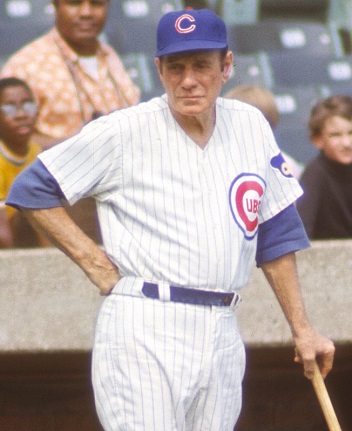
Leo Durocher—disgrace.

Branch Rickey once said Durocher’s genius included his ability to make a bad situation worse immediately. “Two little fly balls,” Durocher fumed after the game. “He just stands there watching one and he gives up on the other. It’s a disgrace. My three-year-old could have caught those balls.”

Durocher’s on-the-record tirade poured out with the hapless Young within clean earshot. The humiliated 23-year-old outfielder finished dressing and high-tailed it out of the clubhouse and the ballpark at once. Santo mistook that for apathy and, when Jerome Holtzman of the Chicago Sun-Times asked whether Santo heard Durocher’s tirade, the third baseman ripped Young a few new ones. On the record.

“He was just thinking about himself, not the team,” Santo steamed about Young. “He had a bad day at bat, so he’s got his head down. He’s worrying about his batting average and not the team. All right, he can keep his head down and he can keep right on going out of sight for all I care. We don’t need that kind of thing.”

Who were those two fools, and which game were they watching? Especially Santo, who’d previously been a mentor to Young, teaching him about the league’s pitchers and assorted outfield differences? It was one thing for the manager to rip a player in the press; however unwise it is, you get the manager doing it. It was something else for a teammate to do it, as Regan understood only too well.

Young did have a bad turn at the plate, going 0-for-4 with a pair of strikeouts in the game. According to David Claerbaut’s Durocher’s Cubs: The Greatest Team That Didn’t Win, Hickman told Santo to settle the rookie down after he’d slammed his bat and helmet after one of those plate appearances, but Santo grabbed Young and ordered him to do his job. So much for settling the rook down.

But Young still had time enough to shake that off, since his last plate appearance was his second strikeout, ending a 1-2-3 top of the eighth. He misread Boswell’s shuttlecock at first in a combination of the afternoon haze and the bright shirts on fans sitting behind the plate—for maybe a second, taking maybe a step and a half back before getting the right read at once and scampering in to try for the ball.

If that’s just standing there watching one, I’m Ray Charles.

But what happened to Young on the Clendenon drive could have happened to any center fielder including Willie Mays. He ran full speed to catch up to the ball and made a backhanded grab on the middle of the warning track. It might have gotten play of the game honours in a heartbeat if, while still on the full run, the ball didn’t fall out of his glove a split second before he crashed the fence like a battering ram.

Just in case Durocher and Santo suffered a deeper brain fart than their postgame comments already indicated, the Mets hadn’t scored yet, and the Cubs—who came into the series with a five-game lead over the upstart Mets—had two outs to go to finish them off on the day, with their best pitcher still working well enough.

The Mets’ hottest bat, left fielder Cleon Jones, was up next. Durocher didn’t want to put Jones aboard to close up the empty base as the potential winning run with Art Shamsky, a lefthanded hitter with power, due up behind Jones. So Jenkins would pitch to Jones, starting him with a curve ball that “got more of the plate than Jenkins wanted,” Coffey writes, and Jones slashed a double to left, tying the game at once.

Jenkins then put Shamsky aboard to pitch to weak hitting Mets infielder Wayne Garrett instead. He got Garrett to ground out to Beckert at second, but the grounder set up second and third again. Two outs and Kranepool, another lefthanded hitter and the last remaining Original Met, was next. Mets catcher J.C. Martin, a lefthanded hitter with an oh-so-sterling .258 on-base percentage to that point, and whose 1969 batting average against righthanders was lower than that against lefthanders, was due up after Kranepool.

With the winning run already aboard, Durocher could have put Kranepool on and gotten the advantage of Martin’s reverse split. But he let Jenkins pitch to Kranepool. And at first it looked like Jenkins would have the best of it, getting ahead of Kranepool 1-2 on a diet of breaking balls at the outer edges. Knowing he wouldn’t see a proper strike, Kranepool got what he expected, another off-speed pitch away.

2019-03-27 RonSanto

When not ripping a hapless teammate after max-effort misplays, Ron Santo’s heel-clickings after Cub wins made him the most frequent Cub target for retaliatory brushback pitches.

With Jones running from third on contact Kranepool reached for the pitch and lofted it on a soft line over shortstop. Kessinger chased it into supremely short left field but couldn’t reach it. The ball hit the grass. Jones hit the plate running. Shea Stadium exploded after the 4-3 win the Mets all but embezzled out of the Cubs. Nobody heard Durocher thundering that his three-year-old could have gotten to Kranepool’s quail.

All hell broke loose after midnight that night when, Clarebaut related, a friend of Santo’s rang his New York hotel room around 3 a.m. to tell him the Sun-Times let him have it over his public criticism of Young. Santo was no shrinking violet: he called a press conference for the next afternoon and apologised.

It was more than the hapless Young got from Durocher, which was nothing. Durocher never mentioned the game in the chapter on those Cubs in his memoir Nice Guys Finish Last.

Still claiming Young’s day at the plate got into his head in the field, Santo added, “I know this is true because it has happened to me. I have fought myself when I wasn’t hitting and, as a result, messed up in the field. But I know I was wrong. I want everyone to know my complete sincerity in this apology.” Too much, too little, too late.

Santo took a back seat to few for giving Durocher the benefit of the doubt, but even he admitted in due course, “He brought us closer to a pennant than anyone else had in a generation. But he also brought disruption and chaos.”

Indeed. When a writer asked whether he thought about resting some of his regulars, Durocher lost it. He called a team meeting on the spot demanding to know whom among his players were tired—and the players, knowing only too well that Durocher would accuse fatigued and injured players of being quitters, nobody said a word.

And one of the reasons the Mets went the distance was their own completely opposite manager. Gil Hodges played for Durocher in Brooklyn and knew Durocher’s blustery style only too well. He also had an instinct Durocher lacked: he monitored his players’ health judiciously, kept his regulars regular but fresh, kept his bench and role players alert and prepared, and kept the Mets in better shape for their magnificent 44-17 season finish.

If Hodges managed Don Young and thought Young loafed on one fly and gave up on the other, he would have buttonholed Young privately first and asked what happened out there first before rendering a verdict Hodges would never have given in public or with insults at all. If Hodges knew Young gave top effort, he would have reviewed the plays with Young and gotten him to think aloud about improving his readings and jumps on the ball.

If only.

Because when Sports Illustrated caught up to Ernie Banks in 2014, two years before his death, Banks was asked which single moment he thought introduced the poison into the 1969 Cubs’ well. The Hall of Famer whom Leo Durocher disliked upon arrival in Chicago but couldn’t get rid of because he was still the spiritual face of the Cubs didn’t mince words:

They say one apple can spoil the whole barrel, and I saw that. Before going to New York to play the [8 July game] against the Mets, I went to different players on our team and told them, ‘We’re going to New York, and when the game is over, there’s going to be more media than you’ve ever seen in the clubhouse, so watch what you say.’ So we got to New York, and lose the first game. Don Young dropped a fly ball, and that was it. We came into the locker room. I was next to Santo, and he just went crazy. Young was so upset, he ran out. [Coach] Pete [Reiser] had to bring him back. I had never seen something so hurtful.

Banks said the Cubs began falling apart factionally from there. Marry that to burnout, both of the regular players and the pitching staff, including bullpen bull Regan, plus Durocher’s long-lost sense of perspective, and that—after spending enough of the first half looking like they had the National League East in a safe deposit box—was the story of the ’69 Cubs’ collapse. (The Cubs from 1 August-1 October: 27-29.)

Durocher went from bad to worse after that, little by little, until he either quit or was fired during the 1972 season. Santo called it “a turbulent clubhouse mess.” He might have been the Cubs’ winningest post-World War II manager by the time he left, but he also hamstrung the club. The Cubs wouldn’t even see .500+ season results again for another twelve years after Durocher left. You could almost predict Opening Day fans whipping up placards as the first pitch was thrown: “Wait ’till next year!”

Young ended up spending 1970-72 in the minors, his once fine throwing arm betraying him, then left baseball and went on with his life, living free spiritedly and working his way across the country. Every so often he signs photographs, caps, or baseball cards for fans who catch up to him.

Three 1969 Cubs—Banks, Jenkins, and Billy Williams (the only Cub regular who didn’t wilt down the stretch)—ended up in the Hall of Fame. So did two 1969 Mets—Tom Seaver and Nolan Ryan, though Ryan didn’t exactly look like a Hall of Famer at the time despite a few performances showing the potential.

Durocher and Santo also ended up in the Hall of Fame—posthumously. Santo at least had the playing record to justify his election; he was the game’s best all-around third baseman after Eddie Mathews faded and before Mike Schmidt came into his own. He may well have had to wait because, no matter his retirement of charity, popularity as a Cub broadcaster, and lifelong courageous battle against diabetes, he’d been a prickly personality as a player with a number of hassles comparable to if not quite as fateful as the Young incident.*

But we’ve known for almost two decades now, for dead last certain, that Durocher cheated the 1951 Giants into a pennant race comeback that forced the legendary three-game playoff they won. Between that, his single World Series championship in a cumulative 24 years worth of major league managing, and his dessication of a Cubs team that should have finished what they started in 1969, how did he get into Cooperstown?

He was famous? So were Gene Mauch and Fred Hutchinson. So was Gil Hodges. But that trio didn’t have the Lip’s penchant for ingratiating himself with the show business glitterati. Somehow, some people are crazy enough to think that you need more than going on the air any time you please or being Frank Sinatra’s buddy pal to qualify for the Hall of Fame.

The 1969 Cubs settled for being Claerbaut’s “Greatest team that didn’t win.” The 1969 Mets settled for becoming the last but most successful of three 1960s miracle teams. (The others: the 1961 Reds and the 1967 Red Sox, neither of whom won their World Series.) And, the far better side of baseball mythology.


* Santo’s 1969 habit of clicking his heels on the field after Cub wins so annoyed opponents that by his own admission he became the Cubs’ most frequent target for knockdown and retaliation pitches. When Mets coach Joe Pignatano called him “bush!” for it before a game, Santo flipped him the bird. But when exchanging lineup cards with Hodges before that game, as the Cubs’ team captain, Santo pleaded, “Tell Piggy the only reason I click my heels is because the fans will boo me if I don’t.”

Hodges didn’t buy it for a minute. “You remind me of [Mets relief pitcher] Tug McGraw,” the Mets’ skipper replied. “When he was young and immature and nervous, he used to jump up and down too. He doesn’t do it anymore.” And Santo eventually wrote in his memoir, “The rest of the league wasn’t so enthralled. Once they started catching onto my act, the fastballs seemed to get a lot closer to my head. The brushback pitches seemed to come a lot closer to my chin.”

And other places. On 8 September, Cub starter Bill Hands drilled Agee in the bottom of the first and Koosman, not hesitating a single degree, drilled Santo in the wrist in the top of the second. It cost Santo his power for the season; he hit only two more of his 29 home runs the rest of the way, including on closing day 2 October—against the Mets, who could afford the 5-3 loss since they won the NL East by eight games.