The hard-earned honour of Henry Aaron

2019-04-08 HenryAaron715

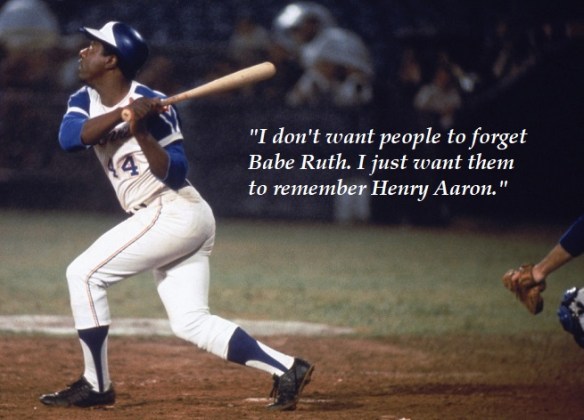
8 April 1974: Henry Aaron, swinging into history.

It really has been forty-five years since Henry Aaron laid waste to Al Downing’s 1-0 service and Babe Ruth’s career home run record. Forty-five years since Milo Hamilton’s immortal holler, through the din of Fulton County Stadium, “There’s a new home run champion of all time, and it’s Henry Aaron!”

Forty-five years since Aaron rounded the bases, accepting handshakes from every Dodger infielder, and plunged into a crowd at home plate that included, somehow, and much to his surprise, his parents. Forty-five years since Vin Scully, the Dodgers’ broadcaster whose team was the victim as Aaron swung into history, purred inimitably:

He means the tying run at the plate now, so we’ll see what Downing does . . . Al at the belt now, and he delivers, low, ball one. And that just adds to the pressure, the crowd booing. Downing has to ignore the sound effects and stay a professional and pitch his game . . . One ball, no strikes, Aaron waiting, the outfield deep and straight away. Fastball — and a high drive into deep left center field, Buckner goes back, to the fence, it is gone!!! . . . (long pause during crowd noise and fireworks) . . .

What a marvelous moment for baseball, what a marvelous moment for Atlanta and the state of Georgia, what a marvelous moment for the country and the world. A black man is getting a standing ovation in the deep South for breaking a record of an all-time baseball idol. And it is a great moment for all of us, and particularly for Henry Aaron, who was met at home plate not only by every member of the Braves, but by his father and mother . . . It is over, at 10 minutes after nine in Atlanta, Georgia, Henry Aaron has eclipsed the mark set by Babe Ruth.

Forty-five years, since the unconscionable pressure of mental cases plying Aaron with hate mail for daring to even think about passing the Sacred Babe; of racists plying him with hate mail and death threats enough to require police and even FBI protection for the unassuming outfielder whose career wasn’t bigness as much as it was sustained excellence.

And, alas, forty-five years, since his own team strove to cheapen a one-time-only achievement by putting the gate ahead of the game.

Aaron entered 1974 needing one homer to tie and one more to pass Ruth. The Braves entered 1974 bent on making damn well sure he could do both before the home audience alone, the Braves’ first homestand due to begin after a season-opening visit to Cincinnati. Boy, wouldn’t that have been great for the gate at the old Launching Pad!

Three New York sportswriters (for the record: Dick Young, the New York Daily News; Dave Anderson, the The New York Times; Larry Merchant, the New York Post) said not so fast, post haste. They denounced the plan without softening their prose or apologizing for their stance, and ramped up a drumbeat on behalf of convincing then-commissioner Bowie Kuhn to thwart  the plan.

Furman Bisher of the Atlanta Journal-Constitution led an equally passionate counterattack and denounced the New York writers as “meddling Manhattan ice-agers” who would do better to demand the cleanup of Times Square before criticizing the sainted Braves one of whom was about to blast the Big Fella out of the books without wearing a uniform from New York.

What the Braves wanted to do hadn’t exactly been unheard of in baseball to that point, alas. When Stan Musial struck toward his 3,000th career hit, the Cardinals were playing the Cubs in Wrigley Field and Musial shot number 2,999 his first time up in the second game of the set. Cardinals manager Fred Hutchinson elected to sit Musial in the final game of the set, with the Cardinals due for a home-stand to follow, unless he needed Musial to pinch hit.

W.C. Heinz, once a New York Sun sportswriter who’d since turned to magazine writing, put it this way to Red Smith (then of the New York Herald-Tribune):

Maybe I’m speaking out of turn, but it seems to me Hutch is sticking his neck out. His team got off to a horrible start and now it’s on a winning streak and he’s got a championship game to play tomorrow, without his best man because of personal considerations. Not that the guy hasn’t earned special consideration, but from a competitive point of view I think it’s wrong. If the Cardinals lose tomorrow, Hutch will be blasted. He’ll be accused of giving less than his best to win and it will be said the club rigged this deliberately for the box office, gambling a game away to build up a big home crowd.

As things turned out, the Cubs were up 3-1, the Cardinals had a man on second, and Hutchinson sent Musial up to pinch hit. Musial hit the sixth pitch of the sequence for an RBI double. Hutchinson lifted him for a pinch-runner; the Cubs stopped the game to pay Musial tribute; and, the Cardinals kept the rally alive and went on to win the game.

Musial was allowed to do it the right way, after all. Back home in Sportsman’s Park the following night, Musial got an elongated standing O from the home audience and thanked them with a drive over the right field pavilion.

Smith would have something to say, too, when Kuhn stepped in and ordered the Braves not to even think about sending out a lineup lacking Aaron:

He explained to [Bill] Bartholomay what self-interest should have told the Braves’ owner, that it is imperative that every team present its strongest lineup every day in an honest effort to win, and that the customers must believe the strongest lineup is being used for that purpose. When Bartholomay persisted in his determination to dragoon the living Aaron and the dead Ruth as shills to sell tickets in Atlanta, the commissioner laid down the law. With a man like Henry swinging for him, that’s all he had to do.
2019-04-08 EstellaAaronHenryAaron

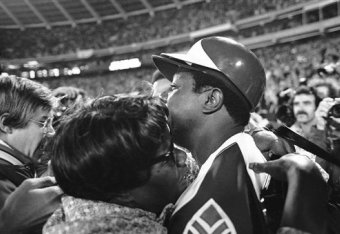
Estella Aaron made bloody certain her baby wouldn’t make history without a hug and kiss from Mom.

Thus did Aaron appear in the Opening Day lineup against Jack Billingham, a Reds pitcher against whom he’d already had four home runs lifetime. Aaron merely drove one over the left field fence in that very first plate appearance to tie Ruth, vindicate Kuhn, Young, Anderson, Merchant, and anyone who believes in honest competition, and receive a pleasant commemoration from Kuhn after he finished rounding the bases.

Braves manager Eddie Mathews, a Hall of Fame third baseman and longtime Aaron teammate as it happens, sat him for the second game of the set, provoking Kuhn to order Mathews to put Aaron back into the lineup for the series closer. Aaron missed fair and square, when the Reds’s Clay Kirby struck him out twice and lured him into a ground out. And home went the Braves.

The first time up against Downing, in the second inning, Aaron walked and scored on an error. Come the fourth, Aaron squared Downing up for the milestone mash. Once a Yankee comer but turned journeyman by a few injuries, Downing earned his living with a fastball that tailed away from right-handed hitters and crawled in on left-handed hitters. This time, it didn’t tail away.

And with one smooth, unadorned, unaffected swing, the ball sailed parabolically into the left center field bullpen.

With the same swing, Aaron demolished all the mental cases, all the racists, and (there were a few) all the baseball Luddites to whom shoving Ruth to one side in the career bomb record books was even more blasphemous than Roger Maris shoving Ruth to one side in the single-season record book thirteen years earlier.

But Aaron also demolished his own team’s shabby pretentiousness and, running four bases, stood foursquare for earning his milestones the old fashioned way. And once he made his way through the home plate crowd of adoring teammates, he got hit with a big kiss on his face from his mother, Estella. “I don’t remember the noise,” Aaron said later.

Or the two kids that ran on the field. My teammates at home plate, I remember seeing them. I remember my mother out there and she hugging me. That’s what I’ll remember more than anything about that home run when I think back on it. I don’t know where she came from, but she was there.

On 8 April 1974 Atlanta, the South, the United States, and the world learned where Henry Aaron came from. To remember how honorably as well as how courageously he got to meet, greet, and pass Ruth would be nothing less than his due.

“I don’t want anybody to forget Babe Ruth,” Aaron said modestly. “I just want them to remember Henry Aaron.” I think he’s gotten his wish a thousandfold.


A different version of this column was published in 2014.—JK.
Pants on Fire: Willie wasn’t stuck by the Stick

0000 PantsOnFire02WillieMays

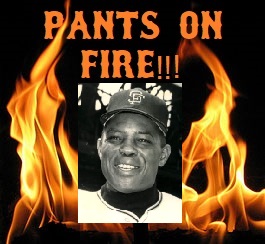
The myth: Candlestick cost Mays buckets of bombs. The truth: otherwise . . .

In 2008, Bob Costas gave Willie Mays and Henry Aaron an hour’s worth of a special joint interview on Costas’s HBO sports program, Costas Now. The mostly amiable discussion yielded only one moment of irritation from either Hall of Famer, when Costas mentioned Aaron hitting 95 more lifetime home runs than Mays hit.

For the only time during the discussion the Say Hey Kid became a little indignant. “But he had much better ballparks to hit ‘em in,” Mays complained. “I must have lost a hundred home runs to my ballparks, especially that wind at Candlestick.”

Alas, to this day you can still bump into fans who buy into Mays’s complaint, which predated by a few decades the Mays/Aaron sit-down with Costas. Just as you can still bump into fans who think selling Babe Ruth, and not incompetent administration plus surrealistic circumstances, turned the Red Sox into baseball’s haunted house for all those decades.

Candlestick Park, the Giants’ home from 1960-1999, was notorious for clashing winds, damp air and fog, and being a particularly chilly ballpark sooner down the stretch than most of the National League’s other parks. Giants players were hardly the only ones to find the joint less than appealing, though nobody noticed the Beatles complaining (even if their fans were heartsick) when they played their last-ever American concert there in 1966.

When Walter O’Malley began planning what became Dodger Stadium, legends include that he obtained a copy of the Candlestick Park blueprints and gave them to his architect with one instruction: “Study these and learn what not to do.” When the original open-back park was enclosed in 1970, the better to accommodate the NFL’s 49ers, it robbed Giant fans of one of their only Candlestick pleasures, a pleasant view of San Francisco Bay.

The Stick earned a few unflattering nicknames during its life—Windlestick, the Quagmire, and the Ashtray by the Bay (hardly as colourful as that attached to the Indians’ old Municipal Stadium: the Mistake on the Lake)—and at least one tragicomic one, when the Loma Prieta earthquake interrupted the 1989 World Series and several wags called the quake-shaking park Wiggly Field.

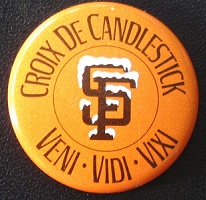
2017-04-07 CroixDeCandlestickThe park’s sour reputation metastasised enough that the Giants themselves finally took to trying to sell the flaws as perverse virtues. They awarded “Croix de Candlestick” pins to fans who went the distance for nighttime extra inning games. The round orange pins featured a frosted Giants cap logo in the center and, circling it, “Croix de Candlestick” at the top and, ad the bottom, Veni, Vidi, Vixi. (“I Came, I Saw, I Survived.”)
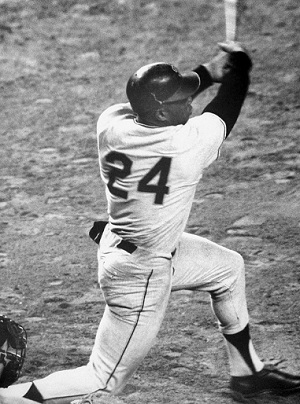
When the Giants began playing there in 1960, following two seasons in ancient little Seals Stadium, after their departure from New York, Willie Mays, too, came, saw, and survived. Rather admirably at that, when all was said and done.

The Hall of Famer played twelve major league seasons with Candlestick Park as his home ballpark and hit 202 of his 660 career home runs in the Stick. But to hear those admirers who continue lamenting he might have passed Babe Ruth on the all-time home run list first, you’d think before seeing the evidence that Mays as a San Francisco Giant couldn’t wait to get out of town at every last available moment.

You’d gotten the same impression from Mays himself, even before the Costas discussion, if you read such comments as these from the 1966 memoir (My Life In and Out of Baseball) he co-authored with Charles Einstein:

Hell, Candlestick was too big. First day I ever came to bat there, in hitting practice the day before the ’60 season opened, it was windy and raw, and whoever was pitching threw me a fat slider and I swung and looked and I was holding just the thin handle of the bat in my hand. The ball had sawed my bat in two!

Oho, but right after that Mays said this:

They made changes the following year, bringing the fences in and putting up a green backdrop behind center field so the hitters could see the ball better, which was important because the Giants play more day games than any other team except the Cubs, who have no lights in their park.

When Candlestick opened for the 1960 season the fences were quite deep and challenging to even the most ballistic power hitters, and the Giants did bring the fences in a bit for 1961. Life got a little easier for Mays and the Giants’ other power hitters such as Hall of Famers Willie McCovey and Orlando Cepeda.

But maybe you’re still not convinced. You need evidence, which I’m more than happy to provide. Here is a table that tells you exactly how Willie Mays hit for power at home and on the road during the twelve seasons Candlestick was his home. The black ink shows when he was better at home:

   Mays in Candlestick Park Mays On the Road  Road HR Diff
  HR OBP SLG OPS HR OBP SLG OPS  
1960 12 .366 .509 .875 17 .395 .596 .990 +5
1961 21 .384 .582 .965 19 .402 .586 .988 -2
1962 28 .408 .683 1.091 21 .360 .548 .908 -7
1963 20 .398 .622 1.021 18 .363 .545 .908 -2
1964 25 .405 .656 1.061 22 .362 .565 .927 -3
1965 24 .400 .640 1.040 28 .396 .650 1.046 +4
1966 16 .359 .556 .917 21 .375 .555 .929 +5
1967 13 .331 .472 .803 9 .337 .435 .772 -4
1968 12 .370 .496 .865 11 .374 .480 .854 -1
1969 7 .361 .432 .793 6 .362 .441 .802 -1
1970 15 .393 .518 .911 13 .388 .496 .884 -2
1971 9 .453 .518 .971 9 .401 .451 .852
TOTAL 202 194  
SEASON AVG. 17 16  

Mays was better on the road than at home in 1960, but then came the fence change at the Stick. And for the eleven seasons to follow, Mays was a little more powerful at the Stick eight times and dead even between home and the road once. Not to mention that, cumulatively, he hit eight more home runs at the Stick than he hit on the road when the Stick was home.

2019-04-07 WillieMays500thHomeRun

Mays, hitting the 500th of his 660 career home runs. He hit it in one of the National League’s actual worst hitting parks, too—the Astrodome.

Willie also had a better on-base percentage at home in half his Candlestick seasons and a better home slugging percentage eight times. Seven times his OPS (on base percentage plus slugging percentage) was better at the Stick. Not to mention that he achieved a 1.000+ OPS four times at the Stick . . . but only once on the road in the same seasons.

Go ahead, ask: If Candlestick Park really didn’t keep Willie Mays’s home run power that heavily in check no matter how insane its climate conditions, what really kept him from beating Henry Aaron to Babe Ruth’s punch?

As Groucho Marx once said, it’s so simple that a child of five could understand it—now, somebody send for a child of five. Well, I don’t have a child of five (my son is 25), so you’ll have to settle for me. But it is that simple: the Army. And, the Polo Grounds.

Mays won the National League’s Rookie of the Year award in 1951, and he got to play only 34 games in 1952 when he was inducted into the Army at age 21. He missed the rest of the 1952 season and the whole of the 1953 season. It’s not unreasonable to suggest that his Army service cost Mays 60+ home runs, which would have been enough to put him past Ruth first.

But I think I know what you’re thinking if you remember the place: The Polo Grounds? With those yummy short foul lines? So let’s have a look at Mays the New York Giant, leaving out his aborted 1952 season, with the black ink showing likewise where he was better at home:

   Mays In the Polo Grounds Mays On the Road  Road HR Diff
  HR OBP SLG OPS HR OBP SLG OPS  
1951 13 .344 .535 .879 7 .364 .410 .774 -6
1954 20 .344 .645 1.059 21 .410 .689 1.099 +1
1955 22 .405 .648 1.053 29 .395 .670 1.065 +7
1956 20 .358 .592 .950 16 .381 .524 .905 -4
1957 17 .424 .624 1.047 18 .393 .627 1.020 -1
TOTAL 92 91        
AVG. 18 18        

In five full seasons with the Polo Grounds as home, Willie Mays hit more home runs on the road in two of the five; he slugged better at home twice and reached base more often at home twice. Yet he hit exactly one more home run in the Polo Grounds than he hit on the road over that entire span, and averaged the same number of bombs at home and on the road give or take a fractional point or two. That’s against hitting eight more in Candlestick Park than on the road during his Stick seasons.

Don’t be surprised that Mays was that close whether at home or on the road in either ballpark; he was virtually the same player on the road as he was at home lifetime. He hit ten more home runs at home; he batted one point higher at home; his on-base percentage was only five points higher at home. Willie Mays didn’t need the home field advantage.

Return for a moment to the season Candlestick opened. The winds weren’t the park’s only issue. Dead center field was 420 feet from the plate; the power alleys in right- and left-center field were 397 feet each; the foul lines were 330 feet (left field) and 335 feet (right field) from home, respectively. Tell me you can’t picture a lot of long fly outs to left- and right-center fields.

That wasn’t exactly a cozy confine for a power hitter. But for 1961 the Giants cut the fences slightly. The foul lines remained the same, but now left center field was 365 feet from the plate, right center field was 375 feet from the plate, and dead center field was 410 feet. And Mays hit nine more homers in the Stick in 1961 than he hit in 1960.

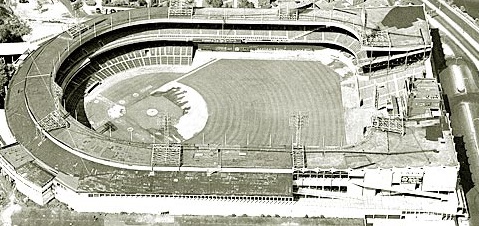
Do you really know or really remember the Polo Grounds? I do both, since I saw the place as a child in 1962 when the Original Mets played there their first two seasons awaiting Shea Stadium’s completion. (I still can’t get over the manner in which the box seats were sectioned—by dangling chains instead of bars.) First, have a look for yourself:

2019-04-07 PoloGroundsAerial

You’re not seeing things. The foul lines were 279 feet from the plate in left field and 258 feet from the plate in right. Left center field was 450 feet from the plate and right center field, 449 feet. Dead center field—extending out between the bleachers and beneath the elevated structure housing the team offices and the clubhouses—was 483 feet. We’re talking about a field that must have looked like the deepest fences moved a little further away every time you checked in at the plate.

(Among other things, now do you get what was so spectacular about Mays’s legendary running catch on the track and throw in off Vic Wertz’s long fly in Game One of the 1954 World Series?)

Willie Mays was most likely kept from passing Babe Ruth first on the all-time career home run list because of both his Army service and playing in the challenge of the Polo Grounds before he ever hit San Francisco. The Polo Grounds didn’t stop him from becoming Willie Mays, of course, but I think the hard evidence says the park didn’t exactly do him that many favours when it came to hitting for distance, either.

San Francisco wasn’t exactly friendly to Mays in his first few years there, either. All the notice he earned in New York with his play and exploits got a chilly reception by the Bay, where Mays himself phrased it best, while remembering how Mickey Mantle got booed in Yankee Stadium: “It wasn’t so much what we were. It was more what we weren’t. Neither one of us was Joe DiMaggio.”

The Giants played two seasons in Seals Stadium, where DiMaggio once shone in center field in the ancient, tough Pacific Coast League, and the memories of DiMaggio before he became the Yankee Clipper remained powerful, especially since DiMaggio was native to the Bay Area and lived there many years after his career ended. No one playing in San Francisco in those years could avoid DiMaggio comparisons.*

Not even Willie Mays. That, plus surprising racial issues such as difficulty finding a renter or realtor who would rent or sell to a black couple (Mays was married to his first wife at the time; the marriage collapsed under her extravagance plunging Mays into debt), and his own manager’s hyperbole (Bill Rigney rashly predicted Mays would break Ruth’s single season home run record), meant Mays playing under pressure he hadn’t experienced since he was a nervous New York rookie.

Perhaps roaming center field and swinging at the plate, Stick or no Stick, provided the best sanctuary from the pressures he felt off the field. After the Giants knocked the Dodgers out of a pennant in a three-game playoff in 1962, that’s when San Francisco began to warm up to Mays even if its ballpark wasn’t warm and too cozy.

But we shouldn’t forget the third reason he couldn’t pass Ruth’s career mark first: age.

Mays’s last truly great season was 1966—when he was 35 years old. Henry Aaron was three years younger. And, also in 1966, the Braves moved to Atlanta and into Fulton County Stadium. Also known as the Launching Pad. Aaron moved from a home park that challenged him to a park that was even better for him than Candlestick Park, for all the kvetching, was for Mays. That was the first time in his career that Aaron got to play his home games in a park like that—after he’d been in the league for twelve seasons.

Mays finished third in the National League’s Most Valuable Player award voting in 1966 and was worth 9.0 wins above a replacement-level player, better than two over his career average and above the minimum that would indicate an MVP-worthy season. He hit his decline phase the following season and stayed there, little by little, heartbreakingly to those who saw him at his peaks, over his final five seasons in the Stick, before he was dealt to the Mets to finish his career in the city that first embraced and loved him.

Aaron, too, was practically the same player on the road as he was at home lifetime. He hit fifteen more homers at home; he batted three points lower; his on-base percentage was ten points higher. And his slugging percentage was five points higher at home. Mays’s lifetime slugging percentage was eighteen points higher at home lifetime.

It’s too easy to understand why Candlestick Park wasn’t even close to being number one on any player’s or fan’s hit parade for baseball conditions. It’s just as easy to look at that pesky evidence. It’s not Mays’s fault or anyone else’s if people choose to continue letting the evidence get in the way of a fun or funny legend.

But if you do look, you should see that while he may have despised the joint, and had problems not of his own making off the field in San Francisco that he didn’t always have in New York, the Stick didn’t hurt Willie Mays anywhere near the extent to which he and his legions of admirers—one of whom will always be yours truly—have believed too long.

And, perhaps pending the final outcome of Mike Trout’s career, Mays and his old New York buddy/rival Mickey Mantle may still be the two best who ever played the game.


* Speaking of Joe DiMaggio: The myth also persists that Yankee Stadium “cost” DiMaggio a bucket or three of home runs. He did have a problem hitting righthanded into that deep-as-the-ocean left center field . . . but he also refused to even think about hitting any other way.

You want to kvetch about today’s pull-happy bombardiers who won’t hit the other way, especially to beat those pesky overshifts? Guess what DiMaggio said when someone suggested he try hitting toward Yankee Stadium’s fabled short right field porch when the occasions arose: I could p@ss those over that wall. That’s not hitting. Well, now.

The Angels, halo-less so far

GasHouseGorillas

This is how the Rangers must have looked to the home-opening Angel Stadium audience Thursday night . . .

When he signed his out-of-this-galaxy contract extension in the middle of last month, I concluded, “Now, if only the Angels, who aren’t exactly in the poorhouse despite deciding to make Mike Trout worth the economy of a single tropical paradise, can figure out a way to build a team baseball’s best player and the no-questions-asked best ever to wear an Angel uniform can be proud of.” I had no idea just how huge an “if” that was.

Because Trout is doing the things Trout does to pick up more or less where he left off last year, but the Angels otherwise are so much of a mess that even those covering their opponents wonder aloud why on earth any team pitches to him. Unless the answer is that they can afford to risk Trout being Trout because nobody else in an Angel uniform is going to make them pay for it.

Trout has opened the season with a 1.117 OPS, the sum of a .517 on-base percentage and a .600 slugging percentage, and a real batting average (total bases plus walks plus sacrifices divided by plate appearances) of .655. The Angels have opened their season 1-6 and sit at rock bottom in the American League West.

Yes, there are still 155 games yet to play. But this is still a team theirs and baseball’s best all-around player can’t be proud of yet. Letting the Rangers commit police brutality upon them Thursday night doesn’t fly.

As Sports Illustrated‘s Jon Tayler reminds us, cold and calm, the Angels’ offense offends. They’re missing Shohei Ohtani, still recovering from Tommy John surgery, and they’ve lost Justin Upton indefinitely. Almost everyone else not named Trout isn’t hitting, three of their starting nine make Mario Mendoza resemble Mickey Mantle, and even Albert Pujols—who’s been reduced to strictly designated hitting after knee and heel injuries enough since becoming an Angel—longs for one more spell of the days when merely mentioning his name made the opposition quake.

What the Angels need right now is what they can’t have: nine Mike Trouts in the lineup. After what Tayler describes accurately enough as “an offseason spent shopping in the bargain bin,” the Angels lack the kind of pitching that can carry such a pasta-bat lineup and reserve corps. Andrew Heaney is still on the disabled list, Shohei Ohtani won’t be able to pitch while he can hit when he returns, and a prospective Trevor Cahill ace-hood isn’t the way to make friends and win divisions. They also lack the kind of pitching out of the bullpen that can rescue anyone who gets into trouble early and often, too.

Matt Harvey learned that the hard way Thursday night. On a night when Harvey didn’t have the best of his changing repertoire, first-year Angels manager Brad Ausmus, who saw enough comparable disaster in his years managing whatever passed for the Tigers, may or may not have had any choice other than to let Harvey take what amounted to an eight-run, ten-hit beating from the Rangers in the Angels’ home opener.


2019-04-05 MikeTrout

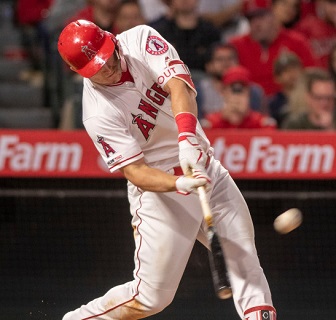
Trout hitting one out Thursday night–it’s a shame the Angels can’t have nine of him in the lineup . . .

Except that nobody asked. Even if it’s not as though the Angels have the strongest bulls among the league’s pens, leaving a starter in to get rung for eight runs is terrible optics, even if one of the bulls surrendered the final two of the eight. Whenever you ask whether Harvey’s willing to take one for the team, he has Thursday night as Exhibit A.

It was too dark a night for the former Dark Knight, especially with the Angels having just about nobody beyond their $430 million dollar man who could take advantage of facing a pitcher, Edinson Volquez, who was bound not to last into the fifth inning for a second consecutive start himself. The 11-4 final score felt a lot worse than it looked for these broken-winged Angels.

And it was the opposite of the Harvey who pitched six strong surrendering a measly pair of runs against the Athletics in the second game of the season, which accounts for the only Angel win thus far, alas.

But Harvey couldn’t keep his fastball down Thursday night and couldn’t get his breaking balls where he wanted them. He plunked Shin-Soo Choo to open the game and struck out Rougned Odor swinging, but then Elvis Andrus lined a single to right and Joey Gallo, behaving much like the organised crime legend with whom he shares a name, shot one into the right center field seats.

And after Harvey followed by walking Asdrubal Cabrera, Ronald Guzman pulled one down the right field line and off the foul pole, pulling the Angels into a 5-0 hole out of which they never saw the moonlight again on the night despite Volquez doing his level best to let them back into the game.

Absurdly enough, Harvey struck out the side when he wasn’t being used for target practise, and Kole Calhoun greeted Volquez rudely enough to open the bottom of the first with a leadoff shot into the same right center field seats Gallo reached. Trout promptly beat out a base hit deep to shortstop and pasta-bat Justin Bour wrung a walk. A strikeout later, Pujols wrung a bases-loading walk, but another pasta bat, Tommy LaStella, dialed Area Code 3-6-1 to blow that threat.

Harvey shook off a leadoff single to get two strikeouts and a ground out in the second. Well, ok, this was the first time he ever pitched in Angel Stadium, and maybe the Angels can still recuperate, right? Not when Volquez breezed in order in the bottom of the second, and not when the Rangers followed a third inning-opening groundout with Guzman doubling to the right field line, and Harvey needing Trout to throw Guzman out at the plate trying to score on a followup single by Logan Forsythe.

And not when Isiah Kiner-Falefa, no known relation to a certain Hall of Famer, lined a double into the left center field gap to score Forsythe post haste and leave the score 6-1.

Trout’s throw home to nail Guzman flew at a 96 mph speed. It was faster than anything Harvey served up to the plate all night. Tempting though that might make it sound, do not get any bright ideas about having Trout pitch an inning or two.

After Calhoun looked at strike three on a full count to open the bottom of the third, Trout stepped up to the plate again and hit one over the shrubbery behind the center field fence. And after Bour flied out to center to follow, Volquez looked again like he could be had: single to right, walk, wild pitch setting up second and third, but LaStella lined out to center for the side.

A game that could have had the Angels pulling back to within two to keep things manageable with six innings to go remained a four-run deficit. And Harvey pitched his best inning of the night in the top of the fourth, shaking off a one-out single to lure Gallo into a lineout double play to end the inning. But after the Rangers hooked Volquez with two out in the bottom and Jeffrey Springs struck out Calhoun swinging, trouble loomed again.

This time Harvey was greeted with an inning opening base hit (Cabrera) before walking the followup hitter (Guzman), and his night ended mercifully if a little late. Reliever Luke Bard surrendered a prompt single to load the pads but got two straight fly outs to follow. Then he threw the wrong pitch to Choo on 1-1 and Choo lifted one to short left field. Angels left fielder Brian Goodwin, a scrap heap waiver pickup in March, misplayed the odd-hopping ball and the ball traveled back far enough to clear the bases and leave Choo on second.

2019-04-05 Matt Harvey

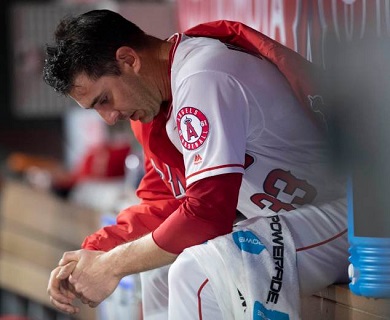
Harvey’s expression says everything he hoped not to have to say . . . 

Goodwin made up for the mistake only partially in the bottom of the sixth when he tagged Springs for an RBI double on which an infield throwing error allowed him to take third. A fly out later, Springs walked both Calhoun and Trout, but Bour grounded out for the side.

The bullpens kept things quiet for the most part from there, if you didn’t count Andrus’s two-run single off a struggling Cam Bedrosian in the eighth. Or, the Angels sending an unearned run home in the ninth on a weak groundout, unearned because Peter Bourjos—returned to the Angels after assorted travels, following his having been nudged out of centerfield by someone named Trout, and now a late-game insertion for Trout—beat it to first leading off after what was a swinging strikeout ended up a passed ball with Rangers catcher Falefa unable to throw him out at first.

“Quite frankly, a couple of times we were one swing of the bat away or one big hit away from being right back in the game,” Ausmus said after the massacre ended mercifully. Go ahead and say it—that’s what they all say.

But the Angels went 0-for-10 with men in scoring position Thursday night, not to mention hitting into three double plays including twice by new catcher Jonathan Lucroy, not to mention Trout never once getting to bat with anyone in scoring position. The Rangers? They went 6-for-12 with men in scoring position.

So that’s the trick with these Angels: Let Trout wreak all the mayhem he wants. Just don’t let anyone else reach base ahead of him. You don’t want the Angels’ pasta bats otherwise helping him make you look foolish.

“Nothing was really down in the zone. Everything was up,” said a crestfallen Harvey after the game. “I used the first game to start with the guys down in the zone and work up and today was everything was up. It was one of those where everything I threw they were making good contact on. So it was a rough one.” The righthander said he’d be mad at himself “for 24 hours” and then get back to work.

File this under Add Injury to Insult Dept.: Angels shortstop Andrelton Simmons, one of the best gloves in the game even if he, too, is something of a pasta bat, was forced out of the game with back stiffness in the third inning. Taken out as a precaution, Simmons hopes to play Friday. Ausmus calls him day-to-day.

Ohtani says he can’t wait to get back into the Angels lineup at least to swing the bat even if he can’t pitch just yet. The Angels say yes you can. Prudence about Ohtani’s health is wise even if the circumstances tell you it’d be nice if he could get back a little sooner than the likely end of this month.

Because that’s the Rangers sitting on top of the world and only a game and a half behind their fellow division-shocking Mariners, with the Angels and the defending division champion Astros opening the season with the American League West’s only pair of losing records thus far. Between them, I’m slightly more optimistic for the Astros right now.

The night of the living T-R-A-T-I-O-R

USP MLB: PHILADELPHIA PHILLIES AT WASHINGTON NATIO S BBN WAS PHI USA DC

Bryce Harper hitting a monstrous eighth-inning home run Tuesday night.

Time was when the not-quite-accurate legend of Washington baseball was: “Washington—First in war, first in peace, and last in the American League.” After Tuesday, the legend may yet become, “Washington—First in war, first in peace, and lack of class in the National League East.” Not because of the Nationals, but their fans.

Simple elementary wisdom includes that the right to boo comes with the price of a ticket, but it went on particularly grotesque display in Nationals Park when Bryce Harper hit town for the first time as a Phillie.

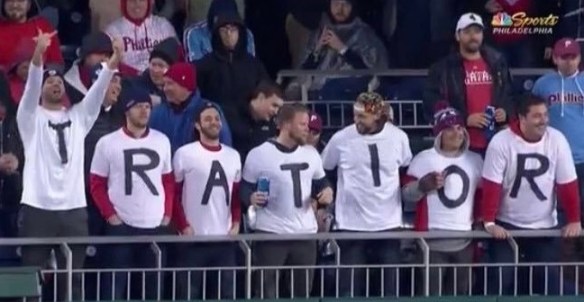
Grotesque and, when all is said and done, ignorant. And, in the case of seven fans spelling out “T-R-A-T-I-O-R!” on the front of white T-shirts, evidence of either ditching or flunking third-grade spelling.

No matter, almost. Harper himself obliterated the grotesquery and the ignorance with a parabolic eighth-inning home run, punctuated by the most epic bat flip this side of Jose Bautista, that actually chased a lot of the Nats fans who came to abuse him out of the park while a large enough contingent of Phillies fans who’d made the trek for the, ahem, big event remained to love him.

Washington’s number one industry—government—is well populated by those in its employ who never allow the truth to get in the way of a good rant. Except for the Phillies contingent the fans in Nationals Park behaved most of the night as if they were auditioning to join the government.

They ramped it up to fever pitch after Harper faced Max Scherzer twice and struck out both times, once on a changeup not even a golfer could meet and the second time on a cutter Mariano Rivera himself would have admired. Scherzer refined the cutter last year and got tougher on lefthanded hitters than he’d ever been before in his sterling career.

The third time up, the lefthanded Harper figured Scherzer enough to wait for something down and in but not too far down and lined a one-out double to right, setting up a second and third the Phillies couldn’t cash. Then Scherzer was gone in the middle of the fifth and the Phillies got to play rough with the Nationals’ rickety bullpen.

After Jean Segura hit a three-run double with two out in the sixth, Harper drove in another run with a single up the pipe off lefthander Matt Grace. Making it 6-0, Phillies, the shutout rudely broken when Anthony Rendon hit one over the left field fence with Wilmer Difo aboard.

But with Segura aboard and one out in the eighth, the T-R-A-T-I-O-R caught hold of Jeremy Hellickson’s down and in four-seamer and blasted it into the second deck past the right center field fence. With a propeller-like bat flip a few steps up the line. Bautista’s after hitting what proved the 2015 American League division series-winning three-run homer was a measly helicopter. Harper’s was a Lockheed Constellation striking to cross the Atlantic.

TRATIOR

If you’re going to accuse a former hometown star falsely of betrayal, at least be sure you didn’t ditch or flunk third-grade spelling!

That was the third longest of any ball Harper ever hit in Nationals Park. After such a night’s disrespect there wasn’t a reasonable observer anywhere who’d have said that propeller flip was unjustified, after he’d built himself up to where he could hit that bomb in the first place.

“You hit the ball that far,” said no less than Nats general manager Mike Rizzo, who got to see more than his fair share of Harper lunar launches, “do whatever the hell you want.”

It was no April Fool’s Day joke that, on that very day, the Washington Post‘s Barry Svrluga published a final in-depth examination about how Harper went, as the headline read, “from ‘I’m going to be a National’ to ‘We’re going to Philly’.” An examination that went too obviously un-read.

The article explains in depth how, essentially, the Nationals low-balled Harper but the Phillies in due course didn’t, especially knowing that no matter which teams out west wanted him, Harper may live in Las Vegas but didn’t want to play out west. “I love the East Coast as well,” he told Svrluga. “I love the vibe there, the intensity, the way Sunday Night Baseball is actually at night. Stuff like that mattered.”

Lost in the hoopla over Harper’s personality, the kid who dared to want to make baseball fun again but ruffled a lot of twisted-panties types of Old School Old Farts by having the nerve to play that way, was one fact: this family-oriented kid who’d done enough traveling around as a pre-organised baseball star in the making wanted a baseball home. Long term. Irrevocable.

“Harper’s desires,” Svrluga wrote, “were specific and contradictory to what the public thought: He wanted as many years as possible. He wanted a no-trade clause. He did not want opt-outs—which would have given him a path back to free agency—even if that might be more lucrative. He wanted, basically, to never again answer the question that to that point had defined his career: Where are you going next?”

Maybe that as well as the truly personal touch Phillies owner John Middleton applied in meeting Harper before their deal got done is why Harper took a no opt-out, no-trade, no-deferral thirteen-year, $330 million deal that’s actually paying him less in average annual salary than than Scherzer, a shade above Stephen Strasburg, and two shades above Patrick Corbin.

“Nobody did anything wrong,” said veteran Nats first baseman Ryan Zimmerman to Thomas Boswell, who tweeted the remarks before the game and published them in his post-game column Tuesday night. “There are no bad guys in this. It is okay. Everyone can be happy. Bryce is not the first MVP to switch teams. This happens. He came. He played. He exercised his right. Sounds like any business anywhere. I hope they cheer him. Once, anyway.”

Not quite. Not even during that classy pre-game video tribute to the controversial but engaging kid who, by the way, reached base as a Nat and before his 26th birthday more than any major league player through that age except Mike Trout and Hall of Famers Mickey Mantle and Al Kaline. Not even for the classy thank-you Harper posted on his Instagram account the morning of the game.

“[T]his is how society has turned,” writes Sports Illustrated‘s Tom Verducci. “Negativity sells. This is how you get noticed, not with civility. Online comments sections, with the cloak of anonymity, have become our town squares. Snark has become so normalized that it promotes role-playing, as if to be ‘cool’ and to be noticed you’re supposed to be caustic. Nationals fans played down to the role.”

Come Wednesday, Harper had himself a 2-for-2 day with a run scored and three walks—two of which were intentional. You think the Nats didn’t get the message from Tuesday night? They weren’t going to give him a chance to drop another nuke on them if they could help it. They made sure he couldn’t hit with men aboard and walked him intentionally when he did bat with men on.

And they could sort of afford it, since the game got to an eight-all tie after eight innings between Aaron Nola being roughed up for three home runs and a fair amount of sloppy Phillies play—two infield errors and a catcher’s throwing error—abetting the Nats’ side of the ledger. The Phillies scored two in the first, two in the fourth, and four in the eighth; the Nats scored three each in the first and the third and two in the eighth.

Then the ninth got extremely interesting: after Rendon led off with a single, Phillies reliever David Robertson—having a shaky season’s beginning after several years of lights-out relief—channeled his inner Craig Kimbrel: he walked the bases loaded and then walked pinch-hitter Jake Noll to send Rendon walking home the 9-8 win.

It left the Phillies 4-1 to open the season and left the Nats still wondering about how to fix a bullpen they only thought was solidified with three bulls who let the Phillies bat around in the eighth Wednesday. Not to mention having to make do without Trea Turner, who suffered a broken finger Tuesday night when a pitch he was trying to bunt hit the finger wrapped around the lower barrel of his bat.

After Tuesday’s game, Harper faced his Phillies teammates and compelled them to delay for a few moments their usual post-win clubhouse routine, complete with spinning bright coloured lights. Then, according to Verducci, he spoke to them, at one point seeming on the brink of tears, thanking them for embracing him and having his back.

Wednesday seemed like just another back-and-forth game involving two of the National League East’s four expected dogfighters compared to Tuesday night. But Tuesday was the real first night of the rest of Harper’s baseball life.

The Phillies and the Nats play seventeen more times against each other this season, including eight in Washington. Maybe by then Harper will be just another opponent on just another team challenging for the NL East, instead of the guy Washington thinks, witlessly and ignorantly, is a T-R-A-T-I-O-R.

They were co-fueled by no less than Washington mayor Muriel Bowser the morning of the Big One. The woman who applauded Harper last year for kicking in on a six-figure project to renovate a community center baseball field tweeted an image of Harper’s bearded phiz atop the body of Benedict Arnold. She deleted the tweet post haste, but not in time to stop some of the Nationals Park fans from holding up posters showing that image Tuesday night.

Philadelphia fans have a long-term reputation once described best by a short-term Phillies pitcher, Bo Belinsky: “Those people would boo at a funeral.” Do you think they’ll hold up signs showing Bowser with a photoshopped muzzle over her mug and under a Nats cap the first time the Nats hit Philadelphia come next Monday?

No, I take that back—don’t give the bastards any more bright ideas!

Dr. Hyde and Mr. Hess

USP MLB: BALTIMORE ORIOLES AT TORONTO BLUE JAYS S BBA TOR BAL CAN ON

David Hess wasn’t faking his surprise that Orioles manager Brandon Hyde (in jacket) came out with a hook when he was eight outs from finishing a potential no-hitter.

Something strange happened to the Orioles. They won three out of four including two against the Yankees to open the season. But something more curious happened to them on the way to the third win.

First-year manager Brandon Hyde hooked his Monday night starter, David Hess, who took a no-hit bid to one out in the seventh before a hard line drive out ended his evening. The Oriole bullpen almost torched away a game they’d led 4-0 before Hess even had to take the mound.

And none of the above were April Fool’s jokes.

Hess threw 82 pitches when Hyde went to the mound to lift him. The righthander put a little extra fuel into his fastball and let it set up his fine secondary pitches including an effective changeup he threw more often than he seems to have done in any of his 2018 games. Throwing twelve out of twenty first pitch strikes didn’t hurt, either.

Hyde’s expressed concern was Hess having also thrown 42 pitches in two innings worth of scoreless Opening Day relief against the Yankees three days earlier. Hess looked as though he’d seen two ghosts and the Loch Ness Monster when Hyde arrived at the mound.

Even the Rogers Centre audience booed when Hyde lifted Hess.

“Hyde likely didn’t want to force his young pitcher to have to throw 150 pitches in the span of four days,” writes NBC Sports’s Bill Baer. Deadspin writer Tom Ley isn’t that sanguine:

[L]et’s not forget that Hess’s pitch count being such a cause for concern was entirely the result of the O’s steadfast refusal to field a real, major-league quality baseball team. This is a team in desperate need of pitching reinforcements, but instead of spending money on a player like Dallas Keuchel, they decided to start the season with just four starters, leaving Hyde a jumble of pitchers with nebulous roles with which to patch together outings. This is how you end up with a guy like Hess—not a reliever but not really a starter, either—losing a shot at a no-hitter because he had to pitch two innings in relief three days earlier.

Some think the Orioles’ front office, as happens with a number of other front offices these days, put Hyde on a strict pitch count for Monday considering that he did work heavily in relief on Opening Day. Others think Hyde was being a little too over-protective. My guess is the truth might be somewhere in the middle.

Hess proved stand-up enough after the game—acknowledging both his personal disappointment but appreciation that his manager was looking out for his health—which was pretty impressive considering what almost happened after he departed. After his eight strikeout/one walk/no-hit performance, the Orioles ended up being lucky they banked a 6-5 win with the potential tying run stranded on third.

Pedro Araujo relieved Hess and walked Justin Smoak promptly enough. Then Araujo lost the no-hit bid entirely when Randal Grichuk, once a touted young Cardinal bedeviled by injuries and traded to the Blue Jays in January, sent a 2-1 pitch over the left field fence.

Araujo escaped after a followup single and an inning-ending double play. His relief, Mike Wright, got two swift enough outs before Freddy Galvis hit one down the line and over the right field fence before Billy McKinney flied out to end the eighth.

But with one out in the ninth Wright turned it over to Richard Bleier. And Bleier almost turned the whole game over thanks to a sacrifice fly (pinch hitter Kevin Pillar) and an RBI triple (Teoscar Hernandez) before he struck out Lourdes Gurriel to let the Orioles escape with their lives.

All other things considered it wasn’t tough to believe they might have lucked out taking two of three from the Empire Emeritus despite being out-scored by a run during the set before arriving in Toronto.

So how realistic was the concern for Hess’s pitch count and workload?

You can look at his first near-full major league season last year and say he wasn’t exactly overworked—but he started the season at Norfolk (AAA) and pitched 45.2 innings in nine starts before coming up to Baltimore to pitch 103.1 innings. Total it as 148 innings.

As an Oriole in 2018, Hess had a 4.88 ERA and a 5.80 fielding-independent pitching rate; he’s not exactly a strikeout artist and he’s neither a hard fly ball nor hard ground ball pitcher. And he worked with an average 2.9 runs worth of support while he was in his games. There’s a certain degree of hard luck in there, but only a certain.

Except for the 154.1 innings he pitched at Bowie (AA) in 2017, Hess’s total 2018 workload was the heaviest of a career that began in 2014 as a fifth-round draft pick and saw him promoted from A to AA during his second season, when he was 21. Now he’s 25. Except for Monday night, he hasn’t exactly looked like the second coming of past great Orioles pitchers.

But he hasn’t been the most overworked pitcher in the business, either. Unless something looms for him that would be completely unexpected, Hess isn’t likely to suffer the fate of four-fifths of the once-vaunted “Baby Birds” Oriole rotation of 1959-61 (Milt Pappas, Jerry Walker, Jack Fisher, Chuck Estrada, Steve Barber) who looked like comers but ended up with broken or dead arms and short enough careers.

The Baby Birds were bedeviled by a man, Paul Richards, with an overblown reputation for handling pitching. He could handle it as a catcher, which is how he got his rep in the first place, but he mismanaged his Baby Birds horrifically. A longtime Orioles scout, Jim Russo, in his memoir Super Scout: Thirty-Five Years of Major League Scouting, dropped the dime on Richards:

With Paul, we led the major leagues in, of all things, tonsillectomies. Paul was from the old school that said, “There’s got to be poison in your system if you’ve got an injury.” When our young pitchers would come up with shoulder problems, Paul would tell our team doctor, “Doc, these kids are having shoulder and arm problems. Better check those tonsils out real close.” We had more kids having their tonsils removed than any other club, and it was all silly and unnecessary. The only thing wrong with those kids was they were throwing too much.

Paul’s teaching ability was genius. But he had another side that was just plain dumb . . . [O]ne of those kids would pitch in an exhibition game and, instead of running and a shower, it was to the bullpen to work on either an extra pitch or the slip pitch. And nobody’s keeping track of how many pitches they’re throwing. We’re not talking about veterans here. We’re talking about nineteen- and twenty-year-old arms. Everybody calls Paul a genius, and he was a real smart man. But how can you lose track of that?

What a surprise, then, that Jerry Walker, Chuck Estrada, and Steve Barber ended up with elbow- or shoulder-compromised careers. What a surprise, then, that Jack Fisher was plain overworked by the time he became a Met in 1964 and turned into a plain workhorse who was far less than half of how he looked in 1959-60 with the Orioles.

They used to say of Milt Pappas that he was “babied” because, somehow, his workload wasn’t quite as heavy as the others. Maybe what they ought to say is, what a real surprise that Pappas was probably lucky to enjoy as long, as healthy, and as fine a career as he ended up enjoying. Among the Baby Birds he was the exception, not the rule.*

Nor does Hess seem likely to go the way of Generation K, the Mets’ prospective mid-1990s front-line threesome of Jason Isringhausen, Bill Pulsipher, and Paul Wilson. Overworked insanely in the minors before they were each 22. One and all ended up with elbow or shoulder trouble, sometimes both. Careers destroyed, if you didn’t count Isringhausen’s somewhat unlikely resurrection as a quality relief pitcher for over a decade.

Generation K’s problem was the Mets’ minor league brain trust and the parent club’s manager at the time. A former pitcher of modest endowment himself, Dallas Green was never programmed to believe that a very young pitcher’s arm and shoulder weren’t born major league ready and could be ruined with overwork before proper development and strengthening.

Neither Green nor the Mets’ farm administration had a clue, and maybe they couldn’t have cared less, that Isringhausen, Pulsipher, and Wilson came up to the Mets half cooked already. Until, one after the other, all three went down injured fast enough and, as Rob Neyer once observed, “it opened a lot of eyes, even among grizzled old baseball men who would much rather have remained blind.”

The thing that bothered me the most about my short career is the fact that I was just learning how to pitch when my arm blew out. I used to challenge everybody.—Chuck Estrada.

I’ve told many people this before: I’ve done two things that never will happen again. Throw 200 innings in a minor league season and throw 131 pitches in my first major league start. Those two things will never happen again.—Bill Pulsipher.

David Hess doesn’t look bound for a Hall of Fame pitching career, and perhaps that’s a big reason why there was such a moan of disappointment that he was pulled with a no-hitter in the making Monday night. You know: a guy who’s liable to be a major league footnote in the long run has a shot at immortality for one night.

Even an organisation that’s the clown show Deadspin describes gets things right once in awhile. Sure it would have been fun to see if Hess could have finished what he started, and fun isn’t likely to be synonymous with Orioles baseball very often this year, barring unforeseen surprises.

But Hess was beginning to droop a bit before he was hooked. The final two outs he got on the night were hard line drives. Like a lot of pitchers, Hess isn’t as effective the third time around the order. And if it’s going to be another long sad season for the Orioles after all, the least they can do is make sure they have live arms later on (they’re missing a few right now, by the way), if only to keep the embarrassments per game from happening too soon, too often.


* Milt Pappas, who died in 2016, once claimed Paul Richards put him on strict pitch limits early enough to ensure his long career. Except that Pappas pitched fifteen complete games in 1959 and eleven in 1960—and, as Rob Neyer once pointed out, it’s kind of tough to throw 26 complete games in two seasons if you’re on a 90-pitch game limit. And from 1959-1965, Pappas pitched 79 complete games, second most in the American League in that span.

The facts include that Pappas averaged nine complete games per 162 games lifetime; he averaged almost seven innings per start lifetime; and in his ages 32-33 seasons—managed as a Cub by Leo Durocher, a man not exactly sensitive to the physical drain of pitching—he threw, respectively, fourteen and ten complete games, including eight shutouts and a no-hitter.

But perhaps those ages 32-33 seasons took more out of Pappas than he was willing to admit. After a very down 1973, he was finished . . . at 35.

There may have been a small stretch when Richards nursed Pappas as a 19-year-old major league pitcher but that seems to have been it. I’m no expert but I think it’s a safe guess to say that Pappas simply was a stronger physical specimen than his fellow Baby Birds. There’s no other explanation, other than that he lived on control instead of hard throwing (his money pitch was a firm slider), for why he forged a sixteen-year career despite Richards’s general carelessness with those pitchers.