A survivor’s milestone

2019-04-30 CCSabathia

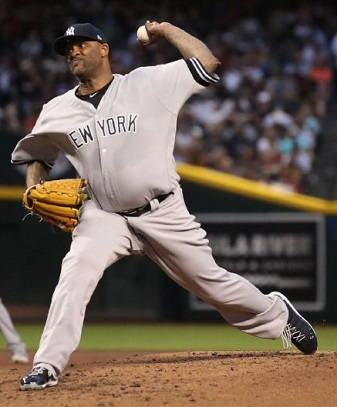
CC Sabathia about to release the changeup that turned into strikeout number 3,000 Monday night . . .

It didn’t happen before the home crowd. It didn’t have to. A Yankee fan made it very clear with the placard he hoisted: “I traveled over 3,000 miles to see CC Sabathia get his 3,000th K. NJ -> LA -> SF -> ARI.” But even the Chase Field audience couldn’t resist the loud standing O after Sabathia fooled Diamondbacks catcher John Ryan Murphy with a changeup in the bottom of the second.

Technically, Sabathia struck out the side to get there. He caught David Peralta leading off, looking at a sinkerball that didn’t sink too far in the low zone. He got Christian Walker to swing and miss on a cutter that wasn’t likely to threaten the stature of his former, Hall of Fame teammate Mariano Rivera.

Then Sabathia was rudely interrupted when a cutter that didn’t quite cut the way he probably hoped met former Met Wilmer Flores’s bat on its way over the left field fence, and Nick Ahmed followed up by doing whatever he could with a changeup and making it work enough to beat out an infield single.

Up came Murphy, a former Yankee who’d caught Sabathia in the past, a righthanded hitter with a little power of his own. Sabathia worked him inside to open, missing with the first pitch before he fouled off a pair. Then Sabathia went a little up in the zone and fouled that one off. That was a quartet of cutters. Then came the changeup taking a neat little dive under Murphy’s swinging bat head.

Sabathia seemed at first to be the only man in Chase Field who looked like it was just another day at the office. His Yankee catcher Gary Sanchez pumped a fist and clung to the milestone ball for dear life. The rest of his teammates swarmed him near the Yankee dugout while his wife and four children roared in the stands with the rest of the crowd. Sabathia made sure to get some hugs from his lady and his kids before letting his mates have at him.

“Count me in,” Sanchez told reporters after the game. “I was one of those that was super excited and happy and desperate for those three strikeouts. Once we were able to get those strikeouts I was able to relax a little bit. Exciting, exciting just understanding what the milestone is and I was just super excited.”

Count Sabathia in, too. The third lefthander in baseball history to cross the 3,000 threshold (after Hall of Famers Steve Carlton and Randy Johnson) came a long way, baby. “Since the end of last year, you coming up short 14 strikeouts . . . it’s the only thing I have been thinking about the last six months,” he told reporters. “So, actually to have it now be over it and I can just worry about the season and try to win games.”

The Yankees so resemble a M*A*S*H post-op ward these days that a lot of people worried how they’d go forward trying to win games, too. But, pun intended, they’ve bloody well done it. So much so that the comparably banged up Nationals in the National League East aren’t earning many sympathy points, which is a little unfair. Except that maybe even the Yankees are a little surprised that they still look like American League East beasts no matter how many key men are still in the ward.

“It was one of those things where it was kind of inevitable, but it’s not something we really talk about,” said manager Aaron Boone, whose own playing career included an exercise in futility against Sabathia: one hit, four strikeouts, and a .167/.167/.167 slash line.

“It was kind of wait and see, see how it happens and it obviously happened at the end of the inning, so we were able to congratulate him coming off the field and not take too big of a break in the game,” Boone continued. “It was kind of fitting that he was leading off the next inning. It’s something that we can really sit down and put things into perspective, you can look back on it as a really, really special accomplishment.”

Special may be a polite way to phrase it. There was a time when nobody thought he would make it far enough to land the milestone he landed Monday night. Including Sabathia himself.

He was a throwback, an innings-eater who thought nothing of going long distance (he led the majors in innings pitched twice with 241 innings or better) while pitching like a dominator, in Cleveland, in Milwaukee (he made the Brewers’ brief 2008 postseason trip possible almost by himself in the second half of that season), and in New York, turning his left arm into considerable money and looking like it was just a question of when, not if he’d get his own set of keys to Cooperstown.

Then Sabathia’s body began betraying him. Most of the betrayal came from his right knee, part of the leg on which he lands when he delivers, and it turned the big, bearish lefthander—never exactly the poster child for a classic male athlete’s physique to begin with (he always looked the way you’d imagine aging Babe Ruth to look if Ruth had remained a pitcher)—into a man whose workhorse days were history.

So were his days as a power pitcher. His once-formidable fastball and his stamina went AWOL. If he wanted to survive long enough to finish what he started, the $161 million free agency deal he signed with the Yankees in the first place, the one out of which he opted and turned into a little more money, Sabathia had to reinvent himself.

Especially after he shocked the game two days before the 2015 American League wild card game, when he went into manager Joe Girardi’s office in the Camden Yards visiting clubhouse and told him he would check into a Connecticut rehabilitation facility. He’d binged so badly during that set in Baltimore that he actually needed to detox first.

Sabathia remains in recovery. Meanwhile, to remake himself as a pitcher, he looked to the classics to do it, the old stereotype of the cleverly crafty lefthander who lived on something close enough to junk, developing a different kind of changeup, adding a cutter that cut just enough to keep him alive, and going to his slider a lot more often than before. He learned to live at the back end of the Yankee rotation and in the junkyard, he worked for his five or six innings’ work every few days, and he survived.

Then he underwent knee surgery this past offseason, not to mention an angioplasty, and he decided going in that 2019 would be the final season of his career. He also decided to enjoy every moment of it as best he could with whatever he had left in the tank. His days as a mound howitzer too far gone to kid himself, nailing number 3,000 testified to something better. His spirit.

The Diamondbacks to their credit didn’t mind the Yankees basking in the moment of Sabathia’s milestone. He’s the seventeenth pitcher to reach it, the first having been Hall of Famer Walter Johnson in July 1923 (the Indians’ Stan Coveleski was his milestone victim) and the last having been Hall of Famer John Smoltz when he punched out the Nationals’ Felipe Lopez in April 2008.

Murphy is a seven-year veteran who isn’t likely to find himself in Cesar Geronimo’s position. (We hope.) That center fielder for the Big Red Machine found himself a Number 3,000 twice before his career ended: Hall of Famer Bob Gibson rang him up for number 3,000 in July 1974—which made Gibson only the second man to cross the threshold—and Hall of Famer Nolan Ryan nailed him in July 1980.

Four more pitchers crossed the 3,000 threshold before Geronimo’s career ended: Hall of Famers Tom Seaver, Carlton, Ferguson Jenkins, and Don Sutton. Their milestone victims weren’t exactly fish cakes, either: in order, Keith Hernandez, Tim Wallach, Garry Templeton, and Alan Bannister. There’s one five-season streak of 3,000th-Ks (1980-84, with Ryan, Seaver, Carlton, Jenkins, and Sutton) and one four-season streak. (2005-08, with, in order, Hall of Famer Greg Maddux, not-yet Hall of Famer Curt Schilling, and Hall of Famers Pedro Martinez and Smoltz.)

“”I want to make sure that I say it loud and clear that if you’re a baseball fan, you have to appreciate what you saw,” said Diamondbacks manager Torey Lovullo. “You saw somebody that’s been going out there for a long time since he’s been 19 years old and he’s done it at a very high level every single year. There’s never really been a down turn. Maybe when I knew him a long time ago, he was more of a fireballer and now he’s learned how to pitch, and it’s fun to watch.”

“I’ve played against him for 12 years,” said Diamondbacks right fielder Adam Jones, who’d tangled with Sabathia on many a day as an Oriole, “and I can say that the competition against him is always A-1. You always know when you face him that the intensity is going to be high. He deserves everything that’s coming his way.”

Jones is well aware that Sabathia also belongs to a particularly exclusive club: the third black pitcher to punch out 3,000 hitters or more, with Gibson and Jenkins; and, the threesome are known as members of the so-called Black Aces, African-American pitchers credited with 20 or more wins in single seasons. (The founder, Brooklyn Dodger legend Don Newcombe, died earlier this year; the other members are Sam Jones, Mudcat Grant, Earl Wilson, Al Downing—the same Al Downing who surrendered Henry Aaron’s record-setting 715th lifetime home run—Vida Blue, J.R. Richard, Dwight Gooden, Dave Stewart, and Dontrelle Willis.)

Sabathia is, too. “Being a ‘Black Ace’ is something that I take very seriously,” he said. “So to be on that list as one of three guys with 3,000 strikeouts, it’s hard to grasp, it’s hard to think about it. But it’s cool to be on that list.”

He knows that since 2013 he hasn’t been the pitcher he was from 2001-2012. And he’s okay with it. Ever onward and upward. He nailed two more strikeouts before his Monday night was done, including Murphy the second time, yielded to the bullpen with two on and one out in the sixth.

But he couldn’t out-pitch Zack Greinke (strikeout victim number 3,001 if you’re scoring at home, by the way) and could only watch as his Yankees couldn’t overcome what finished as a 3-1 Diamondbacks win. Other than the Yankee loss, Sabathia has only one regret about the evening.

“When I actually got that [milestone strikeout], I didn’t want it to be Murph,” he said. “Me and him are really close, I’ve been knowing him his whole career.”

As much as he thought about it coming out of spring training, getting there was something else entirely. “That’s a hard one to grasp,’’ he said at a postgame press conference with his wife and children at his side. “There’ve been some great pitchers who played in this game, but being the third lefty is just incredible.”

When all else is done and said, Sabathia’s endurance could be called likewise.

Bellinger’s April showers

2019-04-30 CodyBellinger

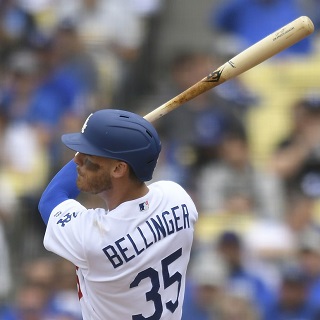
Another day, another RBI for Cody Bellinger, so it seems . . .

At this writing, Dodgers first baseman/ outfielder Cody Bellinger is an RBI freak. He’s driven in more runs prior to today’s date than any. player. ever. (37) to open a season. He’s also hitting so far (a Show-leading 1.487 OPS) as though the only way to stop him is to throw him a ball that implodes before he can swing.

Get Bellinger to the plate with men on base and it’s like having home insurance, right? So far. But get the men on base in the first place? Not so fast, Junior.

Reality check, again: You can’t drive in runs unless the men ahead of you in the order can reach base. Or (as I observed in another essay) unless you can run the bases twice or more before your home run ball lands. If the Road Runner could hit for distance even he wouldn’t be that fast.

If the opportunities aren’t there, you’re not going to drive them in no matter how good a hitter you are. In 128 plate appearances so far at this writing, Bellinger’s batted 73 percent of the time with men on base and driven one in 37 percent of the time he’s had the chance. He seen his opportunities and took them, as the old saying pronounces so ungrammatically.

Last year entering 30 April Bellinger had 114 plate appearances, 53 percent of the time with men on base, and drove one in 20 percent of the time he had the chance. He had a .280/.339/.458 slash line through 30 April while he was at it, with six doubles, two triples, and three home runs among his thirty hits.

This year so far, Bellinger’s getting a little luck his way, which his .400 batting average on balls in play tells you. But he also seems to be making his own luck while he’s at it; his plate discipline has improved rather dramatically. (Eighteen walks to fifteen strikeouts, and the strikeouts are only 22 percent of his 68 outs through this morning.) The question before the house, then, is whether Bellinger can keep it up.

Historically, not really. Bellinger’s best months so far have been April and August. So far in his career he’s hit 136 points lower in May, 76 points lower in June, 106 points lower in July, and 93 points lower in September and the season-ending early October days. His Augusts have served to finish him out as practically the same hitter in the first as the second half of a season, overall.

Unless he’s worked something else new and unique with the Dodgers’ new hitting coach Robert Van Scoyoc, you can probably put to rest your fantasies about a 70 home run/180 RBI/1.500 OPS season for Bellinger. Considering Bellinger’s normal abilities I don’t think the Dodgers will complain.

Because, unfortunately, he can’t run more than one full circuit around the bases before his home runs land. (He’s swift afoot, and he takes the extra base on followup hits 40 percent of the time so far this year, but the fastest power hitter on the planet won’t reach second before the ball reaches the seats.) And, he can’t will those ahead of him in the Dodger lineup to reach base.

Here’s what’s more impressive about Bellinger as of this morning. Forty-six percent of his hits have gone for extra bases, even if 67 percent of those extra base hits have been home runs. He has a .929 real batting average (RBA)—total bases, walks, intentional walks, and sacrifices (all the things you do at the plate; not just your hitting average, which is what the traditional batting average ought to be called), added up and divided by his 128 plate appearances—which is 302 points above his lifetime RBA.

(Though you can just picture someone, in some clubhouse, briefing pitchers about to face Bellinger in the lingo of old Joe Schultz, the manager of the Seattle Pilots: “Somebody’s getting him out—the bastard’s only hitting .434!”)

It’s probably less sustainable than his RBI pace and his OPS through this morning. Mike Trout with a .722 RBA through this morning is playing Mike Trout baseball. (His lifetime RBA: .653.) Cody Bellinger with a .929 RBA through this morning is playing well over his own head. (Lifetime RBA, entering this season: .595.) But it’s been phenomenally fun to watch him so far.

Allen’s Alley should lead to Cooperstown

2019-04-29 DickAllen01

Dick Allen (15), presumed launching a baseball toward LaGuardia Airport’s flight line (he’s hitting against the Mets here) . . .

Some time around Opening Day, I spotted an online baseball forum participant huff that he didn’t want to see a particular player in the Hall of Fame because, well, the man fell far short of 3,000 major league hits. I have no idea whether it crossed his radar that drawing and enforcing lines like that would send some of baseball’s genuine greats out of Cooperstown.

Some who concurred I’d known to defend the Hall election of a 22-season man, himself short of the Magic 3,000, whose sole apparent credential for the Hall was being a 22-season man. That’s the Gold Watch Principle at work. Longevity in baseball is as admirable as it is non-universal, but merely having a very long career isn’t the same thing as having Hall of Fame-worthy career value.

More Hall of Famers than you often recall earn their plaques despite somewhat short careers and/or by their peak values above their career values. They only begin with Dizzy Dean, Jackie Robinson, Roy Campanella, and Sandy Koufax. And the player the aforementioned forum denizen doesn’t think should be in the Hall of Fame has a bona-fide, peak-value Hall case.

This player was a middle-of-the-order hitter who hit frequently, and often with power described politely as breathtaking and puckishly (by Hall of Famer Willie Stargell) as the kind that causes boos because they don’t stay to become fan souvenirs. He was run productive to extremes at his absolute peak, but I’m not going to truck with the runs he scored and those he drove in too much for a very good reason: Those are impressive, and valuable, and entirely team-dependent.

Unless you think he could score when those behind him couldn’t drive him home (unless he reached third and could steal home at will), or drive in runs if those ahead of him in the lineup couldn’t reach base (never mind his power, even he couldn’t hit home runs far enough to allow time for two to four trips around the bases before the ball landed), answering “yes” to either means you shouldn’t hang up your shingle as a baseball professor just yet.

What we should want to know, really, is what he brought to the table by himself, when he checked in at the plate or hit the bases when healthy and not buffeted by too many controversies not entirely of his own making.

We should look at his plate appearances (PA), not his official at-bats, because the latter don’t offer the complete, accurate story of what he did at the plate to create runs for his teams. We should look at his total bases (TB), which treats his hits unequally, as it should be, because all hits are not equal. (If you think a single is equal to a double, a double equal to a triple, a triple equal to a home run, better keep the shingle in its original packaging for now.)

We should look at how often he hit for extra bases. (XBH.) (We should also look at how often he took the extra base on followup hits: XBT.) And, we should look at his real batting average (RBA)—his total bases, his walks, his intentional walks, his sacrifices, divided by his total plate appearances. The traditional batting average should really be called a hitting average, because it divides hits by official at-bats only and implies (incorrectly) that all hits are equal.

What I wanted to know along the foregoing lines is everything this player did to create runs.

When I first pondered the RBA concept I didn’t include intentional walks. But while I began revisiting this player it hit me. Why not include them? They’re not what you work out with your acute batting eye and plate discipline, but you should damn well get credit for being so formidable a plate presence that a pitcher would rather you take first base than his head off.

With all the foregoing understood, I hope devoutly, here are the absolute peak seasons of the player in question:

Year PA TB BB IBB SAC HBP XBH% XBT% RBA
1964 709 352 67 13 9 0 40 52 .622
1965 707 306 74 6 12 2 35 57 .566
1966 599 331 68 13 4 3 45 70 .699
1967 540 262 75 18 1 1 45 53 .661
1968 605 271 74 15 9 1 43 63 .611
1969 506 251 64 10 4 0 46 55 .650
1970 533 257 71 16 1 2 44 49 .651
1971 649 257 93 13 6 1 30 53 .570
1972 609 305 99 16 3 1 45 48 .696
TOTAL 5457 2592 685 120 49 11 41 56 .636
162G Avg. 688 327 87 16 8 2 42 57 .640

That should resemble a peak value Hall of Famer to you whether or not you marry it to his slash line for those nine seasons: .298 hitting average (sorry, I’m sticking to the program here), .386 on-base percentage, .550 slugging percentage, .936 OPS (on base plus slugging), and 164 OPS+.

He did it while playing in a pitching-dominant era and while being perhaps the single most unfairly controversial player of his time, especially during the first six of those seasons:

Years PA TB BB IBB SAC HBP XBH% XBT% RBA
1964-1969 3666 1773 422 75 39 7 42 58 .632
162G Avg. 693 336 80 15 8 2 43 59 .636

The player is Dick Allen.

When the Golden Era Committee convened in 2014, Allen missed Hall of Fame election by a single vote. So did his contemporary and co-1964 Rookie of the Year Tony Oliva. Allen missed despite that committee having more members with ties to his career than the Today’s Game Committee had to Harold Baines when electing him, very controversially, a few months ago.

Allen and Oliva have things in common other than missing their last known Hall of Fame shots by a single vote each. They both had fifteen-season major league careers. They both missed the Sacred 3,000 Hit club. (Hell, they both missed the 2,000-hit club.) They both hit around .300: Oliva, .304 lifetime; Allen, .292. And they both had careers rudely interrupted then finished by too many injuries.

Past that, let’s look at their lifetime averages per 162 games where they count the most:

162G Avg. PA TB BB IBB SAC HBP XBH% XBT% RBA
Dick Allen 678 327 87 16 8 1 42 53 .647
Tony Oliva 665 290 43 13 7 6 31 47 .540

Now, let’s look at those parts of their slash lines that matter the most. If you wish to argue as many still do that a .304 lifetime hitting average makes Tony Oliva the superior hitter to a Dick Allen with a lifetime .292 hitting average, be my guest—after you ponder:

162 G Avg. OBP SLG OPS OPS+
Dick Allen .378 .534 .912 156
Tony Oliva .353 .476 .830 131

Especially if you consider that their primes came during an era where a) they were up against some of the toughest pitching in the game’s history and b) hitting in conditions that gave far more weight to pitching overall than to hitting overall, both these players have firm peak-value Hall of Fame cases. Tony Oliva deserves the honour, too, but Dick Allen was a better player.

Allen had more power, more speed, was feared more considerably at the plate, and took a lot more extra bases on followup hits helping him be more run creative. And even in his seasons with Connie Mack Stadium as his home ballpark, Allen had slightly tougher home parks in which to hit than Oliva did. Let’s compare their peaks:

162 Game Avg. PA Outs RC RC/G
Dick Allen 688 441 129 7.8
Tony Oliva 694 465 113 6.5

You’re not seeing things. Allen at his peak, per 162 games, used 24 fewer outs to create 16 more runs. By the way, assuming the home run hasn’t turned you off yet, given fifteen completely healthy seasons each and allowing for a normal decline phase if they hit one by ages 35 (Allen) or 37 (Oliva), Oliva might have hit a very respectable 315 . . . but Allen might have hit 525. Maybe more.

Other than each missing enshrinement by a single vote in 2014, the most compelling reason to compare the two is that people married to baseball know Oliva’s injury history kept him from making his case more obvious (as would those of Dale Murphy and Don Mattingly, and neither of them were as good as Allen and Oliva) but often forget how Allen’s injury history kept the seven-time All-Star from making his case more obvious.

Because, you know, there was, ahem, that other stuff. The stuff that earned Allen a reputation as a powder keg who earned Bill James’s dismissal (in The Politics of Glory, later republished as Whatever Happened to the Hall of Fame?) of the wherefores:

Dick Allen was a victim of the racism of his time; that part is absolutely true. The Phillies were callous to send him to Little Rock in 1963 with no support network, and the press often treated Allen differently than they would have treated a white player who did the same things. That’s all true.

It doesn’t have anything to do with the issue . . . Allen directed his anger at the targets nearest him, and by doing so used racism as an explosive to blow his own teams apart.

Dick Allen was at war with the world. It is painful to be at war with the world, and I feel for him. It is not his fault, entirely, that he was at war with the world . . .

He did more to keep his teams from winning than anybody else who ever played major league baseball. And if that’s a Hall of Famer, I’m a lug nut.

If names such as Hal Chase, Rogers Hornsby, Albert Belle, and Barry Bonds sound familiar, it’s an extremely ferocious stretch to put Dick Allen at the top of that heap. It’s also a ferocious stretch if you know the complete story of the 1964-69 Phillies. Which you can get from one splendid book, William C. Kashatus’s September Swoon: Richie Allen, the ’64 Phillies, and Racial Integration, from 2004.
2019-04-29 DickAllen02

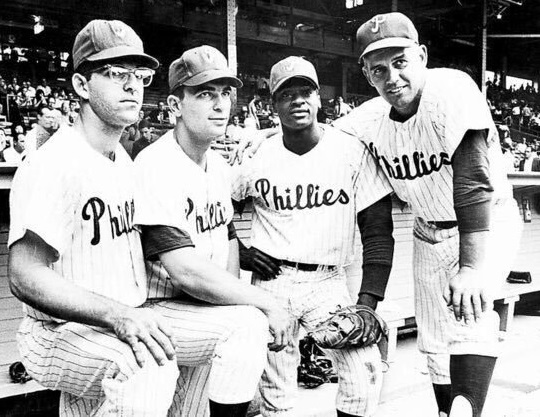
Left to right: infielder Cookie Rojas, outfielder Johnny Callison, third baseman Dick Allen, manager Gene Mauch, 1964. The Phillie Phlop wasn’t anywhere near Allen’s fault . . .

Allen wasn’t even close to the reason for the infamous Phillie Phlop. During September/ October 1964 he posted a 1.052 OPS. Kashatus exhumed the real reason the Phillies didn’t stay truly pennant-competitive again for the rest of the 1960s: a slightly mad habit of trading live young major leaguers and prospects (including Hall of Famer Ferguson Jenkins) for veterans well established but on the downslopes of once-fine careers.

The Phillies had winning records from 1965-67, but that habit began catching up to them in earnest starting in 1968—coincidentally, the season during which Allen really began trying to force the Phillies to send him the hell out of town. But Kashatus and other chroniclers—particularly Craig Wright, a Society for American Baseball Research writer debunking James—have also affirmed that Allen went out of his way to keep his teammates away from any of his desperation antics.

Just ask Bob Skinner, the former Pirate outfielder who succeeded Gene Mauch as the Phillies’ manager in 1968, and who tangled with Allen only over Allen’s bid to dress away from the clubhouse to keep himself from affecting his mates:

We certainly weren’t a bad team because of him. I didn’t appreciate some of his antics or his approach to his profession, and I told him so, but I understood some of it. I do believe he was trying to get [the Phillies] to move him. He was very unhappy. He wanted out. There were people in Philadelphia treating him very badly . . . He obviously did some things that weren’t team oriented, but his teammates did not have a sense of animosity toward him. Not that I saw. They had some understanding of what was going on.

Allen grew up in a strong family, raised by a strong but loving mother (he bought her a new home with his $70,000 signing bonus from the Phillies), in a small, integrated area in Pennsylvania farm and mine country, integrated well enough that black and white children thought nothing of having sleepovers in each other’s homes, even if they might not have dated each other.

Little Rock, Arkansas, was Allen’s first explicit taste of Southern-style racism and his 1963 experience seared him, as well it might have, when sent there for his AAA finishing with no warning of what he was likely to face as the first black player on the Travelers. There were those who wondered why Allen couldn’t take his cue from his hero Jackie Robinson’s experience of a decade and a half earlier.

But Robinson was a 27-year-old Army veteran and Negro Leagues veteran when the Dodgers brought him first to their Montreal farm and then to Brooklyn, and Branch Rickey and company prepared him as thoroughly as possible for facing and surviving the league’s bigots. Allen was 20 when promoted to Little Rock and entirely on his own. As he said himself in his eventual memoir (Crash):

Maybe if the Phillies had called me in, man to man, like the Dodgers had done with Jackie Robinson, and said, “Dick, this is what we have in mind. It’s going to be very difficult but we’re with you”—at least I would have been prepared.

The notorious Philadelphia race riot of 1964, occurring while the Phillies were on a road trip, left white Philadelphia very much on edge and presented the Phillies’ black players as a potential target. But the real first shot of what became Allen’s war was fired 3 July 1965, around the batting cage before a game. The culprit was veteran first baseman/ outfielder Frank (The Big Donkey) Thomas.

Needled by All-Star outfielder Johnny Callison after a swing, Thomas retaliated against Allen–hammering Allen with racial taunts, including “Richie X” and “Muhammad Clay.” Thomas had already infuriated no few teammates, black and white, with a pattern of race baiting, against Allen and other black Phillies, but now Allen finally had enough.

All things considered Thomas should have considered himself fortunate that all he got was Allen punching him in the mouth. But Thomas retaliated by swinging his bat right into Allen’s left shoulder. Those who were there have since said it took six to get Allen off Thomas. And when the brawl settled, manager Mauch made a fatal mistake. Not only did he force Thomas onto release waivers but he ordered Allen, Callison, and all other Phillie players to keep their mouths shut about the brawl or be fined.

Which gave the departing Thomas all the room he needed to bray about it, which he did in a radio interview, accusing Allen of dishing it out without being able to take it and saying the Phillies unfairly punished one (himself) without punishing the other. That’s gratitude for you: Allen actually tried to talk the Phillies out of getting rid of Thomas, out of concern for Thomas’s large family.

Under Mauch’s threat, Allen and his remaining teammates couldn’t deliver the fuller story. That allowed Philadelphia’s sports press of the time to make room enough for the extreme among racist fans to hammer Allen with racial taunts, racial mail, death threats, litter on his lawn (if and when they discovered where he lived), and objects thrown at him on the field, enough to prompt his once-familiar habit of wearing a batting helmet even on defense. (Hence his nickname Crash.)

Already unable to accept Allen as an individual, from rejecting his preferred name (Dick) in favour of one he considered a child’s name (Richie) to out-of-context quoting of him when he did speak out, those sportswriters roasted him at every excuse, even abetting or refusing to investigate the most scurrilous and unfounded rumours about him. The nastiest probably involved the 1967 injury Allen suffered trying to push his stalled car back up his driveway, with speculation that he’d either been stabbed in a bar fight or gotten hurt trying to escape when caught inflagrante with another woman.

Allen didn’t hit as well the rest of 1965 as he had before Thomas smashed into his shoulder with the bat. He overcame a partial shoulder separation in 1966, but the driveway injury severed right wrist tendons enough to require a five-hour surgery to repair them, costing Allen some feeling in two fingers and making it difficult to throw a ball across the infield (which finally made him a near full-time first baseman) or in from the outfield (where he’d also play periodically).

And despite those injuries and those pressures, Allen led the National League with a .632 slugging percentage, a 1.027 OPS, and a 181 OPS+ in 1966; and, on-base percentage (.404), OPS (.970), and OPS+ (174) in 1967. Wright exhumed that Mauch believed to his soul Allen really began wanting out of Philadelphia after the wrist injury rumours.

Introverted by nature, Allen still made friends among black and white teammates alike. He enjoyed talking to younger fans who weren’t possessed of their parents’ bigotries. He smarted over the hypocrisy of fans taunting him and throwing things at him one minute exploding into raucous cheers over yet another monstrous home run the next. He also tried playing through his injuries career-long until their pain became too much to bear.

“Dick’s teammates always liked him,” Mauch himself once said. “He didn’t involve his teammates in his problems. When he was personally rebellious he didn’t try to bring other players into it.” Like perhaps too many overly pressured young men, Allen took refuge in drink, often stopping at watering holes to or from the ballpark. Most of them didn’t have to deal with his so often unwarranted public pressures.

Allen’s possible closest white friend on the Phillies was catcher Clay Dalrymple, who eventually told Kashatus he wondered why Allen—who was known even in Philadelphia for mentoring players without being asked—wouldn’t take the explicit, overt team leadership role Mauch tried to convince him to accept:

It was right there for him to take if he wanted it. “All you have to do is learn how to talk with the press,” I told him. “I’d rather let my bat do my talking and be a team player,” he told me. Well, that was typical [Dick]. He never wanted to tell others what to do, probably because he didn’t like being told what to do.

2019-04-29 DickAllen05

Allen as a Cardinal (right) holding Hall of Famer Willie Stargell on first. Stargell once kidded that Allen got booed because “When he hits a home run, there’s no souvenir.”

Finally the Phillies promised to trade him after the 1969 season. And they did. They traded him to the Cardinals for Curt Flood. Oh, the irony. To Flood, the deal meant he was still a slave at the mercy of his owners; to Allen, who rooted for Flood’s coming reserve clause challenge, the deal was tantamount to the Emancipation Proclamation.

He had a solid 1970 in St. Louis despite Busch Stadium being a far tougher hitter’s park than Connie Mack Stadium and despite a bothersome Achilles tendon and, later in the season, a torn hamstring. He had a solid 1971 with the Dodgers despite Dodger Stadium making Busch Stadium resemble a hitter’s paradise.

Cardinals manager Red Schoendienst, edgy about acquiring Allen originally, was anything but by the time Allen was traded:

He did a real fine job for me. He had a great year, led our team in RBIs, and he never gave me any trouble . . . He was great in our clubhouse. He got along with everybody. He wasn’t a rah-rah guy, but he came to play. They respected him, and they liked him.

The Cardinals traded Allen to the Dodgers not because of any divisiveness issues but because they needed the young second baseman (Bill Sudakis) they didn’t have yet in their own system behind Julian Javier, the veteran coming toward the end of a solid career. The Dodgers traded Allen to the White Sox (for Tommy John) because his reticence about scripted public appearances didn’t jibe with owner Walter O’Malley.

2019-04-29 DickAllen03

Allen with the White Sox: “He played every game as if it was his last day on earth,” said his manager there, Chuck Tanner.

He exploded with the White Sox in 1972, yanking them into pennant contention and winning the American League’s Most Valuable Player Award, then suffered injuries yet again in 1973 and 1974. In spite of which he led the league in home runs (1972, 1974), on-base percentage (1972, also leading the Show), slugging (1972, 1974, the latter also leading the Show), and OPS. (1972, which also led the Show; and, 1974.)

He retired before the 1974 season ended, ground down by the injuries, but he let a very different group of Phillies (Hall of Famer Mike Schmidt led a group to Allen’s Pennsylvania farm) talk him into returning for a final go-round in 1975-76. But the injuries finally extracted their penalties in earnest. After one brief spell with the 1977 Athletics, Allen retired.

White Sox manager Chuck Tanner, who’d known Allen’s family for years as neighbours and had the respect and affection of Allen’s beloved mother, and who was the key in Allen accepting the deal that sent him there:

He was the greatest player I ever managed, and what he did for us in Chicago was amazing . . .  Dick was the leader of our team, the captain, the manager on the field. He took care of the young kids, took them under his wing. And he played every game as if it was his last day on earth . . . He played hurt for us so many times that they thought he was Superman.  But he wasn’t; he was human.  If anything, he was hurting himself trying to come back too soon.

Bill Melton, third baseman and Allen’s best friend on the White Sox and still a White Sox broadcast commentator:

 [M]ost of all he led by example, and had a calming effect on the younger players. He just made us better as a team . . . It meant a lot to him that his teammates befriended him pretty quickly after he was traded here. The young kids loved him, especially the pitchers, because he took the time to mentor them. And the fans cared about him, too. There’s no doubt in my mind that Dick was one of the most beloved players in the history of the White Sox organisation.

Hall of Fame relief pitcher Goose Gossage, a rookie on the 1972 White Sox:

Dick’s the smartest baseball man I’ve ever been around in my life. He taught me how to pitch from a hitter’s perspective and taught me how to play the game and how to play the game right. There’s no telling the numbers this guy could have put up if all he worried about was his stats.

As in Philadelphia, injuries got directly in the way of Allen’s total raw numbers. Enough that White Sox GM Hemond had to defend Allen against accusations by Chicago Sun-Times writer Jerome Holtzman that he was really malingering rather than fighting what proved a leg fracture:

Once we fell out of the pennant race we had to begin thinking about [1974]. We decided that rather than push him and risk further injury to his leg it would be better if Dick sat out and fully recuperated so he’d be ready to go for the next season. Why jeopardise his future for a few extra times at bat?

Allen eventually admitted how immature he’d been in a lot of the ways he’d handled his first Philadelphia tour of duty. Some still believe such immaturity shortened his career. Writing in The Big Book of Baseball Lineups, Rob Neyer rebuked his one-time employer Bill James: “I don’t think his immaturity had much to do with the length of his career. He just got hurt, and so he didn’t enjoy the sort of late career that most great hitters do. It’s that, as much as all the other stuff, that has kept him out of the Hall of Fame”

Calling everything else that buffeted Allen just “all the other stuff” does him a disservice no matter his eventual admission of foolishness trying to beat it back. If anything, it’s to wonder that Allen could have played as well as he played through both the injuries and “all the other stuff.”

Allen might have been given another Hall of Fame shot last year but for his re-classification for the Golden Days Era Committee, which addresses players whose biggest impacts were between 1950-1969, and doesn’t convene again until 2020. Which means that if they elect Allen, he’ll be inducted in 2021.

A man who has endured heartache above and beyond what he was put through in Arkansas and his first Philadelphia tour—a painful divorce, the unexpected death of his daughter, the destruction (electrical fire) of the farm on which he’d hoped to breed thoroughbred horses (asked once about Astroturf, he deadpanned memorably, “If my horse can’t eat it, I don’t want to play on it”)—Allen, who has since remarried happily and keeps his family and friends close, can take or leave the Hall of Fame by himself.

“What I’ve done, I’m pretty happy with it,” he told Kashatus once. “So whatever happens with the Hall of Fame, I’m fine with. Besides, I’m just a name. God gave me the talent to hit a baseball, and I used it the best I could. I just thank Him for blessing me with that ability and allowing me to play the game when I did.”

Jay Jaffe, in The Cooperstown Casebook, gave Allen the first half of his introduction to the chapter on third basemen::

[C]hoosing to vote for him means focusing on that considerable peak while giving him the benefit of the doubt on the factors that shortened his career. From here, the litany is sizable enough to justify that. Allen did nothing to deserve the racism and hatred he battled in Little Rock and Philadelphia, or the condescension of the lily-white media that refused to even call him by his correct name. To underplay the extent to which those forces shaped his conduct and his public persona thereafter is to hold him to an impossibly high standard; not everyone can be Jackie Robinson or Ernie Banks. The distortions that influenced the negative views of him . . . were damaging. To give them the upper hand is to reject honest inquiry into his career.

During Allen’s first Philadelphia tour some fans who rooted for him no matter what hung a banner in the left field upper deck emblazoned with a target framed by two words: “Allen’s Alley.” An honest inquiry into his career should tell you his peak value means Allen’s Alley should lead to Cooperstown at last.

Mets, Phillies: “We still have unwritten rules around here . . . “

2019-04-26 BryceHarperRhysHoskins

Rhys Hoskins (left) gets a high-elbow from Bryce Harper after the slowest known home run trot since maybe the days of Sherman (the Tank) Lollar . . .

I guess there was always going to be something to spoil what might have been a fun set between the National League East’s leaders otherwise. Because they play hard, they play fun, and there are times when you think even a pair of combatants as fun as the Mets and the Phillies are more concerned with the Sacred Unwritten Rules than with, you know, playing the damn game.

Kind of like ancient-school detectives were more interested too often in beating a mere suspect’s brains out than, you know, getting information.

As of this morning the Mets sit atop the NL East by half a game over the Phillies. They’re also the only teams in the division above .500. The Braves are in third and at .500; the Nationals are in fourth a game below .500. The Marlins (yes, Virginia, they’re still in the league, and the division) are 8-17 and tied with the American League Central’s Royals for baseball’s worst record thus far.

The Mets and the Phillies in New York was supposed to be fun. These are two teams with a penchant for upholding Crash Davis’s Law (This game’s fun, ok?) no matter what ill knocks on the door going in. Getting into skirmishes over the SUR isn’t fun, folks. Depending on the SURs in question, it’s either a nuisance or a pestilence.

When Rhys Hoskins avenged himself against Mets reliever Jacob Rhame on Wednesday night, answering a pair of headbound message pitches the night before, with a home run trot slow enough to make you think he’d hired a donkey and a wagon to travel around the bases, he struck a blow for common sense that might have been the only one struck in the set.

The last time I saw a home run trot that slow was when Sherman Lollar was still in the Show. The difference is, Lollar probably was running full speed. Those who called him Sherman the Tank didn’t do so because he did perfect impersonations of the Road Runner. (Though he was an excellent defensive catcher.)

Even if Rhame did little more than send a message in return for a pair of Mets getting drilled in the first game of the set. That happened back-to-back in the seventh, to Jeff McNeil and Peter Alonso, courtesy of Phillies relievers Jose Alvarez and Juan Nicasio. But Mets setup man Jeurys Familia threw only one pitch inside to the three Phillies he erased in order in the eighth, and closer Edwin Diaz threw only three in the ninth, one to Hoskins himself, none of which looked like a message pitch.

Rhame may not have known he’d taken a page out of the late Don Newcombe’s book; the husky Brooklyn Dodgers righthander’s practise was to deck the opposition’s hottest bat at the moment when a message needed to be sent. Just why the Mets didn’t answer their two plunked with a least one message via Hoskins on the night before escapes.

Maybe the Mets thought things were testy enough since earlier in the game, when the Phillies’ Bryce Harper got himself tossed for chirping from the dugout then barreling out to argue a called strike (already under vocal dispute by manager Gabe Kapler) . . . to teammate Cesar Hernandez.

Replays showed manager and bombardier were right: the pitch in dispute sailed clearly enough above the strike zone over the plate. No matter. Certainly not to Phillies pitcher Jake Arrieta, who made almost as egregious a mistake when he called Harper out publicly for the ejection and, while he was at it, called out his team just as publicly for, what, listlessness? Sleepiness? Lying down on the job? Square dancing?

At least when since-departed Carlos Santana took his bat to a big screen television set down last year’s stretch, after catching a few teammates playing a video game on it during a ball game, he didn’t go bragging to reporters about it and never opened his mouth about it until after he’d moved on to the Indians from whence he’d come in the first place.

Calling your own team out in the press isn’t necessarily the way to make friends and influence pennant races for the better. Just ask the 1969 Cubs.

Other than that it’s not clear why neither Familia nor Diaz sent the Phillies no return message on the spot, especially Diaz to Hoskins. But at least it didn’t take almost three years for a particular pitcher to send a hitter a thank-you note (however unwarranted) this time.

And those weren’t even the deepest burrowings toward foolishness in the set. On Monday, the Mets got mad when J.T. Realmuto bolted for second with Hoskins at the plate, the Phillies in an 8-0 hole, and Alonso not even holding Realmuto on the pad. Hoskins fouled the pitch off, sending Realmuto back to first. But still.

You’re not supposed to take off during a blowout when the team blowing you out is being nice enough not to hold the runner, don’t you know? Well, now.

The Phillies were down eight with a baserunner and probably not exactly in the mood to be polite about it. The Mets don’t want to hold Realmuto, the Phillies should have thought about convening a kangaroo court and fining Realmuto if he didn’t make a try for it. Eight runs down, no runs of your own on the board, and only three innings left, you don’t have a lot of time to close that deficit.

So in the bottom of the inning, the Phillies shook it off and chose not to hold Juan Lagares on first. The only thing more dumb than not running when you’re gifted the opportunity while you’re eight runs in the hole is not holding the guys blowing you out and doing your best to keep them from hammering another nail into your evening’s coffin.

And Lagares swung the hammer, all right. With Robinson Cano at the plate he took off on the pitch, guaranteeing he’d make it to third when Cano singled, becoming the Mets’ ninth run after a followup walk and a base hit to left center.

The Mets handed the Phillies a gift and the Phillies blew it. The Phillies picked the wrong time to hand the Mets a return gift and the Mets said thank you very much and beep-beep!

The Phillies were in no position to chirp about the Mets breaking the SURs. The least the Mets could have done was just accept it, instead of one unnamed Met spoiling it by telling a reporter, “They did it first, they broke an unwritten rule,” and another unnamed Met adding, “If you’re still playing, we’re still playing.”

The fact that the Phillies dropped the Mets ten days earlier with a ten-spot in the first inning was entirely irrelevant, of course.

“The Phillies’ offense, though currently hobbled, is plenty capable of an offensive outburst to get back in the game,” writes NBC Sports’s Bill Baer about the two runner non-holds. “The Mets saw the Phillies still putting in effort, so they figured they would continue to try as well. Seems quite reasonable.”

Rhame got himself a two-day unpaid attitude adjustment time off for sailing something over Hoskins. What should the penalty be for an SUR clash that’s more foolish than most of the SURs themselves?

The Mets paid one viable penalty with Hoskins’ blast and his walk-around-the-clock travel home. When they meet again—as June morphs into early July, and August into early September—things stand to become, shall we say, extremely interesting.


Actually, the Judge did sort of kill the left arm of God

0000 PantsOnFireRobinsonKoufax

The Judge (left) and the Left Arm of God, at a Hall of Fame induction ceremony.

Ending a delightful Hardball Times essay about baseball’s historic kangaroo courts, author Alfonso Tusa couldn’t resist an anecdote involving maybe the greatest kangaroo jurist of them all, the late Frank Robinson. Put it this way: the only thing missing from Robinson’s kangaroo courts was probably a real kangaroo. Would have made a great bailiff.

Anyway, Tusa ends by recalling a day “some journalists” asked the Hall of Famer about the best pitchers he’d ever faced. Robinson didn’t flinch, even when it came to a quartet of Hall of Famers. Juan Marichal? “Killed him!” Robinson replied. Bob Gibson? “Killed him!” Don Drysdale, a particularly frequent headhunting nemesis? “Killed him!”

Sandy Koufax? “Killed him!” Then, Robinson hit the brakes. “Wait a minute. You said Koufax? No one killed him, and if they said they did, they’re lying.”

Court is now in session. The charge: perjury. The evidence (XBHt% = extra base hit percentage):

FRANK ROBINSON VS. PA 2B 3B HR XBHt% OBP SLG OPS
Bob Gibson 98 3 0 4 37 .316 .410 .726
Don Drysdale 94 6 0 4 52 .309 .440 .749
Juan Marichal 68 3 0 3 37 .324 .459 .783
Sandy Koufax 124 7 1 7 60 .355 .524 .879

If anything, it looks quite the opposite. Even allowing for how much more often Robinson faced Koufax.

The Judge didn’t exactly kill Gibson, Drysdale, and Marichal. But if Robinson got 52 percent of his hits off Drysdale for extra bases, the highest percentage among the three, that may be fifteen points higher than he got off Gibson and Marichal each but it’s eight points lower than he got off Koufax.

What a surprise that a righthanded Hall of Famer should do that much better against a lefthanded Hall of Famer than against a trio of righthanded Hall of Famers. Notice, too, that Robinson reached base more often against Koufax, slugged 65 points higher off Koufax than the next highest number among the starboard side trio, and has the most total extra base hits off him.

Lifetime Robinson hit for the same traditional batting average against pitchers from both sides, but his on-base percentage against lefthanders is 26 points higher than against righthanders, his slugging percentage against lefthanders is six points higher, and his OPS is 32 points higher against them. (Which just so happens to have been Koufax’s uniform number while we’re at it.) His OPS against Koufax is 96 points higher than against Marichal.

After the infamous Robinson-for-Pappas deal sending Robinson out of the National League, the Left Arm of God faced the Judge in Game Two of the 1966 World Series. And this is how their confrontations went:

First inning—After picking Hall of Famer Luis Aparicio (leadoff single) off first, with Curt Blefary at the plate and flying out to center field, Koufax got Robinson to fly out to left field for the side.

Fourth inning—With two outs, Robinson wrung Koufax for a walk and was thrown out at third base following an error on Brooks Robinson’s ground ball.

Sixth inning—With Koufax now in the hole 3-0 after the ill-fated fifth (Willie Davis’s three errors in center leading to three unearned runs), Robinson led off with a triple, scoring an out later on Boog Powell’s single before Koufax escaped further trouble in his final inning’s work. Of the day, the Series, and his Hall of Fame career.

Robinson didn’t exactly kill Koufax that day; that honour, alas, fell upon Koufax’s own center fielder.

There was a Hall of Famer who did kill Koufax, however . . .

SANDY KOUFAX VS. PA 2B 3B HR XBHt% OBP SLG OPS
Henry Aaron 130 6 3 7 38 .431 .647 1.077

Aaron also worked Koufax for fourteen walks against twelve strikeouts, and Koufax felt compelled to walk Aaron intentionally four times. (Where’s Willie Mays, you ask? Mays didn’t put up quite the same OPS against Koufax as Aaron for one very good reason: he was a little better at working Koufax for walks, with 25, which probably didn’t cost Koufax too many sleepless nights compared to the havoc he might had wreaked.)

But Aaron’s is the single highest OPS among seven Hall of Famers who faced Koufax 100 times or better. Stan Musial has the second highest lifetime batting average against Koufax among Hall of Famers who faced him, but Musial only faced Koufax 44 times and only 30 percent of his hits against Koufax went for extra bases.

Small wonder Koufax tagged Aaron as Bad Henry.

Frank Robinson was one of his time’s greatest students of the game, and he may have been trying in his puckish way to acknowledge Koufax’s greatness. But what the Judge should have told those reporters was, “Sandy Koufax? Killed him! Sort of. Gibson, Drysdale, and Marichal? Bailiff!!!