The Mets, under new ownership?

2019-12-05 JacobDeGrom

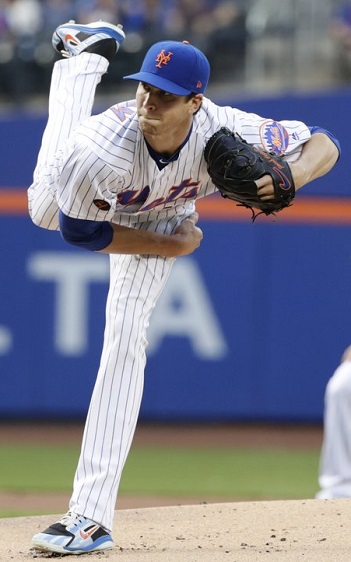
The Mets may soon be owned by a man who paid more for one sculpture than they’re paying Jacob deGrom for the next five years.

Lose a pitcher, gain an owner? As it looked as though the Phillies would sign Zack Wheeler for five years and $118 million, less than he was offered by the White Sox, his now-former Mets looked as though they were about to sell an 80 percent stake in the team to a Long Island boy who, like me, has been a Met fan since the day they were born.

Steve Cohen has in common with me having seen our first Mets games courtesy of the original troupe who played in the ancient Polo Grounds while awaiting Shea Stadium’s completion. That’s almost the full extent of our common ground. For openers, at present he owns a four percent stake in the team, while I own nothing of the team but an alternate game hat and several books.

Cohen played baseball as a boy until a shoulder injury put paid, apparently, to any thoughts he had of growing up to pitch professionally, presumably in a Met uniform. His career ended with slightly more honour than mine did: I discovered 1) I couldn’t hit a fair ball unless the foul lines were moved to a single line crossing the rear point of home plate; and, 2) I couldn’t throw a strike unless the strike zone sat on the batter’s derriere.

So each of us ended our baseball careers and settled for pursuits less likely to provide even that one in a billion shot at immortality.

Mine was becoming an Air Force intelligence analyst and, following, a professional journalist at the regional level with a career described as fitful at best. Cohen’s was going to Wall Street and building a fortune that would, if he intends to buy that 80 percent stake in the Mets, make him baseball’s wealthiest owner almost overnight.

I say “almost” because the reporting holds that the incumbent Wilpons will stay in command for five more years. But the transition of power could happen sooner, as often it does. “According to my sources, Cohen, who is currently a minority owner of the Mets, would immediately own at least a tad over 50% should the deal be approved,” writes Mike Ozanian in Forbes. “Why would anybody buying a majority stake in a dysfunctional business allow the folks who ran it dysfunctionally for years keep running it? Time is of the essence.”

To see the reaction of Met fans who’ve despaired over what The Athletic calls the Wilpons’ “tight fisted and ham handed stewardship of the Mets” is to think the Messiah has come at long enough last. Met fans salivate over the prospect of the tight fists turning into open hands.

Cohen is known for a previous bid to buy the Dodgers (he lost out) and as an art lover and collector who once paid for one sculpture (Pointing Man, by Alberto Giocametti) $3.8 million more than the Mets agreed to pay their back-to-back Cy Young Award-winning pitcher Jacob deGrom for five years beginning in 2020.

The Wilpons’ fists tightened when they turned up among the wounded (victims and partial culprits alike) in the Bernie Madoff Ponzi scheme. Cohen’s SAC Capital Investors, which he built, copped to five counts of insider trading in 2013 and ponied up a $1.2 billion fine. Though Cohen himself wasn’t accused of wrongdoing, SAC Capital was barred from outside investments from there forward.

Cohen merely picked himself up, dusted off, and created Point72 Ventures three years ago and Cohen Private Ventures, which he says will manage his majority Mets stake if the deal is done. The Wilpons are still trying to get out from under the Madoff mess, which only began for them when they thought investing with Madoff would help them with things like the botched Bobby Bonilla deal. (Which the Mets must pay through 2035 at $1 million a year, for a player who’s been retired almost two decades.)

“Madoff ‘made’ them boatloads of money that never existed and they invested it in places they’re still trying to pay back (like their team *cough Bonilla* and television station),” writes Sarah Valenzuela of the New York Daily News. “By 2015, they were paying off about $100M/year to get to the principal amount of their debts, plus the cost of the recently built Citi Field.”

Fred and son Jeff Wilpon have been known as Steinbrennerian meddlers (George, not Hal) without much of anything resembling Steinbrennerian results after they wrested the team’s full ownership from co-owner Nelson Doubleday in 2002. And as often as not the meddlings were destructive enough to be considered human neglect.

The elder Wilpon once forced Hall of Fame pitcher Pedro Martinez to pitch a meaningless game for the box office in 2006 despite a toe injury; it may have aggravated shoulder issues, invited 2007 season-losing surgery, and limited Martinez in 2008, to the point where he returned to the Red Sox after his deal expired to retire as a Red Sox.

When Doubleday wanted in the worst way possible to bring Hall of Famer Mike Piazza to the Mets in 1998, Wilpon actually tried to thwart the deal. Today Piazza’s Hall of Fame plaque shows his head under a Mets cap. Way to call ’em, Fred. Meanwhile, for every Carlos Delgado, Carlos Beltran, and Johan Santana acquisition there were Bonilla’s second Mets deal and acquisitions of aging, past-prime, or completely lost players almost too numerous to mention.

Wilpon pere and Wilpon fils have also been renowned for blocking signings and deals their baseball brain trusts have recommended strongly enough to them while signing off on signings and deals described as dubious most charitably.

And no managerial firing in the Steinbrenner Yankees’ history was half as despicable as the manner in which Wilpon ordered the executions of Willie Randolph, his pitching coach Rick Peterson, and his first base coach Tom Nieto in 2008—after the team traveled to Anaheim and won the first game of the road trip. And after midnight while they were at it.

But before my fellow Met fans drink too deep in celebrating the advent of the Cohen era, they may do wise to ponder the Wednesday evening caution from MLB Trade Rumours‘s Steve Adams:

Any ownership-level shakeup, of course, can have payroll implications for a team, but there’s no immediate indication that the Mets will increase spending in the near future. To the contrary, multiple reports this week have indicated that the Mets may need to move some undesirable contracts before spending further this winter — a reality that has long since been apparent to any who’ve closely examined the team’s payroll outlook. As for what would happen with regard to team payroll down the line, that can’t be known at this time, but it’s worth highlighting that the Bloomberg Billionaire Index lists Cohen’s net worth at a staggering $9.2 billion.

Today’s announcement seemingly puts a finite window on the Wilpons’ rein atop the organization and, as ESPN’s Buster Olney points out (Twitter link), perhaps explains why the club has been so focused on winning as soon as possible and making splashy moves toward that end.

That’s a somewhat extensive way of reminding Met fans—since the day they were born and otherwise—how wise it is to cut the cards no matter how deep you trust Mom.

Cohen grew up on Long Island in Great Neck, a well-to-do place in Nassau County familiar to me mostly as the home of a classic opulent wedding-and-bar-mitzvah semi-factory. Leonard’s of Great Neck, now Leonard’s Palazzo, is known to television fans as the joint where Johnny Sack asked Tony Soprano to perform a hit before Sack was hauled from his daughter’s wedding back to prison, in season six, episode five.

Take that, Mr. Cohen: After my parents moved us from the north Bronx, I finished growing up (har, har) in Long Beach, an island strip across a channel in southern Nassau which had a little bit of every economic strata, a lot of beach and boardwalk, and a home for Don Vito Corleone in The Godfather, from which son and heir Michael plotted and delivered the execution of the heads of the Five Families.

My mob’s better than your mob. #LFGM.

“At least the Reds are trying”

2019-12-03 MikeMoustakasGeorgeBrett

Mike Moustakas (8) sharing a World Series win commemoration with Hall of Famer George Brett. The Reds hope Moustakas helps them to a Series in the next four years.

It’s not that he’ll be the biggest off-season free agency signing, but Mike Moustakas landing four years and $64 million from the Reds made quite a bit of noise to open the week. On the surface, the Reds seem to be shifting into win-now gear, after remaking their starting rotation last year. Below it?

It may prove a mixed bag. May.

“The Cincinnati Reds finished twelfth in the National League in on-base percentage (OBP) in 2019, ahead of two teams in strong pitchers’ parks and the underpowered Miami Marlins,” writes Smart Baseball author Keith Law for ESPN. “So of course, the Reds just committed four years to a 31-year-old hitter without a position who has posted a .320 or better OBP twice in seven full seasons in the majors.”

Law thinks, therefore, that Moustakas might have fit “a lot of clubs” but not the Reds. They needed an upgrade at the plate, finishing twelfth, too, in 2019 runs scored despite their delicious home hitters’ park. And whenever Moustakas played in Great American Ballpark until now, he wasn’t exactly a game buster: he’s hit a buck ninety-eight with a .578 OPS in the big bat-embraceable park to date.

The Athletic‘s Jayson Stark demurs from Law: he thinks the Reds “love the bat, love the fit and love the edge this guy plays with. They’re not more talented than the Cardinals, Brewers or Cubs as currently constituted. But in the times we live in, we should all be applauding any team that is trying to win. It sure beats the alternative.”

As a Brewer in 2019, Moustakas posted a career-high .845 OPS, a career-second .329 OBP, and a career-second 270 total bases. He also hit the second-highest season home run total of his career (35) and was able to drive in the second-highest number of runs in any of his nine seasons. The Reds like power and reaching base about equally, but Moustakas gives them far more of the former.

Since it looks as though Eugenio Suarez has a vise grip on the Reds’ third base job the plan seems to be shifting Moustakas to second base. Not a terrible thought, since he’s played the position before and shaken out as about the league average in the 47 games he did play there. He won’t injure them around the keystone.

He’s had an odd journey to this deal. When he first hit free agency, nobody but his incumbent Royals seemed to want him—and he settled for a single-season $6.5 million deal with the team he helped win two pennants and a World Series. And they traded him to the Brewers in 2018 while they were at it. He looked good enough for the Brewers to want him back; last winter’s mostly dead market turned into a single season and $10.5 million.

But the Reds are also buying a player who earns respect in his clubhouses, takes a few burdens off his managers that way, and also fits with manager David Bell’s penchant for double switching when the games get hot and tight, and a two-position infielder is a fine fit for it.

Banking on Moustakas’s power (he doesn’t walk much, he can be double play prone, and he has little basepath speed despite a satchel full of basepath smarts), defensive steadiness, and personality—including his postseason experience (two World Series, three League Championship Series, and this year’s wild card game)—may show the Reds mean business for 2020. And since they say they’re willing to spend a little more, Moustakas won’t be the only card the play this winter.

“When a team spends to sign a good player to aid their chances to win, it merits acknowledgment, if not applause,” writes another Athletic scribe, Andy McCullough. “At least the Reds are trying. And at least Moustakas got paid.” Right there that could be the beginning of a beautiful friendship.

Seymour Siwoff, RIP: Look it up

2019-11-30 SeymourSiwoffJohnLabombarda

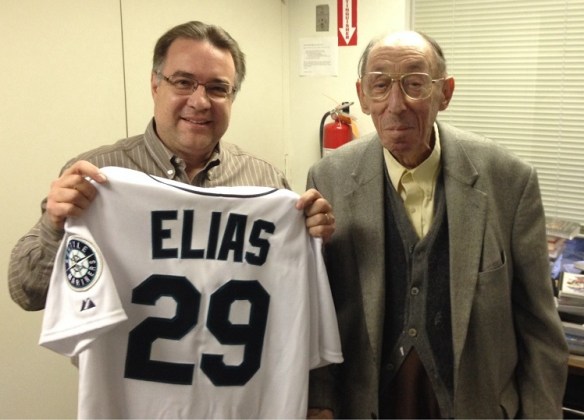
Seymour Siwoff (right) with the Elias Sports Bureau’s John Labombarda in 2014, after a Mariners blog presented them with a jersey worn by a Mariner unrelated to the statistical family. (Yes, you could look it up, below.)

As James Thurber’s Squawks Magrew once said in naming a charming 1941 short story (and as Casey Stengel loved to say regardless), “You Could Look It Up.” As the longtime owner and president of the Elias Sports Bureau, Seymour Siwoff loved to insist, “Look it up anyway. Don’t trust your memory.”

Siwoff, who died Friday at 99, the same number of years as runs driven in by Hall of Famer Eddie Murray in his third major league season, once resembled a slender and balding Walt Disney wearing Groucho Marx’s mustache. He also earned a Purple Heart in the World War II infantry, which ought to tell you how much actual Mickey Mouse recessed within him.

And he was one of the three men (Branch Rickey and his find Allan Roth were the others, arguably) who seeded the garden of change in the way baseball and other sports’ fans and professionals analyse their games. The National League began something marvelous when naming Elias its official statistician in the 1950s.

“I thought I’d try it for a while,” said Siwoff, who actually once considered joining the Internal Revenue Service, lucky for us that he didn’t, about joining Elias in the first place, “and I wound up trying it for a lifetime.”

Today the bureau does that job for all major league baseball and five other professional sports leagues. As Stengel would also say, they’ve been rather splendid in their line of work, which tells you something about the man who first joined the bureau—while a high school student—two decades after its 1916 founding in New York by brothers  Al Munro Elias and Walter Elias.

And, at a time when meeting its payroll was about as simple as sneaking one past a healthy Lou Gehrig. Siwoff himself once endured a streak without weekly paychecks the way Original Mets pitcher Roger Craig endured a 1963 streak of being charged with eighteen consecutive losses, tying Clifton Curtis’s National League record. “Happily,” wrote Sports Illustrated‘s Jerry Kirshenbaum in a 1969 profile, “Siwoff has come to know better times.”

Although he still works at the same place that used to have trouble paying its help, he does so as the boss rather than as an employee. And he has become, as it was his heartfelt mission to become, the sports world’s No. 1 professional answer man. Although primarily a statistician, Siwoff traffics not only in the bare bones of figures and fractions but also in that somewhat fleshier matter that is sometimes called, redolent of a quainter day, dope. “My job isn’t just figuring out batting averages,” he says with an uneasy grandiloquence. “I’m in the business of problem solving, you might call it. I suppose you might even say that I’m running a think factory.”

Siwoff’s Elias developed a penchant for finding diamonds while mining for mere rubies. Kirshenbaum mulcted a typical such find: tasked by writers in the Wrigley Field press box for something in particular about Ernie Banks, Siwoff’s bloodhounds unearthed the knowledge that Banks’s fellow Hall of Famer Willie Mays actually played a game at . . . shortstop, Banks’s own original position. (Turns out Mays played two games at short lifetime. Yes, you could look it up.)

“It’s unbelievable the things you come across just leafing through these sheets,” Siwoff told Kirshenbaum. Siwoff then had four full-time employees working in a room the entrance to which featured a sign above: “Eternal vigilance is the price of accuracy in statistics.”

Kirshenbaum didn’t provide the date, but on 13 May 1969 the Wrigley pressmen wanted to know any previous time Banks drove seven runs in in a game. (He’d just done it against the infant Padres with an RBI double and a pair of three-run homers.) Siwoff’s hounds exhumed two previous such occasions: 4 August 1955 (against the Pirates) and 1 May 1963 (against the Cardinals).

“This intelligence went out immediately over the ball park’s public-address system to the crowd on hand and, via the press box, to the outside world,” Kirshenbaum wrote. “‘If Seymour says it’s so, then it’s so,’ testified Chuck Shriver, the Cubs’ publicity man. ‘He’s my bible’.”

During the 1980s and 1990s, the annual Elias Baseball Analyst was maybe not my full baseball Bible but at least the book of Leviticus. (Bill James’s annual Baseball Abstracts were my Numbers.) From which I discovered such wonderful things to know as which hitter loved or hated to face which pitcher based on the cumulative numbers and vice versa.

“[T]he good news is that our can-do country has gone and done it,” wrote George F. Will about the Analyst in 1985. “It has produced a baseball book that almost contains all the information citizens ought to be required to master before being allowed to vote.”

Do you have a Gibbonesque fascination with declines and falls? The book reveals that the 1984 White Sox were only the eighth team in fifty years to suffer a decline of 150 percentage points in their won-lost record compared with the preceding season. In 1984 Cleveland extended to twenty-four its record for the most consecutive seasons (excluding the 1981 strike season) finishing more than fourteen games behind the league or division leader. Before the 1984 Milwaukee Brewers did it, the last team to go in just two years from the best record in the league to the worst was during the Johnson administration. The time before that, Woodrow Wilson was in his first term.

For the records: the ’84 White Sox suffered that collapse the year after they won the American League West; before the ’84 Brewers that collapse was suffered by the 1966 Yankees; before them, it was the 1914 Philadelphia Athletics, after two straight seasons with the American League’s best record. And you could look it up.

Those were the days before the Internet and the resources of Baseball Reference and retrosheet.org, who are called fairly the grandchildren of Siwoff, Rickey, and Roth. The days when an ordinary baseball fan’s deepest commercially available statistical abstract was the Reader’s Digest-sized Who’s Who in Baseball.

Elias wasn’t above puckishness, either: its Analyst for the 1987 season noted overly self-critical Red Sox reliever Calvin Schiraldi most hated to face effervescent Hall of Fame Mets catcher Gary Carter with two outs. Though all things considered I might have said “Ray Knight with deuces wild.” (Two strikes, two outs, two on. If you have to ask, you could look it up.)

The days about which Kirshenbaum could write and get away with saying, “In encouraging the proliferation of statistics, Siwoff has had the good sense to realize that they are valuable only insofar as they reflect what happened in yesterday’s game and generate interest in what might happen tomorrow. They thus are tools primarily for the historian and the public-relations man, an insight that eludes the fetishist who indiscriminately collects meaningless statistics for no apparent reason but to talk to them, little caring that they often have nothing to say in reply.”

Except that Siwoff hit that one over the center field fence almost promptly:

Statistics can be cold and trivial. But they can also be alive and full of drama. When a batter hits three home runs in a game and then comes to bat for the fourth time, and if you know that only a few people have ever hit four in history, what could be more dramatic? The excitement in the air is unbelievable. It’s electric. And what about a no-hitter? That’s a statistical thing. But, wow, what a thrill when the pitcher keeps retiring the side and the crowd starts buzzing in the seventh and eighth innings. It’s unbelievable.

But what I enjoy most about statistics is the chance they give you to relive the past. When Ernie Banks gets seven RBIs in a game or when Reggie Jackson gets 10, it brings back memories of when Jim Bottomley drove in 12 or Tony Lazzeri drove in 11. In looking up things like that, I can see those guys in my mind as clearly as if they were playing again. And to think that when Jackson got his 10, he struck out one time at bat with the bases loaded. How do you like that?

That was decades before we began examining the absolute depths of what players we couldn’t and didn’t always get to see did or didn’t accomplish. Decades before the serious fan and serious analyst discovered beyond simplistic baseball cards that statistics, the life blood of baseball, enable you to stand athwart nostalgia yelling “Art!”

Little by little, piece by piece, Siwoff, Rickey, and Roth abetted or inspired their eventual disciples to seek and find the meaning of such feats, such meanings as the run batted in being as team dependent as it was on the hitter who drove it in; such meanings as what the pitcher actually controls as opposed to what his team does behind him; such meanings as whether the spectacular fielder really prevented all that many runs against his teams.

Siwoff’s Elias also pioneered the batting and pitching split analysis now as common as breakfast coffee, not to mention mulcting day game/night game splits, home/road splits, and even isolating how batters actually as opposed to allegedly hit with runners in scoring position.

Siwoff returned to Elias after his World War II service, stayed as it struggled a few years to come including when the last active Elias family member died and when the bureau lost big accounts with newspapers to an Associated Press stat service. Siwoff bought Elias from the co-founders’ widows. “As bad as the business was,” he told Kirshenbaum, “I couldn’t let go. It was like an infection.”

An infection not to be cured, blessedly so. Professional sports swelled or re-swelled in the 1950s and Elias swelled with it, especially after the National Football League made the bureau its official statistician in 1960, thus keeping the bureau gainfully employed during baseball’s non-performing off-season.

“Siwoff has experimented with computers on a limited basis, but he has dim hopes for any system that could possibly program all the statistical information he deals with daily and yet be within his reach financially,” Kirshenbaum wrote. Little did he or Siwoff know.

Elias today provides the deep dope to publications on and offline as well as broadcasters, teams, and organisations. We’ve come a long way, baby, from Allan Roth’s reams of graph paper and Topps baseball cards’ Elias-provided statistical minimalism. Today Siwoff’s grandson, Joseph Gilston, owns Elias. Grandpa continued keeping regular office hours until just a few months ago.

“One of the things I’ve admired is that he really tries to learn something new every day,” Gilston told the Toronto Star about his grandfather last March. “He’s an incredible story of somebody who’s just constantly looking for what’s next.” Who also helped teach baseball fans to look constantly enough not just for what was but for what was deeper and what might yet theoretically be.

Quick: Name the only major league baseball player ever to carry the Elias name. Hints: 1) He’s not even close to being a relative of the statistical Elias family. 2) He’s now a member of the world champion Nationals, though he wasn’t on their postseason roster. Answer: Roenis Elias, Cuban defector and lefthanded relief pitcher. And, yes, you could look it up.

Stolen signs of the times

2019-11-29 HiddenLanguageOfBaseballDepending upon your point of view, the freshly published second edition of Paul Dickson’s The Hidden Language of Baseball: How Signs and Sign-Stealing Have Influenced the Course of Our National Pastime is either a blessing or an intrusion. Its timing—arriving shortly before Astrogate broke—couldn’t possibly have been scripted better.

Especially considering Chapter 9, “Devious Digital Devices—From the TV Camera to the Digital Watch.” Which begins with Leo Durocher, perhaps appropriately, performing a deed people not named Durocher would have deemed inappropriate enough.

The Lip, of course, was the mastermind behind the off-field sign-stealing—with a hand-held spyglass in the Polo Grounds center field clubhouse, a buzzer to the bullpen, and relayed stolen signs to those men at the plate who wanted them —that enabled the 1951 Giants’ staggering pennant race comeback (from thirteen games down) to force the once-fabled playoff.

Now, Dickson described Durocher in the broadcast booth, which he joined for ABC’s Game of the Week after leaving the Dodgers as a coach in early 1965. “The American Broadcasting Company was banking on Leo to say and do outrageous things to boost ratings on the show,” Dickson wrote. “They were hardly disappointed.”

Durocher premiered on 8 May 1965, for a game between the Yankees and the second edition of the Washington Senators in D.C. Stadium (the future RFK Stadium). When the network spotted Vice President Hubert Humphrey (a Twins fan, as it happened) in the ballpark, they managed to invite him to join Durocher in the booth.

And the Lip simply couldn’t resist giving Humphrey an on-the-air tutorial in the fine art of baseball espionage. “With the aid of cameras placed by ABC in the dugout and outfield,” Dickson writes, “Leo gave the vice president a quick lesson in how to pick up signs and decode them.”

The cameras were live and real time, not on today’s eight-second delays. Humphrey wasn’t exactly thrilled, “clearly nervous about being put in this position as an accomplice and [he] observed flatly that there were no secrets anymore.”

How you accept that depends on your point of view otherwise considering Humphrey’s boss, then-president Lyndon Johnson, a man to whom chicanery wasn’t exactly alien. But then-commissioner Ford Frick wasn’t exactly amused, either, rebuking both Durocher and ABC publicly “for both the cameras and the live larceny.”

Lest you think the Yankees and the Senators had any cute ideas about the cameras, be advised that they were then managed by two men (Johnny Keane, Gil Hodges) who’d sooner be caught chasing skirts other than those wrapped around their wives than sanction high-tech cheating.

But thanks to Durocher, for the first time real high electronic baseball cheating as opposed to on-the-field gamesmanship or even mere telescopic cheating hit the press past the sports pages. It almost figured that it would be Durocher who was responsible. “[He] had not only willfully gotten himself into a jam,” writes Dickson, himself a Durocher biographer, “but also used the vice president of the United States as his foil.”

Dickson’s book is a remarkably entertaining travelogue through sign-stealing history, which only begins with its development based on flag signaling by soldiers in war and premiered in baseball near the Civil War, through the apparent courtesy of a team known as the Hartford Dark Blues. And, Dickson does an engaging job of discussing those whose on-field gamesmanship was more sophisticated and tougher to decipher than you might expect.

Perhaps his classic example is Hall of Famer Yogi Berra. Dickson writes that he was not only the best in his league at keeping his signs secret (his tricks included, especially, adding numbers on the scoreboard to those shown his pitchers with his fingers) but taught himself to pick signs based on the opposing catcher’s hand shadows he saw from the on-deck circle.

Berra once said he “wouldn’t take [a stolen sign] if their own catcher sent it to me Western Union,” but he was also adept at catching pitch tipping—especially his own pitchers, helping them correct accordingly. And fellow Hall of Famer Mickey Mantle swore the Yankees knew, among other things, when Hall of Famer Early Wynn would go to his knuckleball: it was the only pitch on which Wynn wouldn’t rear all the way back behind his head before throwing it.

That sort of thing was gamesmanship. Slipping people into things like the old-fashioned hand-operated scoreboards above or behind the actual playing field? A whole other thing, and more rampant than you may remember or know. “Periodically,” Dickson wrote, “someone would complain that they were being spied upon by men out of uniform hanging out in the scoreboard, and they would be answered by the official equivalent of a shrug and a scowl.”

Not even the New York Times could help. Dickson cited a story in that paper in 1956, when then-Orioles manager Paul Richards filed a formal complaint with the American League over the White Sox stealing signs with a telescope from the scoreboard. Both then-league president Will Harridge and a few more in the sporting press “mocked Richards.” Sports Illustrated even ran a piece including “a pictorial on signs and how one might learn to pick them from one’s seat.”

They missed the larger point, and that was in the aftermath of the 1951 Giants when their pennant-comeback spyglass-to-buzzer plot was still whispered but didn’t lead to arraignments. The larger point: Decoding signs from the on-deck circle based on a catcher’s hand’s shadow isn’t the same thing as decoding them through an off-field telescope. Or from a hot live real-time off-the-field camera feed.

Which is exactly what Sean Doolittle, the likeable and never-at-a-loss relief pitcher for the world champion Nationals, said in a tweet, two days after The Athletic‘s Ken Rosenthal and Evan Dillich reported former Astro pitcher Mike Fiers’s revelation about that team’s 2017 center field camera-to-clubhouse television set-to-bang on a can stolen sign transmission:

Sign stealing is part of baseball. It’s gamesmanship. A runner picking up signs from 2nd base or looking for how a pitcher might be tipping his pitches based on how he comes set is fair game. If you can do it using your eye balls it’s ok. If you’re using technology it’s cheating.

The TVs in the clubhouses and bullpens are on AT LEAST an 8 sec delay. MLB posts employees in the video room to prevent messages being relayed to the dugout. It’s impossible to use those feeds to pick up signs and relay them in real time.

Almost a full week has passed without new Astrogate revelations. Such silences don’t seem likely to become the exceptions. But Molly Knight, another writer for The Athletic, has a thought for you: the news may have infuriated pitchers the most.

Comments from players haven’t exactly flooded the joint since Fiers first blew the whistle on and the covers off the Astro Intelligence Agency. But Knight has mulcted comments from pitchers around the circuit. And they’re no more amused than Hubert Humphrey was over Leo Durocher’s live lecture in applied espionage.

“If a team is using cameras and decoding your sequences for live relays,” Knight quoted an unidentified pitcher who faced the Astros in 2017, “you’re losing a war that you weren’t informed of your own participation.”

You know that with a runner on second you have to be careful because they see the signs and decipher them. You know that you can’t have an obvious tip because the other team will find it and pounce. Those are known battlegrounds. But this isn’t a fair fight because you weren’t aware the fight existed.

We’ve come a long way, seemingly, from the days when field glasses, spyglasses, and even telescopes off the field and through the scoreboards actually did have baseball people both alarmed and amused. Enough so that by 1961-1962, Dickson writes, the issue actually threatened to become a full-fledged scandal.

First, an unidentified former player turned manager and coach told Baseball Digest he didn’t think that kind of espionage was present “for a long time.” But he kept his identity secret because it “might give me a bad reputation with the coaches who like people to think they’re always swiping signs.”

Then Hall of Famer Rogers Hornsby wrote an article for True called “You’ve Got to Cheat to Win.” In which among other things he had words for Al Worthington, the relief pitcher who quit the White Sox rather than acquiesce in their sign-stealing operation inside Comiskey Park’s fabled exploding scoreboard. “[M]ost of the newspapers said [Worthington’s] was a salary argument,” Hornsby wrote. “In my book, it wasn’t. In my book he was a baseball misfit—Worthington didn’t like cheating.”

That and other Hornsby pronouncements—including what Dickson paraphrased as “a massive Indian head with moving eyes in an ad for Uneeda Water in the Detroit outfield,” the moving eyes used by the Tigers to relay stolen signs—cause a spring training uproar in 1962. Especially when the True article was expanded into a delicious portion of Hornsby’s freshly published memoir, My War with Baseball.

At about that time, Jay Hook—taken off the ’61 pennant-winning Reds by the expansion Mets—told United Press International that those Reds had “scoreboard spies swiping the rival catchers’ signs” from Crosley Field’s walk-in, hand-operated scoreboard. Leonard Shecter—then a New York Post writer, eventually Jim Bouton’s Ball Four editor—called such a spy “the fiend abroad in the ballpark with a pair of field glasses . . . [like] the driver who knocks down an 89-year-old pedestrian. It’s easy but unsporting.”

Then, the Associated Press sportswriter Joe Reichler wrote maybe the first story for publication charging the 1951 Giants with high tech-for-the-time sign stealing down that stretch. Between several emphatic denials and the anonymity of the accuser, who may or may not have been associated with the Giants later on, the story’s noise life wasn’t very long.

Jimmy Piersall, the acrobatic outfielder who’d suffered a nervous breakdown while with the early 1950s Red Sox, wrote a Baseball Monthly article that spring ’62 in which he said, as Dickson phrased it, every part of the ballpark could be and often was rigged. The article was called, “How the Home Team Cheats.” Bill Veeck’s charming memoir Veeck—As In Wreck, was published at the same time, the maverick owner admitting he wasn’t above a little chicanery himself.

Even authorising the White Sox’s exploding-scoreboard spy network. The one that compelled Al Worthington to take a hike. The hike that compelled Rogers Hornsby to dismiss Worthington as a baseball misfit.

All that hoopla died its death in due course, though not without its ironies. The very name of Dickson’s chapter about it says it all: “1962—the Year of the Revisionist Finger Pointers.” Including Birdie Tebbetts, managing the Braves in June 1962, now telling Times columnist Arthur Daley that all that telescopic cheating just had to stop if “you believe in the integrity of the game the way I do.” The way he did when his 1940 pennant-winning Tigers used pitcher Tommy Bridges’s rifle scope to swipe signs from the stands behind the Briggs Stadium outfield.

Leo Durocher tutoring Hubert Humphrey to one side, high-tech sign-stealing charges tended from 1962 forward to be low-keyed and dispatched swiftly enough. Before such things as Mick Billmeyer’s bullpen binoculars, the Blue Jays’s Man in White, the Padres’ TV well spy, the Red Sox’s Apple Watch, and, of course, the Astro worker near the Red Sox dugout who claimed he was trying to be sure the Red Sox weren’t up to no good during the 2018 American League Championship series, wink wink, nudge nudge, suuuure he was.

“Baseball doesn’t have a sign stealing problem,” wrote the Washington Post‘s Dave Sheinin, as cited by Dickson, when the Brewers hinted that the Dodgers were doing it the electronic way during the ’18 National League Championship Series. “It has a technology problem.”

No longer is it just the runner on second base with a clear view of the catcher’s signs to thwart. Now it’s that guy in the center field seats with the telescoping camera or the strength coach in the dugout with the smart watch or the dude in the camera well with the tablet.

An old gag from the hippie era used to hold, “Just because you’re paranoid it doesn’t mean someone isn’t watching you.” And just because baseball in 1962 or 2018 got paranoid about high-tech cheating, it didn’t mean that people weren’t doing it, either. Mike Fiers exposed the Astros doing it. Commissioner Rob Manfred’s investigation is certain to turn up more.

And don’t think fans don’t have the occasional hand in it. Bob Buhl and Joey Jay were exposed by Cub fans who recognised them and warned the Cub bullpen. Days after the Red Sox were caught taking a bite of the Apple Watch, a Yankee fan decided to do Yankee catcher Gary Sanchez a favour at the plate. Dickson tells it better:

[A] fan with a good view of the catcher and a strong set of lungs bellowed out information to . . . Sanchez while he was hitting in the eighth inning of his team’s game with the Tampa Bay Rays. Sanchez heard the voice, but so did Rays catcher Wilson Ramos and the home plate umpire, Dan Bellino, who pointed out the man to stadium security and had him removed from the stadium . . . “You could definitely hear the guy screaming, ‘Outside, outside,’ but you don’t know if it’s going to be a slider or a fastball,” Sanchez said afterward. “You got to stick to your plan, whatever plan you have, regardless of what people are screaming.”

That, Dickson wrote, may have been the first time a fan was thrown out of a game for sign stealing. By the way, Sanchez’s plate appearance ended with a bloop single to send home the fifth Yankee run in a 6-1 win.

Dickson has added a chapter around the Red Sox’s Applegate: “It would appear, at least at this writing near the end of the 2018 season, that the specter of electronic sign-stealing has not raised its head.” I wonder if he wishes now that he’d waited until next year (no pun intended), when Astrogate will be resolved one way or the other, to bring forth The Hidden Language of Baseball‘s second edition. I know I do.

It didn’t start with Astrogate

2019-11-24 LeoDurocher

Leo Durocher’s taste for baseball espionage didn’t stop with the 1951 Giants’ clubhouse spyglass and buzzer to the bullpen.

The Astrogate watch continues apace. Commissioner Rob Manfred and his bloodhounds have widened the dragnet. They’re now said to be asking players “associated with the organization what they know about a range of alleged [electronic] sign-stealing techniques” in 2017 and in 2018-2019.”

And, according to ESPN’s Jeff Passan, still-active players who tell the truth “can expect leniency in exchange.” It ought to be interesting at minimum when we discover at last which players knew what or did what.

The bloodhounds will look into such devices, Passan says, as “‘buzzing,’ via the use of Band-Aid-like wearable stickers; furtive earpieces; pitch-picking algorithms; and other potential methods of sign-stealing.”

In other words, the probe is going above and beyond just a camera beyond center field transmitting real-time signs to a television set posted in the Astro clubhouse where someone, who knows whom just yet, sent the stolen sign to the man at the plate with a big bang or two on a large plastic trash can. Cheating’s gone as high tech as real world espionage.

It’s almost enough to make you pine for the Good Old Days of the Grand Old Game. When just about the most high-tech chicanery you could uncover in a baseball game involved buzzers and telescopes, whether hand-held Wollensak spy glasses a la the 1951 Giants or hobby-shop telescopes on tripods. An eventual World Series contestant thought of that one in 1948.

The Indians had a three-game lead in the American League as of 20 August, not to mention a four-game shutout streak, after Hall of Famer Satchel Paige threw the fourth straight shutout at the White Sox in Chicago. The next day, Hall of Famer Bob Lemon extended the shutout innings streak to 47 innings before the White Sox pulled out a 3-2 win at the last minute, and the Indians went on to lose eleven of their next eighteen games.

That dropped the Indians to three behind after Labour Day. And, wrote then-first baseman (and future coach and front office exec) Eddie Robinson, in his memoir Lucky Me, it prompted “one of our hitters” (Robinson didn’t say whom) to suggest that desperate times called for a desperate measure:

We picked a spot in the Municipal Stadium scoreboard in center field, and placed one of our pitchers out there with a telescope sitting on a tripod. Our pitcher would let us know when he had the opposing catcher’s signals. We had one of the grounds crew dressed in a white uniform sit in the bleachers alongside the scoreboard. For the hitters who wanted the signals, he’d hold his legs together for a fastball, spread them for a curve ball, and get up and walk around if he didn’t have the sign.

So if anyone watching a late 1948 game in the old Mistake on the Lake saw a man in white next to the scoreboard opening and closing his legs and walking around, he wasn’t doing one of the dances men do when they need the men’s room desperately but are just as desperate not to miss the action on the field before the sides changed between innings.

“Some of our hitters, including me, didn’t want the [stolen] signs,” Robinson wrote, partially because Hall of Famer Rogers Hornsby, who’d been a spring training instructor for those Indians, told him just to hit what he saw. “Of course, Hornsby was so good he could just react to the pitch,” Robinson continued. “I probably shouldn’t have followed his advice because I wasn’t as good a hitter and needed all the help I could get. I should’ve been looking for pitches.”

Starting with the nightcap of a Labour Day doubleheader, the 1948 Indians won 20 of their final 26 games including the famous pennant tiebreaker against the Red Sox. Robinson swore the Indians never tried their telescopic theft on the road including in Fenway Park (where the scoreboard sat invitingly at the bottom of the Green Monster, then and now) or in the World Series. (The Indians beat the Spahn-and-Sain Boston Braves in six games.)

“I’ve always thought sign stealing from way out there was overrated,” Robinson wrote, “and it rarely if ever has had any impact on the outcome of a game.”

The key may be “rarely.” The Indians fell to four and a half back by Labour Day before the string to win the pennant. The ’51 Giants—with their center field clubhouse Wollensak spyglass and buzzer to the bullpen for sign-stealing—came back from a thirteen-game deficit on 11 August to force the fabled pennant playoff.

And manager Leo Durocher didn’t exactly retire his intelligence operations when he left the Giants a year after managing them to a World Series sweep against a later crew of Indians. The Lip got very creative when he turned up managing the Cubs in the late 1960s-early 1970s, including their lively 1969 National League East race with the Miracle Mets. Enough to make his ’51 Giants resemble the Flintstones.

During the thick of the Watergate scandal, Victor Lasky recorded a very credible history of previous White House and other politically-based crimes and published it under the title It Didn’t Start with Watergate. Baseball historian Paul Dickson’s delivered an updated edition of his 2003 book The Hidden Language of Baseball. He could have subtitled it, plausibly, It Didn’t Start with Astrogate.

Dickson talks about sign stealing in just about all its ways, shapes, and forms. Including that Durocher often had the opposition clubhouse bugged with eavesdropping devices. “[Hall of Famer] Gaylord Perry, pitching for [the Giants], later related that when the Giants detected this, they held team meetings to loudly discuss bogus pitching plans just to confuse the Cubs.”

Durocher probably wasn’t the only Cub skipper or brain truster with a flair for technological espionage, either. Charlie Metro—once one of the Cubs’ infamous early 1960s College of Coaches managerial rotation—revealed those Cubs used a closed-circuit camera whose receiver was in “a little room” behind the dugout that wasn’t unlocked until game time.

Metro himself had the rig dismantled when he became the Cubs’ third and final manager—er, head coach—during 1962. “I didn’t like the device,” he said, “and, besides, our batters were so poor they couldn’t hit the ball even if they knew what was coming.”

As a matter of face, Dickson wrote further, the 1977 Rangers were so convinced that the Yankees were bugging visiting teams a la Durocher that they once had the Yankee Stadium visitors clubhouse swept by an electronics expert.

The Rangers should have known if anyone did, Dickson revealed: when Yankee manager Billy Martin managed the Rangers earlier in the 1970s, Martin used their closed-circuit television system to steal opposition signs on their behalf. You can’t bug the enemy clubhouse! Only we can bug the enemy clubhouse!

When Hall of Famer Frank Robinson managed the Orioles in 1990, Dickson wrote, he thought the White Sox were up to a little tech espionage—he caught White Sox coach Joe Nossek, a reputed sign-stealing expert, behind the first base dugout with a walkie talkie to send Oriole dugout signs to White Sox skipper Jeff Torborg.

The next year, Robinson caught onto the new Comiskey Park (known today as Guaranteed Rate Field) including a video room right behind the White Sox dugout, “providing manager Torborg and his coaches easy access to the catchers’ signs, as shown by the center field camera as well as the dugout and the third base coach.”

Robinson and the Orioles complained to the American League about the White Sox both times. Both times the league did three things: jack, diddley, and squat. “I’m convinced,” Robinson said, “that they are the one team who cheats.”

Remember: all that technological spookery from off the field is/was against the formal rules of the game and, even if it hadn’t been, was still considered above and beyond the normal gamesmanship pale. Coaches can decipher and steal dugout signs; players can steal them on the bases, and nobody would really call for an investigation. Cameras off the field and bugging devices in the dugout? Unlawful.

And, as The MVP Machine co-author Ben Lindbergh reminds us, whether or not such off-field-based espionage really did you some big favours in the end—the ’51 Giants had that thirteen-game deficit comeback but lost the World Series; the 2017 Astros, not yet shown to be doing it on the road somehow, were better on the road than home until the postseason—doesn’t make it right.

The Astros’ brand of sign-stealing was more brazen than most, and possibly longer-lasting. In its 2017 form, at least, it’s also easier to see, now that we know what we’re looking and listening for. (They didn’t have YouTube, Twitter, and sound-processing software in 1899.) That’s embarrassing for baseball, so the Astros will pay in some way for their crimes. While the baseball world waits to hear Houston’s sentence, it will wrestle anew with some of the sport’s peskiest questions. How widespread is sign-stealing? Can (and should) sign-stealers be stopped? And maybe most unanswerable: How well does sign-stealing work, anyway?

If it’s not old-fashioned on-the-field gamesmanship, it doesn’t matter how well it works for you. Just because you didn’t commit history’s first murder doesn’t acquit you if you tried but failed to commit murder today. Just because your team isn’t the first to commit high-tech sign espionage from off the field doesn’t acquit you if you get caught, either, and it doesn’t matter if it didn’t do you the favours people think it did. Just ask Watergate’s version of Car 54, Where Are You.

Now, something really scary. I pondered it aloud early on during Astrogate, but it’s worth revisiting for now. Trevor Bauer, pitcher, is as well known for his hobby of building and flying camera-wielding drones (he once sliced a finger repairing one during the 2016 World Series, when he pitched for the Indians) as for his unusual training methods.

Bauer once demonstrated his drones to television technicians for potential game coverage techniques, including showing them a panorama flight around Progressive Field and following Indians outfielder Tyler Naquin around the bases when Naquin hit an inside-the-park home run in a game.

Don’t assume someone isn’t pondering Bauer’s drones and their prospects for sign-stealing once they master the building and deployment of those drones. Or, if somebody actually dreams that up, some team or maybe even an umpiring crew preparing strategic defense initiatives. (Wouldn’t that be a sight at the old ball game—time called to shoot down drones?)

If you think that can’t really happen here, I have an Antarctican beach club to sell you cheap. Because whatever comes down upon the Astros and anyone else Manfred and his bloodhounds uncover as guilty of off-field-based sign espionage, and whatever heavy sanctions Manfred drops on the culprits, boys will be boys. Always have, always will.