The Angels bag Tony Two Bags

2019-12-12 AnthonyRendon

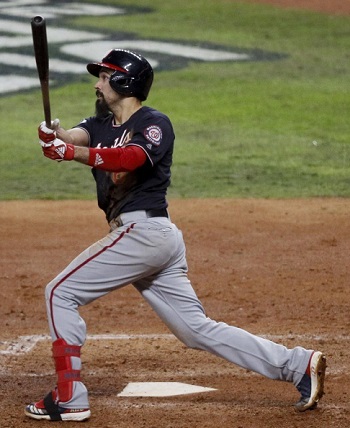
Anthony Rendon hitting the two-run homer that started yanking the Nationals toward winning World Series Game Seven. Tony Two Bags swaps his shark teeth for a halo now.

In need enough of upgrading their starting rotation, the Angels missed their chance to bring either Gerrit Cole or Stephen Strasburg back to their California roots. So they signed Strasburg’s fellow now-ex-National, third baseman Anthony Rendon, for the same time and dollars (seven years, $245 million) it took for the Nats to grant Strasburg’s real wish to stay home in Washington (he’d bought a home there quite recently) for the rest of his baseball life.

Tony Two Bags swaps his shark’s teeth for a halo. And now that they’ve turned third base from a swamp into rolling rapids, the Angels can get right back to the pitching pursuit.

They needed to upgrade at third base almost as badly as they need a pitching upgrade. A trio of third basemen produced a combined 2019 OPS (on-base plus slugging percentage) .359 lower than Rendon’s 1.010. And if nothing else Angel fans should be frothing at the mouth over the prospect of Rendon joining the game’s prize Trout in a tag team that accounted for 14.6 wins above replacement-level last season. That’s a remarkable enough difference if they could have been together then.

Fourteen wins might have meant an 86-76 instead of a 72-90 Angels season. Assuming the Angels don’t stop with Rendon on this winter’s market, free agency or trading alike, they still have room for the pitching upgrade. And to say the Angels require a pitching upgrade is to say Washington, the government and not their world champion baseball team, requires remedial constitutional training.

The entire 2019 Angel staff encouraged walking for sound mind and body; they walked 3.9 batters per nine innings while striking out 8.8 per nine. Their collective earned run average was 5.12 and their collective fielding-independent pitching was 5.04. Collectively they were stingy when it came to surrendering big flies (1.7 average per nine innings) but generous beyond belief when it came to atoning for strikeouts by letting the other guys do the stroll. (2.44 K/BB ratio.)

The bullpen was superior enough to the rotation that you wondered for a few moments why the Angels didn’t go to more bullpen games when feasible than they did. (The crown jewel, of course, was that 13-0 combined no-hitter blowout against the Marines in their first home game following the shocking death of Tyler Skaggs, their best starting pitcher.) The only Angel with an ERA and an FIP below three? Hansel Robles, relief pitcher, the former Met who succeeded where another former Met (Matt Harvey, started) had his moments but collapsed enough to be designated for assignment and released.

What to do this winter, then? At this writing Madison Bumgarner, whose postseason jacket has only Strasburg for a near-equal match, remains on the market and a solid candidate to continue the remaking/remodeling he began in 2019. Also on the market is Hyun-Jin Ryu, the National League’s 2019 ERA leader. Angels owner Arte Moreno is nothing if not a man with stupid money to spend and a reputation for several times spending stupid, but the Angels aren’t exactly hurting for resources and a Rendon signing doesn’t pull them out of the market quite yet.

Bumgarner isn’t likely to cost as much now as he might have a few years ago, and the latest reporting as I write indicate he seeks five years at $100 million, pricey in terms of the average annual value but something of a bargain over the life of the deal. He has a reputation as a Fun Policeman but isn’t otherwise sinister so long as you keep him away from dirt bikes and remember that Angel Stadium’s power alleys don’t point into the Pacific Ocean or any other body of water.

He might find himself having a blast challenging two-way Shohei Ohtani to home run contests in batting practise. And, swapping notes on postseason heroism with Rendon, who landed himself a lifetime of quaffs and steaks on the house or at cut rates with such heroics as Game Five of this year’s division series, Game Seven of the World Series, and a 1.093 OPS toward the Nats’ run to the Promised Land.

Ryu may or may not be a more elusive target, not that he’s seeking stupid money but that there are several teams training their sights upon him, including (it’s said as of this morning) the White Sox, the Twins, and the Dodgers for whom Ryu laboured six seasons. And the White Sox have a kind of incentive with Ryu’s former Dodger catcher Yasmani Grandal having signed with the White Sox for four years and $73 million and said with certainty enough that he’d love to catch Ryu once again.

The better incumbents among the Angels’ starting pitchers, Andrew Heaney and Griffin Canning, are suited better to number three and four positionings pending any adjustments they might begin making come spring. The talent is there for both pitchers but so has been the inconsistency. But the Angels have a concurrent dilemna with teams interested in prying Canning and their plus right field prospect Jo Adell away in any trades the Angels might seek for a starting pitcher. The Angels may have interest in David Price (a trade candidate) and Price might find himself having a bounceback in Angel Stadium, and the Indians’ Corey Kluber, another former Cy Young Award winner and incumbent bounceback candidate, might be another trade target, but general manager Billy Eppler’s challenge would be to bring them aboard without surrendering the family jewels or at least the holiday china.

Still, you have to hand it to the Angels for landing Rendon, the no-questions-asked best regular player on the open market this winter, who’s going to earn more per season than any third baseman in major league history. Just when it looked as though the Rangers had the most solid track to lay down for Rendon, they derailed it when they offered him six years when the third baseman sought the seven to which the Angels agreed. That, and not such silliness as ejaculated by some who think it’s the media’s fault because, you know, the media prefers the Rendons to be in New York or Boston or southern California, not Texas, is why Rendon chose to wear the halo. That and (never discount this car on a baseball player’s train of thought) the challenge of becoming a big enough part of the Angels’ return to contention and, who knows, the postseason soon enough.

Which is no less than the least the Angels could do en route reconstructing themselves into a team their and the game’s best all-around player, the one who made himself an Angel for life last spring, can be proud of. ESPN’s Alden Gonzalez isolates the point: “In short, the Angels want to win, they know there is a sizable gap to make up, and they’re willing to do what it takes to accelerate their timeline. They made a promise to Trout, who eschewed free agency to sign a 12-year, $426.5 million extension, despite barely sniffing October relevance. And the Angels made a promise to [Joe] Maddon, who chose to return to the organization, despite having his pick of managing jobs. The Angels told them they were going to do what it takes to compete. And with the Houston Astros engulfed in a sign-stealing scandal that could yield significant punishment, perhaps now is as good a time as any to take the leap.”

Nationals shortstop Trea Turner only wishes the Angels hadn’t taken the leap at their expense. He got tight enough with Rendon that they had T-shirts made proclaiming each other best friends. When Turner got the news that Rendon has become an Angel, he had shot for himself a video showing him removing his “Anthony Rendon is my favorite player” T from his drawer and kicking it against the wall. Nats reliever Sean Doolittle was a little less, shall we say, demonstrative, posting a GIF of Baby Yoda and a simple, “Goodbye, Tony.”

Maybe the Lerners could have afforded both Strasburg and Rendon. I thought so myself. But then Thomas Boswell knocked me back down to the planet in gentle but firm terms, when he wrote after the Nats re-signed Strasburg, “Before chanting, ‘The Lerners are billionaires, so just pay Rendon his money!’ look ahead just one year. After 2020, the Nats will have to replace or re-sign — in most cases at higher prices — Adam Eaton, Aníbal Sánchez, Sean Doolittle, Kendrick and Kurt Suzuki. Also, Trea Turner and Juan Soto will soon cost much more.” So maybe they couldn’t afford to keep Rendon among the sharks, too.

It makes a fellow not so proud to be an Astro

2019-12-10 AJHinch

A.J. Hinch, looking as though at minimum he’s been sent to the principal’s office.

Once upon a time a very different generation of Astros amused themselves on team buses and planes by singing a randy song to the tune of legendary musical humourist  Tom Lehrer’s “It Makes a Fella Proud to Be a Soldier.” The late Jim Bouton, an Astro from August 1969 until his aging arm plus the hoopla over Ball Four farmed him out to stay in 1970, said every new Astro received a copy almost at once. Then, he recorded the complete lyrics including this verse:

Now our pitching staff’s composed of guys who think they’re pretty cool,
with a case of Scotch, a greenie, and an old beat-up whirlpool.
We’ll make the other hitters laugh
then calmly break their bats in half,
it makes a fellow proud to be an Astro.

Those Astros hung on the fringe of the National League West race in divisional play’s first season. Today’s Astros, long since moved to the American League (they were the team to be named later in former commissioner Bud Selig’s move of his formerly owned team, the Brewers, to the National League), are three-time American League West winners in the midst of which also came two pennants and a World Series conquest.

Now the Astros have lost a pitcher who didn’t necessarily make the other hitters laugh while he broke their bats in half: Gerrit Cole, who served them better than well for two seasons and proved off-the-charts magnificent down this year’s stretch and in the first two postseason rounds. Reaching his first career free agency, Cole couldn’t resist the Yankees’ extending him a deal for nine years at $324 million, the highest ever to be paid to any major league pitcher.

Which tells you something about what can happen when a good pitcher in sound condition finally became a great pitcher in sound condition in 2019, after joining a team with deeper knowledge of the art and its array of correctives than his former team (the Pirates) ever seemed to allow. And Cole joins the team he helped defeat in this year’s American League Championship Series, the team he would have faced in Game Seven if not for Jose Altuve’s stupefying, game-set-and-pennant winning two-run homer in the bottom of the ninth in Game Six.

Everyone including myself ponders the immediacy of the winners and losers on this winter’s market after Cole’s signing. Including the Astros themselves, whose owner Jim Crane, as CBS Sports’s Dayn Perry observes, “is pointlessly worried about staying under the Competitive Balance Tax threshold. According to multiple reports, the Astros are even shopping star shortstop Carlos Correa in the name of payroll efficiency. The Astros are one hundred percent in win-now mode, and the idea of trading Correa and not bidding vigorously to retain Cole should have fans calling Crane to account.”

For that and a few other things, of course. And some of us including myself ponder, too, whether Cole will bring the Yankees such knowledge as he might have, intimate or otherwise, as regards, you know, the other stuff buffeting the Astros now. The Astrogate probe is now said looking beyond 2017, into both the seasons during which Cole suited up and pitched for the Astros, and you’d be less than human if you didn’t contemplate whether Cole would enlighten his new teammates on the Astro Intelligence Agency as did Mike Fiers when he signed with the Tigers, and subsequently joined the Athletics, after 2017.

Hours before the Cole signing detonated the world in general and the Twitterverse in particular, Astros manager A.J. Hinch discovered his presence at this week’s winter meetings in San Diego meant the press finding it impossible to resist asking him about Astrogate. It was certain that he wouldn’t answer questions about it because the commmissioner’s is an ongoing investigation. And far be it for Hinch to break the rules in this instance, one of which enjoins against speaking up or forth while such an investigation proceeds and progresses.

The cynic would chew on the continuing strain of accepting those rules you’re comfortable accepting and breaking those you’re comfortable breaking, on the assumption that Hinch was surely well aware of the AIA, since the concurrent presumption is that a baseball manager a) is responsible for the doings or undoings by those under his command and b) unlikely under most such circumstances to have disapproved above or beyond the customary “just don’t get caught, boys” admonition.

But still . . . but still . . . “If I was in your shoes, I would be on the other side of this table,” Hinch told the gathering in response to a question. “And I would want to ask questions and find answers and get some more information on the investigation and all the allegations and things like that. I know you’re probably expecting this, but I can’t comment on it. It is an ongoing investigation.”

Associated Press reporter Jake Seiner translated thus that Hinch “is eager to tell his side of the story regarding allegations Houston used electronics to steal signs en route to a 2017 World Series championship, but he is going to let Major League Baseball talk first.” The Athletic‘s Spink Award-winning Jayson Stark (presented his award in Cooperstown this past July) tweeted at about 5:34 p.m. Pacific time Tuesday, “”AJ Hinch just finished 19 uncomfortable minutes of meeting with the media. Mostly declined comment on anything related to the cheating investigation. Said he’s talked to MLB ‘a couple of times’ and now is just ‘waiting’ for a verdict. ‘Everything is in their hands’.”

If you’ve lost the track of the AIA flow chart, it’s this: Live, real-time camera operated from somewhere behind the center field playing area transmits live, real-time signs to the opposing pitcher, which transmission is seen on a large enough, duly connected monitor in the Astro clubhouse adjacent to the steps from the clubhouse to the dugout, in front of which someone, who knows whom just yet, deciphers the signs and transmits them to an Astro hitter with one or two bangs on a large plastic or vinyl trash can, dependent upon which pitch the victimised catcher called.

“I’ve committed my time and energy to cooperate with MLB,” Hinch went on to say Tuesday evening. “I’ve talked to them a couple times, and we continue to work with them as they navigate the investigation, and now we’re waiting with everything in their hands. So I know there’s still going to be questions. I hope there’s a day where I’m able to answer more questions, but I know today’s not that day. I know it will disappoint some people.”

In some other words, Hinch may be anxious to lay it down about Astrogate but any time you need Hinch—heretofore considered one of baseball’s most sensitively intelligent managers—don’t just whistle, and he won’t blow the whistle himself until he has some sort of official dispensation or pang of conscience to do so. If the rules of his profession enjoin against commenting publicly about an ongoing investigation, his immediate answer still leaves Hinch with a dubious look, though not even close to the one left to Crane when, at last month’s owners’ meetings, he, too, dismissed Astrogate questioning.

“If you want to talk about baseball, I’ll talk about baseball,” was Crane’s dismissal, as if electronic cheating from off the field, violating baseball’s specific rule against such espionage, and the likelihood that the Astros aren’t the only team operating such spy operations, had absolutely nothing to do with the game. The painfully few Astrogate comments from within the Astros’ apparatus have included hopes that the Astros don’t become the poster children for something not restricted to themselves, and that’s very much to do with baseball.

If Hinch and Crane were employed instead in the business of the government, answers like theirs might harry reporters and investigators toward exhuming a cover-up almost as ardently as they already harried to the original crime, misdemeanour, or contra-constitutional mischief. Reporters and investigators alike on the Astrogate trail are doing just that, surely. The safest assumption is that more than a handful of Astros knew about and availed themselves of the AIA that sauntered far past the accepted bounds of on-the-field gamesmanship.

Believing Hinch knew nothing of or ignored the operation particularly when the bangs! or the bang-bangs! on the can went booming forth insults our own intelligence. What could he believe they were? Teammates rooting? Between-turns batting practise by players anxious not to be more than a few hops from stepping in as a pinch swinger and thus not repairing to the underground batting cages? Practise for banging a drum slowly during a victory parade?

Commissioner Rob Manfred and his bloodhounds may discover very well that the Astros aren’t the only major league team with a taste for espionage—if they haven’t discovered that already. (Published reporting suggests that as of this writing almost sixty witnesses and over seventy thousand e-mails have been gathered with more, much more to come.) But Hinch is in a position that can’t hold very long, and he may yet experience a pang of conscience akin to that of his former pitcher Fiers, who blew the whistle on and pulled the covers off the AIA in the first place.

Hinch heretofore earned a reputation as one of baseball’s most sensitively intelligent managers, a reputation in danger of being very badly vaporised. His face Tuesday evening showed every suggestion of the schoolboy who knows his trouble has only just begun after he’s finished in the principal’s office. Like Fiers, his conscience pang wouldn’t necessarily mean naming or implying suspects. But Hinch would be to baseball as Alexander Butterfield to the Nixon White House, exposing its sophisticated in-house taping system under Senate questioning during the early Watergate peaks.

Butterfield installed the White House system and owned up. Hinch may or may not have conceived the AIA himself. If he didn’t but he was genuinely unaware, his looks could well become those of a man whose smarts were invaded by incompetence that would strike some as cruelly comic and others as tragic. It makes a fellow not so proud to be an Astro.

There’s no place like home

2019-12-10 StephenStrasburg

Stephen Strasburg makes himself a Nat for life.

The temptation is overwhelming. So for once let’s give in to temptation. Stephen Strasburg, essentially, closed his eyes, clicked the heels of his spiked shoes, and chanted the mantra, “There’s no place like home! There’s no place like home!” And made himself a Washington National for life. Which was the probable outcome, after all, when he first bought a home in the D.C. region and then finished 2019 as the world champions’ World Series MVP.

That, as no few commentators observed in the immediate wake of Monday’s news, is what happens when a pitcher learns within the earliest days of his major league baseball life that he happens to wear the uniform of a team that actually cares about him as a human as well as a pitcher in the long term and not the short range. Enough to withstand a small but incinerating storm of criticism for acting upon it.

That’s what Strasburg learned, not without a little kicking and a little whispering (he doesn’t exactly scream), between 2010 and 2012. When he first hit the old disabled list (known nowadays as the injured list) in July 2010 with a stiff shoulder, hit it again after being in too-obvious pain in the fifth inning of an August start, then underwent Tommy John surgery and missed the rest of that plus the entire 2011 season. When former pitcher-turned-broadcaster Rob Dibble, then a Nats talker, said on the air that Strasburg just needed to suck it up and not call in the cavalry to save his butt every time he felt a little ache, the uproar cost Dibble his job. And helped save Strasburg’s career.

There were none so blind as those who couldn’t and wouldn’t see that there’s no such thing as one size fitting every last pitcher who takes the mound, and that there’s no such thing concurrently as every last pitcher experiencing pain in the limb that earns his keep equaling crystal over iron. It only took baseball thought a century to grok that pitching careers lasting two decades or just beyond were aberrations and not pre-ordained actualities, that you couldn’t and shouldn’t, really, expect every highly talented arm to endure just because some were so fortunate.

Strasburg underwent a surgery named for a man who’d been a quality pitcher for twelve seasons prior to undergoing the first such procedure and twelve more to follow, but a man who wasn’t exactly renowned around the game for throwing like a human howitzer, either. When he returned for 2012, the Nationals elected not to allow their prize, a well-hyped, high-priced product of San Diego State in the first place, to overdo it despite any personal inclination, his first full season back. And once again the hoopla, this time accusing the Nats practically of tanking it on behalf of preserving the crystal, never mind that their 2012 and 2013 shortfalls had nothing to do with the Strasburg Plan.

Strasburg didn’t implode the Nats in Game Five of the 2012 division series, when they followed a 6-0 lead taken in the first two innings by trying to hit six-run homers with every other swing of the bat or by trying to throw three strikes with every pitch from the mound. It wasn’t Strasburg who told the 2013 Nats they could survive without lefthanded relief. He didn’t tell anyone that Bryce Harper could survive trying to make himself the second coming of Pistol Pete Reiser in the outfield just because today’s fences are only slightly more forgiving than the concrete wall in old Ebbets Field, or that the Nats could survive him and other key men (Jayson Werth, Wilson Ramos) on the DL with little substantial reserves on which to call in their absence. And Strasburg wasn’t the genius who told that year’s Nats the starting rotation could take the mound believing nothing better than that they had to throw shutouts just to break even.

There were none so dumb as those who spoke beyond their competence, either. The reports of the Nats’ competitive death were more than slightly exaggerated, and so were those saying their absolute World Series-winning window got slammed shut on their fingers. It took a few years, of course, but there’s something to be said for long-term planning and executing, hiccups (there were plenty enough) to one side, and today the Nats sit as world champions, in large portion because of the 31-year-old righthander who’s graduated through long, hard, smartly managed work into a near-perfect number two starter and a postseason menace.

Set that to one side, however, and listen to those in the know who knew that in his heart of hearts, however tempting might have been the offers that would lure him back to within immediate reach of his San Diego roots (the Dodgers and the Angels were thought to have eyes upon him), Strasburg didn’t want to be anywhere but in Washington. Crunching the numbers is fun and revelatory, especially when you divine as The Athletic‘s Jayson Stark has: “I have to wonder if we should be looking at the actual “value” of this deal by dividing $245 million by seven. That’s because Strasburg was already guaranteed four years, $100 million before he opted out of his last contract. So he actually got three years, $145 million out of the opt-out. That comes to $48.333 million a year. How ’bout that AAV!”

Strasburg didn’t exactly behave after the World Series like a young man eager to hit the road, Jack, as Sports Illustrated‘s Stephanie Apstein records: “The Nationals knew something else: Strasburg wanted this done. During negotiations, he asked for the team to open the ballpark every day so he could work out. So when general manager Mike Rizzo and managing principal owner Mark Lerner identified Strasburg as their top priority this offseason, they decided to act like it. They began discussing a potential deal as the 2019 season closed, and they talked in earnest after Strasburg officially opted out on Nov. 2. That urgency appealed to Strasburg, if not exactly to his agent.”

You can accuse Scott Boras of many things, plausibility be damned as it so often is when his name arises, but not caring about his clients above and beyond the commission dollars they earn him for his efforts isn’t one of those charges. (One of the most plain stupid arguments around Boras essentially denies that this is in fact what agents do, assume the heavy lifting of negotiating for their clients on a properly open job market, which in Hollywood and other entertainment worlds is thought right and proper but in professional sports is thought somehow unseemly if not criminal.)

“To establish a legacy and wear the curly W for his career was something that was very important to [Strasburg],” Boras told Apstein. “And I think it was because he knew that people in this organization cared deeply about him and always cared about his interests and the interests of his family.” Meaning that, for all those moments when Strasburg wasn’t entirely happy about the old Plan, as Apstein puts it, “[S]omewhere along the way, he began to feel grateful that his bosses took the long view. His heart was here, but so was his arm, thanks to those weeks on the bench.”

Now the hardest part will be making sure Strasburg’s long, slow arising up from the stoic presence he was for so long continues. Little by little he learned to loosen up in the dugout and finally couldn’t resist getting drawn into the revelries upon this or that moment’s triumphs. The smiles now far more frequent from his fully bearded phiz can provide backup power in the event of a Nationals Park blackout. As illustrated on Twitter—by the Nats themselves, tweeting the news of his signing not with a look at him on the mound but a look at him hitting and celebrating a mammoth three-run homer against the Braves—Stras gotta dance, too.

Boras isn’t entirely altruistic, of course, and he knows bloody well enough that Strasburg now off the market means his other high-profile pitching client Gerrit Cole stands to make out even more like the proverbial bandit, possibly this week during the winter meetings electrified Monday by the Strasburg heel click, if not by some time in early January. If nothing else Strasburg now prompts the Yankees and the Angels—both of whom are known to be all-in on Cole, both of whom are now bereft of a plausible backup in Strasburg—to remake and remodel the numbers enough that Cole lacking Strasburg’s full track record, quite (Cole’s lifetime ERA: 3.22; Strasburg: 3.17; Cole’s lifetime fielding-independent pitching: 3.06; Strasburg: 2.96), could yet make for spring training a $300 million man.

While you ponder what it all means for Anthony Rendon, in the wake of the Nats saying they could afford either Strasburg or Rendon but not quite both, it’s not yet to rule out that Rendon and the Nats might yet decide it’s worth whatever it takes either or both sides to keep him in Nationals Park, too. The Rangers appear to be in position with Rendon as the Angels and Dodgers, possibly, were with Strasburg before Monday, a homecoming option for the Houston native and a nebula for the Rangers moving into a new climate controlled ballpark and needing such a nebula to help the on-field product and the gate counts. And the Nats still have a bullpen to repair behind Daniel Hudson and Sean Doolittle, which repairs aren’t exactly prone to year-end clearance sales.

Rendon may yet remember that, a year ago, the Nats said publicly they weren’t going to break the proverbial bank for Bryce Harper because among other things they wanted to keep Rendon in the family. (We’ve learned long since that that wasn’t quite the complete story.) And Boras, his agent, too, also has one habit one wishes were known far more broadly than it is, which the Harper talks with the Phillies last winter disclosed: when his client prefers to talk to the incumbent or prospective employer himself, the agent obeys when, as Harper did talking to the Phillies, he’s told politely to keep his big trap shut.

There remains the prospect, perhaps taking his cue from Strasburg, perhaps thinking entirely without that factor, perhaps an equal division between the two, that Rendon, too, will click the heels of his spiked shoes and intone, without once referring to his native Texas, “There’s no place like home! There’s no place like home!”

Marvin and Ted, a love story

2019-12-08 TedSimmonsMarvin Miller Press ConferenceWhen all was said and finally done, Marvin Miller got what he no longer wanted. He’d said it expressly and pointedly enough, citing specifically the assorted Veterans Committees he believed with certain merit were often enough stacked for certain results. “At the age of 91,” he said, “I can do without farce.”
Miller’s name turned up on the Modern Era Committee ballot now concluded, and there emerged a bristling debate as to whether Miller’s express wishes did or didn’t supercede the prospect that, at long enough last, he would attain even posthumously the honour many believed too long overdue but his family believed should be set aside according to his very own wishes.

More than most baseball men Miller knew that the Rolling Stones were right about one thing at least, namely that you can’t always get what you want, but if you try sometimes, you just might find you get what you need. What he needed from this year’s Modern Era Committee to go into the Hall of Fame was twelve votes, and he got them, one shy of the thirteen awarded to enshrine former catcher Ted Simmons.

Wherever he reposes in the Elysian Fields now, Miller didn’t get what he wanted but got what he needed, and it’s to lament that previous Veterans Committees or their 21st Century successors-by-category didn’t give it to him while he was still alive and well enough to accept and appreciate it. But there’s a nice synergy in Miller going in however posthumously with Simmons who is very much alive, well, and working as an Atlanta Braves scout today.

Even as Curt Flood’s reserve clause challenge awaited its day before the Supreme Court, Simmons himself came close enough to challenging the clause himself, entering his second year as the St. Louis Cardinals’ regular catcher, who thought establishing himself thus even at age 22 was worthy of just a little bit more than a $6,000 or thereabout pay raise.

Simmons refused to sign for 1972 for a penny less than $30,000. The Cardinals’ general manager, Bing Devine, said not so fast, son, and held in the lowest $20,000s. Simmons opened the season without a contract, the Cardinals renewed him automatically as the rules of the time allowed, and everyone in baseball cast their jeweler’s eyes upon the sophomore catcher who defied the athletic stereotype (among other things, he’d serve time on the board of a St. Louis art museum and a knowledgeable one at that) and the clause that owners abused for generations to bind their players like chattel until they damn well felt like trading, selling, or releasing them.

This wasn’t a veteran who’d seen too much and heard too much more; this was a kid whom you might have thought had everything to lose but who lived as though principle trumped even a three-run homer. He played onward and refused any Cardinals entreaty that didn’t equal a $30,000 salary, then went to Atlanta the selected All-Star choice as the National League’s backup catcher. He’d barely landed and checked in when Devine rang the phone. Would Simmons kindly accept $75,000; or, the $30,000 he asked for for 1972 and $45,000 for 1973?

Miller watched Simmons very nervously, knowing the kid pondered taking it to court if things came that way, never mind that Flood had yet to get his Supreme Court ruling. (And lost, alas.) He understood completely when Simmons accepted Devine’s new proposal, but the Simmons case handed Miller intelligence you couldn’t buy on the black market or otherwise: the owners would rather hand a lad $75,000 than let any arbitrator get to within ten nautical miles of the reserve clause.

A former United Steelworkers of America economist, Miller won skeptical players over in the first place by being just who he was, and he wasn’t the stereotypical union man with a bludgeon instead of a brain, pressing hardest on the point that no concern of theirs was out of bounds and that the doors to the Players Association’s office would remain open whenever they wanted. His mantra was, “It’s your union,” a mantra one wishes was that of numerous other American labour unions to whom the rank and file were and often still are, generally, to be seen and not heard.

Ahead of the Simmons issue still lay Hall of Fame pitcher Catfish Hunter to shine a light on what a fair, open market portended for baseball players, when Oakland Athletics owner Charlie Finley reneged on insurance payments mandated in Hunter’s contract, and an arbitrator hearing Hunter’s grievance ruled in favour of the righthander. At once, Hunter’s Hertford, North Carolina home hamlet became baseball’s hottest address, teams swooping in prepared to offer him the moon, the stars, safe passage through the Klingon Empire, and grazing rights on the planets of his choice.

Hunter merely astonished one and all by finally signing the third-richest offer in front of him, at seven figures plus for the next five seasons, and one that came at almost the eleventh minute, because the Yankees—whose representative Clyde Kluttz went back with Hunter his entire career to that point—were willing to divide the dollars according to his wishes, right down to an annuity to guarantee his children’s education. After writing the division on a napkin in a diner nook, Hunter’s first question ahead of the dollars to be done was whether the Yankees could or would do that. They could. They did.

And ahead of that, still, lay Andy Messersmith, one of the game’s best pitchers, pitching for and haggling contract with the Los Angeles Dodgers in spring 1975. When those hagglings turned a little too personal for Messersmith’s taste, thanks to general manager Al Campanis injecting personal and not baseball issues and stinging the pitcher to his soul (and to this day he refuses to discuss it), Messersmith refused to talk to any executive lower than heir apparent Peter O’Malley and demanded a no-trade clause in the contract to come.

Like Simmons, Messersmith refused to sign unless he got the clause, out of refusing now to let the Al Campanises dictate his future if he could help it. Like Simmons, Messersmith played on in 1975, pitching well enough that when fans and artery-hardened sportswriters weren’t needling him about his unsigned contract the Dodgers were trying to fatten his calf in dollar terms. They offered him princely six-figure annual salaries at three years, but they refused to capitulate on the no-trade clause.

“I never went into this for the glory and betterment of the Players Association,” Messersmith, ordinarily what John Helyar (in The Lords of the Realm) described as happy-go-lucky and a little flaky, said much later. “At the start it was all personal. Al Campanis had stirred my anger, and it became a pride issue. When I get stubborn, I get very stubborn.” Indeed not until August 1975 did Miller reach out to the still-unsigned Messersmith, the last man standing among six players who opened 1975 without signed contracts. Only then did Messersmith agree to file a grievance seeking free agency if he finished the season unsigned.

Messersmith followed through. (Retiring pitcher Dave McNally, technically unsigned but intending to stay retired, agreed to join the grievance as insurance in case the Dodgers’ dollars seduced Messersmith, who wouldn’t be seduced.) The owners refused to listen when such representatives of their own as their Player Relations Committee leader (and then-Milwaukee Brewers chairman) Ed Fitzgerald, pleaded with them to consider negotiating a revision of the reserve system. “We need to negotiate while we’re in a power position,” he pleaded. Plea denied with the very pronounced sound of a gunshot’s bullet going through the owners’ feet.

And—abetted among other evidence by a newspaper article, in which no less than Minnesota Twins owner Calvin Griffith acknowledged a proper reserve clause application would make a player a free agent after one signed season and one option season, properly applied—arbitrator Peter Seitz ruled in Messersmith’s favour. “Curt Flood stood up for us,” Simmons would say. (Helyar described him as choked up.) “[Catfish] Hunter showed us what was out there. Andy showed us the way. Andy made it happen for us all.”

Miller was smart enough not to demand immediate free agency for all, recognising as he did that teams did have certain rights in players they developed even as he knew, and insisted, that baseball players should have the same rights as any other American from the greenest labourer to the most seasoned executive to test themselves on a fair, open job market when they were no longer under contract.

It did more for the good of the game than the artery-hardened hysterics of the day would have allowed, especially in their lamentations over the coming death of competitive balance. (Pace Mark Twain, the reports of its death were extremely exaggerated, and still are: among other things, more teams have won World Series since the Messersmith ruling than won the Series before it.) But few things were more astonishing than the owners’ subsequent chicaneries, unless it was seeing the years go passing by with the idea of Miller in the Hall of Fame not as popular with many of his former clients as his work on their behalf.

Simmons, of course, went forward to enjoy a career that should have gotten him elected to Cooperstown; his peak value matches that of the average Hall of Fame catcher. He went one and done in his only year’s eligibility on the Baseball Writers’ Association of America ballot. Exactly why never seemed clear, other than perhaps residual ill will over Simmons’s late-career tangle with Whitey Herzog (who traded him to the Brewers citing defensive shortcomings, after he declined repositioning the field), but the advanced metrics show Simmons the tenth best catcher to strap it on, ever. Maybe they had a problem marrying baseball’s most honorific museum to an art museum board director.

Whistling under Fiers

2019-12-08 MikeFiers

“Hero or snitch? Depends on the lighting, and maybe Mike Fiers doesn’t care which.”—Tim Brown, Yahoo! Sports.

We know now that both the book and the film Eight Men Out are somewhat riddled with errors, shall we say, but one thing they got right. That was 1919 White Sox third baseman Buck Weaver’s refusal to partake of the payoffs to tank the World Series and to tell what he knew of the fix, which was plenty enough and hazardous to his baseball health.

In the film Weaver was scripted to say that a guy who didn’t “stand by his friends” was no good, enunciating part of a code by which men and women customarily live in professions great, modest, and dubious alike, sometimes all at once. It’s a code for which those who live it evoke honour even as practising it often protects or invites dishonour. Weaver living and practising it cost himself a baseball career when Kenesaw Mountain Landis, the original baseball commissioner appointed because of the Black Sox scandal, banished him specifically for “guilty knowledge.”

“[T]here was a method to Landis’s harshness. By making an example of Weaver, Landis sent a message to the rest of Organized Baseball that any player who learned of a fix was guilty in the eyes of baseball unless he immediately reported it,” wrote Weaver’s Society for American Baseball Research biographer David Fletcher.

The effect of this policy is readily apparent: Prior to Weaver’s banishment, baseball authorities usually only discovered game-fixing schemes after they had already occurred. After Weaver’s suspension, some attempted conspiracies were brought to light before they ever unfolded on the field, thanks to the honesty of players frightened by the Weaver precedent.

“A murder even serves his sentence and is let out,” Weaver told James T. Farrell soon before the former third baseman died in early 1956. “I got life.” In a sense Weaver was sentenced for refusing to be a whistleblower, which might or might not have imposed upon him another kind of hell.

Often as not whistleblowers are viewed paradoxically, depending upon whether they’re honest men and women who happened upon dishonest and even criminal activities or whether they’re among the dishonest and even the criminal by the time too much proves enough or the heat reaches suffocation levels. Government is only one place to hear whistles blown by those on whom they should have been blown.

One-time Trans World Airlines owner Howard Hughes wasn’t the most ethical business titan when he exposed Maine’s U.S. Senator, Owen Brewster, a man with vice presidential aspirations, holding them from the hip pocket of Pan American World Airways chieftain Juan Trippe, carrying a bill to make Pan Am the sole legal American international airline when TWA had its own international flight plans. Joseph Valachi’s 1963 testimony to the Senate providing the first true public exposure of the Mafia and its apparatus hardly came from an innocent bystander.

Frank Serpico and David Durk were clean New York police officers struggling to expose rampant corruption in their department until, in 1970, they took advantage of Durk’s personal connections, those who didn’t prove invested in depth in protecting Mayor John Lindsay, anyway, to get the New York Times to blow their whistles. Lindsay himself having proven between indifferent and impotent in the matter (“If you’ve had as long and as delicate a relationship with the 35,000 member police department as I have had, you might understand,” he told one questioner), it helped vapourise his already uneasy presidential aspirations, too.

Alexander Butterfield was no criminal when he blew the whistle on himself, disclosing to Senate Watergate Committee questioners that the Nixon White House indeed had a sophisticated taping system which he’d installed. It helped to prove the undoing of several culpable in Watergate, and the president who let himself be dragooned into its coverup, while stirring concurrent regrets that Lyndon Johnson’s previous taping system hadn’t been exposed instead of overlooked when it mattered.

Bringing us to Mike Fiers, the former Houston Astros pitcher—since with the Detroit Tigers (2018) and, now, the Oakland Athletics (2019 and for 2020)—who blew the whistle on the Astros’s against-the-rules 2017 electronic sign-stealing operation four weeks ago. Yahoo! Sports columnist Tim Brown probes the senses around baseball regarding Fiers’s expose, to the press and not to major league baseball’s governing apparatus, and the rock and the hard place between which Fiers may yet find himself for his effort.

The senses as Brown draws them are very mixed, quoting players incumbent and past but with the proviso that their names not be revealed. And Fiers for now is reluctant to talk further about his revelations and what compelled them at last, perhaps pending his discussions with baseball’s investigators. “Hero or snitch?” Brown asks, before answering, “Depends on the lighting, and maybe Mike Fiers doesn’t care which.”

After the Times‘s Serpico-Durk revelations, Serpico himself was shot in the face during an arrest attempt and the suspicion never really abates, on his or other cops’ parts, that his partners set him up. (Serpico still lives with a bullet fragment up against his brain.) Indeed, a Serpico biographer recorded him receiving among his well-wishing greeting cards one whose maker printed inside, “With sincere sympathy,” to which the sender added a handwritten addendum “that you didn’t get your brains blown out, you rat bastard. Happy relapse.”

Fiers is about as likely to be set up for a shot in the face by corrupted ballplayers as is a cobra to be set up on a blind date with a mongoose. But he risks the reputation Brown describes him having, a well-liked teammate on a personal level and as “honest, by all appearances, sometimes to his detriment,” but jeopardising his “place in the fraternity of generations of ballplayers who went along, who shrugged and decided it—whatever that day’s it was—was someone else’s problem.”

Baseball’s fraternal inner culture has never really suffered exposure gladly even when what’s exposed is just jovial, can’t-grow-up-yet, boys-will-be-boys stuff instead the sort of thing for which the Astros (and others, prospectively) have been broiled and basted. Boys being boys is one thing, but cheating above and beyond the bounds of on-field gamesmanship is something else entirely, of course. But exposing even benign hijinks from the inside is foolishness not always suffered gladly.

Jim Brosnan (pitcher) merely revealed the clubhouse, the dugout, the bullpen, and the tours through road towns as the repositories of young men running the spread from rakish to priggish to bawdy. Jim Bouton (pitcher) revealed likewise in far more pointed detail and with far deeper shafts of wit. Bill Veeck (owner) exposed pronounced absences of ethical discrimination among owners incumbent and past, including a few of his own,  with shafts of wit Bouton would recognise as kindred.

Brosnan’s The Long Season and Pennant Race, Bouton’s Ball Four (and hilarious recounting of its controversies and aftermath in I’m Glad You Didn’t Take It Personally), and Veeck’s Veeck—As In Wreck and The Hustler’s Handbook were best sellers. Readers were entertained and perhaps enlightened, but the game didn’t always agree. And how.

The White Sox tried to jam a contract clause down Brosnan’s throat that would bar his writing publicly without prior club approval; Brosnan elected to retire instead. Commissioner Bowie Kuhn tried to suppress Ball Four by forcing Bouton to sign a statement saying it was all his editor Leonard Shecter’s fault. Unidentified members of the San Diego Padres left a burned copy of Ball Four on the top step of the Astros dugout. (Bouton was an Astro when the book was published.)

Astrogate has been rather quiet of late, with the commissioner’s office continuing its investigation but not yet revealing whether the Astro Intelligence Agency operated beyond 2017 or their high-tech cheating exists on other teams and to how far an extent. And you notice that from the moment Fiers’s revelation to The Athletic‘s Ken Rosenthal and Evan Dillich hit the world running the Astros themselves really haven’t challenged Fiers publicly.

Whistleblowing’s conundrums include that the honest provide only so much. That’s what the Knapp Commission faced when formed and operating in the immediate wake of Serpico’s and Durk’s 1970 police corruption revelations. The commission needed (and got, in due course) a completely corrupt cop (it turned out to be a detective named William Phillips) to finish what the pair started and expose its truest depths. Commissioner Rob Manfred and his bloodhounds probably need no-questions-asked cheaters to start finishing what Fiers started.

But the conundrums also include a hell-if-you-do, hell-if-you-don’t kind of channel surfing. Take what you know to the proper in-house investigative channel and risk that its administrators do as assorted NYPD superiors did with Serpico and Durk: little to nothing, if that much. Take what you know at long enough last to the channel of press, when the “proper” channels prove off the air, and the public may call you a hero but at least some of your professional colleagues may express sincere sympathy that you didn’t get your brains blown out, you rat bastard.

Brown records that, for every player who says, “Takes big nuts to call bull(feces) on people and stand there and take the heat that follows. I admire that,” there’s another who says, “Freakin’ punk-ass bitch.” And another who says, “I don’t think he’s a hero or a villain. I just hope he doesn’t get demonized.” Or, yet another who says, “I would not have gone public, but I don’t condemn him for going public . . . In the end, I probably would have fallen back on the sanctity of the clubhouse. Would I have felt good about it? Probably not.”

Once upon a time Buck Weaver fell back on the sanctity of the clubhouse, too, as well as falling back upon the code that enjoins against ratting on “friends,” some of whom weren’t exactly his friends. He probably didn’t feel too good about that, either.