The mattresses on the floor

2019-12-23 MiLBThings were quite interesting in 1935. Porky Pig (on screen) and Fibber McGee & Molly (on radio) premiered. Amelia Earhart became history’s first human to fly solo from Hawaii to New York. Bill Wilson founded Alcoholics Anonymous. Babe Ruth played his last major league game. The Phillies and the Reds played the Show’s first night game. The Tigers won the World Series.

And a bellettrist of the time—a former semi-professional baseball player, turned Episcopalian priest, turned journalist and eloquent sociopolitical critic, the work for which he’s remembered best, if at all, outside a small but devoted transgenerational following—delivered his signature critique against eroding the distinction between proper, unobtrusive government and the improper, to a fare-thee-well intrusiveness of the State.

Early in chapter one of Our Enemy, the State, Albert Jay Nock isolated rather lyrically his interpretation of the State’s approach to its subjects (we can hardly call it regarding them as citizens):

The State has said to society, You are either not exercising enough power to meet the emergency, or are exercising it in what I think is an incompetent way, so I shall confiscate your power, and exercise it to suit myself . . . The accumulation of State power in various countries has been so accelerated and diversified within the last twenty years that we now see the State functioning as telegraphist, telephonist, match-peddler, radio operator, cannon founder, railway builder and owner, railway operator, wholesale and retail tobacconist, shipbuilder and owner, chief chemist, harbour maker and dockbuilder, housebuilder, chief educator, newspaper proprietor, food purveyor, dealer in insurance, and so on through a long list . . . [T]he competition of social power with State power is always disadvantaged, since the State can arrange the terms of competition to suit itself, even to the point of outlawing any exercise of social power whatever in the premises; in other words, giving itself a monopoly.

Leave it to a one-time baseball player to point over the fence, hit one right to the spot, and have it unheeded, largely, for eighty-four years hence, to the point where the State of Nock’s suspicions stands potentially to become baseball’s commissionership, at least, if not its operator. And leave it to another former player, who spent shy of a decade in the majors, to pick up the warning and heed it, even if he doesn’t know and probably hasn’t read the Nockian critique.

“The courts are reviewing a case that brought to light the below-poverty-level wages that many minor league players earn,” writes former outfielder Doug Glanville, whose career included time with the Cubs, the Phillies, and the Rangers, in The Athletic. “The salary to qualify for poverty is just over $12,000, and the players bringing the lawsuit are citing the fact that a significant number of players make $7,500 a year or less for a full minor league season.”

Forty-five former minor leaguers signed onto the lawsuit, which seemed thwarted when Congress approved the Save America’s Pastime Act in 2018. Among other things, as phrased by the University of Colorado Law Review, the Act

(I)nsulate(s) its minor-league pay practices from legal challenge after they had become the subject of a federal class-action lawsuit alleging that the league’s teams failed to pay minor-league players in accordance with the Fair Labor Standards Act’s (FLSA) minimum-wage and overtime provisions. The SAPA helps shield MLB from these claims by creating a new statutory exemption largely excluding most professional baseball players from the protections of the FLSA.

Glanville says the lawsuit action didn’t “register” with him in the beginning, him having been a bonus signing and believing as he did that the minors were “just a pit stop” en route his complete lack of doubt that he would get to the Show:

It’s not meant to sustain you while you take care of a family, or pay real rent . . . right? It was the money you collect when you crack open that Monopoly box, play money. Go see a movie, go to the club, it’s just a glorified stipend until the real money comes in, which of course is inevitable. Do people actually live on this? Don’t we all just go home to Mom’s house when the season is over?

But Glanville knows he was one of the absolute minority who make it to the majors for however long their careers prove to be. “Former teammates who didn’t make it through are on the other side of the tracks,” he writes. “And if you never switch off the minor-league track, you just glide along the rainbow and right off a cliff. The vast majority of these players never get out of this theme park of poverty. Some may get on a big-league roster, make a decent Triple-A salary, but that is still an elite group. Most end up as filler — and many decision-makers already knew that about certain players well in advance.”

The Show seems now to be in several places regarding the minors. One place is pondering whether to eliminate 42 teams for assorted reasons, economic and otherwise. Another place is pondering how to remedy the Monopoly money otherwise, particularly after the Blue Jays last May raised the salaries of their minor league players by half. Indeed, baseball’s government said this about that when that happened:

While each Club makes its own decisions regarding minor league salaries, the Office of the Commissioner is presently in negotiations with the National Association of Professional Baseball on the terms of a new agreement between the Major Leagues and the Minor Leagues to replace the agreement that expires in September 2020. The working conditions of minor league players, including their compensation, facilities and benefits, is an important area of discussion in those negotiations.

But Glanville delivers a subtle warning shot to those such as him who made it to the Show and stay for longer terms and bigger dollars:

It appears these court cases, and perhaps some political figures, could be about to change that. MLB players may not notice any significant changes in their pocket books, but minor league players may be able to afford more than a mattress on the floor.

Maybe, one day soon, big leaguers will push for the answer to the question they did not think was worth asking. Only then will minor league players be compensated as true professionals who have a future, regardless of whether they make it to the major leagues.

We’ve romanced the minor league experience often enough, thanks to such films as Long Gone and Bull Durham. We’ve cracked up over their hijinks and not always stopped to ponder the mattresses on the floor. Often as not the current grapple between major league commissioner Rob Manfred and minor league baseball seems like a bid to tell the minors hey, we’ll solve your problem for you—we’ll kill part of you.

Glanville isn’t wrong to suggest today’s major leaguers should consider what was once their own existence as they aimed toward the Show themselves. Theirs could be gilt-edged pressure. They weren’t all big bonus children and they aren’t all nine-figure earners, but they might think about twenty percent of a single year’s minimum major league salary equaling above-poverty-line salaries for ten to twenty sub-AAA minor leaguers apiece.

That’s something for the Major League Baseball Players Association to ponder for themselves: if the Show won’t redress the mattresses on the floor of its own volition, the union certainly could. It would be one of the greatest good-will gestures any labour union ever delivered, but particularly a union representing workers whose products just so happen to be themselves. (Quick: When was the last time you paid your way into the ballpark to see the team’s owners?)

While they are at it, if they choose to be at it, they might also re-consider what no less than the late Marvin Miller himself eventually called one of his biggest mistakes: the Players Association allowing a 1980 pension re-alignment that froze (at the time) over eight hundred players with extremely short Show careers between 1947-1979 out of pensions while shortening the qualifying time for Show players incumbent and to come.

Now, refer back to Glanville writing, “these court cases, and perhaps some political figures” opening the eyes of Show players and administrators. Refer to your own experiences following baseball teams that aren’t always operated with smarts to match their vault contents. Then, remind yourself what Mr. Nock knew when the State’s camel pokes its nose into the tent. You have only so long before the nose is in too far to drive back out without a battle leaving things worse, and further beyond the game’s control, than they might have been.

We almost don’t have to ask what the State’s operation if not ownership of assorted enterprises doesn’t deliver. Describing it as ten-thumbed is polite. The last thing anyone in or who loves baseball should desire, in terms of operatorship if not ownership, is the State making literal the National Pastime. “Some political figures” poking their noses into the tents threaten just that.
Three-batter blues

2019-12-21 RonGardenhire

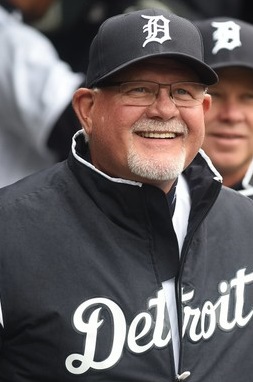
“At times, it’s about trying to win a ballgame.”—Ron Gardenhire. “At times,” he says . . .

Regardless of their teams’ seasons from beginning to end and all stations in between, today’s managers don’t seem as witty as their historic predecessors. You couldn’t possibly imagine the Pirates’ new manager or the Tigers’ incumbent going to the mound with Casey Stengel’s kind of insouciant wit.

Managing the hapless Original Mets in 1962, Stengel visited Roger Craig at the mound with Hall of Famer Willie McCovey checking in at the plate. “How do you want to pitch him?” the Ol’ Perfesser asked his stout righthander. “Upper deck or lower deck?” Getting his first look at brand-new Shea Stadium in 1964, Casey didn’t miss a beat: “Lovely. Just lovely. The park is lovelier than my team.”

Derek Shelton is the Pirates’ new manager; Ron Gardenhire is the Tigers’ incumbent. They seem like steady, agreeable men, the kind of bosses for whom you wouldn’t reject the chance to play. But they’re not likely to make you forget the former Pirates manager who mused, “You can have money piled to the ceiling, but the size of your funeral is still going to depend on the weather.”

Or, the former Tigers skipper who said about facing a team the day after blowout loss to them, “The only reason I’m coming out here tomorrow is because the schedule says I have to.”

But if you ask them about things like the forthcoming three-batter minimum for relief pitchers, Shelton and Gardenhire aren’t exactly stuck for answers, either. Neither were a few other skippers approached by ESPN during this month’s winter meetings. “The three-batter thing will be interesting,” says Shelton, “and it’s going to be interesting for a couple of reasons for me. Never having managed in the National League, it will be interesting to see how that works out with the pitcher.”

He’s never managed in the American League, either, but Shelton has managed in the Yankees’ system in the recent past. Gardenhire’s managed in the American League. (He managed the Twins to six American League Central titles.) “Can we talk about that after a few cocktails?” he quipped. Then he got as serious as a man who’s had a few belts and is liable to trip over his tongue at least once.

“We’ve got a lot of managers still trying to figure out how it’s going to work out,” Gardenhire said. It’s not one of those favorite things for a manager because it starts taking away a little bit of strategy. I know the game is tough when you walk out there and change a pitcher for every hitter; but at times, it’s about trying to win a ballgame, and I think that’s what we’re all here for. Those are the arguments. But we’re trying to improve the game, so we’ve got to give it a look before day one.”

“At times” it’s about trying to win a ballgame, he says. Good one, Skip. Then you remember Gardenhire’s Tigers won only to break up the monotony in 2019: they lost 114. Maybe he has a little Stengelese potential after all. (Codicil: Gardenhire’s own playing career began in a very different organisation of Mets, in 1979.)

When the idea first seeped forth, the three-batter minimum seemed a salve to those who think that either the games are taking too long or the pitchers are getting too fragile. Now it seems a solvent rather than a solution to . . . who knows?

“I think it can affect how you put a lineup together,” said former Yankees/now Phillies manager Joe Girardi. “Depending how many lefthanders they have, maybe you spread your lefthanders out. So if they have a guy that is efficient in getting left-handed hitters out, you surround him with two beasts that are right-handed hitters. So I think it does change.”

“My take on the whole thing is–I’m all for messing with the pace of the game. I think the pace of the game can be messed with; I’m good,” said Joe Maddon, the new Angels manager. “The thing I would never interfere with is strategy, and to me, that interferes with strategy, and that’s the part I don’t like. Pace and length of the game, I think, are interconnected, but strategy is sacred, I think.”

Argue that the games are “too long” and then suggest you might want to scale back on the broadcast commercials, between innings, during pitching changes, during double switches. (If you consider commercial slots between innings amount to two minutes each, that’s over half an hour you spend watching commercials and not baseball for nine innings.) Watch how fast the owners run from the very idea that something should mean a few million dollars fewer in their kitties, even if it’s for the good of the game and those who love and watch it.

Argue that if you’re going to impose the three-batter minimum you’d better not shout, you’d better not cry when a clever manager decides the game situation demands he reach for his best pitcher even if a) it’s a relief pitcher, and b) it’s, say, the fourth inning. Watch the get-off-my-lawn contingent jump up and down in tantrums, screaming blue murder, that you’re destroying the Sacred Tradition.

Never mind that you’re destroying nothing of the sort. Come to think of it, you wouldn’t be destroying the Sacred Tradition, either, if you do something I’ve suggested before: eliminate the eight warmup pitches from the game mound when you bring a relief pitcher into the game in the middle of an inning. He’s just thrown what might be at extreme the equivalent of a quality start’s worth of pitches while warming up in the pen. He needs eight more warmups? He needs them about as badly as the guy who’s hit two home runs already in that game needs batting practise.

One manager who wasn’t terribly concerned about a three-batter minimum was Red Sox manager Alex Cora. “I don’t think it’s going to affect us that much,” he said. “We don’t mix and match that much. Our lefties, they’re pretty solid. Darwinson [Hernandez] and [Josh] Taylor, they get lefties and righties and do a good job against both of them. So I don’t think to us it’s going to affect us that much.”

Not so fast, Cora. The lefthanded Hernandez did look terrific in his rookie 2019 overall. But the righthanded batters hit for a .934 OPS against him against the lefthanders’ .388. Their batting averages against him? Righthanded: .319; lefthanded: .089. Likewise a 2019 rook, Taylor, another lefthander, didn’t get crunched quite that drastically by righthanded batters (.692 OPS) and the lefthanders didn’t exactly have a simple time with him, either (.559 OPS). But the righthanded hit .243 off him and the lefthanded, .209.  Better not say just yet that a three-batter minimum won’t affect you that much, after all.

Remember: Real pitching talent is rare enough. So is pitching talent that can keep hitters from both sides of the plate in equal check. Most teams would be fortunate enough to have one starter and one reliever who can work to men from both sides of the plate and leave them looking equally futile. Getting the men who can do both is a challenge the sharpest scout or the most intricate of analysts would consider equal to driving the Golden Spike home with a rock hammer.

But not impossible. Casey Stengel won his third straight World Series when he reached for just such a man, an otherwise non-descript lefthanded pitcher named Bob Kuzava, who’d only pitched fifteen times on the regular 1951 season, to face righthanded Hall of Famer Monte Irvin—in the top of the ninth, with the Yankees up 4-1, but with the bases loaded and nobody out.

Kuzava wasn’t even close to responsible for the men on base. And he got three straight fly outs, from Irvin, Bobby Thomson, and pinch-hitter Sal Yvars, which did push two Giants runs home that weren’t quite enough, to save it for Johnny Sain, who’d come in to relieve Vic Raschi in the seventh.

Do-able if you have the guys who can do it. But those guys aren’t as prevalent as the commissioner’s office or its supporters regarding the three-batter minimum think, and they’re not likely to be for a long enough time if ever. Human nature and pitching just don’t work according to a preconceived mechanical formula. Even the analytics people who develop formulae and applications to help players improve know that goes only so far. This is baseball, not engineering.

And don’t even go there about the Good Old Days when pitchers went the distance and relief pitchers were just guys who couldn’t cut it as starters. A little real history: they really went the distance in times when the ball might as well have been twine, hard throwing was as common as the telephone, the number one expectation of pitchers was throwing what batters could hit and hopefully putting fielders to work, and pitchers weren’t expected to throw like illusionists, trick-shot artists, or human howitzers. You could even pitch your way to the Hall of Fame despite surrendering almost nine hits per nine innings and striking out less than four per nine. (Cy Young—I think there’s a pitching award named after him— accomplished that.)

“If we’re gonna win,” husky first baseman George (Boomer) Scott once told then-Brewers chairman Ed Fitzgerald, “the players gotta play better, the coaches gotta coach better, the manager gotta manage better, and the owners gotta own better.” The owners also gotta own the concept that the good of the game isn’t necessarily the same thing as making money for it, or themselves.

And the commissioner gotta commission better. He gotta remember that the better, more viable pace-of-game solutions than a three-batter pitcher’s minimum may mean making a little less money but would mean leaving game tactics and strategies to the men they pay handsomely (and often not enough) to develop and execute them.

But there’s one little problem, still. Too many managers still think there’s no problem with warming pitchers up multiple times before actually bringing them into the games. Too many managers think they’re not really pitching unless they’re out there in the game. As if they’re just playing catch in the bullpen and not heating up with, you know, real pitches.

Too many managers think it’s the reliever’s fault that he came in gassed after he’d been warmed, sat, warmed again, and maybe thrown the aforesaid quality start equivalent’s pitches overall, and that’s before he tosses the customary eight warmups before facing his first batter of the game.

The three-batter minimum won’t solve that issue, either. If anything, such gassed-before-they-come-in pitchers, handled by managers whose brains are gassed, are more liable to get driven into the middle of next month before they even face their third batters. And often as not, the only solution for managers like that isn’t a dubious rule change but, rather, unemployment.


Money isn’t everything

2019-12-18 ToreyLovulloMadisonBumgarner

The electric horseman: Manager Torey Lovullo (left) welcomes Madison Bumgarner home.

Arizona the region and not necessarily the baseball team said something to Madison Bumgarner for long before he became a Diamondback at last. Enough to compel him to sign a new contract paying him less than he probably could have earned, even though he’s in the re-invention stage of his career. Sometimes there’s no place like a second home, too.

And more often than you think, money isn’t everything.

Time was when you couldn’t have pictured Bumgarner in anything other than the black-and-orange Giants hat and cream fatigues. When you saw the tenacity on the mound that turned him into a postseason myth in those fatigues and assumed, no matter what else came into play around him, that a Giant he was and a Giant he’d stay.

Madison Bumgarner and the Giants? Married even in the free agency era like Hall of Famers George Brett and the Royals, Tony Gwynn and the Padres, Chipper Jones and the Braves, Mariano Rivera and the Yankees, and Mike Schmidt and the Phillies. Not to mention future Hall of Famers Clayton Kershaw and the Dodgers (so far) and Mike Trout and the Angels, plus Yadier Molina and the Cardinals, and David Wright—whom injuries obstructed from consummating a Hall of Fame career—and the Mets. Right?

But maybe you didn’t catch onto Bumgarner and his wife falling in love with something aside when the Giants hit spring training every year in Scottsdale, Arizona. Something like Arizona itself. The place means almost as much to Bumgarner as the heat of baseball competition and the chance for winning that, right now, the Diamondbacks present better than the Giants do.

“First and foremost, winning,” he said when the Diamondbacks introduced him as their newest Snake Tuesday. “That’s what the whole decision is based on, and being with a team that’s my brand of baseball. They play the way I like to play. They just play hard. They’ve got a bunch of grinders on this team, guys that don’t take any pitch off. They’re just a hard-nosed group of guys.”

That’s a terrific reason for a pitcher who doesn’t know the meaning of the word “quit” to think about a new team, of course. But the lure of Phoenix and the surrounding ambience of Arizona itself was just as powerful, maybe the only presence that could hit Bumgarner for distance and get away with it.

The long-enough-time Giants horse becomes the Diamondbacks’ own Electric Horseman. The Bumgarners imported a few of their horses from Bumgarner’s native North Carolina to Arizona every spring. The Giants training there was so seductive to him that, once he knew the Diamondbacks were more than interested when he finally became a free agent, he was even willing to trade a fan base he came to love as deeply as he loves to compete to surrender.

“It’s tough,” he admitted about leaving them behind. “The fans in that city mean so much to me. I mean, shoot, it’s been ten years there and we won three world championships and have been through a lot together. They’ve always been as good as they could possibly be to me, and I’ll never forget that. I’ll always be thankful for it. That part of it was tough, but coming here, so far, this place has exceeded all my expectations, and like I said, I’m really excited about it.”

The fact that he still gets to have a few skirmishes a year with the Dodgers now that he’s staying in the National League West couldn’t possibly have eluded MadBum, either.

Stephen Strasburg re-signing with the Nationals, like Trout extending for life with the Angels last spring, said essentially that there’s no place like home, even an adopted home. (Strasburg is a native southern Californian; Trout is native to a region near the New Jersey-Pennsylvania border.) Bumgarner signing with the Snakes says there can be no place like the home you long for.

The Giants could have offered him everything including ownership of McCovey Cove, his own private cable car, free feed for the rest of his life at the Fisherman’s Wharf eatery of his choice, and an on-the-house lease to any piece he chose at Hearst Castle down Highway 1 in San Simeon. Once the Diamondbacks indicated they wanted him, you couldn’t pay him enough not to swap the Bay for the desert.

If you think that’s even just a slight exaggeration, be advised that assorted published reports say the lefthander with the Dreamliner wing span in the split second before he throws to the plate had nine-figure offers to ponder from elsewhere, but he instructed his agent, VC Sports’ Ed Cerulo, that Arizona was “the number one place for me.” And money wasn’t everything.

“We definitely left some money on the table,” the newest Diamondback said when the team introduced him formally Tuesday. “You can say that.” If the published speculation is true and Bumgarner looked at $100 million or better for five years in other offers, he’s left at least $15 million behind overall while agreeing to pitch—according to The Athletic‘s Zach Buchanan—for $6 million in 2020 before hitting $14 million for 2021, $18 million a year in 2022-23, and back to $14 million in 2024.

Essentially, Bumgarner gave the Diamondbacks a new-home discount. No, make it actually: Buchanan reported that $5 million a year is deferred from the 2021-23 annual salaries until the deal is finished. And general manager Mike Hazen—who traded a somewhat more expensive desert lover named Zack Grienke to the Astros in 2019’s marquee trade deadline swap—“plans to use that [2020 payroll] flexibility” to shore up the Diamondbacks for contention.

Buchanan thinks Bumgarner all but willed the new Diamondbacks deal into existence, sort of, but don’t dismiss Hazen—who once said that on the one hand he wasn’t exactly starving for starting pitching but, on the other hand, he wasn’t exactly going to say no to the chance for more—being just a little bit shrewd in his own right, either:

Hazen admitted that adding to his rotation wasn’t his top priority, or really any sort of priority, entering the offseason, but that Bumgarner made it plain early on that he preferred to end up in Arizona. Though Hazen stopped short of saying that affinity for Phoenix prodded him into engaging on the longtime Giants starter, the structure and overall value of Bumgarner’s deal—and Arizona’s lack of rotation holes before offering it—suggest the Diamondbacks were able to capitalize on a specific advantage they had over the 29 other major-league teams.

It also looked like the early speculation that made the Bumgarner deal a possible to-come trade scenario for incumbent starting pitcher Robbie Ray isn’t necessarily so. Bumgarner’s deal flexibility lets the Snakes shore up without having to invent payroll room. They’d rather save the invention for the field if they can help it.

And, more important, Hazen’s willing to gamble that Bumgarner continues re-inventing himself on the mound to the point where he’ll deliver better goods than he could with the Giants since 2017. “We just watched a guy leave here in the middle of last season who reinvented himself every year he was here,” Hazen told the Tuesday presser, referring to Greinke. “We feel like [Bumgarner] has that ability.”

The entertainment possibilities can’t be resisted, either. Assuming the Diamondbacks have a better sense of humour now than they had when the late Kevin Towers was their general manager, don’t be shocked to discover a hitching post outside the players’ entrance at Chase Field. Or, to see Bumgarner galloping up to the park aboard one of his horses, maybe hollering, “Hi yo, Tumbleweed! Away!”

Or (sorry, it’s impossible to resist), to see a staredown and bawl-out with an enemy batter (preferably a Dodger?) who’s just hit one over the right field fence in Chase Field turn into a cheerfully snarky “Go get it out of the pool!” T-shirt.

Life and baseball with Bumgarner could be mad fun for the Diamondbacks, even if Bumgarner isn’t yet ready to resign his Fun Police commission. Almost as much fun and soul embracing as life in Arizona for Lieutenant and Mrs. MadBum themselves.

MadBum hitches his horses to the Snakes

2019-12-16 MadisonBumgarner

Postseason legend Madison Bumgarner takes flight and gallops in Arizona now.

Picture the next time Madison Bumgarner surrenders a hefty home run in his home park and snarks over the bomber having fun with the blast. The bomber’s mates will be inspired to produce T-shirts saying not, “Get it out of the ocean” but, rather, “Get it out of the pool.”

Bumgarner has signed for five years and $85 million with the Diamondbacks, and the nearest body of water into which the opposition can hit is the pool behind Chase Field’s right field fence. Until Bumgarner gets to face the team for whom he served so well, mostly, for the first eleven years of his career, in his former playpen, that is.

A few years ago, Bumgarner’s asking price wouldn’t have been as low as $85 million for five years or more. A few injuries and, more important, a heavy workload have taken their toll, though at 30 years old Bumgarner isn’t exactly ready for Retirement Row. But yes, it does feel a little strange that you’ll see him for the next five in something other than Giants’ fatigues.

And, yes, Bumgarner really did prefer going to Arizona if the Giants weren’t going to be that interested in keeping the greatest postseason pitcher in their history. The Diamondbacks, admirably, have continued remaking/remodeling themselves without even thinking about tanking, and Bumgarner is nothing if not a competitor no matter how much his left arm doesn’t always obey his orders lately.

But The Athletic‘s Bay Area scribe, Andrew Baggarly, says it was personal as well: “Bumgarner told me in July that he and his wife, Ali, loved Arizona and he’d be interested in playing for the Diamondbacks. He gets his preferred destination from a life perspective, he’ll play for a team with way more near-term upside than the Giants, he still gets to hit (in a lively ballpark where he loves to take BP) and he still gets to stare down the Dodgers five or six times a year. What’s not to love?”

Thus does it make a little more sense that, yes, the Giants “were interested and engaged in retaining” the lefthander whose arm span as he’s about to deliver a pitch makes him resemble a Boeing Dreamliner with a bearded cockpit on takeoff; but, no, they weren’t exactly rolling the old red carpet for his landing, either.

Baggarly caught the drift at last week’s winter meetings. When he asked the Giants’ new manager, Gabe Kapler, how he was selling both himself and re-selling the Giants to their franchise World Series hero. When Kapler said he hadn’t talked to Bumgarner and (Baggarly’s words) “wanted to give him his space,” but would still reach out “if others thought it was a good idea.”

“And that was it,” Baggarly continued. “That was all I needed to know. There was no way that Bumgarner would continue his career with the Giants.” Because, of course, if the Giants wanted him to stay and thought they had a shot even at $85 million for five more years (they’re said to have offered four and $70 million), “you can bet that calls and meetings would’ve been set up. Kapler would have begun the back-channeling before he even got the job. The Giants would have tried to assuage Bumgarner’s every concern and dispel every bit of unease.”

Bumgarner isn’t the only one now shouldering into a Diamondbacks jersey who’s a bounceback candidate. The incumbent Snakes ace, Robbie Ray, is looking to make a comparable comeback from a somewhat dismal 2019, and much analysis has suggested the team hoped for enough of a comeback to make him attractive at next summer’s trade deadline. Bumgarner’s signing may have made Ray look positively glittering as a trade topic and positively assured of bringing back a haul of delicious enough prospects sooner.

MadBum is almost as renowned for the pleasures he takes in hitting as he is for that lifetime 2.11 postseason ERA, including a transdimensional 0.25 lifetime World Series ERA. He’ll fume at or bawl out enemy hitter taking a little too much pleasure in a monster mash on his dollar, but he enjoys hitting one for distance as much as the next man. Even if he admits he just can’t bring himself to let the kids play, or play with the kids, when he’s the bomb victim.

A shame, too. Two Opening Days ago I had a little mad fun with MadBum’s hitting a pair out, against the Diamondbacks of all people, one a leadoff blast against Zack Greinke in the top of the fifth, the other a one-out shot against reliever Andrew Chafin in the top of the seventh.(In between, then-Diamondback/now-Dodger A.J. Pollock hit one out off Bumgarner in the bottom of the sixth.)

I wrote a puckish column pondering the dialogue between the then Cy Ruth Award candidate and the Giants’ then-manager Bruce Bochy, leaning a little heavily off the day Bumgarner and then-Dodger Yasiel Puig tangled verbally after a ground out, with Bumgarner—who loves Puig about as much as a small child loves liver (after Puig joined the Reds and took Bumgarner deep, Bumgarner cracked, “He’s a quick study. It only took him seven years to learn how to hit that pitch”)—hollering, “Don’t look at me!”

Forgive me, MadBum, but I couldn’t resist looking at you on that Opening Day:

Bochy: Bum, it’s not that we don’t need the runs, but would you kindly remember that your job with this team is not to do your impersonation of Henry Aaron every other time up?

Bumgarner: Skip, don’t look at me!

Bochy: Bum, I know you were p.o.ed about losing the perfect game in the sixth. But you’re not getting paid the gigabucks to beat baseballs into earth orbit. You’re getting paid the gigabucks to throw them, preferably down the throats of enemy batters. Think you can remember that while you’re bucking for the Cy Ruth Award?

Bumgarner: Skip, just don’t look at me!

Bochy: Bum, you’re embarrassing our hitters. Hitting one 410 feet over the left center field fence on 1-2. You realize how many guys around here can’t hit on 1-2? You bucking to get our hitting coach fired?

Bumgarner: Skip, just don’t look at me!

Bochy: Okay, I’ll give you this one, Bum. That shot you hit in the seventh with one out. 2-0. Now, that’s a more reasonable count to swing on. And you did bust a three-all tie while you were at it. But c’mon, you don’t have to do everything yourself. Even if you’re the one who let them tie it up at three-all in the first place. Well, okay, it was A.J. Pollack, and even you can’t keep him from hitting one out now and then, you’re only human, after all.

Bumgarner: I’m only what?!?

Bochy: I knew that’d get your attention, Bum! Now, about those eleven strikeouts … that’s why you’re getting paid the gigabucks. Wait a minute — hey, Denard! Not a great way to open, getting yourself arrested for attempted grand theft second!

Bumgarner: Don’t look at him, Skip!

Bochy: Anyway, you’re getting paid to strike those emereffers out, not hit them into the Cove, buddy. There’s no Sandy Mays Award in baseball. I need you to start and when necessary close your own games, so far, depending on how much of an improvement this bullpen’s gonna be over last year’s bullpen. Christ, last year we couldn’t get save a thing if we’d had the Red Cross coming out of the pen.

Bumgarner: Rowrowrowrowwwrrrrrrrrrrrrrrrrrrrrrrr!

Bochy: What’s eating you, Bum?

Bumgarner: What’s with this Hoover? Who does he think he’s fooling with that slop? Why doesn’t he go back and make his vacuum cleaners where he belongs?

Bochy: He just struck Pence out after Hunter fought him back to 2-2.

Bumgarner: That ain’t exactly beating as you sweep as you clean, Skip.

Bochy: Where’d you learn your history?

Bumgarner: I play Trivial Pursuit just like any normal guy.

Bochy: Normal! Normal! Any normal guy who gets paid the gigabucks to pitch and strike out the other guys but who gets up to the plate and thinks he’s Mike Schmidt. You call that normal?

Bumgarner: Do I look like Mike Schmidt, Skip?

Bochy: Only when you hit.

Bumgarner: When did he ever strike out eleven guys in a game? Hey! We got first and second. Buster walked and Craw singled him to second. Who says I’m the one who has to do it all?

Bochy: Nunez just lined out to right, in case you weren’t looking.

Bumgarner: Looks like Hoover needs to change his beater bar brushes.

Bochy: Come on, Bum, give the guy a break, you had to squirm a couple of times too, you know.

Bumgarner: I twist and shout, I do not squirm.

Bochy: Have it your way, buddy. Look at him. Throws two balls to Hernandez, then strikes his ass out on three straight pitches. Looked like he took a couple of lessons from you.

Bumgarner: OK, give you that one. Poor Gork, forget the breeze, I could feel the hurricane.

Bochy: C’mon, Bum, you did more than your share today. Take the rest of the day off. Law can handle these guys.

Bumgarner: Okay, Skip, but remember who would have hit second in the ninth. For all you know I had another home run in me.

Bochy: Bum, let’s not get into that again, shall we? Can’t you settle for being the only pitcher in baseball history ever to hit two bombs on Opening Day and let it go at that?

Bumgarner: Well, look at poor Law, Skip. Two hitters, two singles, and Goldschmidt coming up. Whoa! Two straight strikes he throws on Goldschmidt. Now balls one and two.

Bochy: Gimme a break, Bum, I didn’t want Pollock to pounce on you again.

Bumgarner: You’re all heart, Skip.

Bochy: Damn! The bastard tied it up with a single.

Bumgarner: He fought the Law and won.

Bochy: Forget it. Jerry Seinfeld you ain’t. Hold on, I gotta get Law out of there.

Bumgarner: Good call, Skip. Blach got the double play. And Strickland got the strikeout. Now I know you’re gonna miss me hitting in the ninth!

Bochy: You gonna start that again?

Bumgarner: Who’s the genius who decided I could take the rest of the day off when I might have had another home run in me?

Bochy: I dunno.

Bumgarner: Well, don’t look at me, Skip!

Bochy: Hey, look who’s pitching the ninth.

Bumgarner: It’s old man Rodney! And Panik triples off him to open! C’mon, Skip, I could have gotten him home without hitting one out.

Bochy: See? Gillaspie got him home! Sacrifice fly. So it’s not like you hitting your third homer of the game, just shoot me.

Bumgarner: Don’t start with me, Skip!

Bochy: Now I got to get Melancon in there. The season isn’t even three hours old for us and already we’ve got a blown save. Thirty last year wasn’t enough, we gotta buck for forty already? Damn, how could we load up the pads on old man Rodney and not cash those guys in? How could we get Span thrown out at the plate to end that inning? Coulda had a two or more run lead.

Bumgarner: Well, Melancon isn’t getting paid the big gigabucks to go up to the plate and hit grand slams, Skip. Damn, Skip! Two outs, he gives up a double to Mathis and an RBI single to Daniel Freaking Descalso!! And Owings sends home the winning run! Why are we paying Melancon the big gigabucks? I told you you should have had me available to hit in the ninth! You ever heard of an insurance run?

Bochy: Don’t look at me, Bum!

The word is that the man who’s been a horse for the Giants even when he wasn’t pitching at his peak performance level owns horses in the Phoenix area and, with his wife, loves the horses as much as the area and as much as baseball. The man who doesn’t want you looking at him when you recover from a knockdown pitch or take him out of your shared baseball real estate isn’t averse to a little horsing around.

But wouldn’t it be something if baseball could give him dispensation for Opening Day, lets him keep a horse adjacent to the batter’s box, then—if he hits one out—lets him mount and gallop around the bases?

All the Diamondbacks have to do otherwise now remind Bumgarner the only body of water into which the other guys can hit is small, behind the fence, and features a hot tub off to one corner. And, keep him away from dirt bikes.

Yeah, we did, because they did, too

2019-12-15 DerekFisherAstrogate

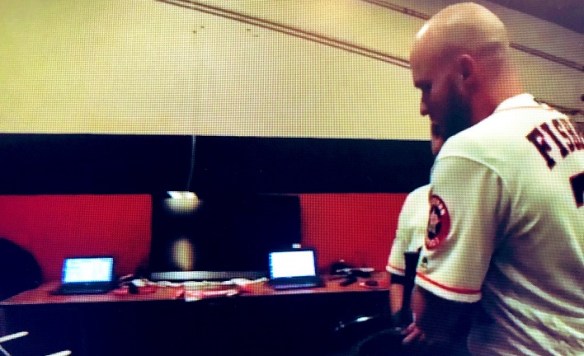
This is the purported monitor setup the Astros used to steal signs electronically, from off the field, in 2017 at least and possibly 2018 and 2019. The larger monitor isn’t engaged but you see two small video tablets on the table. Shown in front of the table is Derek Fisher, an Astros reserve outfielder from 2017 until he was traded to the Blue Jays in July 2019. The image has appeared on numerous Websites.

So the Astros asked for a Minute Maid Park camera out past center field to be taken off baseball’s officially mandated eight second transmission delay, trained live toward enemy catchers, and transmitting live to a dugout television monitor. Because, you know, they were convinced other teams, who knew just how many, were guilty of comparable espionage television networks from off the field and wanted to, you know, level the field a little bit if they could.

Thus reported Andy Martino of SNY Saturday, based upon sources who apparently asked not to be identified in print but had direct knowledge of what was said to the commmissioner’s Astrogate investigators. “They did not install a new camera for sign-stealing purposes, and the players and coaches involved did not even know which camera the feed was coming from,” Martino writes. “They wanted a monitor closer to the dugout, because their video room was too far away. They considered their actions to be in line with industry standards.”

Who were they? The original bombshell by The Athletic‘s Ken Rosenthal and Evan Dillich came from former Astros pitcher Mike Fiers and “four people who were with the Astros in 2017,” all of whom presumably asked not to be identified just yet, if at all. Martino says commissioner Rob Manfred’s bloodhounds have spoken to “nearly sixty people” thus far. An existing video capture shows a former Astros reserve outfielder, Derek Fisher, traded to the Blue Jays in July 2019, standing in front of a table between the clubhouse and the dugout on which were mounted a television monitor showing nothing but two small video tablets showing anything but. And one of the sixty witnesses, according to the aforementioned sources, and presumably unprepared to put his name to it just yet, is quoted thus: “We did ask for a game center field feed to decode signs, as many teams do. All we asked for was a live feed.”

So they broke the rules but they didn’t quite have their own Alexander Butterfield to install a new device dedicated specifically to sign-stealing. Or did they? As Martino observes, it still leaves “questions about whether the camera was installed specifically for that purpose.” And, he asked one: did someone in the Astros front office approve buying a new camera, which would create a paper trail showing the team was preparing to cheat? His answer: “Sources say the camera in question was league-approved and already in place. One source suggested it could have been a scouting camera, which would have been its league-approved purpose. That is more likely than a camera from the TV feed, which would have required the broadcast crew to participate in the scheme.”

It doesn’t acquit the Astros if the hounds turn up the evidence that, yes, there were a few other teams with high-tech espionage operations. Neither will it acquit them to say sure, we broke the rules, but, you know, we’re just the ones who got caught or exposed, and everybody or at least a few others did it, too, so we needed to get in on the fun, too, presumably to nullify the disadvantages. But the everybody-does-it/everybody’s-done-it argument simply disintegrates. Graduate the argument to, say, American political life, then ponder what the everybody-does-it/everybody’s-done-it argument implies, regardless of the partisan or ideological divide, with too many examples that candor requires the intellectually scrupulous to confront.

As far as MLB is concerned, any use of electronics to facilitate sign stealing is illegal,” Martino wrote. “Even Astros witnesses are conceding to investigators that such actions took place, because the feed was aired on a monitor behind the dugout. At this point, the question appears to be not if the Astros broke the rule, but how and to what degree they did it.” Bang-bang! You’re dead. Or, facing consquences at least as considerable, potentially, as those by which former Cardinals scouting director Chris Correa got himself and his organisation slapped after he was caught red-winged hacking into the Astros’ computer scouting database.

They may only begin with punishments administered to general manager Jeff Luhnow, who isn’t necessarily the most popular or respected administrator in the game, and manager A.J. Hinch, who looked to all the world like a schoolboy who knew his trouble only began after he came out of the principal’s office, when buttonholed by the press at the now-concluded winter meetings. It strains credulity now to believe Hinch, heretofore respected for the successful marriage between intelligence and sensitivity somewhat uncommon among major league managers in any era, was the cat caught unaware that the mice raided the refrigerator.

Astro fans aren’t the only fans bracing for revelations as to whom among their players and their coaches were really in on the fun and why, not with the credibility of three American League Wests, two pennants, and one World Series championship under suspicion. But any other team found to have built and operated their own electronic off-field intelligence television networks shouldn’t exactly be clearing space for their Emmy awards, either.