To Law, baseball’s sacred cows are worth . . . steak

2020-04-21 TheInsideGameHe’s never phrased it quite this way, so far as I know, but Keith Law is one baseball writer who believes that a sacred cow is worth one thing—steak. He rarely fails to provoke, instruct, and entertain all at once. Agreeing with him fortifies. Disagreeing with him still leaves you itching to think. Seeing him affirm what you’d already determined comforts.

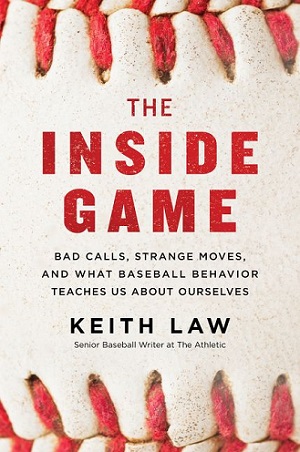
If you already knew that hot streaks didn’t conceive sound investments, that winning managers often won despite their efforts, that groupthink doesn’t equal truth, and that Nolan Ryan’s durability makes him an exception and not a rule, Law’s new book The Inside Game: Bad Calls, Strange Moves, and What Baseball Behaviour Teaches Us About Ourselves will tell you something new only in the breakdowns by which he affirms them.

But if you still believe it’s that smart to ride the hot hand, that Bob Brenly was brilliant winning the 2001 World Series, that the way we’ve always done it is just the way it ought to be, or that if Ryan could throw 200 pitches in a game if need be then any pitcher ought to do it, The Inside Game may hurt more than the coronavirus quarantine ever could.

Based on his reading of the behavioral economist Daniel Kahneman’s Thinking, Fast and Slow, which “went from unknown to must-read within baseball front offices in a fairly short period of time, a shocking development in a sport that generally moves at the pace of a sloth that is still hung over after a weekend bender,” Law identifies and forges individual chapters around biases he says shape the way baseball people—managers, players, commentators, fans—see the game without truly seeing it.

The method by which he analyses and discusses is simple enough. “I’ll start with a baseball story,” writes Law—former ESPN writer, now a senior writer at The Athletic—in his introduction, “then explain what cognitive bias or illusion I think underlies the error I’m describing, and will return to baseball with another salient example.” The nerve of him.

He opens with an examination of “anchoring bias,” prior information having nothing to do with the next decision but deciding it anyway, in terms of whether to use automated umpiring instead of the sacred “human factor.” “The umpire’s mind is anchored on that last called pitch,” he writes, “and therefore the umpire’s internal calibration is thrown off for the next pitch. That means they’re less likely to get the next call right—and that’s another point in favour of giving the job of calling balls and strikes to machines, not humans.”

Want to know what triggered Law on that one? Refer back to Game Five of last year’s World Series, in which umpire Lance Barksdale blew a pair of calls one of which irked Nationals manager Dave Martinez into demanding Barksdale’s awakening and the other of which—on a pitch nowhere within the strike zone’s ZIP code—speared Victor Robles into jumping like a jack-in-the-box and throwing his batting gloves.

“Availability bias” is what Law believes shapes how commentators, writers, and even fans discuss the game, which he defines thus: “When a specific act or example comes to mind more readily, we tend to overemphasise that fact or example—maybe we ascribe too much importance to it, or perhaps we extrapolate and assume that the example is representative of the whole.”

In other words, and Law hits it, too, Joe DiMaggio was the American League’s Most Valuable Player in 1941 mostly because of his fabled 56-game hitting streak but Ted Williams, whose whole season’s performance (in a year DiMaggio had a spectacular season streak or no streak) should have earned him the award, didn’t have a prayer against the unavoidable single feat.

“You thought about some question,” he writes, “and your brain went right to the hard drive and pulled out something relevant. Your brain didn’t go to the archives, though, and it probably just gave you one thing when you actually needed the whole set.” Like the writers in 1941 who handed DiMaggio the MVP. Or—because, as a collusion victim, of the blank-check contract he signed with the Cubs in spring 1987—Andre Dawson getting the writers’ MVP vote despite Tony Gwynn and Eric Davis having superior seasons.

A couple of decades later, of course, came an example Law doesn’t discuss but remains relevant: Maury Wills copped the National League’s 1962 MVP on no grounds further than that he smashed Ty Cobb’s single-season stolen base record and became baseball’s first player to steal in triple figures. Who says crime doesn’t pay, wink wink?

Little else suggested Wills was even the best player on his own team: Tommy Davis was his co-leader in wins above a replacement-level player with 6.0. Willie Mays was worth 10.0 WAR and nobody else in the league was too close. (Frank Robinson was second with 8.7.) The stolen base record-setter wasn’t even in the National League’s 1962 top ten for on-base percentage. (Sixteen players bested him, and none of them stole more than eighteen bases that year.)

DiMaggio’s 56-in-’41 was overwhelmingly available, and so were Wills’s 104 stolen bases. So were Roger Maris’s 61 home runs (smashing Babe Ruth for a single season) in ’61, when Mickey Mantle (10.4 WAR) should have been the league’s MVP but missed the last week of the season with a hip issue and fell out of the infamous home run chase.

That was all each season’s voters seemed to need. Their brains simply didn’t dig into the season’s archive as they might have. “Baseball commentary,” Law writes, “is often a victim of the tropes that have long defined it—and availability bias is behind much of it, if for no other reason than it’s convenient and often obvious.”

From there Law travels through outcome bias, in which you can believe someone a genius for winning even if he blundered his way through it. Brenly blundered his way to a 2001 World Series triumph. Among other things, he sent his team’s worst on-base percentage out to hit leadoff lefthanded against a pitcher who feasted on lefthanded hitters. He often left his best hitter, Luis Gonzalez, with nobody on base ahead of him. He misused his closer Byung-Hyun Kim and left the submariner in to face lefthanded hitters who could kill him. He wasted at-bats with bunts ahead of Gonzalez. He sent Kim out on a second consecutive night after he’d thrown 61 pitches in relief the night before. (Are you still shocked that Scott Brosius tied Game Five with a home run?)

The Diamondbacks won their first (and so far only) World Series despite their manager. “We would all like to believe that good process yields good results and bad process yields bad results,” Law writes, “so that we can tell from the results whether a process was good or bad. That would be true if life were deterministic, but it’s not. Sometimes you do all the right things and are stymied by bad luck. Other times you do everything wrong and are subsequently rewarded for it. That’s outcome bias.” Ask any politician, too.

Law takes you through the mythologies behind lineup protection and clutch hitting, drafting high school pitchers in the first round (something I’ve known for decades after the ruination of David Clyde in the 1970s), and why you should knock it off with the kind of “survivorship bias” that uses Nolan Ryan and even prehistoric pitcher Old Hoss Radbourne to counter the pitch count:

Nolan Ryan is the ultimate survivor, the survivor ne plus ultra, the ubersurvivor when it comes to survivorship bias . . . He is, however, an outlier, a great exception—not one that proves the rule, but one that causes many people to discard the rule. Most pitchers can’t handle the workloads that Ryan did; they would break down and suffer a major injury to their elbow or shoulder, or they would simply become less effective as a result of the heavy usage, and thus receive fewer opportunities to pitch going forward. Teams did try to give pitchers more work for decades, well into the 2000s, but you don’t know the names of those pitchers because they didn’t survive: they broke down, or pitched worse, or some combination of the above.

[The] pitching deity known as Charles “Old Hoss” Radbourn started 73 games for the Providence Grays in 1884 and threw 678.2 innings, but survived to pitch another seven years beyond that. The game itself has changed dramatically in the last few decades, with pitchers throwing harder than ever, and hitters bigger and stronger than ever, but those outliers were even outliers in their own times—and they should not distract us from what we see from looking at all pitchers, not just the ones we remember.

Radbourne—who threw underhanded with assorted unstressed arm angles—pitched in a game that had no power hitting as we know it and in which pitchers were usually encouraged to throw things batters could hit easily enough. Radbourne’s baseball isn’t post-Depression baseball, never mind today’s baseball. And even he lasted only eleven seasons. He was one of the luckier ones there, in any era.

Law also takes on “recency bias” (the hot hand now isn’t always the most sound lineup choice or long-term investment) and status quo movement. (Grady Little and John McNamara, ill-fated Red Sox posteseason managers, will look even worse in this chapter than they looked in their moments of non-decisions. ) He examines the problem with the “moral hazard” (moves whose messes the next guys will have to clean up, as in the Angels’ ill-fated Albert Pujols and C.J. Wilson deals) and the “primary agency” factor. (Pete Rose’s remaining partisans will wish to walk Law to the guillotine over this, regarding his gambling and how Pete Rose, manager, hurt his teams while letting Pete Rose, player, pursue the hits record to which he believed he was all but entitled, mind you, never mind his batting skills surrendering to Father Time.)

Not to mention what he calls the “fallacy” of the sunk cost. Law thinks the Angels were silly to play Pujols despite his injury-abetted decline merely because they were paying him three kings’ ransoms: “If you have already paid for something, your choice of whether to use it should be a function of whether you want or need to use it, not a function of the money that is already gone regardless of what you do.” He thinks likewise regarding the Tigers and Miguel Cabrera post-2107; and, the Orioles and Chris Davis since 2014.

Don’t get Law started about “eating money,” either. He’ll remind you of his indigestion when, two weeks after he joined ESPN as a writer in 2006, the Diamondbacks released Russ Ortiz with $22 million still owed the pitcher who’d “been a dumpster fire on a train wreck since signing.” The Associated Press said the Snakes decided they’d “rather eat the remaining $22 million . . . than keep him on their roster.” Law says the team ate nothing: “That salary was already somewhere in Arizona’s GI tract, likely causing indigestion but there nonetheless. Major League Baseball player contracts are guaranteed; there is no way to un-eat that meal.”

Before such dumpster fires on train wrecks are disposed of, Law goes on, he reminds you that managers and general managers don’t always want to keep them bristling and wrecking—but owners often do:

An owner might say that he’s not paying Twerpy McSlapperson $23 million a year to sit on the bench, or that he won’t release Joey Bagodonuts because he’s paying the guy $19 million this year and he’s determined to get something for his money. It’s entirely irrational, and can be at odds with the owner’s likely goals of winning more games and making more money. However, if you’re a manager, and your boss tells you to put Bagodonuts in the lineup every night, you’re going to do it.

Law gives you fair warning at the outset: he knows a lot of the biases he examines came subconsciously, and the best he can offer over 268 pages is a series of well-educated guesses. “I present them,” he writes, “to explain the cognitive errors, and to tell good baseball stories, some of which you’ll know and, I hope, some you won’t.” Marrying a gimlet eye and charming wit, he hits a line drive off the left field fence.
Teddy Ballgame’s grandchildren

2020-04-18 SwingKingsHall of Famer Ted Williams wrote three books with Sports Illustrated writer John Underwood, and one of them was his memoir My Turn at Bat. I read it when it was first published in 1969 and when it was republished in 1988. I should have read another of their collaborations, 1970’s The Science of Hitting, because the absolute root of today’s power revolution is there on page 47.

Revolutions don’t happen immediately after their theories or mechanics are first pondered and enunciated. (Almost seven decades passed from The Communist Manifesto to the birth of the Soviet Union, but I didn’t say all revolutions are admirable.) In baseball revolutions often require decades to pass.

Williams contravened the entrenched wisdom of swinging “down” and called that swing dead flat wrong. Teddy Ballgame himself didn’t swing that way. If you look at him according to my concept of real batting average (RBA)—total bases, walks, intentional walks, sacrifices, and times hit by a pitch, divided by total plate appearances—he has the evidence of performance to back him up.

Do you think a man with a lifetime .482 on-base percentage (the highest in baseball history) and a lifetime 1.116 OPS (second highest) was talking through his chapeau? How about a man with the absolute highest RBA of any player the bulk of whose career came in the post-World War II/post-integration/night-ball era?

Player PA TB BB IBB SAC HBP RBA
Ted Williams 9788 4884 2021 243 25 39 .737

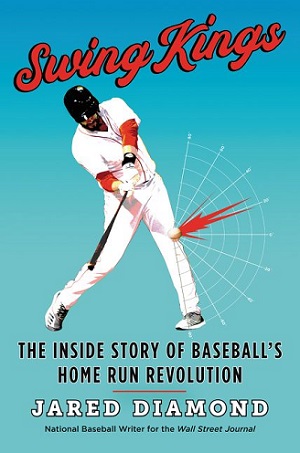
“He advocated for what he described as a ‘slight upswing’ of about 10 degrees,” writes Wall Street Journal baseball writer Jared Diamond in Swing Kings: The Inside Story of Baseball’s Home Run Revolution. (New York: William Morrow; $28.99.)

His first reason for this was obvious: the only way to drive the ball, to hit a home run, is to hit the ball in the air. The other reason was a bit more subtle and insightful. Willams wrote that because pitchers are standing on a mound, by definition the flight of the ball will always be down. An upswing will put the bat “flush in line with the path of the ball for a longer period,” essentially giving hitters more margin for error. Modern hitting coaches, the leaders of the revolution, would call this “matching the plane of the pitch”—in other words, getting the barrel of the bat behind the ball as quickly as possible and swinging up through it, rather than swinging down to meet the flight of the ball.

Williams’s explanation of the upswing is accompanied by a diagram that shows the difference between the level stroke and the Williams stroke. It’s a simple sketch—just a white box, with the outline of arms, bats, and baseballs showing the value of the upswing. But that little graphic, buried in the middle of Ted Williams’s book, is perhaps the most significant visualisation of the swing ever produced. It inspired a revolution.

The revolution, Diamond writes, was delivered in due course by a cast of one-time players who couldn’t hit with a telephone pole when they did play the game at assorted amateur and lower professional levels. Or, whose skills vanished for various reasons. For assorted reasons, and from assorted starting points, they fell into post-playing lives during which they just had to know what they’d done wrong that younger siblings, friends, acquaintances could avoid doing wrong.

You know only too well the ancient saying about those who can doing and those who can’t teaching. But teachers have to do something first. They have to learn some things. Even if it involves learning what they did wrong before teaching someone else how to do things right. Even if they arrive in part from a few places you’d least expect to have baseball on the brain.

Mike Bryant devoured The Science of Hitting in his youth. He wasn’t talented enough to make it work for himself, but he could teach the Williams way to his son and his son’s friends. Another father he knew, Tony Gallo, former minor leaguer, was more than interested. He asked Bryant to teach his own son. Their sons made the Show, and those boys are rather splendid with the bat. You may have heard of them: Kris Bryant and Joey Gallo.

2020-04-18 TedWilliams

Ted Williams didn’t believe in swinging down, either.

Craig Wallenbrock was a surfer dude turned food broker who once played college baseball and developed his own approach to the Williams philosophy by shooting and studying film over a decade before Hall of Famer Tony Gwynn made a fetish (and a nickname, Captain Video) out of it. The approach included studies of nature’s predators, karate, and samurai, applying their balances to the baseball swing.

When his own baseball coaches told him not to swing like Henry Aaron and others with classic power strokes, he asked why and was told those were freaks. Better to model yourself on someone like, say, Ron Fairly, a solid enough hitter but not exactly a game changer. By Wallenbrock’s coaches’ reasonings, Ted Williams was a freak, and so were Willie Mays, Mickey Mantle, Stan Musial, and Frank Robinson, among other such Hall of Famers.

“I’m thinking, let’s see—Ron Fairly, .260, not much power. Henry Aaron, 40 home runs,” he tells Diamond. “And I said, ‘Yeah but the freaks always seem to be the best players. So I want to study the freaks.”

One of Wallenbrock’s eventual disciples was Paul Konerko, the longtime White Sox first baseman. Another was a man he turned from nothing special as an Astro to never better after leaving the Astros—J.D. Martinez. Konerko may yet inspire a Hall of Fame debate; Martinez is one of baseball’s most feared hitters today. Wallenbrock’s analyses and observations took both players’ swings with too many moving parts, simplified them, and re-oriented them.

Richard Schenck taught high school, ran a tavern, raised baseball-loving sons, scoured the Internet for what was missing from his own college career (including sound coaching), shared his knowledge so contentiously he became a Twitter legend as a pariah as much as a prophet—and eventually turned Aaron Judge into a bit of a beast at the plate.

Doug Latta, at whose tiny facility Wallenbrock went to work applying his theories, was a swimming pool builder and former college player whose career was ruined by an ankle fracture. He created the near hole-in-the-wall Ball Yard facility, where major league hitters such as Chase Utley, Marlon Byrd, and Michael Young came to refine their swings. Latta suggested swinging up and staying back when asked. The line drives and periodic big flies started sailing off their bats regularly enough to put them on a timetable.

Wallenbrock, Schenck, Latta, and the other semi-underground hitting remodelers who reached (as hitting coaches) or influenced the game don’t all reference Williams by name, but they and their disciples are Teddy Ballgame’s grandchildren. Diamond not only tells their stories empathetically and in a user-friendly, panoramic prose style, he tells their thinkings and teachings without pedantry or condescension.

He also knows that for all Williams’s genius the man wasn’t a great teacher. It was one thing for Williams to break his own theory into a book but it was something else to teach it in person. Away from the printed page, man to men, Williams was better at conveying the mental approach to hitting than in communicating the mechanics. It took others, Diamond writes, “to take Williams’s ideas and figure out a way to explain them so that people could actually understand—to couple the upswing with the ability to pass it on to others.”

If you’re about to think that Swing Kings is just a long and winding defense of what’s been known as the launch angle since 2015 (when Statcast introduced it), don’t. The very mention of launch angle drives critics either to drink or to attempted murder, but Diamond and the Swing Kings each would remind you that chasing launch angle alone is as hazardous to a hitter’s health as seeing nothing but launch angle in a swing is to coaches.

[S]imply chasing “launch angle” without a full understanding of how to do it is a good way to ruin a swing. After stories about [Justin] Turner’s and Martinez’s surges rocked the baseball landscape, plenty of hitters attempted to mimic their success by changing their swings to improve their launch angle—almost always without the assistance of an outside coach. Most saw their performance decline.

It’s for that reason that most of the renowned “Swing Kings” avoid talking about launch angle at all, creating a lovely bit of irony: the people most often thought of as disciples of launch angle don’t actually use the term . . . to describe what they do . . . Martinez, a hitter who understands a thing or two about the swing, said, “People don’t understand—they just say ‘launch angle swings’ without breaking down and understanding what they are and what they do’.”

The one thing the Swing Kings couldn’t always re-align with their disciples, alas, was the thing that Ted Williams knew was just as important to a genuinely great hitter were as the physics and mechanics of the craft. The Science of Hitting includes a chapter called “Three Rules to Hit By”—1) Get a good ball to hit. 2) Proper thinking. (Have you done your homework? What’s this guy’s best pitch? What did he get you out on last time?) 3) Be quick with the bat.

There are reasons why strikeouts climbed concurrent to home runs the last few years. Even the best of the Swing Kings’ disciples strike out too often, and on pitches they had little business trying to hit in the first place. There’s no disgrace in working out the base on balls if you don’t see a pitch you can nail no questions asked. The Swing Kings’ students’ discipline in refining their swings hasn’t always meant stronger plate discipline. (J.D. Martinez has almost a 3-1 strikeout-to-walk rate per 162 games; Aaron Judge: 2-to-1.)

“A good hitter,” Williams wrote, “can hit a pitch that is over the plate three times better than a great hitter with a questionable ball in a tough spot. Pitchers still make enough mistakes to give you some in your happy zone. But the greatest hitter living can’t hit bad balls good.” (In other words, among other things, Hall of Famers Yogi Berra and Joe Medwick—two guys who could send pitches outside their ZIP codes for base hits or over the fence—were outliers.)

Not everything you do hit for a solid line drive or a climbing fly ball is going to land for hits, bound off the fence, or fly into the seats. On the other hand, which would you really prefer: a batter striking out a little too much, or a batter hitting into a few too many double plays?

Going tough as coming for Jackie Robinson

2020-04-15 JackieRobinsonSalMaglieGilHodges

Jackie Robinson with Sal Maglie (35) and Gil Hodges (14) after a 1956 win for Maglie—once a hated Giant but, in ’56, the veteran who helped make the last Brooklyn pennant possible . . . before Robinson’s retirement intention was rudely interrupted by a trade to the Giants.

When baseball observed the centenary of Jackie Robinson’s birth last year, I wrote my own tribute in which I included a somewhat passing mention of his retirement after the 1956 season. Robinson had things tough enough when he was granted the opportunity to re-break baseball’s disgraceful colour line. He wouldn’t exactly have them simple for the rest of his life, either.

The Hall of Famer changed baseball’s face, for however long baseball accepted it kicking and screaming. This year’s Jackie Robinson Day falls while baseball remains under suspension thanks to the coronavirus. I can’t help remembering that coming and going were tougher for him than they should have been.

Robinson and his Dodgers went through and won a final pennant race together in 1956. They lost the World Series in seven to the Yankees a year after they won it in seven for their only world championship as the Brooklyn Dodgers. At age 37, the knees Robinson punished for ten major league seasons finally told him not to even think about playing baseball for one more season.

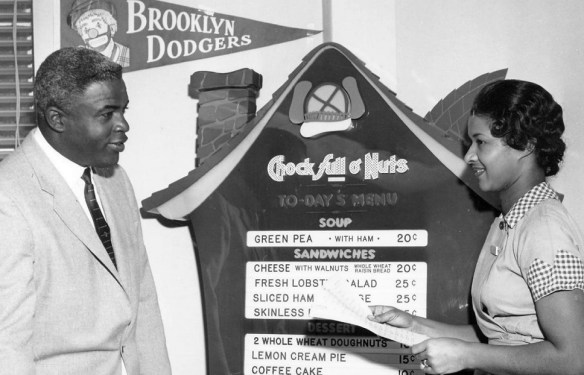
He had a job lined up, with Chock Full o’Nuts, the coffee makers whose chain of lunch counters featured mostly black staff, where he’d be vice president in charge of company personnel. He’d also agreed to tell the story of his retirement to Look magazine for $50,000. He made only the mistake of not making his retirement intentions formal with baseball’s administration or public just yet.

And that hesitation, which many players experienced before and after Robinson, delivered an unexpected posterior bite in December 1956. The Dodgers—now long run not by Robinson’s original patron Branch Rickey but by Walter O’Malley and Buzzie Bavasi—decided to trade him to . . . the crosstown Giants, of all teams.

The same Giants against whom Robinson’s Dodgers had a blood feud that continued after both teams moved to California after 1957. The same Giants whose pitcher Sal Maglie was considered such a Dodger nemesis (If that sonofabitch Maglie throws at my head one more time, I break my bat across his [fornicating] dago head—Dodger right fielder Carl Furillo) that Brooklyn fainted when, after a halting spell in Cleveland, the Dodgers bought the 39-year-old Maglie about a quarter way into the 1956 season.

Perhaps more surprising, getting Maglie helped make the final Brooklyn pennant possible. Maglie had a 2.87 ERA with the ’56 Dodgers, led the National League in ERA+, and finished second to his rotation mate Don Newcombe for baseball’s first Cy Young Award. The bad news was that Maglie was also the very hard luck loser on the flip side of Game Five of the ’56 World Series—Don Larsen’s perfect game.

With the Dodgers now trading Robinson to the Giants for lefthanded pitcher Dick Littlefield and about $30,000 cash, you might imagine competition between Dodger and Giant fans over who’d faint first and hardest. You might also imagine sports cartoonists of the day having a field day with it. According to Roger Kahn in The Boys of Summer, one magazine was preparing along that line: Sport commissioned a cover illustration of Maglie the Dodger pitching to Robinson the Giant. But you might imagine even further Robinson fighting a battle in his own mind.

2020-04-15 JackieRobinsonChockFullONuts

Jackie Robinson with an unidentified staffer in his Chock Full o’Nuts office. His association with the company provoked Casey Stengel to a wisecrack when the two had a public argument: “Jackie Robinson was a great player, but now everybody knows he’s Chock Full o’Nuts.”

The Giants were ready to sign him to a generous enough 1957 deal, and Chock Full o’Nuts’s president William Black—perhaps mindful of the extra publicity thrust likely to arise—was ready to hold Robinson’s job for him if he did decide to play one more season. Still marveling at the imagery of Dodger Maglie against Giant Robinson, Sport editor Ed Fitzgerald asked Kahn, a Sport writer at the time, to find out first if Robinson would indeed suit up for the Giants.

Robinson “was vague,” Kahn would remember of that telephone call. He acknowledged the Giants offering $40,000 for him to play in 1957, followed by $20,000 a year as a scout for the two seasons to follow. But when asked if he’d play, he could only say, “Whatever I do, I’ll give it all I’ve got.” “What Robinson was trying to say (and has never known how to say),” Kahn remembered, “was ‘No comment’.”

A month later, Look called a press conference announcing the publication of Robinson’s article, “Why I’m Quitting Baseball.” Robinson said he’d had help with the piece but, no, the trade to the Giants didn’t make him quit, he’d already started work on the Look article when he got the call about the trade. Two days after the Look press conference, though, Bavasi shot his own mouth off to the press. “Robinson will play,” Bavasi said. “I know the guy and he likes money. Now that Look‘s paid him, he’ll play so he can collect from the Giants, too.”

“If Mr. Black had come to me and said it might be a good idea for me to play,” Robinson told New York Daily News columnist Dick Young, not always a Robinson fan, “I certainly would have considered it.” Bavasi changed all that: “[T]here isn’t a chance—not if Mr. Black got down on his knees and begged me to stay.” One small irony was that, at Chock Full o’Nuts, Robinson’s duties would include doing his best to keep personnel turnover minimal.

“Reading [Bavasi’s] sentences,” Kahn eventually wrote, “Robinson knew: the retirement [from baseball] wold have to be permanent. Already [New York Herald-Tribune columnist] Red Smith was attacking him for ‘peddling a news story, the rights to his retirement.’ If he did play again, critics would denounce him as a phony. His baseball years, begun with heroic pioneering, could end amid cries of fraud.”

The knees that drove him to think about retiring in the first place helped bail Robinson out of an untenable situation at last. (The commissioner’s office voided the deal, returning Littlefield and their thirty large to the Giants.) They also reinforced his retirement decision and removed any lingering doubts on Opening Day 1957, when he awoke unable to get out of bed thanks to his right knee swelling to a size comparable to a pumpkin.

Writing upon Robinson’s death at 53 in 1972, Smith himself described him as “the unconquerable doing the impossible.” Indeed. You couldn’t beat him with a trumped-up Army court-martial. Baseball’s racists couldn’t grind him down. When he suited up, as ally-turned-adversary Leo Durocher once observed, “He didn’t just come to play. He come to beat you. He come to stuff the goddam bat right up your ass.”

Robinson also turned baserunning into guerrilla warfare. Baseball knew its base thieves in the past; Robinson turned even the threat of grand theft into must-see viewing. Smith swore that television introduced split-screen viewing so you could see the pitcher vs. the batter on one side and, on the other side, Robinson on base making that pitcher “wish he didn’t have to throw.”

Jackie Robinson established the black man’s right to play second base. He fought for the black man’s right to a place in the white community, and he never lost sight of that goal. After he left baseball, almost everything he did was directed toward that goal.

Hadn’t coming to and staying in the Show been tough enough without his retirement getting caught in cynical machinations not of his own making? Sal Maglie the Dodger wouldn’t get to pitch to Jackie Robinson the Giant, after all.

Glenn Beckert, RIP: “The closeness is real”

2020-04-13 GlennBeckertRonSanto

Glenn Beckert (right) and Hall of Fame third baseman Ron Santo display their 1968 Gold Gloves. Rawlings presented the award, but Beckert preferred the Wilsons that Hall of Fame pitcher Ferguson Jenkins broke in for him every spring.

When the 1969 Cubs sputtered down the stretch as the Miracle Mets heated up for keeps, Glenn Beckert wasn’t quite as exhausted as several teammates. That’s what missing a month on the disabled list—with a badly jammed thumb after a collision tagging Reds pitcher Tony Cloninger to start a double play—can do for a fellow who was as reliable at second base as the season was long.

Beckert died at 79 Sunday morning. Decades after the 1969 collapse and before his death, he wasn’t unaware of the toll manager Leo Durocher’s whiplash style took on several Cub regulars and especially their bullpen. But he thought those Cubs—enjoying celebrity to levels previously unknown to them, in and out of Wrigley Field—were drained more in the brain than the body.

“Tired? I don’t know, we came up short,” Beckert told Peter Golenbock for the oral history Wrigleyville: A Magical History Tour of the Chicago Cubs. “More than anything, I think we were emotionally drained. None of us were accustomed to the crowds and the intensity. An awful lot of what happened was mental. The whole thing was a sobering experience, but we were young.”

Not that Beckert ignored the physical side. Durocher’s unwillingness to use his decent enough bench or to trust his bullpen deeper than Phil (The Vulture) Regan flattened the Cubs—a team with four Hall of Famers (Ernie Banks, Ron Santo, Billy Williams, and Ferguson Jenkins)—into burnout that September.

“Leo had stuck with his horses, and maybe that hurt us the last month of that season,” Beckert told Golenbock. “Who knows? That’s second-guessing now. But there was no platooning with Leo. I knew I was somewhat tired, and I had an injury before that. [Shortstop Don Kessinger] was getting a little weary, not only physically, but mentally. Ron and Randy [Hundley, stubborn everyday catcher] were hurting.

“We were playing banged up, and maybe that was the time when we could have used a couple of days’ rest,” Beckert continued. “We had a good bench. Papa [Paul Popovich] was the best utility infielder in baseball, the greatest hands, and he could have come in for a week. But that’s looking back. It’s history.”

Mets manager Gil Hodges went the other way completely. “As well as any manager in the game,” Wayne Coffey wrote in last year’s They Said It Couldn’t Be Done, “Hodges understood the importance of making every player feel involved, keeping every player fresh, giving everyone on his club a slice of ownership in what the collective team was doing.”

Durocher “brought us closer to a pennant than anyone else had in a generation,” said Santo in due course, even though he’d been the Cub above all who could be counted on to give Durocher the benefit of the doubt. “But he also brought disruption and chaos.”

“For Durocher’s part,” wrote David Claerbaut in Durocher’s Cubs: The Greatest Team That Didn’t Win, “his feuds, his attempts at intimidating young players, particularly pitchers, and the general tension he generated must have worn on the players.”

And the wear was more severe because of his unwillingness to rest his players and to use his entire roster more wisely. Despite the occasional protestations to the contrary, the team was tired. One need only look at the statistical crumbling, evident in the records of individual players, to draw that conclusion. Only [pitcher] Bill Hands and Billy Williams averted a season-closing freefall . . .

. . . Durocher compounded the fatigue factor by daring his players to admit they were tired . . . in August, when asked by a writer whether he planned to rest some of his regulars, Leo exploded. Cursing at the writer, Durocher called an impromptu team meeting to embarrass him. “Are any of you tired?” he hollered. “Anybody want to sit down for awhile? This man wants to know. Go ahead—anybody who’s tired just speak up.” Not wanting a quitter label and knowing the answer Leo wanted, the players were mum.

Beckert and Kessinger are remembered as a formidable double play combination; Beckert turned 71 double plays in 1969 (he’d turned 107 the year before, arguably his best individual season) but he also committed 24 errors and had a fielding percentage nine points below the league average while being worth five defensive runs above the league average at second base.

He earned his only Gold Glove in 1968, and for his career he did have range factors slightly above the league average. Also in 1969, Beckert found himself on the first of four straight National League All-Star teams.

Yet Durocher’s rejection of the fatigue factor hurt Beckert and Kessinger down that crucial 1969 stretch. Which might be seen through strange eyes, considering Durocher once smiled admiringly when told Beckert was native to a portion of Pittsburgh “where they hit first and ask questions later.” No matter.

“The fact is that when it counted most,” William Barry Furlong wrote in Look during the offseason (in “How Durocher Blew the Pennant”), “both Don Kessinger at short and Glenn Beckert at second were letting ground balls by them that they’d have gobbled up earlier. And what Santo says about it now is, ‘Next season I’m sure Leo will rest the regulars from time to time’.”

As a hitter Beckert was a tough strikeout (he walked seventeen more times lifetime and, after 1966, never struck out more than he walked in any season), which may explain the number one reason why he was made a number two hitter. That was a time when middle infielders were often thought to “belong” at or near the top of the batting order, almost regardless of their actual batting skills.

Like former Yankee second baseman Bobby Richardson, another tough strikeout whose career wound down as Beckert’s began, Beckert’s on-base percentages (1969: .325; lifetime: .318) weren’t really the kind you needed from your top two lineup slots. (Kessinger’s—1969: .332; lifetime: .314) But once he did reach base Beckert was as intelligent as it got; he’d score 90+ runs in a season three times in his eleven-year career and led the National League with 98 in the Year of the Pitcher 1968.

In his rookie season 1965, alas, Beckert had the honour of looking at a Sandy Koufax curve ball for strike three and flying out to right field twice during the Hall of Famer’s perfect game that September 9. According to Koufax biographer Jane Leavy, Beckert’s roommate Santo called back to him after the strikeout. “Hey, Rooms,” Santo asked, “what kind of fastball does he have.”

“So-so,” Beckert answered—right before Williams looked at a similar curve ball for strike three to end the Cub first.

In 1971 Beckert heated up at the plate enough to threaten for the National League batting title—until he ruptured a thumb tendon trying to make a play on a bouncing infield grounder. A few more injuries to follow turned into a trade to the Padres after the 1973 season. Beckert played two more seasons and retired when he realised an arthritic ankle had sapped what remained of his play, though he ended up collecting back pay from the Padres for their releasing him while he was on the disabled list.

It’s not that Beckert was all that sorry to go. “The Padres had the world’s ugliest uniforms, puke yellow and brown,” he’d say later, “and it was a bad experience, going from . . . Scottsdale in spring training to Yuma, Arizona . . . It was like where they filmed Lawrence of Arabia. The sand and the wind. It was like Stalag 17.

He was originally a Red Sox draft who was left exposed to the minor league draft from which the Cubs plucked him. When National League Rookie of the Year (1962) second baseman Ken Hubbs was killed in the crash of his Cessna plane in spring 1964, the Cubs finally settled on Beckert as Hubbs’s successor, bringing him up in ’65.

“A hardscrabble player who sometimes seemed eager to join in collisions at second base,” Bill James wrote in The New Historical Baseball Abstract, “Beckert was the Billy Herman of the 1960s, a pretty good second baseman, and the best hit-and-run man in baseball.”

Beckert made a successful second career as a grain futures trader. His Cub teammates remember a fellow with a fine, dry wit and a friendliness that was priceless. Twenty-seven years after they first met behind a minor league batting cage, Beckert stood as best man at Jenkins’s second wedding.

“Just knowing Glenn was a player who wanted to play every day and knowing he was behind me defensively, that always gave me a good feeling when I pitched,” the righthander told the Chicago Sun-Times.

Jenkins also gladly broke Beckert’s new gloves in for him every spring, something the Sun-Times said wasn’t one of Beckert’s more pronounced abilities. “He’d just hand me his Wilson A2000s, and I’d take care of it,’’ Jenkins said. ‘‘I’d pound a fungo bat into the pocket, put hot water into it, put a ball into it and wrap it nicely overnight. I broke in at least a few gloves for Beck.”

Hitting in front of Williams did Beckert more than a few favours, though whenever Williams fell into a rare slump Beckert would needle him by telling him to start hitting again so the second baseman might reunite with some badly-needed fastballs.

“I was happy to have him up there in the lineup and happy just to have him as a teammate,” Williams told the Sun-Times. “He was a great teammate and a fun guy to be around. He was quick-witted. He and Santo and myself, we used to go out and really enjoy life.”

As often as Beckert dealt with injuries during his playing career, they were nothing compared to the fall he took down fifteen concrete steps in 2001. He was hospitalised long and rehabilitated hard. Then he was diagnosed with lung cancer in 2006. It cut down on the frequency with which Beckert usually attended Cubs conventions and games at Wrigley Field.

“I’m thinking about the good times,’’ said Williams, himself now caring for his wife who battles late-stage dementia. ‘‘That’s what you do when something like this happens, when a person you spent a lot of good times with passes away. We had a really good group of guys on the Cubs back then. Unfortunately, there aren’t a whole lot of us left.”

The departed among the 1969 Cubs now include Beckert, Santo, reserve catcher Gene Oliver, right fielder Jim Hickman, starting pitchers Hands (who had a career year as a ’69 Cub) and Dick Selma, relief pitchers Hank Aguirre and Ted Abernathy, and especially the irrepressible Banks.

Those Cubs experienced two more pennant races with the same results, before Durocher was finally fired in favour of the sometimes-indifferent Whitey Lockman. Most of the team bonded personally as well as professionally, showing up in annual droves after Hundley first established fantasy camps that enabled frequent reunions.

“What you see with us in [the fantasy camp] is just the way it was in the clubhouse when we really played,” Beckert told Claerbaut. “Some guys are outgoing, some more inward. But the closeness is real, maybe because we played together so long.”

He’d had the habit of calling and meeting his old teammates and friends frequently before his accident and illness. Missing those calls will be nothing compared to how much they will miss Beckert himself. But that will be nothing compared to how much his daughters, grandchildren, and longtime companion Marybruce Standley will miss him.

From cycle breaker to brain truster

Chicago White Sox v Tampa Bay Rays

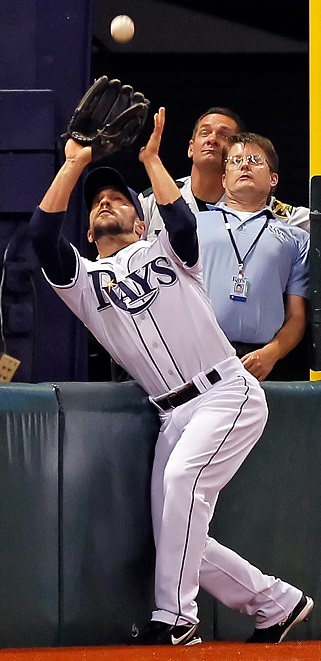
“A manager’s dream and a trainer’s nightmare,” was once the word about outfield acrobat Sam Fuld—who managed not to scramble his brains enough to rob him of the economics and statistical education that’s since made him the Phillies’ information coordinator.

The Phillies’ incumbent coordinator for major league player information used to be a swift outfielder with a penchant for defense that included a remarkable inability to yield to immovable objects. Sam Fuld also has a bachelor’s degree in economics from Stanford, where he insisted on studying before becoming a major league baseball player, and is striking for a master’s in statistics.

And eleven years ago Saturday, as ESPN’s Tim Kurkjian couldn’t resist remembering, Fuld needed a measly single in the top of the ninth to do what Hall of Famers Willie Mays, Henry Aaron, and Babe Ruth, plus Barry Bonds, never did even once in their careers. A single against the Red Sox, whom the Rays were blowing out in Fenway Park as it was, and Fuld would have hit for the cycle.

He didn’t make it.

Not because he didn’t nail a hit—he shot a line drive into Fenway’s right field corner. But neither did he stop at first the way some players might have done if that’s what they needed for the cycle. Fuld knew his hit was deep enough for a double and that’s what he ended up with, running to second just about standing up. And Fuld never once thought he’d made a big mistake.

It would have been a defining moment in the career of a player who wasn’t physically imposing at 5’9″, who was probably mis-seen and mishandled very early in his career, whom injuries compromised to a certain degree, and who never quite found a full-time slot regardless of his contact skills at the plate and his fearless defense.

But it wasn’t baseball. Even with a host of family and friends in the seats (Fuld is native to New Hampshire and grew up a Red Sox fan) who probably would have been the loudest in the park if he’d completed the cycle, it wasn’t proper baseball so far as Fuld was concerned.

“I never thought about stopping at first,” Fuld told Kurkjian in a post-game interview, the game having been showed on ESPN’s Monday Night Baseball. “That’s not the right way to play the game. If you can advance to the next base, you advance. That’s the only way to play baseball.”

So he settled for a night of two RBI doubles, a leadoff triple, a two-run homer into the right field corner seats, and a bath of postgame applause from his Rays teammates. “Everyone in this room respects him even more for that,” said the Rays’ then-general manager Andrew Friedman after that game. “That’s why he’s Sam Fuld.”

Fuld became a Ray in the first place because the Cubs, who drafted him out of Stanford in 2004, found it difficult to find a place for an outfielder described as “a crash test dummy with a death wish” for his daring defense while also swinging a bat that delivered high on-base percentages in the high minors.

In 2008, 2009, and 2010, the Cubs continued having that difficulty. When he was sent to Iowa (AAA) yet again before spring training expired, Fuld was defended from two disparate sources.

“[D]on’t you think you could find a place for a fast guy who gets on base and plays great defense?” asked Rob Neyer, who promptly delivered the answer he didn’t like. “The Cubs did find a place for him. No, not Wrigley Field. Not Heaven, either. Iowa. Again. Where Fuld posted a .383 on-base percentage . . . I’m telling you, there are worse fourth outfielders on half the teams in the majors right now.”

Larry Thornberry, writing then for the political magazine The American Spectator, saw and raised, after Fuld was traded to the Rays for 2011 (in a deal sending pitcher Matt Garza to Chicago and pitcher Chris Archer to Tampa Bay) and made the team out of spring training for the first time—at age 29.

“[P]erhaps decision makers where Fuld has played before Tampa Bay didn’t move him along or pencil him into lineup cards because they were prejudiced against players of Fuld’s stature,” Thornberry wrote. “But those who don’t believe guys of Fuld’s size can be solid major league players should be sentenced to sit in the corner under the dunce hat and read Joe Morgan’s statistics over and over.”

Fuld got his shot as a Rays regular in the first place because Manny Ramirez, being only Manny after all, elected to retire rather than sit out a hundred-game suspension for actual or alleged performance-enhancing substances. “[T]here are no stats to identify the player who captured the hearts of his local fans most quickly,” Thornberry wrote. “If there were, Tampa Bay Rays outfielder Sam ‘The Man’ Fuld might have his first major league record.”

The bad news is that Fuld went from being one of the American League’s on-base percentage leaders ending April to a drop-off at the plate almost inexplicably. Perhaps his acrobatic defense (wags suggested renaming ESPN’s Baseball Tonight to The Sam Fuld Show after so many highlight-reel outfield plays showed up so many times) took the initial toll on his early plate breakout.

Perhaps more, a wrist ligament injury he suffered that September and re-aggravated the following March eroded his once formidable batting skills. The Rays let him walk as a free agent and he signed with the Athletics for 2014; the A’s farmed him out and left him prone to a waiver claim which the Twins placed in late April.

He played thirteen games before suffering a concussion crashing into an outfield wall; he ended up playing only 53 games as a Twin and still managed to lead the team with a .370 OBP, and flying-trapeze outfield plays, before they traded him back to the A’s at the end of July 2014.

2020-04-12 SamFuldSeanRodriguez

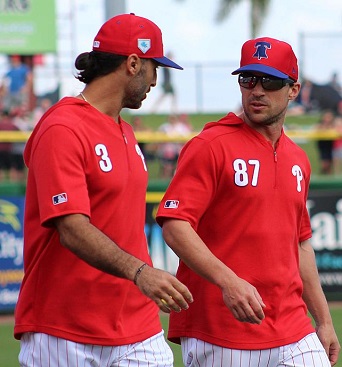
Fuld (right) with Phillies infielder Sean Rodriguez, spring training 2019, before Rodriguez yielded number his uniform number to incoming Bryce Harper.

In Oakland Fuld’s high point was probably the 2014 American League wild card game in which he reached base three times while the A’s fell to the eventual pennant-winning Royals. He moved around the outfield as a part-timer the next two seasons (he led the American League in double plays turned from left field in 2015), never really recovered his batting skills, until the prospect that he’d done so during spring training 2016 ended when he injured his left rotator cuff.

Surgery, season lost, career over. He made his retirement official in November 2017. The Phillies hired him almost before he could finish his announcement that day.

Once it was said about 1960s center field gazelle and 1970s reserve clause challenger Curt Flood that 75 percent of the planet was covered by water and the rest by Flood. When David Price was a Rays pitcher and a Fuld teammate, he plagiarised that observation to say the world was covered 75 percent water and 25 percent Fuld.

What Fuld covers now is baseball knowledge and analytical skill, enough that he was considered seriously for assorted managers’ openings. Last fall, in fact, he was said to be on the candidate lists with the Pirates (who hired Derek Shelton), the Cubs (who canned Fuld’s manager in Tampa Bay, Joe Maddon, in favour of David Ross), the Giants (who replaced retiring Bruce Bochy with ex-Phillies manager Gabe Kapler), and the Mets. (Fired Mickey Callaway, hired Carlos Beltran, unloaded Beltran in the Astrogate wake, hired Luis Rojas.)

A near lifelong Type I diabetic (he was diagnosed at age ten), Fuld is well accustomed to working under pressures. Those who think the analytic nerds come from places having nothing to do with baseball may not have realised that Fuld, who insisted on getting his bachelor’s degree before giving pro baseball a try, merely took what he knew as a player and married it to an already analytical brain.

Even if he scrambled that brain more than a few times making those human cannonball plays.

“A lot of the battle is getting the information to the players when it really matters and that’s when you’re on the field,” Fuld told Philadelphia Inquirer writer Matt Breen in spring training 2018. “You can have all the meetings you want at 1 p.m., but at 7 p.m., when the game really matters, it’s important that they get the right amount of information and the most important information.”

Kapler managed the Phillies in 2018-2019 until he was executed after last season. He was unable to marry his own analytical inclinations to critical, in-game, game-on-the-line moments. Perhaps he forgot that Fuld, his information coordinator, who once immersed himself in Moneyball (the book, not the film) while studying at Stanford, could and did marry both, as a hair-raising outfielder whose very trademark eroded his once-formidable plate smarts and skills but not his intelligence or his feel for the game.

A feel that Fuld displayed for all time on 11 April 2011, in a ballpark where Kapler himself once enjoyed many a high as a championship, real-or-alleged cursebusting Red Sox outfielder. Where Fuld was tempted of the cycle and gunned it past first on to second on an obvious double, ordering that particular Satan to get himself behind.

No wonder there may yet be teams looking for him to take their bridges even if he’s content where he is right now. An analyst who played the game right when he could have stopped short for a moment’s personal glory. It’s as valuable to the game now as sports newscast programmers once held Fuld’s threats to outfield walls everywhere.