Alex Rodriguez, prodigal owner?

2020-07-17 JenniferLopezAlexRodriguez

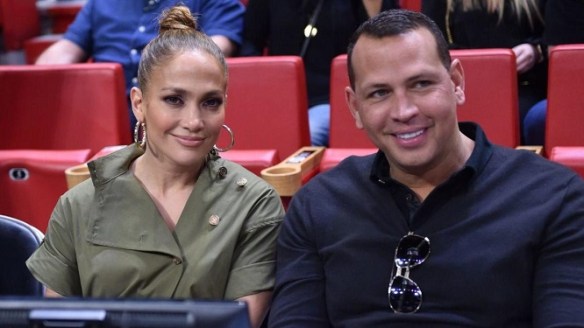
Alex Rodriguez with Jennifer Lopez, watching a game. J-Rod, as a few tabloid papers refer to the couple, are in play to buy the New York Mets.

It’s one thing for Alex Rodriguez to have rehabilitated his public image somewhat, during his final major league playing season and in his life since then as a broadcaster who’s owned up to his baseball sins. Including those that made him persona non grata for 2015 and finished the reputation wreckage from which a comeback then seemed only slightly less likely than Richard Nixon’s was once upon a time.

But it’s something else entirely that A-Rod and his paramour Jennifer Lopez now seek to become baseball owners. They can well afford to be, of course, but red flags hoist. The couple is in play to buy the New York Mets. Wherein lies a tale I’ve told before, elsewhere. It’s worth revisiting, because had he gotten what was once believed his career wish he might (underline that) have resisted the temptations to which he became prone in due course.

When Alex Rodriguez the player arrived at his first major league free agency, in 2000, he let it be known that the team he wanted to play for more than any on the planet—if his now-former Seattle Mariners were disinclined to re-sign him for the dollars he was sure to command as baseball’s greatest all-around shortstop—was the Mets. He grew up a Met fan (his idol was said to be first baseman Keith Hernandez) and, as I wrote once upon a time, there wouldn’t have been a structure big enough to contain his happiness if he could suit up for them beginning in 2001.

The dollars in play weren’t disclosed, but know this: the Mets then could have had A-Rod for a decade, and for two-thirds or a little less of the money for which he’d sign in due course. Coming off a 2000 World Series loss to the Yankees that was closer than the five-game Series looked on the surface, the Mets would have loved nothing more than to dress baseball’s best shortstop cross town from the Yankees’ Derek Jeter—who just so happened to be A-Rod’s best friend in the game at the time.

The Mets’ then-general manager Steve Phillips went to the December 2000 winter meetings to meet Rodriguez’s then-agent, Scott Boras, believing he was going in with A-Rod on the hook over very succulent bait. Phillips came out of that meeting without his stomach. It went AWOL. A decade later, ESPN’s Ian O’Connor ran it down:

A-Rod’s agent was telling the team’s general manager his client needed perks that would have made the world’s greatest divas blush . . . The list included a Shea Stadium office, a marketing staff, a merchandise tent at spring training, a luxury box, use of a private jet, and more billboards than Jeter could count.

The agent said some of the perks, not all, were absolutely required in any deal worth A-Rod’s signature. Boras never mentioned a dollar figure in the meeting, and he didn’t need to. The Mets wouldn’t even be offering Rodriguez cab fare home.

Nobody knew for dead last certain whether Boras’s laundry list was composed in any part by Rodriguez himself, and Rodriguez wasn’t known to have spoken of it publicly. “I remember Steve coming back to our suite and telling everyone, ‘You’re not going to believe it, but this is what Boras wants for Alex Rodriguez’,” another former Met executive, Jim Duquette, told O’Connor. “All of our jaws just dropped. We kept hearing how this was the place Alex wanted to play, but we knew then it wasn’t going to happen.”

Phillips then made a grave mistake. He spoke publicly about the Mets wanting to avoid a 24-man-plus-one roster, even though he never knew how much of the perk list was far more Boras than A-Rod talking. He lived to regret his remark.

That label stuck to Alex, and I didn’t mean for that to happen. But I just thought the rules had to be the same for everybody. Mike Piazza was the most low-maintenance superstar there was, with no entourage, only his brother and dad coming around once in a while. Mike always had the prettiest girl waiting for him after the game, and that was it. It was just Mike.

Not only was Rodriguez not going to become a Met, he inadvertently tore it with his BFF Jeter, who was going through his own contract haggle with the Yankees at the time. When A-Rod finally signed his precedent-busting deal with the Texas Ranger ($250 million), he also commented on the Jeter haggle. Oops.

“Jeter’s been blessed with great talent around him; he’s never had to lead,” Rodriguez said. “He can just go and play and have fun. He hits second—that’s totally different than third or fourth in a lineup. You go into New York, you wanna stop Bernie [Williams] and [Paul] O’Neill. You never say, ‘Don’t let Derek beat you.’ He’s never your concern.”

He didn’t mean for it to sound as though he’d just reduced The Captain to a mere ship’s mate. But there was a right and wrong way to say aloud that you thought Jeter was only one of a pack of leadership-quality Yankees who didn’t have to take the whole thing upon himself. Which is probably what A-Rod tried to say. Seeing it in cold print, he knew it meant trouble.

Assorted stories then and since have said Rodriguez hustled it to Jeter’s Tampa spread post haste to straighten it out and got a closed door to greet his arrival. The worse news for Rodriguez was that Jeter did have one thing in common with the Yankees’ Hall of Fame legend Joe DiMaggio, or so it was said: if he thought you did him dirty, even once, you might as well remove him from your address book. Permanently, perhaps. (Since 2010, their first spring training together after a Yankee World Series win, A-Rod and Jeter have patched up their once-fractured friendship.)

The Rangers didn’t exactly blow up the league with A-Rod. It wasn’t exactly A-Rod’s fault that the pitching-challenged Rangers of the time thought the solution to their most glaring problem was to spend the equivalent of a solid pitching staff on . . . one shortstop. The worse news was A-Rod’s insecurities kicking his insides out. “You wonder now about the real impact all that had on A-Rod,” I wrote upon his finalized suspension.

You wonder how his own agent botching a deal with the team of his dreams ate away at him. You wonder how deeply costing himself his best friend in baseball haunted him. You wonder what that cost him in a time when Jeter could have given Rodriguez critical moral support and steerage, when—slapped hard across the face with the reality of his off-the-chart deal, and the expectations attached to it, actual or suggestive — Rodriguez instead drove himself toward the netherworld of actual or alleged performance-enhancing substances, out of a quiet desperation to live up to his deal that equaled not trusting the talent that put him in position for the deal in the first place . . . Even if you acknowledge the Rangers bid against themselves to give one shortstop the money that would have built a long-term competitive pitching staff, you can’t lay that kind of responsibility upon his head.

Which brings us now to Rodriguez’s public suggestion that major league baseball players need—wait for it!—a salary cap. Especially after the owners tried to strong-arm them into a virtual one during the haggling over when and whether to open a 2020 season during the coronavirus world tour. A-Rod sounds only slightly less hypocritical than the Congresspeople standing foursquare for the balanced budget on the campaign trail but standing for glandular deficit spending in office.

As happened with his ancient observation of Derek Jeter, Rodriguez probably stumbled over his own tongue. He wasn’t wrong to suggest as he did concurrently that baseball would be wise to “get to the table and say the No. 1 goal, let’s get from $10 to $15 billion [total value of baseball] and then we’ll split the economics evenly.” But sports circles tent to interpret that as code for salary capping. A man who earned almost half a billion dollars playing the game and now implies it’s time for a salary cap looks too deeply to be saying, “I got mine, the hell with yours.”

Which is exactly how a number of players and other officials representing them see it. A-Rod’s one-time Yankee teammate, now-retired pitcher Brandon McCarthy, practically called for a little cancel culture sent his way. “I hope to god he’s shouted out of every clubhouse he attempts to enter in this and future seasons,” former 13-year pitcher Brandon McCarthy said in a Thursday tweet. “Call him a self-serving liar and make him explain himself to a room full of his former peers if he wants broadcast content.”

Tony Clark, the executive director of the Major League Baseball Players Association, wasn’t quite inclined to go there. “Alex benefited as much as anybody from the battles this union fought against owners’ repeated attempts to get a salary cap,” said Clark a little more reasonably. “Now that he is attempting to become an owner himself his perspective appears to be different. And that perspective does not reflect the best interest of the players.”

Before you decide that A-Rod is unique in threatening to graduate from a player to a potentially odious owner (assuming J-Rod become the winning bidders for the Mets), hark back to some baseball history. It’s strewn with players who became snakes in the front office. Eddie Lopat (pitcher), Paul Richards (catcher), Ralph Houk (catcher), and Al Campanis (second baseman and, incidentally, eventual provocateur of Andy Messersmith’s successful reserve clause challenge) were just four such reptiles known to screw players on contracts and other things.

It also features Al Rosen. The power-hitting Cleveland Indians third baseman of the 1950s became a very generous general manager in the 1980s, having learned from the ever-spending Yankee owner George Steinbrenner. Rosen injected a steroid shot (no pun intended) into salary escalation when, running the San Francisco Giants in 1990-91, he signed decent but no great shakes pitcher Bud Black to the kind of deal you’d have expected the Orel Hershisers and Dwight Goodens of the time to sign first.

The same Al Rosen who lamented runaway salaries to reporters at the December 1990 winter meetings, saying, “For a hundred years we couldn’t find a way to destroy this game, but now I think we’ve found the key.” John Helyar (in The Lords of The Realm) wasn’t the only observer wondering whether Rosen’s listeners should laugh, cry, or drop a hood over him and a final cigarette between his lips before a firing squad.

Now, along come J-Rod. Seeking to own the team for whom A-Rod once wanted in the worst way possible to play, until he did or didn’t freeze himself out of the chance. Bear in mind, too, that power couples owning sports teams doesn’t always mean joy to the world, or at least their teams and fan bases. Just ask former Los Angeles Dodgers owners Frank and Jamie McCourt.

With Rodriguez speaking of salary caps after earning about half a billion uncapped balloons during his own playing career, Mets fans and observers may not be the only ones pondering whether they’ll have to laugh, cry, or bring in the firing squad. If not pondering whether A-Rod has some sort of peculiar revenge in mind.

Rodriguez the boyhood Mets rooter might care to know that there is a one-time Mets pitcher named Bill Denehy living in southern Florida. He’s the man the Mets traded to the second Washington Senators to obtain manager Gil Hodges. Injuries (and a grave misdiagnosis or two) shortened Denehy’s career to portions of three major league seasons with the Mets, the Senators, and the Detroit Tigers. Excessive cortisone injections likely contributed to Denehy’s near-total blindness today.

The affable Denehy (fair disclosure: we have become friends over the past year plus) is one of 600+ short-career former major league players who were left out of the 1980 player pension realignment that vested players for pensions after 43 days’ major league service time and for health benefits after one day’s time.

Since 2011, when then-Players Association leader Michael Weiner and then-commissioner Bud Selig hammered out one small adjustment, those players get $625 per quarter for every 43 days’ major league time, up to four years. It was a start Weiner didn’t live long enough to pursue further.

Denehy, former Rangers pitching phenom David Clyde, former Atlanta Braves pitcher Gary Niebauer, and former Chicago Cubs third baseman Carmen Fanzone, are just four of those players. They and dozens more such as them, all whose careers proved short for assorted reasons, also hit the hustings for the Players Association to get among other things the free agency that brought Rodriguez his un-capped millions.

J-Rod (and Clark, for that matter) might want to lend them even a small eye and ear about that.
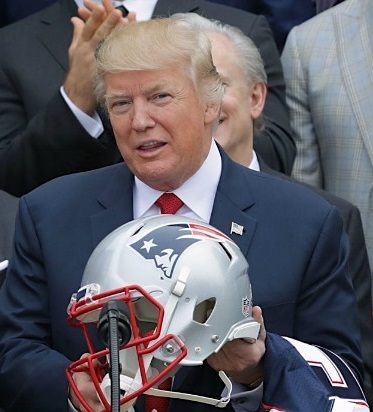
With a friend like Trump . . .

DonaldTrumpNewEnglandPatriots

President Donald Trump, holding a New England Patriots helmet at the White House celebrating the Pats’ Super Bowl LIII victory. He managed to conflate a football beneficiary of the former Alabama coach running for the Senate with the man who coached the Pats’ American Football League ancestors, among others.

When last we had occasion to think of Donald Trump in sports terms having nothing to do with kneeling during the National Anthem, he attended Game Five of the last World Series in Nationals Park. He was booed rather lustily, with intermittent chants of “Lock him up!” punctuating the chorus.

The “lock him up!” chants returned in the seventh inning—not for President Tweety, but for home plate umpire Lance Barksdale, whose evening to that point was full of such dubious calls (including the fourth ball called a third strike on Nationals outfielder Victor Robles during the inning) that both Nationals and Houston Astros fans alike wanted him in the stockade.

Now, though, the president about whom “polarising” often feels high praise arouses the attention of Deadspin, the online sports publication. He arouses it by way of the campaign trail, on a conference call, supporting former longtime Auburn University football coach Tommy Tuberville’s campaign as Alabama’s newly-crowned Republican nominee to the U.S. Senate.

Trump wanted to praise Tuberville as the reason the University of Alabama hired a particular football coach, after the Auburn Tigers bushwhacked the Crimson Tide in six straight meetings between the two schools. Then, he wanted to praise that coach. Uh, oh. “Beat Alabama, like six in a row, but we won’t even mention that,” President Tweety began, starting with Tuberville. “As he said . . . because of that, maybe we got ‘em Lou Saban . . . And he’s great, Lou Saban, what a great job he’s done.”

Crimson Tide coach Nick Saban must be double-checking his records to be sure he didn’t change his name inadvertently, somewhere. And, to re-assure himself, with apologies to Mark Twain, that the reports of his death have indeed been exaggerated greatly. The National Football League and its long-ago-absorbed upstart competitor the American Football League would love to know how the real Lou Saban coached from beyond.

That real Lou Saban, as Deadspin couldn’t wait to remind anyone caring, coached in both American pro football leagues and in college football for a very long time. But not past 2002, after a decade of working at far lower than Division I programs.

The president who once denounced the late Sen. John McCain for having been captured as a prisoner of war during the Vietnam War (“I like people who weren’t captured”) and makes a fetish of “winning” (without stopping to think that one man’s “winning” is another’s self-immolation) chose quite a winner to conflate with Alabama’s incumbent football coach.

Saban, who may or may not be a second or more distant cousin to Nick, was a charter coach of the Boston Patriots, when the AFL was born in 1960. From there he enjoyed a sixteen-season career coaching in the AFL and—when his Denver Broncos moved with the merger—the NFL. He had three first-place finishes (coaching the Buffalo Bills, 1963-65) and two AFL championships. And that’s all, folks.

He had six winning seasons in sixteen coaching the pros. His final record as a pro football coach is 95-99-7. Except for his back-to-back AFL championships, Saban never led his teams past a single playoff win. He did get to return to the Bills in 1972, coaching the teams fabled for O.J. Simpson and the Electric Company offensive line, but they never got past second place or a single playoff loss, either. He resigned after a 2-3 start in 1976 and never coached in the NFL again.

But he did return to the college coaching lines, which he’d visited once in the middle of his pro coaching life (University of Maryland: 4-6 in 1966), and where his coaching career began for a single season in 1956. (Northwestern University: 0-8.) He coached the University of Miami to back-to-back losing seasons (1977-78) and Army (1979) to one losing season. His complete coaching record at the major schools: 15-35-2.

Saban left Miami in the middle of a row over three freshman players attacking a Jewish student in yarmulke while he walked toward a campus religious service. They carried him to Lake Osceola in the middle of the campus and threw him in. Having been off campus when the attack happened, Saban returned to learn of it and say, according to Bruce Feldman’s history of Miami football, “Getting thrown in the lake? Sounds like fun to me.”

After he left Army, Saban took a brief, curious career turn. He became one of George Steinbrenner’s “baseball people,” doing Steinbrenner (a personal friend) a favour and becoming president of the New York Yankees for 1981-82. Even allowing that Steinbrenner did love football, engaging a football lifer as a baseball president seemed along the line of hiring a furniture designer to develop vacuum cleaners.

If Saban had anything to say about some of the turmoil around those Yankees, there seems little enough record of it:

* Steinbrenner fired first-time manager Gene Michael in 1981, after Michael challenged The Boss to knock it off with the constant threats. Steinbrenner’s bid to mollify The Stick became a classic of Yankee panky: Why would you want to stay manager and be second-guessed by me when you can come up into the front office and be one of the second guessers?

* Steinbrenner burned through three managers in 1982: Hall of Fame pitcher Bob Lemon (who’d picked up Billy Martin’s pieces and led the Yankees to a World Series championship in 1978), Michael again, then Clyde King.

* Steinbrenner hired former Olympic hurdler Harrison Dilliard to help turn the Yankees into a speed team, an idea so hilarious as it was accompanied by continuous running drills in spring training that wags began calling the Yankees “the Bronx Burners.” (The experiment lived only slightly longer than some Yankee managers kept their jobs.)

The man who thought it sounded like fun for three of his Miami players to dunk a Jewish student in Lake Osceloa isn’t on record anywhere that I know of suggesting what fun Steinbrenner’s King of Hearts act in the south Bronx must have been for those on the wrong end of His Majesty’s scepter.

Lou Saban died at 87 in 2009, two years after Alabama hired Nick. He might not have had a real reputation as a long-term winner but he did have one as a teacher. He was also in no position to be the direct beneficiary of  Tuberville’s constant seawalling of the Crimson Tide. Alabama isn’t exactly renowned for hiring octogenarian head coaches. Nick Saban, on the other hand, has a long-term winning reputation in college football: a 248-65 record; three Bowl Championship Series wins; and, ten bowl game wins otherwise.

Deadspin offers the charitable suggestion that Trump might have conflated Saban with Lou Holtz, the Notre Dame coaching legend. Careful with that axe, Eugene: In some portions of the South, confusing or conflating a Crimson Tide coach with some Hoosier coach can provoke the same kind of tavern debate (if not brawl) as could be provoked in the northeast, formerly,  if you inadvertently confused or conflated Mookie Betts with Mookie Wilson.

Trump’s sports record is dubious at best, shall we say. When he hasn’t beaten his gums about kneeling National Anthem protesters (a subject for another time, for now), he’s been a football owner (in the failed United States Football League some say he destroyed in the first place), a less-than-knowledgeable advocate (speaking politely) of Pete Rose’s reinstatement to baseball and election to the Hall of Fame, and a public critic, equally less than knowledgeable, of Maximum Security’s rightful disqualification in the 2019 Kentucky Derby.

With an expert like that on his side, I’m not entirely sure that Tuberville—whose own college football coaching career was impressive enough (159-99 record; seven bowl wins)—needs adversaries.

Not right, Nats

2020-07-14 DaveMartinezMikeRizzo

Dave Martinez (left) and Mike Rizzo. The Nats’ GM hasn’t heard a peep about a contract extension or wholly new deal yet despite being in the final year of his current deal. The skipper hasn’t, either, despite having one more year on his current deal.

You built a World Series champion through trials, errors, and very occasional calls for your head on a plate while you stayed your course and kept your eye on the Promised Land. It wasn’t just any World Series champion but Washington’s first Show champion* since the Coolidge Administration.

But your contract expires after the season to follow, however truncated the coronavirus world tour makes it. Wouldn’t you think your bosses would want you to stick around so you can give it your best shot at sustaining that success?

Or, you managed that club from hell to the highest waters possible, despite the not-so-great bullpen you were handed to work with when last year began, keeping them from losing their marble (singular) despite a 19-31 season beginning. They bought your go-1-0-every-day philosophy. You gave them room to go 74-38 the rest of the season and perform feats of derring-do without nets and, sometimes, logic.

You also did it while earning barely more than the minimum major league player’s salary. Wouldn’t you think, too, that the same bosses would want you to stick around so you can give it your best shot at convincing your team their next theme song—Gerardo Parra, after all, has moved onward, taking the “Baby Shark” mojo with him—should be, “I Want to Take You Higher?”

Sure you would. Both of you would. But nobody in the Washington Nationals’ executive suite seems to have moved so much as a fingernail on it. Meaning, as USA Today‘s Bob Nightengale reminds us, that general manager Mike Rizzo is a lame duck in a truncated season and manager Dave Martinez is a year from the same quack.

And, if Rizzo’s a lame duck this year he may not be the one able to move on keeping Martinez above and beyond 2021, presuming the Nats’ success sustains. Which it should, whenever the game returns to something resembling normal, with the extending of Stephen Strasburg, Max Scherzer not exactly showing age just yet, a new young core and several reliable veterans.

This is the GM who took a big hit in 2018 when—in the middle of an already injury-compromised season that also included Bryce Harper’s walk year—he dumped two relief pitchers in circumstances described as dubious at best and disingenuous at worst.

When Shawn Kelley was brought in to pitch near the end of a blowout, looked toward Martinez for guidance about an umpire’s positioning, then spiked his glove after surrendering a home run, Rizzo took it as showing up the skipper even though Martinez didn’t see it that way. He didn’t give Kelley a chance, getting in the reliever’s face then releasing him to be snapped up by the Oakland Athletics.

When Rizzo suspected concurrently that Kelley’s fellow reliever Brandon Kintzler was the source of a Yahoo! Sports story calling the Nats clubhouse a big mess, he didn’t even bother to verify it—he sent Kintzler off to the Chicago Cubs. Both Kelley and Kintzler found themselves back in the races at their new addresses. Kintzler denied emphatically, with then-Yahoo! Sports writer Jeff Passan’s affirmation, that he was the source of the clubhouse mess story.

“If you’re not in,” Rizzo said emphatically, “you’re in the way.” In those moments it looked as though the GM himself could be charged under that statute.

Rizzo stood his ground for better or worse. So did Martinez, whose bullpen management was considered suspect but who was, in fairness, suffering a malady his predecessors had to suffer, too. For the longest time Rizzo was seen as the GM who could and did build solid starting rotations, solid position cores, and reasonable benches, but just couldn’t build bullpens with the same surety.

Martinez never lost his players when all was said and done, either. “They held onto Martinez,” writes Washington Post sportswriter Jesse Dougherty in Buzz Saw: The Improbable Story of How the Washington Nationals Won the World Series, “despite faint calls for his job, and he didn’t spend October [2018] watching the postseason. That would have been one kind of torture. He chose even worse.”

He went everywhere with an iPad that had each of the Nationals’ 162 games loaded onto it. He hunted in Wisconsin, fished outside Salt Lake City, lay in the hammock at his farm outside Nashville, and still carved out time, every day, to relive all the mistakes. There were his mistakes, mostly with the bullpen, such as leaving relievers in too long, or not striking the right balance between analytics and his gut. Then there were his players’ mistakes, such as taking the wrong plate approach, the wrong baserunning approach, or lapsing on defense . . .

He got to West Palm Beach [for spring training 2019] in early February and called for a staff meeting. That’s when he told the coaches about correcting the little things. Mistakes were met with yelling “Do it again!” into quiet mornings . . .

The calls for both Rizzo’s and Martinez’s heads ramped up at that 19-31 start last year. By the time they shoved the Milwaukee Brewers out of the wild card game, upended the Los Angeles Dodgers in the division series (something about a guy named Howie Kendrick detonating a grand slam at the expense of a manager who misread his bullpen even worse), and buried the St. Louis Cardinals in the National League Championship Series, executions were no longer an option.

When Rizzo’s midyear trade acquisition Daniel Hudson struck Michael Brantley out swinging to finish what a gutsy Scherzer started (pitching five innings on fumes and probably lucky to have only two runs pried out of him) and Kendrick overturned (that pole-ringing two-run homer turning a deficit into a lead the Nats never lost) in Game Seven of the World Series, the calls weren’t for executions but canonisations.

Lately Rizzo has been more than just the deft rebuilder. The Show’s contradictory COVID-19 issues of late got a verbal beatdown from Rizzo after Nats’ tests were still delayed 72 hours after July 3.

“We cannot have our players and staff work at risk,” Rizzo said. “Therefore, we have cancelled our team workout scheduled for this morning. We will not sacrifice the health and safety of our players, staff and their families. Without accurate and timely testing it is simply not safe for us to continue with Summer Camp. Major League Baseball needs to work quickly to resolve issues with their process and their lab. Otherwise, Summer Camp and the 2020 Season are at risk.”

He wasn’t alone. The A’s, the Houston Astros, the Los Angeles Angels, the Arizona Diamondbacks, and other teams found themselves canceling workouts or intra-squad games over testing delays. This is no bowl of Raisin Bran they’re dealing with.

Letting Rizzo be the face of the Nats when it comes to coronavirus safety protocols is one thing, Nightengale writes. Letting him sit as a lame duck otherwise isn’t acceptable. “It’s insane,” he continues, “but again this is the same ownership that fired manager Dusty Baker after winning back-to-back division titles. It’s the same owners that told Bud Black he was their new manager, only to offer him a one-year deal. The same owners who have perhaps the smallest and lowest-paid front office staffs in baseball.”

The same owners whose manager earns barely more than infield comer Carter Kieboom would have earned in a full 2020 season.

Nightengale notices something else, too. He notices that, during Rizzo’s tenure, not one Nat—other than longtime clubhouse leader Jayson Werth hit with a reckless driving charge (going 105 on the Beltway)—has made room for even the mildest scandal: “No PED suspensions. No domestic violence suspensions. No discrimination lawsuits.”

No extracurricular, off-field-based high-tech cheating, either. So far. The Astros and the Boston Red Sox may or may not be right that they weren’t the only ones operating illegal intelligence agencies during their World Series-winning seasons. The New York Yankees still have some splainin’ to do about that illicit dugout phone and possible other extracurricular Yankee panky. But nobody’s pointed any such finger toward the Nats just yet. They might be the only part of Washington you can still call scandal free. So far.

When ancient questionable tweets by shortstop star Trea Turner surfaced, Turner simply manned up, said he was young and stupid and not necessarily in that order, and that was that. No muss, no fuss, no attempt to duck, nothing more than a quick apology.

Loyalty is one thing, and Rizzo has that in abundance to his bosses and his players alike, so long as he doesn’t think those players are in the way. But what does it tell you that only two other teams won more games than the 2010s Nats while the Nats finished the decade with the keys to the Promised Land but you can find almost ten teams with better-paid front office people?

Rizzo and Martinez have earned new deals. For Martinez, it might make up for his not being named Manager of the Year over the Cardinals’s Mike Schildt as he should have been for 2019. Schildt lifting a slightly leaky boat isn’t even close to Martinez raising the Titanic.

“[T]his is a proud baseball franchise,” Nightengale writes, “and shouldn’t be run like a construction site, sitting back and making bids to get the cheapest cost.” Maybe some Nats players—who are as loyal to Rizzo and Martinez as those two bosses are to them—could drive the point home further by having their batting helmets re-shaped into construction site hard hats?

——————————————-

Let us not forget: The Homestead Grays, playing their home games in Washington’s ancient Griffith Stadium, beat the Birmingham Black Barons in the final Negro Leagues World Series in 1948.

Freese’s pieces, revisited

2020-07-12 DavidFreeseSeriesMVP

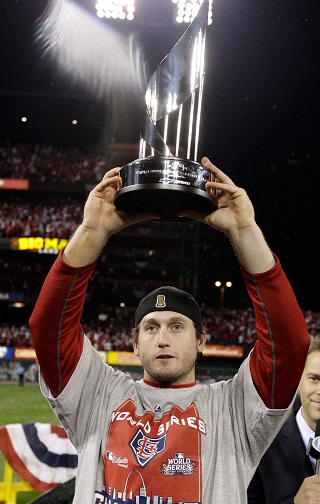
David Freese hoists the 2011 World Series MVP trophy. He’d also won that National League Championship Series MVP.

Notoriously enough at the time, Hall of Famer Reggie Jackson pre-Yankee mused aloud, “If I played in New York, they’d name a candy bar after me.” When fellow Hall of Famer Brooks Robinson was given a day at Baltimore’s old Memorial Stadium, on the threshold of his retirement, the host of the event told the cheering crowd, “Around here they don’t name candy bars after Brooks—they name their children after him.”

When David Freese made the St. Louis Cardinals’ difference in the 2011 National League Championship Series, I noted—after recalling he first thought his trade from the San Diego Padres to the team for whom he grew up rooting madly, the Cardinals, was a joke—“(E)veryone except citizens of Milwaukee might be laughing with the National League Championship Series’ most valuable player.”

In St. Louis, of course, they may be ready to name a candy bar after him. Freese’s Pieces, anyone? It isn’t everyone who comes up from oblivion to out-slug Albert Pujols when Pujols is having the best postseason set of his career, or drives home a ferocious exclamation point on it Sunday night with a first-inning blast that merely starts the Cardinals en route a secured trip to the World Series.

Who knew after Game Six of that NLCS that Freese’s series would prove a mere dress rehearsal for the big event to come? Not even Freese himself, about whom Joe Posnanski—amidst a series in The Athletic remembering sixty transcendent baseball moments—writes with loving eloquence that he was one kid who got to live every baseball kid’s backyard or schoolyard dream, suiting up for the home team he grew up loving, and hitting the blasts that either send the team to the Promised Land or yank them back to the threshold.

Most such kids would sell their souls to get a chance to do it for the home team even once. Freese did it twice, also in Game Six, but this time during the 2011 World Series. He tied it with a two-run triple in the bottom of the ninth and won it with a leadoff home run in the bottom of the eleventh. Telling the Texas Rangers, “Not so fast,” he sent the set to the seventh game his first-inning, game-tying two-run double would help the Cardinals win.

Think about the roll of Cardinals World Series heroes and from whence they came in the first place. Grover Cleveland Alexander (pitching and winning Game Six to send the 1926 Series to a seventh game his team would also win)—Elba, Nebraska. Pepper Martin (hitting .500 in a seven-game 1931 Series)—Temple, Oklahoma. The Dean brothers (Dizzy: two wins; Paul, two wins, including Dizzy’s Game Seven shutout, 1934 Series)—Lucas, Arkansas. Enos Slaughter (the Mad Dash, Game Seven, 1946 Series)—Roxboro, North Carolina. Bob Gibson (MVP of the 1964 and 1967 Series)—Omaha, Nebraska. Darrell Porter (MVP of both the 1982 National League Championship Series and World Series)—Joplin, Missouri. David Eckstein (resident pest and MVP, 2006 World Series)—Sanford, Florida.

Did somebody mention Sandy Koufax? He got to be a World Series hero twice for his hometown Dodgers, the MVP of the 1963 and 1965 Series—but that came after the Dodgers left Brooklyn for Los Angeles, and after a serious hitch in Koufax’s delivery was caught at last and fixed in spring training 1961, turning him from an untamed talent into an off-the-charts Hall of Famer.

Think a little bit, too, of how many players were Hall of Famers who came up too short in postseasons if they got there at all. Of how many—like Freese—who weren’t Hall of Famers on the best days of their regular season lives, but played like Hall of Famers when they did get to the big postseason dance. Of how the Freeses of the game live the truth of Gene Hackman’s valedictory in (of all things) the football film, The Replacements: “Greatness, no matter how brief, stays with a man.”

(Eckstein? Al Gionfriddo? Dusty Rhodes? Sandy Amoros? Don Larsen? Moe Drabowsky? Al Weis? Donn Clendenon? Gene Tenace? Brian Doyle? B.F. Dent? Dave Henderson? Mickey Hatcher? Sid Bream? Tony Womack? Edgar Renteria? Luis Sojo? Scott Spiezio? Scott Podsednik? Carlos Ruiz? Pablo Sandoval? Steve Pearce? Call your offices.)

Porter came the closest to being a homegrown Series hero, Joplin being a measly four-hour, 284-mile drive to St. Louis. Freese was born in Corpus Christi, Texas, but raised in St. Louis’s Wildwood suburb. He’d set Wildwood’s Lafayette High School’s single-season record of 23 home runs and a .533 batting average in his senior year, but felt burned out enough by baseball to spurn a baseball scholarship at the University of Missouri to try studying computer science instead.

So much for that idea. After visiting Lafayette during a summer while working in his school district’s maintenance department, Freese gave baseball another shot at two other schools and—the year Eckstein made himself the cockroach the Detroit Tigers couldn’t exterminate in the 2006 Series—made himself the Sun Belt Conference’s player of the year. The Padres drafted him in 2006’s ninth round.

2020-07-12 DavidFreese

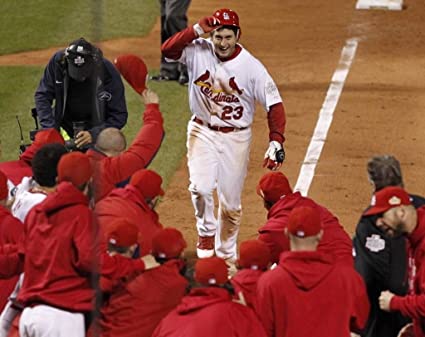
Freese about to hit the plate in a swarm of teammates, Game Six, 2011 World Series. “I just got beat up by thirty guys,” he laughed to reporters afterward. It was nothing compared to how depression was beating him up inside.

The Cardinals sent a spent Jim Edmonds to San Diego to get Freese in 2008 because they needed a solid minor league third baseman. Then, with former Angels World Series MVP Troy Glaus injured, the Cardinals needed Freese—until they didn’t. He didn’t turn up in the Cardinals’ fatigues again until 2010, where a hot start turned unfortunately into a season-ending ankle injury that June.

His 2011 threatened to be injury compromised, too, a hand fracture when hit by a pitch costing him 51 games. After his return, he finished the regular season with a flourish of eight hits in the final nine games. Then came the NLCS. Then came the World Series. Then came first and second with two outs for Freese in the Game Six bottom of the ninth, against Rangers closer Neftali Feliz. Then came Freese on 1-2 down to his and the Cardinals’ final strike—of game, set, and season.

Then came Freese swinging at a fastball on the outer half of the plate. “The beauty of it,” Posnanski wrote at the time, “was that in the instant after the ball was hit, it had a chance to be anything.”

He had obviously hit it well — the ball cracked off the bat — but there was no telling how well. It had a chance to be a home run. It had a chance to be an out. I have written before that there is nothing in sports like the successful Hail Mary pass in football, and the main reason is that no two Hail Mary passes are alike. Sometimes they deflect from one receiver to another. Sometimes they bounce off the defenders’ hands and back to a waiting receiver. Sometimes the pass just drops into a pile and sticks in a receiver’s hands. Really, there are countless geometrical possibilities. Baseball doesn’t usually have that kind of geometry. Home runs are home runs. Singles are singles. Pop-outs are pop-outs . . . But Freese’s fly was something like a Hail Mary. There was just no telling how it would turn out while the ball was in the air.

Rangers right fielder Nelson Cruz misjudged where the wall was, playing in the Rangers’ no-doubles defensive alignment, and the ball sailed over his head and into the wall. It sent the game to extra innings, where Josh Hamilton restored the Rangers’ two-run lead with a home run in the top of the tenth but a pair of singles, a run-scoring ground out, and Lance Berkman’s two-out RBI single—with the Cardinals again down to their final strike—tied things up again, this time at nine each.

Then Jake Westbrook kept the Rangers to a mere base hit in the top of the eleventh and Freese led off the bottom against Mark Lowe. Remember, now, that this was also the Series in which Pujols channeled his inner Reggie Jackson in Game Three, hitting three home runs—from the sixth inning forward, nourishing a 16-7 blowout. Who could possibly top that?

For that matter, who could possibly top Freese’s Game Six-tyer? The one that turned eight innings of somewhat sloppy baseball into three innings to come of surrealistic baseball? The answer turned out to be Freese himself. On a full count. On what looked like a changeup hanging into the middle of the plate. Over the center field fence, onto the green lawn beneath the Busch Stadium batter’s eye. With Hall of Famer Nolan Ryan, then the Rangers’ president, watching from the field level seats in abject disbelief.

Trotting around the bases as the Rangers left the field, Freese slammed his batting emphatically onto the third base line, down between his briefly leaping legs, a few feet before he hit the plate to be buried by a swarm of celebrating teammates. “I’m just about out of breath,” Freese told reporters in an on-field post-game interview. “I just got beat up by thirty guys.”

His Hall of Fame manager Tony La Russa—whose Game Five bullpen communication breakdown got close to vaporising his image as a tactical master and big-picture strategist, and who should have blown his team to world-tour vacations for pulling his kishkes back out of the incinerator—could only say, “You had to see it to believe it.”

This was a player who battled clinical depression his entire life, fell into alcoholism while battling it and suffered a small number of accidents and incidents before he became a Cardinal, then took the battle public eight months after he married and while in the Busch Stadium visitors’ clubhouse as a Pirate. “I’ve had moments like that since high school, to be honest,’’ he told USA Today‘s Bob Nightengale in 2017.

It’s been 15-plus years of, “I can’t believe I’m still here.” You win the World Series in your hometown, and you become this guy in a city that loves Cardinal baseball, and sometimes it’s the last guy you want to be. So you start building this façade, trying to be something I was not. And the whole time, I was scared to death what was going to happen to me after baseball.

. . . Who knows where I was headed, but as long as I was here, I had so many friends here, I wasn’t good at just saying no. I wanted to please people, make everyone happy, and that became impossible.

What happened was the Cardinals trading Freese to the Los Angeles Angels in November 2013, the Cardinals knowing Freese needed to leave in the worst way possible to blow the pressures away. That was part two of what began resolving his inner turmoil. He met part one at his friend’s media studio a week before the deal, an intern named Mairin O’Leary—who became Mairin Freese in the simplest ceremony possible, in a Pittsburgh coffee shop in September 2016. Over a crepes breakfast.

Freese had one more chance at postseason glory as a 2018 Dodger. He did his part, hitting leadoff home runs in Game Six of the NLCS and Game Five of the World Series, but the Dodgers fell to the Boston Rogue Sox who may or may not have deployed their now-infamous replay room reconnaissance ring sign-stealing plot during that postseason.

When he retired after last season, Freese no longer saw his stupefying 2011 postseason as a cross to bear from behind the wall of depression. He looked forward to taking his almost three-year-old son to a live Cardinals game in due course. Not to mention showing the little boy what Daddy delivered in Game Six. And all that postseason, including a still-record fifty total bases and 21 runs batted in.

“It’s going to be cool when Kai understands and I show it to him,” Daddy told the St. Louis Post-Dispatch as he retired, “and he says, ‘Is that really you on the TV?’ He understands it’s me now if he’s watching and there’s a closeup of me hitting or something. It is going to be cool (showing him the World Series ring). Look at that damn squirrel. He might not care, which might even be cooler.”

Kai Freese will have to wait, unfortunately, until the coronavirus world tour dissipates enough to let the games bring the fans back to the stands. His father has probably told him, “Trust me, it’ll be worth the wait.”

“There are 270 players in the Baseball Hall of Fame. There is only one player who grew up in St. Louis and got to live the dream again and again for the team he grew up loving,” Posnanski writes, observing the contrast between Hall of Famers who lacked for truly signature moments and ordinary men who have one that transcends the game itself. “I suspect David Freese is pretty happy with how it turned out.”

The guy who made St. Louis baseball the happiest place on earth in 2011 fought hard enough to get to happiness with how his baseball legacy turned out in the first place.

Rank desertion? Don’t even go there.

2020-07-11 BusterPosey

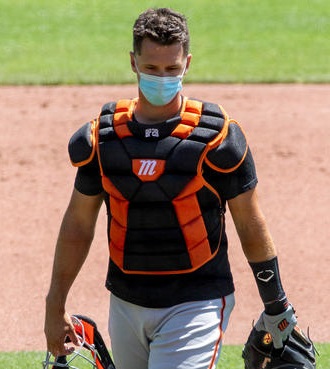
San Francisco Giants catcher Buster Posey has opted out of playing this year for the sake of his children—an incumbent pair of twins and a pair of twin newborns freshly adopted. Some dare call it desertion—erroneously.

Whatever else you think about those major league players who have opted out of playing in 2020, or who think about doing so, here’s something that shouldn’t come into play: someone snarking about such players committing “rank desertion.” (So help me, that’s how someone phrased it in one online baseball forum.) Ignore them. Let them rant their heads off, but you’re under no obligation to listen.

That’s one of the beauties of free speech, what’s left of it. You can rant your head off any old time and place it strikes you to rant. You also bear no known mandatory obligation to listen to any particular ranter for any particular reason.

Militarily, of course, “rank desertion” equals one soldier, sailor, marine, or airman, or a group of them, walking away from their units or posts without call, usually but not exclusively in wartime. In civilian terms, “rank desertion” implies someone or a group of someones walking off the job where there’s no known option aside from a labour strike or formal resignation to do it.

The players were given the opt-out option after all those weeks of haggling between the owners trying to game them out of agreed-upon-in-March pay protocols before they finally agreed to give what remained of a 2020 season a try. Handed that option, those players exercising it cannot be accused credibly of rank desertion.

There’s a coronavirus still on world tour, to various extents, and baseball players play and sojourn in places that still present exposure risks they’re not entirely anxious to bring home. Especially when they have loved ones considered in the high-risk category.

San Francisco Giants catcher Buster Posey may be the highest-profile player to opt out of the season to date. There but for the curse of injuries might he be in the Hall of Fame conversation; maybe two or even three more injury-free seasons on his jacket might keep him there. He could still get those seasons beginning next year.

As was his right under the current protocols, Posey thought more than twice about the twin babies he and his wife, Kristin, are adopting. They were born prematurely last week and at this writing remain in neonatal intensive care. The San Francisco Chronicle says the little girls are doing well enough in the circumstance.

Already the father of incumbent twin children, Posey weighed the risk and pondered the opt-out option that has yet to be rescinded. Then, he made his decision for the sake of his children’s health. The same decision Los Angeles Angels demigod Mike Trout continues weighing as the birth of his first child with his wife, Jessica, looms next month.

Trout isn’t exactly on poverty row so far as major league baseball players are concerned. Neither is Posey, even if Trout is above and beyond his and any other player’s pay grade. Atlanta Braves outfielder Nick Markakis has a family to consider as well, and he’s not exactly going to be among the poor by opting out of 2020, either, as he did during the week now past.

Two factors moved Markakis to opt out, the risk to his family and the very real COVID-19 infection incurred by his franchise co-face face teammate Freddie Freeman. (Braves fans have a case to make that Freeman now shares the distinction with Markakis’s fellow outfielder Ronald Acuna, Jr. Markakis also admits playing with no audience at first doesn’t exactly pose a thrill.)

Markakis spoke to Freeman by phone and learned fast enough. “Just hearing him, the way he sounded on the phone, it was tough,” he told reporters last Monday. “It was kind of eye-opening. With everything that’s going on, not just with baseball but all over the world, it makes you open your eyes.”

Felix Hernandez, the longtime Seattle pitching bellwether now trying to resuscitate his career with the Braves, has also opted out of 2020. So has Michael Kopech, the Chicago White Sox pitcher who’d otherwise hoped to begin his return from his 2018 Tommy John surgery. So has Colorado Rockies outfielder Ian Desmond, whose teammate Charlie Blackmon was hit with COVID-19 and who has alarms about equal to health alarms for doing so.

On health terms, Desmond and his wife, Chelsey, are already parents of four young children and Mrs. Desmond is pregnant with their fifth. That’s the immediate reason Desmond exercised his opt-out option. But it provided him a chance to speak publicly enough on social and even spiritual terms.

Desmond—who is bi-racial—laments what the George Floyd murder at police hands in Minneapolis re-exposes of society in general and, from his perspective, the game he loves otherwise. “Think about it: right now in baseball we’ve got a labor war,” Desmond began in a round of jolting but thought-provoking Instagram posts.

We’ve got rampant individualism on the field. In clubhouses we’ve got racist, sexist, homophobic jokes or flat-out problems. We’ve got cheating. We’ve got a minority issue from the top down. One African American GM. Two African American managers. Less than 8% Black players. No Black majority team owners.

Perhaps most disheartening of all is a puzzling lack of focus on understanding how to change those numbers. A lack of focus on making baseball accessible and possible for all kids, not just those who are privileged enough to afford it.

If baseball is America’s pastime, maybe it’s never been a more fitting one than now . . .

Other opt-outs, also for familial health concerns, include Los Angeles Dodgers pitcher David Price (who has yet to throw a pitch in regular-season competition for them), and three Washington Nationals: first baseman and elder statesman Ryan Zimmerman, relief pitcher Joe Ross, and catcher Welington Castillo.

Baseball’s coronavirus testings have not exactly proven the epitome of consistency or coordination. Teams like the Giants, the Nationals, the Houston Astros, the St. Louis Cardinals have postponed several “summer camp” workouts over them. Astros third baseman Alex Bregman skipped a subsequent Astros workout when his test didn’t arrive back on time. That had a few of his teammates more than a little shaky.

“We want to know how these test results are going to work out for us,” said outfielder Michael Brantley. “Not having Alex here today was just another day he didn’t get to prepare. As I read around the league, a lot of players are voicing their opinions that we need our test results back faster.”

You can say anything you wish about those players opting out and others yet to come who opt out of 2020 for their health’s sake first. If baseball’s testings continue being that inconsistently performed and handled, would you really be shocked to see more players deciding their health and their families’ health just can’t be entrusted to that? Regardless of their salaries?

You can also say as you wish about Desmond’s not-to-be-dismissed-out-of-hand thoughts regarding the first American team sport to end segregation officially while still having issues 73 years later accepting and assimilating non-white personnel on and off the playing field. You don’t need to demand a quota system to say baseball can, should, and must do a better job of it.

Much as we’ve missed a major league season thus far, we seem to need reminders more often than comfortable that certain things cut both ways. Things like the “human element,” for example. The traditionalists screamed blue murder over technological advances they thought (erroneously) would erode the “human element.” But it isn’t just traditionalists dismissing the opting-out as rank deserters.

That dismissal is a plain, no-further-discussion-necessary false dismissal of, what do you know, the human element. The element that says baseball players are not invincible androids who can’t be felled by or transmit disease but mere human men, prone to all manner of incurring and transmitting affliction, particularly during a pandemic that’s become as much a political football as a challenge to medicine.

The rank desertion accusers should be asked how swiftly they’d step in and take the risk for the sake of playing a game much beloved but not without risk. When they answer, “five minutes ago,” they should be asked just as promptly whether they’d like to bring an infection back to their loved ones.

The crickets should be heard playing the entirety of a classic jazz album—In a Silent Way.