Dante’s Paradiso

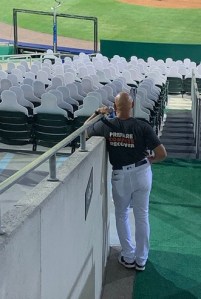
Toronto Blue Jays coach Dante Bichette looking over a sea of cardboard cutouts behnid the plate in the Jays’ temporary Buffalo home.

Whether one of the too-numerous young comers the Los Angeles/California/Anahiem/Los Angeles Angels let get away over the decades, or whether the wizened veteran who called it a career after a season and a half with the Boston Red Sox, one thing stood out especially about Dante Bichette. He looked at times like a mob enforcer.

Wide, wide eyebrows above narrow eyes, plus his muscular 6’3′ physique, often made Bichette look as though he’d break your legs on demand. Until he flashed his boyish, friendly smile. Pitchers who faced him in his prime probably thought they escaped with their lives when he tagged them for one of his 274 home runs.

At 56 today, Bichette remains a muscular specimen whose concurrent sporting of a clean-shaven head makes him resemble Mr. Clean’s tough but tender inner-city nephew. The Florida native also remains one of the friendliest men in the game and, since returning to the profession, one of its most enthusiastically attentive coaches.

The Buffalo Blue Jays of Toronto invited him to spring training as a guest instructor, perhaps because one of his two baseball-playing sons, Bo, has been raising eyebrows among teammates, team officials, and enemy pitchers with his howitzer of a bat. The lad came by it honestly; his father has coached him and his older brother, Dante, Jr. (now a Washington Nationals prospect), since boyhood.

The invitation turned into something the elder Bichette hadn’t felt since he last worked as a Rockies coach. He’d given that up on behalf of not missing valuable time working with his sons. But with Bo helping to make Blue Jays baseball fun again and Dante, Jr. settling into the Nats’ organisational picture (uneasily, with the minor league season mostly cancelled), Dad enjoyed working in the Jays’ “summer camp” so much he got what he called the itch to coach full time again.

Call it Dante’s Paradiso if you must. Even if Bichette wouldn’t necessarily know The Divine Comedy from a double play. “Should I put [my sons] in baseball and put that kind of pressure on them to be like the dad that played in the big leagues?” he once asked his wife, Mariana. “And she said, what else are you gonna teach them? And I was like, yeah, I don’t know anything else.” Then, he laughs.

All that is according to a pleasant profile by The Athletic‘s senior Blue Jays writer, John Lott. “The understanding was, let’s see how it goes, let’s see if I can really help,” Bichette told Lott about joining the Jays.

I was more sensitive with Bo on the team. I didn’t want to make it awkward at all, so I had a long talk with Bo. It was just, let’s try it out first and see how it goes down. Spring training just seemed to work real easy. I helped out where I could and all of a sudden you start to develop relationships with the kids. As a coach, you kind of fall for them. So that’s when I said, yeah, I gotta do this.

Because of the Show’s current pandemic-inspired restriction limiting teams to eight coaches in the dugout, Lott wrote, Bichette had to pick a spot in the ballpark to watch his co-charges (with hitting coach Guillermo Martinez) during Blue Jays games. He likes to station himself atop a section of seats behind and to the first base side of the plate.

From there, he watches to see Jays hitters exercise his counsel. Bichette isn’t big on the mechanics of the swing but he’s huge on encouraging players to step up to the plate with a plan. He teaches or reminds them to take advantage of the reams of information now available about enemy pitchers, and he teaches and reminds them likewise—and especially—to think hard about hitting with two strikes.
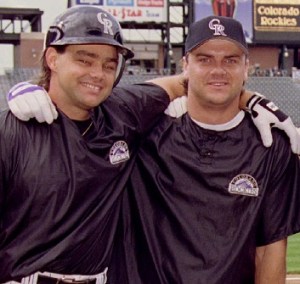
Bichette as a Rockies player with his Hall of Fame teammate Larry Walker. He still has the smile that turns his expression from enforcer to big kid.

Much like the Rockies teams for whom Bichette himself played, these Blue Jays have power to burn, think of bases on balls as castor oil, and love to swing their bats. Bichette tries to get them to swing intelligently especially after that second strike is rung up. Since the Show’s overall batting average on two strikes is about .169, Bichette probably had his work more than cut out for him.

“I also point out that every count without two strikes, the whole league mashes,” he told Lott. “So turn (all) those counts into two different counts, not a bunch of different counts. You have a two-strike count and an I’m-looking-to-do-damage count, period. That’s two approaches.

“When you’re looking to do damage, you’re hunting a certain pitch and you’re committed to that pitch,” he continued. “When you’re hitting with two strikes, you have to handle all the pitches in all the parts of the zone. You have to let the ball get a little deeper, so if you are fooled by an off-speed pitch, then you still have some room for the bat to get through the zone and make contact.”

Bichette’s own idol was Hall of Famer Ted Williams, though he was born three years after Williams’s final major league game. Merely mention Teddy Ballgame, and Bichette will talk your ears off more than a politician given an excuse for a speech, if not a tweetstorm.

When he talks about all parts of the zone, he’ll point out happily enough how he read Williams’s book The Science of Hitting and paid scholarly attention to the charts that showed Williams’s batting averages on every pitch in every nook, cranny, and crevice of the zone.

(Fair disclosure: It’s also personal with Bichette. When he was named 1995’s Players Choice Award winner, he told Lott, Williams himself presented the award at a ceremony, leading to an evening’s discussion of hitting and a breakfast invitation for the following morning. “I’ve got it somewhere at home on a CD, the whole conversation,” Bichette said. “It’s the neatest thing I have.”)

Two-strike hitting is something Bichette learned about the hard way. As a player himself, a second strike usually meant he was dead meat. His OPS on two strikes, lifetime: .587. Once that second strike was on the clock, Bichette—who hit 63 of his lifetime home runs after two strikes—was swim-or-sink. His challenge with the Blue Jays’ hitters was helping their Rockies-like aggressiveness deliver instead of drop the packages.

“[T]o me, letting it get deep and getting on top is kind of an inside-out swing,” he continued. “You know, taking the air out of it. We live in an era of launch angle, but we gotta take the air out of it with two strikes. That’s where the pitchers are taking advantage of hitters with two strikes. The hitters are trying to get air and they throw the fastball over the bat.”

So just how much coaching does Bo Bichette now require from the father who first gave up professional coaching the better to make sure he didn’t lose invaluable time with his sons?

“Bo’s very self-sufficient now,” Dad told Lott, who got one of Dad’s 2013 Rockies charges, Michael Cuddyer, to talk about the kid being so attentive while seeming just to hang at the park with his old man that he’d pepper the Rockies’ hitters with serious questions about serious hitting, then take his own batting practise and hit balls into the mountains. At fifteen.

We talk at-bats. He’ll tell me what he was thinking, and most of the time, we’re so connected now that I can tell when he’s looking for a certain pitch or he’s trying to do a certain thing. So we’re pretty much in tune with each other. Now it’s more game plans. Very little swing stuff. We’ll talk about intent or conviction to the game plan . . .

It’s actually really neat because I feel like Bo is an old soul at this. I feel like I’m talking to a 38-year-old veteran when I talk to him about hitting because I’ve talked to him like that since he was six years old. That’s probably why he’s so advanced at hitting for his age.

So says the former Rockie bombardier who was only half kidding when he told Lott his wife raised two sons and a husband. (And, who was as relieved as the rest of Blue Jays fans and the game itself when Bo’s knee injury proved not terribly serious.)

The man who must have had questions and doubts when the Angels traded him to the Milwaukee Brewers for an ancient Dave Parker. Or, when the Brewers traded him to the Rockies for a fading Kevin Reimer. (Both after he’d been little enough used despite his potential, blooming somewhat late with the Rockies at 26.)

The man who quit after a decade plus as the Rockies’ hitting coach because the idea of missing his sons’ continuing development and learning any more than he already missed worried him. The man who now doesn’t mind when his senior Martinez sends him video at two in the morning asking for his takes on this player’s swing or that pitcher’s factoring in the next day’s game plan.

The man who only looked like a headbreaker at times in his playing youth, but whose geniality and intelligence have married to invite anyone who wants it to take a seminar in smart baseball and more than a few reminders that these Blue Jays made him fall in love with them. Not to mention more than a few recollections and lessons from Ted Williams.

Take your pick: a .400 hitter, or a .700 batter

Much talk now hooks around Colorado Rockies outfielder Charlie Blackmon hitting (as of Friday morning) .424, and whether the short season means he’ll finish the season hitting .400 or over. I have a better piece of conversation for you.

Suppose I tell you Blackmon was really batting .648 when he woke up Friday morning?

While you reel your tongues back into your mouths from the floor and retrieve the eyes that blasted out of their sockets, I’ll begin the splainin’ I have to do by saying you might notice where I said “hitting” and where I said “batting.” Because when you say Charlie Blackmon’s hitting .424, it’s not the true, full picture of him at the plate.

The traditional batting average still has isolated value, but it’s also an incomplete statistic. I’ve said it before, I’ll say it again: there’s something intrinsically wrong with a stat that makes two grave mistakes. Mistake number one—it treats every hit equally. Mistake number two—it addresses official at-bats alone.

I’ve said this before, too: Should you really trust a statistic that treats all hits equally when all hits are not equal? Do you really think a single is as valuable as a double, a triple, or a home run? If you answer “yes” to both questions, you’re really cheating yourself—or you might really be Frank Lane returned to earth and living in someone else’s body.* If you answer “no,” pull up a chair and a cold drink.

Let me present to you once again, with one modification to my original concept, the formula I believe gives the most complete possible look at what a batter does at the plate:

TB + BB + IBB + SF + HBP
PA

In plain English, that’s total bases plus walks plus intentional walks plus sacrifice flies plus hit by pitches, divided by plate appearances. What the formula determines is a player’s real batting average (RBA), everything he does at the plate.

And when you add Charlie Blackmon’s 2020 total bases (60 entering today), walks (8), intentional walks (1), sacrifice flies (0), and times he was hit by a pitch (1), then divide the sum (61) by his plate appearances (108), you have his real batting average. Tell me now that a .648 batter isn’t as impressive as a .424 hitter. Still have questions? OK, here goes.

Total Bases—It counts a player’s hits the way they ought to be counted—unequally. A single is worth one base. A double, two; a triple, three; a home run, four. If all you see is a player with 42 hits (Blackmon led the entire Show entering Friday morning) you think that’s a lot of hits in 25 games—and it is, of course—but you’re not seeing the real value of those hits or everything he’s doing to help his team create runs.

The last I looked, the name of the game in baseball is putting more runs on the scoreboard than the other guys. A man who’s batting .648 is doing a magnificent job of creating and/or producing runs above and beyond scoring them or driving them in. To do both of the latter, it depends entirely on his teammates knocking him home or reaching base in the first place.

(Why discount runs scored and runs batted in to any degree? Easy: Find me the rule that says you can drive yourself in. Find me the player who steals three bases in one unmolested turn on the bases every time he reaches base. Find me the player who can steal home at will every time he reaches third base. Not even Rickey Henderson, the Man of Steal himself, could do that.)

Charlie Blackmon’s hits as of Friday morning were: 31 singles, seven doubles, one triple, and three home runs. That’s 31 + 14 + 3 + 12 bases each. That’s 60 total bases. We’re not talking about a fellow who’s coming up very big in the extra-base hit department (26 percent of his hits are extra-base hits so far), but we are talking about a productive fellow regardless.

Walks—You’d think the walks would be covered within the total bases, but they’re actually not. But I think a player who’s sharp enough at the plate to read the zone and the pitches in flight and take them appropriately should get particular credit for that. The walk doesn’t count as an official at-bat, of course, but unless I have been very deceived by my own eyes all these years, the last I looked the man was at bat, in the batter’s box, when he worked out the walk, and he wasn’t there without his bat.

Intentional Walks—It may seem superfluous since they’re also counted in the total walks, but there’s a damn good reason a player should get additional credit for intentional walks. Why would you not credit him for a batting situation in which the other guys would rather he take his base than their heads off? Whether it’s him taking their heads off or the guy batting behind him posing the better shot at a defensive out, that batter should get credit for being presence enough that they don’t want him swinging the bat.

Sacrifice Flies—The one change I made to my original RBA concept is removing sacrifice bunts from the equation. Not just because the bunt in general is in disfavour now but because of the basic reason it fell that way in the first place—you don’t give the other guys a free out to use against you.

So you moved the runner over? Good for you. But you also gave your team one less out to work with trying to get that man home, and your chances of getting him home just fell by 33.33 percent. Don’t get me started on the fools who think bunting a runner over with two outs is sound baseball. (And, as the invaluable Keith Law has put it, show me any crowd at the ballpark under normal circumstances who paid their way in to see all those sac bunts dropped, or flipped on the TV set to watch them.)

So why keep sacrifice flies but not sacrifice bunts in the RBA formula? Easy: sacrifice flies aren’t intentional outs and, by their very design and the rule book, they put runs on the scoreboard.

There isn’t a batter on the planet who goes up to the plate thinking, “Let me take one for the team. I’ll just hit this fly ball right to Bernie Boxorocks in left field so I can get Frankie Feetsies home from third on the cheap.” That batter kinda sorta wants to reach base himself, unless he gets to step on each base en route home plate after hitting one into the nearest cardboard cutout or stuffed animal in the seats.

Hit By Pitches—As Groucho Marx once said, this is so simple a child of five knows it, now let’s find a child of five.

It doesn’t matter whether he was just trying to push you back off the plate. It doesn’t matter if he drilled you because you took him over the International Date Line your last time up. It doesn’t matter if he did it because he’s P.O.ed that the guy just ahead of you took him there. It doesn’t even matter if he drilled you for wearing a cheating team’s uniform even though you weren’t on the team to join in the cheating.

If that pitcher wants to hand you first base on the house the hard way, let it be on his head and the plus side of your ledger.

As of this morning the Show had one other .400 hitter—D.J. LeMahieu, about whom the bad news is that he’s another hapless New York Yankee on the injured list. (Yes, children, if The New England Journal of Medicine could have been last year’s Yankee yearbook, this year’s may yet become The Journal of the American Medical Association.) RBA says LeMahieu’s really batting .556.

How about Bryce Harper, about whom everyone harped on his modest traditional batting averages in recent seasons without looking his true depth at the plate? This year, he’s hitting a traditional .338. RBA says Harper’s batting .744. Mike Trout, who plays for a team that’s still not a team its best player can be proud of? He’s hitting a traditional .338 so far. RBA says he’s batting .707.

How about Fernando Tatis, Jr., who inspired this week’s major kerfuffle when he swung on 3-0 with the bases loaded in the eighth inning of a San Diego Padres blowout-in-the-making, ground salami, and infuriated the boring old unwritten rule farts including his own momentarily brain-vapourised manager? Let’s see. Tatis woke up this morning leading the Show in total bases. (77.) RBA says he’s batting .738.

Forget the race to see whether Blackmon can finish hitting .400+ in this season of Alfred Hitchcock Presents Quiet, Please! Lawrence Fechtenberger Escapes the Intergalactic Nemesis Beyond Tomorrow’s Stroke of Fate. Wouldn’t it be more fun seeing whether Blackmon, Harper, Tatis, or Trout can finish batting .700+?

If you answered “no,” tune in tonight to Chocolate Cookies with White Stuff in the Middle Presents The Wilderness Family Theater.

—————————————————–

* When Frank Lane made the notorious Rocky Colavito-for-Harvey Kuenn trade as spring training finished in 1960, among his explanations for the deal Cleveland still can’t forget was, “We’ve given up forty homers for forty doubles. We’ve added fifty singles and taken away fifty strikeouts . . . Those singles and doubles win just as many games as home runs.”

(Harvey Kuenn was better at avoiding the strikeout, but Rocky Colavito was better at it than you might remember: he never struck out more than 89 times in any season and he only ever reached that number once, in 1958.)

In 1959, Colavito led the American League with 42 home runs and 301 total bases. Kuenn in 1959 led the American League with a .353 traditional batting average and by hitting as many doubles as Colavito hit home runs. But he wasn’t even close to Colavito with 281 total bases. Colavito also produced 201 runs (scored/driven in) to Kuenn’s 170. And, 44  percent of Colavito’s hits were for extra bases against 29 percent of Kuenn’s.

RBA says Colavito batted .580 in 1959 and Kuenn, .543. I’d submit that those singles and doubles didn’t necessarily win as many games as the home runs. So did the 1959 American League standings, with the Indians finishing five games out of first place and the Detroit Tigers—who dealt Kuenn for Colavito—finishing eighteen games out.

It wasn’t Rocky Colavito’s fault the ’59 Indians finished five behind the pennant-winning White Sox, of course, and neither was it Harvey Kuenn’s fault the Tigers finished thirteen behind the Tribe. But Lane also described the trade as “hamburger for steak.” He was too thick—and, in fairness, baseball men of the time not named Branch Rickey wouldn’t have dug deep enough—to know he’d acquired hamburger for steak.

Thom Brennaman’s foot-in-mouth disease

Thom Brennaman during his on-air apology for an anti-gay insult captured on the air earlier Wednesday. (Fox Sports/Cincinnati Reds.)

The story of the second game between the Cincinnati Reds and the Kansas City Royals Wednesday might otherwise have been Matt Harvey, exhumed by the Royals from the scrap heap after some thought his pitching career might be extinct.

It might have been Reds outfielder/designated hitter Jesse Winker giving Harvey a very respectful a thumbs-up in the top of the first, after Harvey struck him out looking on a rather filthy-looking fastball, with more movement than speed, then hitting Harvey’s first-pitch curve ball over the right field fence with two out and Nicholas Castellanos aboard in the top of the third.

It might have been Winker and Eugenio Suarez taking Harvey out of the yard back-to-back in that third inning. It might have been Harvey managing to wriggle out of further trouble for the side before his evening ended and, when all was said and done, only those back-to-back bombs ruined a mostly encouraging night for the erstwhile Dark Knight.

It might also have been Castellanos facing the Royals’ prodigal reliever Greg Holland to lead off the top of the sixth and, after looking at a strike on the low inside corner, catching hold of another four-seam fastball to just about the same real estate and sending it over the left center field fence.

But something happened as Castellanos prepared to swing on the former leader of the Royals’ once-vaunted H-D-H bullpen. (Holland, Wade Davis, Kelvim Herrera.) Reds broadcaster Thom Brennaman began an on-air, on-camera apology shortly before he was removed from the broadcast, having been caught on a hot microphone earlier in the evening referring to “one of the great f@g capitals of the world.”

What follows is a complete transcript of the Brennaman apology.

Castellanos to lead things off. Jim Day’s gonna be taking us the rest of the way through this game, as Holland takes over on the mound. [Strike one called.] I made a comment earlier tonight that, uh, I guess, uh, went out over the air that I am deeply—ashamed of. If I have hurt anyone out there, I can’t tell you how much I say from the bottom of my heart I’m so very, very sorry. I pride myself and think of myself as a man of faith, as there’s a drive into deep left field by Castellanos, it will be a home run, and so that’ll make it a four-nothing ball game.

I don’t know if I’m gonna be puttin’ on this headset again. I don’t know if it’s gonna be for the Reds, I don’t know if it’s gonna be for my bosses at Fox, I want to apologise for the people who sign my paycheck, for the Reds, for Fox Sports Ohio, for the people I work with, for anybody that I’ve offended here tonight. I can’t begin to tell you how deeply sorry I am. That is not who I am, and never has been. And I’d like to think I could maybe have some people that can back that up.

I am very, very sorry. And I beg for your forgiveness. Jim Day’ll take you the rest of the way home.

To which city Brennaman referred wasn’t clear as his spontaneous case of foot-in-mouth disease went slightly beyond viral from almost the moment it was captured. Was it New York, where Harvey once shone as a Mets pitcher before injuries and especially thoracic outlet syndrome collapsed his career? Was it Kansas City for itself or for having taken a flyer on an earnest new Harvey trying for one more major league comeback?

Does it matter?

If you can call it good news, Brennaman delivered his apology without a written statement. Nobody with the Reds or Fox swung their damage-control action troops into action to bang out a boilerplate mea culpa, slide it under Brennaman’s head, and order him, “This is it. If you even think about going off script we will kill you to death on the spot.”

Once upon a time, to err was human and to forgive, divine. (Never mind stage and film legend Mae West: To err is human, but it feels divine.) Today, to err is human but to forgive is not always social policy. Once upon a time John Lennon got himself and the Beatles off the hook, more or less, by apologising at a press conference after Lennon’s once-infamous 1966 observation,  that the Beatles then were more popular than Jesus Christ, raised a furor in the U.S., never mind that it was published slightly out of its original context.

Saying you demur from homosexuality is one thing. Saying you prefer not to associate with the gay world is likewise. Neither remark by themselves would mark you as an unrepentant homophobic bigot, even if one or both might suggest you’re not exactly in step with the politically correct times, so long as you do or say nothing otherwise that suggests gay men and women ought to be unemployed, or isolated, or even eradicated.

But saying it in the sort of insult once reserved for the schoolyard in the bad old days or a Ku Klux Klan gathering any days is something else entirely, whether or not you were aware of a live microphone delivering it uncut to a television audience. It raises legitimate questions as to whether or not you can be accepted comfortably as a man or a woman who would leave your biases outside the door when you report for work.

Brennaman has been a sportscaster for three decades and a Reds broadcaster since 2006. His father, Marty, is a Ford C. Frick Award honoree in the Hall of Fame, and he has had his share of admirers and detractors purely in terms of his own professional work, independent of his father’s legacy.

With one careless remark he may have talked himself out of a job and perhaps out of the industry, no matter the haste and unrehearsed and unscripted apology. The Reds suspended Brennaman after the game and added that they would “address our broadcasting team in the coming days.” When men and women sink their own careers and legacies in single isolated moments of abject brain vapour it’s always enough to make you sick.

There was an irony in the entire affair that should sober you and Brennaman even more. Castellanos’s mid-apology home run seemed to hit a sign above a three-row section of seats behind the left field fence. The purple sign reads, in bold yellow lettering, “Judgment-Free Zone.”


This post has been updated to reflect Brennaman’s suspension, announced Wednesday night after the original column was published.—JK.

“It’s never going to be good enough”

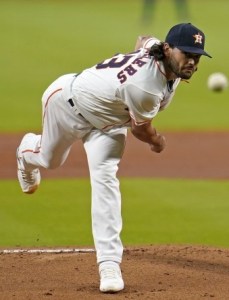
“They’re continuously advocating for this head-hunting season of the Astros.”–Lance McCullers, Jr.

At this writing, this season’s Houston Astros have been hit by pitches twelve times for fourth among American League teams. The on-field administration of that Astrogate justice denied by the commissioner produces a disturbing sidebar. Quick: Name the Astro who’s been hit by the most pitches since the pandemic-truncated season began.

The answer is Abraham Toro, reserve third baseman/designated hitter. He’s the only Astro to be hit by pitches three times thus far, and he wasn’t even a member of the 2017-18 Astrogate teams. His reasonable responses to such embryonic team plunk leadership might include thoughts of first-degree manslaughter.

Toro’s position is much like that of a bright young financial whiz, freshly graduated from a prestigious university, freshly hired by a brokerage firm that faced sanctions, fines, imprisonments, and in-the-toilet public relations a year before bringing him into their tattered ranks, and who now feels the stings and fastballs of guilt by association.

This year’s Astros include nine from the 2017-18 teams: their entire starting infield—Jose Altuve, Alex Bregman, Carlos Correa, Yuli Gurriel; two outfielders—Josh Reddick, George Springer; and, three pitchers—Chris Devenski, Lance McCullers, Jr., Justin Verlander. Gurriel and Springer have been hit by pitches twice this year; Altuve, Bregman, and Correa, once each. Reddick as of this writing has escaped thus far.

Toro is one of two non-2017-18 Astros to take one for the team with which they had nothing to do in the first place. Last year’s American League Rookie of the Year, Yordan Alvarez, possibly out for the season with a knee injury, got it once before his injury.

Exactly why Toro and Alverez should be taking balls to their ribs or other assorted anatomy is anyone’s guess aside from opponents believing that, if you wear an Astro uniform, the deets don’t matter, you’re fair game. That’s as patently unfair as would be a prosecutor taking one look at the aforementioned, hypothetical new brokerage recruit and filing an arrest warrant because, well, “That’s for even thinking about joining that cesspool house.”

You got why it seemed about seven-eighths if not more of the rest of the Show’s players wanted to administer the justice commissioner Rob Manfred didn’t in handing 2017-18 Astro players immunity in return for their spilling about the Astro Intelligence Agency. And you get why pitcher McCullers, one of the more thoughtful Astros, is just a little bit fed up with that desire.

McCullers thinks “they” continue advocating for the Astros to suffer the brushbacks, knockdowns, and beanballs over Astrogate’s perfidy. “They,” of course, are that majority of non-Astros players and enough press and fans who think the Astros’ players got away with murder over their 2017-18 illegal electronic sign-stealing operation. And “they,” of course, are wrong, as McCullers sees it.

“[S]peaking to players was probably the least part of [MLB’s] whole investigation,” McCullers told The Athletic‘s Jayson Stark and Doug Glanville (himself a former major league player) on the Starkville podcast.

I can’t go into it because I don’t know how much I am or am not allowed to say. But I’ll say that … the notion that, oh, players negotiated immunity, players then were interviewed and rolled on everyone just to save themself, isn’t the case. And that’s as much as I can say. That’s not what happened. That’s not how this went down. So if that’s what people are upset about, then I guess we can all move on because that’s not how it happened.

Manfred also suspended now-former general manager Jeff Luhnow, now-former manager A.J. Hinch, and now-former bench coach Alex Cora for the whole of 2020. Cora–who went on to manage the 2018 Boston Red Sox to a World Series title a year after the Astros’ now-tainted title—subsequently lost that job for his Astrogate involvement, too.

Manfred didn’t suspend the Astros’ 2017 designated hitter, Carlos Beltran, considered a key Astrogate operative himself, but his role cost him his freshly-minted job managing the New York Mets—before he had the chance to manage even a spring training exhibition game.

“And it’s never going to be good enough,” McCullers told Stark and Glanville. “The whole franchise could be dismantled, and it wouldn’t be good enough.”

Toro taking three plunks and Alvarez taking one gives a shard of credence to McCullers’s remark. There were observers and analysts, yours truly among them, who said early during the unfurling of the Astrogate revelations that it might indeed require a complete turnover of even the current roster before the stain dissipates from the franchise.

The 2020 Red Sox have enough trouble of their own on the field as it is. They’re collapsing like a rickety folding chair after losing their franchise face Mookie Betts in a lopsided, money-nourished trade to the Los Angeles Dodgers. But they’ve been scored by Manfred over their Replay Room Reconnaissance Ring of sign-stealing. And this year’s Red Sox have had nine players hit by pitches and ten such hits total, seventh in the American League.

At least four of the replay reconnaissance ring team members have been drilled thus far: Mitch Moreland, Rafael Devers, Kevin Pillar, and J.D. Martinez. But nobody huffed, puffed, or threatened to blow the house down over the Red Sox. If that bewilders McCullers, the Astros as a whole, and the Astros’ and Red Sox’s fan bases that continue coming to terms with their world champion cheaters, it’s both understandable and unfathomable.

The reasons may be simple. Cora was cashiered when Manfred’s Astrogate report came forth, well before the commissioner finished and released his Red Sox reconnaissance findings. Accurately or incompletely, the Red Sox looked far more decisive doing so, and there remained the prospect that Cora got his not just because of Astrogate but because the Red Sox brass suspected he had at least a fingertip on the reconnaissance ring.

More to the point, the Rogue Sox simply used what was handed to them and every major league team at home and on the road. They didn’t have to alter an incumbent camera’s mandatory eight-second delay or install a separate real-time camera. All they had to do, and did, was read the replay room monitors and signal their baserunners who’d send the pilfered intelligence to their hitters.

Neither the AIA nor the Rogue Sox Replay Room Reconnaissance Team had anything to do with their pitchers, whether McCullers in Houston or Joe Kelly, now with the Dodgers, who dropped Bregman and Correa on 28 July but was a Red Sox pitcher in 2017-18.

The whatabout argument doesn’t pass muster, either. Just because others did it, and we don’t really know yet whom and when in recent seasons (other than the New York Yankees, perhaps), it doesn’t mean the Asterisks or the Rogue Sox do or should get off the hook.

Just when you thought McCullers earned your stubborn admiration for trying to defend his team, however edgily, he had to spoil it. Alluding to Kelly’s recent podcast dismissing the Astro players accepting immunity to spill as “snitches,” McCullers huffed, “By the way, there was only one snitch. And that’s the person who spoke to The Athletic.”

So Astrogate is still all Mike Fiers’s fault. Never mind that he and others (including the Oakland Athletics administration) couldn’t persuade the Show’s government or reporters to convince their editors to investigate or publish, until Fiers finally blew the Astrogate whistle last November. Never the cheaters’ fault, always the whistleblower’s

Well, to this day there may well remain people who think New York’s police corruption scandal of the early 1970s was all the fault of the two clean cops, Frank Serpico and David Durk, who took it to The New York Times after they couldn’t persuade their own department to clean up and wise up, too. Never the crooked cops’ fault, always the whistleblowers’.

What was a terrible look for New York’s Finest then is still a terrible look for the Astros now. McCullers may want to ponder that further and deeper while he laments with some justification how little seems good enough to sate Astrogate critics.

But Kelly at least sent his messages to a pair of actual Astrogaters. Holding Toro, Alvarez, and any other Astro answerable for baseball crimes they didn’t commit and weren’t there to commit is a terrible look, too.

“It shouldn’t be against any rules”

2020-08-18 TatisMachado

Looks like a winner to me.

Collin McHugh may have opted out of pitching in 2020, but the former Houston Astro hasn’t opted out of thinking. Lucky for us. Concerning the Fernando Tatis, Jr. grand slam kerfuffle, McHugh has wisdom the old farts will likely ignore but the young and young-at-heart will receive as writ.

Swinging in a 3-0 count should not be against any rules, no matter the score,” McHugh tweeted the morning after Tatis’s eight-inning salami on 3-0 rubbed the Texas Rangers the wrong way and got the next San Diego Padres batter, Manny Machado, a pitch thrown right to and past his rump roast.

“Before a game I would always look to see what [percent] a guy swings 3-0,” McHugh continued. “If it’s over 20%, it means I can’t just groove one. The guys who will never ‘give you a pitch’ at the plate are the toughest AB’s.”

Someone among the Rangers brain trust ought to communicate McHugh’s wisdom to Ian Gibaut, who relieved Juan Nicasio after Nicasio’s 3-0 fastball just off the middle of the plate took a ride into the fan cutouts behind the right field fence off Tatis’s bat Monday. Gibaut is the Ranger who thought Tatis’s flouting of the Sacred Unwritten Rules earned Machado a target off his tail.

Tatis wasn’t the only hitter running afoul of the SURs that day. In Atlanta’s Truist Park, Washington Nationals outfielder Juan Soto had the temerity to send Braves reliever Will Smith’s service on a 445 foot trip to the seats in the top of the ninth and give it a far quicker look of self-admiration than the young Nat has given other such thumps in his young career.

Smith promptly switched his Braves hat for his Fun Police hat and fired an expletive Soto’s way. That’ll teach him. Not only did Smith’s bark prompt Soto to take an even slower trip around the bases than he might have planned, it prompted Nats manager Dave Martinez to play the other side of unwritten law enforcement as Soto’s defense attorney.

“Will Smith said something to Soto that I didn’t really appreciate,” the manager told reporters after that game—which the Braves came back to win on Dansby Swanson’s game-ending bomb. “So I just want to let him know, hey, it wasn’t Juan who threw the ball. His job is to hit so just be quiet and get on the mound. You threw the pitch, make a better pitch.”

Well, what do you know? A piece of me would love to think Martinez might have seen what I wrote earlier Tuesday morning:

You let a hitter get into a 3-0 count with or without the bases loaded? That’s on you. You throw him something he can meet with the bat at all? That’s on you. You want to scream bloody murder because he didn’t thank you nice fellows by taking strike one and his medicine after you were already so generous as to let him and his take a seven-run lead on you going in? That’s on you, too.

But I know better. I have about as much chance of being seen, never mind read and heeded, by the manager of the defending world champions as Donald Trump has of being added to Mount Rushmore. And Rangers manager Chris Woodward has less chance of being seen as a wise man than as an artery-hardened wisenheimer.

“You’re up by seven in the eighth inning — it’s typically not a good time to swing 3-0,” you may remember Woodward fuming after the Padres finished what they started, a 14-4 blowout. “It’s kind of the way we were all raised in the game. But, like I said, the norms are being challenged on a daily basis, so just because I don’t like it doesn’t mean it’s not right. I don’t think we liked it as a group.”

This season has already challenged norms enough. Remember: we’re trying to get through a major league baseball season in a time of coronavirus pandemic. The Show’s government has put into place enough truly dubious actual rules and experiments. The whole thing continues to play a lot like you’d imagine an episode of Alfred Hitchcock Presents the Inner Sanctum of the Outer Limits Brought to You By Chocolate Cookies with White Stuff in the Middle.

You would have thought the last thing any team wanted to exhume was yet another fruitless debate on yet another violation of the SURs that does nothing much more than make the exhumers resemble the would-be enforcers of a protection racket.

You might also have thought the Rangers had a working sense of their own 21st Century history. We take you back to 22 August 2007, in Camden Yards, when a different group of Rangers could have been brought up on charges of human rights violations for the 30-3 massacre they laid on the Baltimore Orioles that fine evening.

The abuses included a ten-run top of the eighth—including Travis Metcalf grinding salami—with the score already 14-3 . . . and a six-run top of the ninth when the casualties amounted to 24-3. I don’t remember if the Orioles raised any objections to any SURs that may or may not have been violated during the carnage, but I did wonder at the time whether they’d suffer post-traumatic stress syndrome.

McHugh isn’t the only pitcher present or past who thinks the Rangers should have spent more time making solid pitches and less time complaining because one not-so-solid pitch got demolished on 3-0 late in a blowout-to-be.

“I’m old enough that I grew up in a game that a lot of older guys had all the power and they would tell you how to act, what to do, and you did what they told you to do because that’s how it was,” said Ron Darling, once a world champion 1986 New York Mets pitcher and now a Mets broadcaster.

“Unwritten rules only work if everyone knows the unwritten rules,” Darling continued. “By their very definition, nobody knows an unwritten rule, so what you have now is you’re trying to make a decision that a 3-0 count in a seven-run game is off limits. I’m just not with that at all.”

How about we ask Zach Davies, the Padres’ starting pitcher Monday night, who might have a thing or three to say about whether the SURs ought to overthrow such game facts as the Padres bullpen entering the game with the third-highest collective earned-run average of any Show bullpen? Such bullpens make even seven-run leads feel about as secure as a bank whose vault is left open after closing time.

“A lot of guys talk about unwritten rules of baseball, but you’re in the heat of the moment, you’re gonna try to get your pitch as a hitter and he didn’t miss,” Davies told The Athletic‘s Dennis Lin.

So you can’t really fault him for that, in my opinion. Some guys feel differently, but everybody has their own opinion on it. Make sure your 3-0 pitch is a little bit better. I’ve been hit on 3-0 and homers have been hit off me, maybe not in the same situation, but that’s something that everybody kind of has a little bit different opinion on.

Would Tatis have escaped scrutiny (and would Machado have escaped a sailer toward his seat) if he hadn’t hit a three-run homer an inning earlier? That one made the score 10-3 in the first place. Grinding salami in the next inning regardless of the count could be taken by some teams and their pitchers as putting out the first insult’s fire with gasoline.

Meanwhile, it looks like San Diego’s Wil Myers taught the Rangers and their Tuesday starting pitcher Mike Minor a little lesson in manners in the top of the first. With two out and the bases loaded, Myers caught hold of a Minor changeup that hung like a condemned man and hung it into the left center field bullpen.

Then Tatis exacted his own revenge on Gibault in the top of the fourth, after Jurickson Profar belted a two-run homer. With Tatis singling to left with two out and Machado drawing the walk that pushed Minor out of the game, bringing in Gibault in the first place . . . Tatis stole third.

He was stranded, and the most the Rangers could muster was a four-run bottom of the fourth, kicked off when Joey Gallo bombed San Diego reliever Javy Guerra for a three-run homer with nobody out.

But the real messages were sent and re-sent. Including Gibault and Woodward being suspended for their upholding of the SURs Monday night. Gibault appealed his three-game suspension and thus was able to get Tatis’s return message; Woodward served his suspension Tuesday.

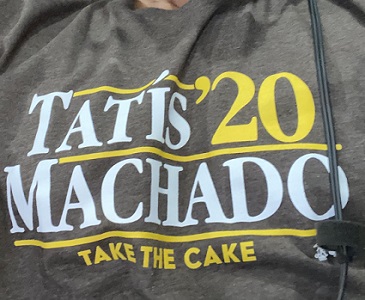
Another former major leaguer, Chris Singleton, tweeted a political campaign-style T-shirt emblazoned, Tatis-Machado ’20: Take the Cake. Sounds like a winning ticket to me. Neither actual presidential campaign has yet devised a campaign slogan that snarkily creative, which figures. And letting them have fun is just about the last thing the country needs.