Fish fouled

Adam Duvall has just low-fives third base coach Ron Washington after helping the Braves to an eleven-run second and a 29-9 slaughter.

Not even Joe West’s umpiring crew working the game could prevent it. For all anybody knows, maybe even Country Joe himself took pity on the Miami Marlins and called the Hague–or, at least, the Georgia Department of Natural Resources—himself, to file on their behalf against the abuses they suffered in Atlanta Wednesday night.

Or, at least Marlins manager Don Mattingly might have slipped a note to Atlanta Braves manager Brian Snitker, asking only partially puckishly, “Brian, could we have the bottom of the second back? Pretty please? With tartar sauce on it?”

Call it the Fish Fricasee. But call the Braves’s 29-9 cleaning, scaling, and fileting the arguable nastiest combined attack of ground troops, close-cover strafing, aerial assault, and strategic bombing ever committed by them, their 29 runs setting a new franchise record.

Sure, the Milwaukee Brewers de-clawed the Detroit Tigers 19-0 in Comerica Park earlier in the day. Only they did it in gradual clips and snaps, a couple of runs here, a few there, a few more yonder. Who the hell needed that nonsense from rude guests when you had the hosts in Truist Park treating their oceanic guests like a shipment of cat food?

What started as a 2-0 Marlins lead got vaporised by fourteen Braves batters including four repeaters before Ender Inciarte showed the Fish mercy and cast his line for an inning-ending ground out to first base. The carnage only began with Dansby Swanson singling his way aboard against Marlins starter Pablo Lopez.

Lopez’s next two mistakes were back-to-back walks to Austin Riley and Adam Duvall. And then it began:

* Ozzie Albies returning from a month on the injured list pushed Swanson home with a ground out to first.

* Inciarte sent a sacrifice fly to the deeper region of left center field, tying the game at two.

* Duvall took third on the play and the Marlins called for a review to see whether third baseman Brian Anderson got the tag on the sliding Duvall’s leg before or after a) Duvall’s foot hit the pillow and b) Riley crossed the plate. The review said no, sir, umpire Hunter Wendelstedt making the emphatic safe sign.

* After Lopez walked Ronald Acuna, Jr., Freddie Freeman hit a line drive to right that diving Marlins right fielder Monte Harrison couldn’t grab, the ball bouncing under his blue glove, scoring Duvall and sending Acuna to third.

* Marcell Ozuna floated a pop to shallow left near the line that hit the grass before Miami left fielder Lewis Brinson could reach it, sending Acuna home. “And the Braves are first-and-thirding the Marlins to death,” crowed Braves broadcaster Chip Caray after the fourth run rang in.

* Travis d’Arnaud, the former Met, checked in with first and third yet again. He hit the first-pitch hanging changeup into the first empty row of the left field seats. The blast ended Lopez’s evening and it’s not impossible that the only thing the Marlins righthander could say when Mattingly came forth to end his misery was, “What took so long, Skip?”

Exit Lopez, enter Jordan Yamamoto for the Fish. Swanson greeted him with a base hit to left, then Riley shot one right between shortstop and third basemen trying to converge to send Swanson home. Then Duvall hit yet another first pitch into the right center field bullpen.

Yamamoto finally said too much was enough about the Braves’ first-pitch hitting and wrestled Albies to an eighth pitch. Unfortunately, it was finally ball three and a full count, forcing Yamamoto to throw a ninth pitch. And Albies drove it four rows up the empty center field seats.

A smooth-looking righthander otherwise, Yamamoto shares a surname with World War II’s Japanese Combined Fleet commander. What the U.S. Navy did to Admiral Yamamoto’s forces at Midway and beyond, the Braves did to the Marlins in the bottom of the second. They one-upped the ten-spot second under which they might have buried the Philadelphia Phillies two Sundays ago—but for the Phillies crawling back to make the Braves sweat out a 12-10 final.

Yamamoto the pitcher’s misery didn’t end when he and the Marlins finally escaped the second inning with what was left of their lives, unfortunately. He’d pitch two and two-thirds innings total and leave with twelve earned runs on his evening’s jacket. Making him only the second relief pitcher in seventy years to take twelve or more for the team, joining the sad company of Vin Mazzaro—who took fourteen from the Cleveland Indians for the Kansas City Royals in two and one third on 16 May 2011. He’d have had better survival odds if he was a World War II naval commander.

About the only thing the Braves didn’t do to the Marlins Wednesday night was drop the atomic bomb. Oops. Take that back. After a one-out single, a hit batsman, and a shallow base hit against another Marlins reliever, Josh A. Smith, Duvall—who also hit a three-run homer in the fifth—dropped the big one, slicing salami on an 0-1 meatball in the bottom of the seventh, for what proved the final four Atlanta runs.

Whoever files the report with the Hague, or with the Georgia department’s fisheries management, they’re going to have to include that. It might be the only time in history that a late atomic bomb did less damage and was less lethal than what happened earlier in the war.

Practise makes perfect

Hall of Famer Sandy Koufax poses after the perfect game he pitched 55 years ago tonight. Said Cubs pitcher Bob Hendley, who almost no-hit the Dodgers on the backside of the game, “It’s no disgrace to get beat by class.”

Now and then the best story of a particular baseball game doesn’t happen during the game itself. I can think of one that happened four decades after the fact, a story Sandy Koufax’s biographer Jane Leavy exhumed when writing her remarkable book, which wrapped  around the perfect game he pitched 55 years ago tonight.

Leavy had just written that Koufax remains proud of his accomplishments while refusing “to exist in cinders and ashes” when she described him as a good friend who remembers birthdays and has an open heart. She also observed, almost insistently, that Koufax would love nothing more than to be another regular guy if only people would let the man come before the legend—as he strives to do even now.

“He does not disavow who he was or what he accomplished,” she wrote. “He is proud of it . . . He doesn’t speak of himself in the third person, but he does think of ‘Sandy Koufax’ as someone else, a persona separate from himself.”

Her immediate example of the open heart from there was Bob Hendley, the righthanded Chicago Cubs pitcher he defeated in the perfecto. Earlier in the same chapter, Leavy noted that Hendley’s youngest son, Bart, clipped a local article about Hendley and the game and sent it to Koufax. Koufax returned the clip autographed and included a note saying, “Say hello to your father.”

Then, around the actual anniversary, Hendley received an unexpected package. Inside was a clean baseball hand-inscribed, “What a game.” Included was a handwritten note: “We had a moment, a night, and a career. I hope life has been good to you—Sandy.”

Koufax’s path to the Hall of Fame includes that he threw no-hitters against the embryonic New York Mets in June 1962, the San Francisco Giants in May 1963, and the pennant-contending/ultimately collapsing Philadelphia Phillies in June 1964. It looked then as though among the other achievements that placed him somewhere in his own quadrant, a Koufax no-hitter was likely to become an annual ritual.

Then he squared off against Hendley in Dodger Stadium that Thursday night 55 years ago. Except for Dodgers outfielder Lou Johnson in the bottom of the seventh, Hendley himself would have pitched a no-hitter on the backside of Koufax’s jewel. Surrealistic as it still sounds, Johnson accounted for the game’s only hit and the game’s only run but never the twain did meet.

With two out, Johnson blooped one behind second, eluding both Cub second baseman Glenn Beckert and Hall of Famer Ernie Banks running over from first. By the time Banks reached the ball, Johnson had second, credited with a bloop double. Dodgers right fielder Ron Fairly grounded out to shortstop Don Kessinger for the side.

The irony was Johnson scoring the game’s only run two innings earlier. He led off with a walk, took second on Fairly’s bunt, then stole third with eventual 1965 National League Rookie of the Year Jim Lefebvre at the plate and scored when Cubs catcher Chris Krug’s throw sailed past Hall of Fame third baseman Ron Santo.

Of all the cliches about the mid-1960s Dodgers, the most enduring one is that they were so weak at the plate the leadoff batter working out a walk, taking first base clean after a strikeout pitch was lost by the opposing catcher, or getting hit by a pitch was equivalent to starting a rally with the bases loaded and nobody out.

The pitching win has become devalued in the decades since Koufax’s time, mostly because you can count on half your hand how many pitchers really do the bulk of the work needed to win. Koufax was one of those pitchers when all was said and done.

In 1965 he was probably lucky to average three runs to work during the games he pitched. Marry that to the league hitting .179 against him while he led the entire Show with a 2.09 earned run average and a 1.93 fielding-independent pitching and Sandy Koufax earned every one of his Show-leading 26 wins and the second of his three major league Cy Young Awards.

Perfect games aren’t usually the sole work of the pitcher who performs them, either, but Koufax again is an outlier.

When he no-hit the Mets in June 1962, he struck out thirteen but walked five while facing thirty batters, accounting for 43 percent of the game outs himself. Against the Giants in May 1963, he struck out only four and walked two while facing 28 batters, accounting for 14 percent of the outs himself. Against the Phillies in June 1964, he struck out twelve and walked one while facing the minimum 27. (He walked should-be Hall of Famer Dick Allen with two out in the fourth, but Allen was thrown out stealing while Koufax pitched to Danny Cater.) That meant he accounted for 44 percent of the outs himself.

But when he pinned the Cubs 55 years ago today, Koufax struck out fourteen including nine straight in the final two innings. He was responsible for 52 percent of the outs directly. Breaking Bob Feller’s record of three career no-hitters, Koufax did what Feller couldn’t—he proved that practise makes perfect.

Only one other pitcher has struck out as many as fourteen batters in a perfect game, and that was Giants pitcher Matt Cain striking fourteen out in 2012. Unlike Koufax, Cain didn’t strike anyone out in the ninth. It also took half a century before another no-hit pitcher struck out the side in the ninth, when two pitchers—the Giants’ Chris Heston and the Cubs’ Jake Arrieta—did it in 2015.

Koufax is also the only pitcher to consummate two no-hitters against two separate teams by retiring the same batter. He did it to grizzled veteran Harvey Kuenn to finish his 1963 no-no, with John Roseboro behind the plate for him, getting Kuenn to ground out right back to the box. Then, finishing the 1965 perfecto, with Jeff Torborg behind the plate for him, he got Kuenn—traded by the Giants to the Cubs with Hendley himself in May 1965—on a swinging strikeout.

The 1965 strikeout climaxes Vin Scully’s much-anthologised call of the ninth inning, often under the title, “29,000 People and a Million Butterflies.”

He is one out away from the promised land, and Harvey Kuenn is coming up. So Harvey Kuenn is batting for Bob Hendley. The time on the scoreboard is 9:44. The date September the ninth, 1965. And Koufax working on veteran Harvey Kuenn.

Sandy into his windup, and the pitch—fastball for a strike. He has struck out, by the way, five consecutive batters, and that’s gone unnoticed.

Sandy ready, and the strike-one pitch—very high, and he lost his hat. He really forced that one. That was only the second time tonight where I have had the feeling that Sandy threw instead of pitched, trying to get that little extra, and that time he tried so hard his hat fell off. He took an extremely long stride toward the plate and Torborg had to go up to get it. One and one to Harvey Kuenn. Now he’s ready—fastball, high, ball two.

You can’t blame a man for pushing just a little bit now. Sandy backs off, mops his forehead, runs his left index finger along his forehead, dries it off on his left pants leg. All the while, Kuenn just waiting.

Now Sandy looks in. Into his windup, and the two-one pitch to Kuenn—swung on and missed, strike two. It is 9:46 p.m. Two and two to Harvey Kuenn, one strike away.

Sandy into his windup. Here’s the pitch—swung on and missed, a perfect game!

When the game ended, Koufax faced reporters, one of whom asked, “Who gave you the most trouble?” Still spent from his evening’s work, Koufax quipped, “Torborg.” The rookie catcher lingered to get a Koufax autograph on something as a memento. The joke went past the scribes faster than Koufax’s final fastball shot through Kuenn’s swing.

The same home plate umpire who called Koufax’s 1964 no-hitter against the Phillies worked behind the plate for the perfecto. “He had a perfect game, too,” Hendley said of Ed Vargo. “Except for getting hit by a foul ball,” Koufax said. So call Vargo the only umpire in major league history to be hit by a foul calling two no-hitters by the same pitcher when he was behind the plate.

Koufax didn’t let Vargo’s work go unheeded, Leavy recorded. When the tumult and shouting dissipated in the Dodger Stadium clubhouses, Koufax handed Vargo a ball signed, “Thanks for a second great game, Eddie.” To which Vargo could reply, appreciatively, “The game called itself.”

Bart Hendley, the same son who sent Koufax the commemorative newspaper clip, looked at the ball and accompanying note Koufax sent around the 35th anniversary of the game. “Dad,” he said, “this ball is from that era.” It was, indeed—a 1965 Rawlings ball, showing the official signature of then-National League president Warren Giles.

Koufax and Hendley squared off again later that September. That time, Hendley beat Koufax, 2-1. The two pitchers posed for pictures at Wrigley Field before the game. An Internet search shows a copy of one showing Hendley to Koufax’s right, Hendley in his home Cubs uniform and Koufax wearing a Dodgers jacket over his road uniform. Koufax autographed the picture—on Hendley’s side.

Hendley became a physical education teacher and high school baseball coach near his home in Macon, Georgia, after his pitching career ended. He told Leavy he would have liked doing better in his own pitching career, but that he wouldn’t have wanted to be Koufax. Not even if the roles could have been reversed and he’d thrown the perfect game while Koufax settled for just missing a no-hitter on its backside.

“I am who I am,” Hendley said. “I’m from where I’m from. I understand he has a problem wherever he goes, he’s swarmed. I don’t want to switch places.” He admitted to Leavy he’d have liked to have something like a signed ball to pass to his grandchildren, but he didn’t expect something like that.

Then came the autographed newspaper clip to his youngest son, and that 1965 National League ball with the accompanying, handwritten note. “I’d often been asked what it was like to be the other guy,” Hendley told Leavy. “I wrote Sandy a note and I said I always responded, ‘It’s no disgrace to get beat by class’.”

What a game.

Dark are baseball’s video rooms

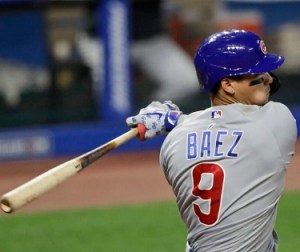
Javier Baez wants his and other players’ in-game television back.

The following program is not brought to you in living colour, on NBC or elsewhere around the Show. Javier Baez, Chicago Cubs shortstop, is not amused.

Baez is having less than an exemplary season at the plate as it is without being frustrated because a valuable tool he and most players use during games is denied them this year.

They can’t duck into the video room during games this season to review their prior plate appearances or pitching turns during games, spot mistakes, and adjust accordingly when they check in at the plate or on the mound next.

“To be honest, it sucks because I make my adjustments during the game,” Baez told ESPN writer Jesse Rogers Monday, and that was after he picked up three hits while his Cubs beat the St. Louis Cardinals, 5-1. “I watch my swing. I watch where the ball went, where the contact was. I’m mad. I’m really mad about that we don’t have it.”

Baez thinks, not without reason, that it simply wasn’t right for baseball’s government to put the entire Show on video restriction simply because of the malfeasance of two known teams at least. Think of Mom and Dad grounding all the kids because one broke into the liquor cabinet while the others were nowhere within two miles of the scene of the crime.

As Rogers writes, “In-game video was taken away this season in the wake of the Houston Astros sign-stealing scandal.” But the culprit wasn’t Astrogate alone.

Bad enough: the Astros either adjusted an existing camera illegally or installed another one just as illegally to enable off-field-based sign stealing. Nowhere near as bad, though enough Astro fans think otherwise, of course: the Boston Red Sox didn’t adjust or install cameras, but they did develop off-field-based sign-stealing reconnaissance by way of their existing video room.

Video rooms are in all ballparks behind both dugouts. The Rogue Sox Replay Room Reconnaissance Ring involved someone deciphering pitch signs on existing screens, then signaling a baserunner to send the sign to the hitter. The Rogue Sox exercised a sophisticated if sneaky variation of old-fashioned gamesmanship, but doing it by way of the video room was a major no-no.

Unlike the Astros’ extracurricular installations or adjustments, whichever they were, MLB itself installing the video rooms handed the Red Sox and every other team surrendering to similar temptations the keys to the liquor cabinet expecting they’d be good little boys and not even think about drinking unlawfully.

“[P]rotocols put in place during the coronavirus pandemic all but assured that there would be no way to monitor usage properly,” Rogers writes. “Now players can’t watch their at-bats until after games.”

The old-school old farts would remind you, of course, that once upon a time, in the dark days before technology advanced at warp speed to destroy Life As We Knew It When the Going Was Good, coaches and managers observed batters and pitchers and suggested adjustments accordingly, if not necessarily astutely, all by their own selves. With no subversive help from God or those subversive technocrats from General Electric, RCA, Bell & Howell, IBM, Wollensak, or others.

(Oops. Wollensak’s and other hand-held spyglasses and telescopes ended up in the hands of such off-field sign-stealing cheaters as the 1940 Detroit Tigers, the 1948 Cleveland Indians, and—especially—the 1951 New York Giants, to name a few.)

What brass balls on early 1950s Brooklyn Dodgers manager Charley Dressen, then. Dressen once helped Gil Hodges break out of a ferocious batting slump by commissioning a filmmaker to shoot hours of footage of the beleaguered first baseman at the plate. Then, he showed Hodges on extensive film the backward mis-step he’d take in the box—his back foot pulling himself and his swing off line—and gave a successful suggestion on how to keep that step from hurting his swing. Career saved.

The nerve of such people as the now-late Lou Brock. In the mid-1960s, he first took up the practise of filming enemy pitchers to study everything he could about their mound  tendencies and how he might exploit them for more efficient basepath crime. (I don’t want to be in your goddam movies, Brock!—Hall of Fame pitcher Don Drysdale.) From Kodak to Cooperstown.

The gall of such people as the late Hall of Famer Tony Gwynn. In the early-to-mid 1980s, Gwynn started carrying a video recorder and player around with him, at home and on the road, while his wife shot and captured his plate appearances so he could study them as a rabbinical scholar studies the Talmud, during and after games alike, and correct any mistakes or flaws he happened to catch.

Today’s baseball player can normally survive a tough plate appearance or turn on the mound, duck into the video room at next opportunity, and observe and adjust on the fly. Or, have a successful turn, then study and retain what he did right. Argue against such legitimate helpmates? You might as well argue the American family never had it so good as when they had to beat the dust and dirt of the rugs and slipcovers hanging on clotheslines, instead of reaching for the Electrolux.

This is not to suggest that a batter or a pitcher has lost the capability to think hard enough on their own and figure necessary adjustments. Minds greater than baseball minds rarely say no to all the sound help they can get from all the sound sources they can find, technological or otherwise.

Try to convince yourself that even such a Hall of Famer as Ted Williams would have said no to seeing some film of himself at the plate and catching the occasional kink or further refining the betters. When he met and befriended Gwynn late in life, Teddy Ballgame surely approved of Captain Video’s private television production operation on behalf of (the horror) improving himself at the plate.

Set to one side the temptations that manifest because boys will be boys, in Houston, Boston, and anywhere else, and video lacks what even the best managers and coaches have no matter how well they train themselves or get themselves trained otherwise. Video doesn’t lie, or at least surrender to coaches’ biases based on how they swung or pitched back in their Good Old Days.

(How many coaches ruined how many players by trying to bend them to their own former playing ways or toward presumed styles? Possible racial considerations to one side, the Cubs traded Lou Brock after they couldn’t make him into the pure slugger he really wasn’t. The Mets once thought their phenom pitcher Dwight Gooden needed to stop trying to miss bats and add off-speed pitches he couldn’t throw comfortably though their pitching coach Mel Stottlemyre once did. Hall of Fame talent ruined: Gooden’s confidence and in due course his shoulder and his career were compromised.)

After the Astrogate/Soxgate kerfuffles, baseball’s government decided the video room’s future would include specially hired and trained security the better to keep the game’s grand theft felons from even thinking about future replay room reconnaissance cheating. Baez doesn’t exactly object to the idea. He just didn’t think the future wouldn’t be right now.

“We didn’t cheat. We’re not cheating, and we got to pay for all this,” he told Rogers. “It’s tough . . . but a lot of players are struggling, too. A lot of stars are struggling, and I’m just one more. The way that it is is not the way we play baseball. And I need video to make adjustments and during the game. It doesn’t matter who is there to watch us. It doesn’t matter if we have all the police the MLB wants to send over here.”

In this pandemically truncated season played in conditions unheard of in previous seasons, many players aren’t struggling but many players are. The reasons are varied widely. And it isn’t as though Baez is crying out from the subterranean depths. His Cubs at this writing have the best record in the National League Central and the fourth-best in the entire league. Somehow.

Once upon a time, in 1980, the hits on the music charts included a ditty called, “Video Killed the Radio Star.” The lack of video in this Quiet, Please! Geniuses Playing with Mental Blocks season isn’t going to kill the baseball star. (Shane Bieber, Jacob deGrom, Yu Darvish, Zack Greinke, Clayton Kershaw, Juan Soto, Fernando Tatis, Jr., and Mike Trout, call your offices.)

But it’s not making their serious work of play simple, either.

End the umpires’ version of qualified immunity

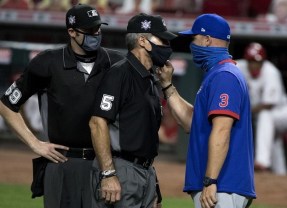
Umpires Nic Lentz (left) and the ever-popular Angel Hernandez (center) debate with Chicago Cubs manager David Ross. On that day, it was Grandpa Rossy objecting to the umps tossing his coach Mike Borzello for objecting to the near-decapitation of Anthony Rizzo by a pitch. Umpire accountability remains a burden on the game for its lacking.

In more than one way, enough major league baseball umpires have something in common with rogue police. The rogue cop survives thanks to a disgraceful (and court-invented) doctrine known as “qualified immunity.” The rogue or at least incompetent umpire survives similarly, if not phrased formally in quite those words. Unlucky for us.

MLB’s government swears it’ll get to the bottom of Joe West throwing out the first general manager of the season Sunday. The way things continue to stand, it looks like that Antarctican beach club is still on sale at a bargain rate.

Mike Rizzo’s heinous crime, all by his lonesome in a club box in Atlanta’s Truist Park, was spending a considerable part of his weekend hollering over dubious calls by West’s crew while his Nationals played and took two of three from the Braves. When Rizzo objected to yet another dubious call Sunday, this time on a called strike that missed the zone, West said, “Enough is enough,” and his crew ordered ballpark security to cart Rizzo away.

Enough is indeed enough, but not the way West thinks. When it comes to MLB holding umpires just as accountable as they’re presumed to hold players, coaches, managers, trainers, medical staffers, front-office workers, and even owners now and then, enough was enough long before this surrealistic pandemically-truncated season. Prowl through the rule book and you’ll be hard pressed to find specific language handing incompetent or rogue umpires qualified immunity. But they have it mostly in spirit.

They also have one up on the rogue cop. We’re told an awful lot more about the periodic rogue cop who doesn’t escape consequences when he becomes the lawbreaker instead of the law enforcers than we’re told about the rogue ump’s consequences when he steps out of line.

On the extremely rare occasions when the Wests, the C.B. Bucknors, the Laz Barreras, the Angel Hernandezes, and others are held to account for their behaviours, fans usually  have no right to know how they were disciplined, if they were disciplined. (Usually, but not always exclusively.) Let a player or manager step out of line, and every dollar and day of their fine or suspension hits a line drive on SportsCenter.

I hate to resurrect a dead horse to beat, but many may forget now what happened over twenty-one years ago, when baseball government actually tried imposing a little accountability on the arbiters and the arbiters actually tried telling baseball government to perform an anatomical impossibility upon itself. It led to the self-immolation of the original umpires’ union and the creation of the current one.

We take you back to 14 July 1999, when Major League Umpires Association executive director Richie Phillips announced that fifty-seven of the Show’s then sixty-six umpires would resign effective that 2 September. The fifty-seven “wanted to continue working as umpires, but they want to feel good about themselves and would rather not continue as umpires if they have to continue under present circumstances,” Phillips harrumphed. “They feel in the past seven months or so, they have been humiliated and denigrated.”

The late Society for American Baseball Research analyst Doug Pappas described such humiliating denigration, or was it denigrating humiliation:

Many umps were outraged when umpire Tom Hallion was suspended for bumping a player — though not as outraged as they’d be if a player wasn’t suspended for bumping an ump. When MLB redefined the rulebook strike zone to reflect the umpires’ collective refusal to call the high strike, Phillips insisted that MLB had no right to do so without MLUA approval. Before the season, the MLUA blocked MLB’s proposal to move control of the umpires from the league offices to the Commissioner’s Office by claiming that the move would constitute a change of employer, entitling the umpires to millions in severance pay.

Phillips reserved his greatest scorn for attempts to hold the umpires accountable for their on-field performance. Upon learning of a MLBPA survey of players, coaches and managers which ranked each umpire against his peers, Phillips sneered, “I don’t give any credence at all to ratings of officials because ratings are always subjective.” When MLB asked clubs to chart pitches and file a report on each umpire’s strike zone, Phillips snarled that this was “just another case of Big Brother watching over us.”

An employer evaluating the competence of its employees. The nerve!

Phillips went so far as to proclaim that, as of that 2 September date, they’d form Umpires, Incorporated, both negotiating to provide MLB umpiring and becoming the sole umpire supervisor. “In short,” Pappas wrote, “Phillips proposed to turn the umpires into a self-governing association, free of MLB control.”

To owners and players alike, this demand was tantamount to a municipal police union demanding an end to civilian control of the police force. Even if the owners had been willing to cede such authority, the screams of the MLBPA would have killed the deal. And the owners weren’t willing. When informed of the umpires’ move, Sandy Alderson of the Commissioner’s Office termed the resignations “either a threat to be ignored or an offer to be accepted.”

Behind the scenes, Alderson and MLB’s lawyers must have been exchanging high fives. By “resigning” — a transparent attempt to evade the no-strike clause in their labor agreement — the umpires had abandoned the protections of their contract and left themselves at MLB’s mercy. Aided by the advice of their personal attorneys, a few arbiters came to the same conclusion and rescinded their resignations.

The net consequence was twenty-two umpires losing their jobs, and losing in court when they sued to allow rescinding those resignations. (In due course, an arbitrator ruled nine of had to be re-hired, while another three would be re-hired in a new collective bargaining agreement, and the ten not re-hired would receive severance pay.)

Dissidents from the Phillips-inspired self-immolation, led by Joe Brinkman and John Hirschbeck, pushed for and got the 2000 decertification of the MLUA, subsequently forming a new union, the World Umpires Association. The new union changed its name to the Major League Baseball Umpires Association in 2018. (The president since 2009, when he succeeded Hirschbeck: Joe West.)

The trigger for the old umps’ union’s madness may not be forgotten by either the umps or the game’s administration today. Perhaps nobody wants to pull it and provoke a madder calamity. Except that there’s no sane reason to keep a rogue cop in uniform entrusted with law enforcement, and there’s no sane reason to allow umpires to act as laws unto themselves, regardless of the rule book or the common sense God gave a paramecium but enough umpires and administrators ignore.

Too many balls continue being called strikes, too many strikes continue being called balls, through the courtesy of an umpire’s “own” strike zone rather than the one prescribed in the rule book. The errant ump can still lean on other clauses in the rules to purge those objecting, and MLB still has strictures against speaking publicly about errant umpiring by players, coaches, managers, and other team personnel.

When an umpire finally throws out a general manager way up in the pandemically-empty stands, for hollering loud enough and long enough that there’s less than consistent competence among the arbiters, it’s time long overdue to consider disqualifying the umpires’ version of qualified immunity. The rogues among the nation’s gendarmes have had it long enough.

Country Joe tosses the boss

Umpire Hunter Wendelstedt, unmasked, confabs (and points to Nats GM Mike Rizzo in the second deck) with masked crew chief Joe West Sunday.

Among many distinctions, not all of them affirmative, Joe West is now the man who threw out the first general manager of the season. The Washington Nationals aren’t the only ones among the barely amused.

What a weekend for Mike Rizzo. After entering spring training with his contract status unresolved beyond his own walk year this year, he finally landed the extension he deserved when all was said and done. He barely had time to savour it when he got into West’s crosshairs Sunday.

This pandemic-truncated season hasn’t exactly gone the way the defending world champions had in mind. They’re dead last in the National League East and next-to-last in this season’s crazed wild card picture. Their tragic number for elimination is sixteen. When the only National League outfit worse is the Pittsburgh Pirates, it’s enough to give last year’s self-resurrecting World Series conquerors pause going in.

Then the Nats spent the weekend with the Atlanta Braves and both sides seemed to spend much of it complaining that the umpiring was, shall we say, far less than exemplary or accurate. Rizzo all weekend was a particularly vocal complainer.

Thanks to pandemic-empty ballparks you can hear a lot more than perhaps you’d like to hear from the dugouts and even the men on the field or the coaching lines. There was Rizzo, all alone in a club box in the second deck of Atlanta’s Truist Park. Not a soul within a few hundred feet of him in either direction.

The next thing you knew, Rizzo was escorted from the premises by stadium security in the top of the seventh. That was as much a seventh-inning stretch as you could imagine in such surrealistic circumstances.

With the Braves up, 7-1 (they went on to win, 10-3), umpire Hunter Wendelstedt started pointing to the club level where Rizzo reposed and, apparently, objected to this or that call. “The umpiring crew, led by West, then went to call security,” writes Larry Brown. “The Braves’ announcers speculated that West might not have liked Rizzo complaining about balls and strikes. They also mentioned that Rizzo was not wearing a mask in the park.”

The mask issue seems a little like a red herring with no one within a hundred feet of Rizzo. Especially since a) West’s on record as thinking COVID-19 isn’t exactly a deadly enemy; and, b) Wendelstedt was unmasked while he confabbed with West, who was masked. They were probably ticked off most at Rizzo objecting to a strike call on a pitch that actually sailed in well enough off the plate while Nats infielder Asdrubal Cabrera batted.

Apparently, Rizzo kept barking over the pitch calls by the time first baseman Eric Thames batted on a 2-2 count. Then West pointed to the club boxes where Rizzo reposed and called stadium security after hollering, “You’re out! Get out!” Rizzo’s way.

“Should Rizzo be yelling at the ump audibly from his suite? Probably not, but it’s also the kind of thing that that happens every game,” deadpans Deadspin writer Sam Fels. “It’s the kind of thing that could probably be solved with a solitary look, or maybe a pointed finger. But no, that won’t due for hilljack Joe.”

You want to talk about delays of games? West held up the game so he could show Rizzo who’s boss around here. “Call security,” a voice hollered. You’d think objecting to dubious pitch calls equaled a small child refusing to go to bed when Mom and Dad so order. Unless Mom and Dad confuse proper parenting with tyranny for its own sake, they’re not Joe West.

“Joe West is the passenger on the plane who won’t let you out of the row to go to the bathroom because drink service will begin in five minutes,” Fels writes.

Joe West constantly tells the bartender when they’re low on ice. Joe West kettles protestors without informing them of curfew, then arrests them for violating curfew. It’s not so much that Joe West has to enforce the rules. He has to enforce that he knows the rules better than anyone. It’s not the order he’s after, but the acknowledgement, or more to the point the worshipping, of his knowledge and power.

West decided then and there it was time to show who knew the rules better than anyone. As His Holiness himself put it after the game, “I wouldn’t take that from a player. I wouldn’t take that from a manager. If it was Donald Trump, I’d eject him, too. But I’d still vote for him.”

Just let West try ejecting President Tweety. He’d be on the Trump tweetstorm target list faster than a base hit travels past the infield. And if West would have a GM thrown out of the ballpark for objecting to the umpiring, what’ll happen when fans—who aren’t exactly kind and gentle about questionable umpiring—are finally allowed to come back to the games?

Historically, umpires suffer neither fools nor protests gladly, even if they don’t always mind a little debate if the debator isn’t looking to show them up. The bad news is that even the best-humoured umpires lose their senses of humour when a questionable call is given.

The rules say players, managers, and coaches can’t argue ball and strike calls, and that if they head for the plate for such a protest they can be tossed. So can pitchers leaving the mound or batters stepping out of the box for such protests. But what about people in the stands, team personnel or otherwise? Umpires haven’t exactly been historically shy about throwing them out at certain times, either.

They’ve been known to eject ballpark organists or DJs for playing “Three Blind Mice” over bad calls. Or, for playing the theme from The Mickey Mouse Club. Or, for playing Bob Uecker’s sarcastic “Personally, I think we got hosed on that call” from Major League. They’ve been known to eject entire press boxes over catcalls coming down over questionable calls.

It’s one thing, too, for an ump to eject a fan suspected of doing a little sign-stealing on behalf of their hometown heroes. But good luck to the next fan who protests a pitch call by whipping up a placard that shows an eye test or performs a perfect impression of an optometrist’s business card.

Rule 4.06 bars managers, players, substitutes, coaches, trainers, and bat boys from “incit[ing] . . . by word or sign a demonstration by spectators.” (It also applies to broadcasters, technically, when fans cling to their radios in the ballpark as they’ve often done. Normally, though, such announcers escape with a mere warning.)

Rule 9.01(b) gives umps “the authority to order a player, coach, manager or club officer or employee to do or refrain from doing anything which affects the administering of these rules, and to enforce the prescribed penalties.”

Allow for pandemically empty ballparks allowing one and all on the field, in the dugouts, and even isolated singularly in the stands to hear every beef, debate, and expletive un-deleted. That said, just how could Mike Rizzo all alone in a second-deck club box objecting to pitch calls interfere with West and crew’s control of Sunday’s game?

If Rizzo was in that club box raining objections down with a full house of fans in the stands making their usual racket, only a dog could have heard it. The chances of West, Wendelstedt, and crew hearing his specific words would have been reduced to the margins and maybe further.

“We have already been in communication with the Nationals regarding what transpired during today’s game, and we will speak with the umpiring crew today,” said MLB’s government in a formal statement. “We will expect Joe West’s crew to provide a full account of their perspective, and we will follow up with them accordingly.”

Can you see the electronic strike zones and robo-umps coming a little more clearly in the rear-view mirror, too?