Cut the crap

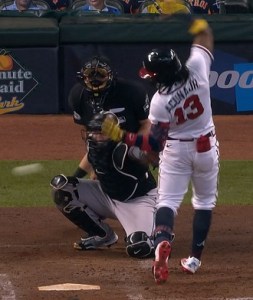
Sandy Alcantara’s pitch ricochets off Ronald Acuna, Jr. in the third.

So far as the Miami Marlins seem concerned, the heir apparent to Freddie Freeman as the Atlanta Braves’s franchise face doesn’t wear a Braves uniform. He wears a target. Especially after he hits home runs, in the postseason and otherwise.

Here we went again Tuesday afternoon. Game One, National League division series. And, yes, it was weird enough that the Braves and the Marlins played in Houston’s Minute Maid Park, with the Braves as the home team.

Then Acuna hit the second pitch from Marlins starter Sandy Alcantara over the right field fence opening the bottom of the first. As is characteristic of the ebullient outfielder, he watched for the briefest moment before flipping his bat to one side on his way up the first base line to run it out.

Acuna had reason enough to celebrate even before the Braves demolished the Marlins with a comeback 9-5 win. He became the youngest man in Show history to hit a leadoff bomb in a postseason game. He and the Braves got to enjoy it until the bottom of the third, with the Marlins holding a 4-3 lead and Acuna at the plate with one out.

Alcantara threw at and hit Acuna on an 0-1 count with a 98 mph fastball. At least Alcantara waited until Acuna greeted him again instead of going completely infantile and drilling Freeman following Acuna in the first. That may be the only thing to his credit.

Acuna might have said after the game that he’s kinda, sorta, kinda getting used to being Fish fodder, but that didn’t mean he was necessarily thrilled to be so high on their hit parade when the third-inning pitch struck. He took a few steps forward, toward the mound, holding onto his bat a bit, and both Braves coaches and umpires surrounded him before he entertained any ideas about relieving Alcantara of his head or any other extremities.

“I looked over to their bench,” Acuna said post-game. “I said it’s been five times. At this point, I think we’ve become accustomed to it.” Not necessarily. If that were true, the Braves wouldn’t have engaged in a chirping contest with the Marlins before Acuna finally dropped his bat and took his base.

They also might not have answered the Marlins’ three-run top of the third with Marcell Ozuna doubling Acuna home following Freeman’s followup fly out and Travis d’Arnaud doubling Ozuna home to bring things back to within a run.

And they wouldn’t have bided their time, chased Alcantara out of the game in the seventh with a pair of inning-opening infield singles, one by Acuna himself, before Freeman forced Acuna at second with Yimi Garcia on the mound, Ozuna singled home Austin Riley to tie the game at four, and d’Arnaud hitting a 2-0 grapefruit far enough over the center field fence.

Nor would Ozzie Albies have followed d’Arnaud’s demolition with a base hit to chase Garcia in favour of James Hoyt, whose first service to Dansby Swanson disappeared over the center field fence, too.

That’s where the score stayed other than Matt Joyce’s excuse-me RBI single in the top of the eighth.

“I think it woke us up,” d’Arnaud said of Alcantara drilling Acuna. “And we took advantage of the momentum.” Said Braves manager Brian Snitker, “You better be good at going in and not hitting [Acuna] after a homer.”

Alcantara wasn’t, obviously. Nor was he especially good at covering his tracks after the game. Any expressions of the-ball-got-away-from-him/the-dog-ate-his-homework got vapourised when he added, referencing Acuna’s brief but interrupted advance to the mound, “If he’s ready to fight, I’m ready to fight, too, no matter what happens.”

Cut the crap.There was only one reason Acuna might have been ready to fight, and that was getting drilled his next time up after hitting one out and—oh, the hor-ror!—showing his pleasure over his feat.

Cut the crap. He’s hitting for a .318/.414/.665 slash line against them since he first faced them in 2018. It couldn’t possibly be that the Fish are fed up with Acuna making tuna salad out of them so far in his career.

Cut the crap. It doesn’t matter that has a .182 lifetime batting average against Alcantara into the proceedings. Maybe Acuna also felt like celebrating finally having something more to show than two walks, two strikeouts, and nothing else off the Miami righthander in ten previous plate appearances. Since when does that give Alcantara a license to drill when the first hit he surrenders to Acuna is a parabolic opening launch?

Jose Urena, whose 2018 drilling of Acuna after a bomb-flip got Urena suspended six games, has decent performance papers against Acuna otherwise, if not quite those of Alcantara’s: five strikeouts, three walks, four hits including that lone bomb, and a .235 batting average against him. But Acuna also has a .409 on-base percentage against Urena in 22 plate appearances. And he’s been hit twice in the bargain.

Cut the crap. I’ve said it before, I’ll say it again. You don’t want Acuna turning his bat into a helicopter rotor when he hits one out against you, stop throwing him cantaloupes to hit in the first place. You want to be a Fun Policeman, wear a police uniform and not a Marlins uniform on the mound.

It ruined Alcantara having a solid outing otherwise, until the Marlins bullpen—whose main men are the proud possessors of a 2.72 irregular season ERA—got dismantled in the seventh. It also put a little smudge on the Marlins’ 2020 reputation as a pleasant surprise who missed winning the National League East by finishing four behind these Braves.

But it also reminded close observers that Acuna has been bitten twice as often by the Fish as he’s been by any other major league team. MLB.com’s Mark Bowman was kind enough to point out that Acuna’s been drilled by Miami pitching once every 41.2 plate appearances—and once every 80 plate appearances by everyone else’s pitching staffs.

Acuna answered on social media after the game too. “They have to hit me because they don’t get me out,” he said in one tweet. “I’d like to take this time to apologize to absolutely NOBODY,” he insisted in an Instagram post. I’d like to take this time to say Acuna owes apologies to absolutely nobody.

Don’t kill the umps just yet

Justin Verlander may have sought divine intervention with Angel Hernandez, but his ex-Astros rotation mate Cole may have other sobering thoughts about the Angel of Doom.

The mere presence of Angel Hernandez among the division series umpiring crews may have been enough to drive most baseball temperatures through the top of the tube. His crew is working the National League division set between the Los Angeles Dodgers and the San Diego Padres.

But New York Yankees pitcher Gerrit Cole may wish Hernandez was working their set with the Tampa Bay Rays, instead. Even if he ever had occasion to dispute one of Hernandez’s calls and the controversial umpire’s long-established reputation for trying to insert himelf too deep into the game for comfort.

This one comes from our Who’d-a-Thunk-It Department: Cole has pitched three times in his career with Hernandez calling balls and strikes. His ERA with the Angel of Doom behind the plate is—wait for it!—1.80.

Just don’t tell that to at least one ex-Yankee for whom Hernandez was as useful as a sore throat, CC Sabathia.

The only way Cole might reject Hernandez behind the plate would be if he were offered the choice between Hernandez and Adrian Johnson. Among the umps behind the plate for three or more games Cole’s pitched, his ERA with Johnson (also three games) is 0.90. But if you mention any of that, bank on it: it’ll be Hernandez who makes the jaws hit the floor.

Now, it’ll be easier to pass the political (lack of) class through polygraph tests than to discover Gerrit Cole demanding Angel Hernandez work his games behind the plate, of course. But wouldn’t you love to know how a group of today’s top-of-the-line pitchers work with certain umpires calling their pitches?

Cole himself has worked with three of the Four Wisenheimers: Hernandez, C.B. Bucknor, and Laz Diaz. Somehow, some way, Cole’s managed to pitch without Country Joe West behind the plate even once. Prepare yourself: With Bucknor behind the plate, Cole’s lifetime ERA is 1.50. (Maybe Hernandez shouldn’t be in a hurry for Cole’s personal invitation.) With Diaz behind the plate, though, Cole’s lifetime ERA is 5.68.

Let’s assume for argument’s sake that Bucknor, Diaz, Hernandez, and West are baseball’s four worst or at least most confrontational self-promoters in the game today. Everybody with me?

Now, let’s look at how this season’s ERA leaders—every starting pitcher with a sub-3.00 ERA in 2020, irregular season or not—have fared in their careers according to the umps calling their balls and strikes. Among those umps who’ve worked behind the plate in a minimum three of their games lifetime, who do they love and hate the most back there?

You may or may not be surprised. (Arizona’s Zac Gallen, who sits between Zach Davis and Kyle Hendricks on the 2020 ERA parade, isn’t included because he’s never worked with any single umpire behind the plate for more than two games so far. He’s also never worked with the Four Wisenheimers. Yet.)

Pitchers & Plate Umps, At Least Three Games (2020 ERA Leaders)
Pitcher Loves Behind the Plate Hates Behind the Plate
Shane Bieber Carlos Torres (3.94) Larry Vanover (4.80)
Trevor Bauer Ted Barrett (0.78) Alan Porter (9.27)
Dallas Keuchel Mark Ripperger (0.95) Paul Nauert (7.91)
Yu Darvish Bill Welke (0.94) Rob Drake (7.53)
Dinelson Lamet Mike Muchlinski (2.65) Tom Woodring (2.81)
Chris Bassitt Alfonso Marquez (0.34) Phil Cuzzi (7.04)
Jacob deGrom Lance Barrett (0.48) Mike Muchlinski (7.98)
Hyun-Jin Ryu Brian Knight (0.43) Alan Porter (5.40)
Kenta Maeda Scott Barry (1.13) D.J. Rayburn (8.56)
Zach Davies Chris Conroy (1.00) Rob Drake (6.75)
Kyle Hendricks Marvin Hudson (0.44) Kerwin Danley (6.38)
Carlos Carrasco Adrian Johnson (0.52) Joe West (8.44)
Zack Wheeler James Hoye (0.87) Pat Hoberg (8.10)

Hands up to everyone who’s surprised three out of the Four Wisenheimers didn’t show up even once on that survey—never mind Alan Porter and Rob Drake showing up twice in the hates-behind-the-plate column.

Now, hands up to everyone who’s shocked that Joe West shows up only once. (Was anyone really surprised to see it’d be in the hates-behind-the-plate column?) Hands up, too, to everyone who’s shocked that Trevor Bauer hates Porter behind the plate more than Carlos Carrasco hates Country Joe.

You may have noticed that Mike Muchlinski is the only umpire to show up once each in the loves and hates columns. Making it tempting for cynics to ask what he has against Jacob deGrom that he doesn’t have against Dinelson Lamet. (Or, to ask when Chris Bassitt plans to blow Alfonso Marquez to a chateau briand dinner with all the trimmings.)

Of course, a pitcher’s ERA with a particular umpire behind the plate isn’t necessarily conclusive. Brian Knight could have given Hyun-Jin Ryu a small volume of strike calls on pitches that weren’t within a mile of the zone’s ZIP code. Porter could have called every pitch from Bauer on the money.

It could go in reverse, too. Knight could give Ryu a ton of balls that hit the zone and Ryu could just shake them off and bear down harder. Porter could call some strikes for Bauer that weren’t even visible on radar and Bauer could just get plain clobbered no matter where the other pitches were called.

Nor does any of the foregoing mean I’m backing off my calls for umpire accountability, for the end of umpires having their own kind of qualified immunity. I’m not backing off my approval of the coming electronic strike zones and even robot umps.

I’m funny that way. I don’t believe umps deserve qualified immunity from their glaring inaccuracies, any more than I believe rogue police deserve qualified immunity from answering for their misdeeds or crimes when they commit them. I don’t believe the “beautiful human factor” (Joe Torre’s words) means a license to blow calls on pitches Ray Charles could see in the zone or Superman couldn’t see out of the zone.

And, I don’t believe there’s a damn thing wrong with getting it right. Especially when championship advance or championship victory is squarely on the line.

But I’m still trying to fathom whether Gerrit Cole’s lifetime 1.80 ERA with the Angel of Doom calling his balls and strikes is more peculiar than Carlos Carrasco among this irregular season’s ERA leaders wishing for anyone except Joe West working behind the plate.

(Even the others among the Four Wisenheimers? Carrasco has three with C.B. Bucknor—7.54 ERA; thirteen strikeouts, three walks. He has three with Joe West, too—aside from the ghastly 8.44 ERA, he’s got a measly six strikeouts and five walks with Country Joe behind the dish. With the Angel of Doom behind the plate? One game, 0.00 ERA for the game with ten strikeouts and a walk. Maybe Carrasco ought to send Cole a text message.)

Or, maybe it’s just another useful affirmation of one of baseball’s oldest laws: Anything can happen—and usually does.

California bombs, California rough stuff

The pandemic-mandated empty house aside, 5 October might as well be Alex Bregman Day . . .

Mr. October Fifth? What’s up with that?

It’s not Alex Bregman’s birthday. (For the record, that’s 30 March.) It’s not his engagement date. (He popped the question to a Colorado lady named Reagan Howard in January.) It’s not his future wedding date. There seems nothing significant elsewhere for him about that date.

Except when he plays postseason baseball. For a fourth consecutive 5 October Bregman found a pitch meaty enough to send long distance. Mark your 2021 calendar accordingly if you must.

He led off the top of the fourth against Oakland starter Chris Bassitt Monday afternoon, starting an American League division series, and sent a 1-2 service into the pandemically-required unoccupied left field bleachers.

It put his Houston Astros on the board after the Athletics helped themselves to a 3-0 lead on long balls themselves. It gave his infield teammate Carlos Correa thoughts about not wanting to be left out of the action after Kyle Tucker followed with a single through the left side of the infield, Correa hitting a 2-0 pitch over the center field fence.

And—with no small assistance from Oakland’s normally vacuum-handed shortstop Marcus Semien’s boot on Josh Reddick’s two-out grounder in the top of the sixth—the Astros seized the chance at new life, not letting something like a subsequent 5-3 deficit spoil the day, and finished with a 10-5 Game One win.

It almost figured.

There are far worse talismans to attach to a team than 10-5. Especially to a team who got into this convoluted postseason with a losing record and who spent 2018 and 2019 doing not even once what they did Monday—come back from a pair of multi-run deficits.

Especially when several signature Astro bats returned to life at last. Let’s see. George Springer going 4-for-5 after an irregular season in which he had no four-hit games. Correa dialing nine twice and sending four runs home, after an irregular season in which he didn’t send four home or homer twice. The quartet of Bregman, Correa, Springer, and Jose Altuve each driving in at least one run in the same game after not having done that together even once on the irregular season.

And, thanks to the bubble concept putting postseason teams from the division series forward into neutral parks, the Astros’ three postseason wins have now happened in ballparks not their own.

The third, of course, happened in . . . Dodger Stadium. The home of a team with whom they have, ahem, some recent history. The division series home for Games One, Two, and (if necessary) Five of an A’s team that includes the former Astro who blew the whistle on Astrogate at last, last November, after those too well aware of their illegal, off-field-base, altered or extra camera transmitting sign stealing schemes couldn’t convince anyone else to expose it.

“As the game got deeper, the at-bats got better,” said Springer of the Astros’ Monday breakout. “They played the later innings better than we did. We just didn’t have the at-bats we typically do at the end of the game,” said A’s manager Bob Melvin.

How much of a pitcher’s park is Dodger Stadium still, even if it’s not quite the equal of its first two decades? In 91 previous postseason games played there, not once were six home runs hit there. Bregman’s one and Correa’s two were joined by Oakland’s Khris Davis, Sean Murphy, and Matt Olson.

“I’ve never seen the ball carry like that here,” said Astros manager Dusty Baker, who played eight seasons for the Dodgers from the 1970s to the 1980s.

Bregman’s 5 October long-distance mastery has also broken the three-straight-same-date postseason strings of Hall of Famer-to-be Albert Pujols (17 October 2004-05-06) and Francisco Lindor (6 October 2016-17-18). But he’ll have to wait ’till next year for a shot at equaling the five-streaks of Pujols (five straight 30 Mays) and Ryan Braun (five straight 24 Julys) among still-active players.

What’s the regular-season record? Seven. Who holds it? Hall of Famer Lou Gehrig (8 June 1932-38) and former Astros mainstay Lance Berkman. (21 September 2001-07.)

Then the doings down the freeway in San Diego, in Petco Park, had to go steal the show. The Padres had nothing to do with it. The New York Yankees did. Their winning score against the AL East champion Tampa Bay Rays was a measly 9-3, but oh what a show the Yankees made of it.

Somehow, some way, the Yankees find ways to make history just when you think there isn’t a single piece of history left for that franchise to make. It only began with this: Not since 1956 (when Moose Skowron and Hall of Famer Yogi Berra did it in that World Series) had the Yankees hit two grand slams in a postseason at all—but Monday night they sliced salami for a second straight postseason game. No other American League team has ever done that.

Score nine or more runs in three straight postseason-opening games? Nobody did that before the Yankees did it this year. Score 31 runs in its first three postseason games? Nobody did that, either, until this year’s Yankees delivered.

So who the hell needed Gerritt Cole pitching six, striking out eight, and not letting a measly three runs shake him out of his skin before turning things over to Chad Green, Zack Britton, and Luis Cessa?

. . . but John Curtiss knocking down Gio Urshela (29) and Gleyber Torres after his salami was sliced was an uncalled-for and terrible look.

Luis who?

Simple: with a 9-3 lead, Yankee skipper Aaron Boone—with the spectre of no division series days off looming—wasn’t going to burn Aroldis Chapman unless the Rays got ornery in the ninth, which they didn’t. And Cessa got rid of the Rays with no interruption but a mere two-out walk.

Monday’s delicatessen slicer was Giancarlo Stanton in the top of the ninth against Rays reliever John Curtiss. It wasn’t as if Stanton was unfamiliar with Petco Park—he won the Home Run Derby there four years ago. Batting now on 2-2, Stanton caught hold of Curtiss’s slider just off the middle of the plate, and drove it just beyond Rays center fielder Kevin Kiermaier’s glove-extended leap and over the center field fence.

Then Curtiss just had to make the Rays look even worse, didn’t he? The next batter was Yankee, third baseman Gio Urshela—whose second-inning defense would have made ancient Yankees Clete Boyer and Graig Nettles plus Hall of Fame Oriole Brooks Robinson proud, with his leaping stab to pick Manuel Margot’s high hopper and throw him out, then his rolling seat-of-the-pants throw to nail Joey Wendle off a hard smash into the hole.

Curtiss sent Urshela sprawling on an up and in 0-1 pitch, with Urshela finally wrestling his way to popping out to the infield. Then Yankee shortstop Gleyber Torres checked in at the plate. Curtiss waited until 2-2 before playing Torres a little chin music. No wonder Torres couldn’t resist stealing second while Brett Gardner batted next.

Oops. Apparently, an awful lot of people called Torres out for the ninth-inning theft. “I don’t like seeing disrespectful things in the game,” crowed Hall of Fame pitcher Pedro Martinez on a TBS postgame show. Forget that the Yankees went 2-8 against the Rays on the irregular season and might be thinking that, no matter the score or the inning, every run counts.

Martinez might be the wrong man to ask, of course, but if you don’t like Torres stealing second with his team up by six in the ninth, did you like Curtiss making the usually likeable Rays—those unknown soldiers, who can normally beat you with the same aplomb as the big boys with the big names and the bigger paychecks—resemble unsportsmanlike sore losers?

Curtiss also made the Yankees look the way the beasts of the Bronx rarely look—sympathetic. And that’s over a month after Chapman nearly decapitated Michael Brousseau with a 101 mph fastball. But that was then, and Chapman’s been a little wild most of his career, anyway. He doesn’t have quite the control required to plan an execution. Not even with the Rays pitching inside tight to a few too many Yankees on the season before that head scratcher.

You’re embarrassed when a guy slices salami on your dollar? You man up, tip your hat, shake it off, and get the next guy out. You don’t knock that next guy and the guy following him down, off, back, or through just because your ego was sent into half orbit, with or without the bases loaded. (It would also help if you don’t surrender a leadoff single, a walk, a one-out RBI single, and a bases-loading walk to set it up, too.)

Things were notoriously tense enough between the Yankees and the Rays on the irregular season. Then, both sides tried to indicate going in that they were going to do their level best to play nice and no rough stuff. Then Curtiss had to deliver a little un-called for rough stuff anyway. No more Mr. Nice Guys?

Don’t be terribly shocked if Monday’s proceedings make Yankee rooters out of even those to whom rooting for the Yankees otherwise flouts family tradition. For this postseason, anyway, depending on whether the Rays behave reasonably from here on out.

So what really made the Year of the Pitcher?

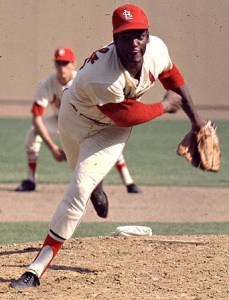
Bob Gibson, whose talismanic 1.12 ERA may remain the best-remembered element of 1968’s Year of the Pitcher. But . . .

When Hall of Fame pitcher Bob Gibson lost his battle with pancreatic cancer at 84 last Friday night, two things above all seemed looming large over any retrospective of the St. Louis Cardinals marksman who was just as good a man as a pitcher. Even above his striking overall World Series performance record.

Thing One: Gibson’s still somewhat exaggerated image as an intimidator. So much so that a friend hailed me aboard a social media platform to remember Gibson saying he’d knock his own grandmother down if she dared to challenge him. It took me a short while to convince him Gibson never said that about his grandmother or any other relative.

For the record, Hall of Famer Henry Aaron plagiarised Hall of Fame pitcher Early Wynn to say Gibson would knock his grandma down, and Aaron mis-plagiarised Wynn about the challenge part. Wynn had actually said he’d knock Grandma down if she dug in against him. Apple sauce and orange chicken.

The closest Gibson ever came to admitting he insisted upon going one-up on family members is when he admitted, a little puckishly, when asked if competitiveness was his more-or-less lifelong companion, “I guess you could say so. I’ve played a couple of hundred games of tic-tac-toe with my little daughter, and she hasn’t beaten me yet. I’ve always had to win. I’ve got to win.”

Which leads to Thing Two, since Gibson revealed his tic-tac-toe conquering during the same year’s World Series: 1.12. That was Gibson’s earned run average in 1968. A number at least as talismanic for baseball fans ancient and modern as have been numbers such as 60, 61, 511, 714, 755, 2,130, and 5,714.

To this day you can meet people who think 1.12 was the reason, maybe the only reason, or the reason first above lesser challengers, why the Year of the Pitcher freaked the Show’s government enough to deliver a couple of rules changes after 1968 that were just as significant as the change that made the damn season almost necessary in the first place.

Hall of Fame writer Roger Angell, who admires and loves top-of-the-line pitching as deeply as he does top-of-the-line hitting and defense, observed in an October 1968 essay (“A Little Noise at Twilight“) that, by mid-July 1968, “it was plain to even the most inattentive or optimistic fans that something had gone wrong with their game.”

Why were the pitchers so good? Where were the .320 hitters? What had happened to the high-scoring slugfest, the late rally, the bases-clearing double? The answers to these questions are difficult and speculative, but some attempt must be made at them before we proceed to the releasing but somewhat irrelevant pleasures of the World Series. To begin with: Yes, the pitchers are better—or, rather, pitching is better. All the technical and strategic innovation of recent years have helped the defenses of baseball; none have favoured the batter. Bigger ballparks with bigger outfields, the infielders’ enormous crab-claw gloves, more night games, the mastery of the relatively new slider pitch, the persistence of the relatively illegal spitter, and the instantaneous managerial finger-wag to the bullpen at the first hint of an enemy rally have all tipped the balance of this delicately balanced game.

Gibson didn’t need the Year of the Pitcher to prove his greatness or make himself a Hall of Famer. He’d established that in a gradual buildup from his first major league gigs in 1959 forward, including and especially during two previous World Series. (1964, 1967.) His ERA over those nine seasons was 3.12; his fielding-independent pitching, 3.10. Among his fellow righthanded pitchers across those seasons, only Hall of Famer Juan Marichal (2.67 ERA; 3.00 FIP) was better.

Gibson pitched seven more seasons after 1968. His ERA over those seven: 3.01; his FIP over the seven: 2.87. You could look at his FIP and argue he was a slightly better pitcher than he’d been before 1968, and that’s without getting another chance to pitch in the postseason before his 1975 retirement.

Let’s look at some of Gibson’s other critical measurements, various key pitching averages, comparing his pre-1968 seasons and his post-1968 seasons:

Averages Sho BB K WHIP H/9 HR/9 BB.9 K/9 K/BB
1959-1967 3 78 176 1.22 7.6 0.7 3.3 7.5 2.25
1968 13 62 268 0.85 5.8 0.3 1.8 7.9 4.32
1969-75 3 81 181 1.22 7.9 0.5 3.1 6.8 2.22

Gibson himself rejected the idea, though not impolitely, but even he had to know that even the greatest of the great have had fluke seasons, outlying seasons. (One-time teammate and fellow Hall of Famer Steve Carlton had one in 1972, to name one.) His 1968 is a no-questions-asked outlier, if not a flat-out fluke. His 1967 ERA  was 2.98, and that’s despite being rudely interrupted by Hall of Famer Roberto Clemente’s liner breaking his leg that July. Any pitcher’s ERA dropping 1.86 below the previous season’s mark, which is exactly what Gibson’s 1968 ERA did, is a drop comparable to the poor soul who falls from the apex of the Gateway Arch.

And, whether his most stubborn partisans like it or not, Gibson had only too much help both making the Year of the Pitcher and inspiring subsequent rules changes.

You probably remember some of that help better than others. Maybe the help you remember best is Denny McLain, the gifted but self-destructive Detroit Tigers pitcher, credited with 31 wins—the first pitcher to cross the 30 threshold since Hall of Famer Dizzy Dean in 1934, the 31 equaling Lefty Grove’s 31 in 1931.

Those still foolish enough to think those 31 wins (when you get four-plus runs support to work with while you’re on the mound you’d better win thirty-one games) mean McLain was better than Gibson that year (because, wins!), think again:

  Sho BB K WHIP H/9 HR/9 BB.9 K/9 K/BB
McLain ‘68 6 63 280 0.91 6.5 0.8 1.7 7.5 4.44
Gibson ‘68 13 62 268 0.85 5.8 0.3 1.8 7.9 4.32

Maybe the help you remember second best is another Hall of Famer, Don Drysdale, breaking Walter Johnson’s 55-year-old mark by pitching 58.1 scoreless innings across six complete-game shutouts. Maybe the help you remember third best is yet another Hall of Famer, Carl Yastrzemski, delivering the lowest-ever average (.3005, rounded to .301) for any league batting champion.

Now, here’s some of Gibson’s Year of the Pitcher help that you may not remember quite so well. Such help as:

* The entire Show posting a 2.98 ERA and FIP.

* The American League slugging .339—the lowest in the league since 1915.

* Gibson’s Cardinals pitching 30 shutouts, followed in order by the Mets (25), the Indians (23), the Los Angeles Dodgers (23), and the Giants (20.)

* The whole Show’s combined .237 batting average was the lowest in major league history to that point and lower than the .240 team average of the 1962 Mets. The American League’s .230 remains the lowest league batting average in history.

* Luis Tiant, the Cleveland Indians’ righthander, posting a 1.68 ERA and a 2.04 FIP, both of which led the American League. (McLain’s FIP: 2.53, the lowest of his career by very far.)

* Jerry Koosman, rookie New York Mets lefthander, pitching seven shutouts. (He lost the Rookie of the Year award to Hall of Famer Johnny Bench, a year after the late Hall of Famer Tom Seaver won the award.)

* Ray Washburn (journeyman St. Louis Cardinals pitcher) and Hall of Famer Gaylord Perry (San Francisco Giants) pitching no-hitters on consecutive days, against each other’s teams, in Candlestick Park.

* Everything else meaning nobody sat up bolt upright in amazement when Hall of Famer Catfish Hunter—who managed somehow to avoid posting a sub-3.00 ERA and FIP—pitched a perfect game against the Minnesota Twins in early May. (It probably didn’t help that, in his next start, the Twins battered him for eight earned runs on eight hits and five walks.)

“The 1968 season has been named the Year of the Pitcher,” Angell wrote earlier in his essay, “which is only a kinder way of saying the Year of the Infield Pop-Up. The final records only confirm what so many fans, homeward bound after still another shutout, had already discovered for themselves; almost no one, it seemed, could hit the damn ball anymore.”

You’ll note Angell wrote “almost”: three teams—the Cincinnati Reds (.273), the Atlanta Braves (.252), and the Pittsburgh Pirates (also .252)—managed to hit .250 or better as teams. Gibson’s Cardinals hit .249 collectively; McLain’s Tigers hit two points below the Show average. The worst hitting team in the Show, further evidence of their sad post-1964 Lost Decade, was the New York Yankees—the Bronx Bombers disarmed to Bronx Busts—and their team .214 average.

The two 1968 World Series combatants, the Cardinals and the Tigers, batted .242 between them in a season that wasn’t just the Year of the Pitcher but one in which the last pre-divisional play pennant races were all but decided by the middle of July. Old-school fans probably throve on the idea of a World Series matching a pair of old-time franchises who’d previously played a thriller of a 1934 Series that ended in a trash riot (over Cardinals outfielder Joe Medwick) and a Cardinals triumph.

But the Tigers pitched nineteen shutouts to the Cardinals’ staggering 30 going in—and hung on to beat the Cardinals in seven games only three of which could be called thrillers. Three others were no-questions-asked blowouts, with Gibson and the Tigers’ eventual World Series MVP Mickey Lolich benefiting from one blowout apiece.

McLain himself pitched six shutouts but Lolich—the portly lefthander who lived on a mix of off-speed pitches and a sinkerball that got deadlier as he tired by late innings—pitched four, including three down the stretch after he was restored to the Tigers’ starting rotation in late August. Gibson, though, accounted for almost half his team’s shutouts with thirteen. He’d also pitch the Series’ lone shutout, the Game One in which he broke Hall of Famer Sandy Koufax’s record for strikeouts in a single Series game.

The ’68 Series is also remembered for the two phenomenally-anticipated pitching matchups between Gibson and McLain that turned into mismatches with McLain coming out on the short end. Well, only one of the pair was a real mismatch: Game Four, the Cardinals battering McLain for four runs (three earned) in two and two-thirds, two more runs by Joe Sparma in a third of an inning, then prying John Hiller without an out in the eighth, including Hall of Famer Lou Brock’s three-run double.

That kind of run support must have staggered Gibson, who’d enjoyed 2.8 runs of support while he was in the game during his regular-season starts.

It’s so simple even now to think that when push came to shove Gibson simply out-classed McLain and McLain was exposed as a paper Tiger, but there was a backstory to it: McLain was pitching with shoulder trouble that began when he felt a pop in a 1965 start. And, by 1967-68, McLain was taking copious cortisone shots to pitch with that shoulder. Should you really be shocked, after all, that after another full-out 1969 (and a second straight American League Cy Young Award) McLain’s career took a nose-dive into Lake Michigan?

Some may remember, years after he retired, McLain fuming, “The name of the game back then was you gotta win one for the Gipper. [Fornicate] the Gipper!” He wasn’t referring to Ronald Reagan, either. “McLain’s bitterness was well earned,” wrote Sridhar Pappu in The Year of the Pitcher: Bob Gibson, Denny McLain, and the End of Baseball’s Golden Age. (2017.)

Those cortisone shots would cost him his major league career. The myth that baseball players were tougher and more resilient back in the day, that they were willing to endure anything for the sheer love of the game, is just that—a myth. In truth, they were victims of terrible medical advice, merciless management, and unforgiving fans who believed that a worn-out, hurting arm signaled a kind of moral weakness.

Excessive cortisone administration doesn’t just cause the kind of visual issues that can result in blindness such as afflicts former Mets/Senators/Tigers pitcher Bill Denehy (who joined the Tigers the season after McLain’s departure), who received a multitude of such shots after a shoulder injury in his rookie 1967. Citing pitcher Mike Marshall (reliever in 37 games for the 1967 Tigers; eventual 1974 Cy Young winner who earned a subsequent doctorate in exercise physiology), Pappu wrote ominously:

Marshall even then understood what cortisone is: not a cure-all for pain, but a corrosive that softens the bone and weakens the ligaments. [Marshall] could see McLain growing addicted to it. Despite what doctors might have said, cortisone was more of an analgesic than a curative treatment. And, ultimately, it would destroy McLain’s career.

McLain was reckless, a self-destructive self-promoter, most likely due to the early death of a father who yearned for his son to escape the hard paycheck-to-paycheck labourer’s life and taught that yearning with ferocious, excessive beatings. (Bob Gibson never knew his father, who died three months before he was born, but his older siblings and mother taught him with firm but loving hearts.)  Whatever else you’ve read about McLain’s worst, the real cause of his baseball death was his shoulder trouble and his excess dependence on cortisone.

Removing the 1968 World Series from the equation, the question before the house is the same which the political humourist P.J. O’Rourke attached to his book about the 2016 presidential election as a title: How the hell did this happen? Well, this is how the hell the Year of the Pitcher happened:

Hint: Sandy Koufax won the first of his record three MLB Cy Young Awards (it became an each-league prize after Koufax retired) and beat the Yankees twice in that World Series, including the Game One in which he set the strikeout record Gibson broke.

From 1950-1962, the strike zone was between the batters’ arm pits and his knees, however they stood at the plate, whether crouching little pests like Hall of Famers Luis Aparicio and Nellie Fox, or more upright demolition experts like Hall of Famers Mickey Mantle and Willie Mays. Then the Baseball Rules Committee decided the hitters were having too much fun and the pitchers needed a reasonable break.

So, in 1963, they expanded the strike zone, from the top of the batters’ shoulders to the bottoms of their knees. Oops.

That Rules Committee “apparently thought they were, in taking this action, returning the strike zone to what it had been prior to 1950; that, at least, is what they announced at the time,” wrote Bill James in The New Historical Baseball Abstract. “They overshot the mark just a little; the definition used prior to 1950 was from the player’s knees to his shoulders; the new definition said from the bottom of the knees to the shoulders.”

The effect of this redefinition was dramatic. The action was taken, quietly, because there was a feeling that runs (and in particular home runs) had become too cheap. Roger Maris’s breaking Babe Ruth’s single-season home run record contributed to that feeling. The thinking was that, by giving the pitchers a few inches at the top and bottom of the strike zone, they could whittle the offense down just a little bit.

Denny McLain, at the painful height of his career.

Baseball observers and analysts of the 1960s, bless them, didn’t stop to think that, yes, Roger Maris, a compact but muscular lefthanded pull hitter who hit booming high line drives instead of parabolic bombs, did have a delicious short porch at which to aim in Yankee Stadium . . . but he hit one less home run at home in 1961 than he did on the road. And, that five out of Maris’s nine road ballparks were rated pitchers’ parks that year.

James also argued, like Angell, that the ballparks themselves contributed to a game weighted to pitching by the 1960s as a whole and 1968 in particular: every ballpark change between 1930 and 1968 took hits out of the leagues with increasing volume of foul territory. Nor did anyone in either league or from the commissioner’s offices bothered checking height or slope of pitching mounds visibly higher than the rules allowed.

There was also the nocturnal factor. Night ball continued growing. In elementary terms, you tell me how simple it might be to swing on and connect with a 95 mph-plus fastball. You tell me if you’d like to face Bob Gibson, Sandy Koufax, or Nolan Ryan—or even Juan Marichal with that multiple array of windups and leg kicks—in the dead of night no matter how well lit the ballpark might be.

This is the total of night games played in each season from 1963, when the new pitcher-delicious strike zone took effect, through the end of the Year of the Pitcher:

Season Day Games Night Games +/- Night ERA
1963 4,209 3,837 -372 3.46
1964 4,326 4,055 -271 3.58
1965 4,402 4,197 -205 3.50
1966 4,120 4,385 +265 3.52
1967 3,986 4,442 +456 3.31
1968 3,731 4,309 +576 2.98

The Show played 576 more night than day games in 1968, compared to 456 more night than day in 1967 and 73 more night than day games in 1966. Baseball also played 204 more night games in 1968 than 1963. More to the point: marry that -0.33 drop in the Show’s ERA from 1967 to 1968 to that still-expanded strike zone.

Even allowing the gradual pre-1967 adjustments to night ball and the 3.53 ERA from 1964-66, now should it have been that much of a shock that the season would come in which the pitchers had that tight a grip on the game?

Gibson pitched 23 of his 34 1968 starts at night and threw nine of his thirteen shutouts at night. McLain also pitched 23 night games out of 41 starts in 1968, and he threw five of his six shutouts at night. Tiant, the American League’s ERA/FIP champion, also led the league with nine shutouts. Like Gibson, El Tiante started 34 games in ’68. He started sixteen night games and threw three of his nine shutouts at night. But he also pitched in maybe the most cavernous of the trio’s home ballparks, Cleveland’s Municipal Stadium. (The Mistake on the Lake.)

Let’s look further at 1968’s major league shutout leaders:

Pitcher ’68 Starts ’68 Sho Sho-night Sho-day Sho%
Bob Gibson 34 13 9 4 38
Luis Tiant 32 9 3 6 28
Don Drysdale 31 8 4 4 26
Jerry Koosman 34 7 4 3 21
Steve Blass 31 7 5 2 23
Ray Culp 30 6 5 1 20
Ray Sadecki 36 6 2 4 17
Mel Stottlemyre 36 6 3 3 17
Jim Nash 33 6 2 4 18
Dean Chance 39 6 4 2 15
Bill Singer 36 6 3 3 17
Denny McLain 41 6 5 1 15

(While I was looking them up, I noticed that if the 1968 Boston Red Sox were smarter, or at least less afraid of vampires, they’d have pitched Ray Culp strictly at night. Culp had a 1.91 ERA after dark but a whopping 4.02 ERA in broad daylight.)

Notice that six of those pitchers had twenty percent or better of their starts result in shutouts; four threw more shutouts at night than in daylight; and, that two—Denny McLain and Ray Culp—threw all but one of their shutouts at night. But if you broaden the cut, and look at all 339 of the Show’s 1968 shutouts, 163 were pitched at night—48 percent. Nearly half the shutouts in 1968 were pitched at night.

That was in a season during which 1,404 games had two runs or less and the Show ERA for those games was 2.99; 1,224 had between 3-5 runs, with an ERA of 2.86; and, a mere 622 featured six or more runs, with a 3.17 ERA. Strangely enough, in 1967 the percentage of shutouts thrown at night was 52 percent—but there were also 113 fewer shutouts (226 total) thrown.

However you care to slice and dice it, the pitcher’s parks coming online between the 1950s and the 1960s, the 1963 strike zone expansion, and the non-existent enforcement of uniform and reasonable mound heights, made it perhaps inevitable that the decade wouldn’t end before such an outlying, fluky season as the Year of the Pitcher was played.

Starting in 1969, the mounds were required to be no higher than ten inches and the requirement was enforced strictly. Also for the first time, ever, the Show’s government mandated protection for the hitters’ visual backgrounds, which until then were dominated by bleachers, center field wall advertisements, or both. Finally, as James’s Abstract reminds us, several teams either moved in the fences or moved home plate out toward the fences.

The official strike zone got re-shrunk, too. Back to its pre-1963 dimensions.

Strangely enough, the Year of the Pitcher’s five no-hitters (Cincinnati’s George Culver and Baltimore’s Tom Phoebus also pitched 1968 no-nos) weren’t the most in any major league season. There were six in 1915 (including Hall of Famer Rube Marquard) and 1917 (including eventual Black Sox confessor Eddie Cicotte and the legendary Babe Ruth-to-Ernie Shore game). There would be seven in 1990.

The five no-nos were just about the only way 1968 wasn’t an outlier: in 1969, after the re-shrunk strike zone and shaved-down pitcher’s mounds, five no-hitters were also pitched—by Hall of Famer Jim Palmer, plus Ken Holtzman, Jim Maloney*, Bob Moose, Bill Stoneman, and Don Wilson.

McLain’s shoulder-compromised demise began in 1970. Even before he was suspended for the season for carrying a gun on a Tigers team flight, his ERA in fourteen starts was 4.63 and his FIP was 5.22. In a miserable 1971 with the Washington Senators, he was not only hung with 22 losses to lead the entire Show, his ERA was 4.28 even if his FIP came down to 4.40. But after a ghastly 6.37 ERA and 5.43 FIP in 1972 (twenty games, thirteen starts, with Oakland and Atlanta), McLain’s career was over.

Gibson was more fortunate. He had seven seasons to pitch following 1969, with a few highs, no more postseasons, and the advent of arthritis and knee trouble. He thought of retiring after 1974, but the end of his first marriage compelled him to pitch 1975, partially to cope and partially because he needed the money.  But after he surrendered a grand slam to Chicago Cubs spare-part spaghetti bat Pete LaCock, Gibson retired.

Don Drysdale, who’d already had long-term knee and shoulder issues (Koufax once told a reporter privately Drysdale would have retired if he could have in 1966), proved not long for baseball’s world, too. In early 1969, however, his load finish its final toll, too—his rotator cuff vaporised. With no surgery then available to repair it, Drysdale’s career was history, too.

The Tigers finally won the World Series, with a lot of help from Lolich’s career week and no little help from Curt Flood’s sad mishap in the top of the seventh, the great center fielder losing Jim Northrup’s high liner in the sun for just long enough to reverse on a dime and kick up some grass while the ball out-raced him to the fence for a two-run, scoreless tie-breaking triple.

Perhaps remarkably, considering the season it ended, the Tigers posted a .718 Series OPS with 56 hits, eight home runs, and fifteen total extra base hits. “It was still the Year of the Pitcher,” Angell concluded, “right to the last, but the Tiger hitters had restored the life and noise that seemed to go out of baseball this year.”

————————————————-

* Jim Maloney, like McLain, suffered long-term shoulder trouble but with even less understanding from his team than McLain incurred.
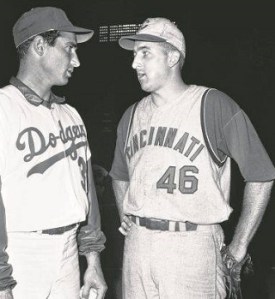
Jim Maloney (right) confabs with Hall of Famer Sandy Koufax.

In 1969, Jim Maloney was pitching for the Reds and losing his war against constant, searing pain. He still had enough to pitch a no-hitter against the Astros, but in the process he hurt his arm just at a time when the team that would come to dominate the next decade really needed him. When pitching in another start against the Mets, he simply didn’t have it in him to go on. He ached so much that he had the gall to ask his manager, Dave Bristol, to take him out of the game. An enraged Bristol—soon to be replaced by Hall of Fame manager [Sparky] Anderson—called a meeting with his pitchers and told them that he wouldn’t accept pain as an excuse, that they simply had to play through it.

“Listen, if a guy’s arm is sore he wouldn’t even be able to throw the ball,” Bristol said. “Right? If he can throw it up to the plate and get somebody out, then it can’t be that sore, so he’s gotta stay in there.”

—Sridhar Pappu, in The Year of the Pitcher.

Once one of the National League’s premier power pitchers—with Hall of Famer Sandy Koufax, he co-led the Show with five shutouts in 1966, and had a 2.70 ERA and 2.68 FIP from 1963-66—Maloney suffered especially under a tragic change in regime.

His first major league manager, Fred Hutchinson, himself a former pitcher, once lifted Maloney while the righthander had a no-hitter going against Koufax, of all people—when Maloney suffered a muscle strain in his arm. “When a fellow has an arm like that,” Hutch told the press, “you just don’t take chances.” That’s one up for Uncle Fred!

But when Hutchinson’s cancer took him out late in the 1964 season, successor managers Dick Sisler and Dave Bristol weren’t so careful with Maloney. By 1967 at least, he, too, was taking numerous cortisone shots. In time, Maloney would have a contentious relationship with teammates, fans, and the press, inflamed by then-Reds GM Bob Howsam questioning his injuries and his commitment.

Ironically, it was a baserunning injury—a torn Achilles tendon in 1970—that put paid to Maloney’s career for all intent and purpose. His last thirteen major league games were as a worn-down, ineffective spot reliever for the 1971 California Angels. After baseball, he worked for his father’s car dealership before his first marriage collapsed as he fought a battle with the bottle.

Maloney sobered up, re-married happily, and became his native Fresno’s director for its Alcoholism and Drug Abuse Council until his retirement.

Bob Gibson, RIP: Disabusing prejudice and pretense

Bob Gibson gets the better of fellow Hall of Famer Al Kaline during the 1968 World Series.

How terrible is this? Bad enough for the St. Louis Cardinals that were sent home for the winter by the San Diego Padres Friday night, when  former Cardinal Trevor Rosenthal struck out the side all called in the top of the ninth Friday night.

Worse: The greatest pitcher in Cardinals history lost his battle with pancreatic cancer at 84 concurrently, on the anniversary of setting a record striking out seventeen Detroit Tigers in Game One of the 1968 World Series. Losing a Bob Gibson who was at least as good a man as he was a pitcher on such an anniversary stings even deeper.

Calling Gibson a tenacious, relentless, intimidating competitor on the mound is probably the first way he’s remembered, complete with the gags and exaggerations that have long since been both cliche and deceptive. Remembering that he was an intelligent man who was his own kind of sensitive and suffered fools no more happily than plate-crowding batters should be equal.

We remember the peculiar elegance of Gibson on the mound even past the severity of his otherwise handsome face as he began a pitch. It only began with the full back-swing of his long arms starting his windup and the leg kick that bent and lifted his knee even with the lettering on the front of his uniform.

There was that half turn that showed half his number 45 on his back, the slight incline of his body as he actually began to throw, then, especially, that whip-like arm movement down and across his body, glove arm extending up behind his shoulder like an eagle’s wing in flight.

There were his legs looking a split second as though they’d give way until he swung his right leg over and across his left, almost in a football punter’s kick, landing to keep him from sprawling to the ground as he finished his delivery in three steps but still keeping him erect enough to field a ball batted back toward the mound if need be.

Like his fellow Hall of Famers and contemporaries Sandy Koufax and Juan Marichal, you could remove Gibson’s uniform and still identify him immediately, even from the highest seat in the park. A notoriously swift worker on the mound, Gibson at full delivery speed often seemed like an armada of men aiming to paralyse hitters and a solitary man rushing to catch the last train before he’d be late for work.

“Bob Gibson pitches,” Vin Scully once said of him, “as though he’s double-parked.”

Said his longtime Cardinals catcher and life-long friend Tim McCarver, who learned how to tease for positive effect from men like Gibson himself, “Bob Gibson is the luckiest pitcher in baseball. He’s always pitching when the other team doesn’t score any runs.”

That’s only a slight exaggeration. Gibson did pitch 53 lifetime shutouts in 482 lifetime starts, and he did lead the National League three times including with thirteen during his out-of-the-box 1968, the year of his spectacular 1.12 earned run average. In the Year of the Pitcher, that was both a staggering achievement and only somewhat flukish. (His lifetime ERA pre-1968: 3.12, His lifetime ERA post-1968: 3.01.)

“You can’t say it was flukish, although some people have said that,” Gibson told Hall of Fame writer Roger Angell, during Angell’s visit to his home outside Omaha that produced a remarkable 1980 New Yorker profile. (It’s been republished twice, in Late Innings and Game Time.) “Just say it was totally unusual. Everything I threw that year seemed to go where I wanted it. Everything was down, all year.”

Baseball imposed a few rule changes including a lower mound after that Year of the Pitcher. “The next year,” Gibson admitted, “was a terrific struggle. I had a good season, but I never worked so hard in my life, because so many of my breaking pitches were up. I’ll never know, but I doubt seriously I’d have had another 1.12 ERA, even if they’d left the mound where it was. I’d like to think I’d really perfected my pitching to that point, but I’ll never know.”

Off the mound, Gibson was both a gentle, friendly needler on the days he didn’t pitch and a self-aware man who found some of the gentlest and wittiest ways of deflating racial prejudice when it confronted him directly or made itself manifest in his presence.

“In a world filled with hate, prejudice, and protest, I find that I too am filled with hate, prejudice, and protest,” he wrote in his memoir, Stranger to the Game. He chose to fight it on human terms and not on the terms of the rioter, the vandal, or the vigilante. Coming to the Cardinals as they were still feeling racial growing pains as the 1950s crossed into the 1960s, Gibson and his fellow black teammates chose to tease and teach at once, not inflame.

McCarver, the son of a Memphis police officer, once got a very solid taste of such teaching, as described in David Halberstam’s October 1964. “Hey, Timmy,” Gibson hailed, “do you know how a white boy shakes hands with a Negro?” When McCarver said no, Gibson drew in Curt Flood as his straight man, played the role of the white boy, then shook hands with Flood—and immediately looked at his hand a moment before wiping it on his pants.

“You’ve done it before, haven’t you, Tim?” Gibson asked. McCarver thought twice and realised Gibson was right, and admitted as much. That routine and other subtleties were Gibson’s ways of encouraging whites willing to know him as a man to be better friends as well as teammates. “For him,” Halberstam wrote, “friendship was based not just on ability, it was based on what kind of a man a teammate was; how he treated others, what he really believed in.”

He also knew how to disabuse fans of their pretenses. Asked once why he disdained the idea of himself or any baseball player as a role model to a fan’s son, Gibson answered the inquiring father, “Why do I have to be an example for your kid? You be an example for your own kid.”

Gibson gave Angell another, more telling take on such disabuses. Fans, he told Angell, “always know so much, to hear them tell it, and they always think baseball is so easy.”

You hear them say, “Oh, I was a pretty good ballplayer myself back when I was in school, but I got this injury . . . ” Some cab driver gave me that one day, and I said, “Oh, really? That’s funny, because when I was young I really wanted to be a cab driver, only I had this little problem with my eyes, so I never made it.” He thought I was serious. It went right over his head.

It was remarkable in its own right that Gibson could use an eyesight problem in a joke aimed at deflating an annoying fan. Considering his fatherless boyhood of too much illness too often—rickets, pneumonia, bronchitis, asthma (one of Gibson’s few known commercial product endorsements was for Primatene Mist)—the wonder may be that he lived to pitch his way into the Hall of Fame at all, never mind life as full a life as he lived until pancreatic cancer struck him in 2019.

“Bob Gibson is a nice man, but he’s quiet,” McCarver told Angell for that 1980 profile, “Distance.”

He doesn’t enjoy small talk. He doesn’t like to waste his time with anything that’s weak or offhand. He wants to deal from strength all the time . . . He’s very proud, you know, and he had a ghetto upbringing, so you could understand why he was so sensitive to bigotry . . . Any relationship you get into with Bob is going to be intense. He’s a strong man with strong feelings.

Bob Gibson and his wife, Wendy, at the unveiling of a statue honouring Gibson in his native Omaha.

Gibson retired to his native Omaha, where he helped start a successful bank that did most of its business in Omaha’s black community but was governed on his impetus by an inter-racial board of directors. He also opened a successful restaurant (Gibby’s) near his alma mater, Creighton University, which hired inter-racial workers and managers.

His enduring—and very exaggerated—image as a hard-throwing kind of baseball samurai who treated the game as total warfare was belied when Angell asked him about late-career changes to his approach. “Pitching,” Gibson replied, “is about ninety per cent thinking.”

I threw hard when I was younger, but I didn’t know how to get people out. I don’t care how hard you throw, somebody’s going to hit it if you don’t think out there. It’s not all that detailed—you don’t think three or four pitches ahead. But one pitch might set up the next two you throw—it depends on what the guy does with it. You know. If he misses a fastball by a foot, then he’ll see another one. If he fouls it off or just misses it, he’ll probably get a breaking ball next. It isn’t exactly scientific, or anything.

Still, Gibson’s image as an executioner has never really dispelled. In the hour after his death, a social media friend of mine referenced what he thought was Gibson once having said he’d knock his own grandmother down at the plate. Hall of Famer Henry Aaron actually said Gibson would do just that. Another Hall of Fame pitcher, Early Wynn, once did say, unapologetically, that he would do just that.

Gibson might talk about batters he’d knocked down and why. He also once admitted his competitive spirit included making sure his daughters as little children could still never beat Daddy playing tic-tac-toe. But never even in jest did he suggest he’d knock one of his children, one of his wives (his first marriage produced two of his daughters; his second marriage produced his third and endured until his death), his mother, his grandmother, or any other relation.

Angell once called Gibson a compulsive truth teller. Such a man would understand the one-time lament of one-time Hell’s Angels president Sonny Barger about their histrionic press coverage in the 1960s: “All that bullshit, hell, ain’t the truth bad enough for ’em?”

I finally lost my own patience with the exaggerations when I saw a forum entry insisting flatly that anyone hitting a home run off Gibson (he surrendered 257 lifetime and averaged surrendering 17 a year) was guaranteed to take one in the ribs, the back, the shoulder, or any other extremity Gibson could reach.

Aside from having seen Gibson pitch often enough when I was growing up to know how exaggerated the image was, it was very much like a trans-decade version of the classic party telephone game—where you whisper something to the person next to you and, by the time it comes back to you from around the circle of friends, it’s nowhere near what you said in the first place.

So I looked it up. In a seventeen-season career, Bob Gibson only ever hit one batter the absolute next time up after he hit one out off him—Hall of Famer Duke Snider, in April 1961. More to the point: Thirty-six times in 528 major league games, Gibson surrendered at least one home run and hit at least one batter in the same game, and only three times was it the same batter who hit one out against him. He also retired with 102 lifetime hit batsmen. Placing him at number 85 on the all-time plunk list.

For the record, the three bombers who got drilled after homering off Gibson—not their next times up but in much later plate appearances in those same games—were Willie Crawford, Ron Fairly, and Hall of Famer Willie Stargell. He also surrendered home runs after hitting batters with pitches in . . . fourteen games lifetime.

If Gibson was trying to hit batters after they dialed nine on his dime, he failed miserably. He was unapologetic about pitching inside and insisted that if a plate crowder got hit inside it was his fault for over-crowding the plate, but he wasn’t exactly trying to drill holes in home run hitters’ bodies or heads. And this was a pitcher with outstanding control of a whistling fastball and a nasty, knee-trembling slider.

As a matter of fact, Gibson hit only two men with pitches more than four times—both light-hitting middle infielders, Ron Hunt and Roy McMillan. In fact, McMillan’s sixth came in a 1965 game, when his career as a fine defensive shortstop was winding down with the New YOrk Mets . . . and Gibson got plunked by Jackson when he batted in the top of the fifth. All things considered, you wouldn’t blame McMillan if he said he wanted to have Jackson’s children right then and there.

Gibson once spent a few seasons working as a pitching coach for another friend and former teammate, Joe Torre, now a Hall of Fame manager but then managing the then-hapless Mets and Atlanta Braves. That didn’t last; he found it difficult to connect with a new generation of pitchers with fat contracts and little else beyond just throwing hard without thinking. His post-baseball business success didn’t satisfy him half as much as playing baseball did.

“Yes,” his second wife, Wendy, told Angell in 1980, “he’s still looking for something, and don’t know if the right thing for him will ever come along. It’s sad.” Told of that observation, Gibson denied sadness.

I just think I’ve been spoiled. When you’ve been an athlete, there’s no place for you to go. You’re much harder to please. But where I am right now is where the average person has been all along. I’m like millions of others now, and I’m finding out what it’s like. I don’t think the ordinary person ever gets to do anything they enjoy nearly as much as I enjoyed playing ball. I haven’t found my niche now that that’s over—or maybe I have found it and I don’t know it. Maybe I’ll still find something I like as much as I liked pitching, but I don’t know if I will. I sure hope so.

I never had the impression Gibson was a spoiled man. I saw him on the mound and, whenever he re-appeared on the public radar, as that perhaps too self-aware man who asked for few things more than that you engage him as a man, that you not insult him by admiring the pitcher while disdaining the man, because of his colour or otherwise, and that you be as straight, no chaser with him as he’d be with you, even teasing you to teach you.

It’s enough to make me wish I’d gone to Gibby’s one night, while I lived in Omaha during my Air Force service, and met the man first and the former pitcher second. I would have liked and respected him without seeing him one more time on the mound, the retired assassin who wore a chain around his neck with a gently bejeweled number 45, the man who mingled around his integrated business and crowds with firm ease.

The man who was wary of the duplicities of the sports press yet was so pleased by Roger Angell’s revelatory profile that he sent Angell a photograph that he inscribed, “The world needs more people like you.”

The Elysian Fields now have Gibson, and the Lord’s angels now end his suffering, grant him eternal peace, and reunite him with such favourite teammates as Lou Brock and Curt Flood, and such favourite managers as Johnny Keane and Red Schoendienst. They also remind us how blessed we were to have had him as long as we did, though it doesn’t make our loss any less profound and sad.