The pastor and the pension problem

Tom Johnson, in Twins jersey and a 1977 Twins cap, at GoodSports Slovakia, a program teaching and ministering Slovakian youth in baseball and in spirit. (GoodSports photo.)

In 1980, righthanded relief pitcher Tom Johnson—former Minnesota Twin, credited with sixteen relief wins in 1977; struggling with shoulder trouble in 1978; missing 1979 rehabbing from rotator cuff surgery—had reason to believe his career would still have a second act. He was signed by the Chicago White Sox during Bill Veeck’s second ownership of the team.

After five seasons as a Twin, Johnson pitched in the White Sox organisation in 1980. The same year, major league owners and the Major League Baseball Players Association re-aligned the player pension program. Johnson had every reason to applaud—at first.

The new plan vested players for pensions after 43 days’ major league service time and for health benefits after one day. Johnson believed he would come back strongly enough to pitch for the White Sox.

“When I initially heard they had made the decision to make the change, I was very excited,” Johnson said during a telephone interview a few days ago. “I wasn’t paying a ton of attention to it because I was in the midst of trying to come back from surgery. So I had my eyes focused on getting back to the major leagues, and I had every reason to believe I was going to do that.”

But in January 1981, saying he couldn’t afford to operate in the full free agency era any longer, Veeck sold the White Sox to Jerry Reinsdorf and his minority partner Eddie Einhorn.

The new owner didn’t offer Johnson a new pitching deal, but they did offer him a gig as a roving minor league pitching coach. His pitching career was over—and he was now going to be without a baseball pension to look forward to. The 1980 re-alignment omitted short-career players who played between 1949 and 1980.

“When I heard that the [pension] change had taken place,” he told me, “I was excited, because in the past all improvements to the pension plan had been retroactive. So I had every reason to believe, until I found out otherwise, that that would include me.

“I was looking forward to the new system and having a pension, only to find out this was one of the few times in which it was not retroactive,” Johnson continued. “That came later. The disappointment compounded itself when I realised I wasn’t going to make it back, my shoulder wasn’t responding the way I hoped.”

Johnson today is one of 618 still-living, pension-less, pre-1980 short-career players. Their only redress since has been the plan devised in 2011 by then-commissioner Bud Selig and then-MLBPA executive director Michael Weiner—giving them $625 a quarter for every 43 days major league service time, up to four years. It was a start, but should they pass away before collecting the entire dollars due, those dollars can’t be passed to their families.

“That’s kind of a hard one to take,” Johnson said. “It’s like, that would be such a small thing but a good thing for us and give us some comfort in knowing that this small payment we get once a year is going to pass on [to our families].” Johnson told me that, after taxes, he gets $5,800 per year under the Selig-Weiner adjustment.

Weiner died of brain cancer two years after he and Selig struck that deal. Neither the players union nor the owners have sought to revisit the pension issue for the pre-1980 short-timers since. Asked why not, Johnson says he doesn’t know. “I have no idea, other than that people just don’t want to be bothered,” he said. “It doesn’t make sense.”

He thinks that if the issue ever has arisen in negotiations between the owners and the union since, it’s taken off the table very early if it got there at all. “Probably the reason that it hasn’t gone forward is that there hasn’t been a strong advocate in the system that believes changes are needed,” he said.

Tom Johnson, on the mound for the Twins during his career year 1977. (Twins Daily photo.)

The pre-1890 short-timers have had varying lives since leaving baseball. Johnson became a full-time minister later in the 1980s. Active in the Fellowship of Christian Athletes during his playing days, he’s also worked for GoodSports Slovakia, a program that ministers and teaches baseball to Slovakian youth, since 1995. He’s been its president since 2006; he and his wife, Deb, lived in Slovakia full-time promoting baseball from 2005-2017.

When not supervising and making sure GoodSports staffers are paid on time—a task made arduous thanks to the coronavirus pandemic—Johnson wants to see the pension plan redressed on behalf of his fellow 1949-1980 short-career players.

Like several other affected short-career players, Johnson believes Marvin Miller—the longtime players union leader who was elected to the Hall of Fame posthumously for his groundbreaking work—took one major regret to his grave: not revisiting the pension issue and redressing the freeze-out of the pre-1980 short-timers.

“Nobody has picked it up,” Johnson said, referring to people within the professional baseball system. “Don Fehr [Miller’s successor] didn’t pick it up, [present MLBPA director] Tony Clark hasn’t picked it up, nobody has picked it up and cared about it. I wish they’d go back and listen to that.”

And, like several such players to whom I’ve spoken since first interviewing former pitcher Bill Denehy in spring 2019, Johnson believes that if Weiner had lived he might well have worked toward going beyond the 2011 deal with Selig on behalf of those players. “Absolutely,” he said.

Why doesn’t Clark—the first former player to head the MLBPA—address the issue or even give it a single listen, on behalf of these former players who also partook of all players union actions pre- and post-free agency?

Clark’s playing career began two decades after the Messersmith decision ushered free agency in. Johnson isn’t alone among his fellow pre-1980 short-timers in believing the former first baseman wasn’t close enough to the key battles for which players like Johnson fought just as arduously as did baseball’s major stars.

“I would just go back to something I believe strongly about,” Johnson said. “Any issue of what you might call injustice, it’s easy not to address it if you’re not close to it, if you’re not proximate to it. And I would say, for Tony Clark, he’s just never taken the time to sit down with people like myself and hear us and get close enough to us and hear what we have to say.”

If Johnson could tell Clark one thing, it’s to take that time. “Take some time to get to know us,” he continued. “Take some time to hear from us. We played. We did walk the picket lines. We did participate in lockouts. We did work on behalf of players who are now making six and seven figures, to make it possible to make it happen.”

He might tell likewise to dozens of former ballplayers who’ve made second careers in the sports media and who could wield major influence but don’t for now. “I think it’s the same reason, it doesn’t affect them directly, they don’t know anybody that’s personally affected by it, so it’s just easy to dismiss it. I would guess some of them aren’t even aware of it, some don’t bother to be, and the ones who are made aware of it, it’s just too easy for them to go on to other things.”

If the union and commissioner Rob Manfred today can’t be made to look twice at the 1980 pension re-alignment freeze-out of the pre-1980 short-timers, what about individual owners—say, Steve Cohen, the new owner of the Mets; or, John Middleton, owner of the Philadelphia Phillies—each taking up just on behalf of those short-timers who played for the teams they now own?

“I think that’s a fantastic idea,” Johnson said. “I would love to think there would be people who would lead the way and call on other owners to step up. They don’t have to; after the difficult situation they’ve faced financially with the pandemic, I’m not hopeful.”

Not for now. But perhaps down the road that option might be considered. Perhaps by a Cohen, or a Middleton; perhaps by another. It would be a strange irony if the union that made such a terrible mistake found itself upstaged over four decades later, by even a single owner persuaded that it’s long past time to do the right thing.

Let the Negro Leagues records Show

Why should anyone fear to know exactly how many home runs Josh Gibson really hit in major league competition?

Have you ever heard of the Wilmington Quicksteps? They were a replacement team in the 1884 Union Association, after the Philadelphia Keystones folded down the stretch with a 21-46 record. The Quicksteps ruled the ancient Eastern League (forerunner of the AAA-level International League) to the point where fan interest collapsed.

Enter UA founder Henry Lucas. When the Keystones folded, Lucas invited the Quicksteps to replace them. That was the good news. The bad news: the Quicksteps played eighteen games, lost sixteen of them, and with several key players jumping the team to sign with other UA clubs for better pay, the Quicksteps stepped away and folded before the season ended.

Lucas owned the 1884 UA’s pennant winner—the St. Louis Maroons. He replaced the Quicksteps with the first club known to have been called the Milwaukee Brewers. After the season, both those Brewers and the entire UA folded. Now, the fun part: Because the Brewers played twelve games, won eight, and made for a .667 winning percentage, they were considered the league’s second-place finishers. (The Maroons won the pennant with a 94-19 record, if you’re scoring at home.)

What maroons! you say.

Folded but not forgotten. In 1968, after then-baseball commissioner William D. Eckert convened a panel to determine whom among the latter 19th Century’s professional leagues merited classification as major leagues, the UA was one of four leagues recognised thus. (The others: the 1882-91 American Association, the 1890 Players League, and the 1914-1915 Federal League.)

Thus do the Quicksteps’ 2-16 record, the Brewers’ 8-4 second-place finish, and all individual and team statistics therein, count as major league statistics. You can look them up, too, at either Baseball Reference or Retrosheet. (They list the Brewers as the Milwaukee Grays, by the way.) You’d be betting on a sure thing, too, if you suggest that no one otherwise gives a fig’s leaf about it.

But oh, doctor, did enough people give figs’ leaves about what to do about the records now that the seven known Negro Leagues have too-long-overdue major league status. (They weren’t even a topic before that 1968 panel.) Forget “you could look it up,” some of these people seemed to be afraid we were now going to blow it up.

Just a cursory tour through the social media swamps and lakes shows those who think Negro Leagues stats might distort the overall record, those who think they’ll screw up some Negro Leaguers who made what were then the majors, and even—so help me God I saw someone say this—maybe more than one fearing that Jackie Robinson’s and Branch Rickey’s accomplishment in 1947 would be diluted, diminished, deceased.

Need a reminder about a couple of things? Thomas Boswell—who made me aware of the Quicksteps in the first place—has a few. “MLB played just 60 games this past season, far fewer than many Negro League seasons,” he wrote Friday. “Yet the [Washington Nationals’] Juan Soto can claim his batting, slugging and on-base titles forever.”

Boswell says, plainly, let the records show. The keepers of baseball’s statistics and its flames have spent eons on expeditions to get the real records. So why shouldn’t the Negro Leagues get the same attention and respect now that they’re officially the group of major leagues that everyone with heart, soul, and brains knew they were in fact though not in official branding and badging?

What are the worriers worried about? That Willie Mays might lose three points on his lifetime hitting average (he would, down to .301) but gain a lifetime home run if his single season with the Birmingham Black Barons joins the major league books? That Josh Gibson might turn out not to have hit 800+ home runs? (At least not in official league competition.) That those and more changes might do what nobody with a brain would really suggest—dilute their actual greatness?

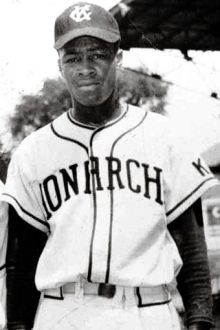
Try this one on. Jackie Robinson played the 1945 season with the Negro American League legend Kansas City Monarchs. (His teammates included Hall of Famer Satchel Paige and Double Duty Radcliffe.) His slash line was .414/.460/.569 in 63 games known on the record. Now that the Monarchs are an official major league team, guess what that does for Robinson so far? It bumps his hitting average to .314 but keeps his on-base percentage at .414 and his slugging percentage at .474.

Monte Irvin’s life as a New York Giant was compromised by a nasty ankle injury. Marry his known Newark Eagles (Negro National League II) stats to his Giants stats (and his one season as a Cub) and he’s got a .304 major league hitting average. He might even shake out higher when they finally exhume the complete statistics. (Surely you’ve read that, at the time Rickey made his move, his first target was Irvin, considered at the time the best in the Negro Leagues, but Irvin turned it down saying he wasn’t quite ready after missing time to World War II.)

Spare me the crap, too, about the Negro Leaguers not facing major league competition except in exhibition or barnstorm games. It wasn’t their fault. Nobody held the Show at gunpoint to force it to enforce a colour line. Nobody will ever know for dead last certain why team and league administrators in the seven Negro Leagues didn’t keep complete records that the mainstream newspapers wouldn’t.

In baseball’s first generation of desegregation, as slow on the uptake as it actually was, you saw just enough of what Negro Leagues players might do against their white competitors. Robinson has a .281/.333/.481 slash line with nine home runs against Hall of Famer Robin Roberts. Irvin went 2-for-4 against Hall of Famer Don Drysdale and posted a lovely .276/.383/.449 slash line with four homers against Hall of Famer Warren Spahn.

Paige kept Hall of Famer Ted Williams to a .222/.364/.222 slash line—with no home runs. And that was when Paige was in his 40s, far past his prime, but still an effective relief pitcher who inspired Yankee manager Casey Stengel to hector his hitters, “Get your runs now—Father Time is coming!”

Maybe the worriers are worried that a few sacred Show cows might turn out to have been steak? Boswell isolates a case: “Artie Wilson hit .428 in 1948 in the Negro Leagues. Does that make Wilson, not Ted Williams, the last .400 hitter? Teddy Ballgame would get a kick out of that; few men ever boosted and boasted about the quality of Negro League play more than Ted.”

Oho, some cynics might ask (and have asked), but how many of Josh Gibson’s home runs came off guys that would never have made the major leagues even if there was no segregation?

Elston Howard—from teenage Kansas City Monarch (1949) to Hall of Famer Yogi Berra’s eventual successor behind the Yankee plate.

OK, you asked for it. How many of Henry Aaron’s, Babe Ruth’s, Albert Pujols’s, Willie Mays’s, Ken Griffey, Jr.’s, Jim Thome’s, Frank Robinson’s, or Harmon Killebrew’s home runs came off guys who probably had no business being in the majors, too? No hitter faces only the Walter Johnsons, Lefty Groves, Satchel Paiges, Double Duty Radcliffes, Whitey Fords, Sandy Koufaxes, Bob Gibsons, Juan Marichals, Tom Seavers, or Randy Johnsons.

The only thing anyone should worry about is that it may take a good long while before finalising the complete stats is done for Gibson, Irvin, Paige, Radcliffe, Robinson, Wilson, Cool Papa Bell, Roy Campanella, Larry Doby, Sam Jethroe, Elston Howard, Buck Leonard, Don Newcombe, Buck O’Neil, and every Negro Leagues player who did or didn’t eventually make it to the Show after Robinson. If they can be done at last.

“The new Negro League numbers will have many such gaps, a byproduct of the discrimination that limited every aspect of those players’ lives, right down to the tiny detail that many of their games got no box scores in papers,” Boswell observes.

As more information is gathered, all those Negro League stats will change, just as, over my life, I have watched the win, strikeout and hit totals change for Walter Johnson and many other white Hall of Famers.

What the true baseball fan wants to know is: everything. All the data that is available. We will figure out, each in our own way, what to make of it, how to rank it and, in some cases, how to get our jaws off the floor.

We’ll also figure out that there was so much more to regret than we ever knew, when we first learned of the shameful decades of baseball’s segregation. But we’ll also figure out just how much richer the game we love is, now that those men are given officially what we always knew they were, from the stories, the legends, and the eventual actualities when they were finally allowed to join their white baseball brethren on the field:

They’re major leaguers, dammit!

Formalising what people of heart, soul, and mind always knew

Monte Irvin and Willie Mays—major leaguers as Giants and as a Newark Eagle (Irvin) and Birmingham Black Baron (Mays).

When Ted Williams was inducted into the Hall of Fame in 1966, he kept it short, sweet, and shameless. One moment, Williams gave props to Willie Mays, who’d passed him on the all-time home run list days earlier: “[H]e’s pushing, and I say to him, ‘Go get ’em, Willie’.” Then, the Splinter hit a grand slam:

Baseball gives every American boy a chance to excel. Not just to be as good as someone else, but to be better. This is the nature of man and the name of the game. I hope that one day Satchel Paige and Josh Gibson will be voted into the Hall of Fame as symbols of the great Negro players who are not here only because they weren’t given the chance.

Gibson didn’t quite live long enough to receive his chance to play major league baseball; he died before Branch Rickey finally began the undoing of what should never have been done in the first place. But he was inducted into the Hall of Fame as a baseball immortal in 1972.

Paige did get his chance. Among other things, he kept Williams to a .222 hitting average and slugging percentage but a .364 on-base percentage, after joining the American League with the Cleveland Indians and in due course the St. Louis Browns—in his forties.

Unlike Gibson, Paige did live long enough to see himself inducted into the Hall of Fame, the first Negro Leagues player so inducted (in 1971) after a special committee was formed to determine, as best they could with what they had, whom among the Negro Leagues’ best belonged in Cooperstown.

Not long before then-commissioner Bowie Kuhn formed the committee, his predecessor William Eckert convened another committee to isolate which among the earliest professional leagues merited official major league status. Four leagues were given such formal recognition by that group: the American Association of 1882-91, the Union Association of 1884, the Players League of 1890, and the Federal League of 1914-1915.

The Negro Leagues weren’t even a topic then. Boy, are they a topic now, with commissioner Rob Manfred having pronounced that the seven professional Negro Leagues which played from 1920 to 1948 shall henceforth be known as major leagues. Did I say seven?

Manfred conferred formal major league status on the first Negro National League of 1920-31, the Eastern Coloured League of 1923-28, the American Negro League of 1929, the East-West League of 1932, the Negro Southern League of 1932, the second Negro National League of 1933-1948, and the Negro American League of 1937-1948.

That’s the formality. Any baseball fan with heart, soul, and mind coordinating properly didn’t need a formal proclamation to know the Negro Leagues were as good and sometimes better than the “official” major leagues. They knew down to their bone marrow that Ted Williams was dead right in his implication that the “official” Show’s pre-1947 segregation denied those leagues and a good number of their players their propers.

Why the 1948 cutoff? That was the year of the final Negro World Series, between the Homestead Grays of the NNL and the Birmingham Black Barons of the NAL. (The Grays flattened the Barons in five, despite the Barons’ sharp center fielder—a child prodigy named Willie Mays.) With Jackie Robinson having cracked the old, disgraceful major league segregation line a year earlier, and National and American League teams beginning to scout and sign Negro Leagues talent, however incrementally, the Negro Leagues’ days were numbered.

After that Series (the Grays won the last such major league-level championship in Washington until last year’s Nationals), the Negro National League folded, followed by the Grays themselves in 1951 after barnstorming proved financially untenable. With the two then-solely recognised major leagues continuing to bring black talent aboard, the Negro American League fell back to the equivalence of the highest minor league before folding in 1958.

Bob Kendrick, a man of impeccable intelligence and sensitivity who presides over the Negro Leagues Baseball Museum, knows the difference between conferring historical merit and validating the Negro Leagues and its players as major leaguers. “[T]hey never looked to Major League Baseball to validate them,” Kendrick tells MLB.com writer (and author of the splendid A Fan’s Guide to Baseball Analytics) Anthony Castrovince.

But for fans and for historical sake, this is significant, it really is. So we are extremely pleased with this announcement. And for us, it does give additional credence to how significant the Negro Leagues were, both on and off the field.

A writer for The Athletic, Marcus Thompson II, sees and raises. “‘Oh, so now they’re good?’ was my initial reaction,” he writes in a forum convened by the journal to discuss the Manfred pronouncement.

Josh Gibson doesn’t need validation from Major League Baseball. Oscar Charleston doesn’t need validation. Pop Lloyd ain’t suddenly legit now because MLB basically decided to include him in the fold. It reeked of baseball’s arrogance. It wasn’t so much the inclusion of Negro League players, but the idea that somehow they are being officialized by this inclusion. This, obviously, should have been done a long time ago. But the pretentiousness of believing this to somehow be an elevation of those players, as if they’re being knighted posthumously, is insane and offensive . . . Satchel Paige was already a Major Leaguer by every other possible definition. Cool Papa Bell’s been official. His name is Cool Papa Bell.

Did we really need Rob Manfred to tell us Satchel Paige (left) and Jackie Robinson were major league level in the Negro Leagues?

Indeed. And, what do you know, just one prowl of social media delivered enough of the half-witticisms of those who think any thought of the Negro Leagues as “official” major leagues carries the whiff of political correctness. One such miscreant sticks uncomfortably in my mind: “[T]hey didn’t play against ball players like Bob Feller and Ted Williams sooooo… they didn’t play against major league talent.”

Well, now. I’d have loved the miscreant to explain what he thinks of the Show’s willful exclusion of non-white talent prior to 1947. (Fair disclosure: I zapped him by answering his foolish remark with the aforequoted Williams valedictory. As I write, he hasn’t offered an answer.) Do he and others of (I hate to use a four-letter word when ladies might be reading) like mind think such “major leaguers” as Robinson, Mays, Larry Doby, Roy Campanella, Henry Aaron, and Ernie Banks were just another bunch of minor leaguers before “organised baseball” deigned to invite them aboard?

Those of us who love the game and share the concurrent strain that its statistics are its life blood face a pretty pickle, too: How to finalise the true statistics of Negro Leagues competition. For one thing, it was known long enough that the Negro Leagues didn’t keep complete statistics for assorted and largely unpleasant reasons tied in large part to the unconscionable segregation of the so-called National Pastime.

The legends yielded by the Negro Leagues have been fun as legends but problematic as statistical analysis. Josh Gibson hitting eight hundred home runs plus in his baseball life is great fun as a legend, but how many did Gibson actually hit in Negro Leagues competition against how many did he actually hit on the barnstorms?

Castrovince observes that Negro Leagues statistics from leagues competition in 1920-1948 will be the ones brought to account, for a couple of very good reasons: Trying to develop the leagues before 1920 weren’t successful “and lacked a league structure.” Fans black, white, brown, and paisley alike may be disappointed with the net result because the barnstorm and exhibition stats won’t be included.

It won’t be simple, says another Athletic forum participant, Marc Carig. “[T]here are still games missing from the historical record,” he begins.

As of now, researchers have documented 73 percent of Negro League games contested in the 1920-1948 window of inclusion. That figure will keep climbing. More and more newspapers are getting digitized, making it easier to search for documentation. But it is still unlikely it will ever get to 100 percent. That can be a challenge. Now begins the work of figuring out how to incorporate that existing data into the official records. That’s the next step in the process. It’s not an easy one. But it’s worthwhile.

Forget about whether Gibson knocks Aaron and Barry Bonds out of the home run record books. He’ll probably still look like the great bombardier of his legend. And, since Aaron’s Negro Leagues play came after 1948, any home runs he hit before joining the Braves’ organisation won’t change his career home run total. Or the magnitude of his career and of a certain night in April 1974.

But Mays will see some changes. Let’s look. He had 73 plate appearances for the 1948 Black Barons, with sixteen hits including two doubles, twelve runs batted in, and twelve walks.He hit .262 with a .384 on-base percentage but a .295 slugging percentage with the ’48 Black Barons. His OBP won’t change, but his hitting average (sorry, the traditional batting average is incomplete and mistreats hits) will fall . . . one point, to .301. His slugging percentage will also fall . . . one point, to .556.

Another Athletic forum participant, Jason Jones, understands the concurrent late symbolism and undercurrent shame in Manfred’s pronouncement. “[I]f it took this announcement for you to believe Josh Gibson was one of the best to ever swing a bat, shame on you,” Jones says. “This is clearly long overdue. I wish those players were here to see baseball finally do the right thing.”

It shouldn’t have taken us that pronouncement, either, to believe Satchel Paige was one of the best ever to take the mound. (Casey Stengel would hector his Yankees when he saw Paige throwing in the bullpen, “Get your runs now—Father Time is coming!” That was when Paige was in his 40s and not exactly in his prime.)

Or, that Buck Leonard was one of the best ever to play first base.

Or, that Monte Irvin may have been the actual best of the Negro League talents to cross into the Show when he finally did, and that he might have given the Show another decade of his best before an ankle injury compromised him while with the Giants. Among others. (Irvin’s lifetime major league hitting average might jump to .304 when the records are adjusted.)

Said Manfred in a formal statement, “All of us who love baseball have long known that the Negro Leagues produced many of our game’s best players, innovations and triumphs against a backdrop of injustice. We are now grateful to count the players of the Negro Leagues where they belong: as Major Leaguers within the official historical record.”

Where they always belonged.

Now, if only Manfred and his minions would take things from there to send the Show on a real, substantial mission to rekindle deeper interest in baseball among black youth around the country, whether inner city, suburbia, or the country life. Black people have elevated the game as men and as players, coaches, managers, and executives, even if the number  among the last three of those remains terribly low.

Today’s young black aspirants deserve to know the game belongs to them, too. Numerous localised organisations carry that mission splendidly. It would give them a badly needed lift, and further honour the Negro Leagues legacy, if Manfred and his get off the schneid and onto the hunt. It’d mean as much and maybe more than how Jackie Robinson’s Hall of Fame plaque would look with the addition of his seasons with the Kansas City Monarchs.

Dick Allen, RIP: Big stick, bigger man

Dick Allen’s big stick hit home runs that should have had astronauts aboard.

Around noontime Monday (PST), his family announced it on his own Twitter account. I came home from a morning errand to see the news, and I could only open his Twitter and write, without clicking on the heart symbol for a like, “How can you like the passing of a great ballplayer and a good man?”

Dick Allen is dead at 78 after a battle with cancer. There’d been a swell of support for his election to the Hall of Fame in recent years. He might have made it via the Golden Era Committee this year. Except the committee decided that, well, if they couldn’t meet in person to discuss and vote, by God they weren’t going to meet until next year.

When they made that announcement in late August, I zapped the Hall of Fame and the Committee for suddenly discovering their inner Luddism: “Hall of Fame chairman Jane Forbes Clark seems to think, erroneously, that technology mustn’t overcome the coronavirus’s travel confusions and constrictions to compromise Era Committee nominations and elections.”

They never heard of setting up a Zoom remote conference? Trust me, since I just took part in my own first one. They can be set up simply, such a conference is restricted to invited guests via meeting codes and passwords, and none would have compromised the integrity of the discussions and votes.

The Committee pushed the meeting back to winter 2021. They just might elect Allen this time around. (He missed by one vote the last time around, in 2014.) Only he’ll be well serene and happy in the company of the angels and not on earth to accept the plaque I’m sure his family will accept proudly when it’s awarded.

It’s not that my opinion means two figs, but I’ve championed Allen’s Hall of Fame election for long enough now, and I’ve seen nothing to change my mind about it. I was on the fence about it for a good long while before that, alas, but once and for all I took as deep a look into the record as it was as I could and became convinced. Allen has a no-questions-should-be-asked case as a peak value Hall of Famer.

If you consider his peak to be 1964-1972, Allen’s .936 OPS and 164 OPS+ should say most of it, especially considering most of that peak came in one of the toughest hitting eras ever. If you consider the absolutely unfair and out-of-line racism he was forced to face and fight, especially as a Phillie, it’s to wonder and marvel that he could even check in at the plate, never mind play as he did when he was healthy.

Let’s look at Allen and his big stick by way of my Real Batting Average (RBA) metric. When I first examined Allen that way two years ago, I discovered a flaw: I shouldn’t have included sacrifice bunts or excluded times he was hit by pitches. The former’s flaw: you shouldn’t be credited when you’re surrendering outs willingly; outs are precious. The latter’s flaw: if the pitcher’s fool enough to drill you, let it be on his head and to your credit.

The RBA metric otherwise is a bid to atone for the incompleteness of the traditional batting average, one of the single most flawed statistics ever devised. Hits divided by official at-bats treats all hits equally and misses too much of what batters do to create and produce runs on the scoreboard. (You still think all hits are equal? Tell me why a single’s as good as a double, triple, or home run and vice versa. Didn’t think so.)

My RBA adds total bases (which treats hits the unequal way they deserve), walks, intentional walks (one more time: you should damn well get credit when the other guys prefer you take your base than their heads off), sacrifice flies (you didn’t intend to fly out but it scored a run so credit to you!), and times you were hit by pitches, and divides the sum by your total plate appearances.

And, this is Dick Allen’s peak according to RBA:

Years PA TB BB IBB HBP SF RBA
1964-72 5,457 2,592 685 120 11 33 .631
Career 7,315 3,379 894 138 16 53 .612

Rest assured that these numbers helped rank Allen among the top twenty third basemen who ever played major league baseball. They would also show him with the third-highest RBA of all post-World War II/post-integration/night-ball era Hall of Fame third basemen except two: in ascending order, Chipper Jones and Mike Schmidt.

This is before revisiting his breathtaking power or mentioning that Allen was one of the smartest and most effective baserunners of his time. (Did you know Allen took extra bases on followup hits 53 percent of the time he reached base?) And, before lamenting that early enough injuries impacted his defense either at third base or the position to which his injury-weakened throwing arm finally sent him full time, first base.

Allen didn’t just hit home runs. Phrased politely, they didn’t need the proverbial meals and stewardesses aboard. What he hit typically should have had astronauts. When first analysing his performance two years ago, I concluded based on the evidence that, if he’d been far more healthy and uninjured, Allen might have finished his career with 525 home runs or thereabout.

Dick Allen sharing a big laugh with his old Phillies teammate Jim Bunning at an old-timers’ event in Citizens Bank Park.

Hall of Famer Willie Stargell once tried to take the sting out of the Philadelphia boo birds’ booing Allen by suggesting the reason they booed him was that his home runs didn’t always stay in the park to become souvenirs.

That’s putting things too politely. Allen once told a Phillies historian (and an Allen biographer), William C. Kashatus, “I thought of myself as a victim of racism. I was also something of a jerk. There were others who had to deal with racism, and some of them handled it better than I did. But that’s all in the past. I’m at peace with my career, and grateful that the Lord gave me the opportunity.”

A man who grew up in a racially tolerant and accommodating Pennsylvania hamlet, but whom the Phillies sent to 1963 Little Rock with no support system, who once remembered, “Maybe if the Phillies had called me in, man to man, like the Dodgers had done with Jackie Robinson, and said, “Dick, this is what we have in mind. It’s going to be very difficult but we’re with you”—at least I would have been prepared,” has no reason to apologise.

Whether you believe he was a jerk or just immature, some people persist in believing Allen’s career was shortened by it. Not so, argued Rob Neyer when writing The Big Book of Baseball Lineups: “I don’t think his immaturity had much to do with the length of his career. He just got hurt, and so he didn’t enjoy the sort of late career that most great hitters do. It’s that, as much as all the other stuff, that has kept him out of the Hall of Fame.”

Oh, the sad irony. When the Phillies finally traded Allen out of town, to the St. Louis Cardinals, they thought they were getting Curt Flood in return in the package. To Flood, the trade smacked of treating even a $90,000 a year center fielder as a piece of property like a slave. To Allen, who’d been to hell and back almost daily in Philadelphia and rooted for Flood’s reserve clause lawsuit, the trade was his Emancipation Proclamation.

Allen incurred assorted nagging injuries and severe leg injuries after leaving Philadelphia and especially during his otherwise shining time with the Chicago White Sox. (He won the American League’s Most Valuable Player award in his first White Sox season.) “[W]hat he did for us in Chicago was amazing,” said Allen’s White Sox manager, Chuck Tanner.

Dick was the leader of our team, the captain, the manager on the field. He took care of the young kids, took them under his wing. And he played every game as if it was his last day on earth . . . He played hurt for us so many times that they thought he was Superman.  But he wasn’t; he was human.  If anything, he was hurting himself trying to come back too soon.

The best short summary of the hell through which Allen was put so unconscionably in his Philadelphia years—by Little Rock, by a Philadelphia sports press and population uncertain or unthinking about the city’s racial growing pains, by some teammates likewise uncertain or unthinking—belongs to Jay Jaffe, in The Cooperstown Casebook:

[C]hoosing to vote for him means focusing on that considerable peak while giving him the benefit of the doubt on the factors that shortened his career. From here, the litany is sizable enough to justify that. Allen did nothing to deserve the racism and hatred he battled in Little Rock and Philadelphia, or the condescension of the lily-white media that refused to even call him by his correct name. To underplay the extent to which those forces shaped his conduct and his public persona thereafter is to hold him to an impossibly high standard; not everyone can be Jackie Robinson or Ernie Banks. The distortions that influenced the negative views of him . . . were damaging. To give them the upper hand is to reject honest inquiry into his career.

His death before the Hall election he deserves inflicts a final injustice upon a man accompanied by too many injustices too long. It elevates him and reduces his critics further that he eventually found equilibrium in his life and peace with baseball.

Allen knew and survived heartbreak enough outside of the racial buffetings: a painful divorce, the unexpected murder of his daughter, Terri, the electrical-fire destruction of the farm on which he hoped to raise thoroughbred horses. (“If my horse can’t eat it, I don’t want to play on it,” he once cracked about artificial turf.)

He overcame those to re-marry happily, keep friends and family close, become one of the most popular members of the Phillies’ speakers’ bureau under a very different organisation than the one for which he played, and a friendly social media presence who beamed justifiably when the Negro Leagues Hall of Fame inducted him in 2018.

When the Phillies finally retired Allen’s uniform number 15 in September, the Philadelphia Inquirer suggested the timing might have been intended partially to push for Allen’s at-last enshrinement in Cooperstown. Allen himself once told Kashatus, “What I’ve done, I’m pretty happy with it. So whatever happens with the Hall of Fame, I’m fine with it. Besides, I’m just a name. God gave me the talent to hit a baseball, and I used it the best I could. I just thank Him for blessing me with that ability and allowing me to play the game when I did.”

Former Phillies pitcher Larry Christenson, an Allen teammate when the latter returned to Philadelphia in 1975, remembered then a teammate’s teammate who preferred to lead by quiet example and humanness. Allen often invited Christenson to lunch on road trips and once signed a bat for him as a memento: “To L.C., two homers with my bat. How about that? Dick Allen.”

Christenson once borrowed Allen’s once-fabled 40-ounce bat in a game. “Son,” Allen told the pitcher, “if you can swing it, you can use it.” Christenson used it to hit a home run in that day’s game.

Bereft on earth now are Allen’s loving wife, Willa, his family, his friends, and all of those who saw through the cluttering, clattering nonsense and saw the player and the real young man who didn’t deserve his seasons in hell and deserved election to the Hall of Fame. Now that election will have to be posthumous on earth, damn it.

But surely the Lord’s angels escorted Allen kindly and gently to the Elysian Fields, and that was the only other thing we could ask through our own loss.

————————————————————————–

Some portions of this essay have been published by the author previously.

One more grip of Jim Bouton

Wasn’t it true, Don Vito Corleone wondered while commiserating with a fellow Mafia chief in The Godfather (the novel, not the film), that great misfortune often led to unforeseen reward? It proved to be for the late pitcher/writer Jim Bouton, whose sometimes deceptive but nearly-incurable optimism was finally smashed when his youngest child was killed in August 1997.

Driving home in New Jersey, Laurie Bouton stopped short to stay out of an accident in front of her, but a driver behind her didn’t do likewise, smashing into her car. The 31-year-old an uncle described as “Jim all over again” for her free spirit died hours later. It destroyed Bouton’s generally sunny view of life—until it reconciled him to the New York Yankees.

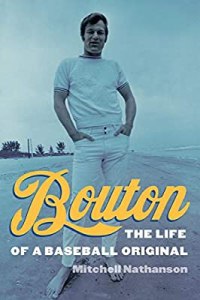
In fact, as biographer Mitchell Nathanson also notes in Bouton: The Life of a Baseball Original, Bouton struggled for months to follow until Laurie’s oldest brother, Michael, wrote an op-ed in The New York Times urging the Yankees to do what had never yet been done and invite his father back for an Old Timers Day. (Father once revealed his son’s essay moved him to tears.)

What nobody including Bouton knew was that his decades-long blackballing from the Yankees—for whom he once starred as a pitcher, before his too-hard throwing style ruined his arm and shoulder, reducing him to the margins and back to a knuckleball he abandoned earlier in his career—had absolutely nothing to do with Bouton’s own longtime prime suspect.

Mickey Mantle was hardly thrilled at Bouton’s Ball Four revelations about him, but six years before Laurie’s death the death of one of Mantle’s sons provoked a sympathy letter from Bouton. That prompted Mantle to call his old teammate to say yes, he was ok with Ball Four at last and, no, he wasn’t the reason for Bouton’s Old Timers Day freeze-outs.

The freeze-outs turned out to be courtesy of former Newark Star-Ledger writer Jim Ogle, whom Bouton zinged in Ball Four for treating players “purely on how much they were helping the Yankees to win. Charm, personality, intelligence—nothing counted. Only winning. Ogle didn’t have even the pretense of objectivity . . . in fact, Ogle’s ambition was to work for the Yankees. But they would never give him a job.”

Until they did. The Yankees hired Ogle to direct their club alumni association in 1975, his duties including, as Nathanson writes, “keeping the Yankees in the good graces of their most iconic alumni and organizing Old Timers Days. In his mind both responsibilities could be best discharged by blackballing Jim Bouton.”

Nathanson’s book unfurls Bouton’s story with both affection and the kind of candor Bouton himself would have appreciated. (And in fact insisted upon, when he and his wife agreed to let Nathanson have access to everything from family doings and undoings to the still-preserved Ball Four notes and tapes that ended up sold to the Library of Congress during Bouton’s final illness.)

It’s the story of an intelligent and sensitive young man who didn’t become a pitcher because he looked to turn sacred cows into steak or to write the book that secured his name and sent baseball and about half the world of sports journalism to the rye bottle, either.

Nathanson’s Bouton is a pitcher who had eyes to see, ears to hear, and a conscience to heed, with no malice aforethought but flying in the face of an establishment unwilling to concede the great and glorious game (A. Bartlett Giamatti’s phrase) was only too human. He couldn’t deny the caprices he saw in front of him, whether front office people engaging one-sided, lopsided, deceitful contract talks with players to players themselves proving unheroic often enough while letting the fans in the stands or with their morning after newspapers worship them as gods.

The fun-loving Bouton loved the game but hated its business and duplicities. The longer his pitching career went despite the arm issues, the less Bouton could turn the blind eye. Unlike most players even then, Bouton talked freely when interviewed and didn’t try to hide the sides of him that were unlike the typical jock of his time. Some respected him for it, others rejected him for it.

When his established sportswriting friend Leonard Shecter suggested he keep a kind of running diary on his 1969 season with the expansion Seattle Pilots, Bouton revealed he’d already begun taking notes. Anyone could do it regarding the old imperial Yankees; who else would have thought about doing it among an expansion team of fellow outcasts just trying to keep their jobs and their sanity?

Many Bouton teammates weren’t sympathetic to his final product. The embarrassments of some kept them from seeing that Bouton humanised them and thus elevated them. He was as observant of their field or mound struggles as their off-field shenanigans, sorrows, and oft-ignored or mistreated injuries. He told the world these were human men when it seemed often enough that baseball ignored or denied their humanness.

Bouton had already stepped beyond the bounds of baseball’s proprieties before starting his Ball Four season. He’d supported publicly a threatened American boycott of the 1968 summer Olympics if South Africa’s then whites-only teams were allowed to compete. He spoke against the Vietnam War whenever asked.

Bouton’s original notes, tapes, and the pages shaped by his editor/friend Leonard Shecter for Ball Four now repose in the Library of Congress.

But with Ball Four he was considered either a revelator by those who loved the book or a traitor by those including then-baseball commissioner Bowie Kuhn who tried to suppress it. (Or, in the case of the San Diego Padres, leaving a burned copy of it on the Astros’ dugout steps.) It was enough to seed a followup, I’m Glad You Didn’t Take It Personally, about the controversy, his final pitching days before his first retirement, and his early days as a New York sports reporter.

That book wasn’t quite the hit Ball Four was, of course, but it offered a few more insights into what Bouton thought and felt about becoming an unexpected literary star. Not to mention his further thoughts on the real reason the old guard sportswriters resented him: he’d told the stories they thought they should have told but, for assorted and not always edifying reasons, couldn’t or wouldn’t.

Some saw themselves as keepers of the proverbial baseball flame. Others saw themselves as club adjuncts. Jim Brosnan, whose from-the-inside books Nathanson called “tell-some” books, had annoyed them enough. This was too much of enough already.

But Ball Four proved in due course as significant as any other evidence, when it was introduced at the arbitration hearings through which pitcher Andy Messersmith finished what outfielder Curt Flood’s brave but failed prior lawsuit (begun the same year in which Ball Four first appeared) started, ending the reserve era and its suppressions of player pay and rights. Well after its literary stature was affirmed.

The book inspired a rash of further tell-alls from baseball’s insides, from players and collaborators who lacked Bouton’s wit and Shecter’s sensibilities. They hardly understood  that Ball Four‘s success lay as much in Bouton’s ability to show baseball’s humanness as in the, shall we say, steamy revelations on which those subsequent books leaned most heavily. (“More outrageous than Ball Four” was a tellingly typical cover blurb.)

Nathanson goes into fine detail Bouton’s years as a sports reporter, his head-buttings with those who thought sports reporting equaled promoting their teams instead of, you know, real reporting. He also goes deeper into the truest conflict inside Bouton’s psyche and life—the guy who achieved beyond his own expectations but couldn’t resist a challenge because he had something to prove past the challenge itself.

His love of baseball the game prompted him toward a comeback bid in the mid-to-late 1970s, including a spell with the minor league legend Portland Mavericks. He eventually made it back with the Atlanta Braves for a September 1978 spell—he once went mano-a-mano with Houston’s ill-fated howitzer J.R. Richard, pitching him to a draw—then walked away feeling for the first time that he didn’t have to prove a thing anymore.

His first baseball retirement led to the crumpling of his first marriage; Bouton and his first wife, Bobbie, had simply grown apart, though Bouton wasn’t immune to the occasional extracurricular activity, with the emphasis on occasional. (They divorced in 1981.) He didn’t really move to do something about it, though, until he met an attractive academic named Paula Kurman unexpectedly at a fundraiser to which both were invited.

Jim Bouton and second wife Paula Kurman, at a Ball Four retrospective.

It was Kurman (a speech therapist with Ph.d in interpersonal communications) who showed Bouton most of all what even his own family couldn’t, that he no longer had to take up quixotic challenges to prove himself to himself. The deception in his optimism until then was that it masked a man who had a difficult if not sometimes impossible time believing in his own worthiness. They married in 1982.

Bouton promoted Big League Chew (his Mavericks teammate Rob Nelson came up with the idea but Bouton sold and promoted it to buyer Wrigley), became a motivational speaker, helped to renovate an old but somewhat storied minor league ballpark, joined his wife learning and becoming a competitive ballroom dancer, continued writing, and eventually also became a stonemason who’d build walls and other supplementing fixtures for their home in the Berkshires.

In other words, this unfairly reputed miserable smasher of icons for its own sake was as normal, life-affirming, and human a man as his critics didn’t or couldn’t see. (Well, not everyone gets dance lessons from stage and film legend Marge Champion.) That 1998 Old Timers Day appearance simply began Bouton’s return from the ranks of the living dead into which his daughter’s senseless death plunged him.

“Looking up in the stands, at all of the family and friends who were there . . . ,” Nathanson writes (they included a contingent of friends bannering themselves “Laurie’s Girls!”), “[Bouton] understood that life could and would go on. It was what he needed to know at the precise moment he needed to know it most.”

The only thing that could and did knock Bouton out permanently enough was the 2012 stroke he suffered on the fifteenth anniversary of Laurie Bouton’s death. It exposed a condition of cerebral amyloid angiopathy and presented him the first and only challenge he couldn’t take on as successfully as he had others. It didn’t rob his intelligence, but his intelligence made him too aware of what he’d lose.

The most famous single line in Ball Four is the one that closed it: “You see, you spend a good part of your life gripping a baseball, and it turns out that it was the other way around all along.” On the day of Bouton’s death in 2019, his ability to speak gone, “in the netherworld between life and death,” his wife put a baseball into his right hand.

In his final act of life on earth, Bouton did with that ball what Nathanson’s biography will do to you once you open the covers and start reading. He gripped it tight.