Don Sutton, RIP: Craftsman (har, har)

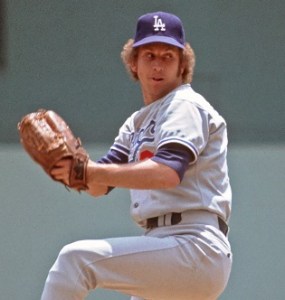
Don Sutton only looked like a surfer dude.

Last year’s sad parade of Hall of Famers going to the Elysian Fields waited at least until spring to begin. This year’s began with the year a mere seven days old and the nation battered by the Capitol riot a day earlier. Tommy Lasorda died of heart failure on 7 January; one of his pitchers, Hall of Famer Don Sutton, died of cancer Tuesday night.

Sutton got to the Hall of Fame by way of his unique durability. In 23 major league seasons he didn’t miss a starting assignment until his last season, 1988. He earned credit for 324 wins despite having a 20-win season only once (in 1976, winning 21). He led his league three times in strikeout-to-walk ratio and four in walks/hits per inning pitched but never led in strikeouts while leading his league in earned run average only once.

That’s despite spending his career in pitcher-friendly home ballparks. Sutton wasn’t too gapingly different on the road; enemy batters hit .247 against him on their home turf and .226 against him on his home turf, with a .606 OPS on his grounds and a .678 OPS on theirs. His forte was workman-like speed changing, smarts, and guile, heh heh heh.

As of this morning, Baseball-Reference lists Sutton as the number 73 starting pitcher of all time with the most-similar pitcher being fellow Hall of Famer Gaylord Perry. Most similar doesn’t exactly mean equal value, of course; Perry is slightly above the peak and career value averages for Hall of Fame pitchers and Sutton is somewhat below those averages.

All aboard for fun time? Like Perry, Sutton was suspected very frequently of, shall we say, extracurricular craftsmanship on the mound. Like Perry, Sutton knew how to ride the suspicions well enough, even if he wasn’t half as dedicated to psychological warfare as Perry was.

Both men had mischievous senses of humour about the suspicions versus the actualities. If Perry titled his memoir Me and the Spitter and went through a famous series of motions from head to torso when he wanted hitters just to think he was going to grease them, Sutton didn’t have any particular trademark suspect gestures.

Perry looked like the Carolinas peanut farmer he was in the off-season; Sutton, despite his Alabama sharecropping roots, resembled the classic California surf rat from his rookie season to his Hall of Fame induction speech. Perry preferred to live rent-free in a hitter’s head; Sutton preferred tweaking the powers that were.

Sutton took to leaving tiny notes in the fingers of his glove for umpires to discover when they or a protesting manager thought it wise to have him patted down and frisked on the mound. A classic: “You’re getting warmer. But it’s not here.”

After frequent enough accusations that “I ought to get a Black & Decker commercial out of it,” Sutton actually got just that. “The only fun I get now,” he once said to Thomas Boswell of the Washington Post, “is hiding dirty notes in my uniform pockets for the umpires to find them when they search me.”

“Sutton has set such a fine example of defiance,” longtime Orioles pitching coach Ray Miller told Boswell, “that some day I expect to see a pitcher walk out to the mound with a utility belt on—you know, file, chisel, screwdriver, glue. He’ll throw a ball to the plate with bolts attached to it.”

Nobody expected Sutton to sue longtime respected umpire Doug Harvey when the latter ejected him over a “defaced” ball in 1978. While pitching against the Cardinals and leading 2-1 in the seventh on 14 July, Harvey gave Sutton the ho-heave. “I’m not saying Sutton was defacing it,” Harvey told reporters. “I’m saying he was pitching a defaced baseball and the rules state that anyone pitching a defaced ball shall be ejected from the park.”

United Press said the “defacement” may have involved Sutton scratching a mark into the ball with his fingernail. “I have one thing to say and then no questions,” he told reporters. “On the advice of my attorney, I’m to say nothing about this. I’m filing suit against Doug Harvey, the National League and whoever runs the umpiring.”

Said Lasorda, who played the game under protest: “[Harvey] is judge and jury, and depriving Sutton of his right to pitch. It’s the first time I’ve ever seen that; it’s the first time he’s ever been ejected.”

“It was not the first confrontation over doctored balls between Harvey and Sutton,” UPI noted. “At other times in his twelve‐year career, the pitcher has been accused of scratching the ball with his fingernail to rough the surface for a better grip.”

Sutton’s lawsuit didn’t exactly set new legal precedent. It didn’t exactly get far enough to set one, let us say. Since the only verified implement he used was his fingernail, you certainly couldn’t accuse him of applying a foreign substance. (“I don’t use foreign substances,” one-time Yankee pitcher George Frazier snarked. “Everything I use is made in the U.S. of A.”)

But about a decade later, when Sutton was an Angel after some traveling from the Dodgers to the Astros, the Brewers, and the Athletics, he squared off in Anaheim Stadium against Tommy John, a former Dodger teammate then with the Yankees, and a pitcher Boswell described as able “to turn a tiny scratch into a double play grounder.”
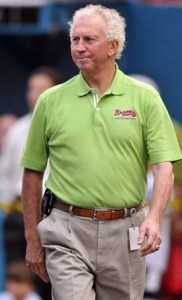
Sutton during his years as a popular Braves broadcaster.

Yankee owner George Steinbrenner, watching from his Tampa home, decided Sutton was being a little too blatant about things, calling the Yankee dugout and manager Lou Piniella. Steinbrenner demanded Piniella have Sutton frisked, arrested, arraigned, bound over, tried, convicted, and executed on the spot. Piniella tried to reason with The Boss.

“George, do you know what the score is?” Piniella asked, according to Bill Madden and Moss Klein’s Damned Yankees, referring to the early 1-0 Yankee lead. “George, if I get the umpires to check Sutton, don’t you know that the Angels are going to check TJ? They’ll both get kicked out. Whatever they’re doing, TJ’s doing it better than Sutton. So let’s leave it alone for now.”

John was lifted after six and a third innings; Sutton pitched seven full. Each man surrendered a pair of earned runs, including Sutton surrendering a bomb to Hall of Famer Dave Winfield. After the 3-2 Yankee win, Madden and Klein recorded, a scout in the press box said, “Tommy John against Don Sutton. If anyone can find one smooth ball from that game, he ought to send it to Cooperstown.”

Sutton may have been puckish about his reputation for baseball carpentry but he often admitted candidly that he took baseball to be serious work perhaps too often. He was described often enough as a kind of blithe spirit but it seems to have been his way of protecting himself against the contradictions of the jock shop.

“[M]ost of us have similar abilities,” he once said, of fellow ballplayers and of people in general. “The differences are mental and emotional and the big thing is mental preparation. That’s where everything starts: the poise, the confidence, the concentration.” It didn’t hurt that Sutton’s rookie 1966 saw him the number four man behind a pair of Hall of Famers named Sandy Koufax and Don Drysdale and a stolid number three in Claude Osteen, either.

Raised a devout Christian, Sutton didn’t buy into Lasorda’s Big Dodger in the Sky routines or the manager’s celebrity style, probably because his first manager Walter Alston was the polar opposite and a man Sutton respected deeply for rejecting celebrity and respecting his players as men. Sutton often called Alston the most secure man he’d ever met in baseball and praised the manager for keeping problems and questions with his players behind closed doors.

Sometimes, Sutton discovered the hard way that a little honesty can get you into a nasty spat. When he was an Astro and admitted he hoped he could finish his career on the West Coast where his wife and children still lived, it provoked Astros general manager Al Rosen—who once ended his playing career early due to injuries and a desire to be more a family man—to spar with him in the press.

When still a Dodger in 1978, Sutton said candidly and somewhat benignly that similarly quiet outfielder Reggie Smith was the actual most valuable Dodger, praising the talented and silent Smith because he wasn’t “a facade or a Madison Avenue image.” Taken as the thinly-veiled poke at popular first baseman Steve Garvey that it was, it triggered a clubhouse argument turned brawl between Sutton and Garvey.

John once said that during the worst of the brawl, an unidentified Dodger hollered to break it up because they might kill each other—to which catcher Joe Ferguson replied, “Good.” The problem was that Sutton was actually right. Garvey’s OPS was .843 and his OPS+ for 1977-78 was 130. For the same two seasons, Smith’s OPS was .974 and his OPS+ was 165. Garvey also hit into 22 more double plays than Smith in that span, too. Garvey was worth 8.5 wins above replacement-level for those two seasons, but Smith was worth 10.6.

“I’ve tried over and over to figure out why this had to happen,” Sutton told reporters subsequently. “The only possible reason I can find is that my life isn’t being lived according to what I know, as a Christian, to be right.” That from the pitcher who once ruffled feathers, especially Lasorda’s, by saying unapologetically, “I believe in God, not the Big Dodger in the Sky.”

“It took a big man to say what Don said,” said Lasorda himself, who didn’t always see eye-to-eye with Sutton, “and it took God to inspire him to say it.”

Sutton’s post-pitching life was mostly as a popular Braves broadcaster, where their fans reveled as much in Sutton’s easygoing repartee as in the turnaround of the Braves from the gutter to greatness. (The Braves elected him to their team Hall of Fame in due course.) He was also an enthusiastic Hall of Fame presence following his own election in 1998.

As a rookie during the once-fabled Koufax-Drysdale joint contract holdout of spring 1966, Sutton took the long view in due course. “Baseball players today,” he told Koufax biographer Jane Leavy, “owe a lot to Curt Flood and Andy Messersmith and Dave McNally. But Flood, Messersmith, and McNally owed a lot to Koufax and Drysdale. Because they were the first guys who really took a stand. This was the first challenge to the structure of baseball.”

At the Hall of Fame Sutton let himself be plain human. In the same speech in which he thanked Koufax for teaching him how to act like a baseball professional, he began by saying, “I’ve wanted this for forty years. Why am I now shaking like a leaf?” Then, he answered his own question: “I think part of it is because I’m standing in front of some of the people who were the greatest artists in a wonderful business that I’ve ever seen before.”

The man who often called himself a journeyman hack appreciated the art of the game, and of his own craft, after all. May the Lord in whom his faith was profound enough have welcomed Sutton home with the same appreciation.

Old sexts mean new unemployment

Imagine for one moment an otherwise bright child who’s made mistakes as most children make, bright or otherwise. He comes home from whatever he was doing with his friends, but he discovers an old incident he thought passed without notice or consequence was now unearthed, and his father demands accountability.

Let’s say it was something like giving a push back to that cute but obnoxious little girl who decided the way to make friends and attract the opposite sex was to push, shove, or even punch. He took it long enough because he was taught young gentlemen do not push, shove, or punch young ladies, but he finally got fed up with this particular chick who didn’t know the meaning of the words “knock it off.”

Nobody was truly harmed. It’s not as though she’d shoved him out of third-story windows, it’s not as though he finally dragged her to the nearest open window on the sixth floor. But somebody, who knows whom, let the ancient push back slip within his father’s earshot, and Dad confronts him subsequently giving him minus two seconds to explain himself.

Aware that the conversation is about a comparatively ancient error, he gives the deets straight, no chaser, certain that no father in his right mind would even think about punitive action regarding such a cobwebbed misstep. But he discovers the hard way how wrong he is when Dad pounces, pronounces him grounded for the rest of the forthcoming month, and fans his behind rather mercilessly for an exclamation point.

The boy repairs to his room with more than just a chastened ego and a very sore bottom. He’s between rage and sorrow because it was only a foolish mistake, not exactly the crime of the season. He pushed back after taking it long enough, but it didn’t make him any less a young gentleman or prove he had murder in his heart.

You might want to contemplate that when you wonder whether the Mets went a few bridges too far firing general manager Jared Porter Tuesday morning—almost a fortnight after he and the Mets delivered the trade of the winter bringing Francisco Lindor and Carlos Carrasco aboard—over infractions he committed while he was the Cubs’ director of professional scouting four years ago.

Our hypothetical push-back kid merely responded in kind at long enough last. Porter wasn’t pushed. He sent, shall we say, naughty/nasty sexual images among 62 text  messages to a young woman working as a reporter whose only provocation, if we can call it that, was exchanging business cards on the pretext of coming discussion about international baseball scouting.

The lady discovered the hard way that Porter had amorous designs upon her and didn’t readily take “no” for an answer or ignorance as a subtle hint.She was a foreign correspondent come to the United States for the first time, assigned specifically to cover the Show. She had no idea going in that she’d run into more than a few Porter screwballs on the low inside corner.

“The text relationship started casually before Porter, then the Chicago Cubs director of professional scouting, began complimenting her appearance, inviting her to meet him in various cities and asking why she was ignoring him,” say ESPN writers Mina Kimes and Jeff Passan. “And the texts show she had stopped responding to Porter after he sent a photo of pants featuring a bulge in the groin area.”

Kimes and Passan say ESPN knew of the Porter texts to her in December 2017 and thought about reporting them until she told the network she feared her career would be harmed. She has since left journalism, though Kimes and Passan say she’s kept in touch with ESPN concurrently and went public only under anonymous cover, fearing backlash in her home country.

“My number one motivation is I want to prevent this from happening to someone else,” she’s quoted as saying. “Obviously, [Porter]’s in a much greater position of power. I want to prevent that from happening again. The other thing is, I never really got the notion that he was truly sorry.

“I know in the U.S., there is a women’s empowerment movement. But in [my home country], it’s still far behind,” she continued. “Women get dragged through the mud [in my country] if your name is associated with any type of sexual scandal. Women are the ones who get fingers pointed at them. I don’t want to go through the victimization process again. I don’t want other people to blame me.”

The Mets hired Porter in December, from the Diamondbacks, for whom he worked as an assistant GM since 2017. On Monday night, Porter told ESPN that yes, he’d texted with her, but no, he hadn’t sent any pictures, until he was told their exchanges included selfies and other images, at which point he said, “the more explicit ones are not of me. Those are like, kinda like joke-stock images.”

Mets owner Steve Cohen isn’t exactly laughing, tweeting Tuesday morning, “We have terminated Jared Porter this morning. In my initial press conference I spoke about the importance of integrity and I meant it. There should be zero tolerance for this type of behavior.” Especially since, speaking metaphorically, the lady didn’t exactly push, shove, or punch Porter first all those years ago.

The Athletic‘s Ken Rosenthal says the lady had an ally in a baseball player from her home country, who helped her create a rather forceful message to Porter back when that Porter didn’t exactly heed at first: “This is extremely inappropriate, very offensive, and getting out of line. Could you please stop sending offensive photos or msg.” He’s said to have apologised to her much later.

“Colleagues of mine who are women use words such as ‘tired’ and ‘exhausted’ to describe their daily struggle to be treated the same as men, to command the same respect when they walk into a clubhouse, to do their jobs without facing sexual provocation,” Rosenthal adds. “They are professionals, not playthings.”

It’s one thing to ask a lady for a date. It’s another thing to try your best to change her mind if she says “no.” But turning from there to hot pursuit sexting is something entirely different and disturbing.

The Mets were unaware of Porter’s sexually explicit hot pursuit until Monday. They cut Porter loose early enough the morning after. A 7:30 a.m. Eastern time firing happens when enough New Yorkers have barely finished coffee at the breakfast table before rumbling out  hoping for just a little more snooze on the subway before work.

Some think the Mets could have been aware of Porter’s old lewd hot pursuit sooner. Some think Cohen and company have surrendered to cancel culture, to which Cohen had a reply when one indignant tweeter demanded to know Porter’s path to redemption “now that his life has been ruined.”

“I have no idea,” Cohen replied, though surely he knows Porter’s redemption is likelier to come away from baseball than within it, as second chances so often do. “I have an organization of 400 employees that matter more than any one individual. No action [taken] would set a poor example to the culture I’m trying to build.”

A subsequent tweeter isolated a parallel point addressed directly to the demand for a path to redemption: “As someone who is 100% opposed to cancel culture, this is a ridiculous thing to say. Jared brought this on himself. His path to redemption is on him. This has nothing to do with cancel culture.”

Others think the Mets in the Cohen era have now become the essence of decisive action when made aware of such wrongdoing. The joke is kinda like on Porter now. But nobody’s laughing.

Tommy Lasorda, RIP: “I made guys believe”

Tommy Lasorda (right) shares a handshake with Sandy Koufax near the Dodger clubhouse. “It took a Hall of Famer to get rid of me,” Lasorda loved to boast about Koufax’s bonus signing leading to Lasorda’s spring 1955 cut from the major league roster. (Los Angeles Dodgers photo.)

Last year’s losses of seven Hall of Fame players (eight, if Dick Allen is elected by the Modern Era Committee this year) were bad enough. Please, Lord, let Tommy Lasorda not begin a 2021 trend of Hall of Fame managers departing our island earth.

The odds may not be very good there. There are only four living Hall of Fame managers now that Lasorda is gone at 93: Bobby Cox, Whitey Herzog, Tony La Russa, and Joe Torre. Cox, Herzog, and Torre remain elder statesmen of a sort. La Russa has returned to the game to manage the White Sox, hardly without controversy.

Lasorda took the Dodgers’ bridge from Hall of Fame manager Walter Alston in 1976. Twenty-two years later, he retired as an eight-time division winner, four-time pennant winner and two-time World Series winner. It didn’t exactly come the easy way for a man whose major league life began as the marginal relief pitcher cut for a bonus baby.

Under the 1950s bonus rule mandating players kept on big-league rosters two full seasons if their bonuses were higher than $4,000, the Dodgers had to keep such a green lad after signing him for 1955. The man they cut was Lasorda, who’s said to have taken one look at the kid and said, “He’ll never make it.”

It might have taken six seasons for the kid to come into his own and beyond, but the kid was Sandy Koufax. It wouldn’t be the last time Lasorda gave himself the chance to dine out on an old mistake in judgment.

“I did not have a lot of ability, but I’ll guarantee you one thing,” Lasorda said in 1997 when recalling his own pitching days. “When I stood on that hill of thrills, I didn’t believe that there was any man alive who could hit me. And if they did hit me, which they did, I thought it was an accident.” That from the man who dined out further on Koufax, saying, “It took a Hall of Famer to get rid of me.”

Lasorda’s three major league seasons—eight games with 1954-55 with the Dodgers, then eighteen with the 1956 Kansas City Athletics—show 53 accidents while facing 253 batters and posting a lifetime 6.48 earned run average.

Maybe it depended upon whom you asked. To Dodger fans Lasorda was the second-closest thing to a franchise face behind Koufax himself. To non-Dodger fans, Lasorda was either loved, tolerated, or waved away. Dodger fans loved Lasorda’s “Big Dodger in the Sky” schpritzing. Non-Dodger fans thought it was either sacrilege or malarkey.

Come to think of it, not all Lasorda’s players bought into it, either. “I believe in God,” said Hall of Fame pitcher Don Sutton, “not the Big Dodger in the Sky.”

Lasorda was nothing if not both content to be a Dodger for the rest of his life, after his playing career ended in the minors in 1960, and to be Tommy Lasorda. He wasn’t exactly one of the most modest of men, and he rarely apologised for it.

When Hall of Fame broadcaster Vin Scully asked about the pressure of following Alston—who’d won the only Brooklyn Dodgers World Series and three more to follow in Los Angeles—the reply was almost classic Lasorda: “I’m not worried about the guy I am following. I’m worried about the guy that is going to have to follow me.”

Well, it isn’t bragging if you can kinda sorta do it.

That’s not to say Lasorda couldn’t be humbled when humility was the mandate. Maybe no manager this side of John McNamara was as humilitated in the 1980s as Lasorda was with the Dodgers one out from forcing a seventh National League Championship Series game in 1985.

With two Cardinals on and first base open, Lasorda decided it was absolutely safe to let Tom Niedenfuer pitch to Jack Clark instead of putting Clark aboard to pitch to Andy Van Slyke. And Jack the Ripper decided it was perfectly safe to hit Niedenfuer’s first pitch three quarters of the way up the left field bleachers.

“Lasorda wept in the clubhouse,” wrote Thomas Boswell in the Washington Post several years later, “went to the players to apologise, then went on with his life. At the moment he manages the [1988] world champions. Maybe Lasorda coped so well because he’d already gone to three Series and won one.”

The skipper who looked more like he’d be coming out to chat with you in his neighbourly Italian restaurant (“Two World Series Rings. Ate everything he wanted. Drank everything he wanted. 70 Years in the same work uniform. Lived For 93 Years. Absolute Legend,” tweeted sports business analyst Darren Rovell) loved being Tommy Lasorda almost as much as he loved the Dodgers.

He brought Hollywood back to the Dodgers once he realised the celebrities got as much of a kick out of him as he got out of them, and he wasn’t exactly a shrinking violet when it came to being an occasional pitchman. The problem—particularly remembering his once-familiar spots for Slim-Fast diet drink—was that he didn’t always shrink.

Of course, Lasorda’s celebrity provoked a little friendly mischief aimed his way by players who couldn’t resist tweaking him. His late utility outfielder Jay Johnstone often conspired with teammates Don (Stan the Man Unusual) Stanhouse and Jerry Reuss to swipe Lasorda’s wall of photos with him and various celebrities and substitute photos of themselves in their stead. And those were the more benign pranks at the skipper’s expense.

Which didn’t stop Lasorda from writing the introduction to Johnstone’s first book, Temporary Insanity: “[He] wrote a book? What with, a fire extinguisher? . . . What’s that they say about marching to a different drummer? Johnstone must hear a symphony out there . . . That’s some book title. But I’m not so sure about the temporary part.”

The skipper’s outsize personality sometimes masked that he was as inclusive and unprejudiced as the week was long. It didn’t matter if you were white, black, brown, beige, yellow, or paisley, whether you came from flyover America, urban America, outback Mexico, downtown Tokyo, or the penguins of Antarctica. (Which may be where some people thought the Dodgers found 1970s third base mainstay Ron [The Penguin] Cey.) If you could play to the standard the Dodgers prescribed, Lasorda wanted you in the worst way possible.

He preferred positive reinforcement with his players, which didn’t necessarily keep him from reading the proverbial riot act when necessary. There were times when those players perceived as Lasorda pets enjoyed less than consistently friendly relationships with others in the Dodger clubhouse. Sutton and longtime first baseman Steve Garvey didn’t have a clubhouse brawl once upon a time because Lasorda could make them  bosom buddies.

“I made guys believe; I made them believe they could win,” he said in a 2013 interview. “I did it by motivating them. I was asked all the time, ‘You mean baseball players that make $5 million, $8 million, $10 million a year need to be motivated?’ They do. That’s what I did.”

It’s not unreasonable to suggest Lasorda’s presence at last fall’s World Series had even a little hand in pushing the Dodgers back to the Promised Land they hadn’t seen since Lasorda himself managed Orel Hershiser, Kirk Gibson, and company in 1988.

“He was a fellow with limited ability and he pushed himself to be a very good Triple-A pitcher,” Scully said in a statement upon Lasorda’s death. “He never quite had that something extra that makes a major leaguer, but it wasn’t because he didn’t try. Those are some of the things: his competitive spirit, his determination and above all, this boundless energy and self-belief. His heart was bigger than his talent, and there were no foul lines for his enthusiasm.”

There were if someone went nuclear against his Dodgers with bombs that didn’t sail foul.   Lasorda’s wild postgame rant after then-Cubs outfielder Dave Kingman destroyed the Dodgers with three mammoth home runs starting in the sixth inning of a fifteen-inning marathon in 1979—the Cubs won in the fifteenth after Kingman hit a three-run shot—is considered one of the greatest managerial fly acts in baseball history:

What’s my opinion of Kingman’s performance? What the [fornicate] do you think is my opinion of it? I think it was [fornicating] horseshit. Put that in. I don’t [fornicating] . . . opinion of his performance? Jesus Christ, he beat us with three [fornicating] home runs. What the [fornicate] do you mean what is my opinion of his performance? How can you ask me a question like that? What is my opinion of his p – of his p-p-performance? Jesus Christ he hit three home runs. Jesus Christ. I’m [fornicating urinated] off to lose the [fornicating] game, and you ask me my opinion of his performance. Jesus Christ. I mean that’s a tough question to ask me, isn’t it? What is my opinion of his performance?

Lasorda probably survived only because a) he was the defending National League champions’ manager, b) he had his Dodgers in the thick of the National League West race at the time, and c) he was Tommy Lasorda, liable to go from celebrity pennant winning skipper to everybody’s crazy uncle on the terrazza in the proverbial New York minute.

The hapless Los Angeles radio reporter who asked Lasorda the fateful question was Paul Olden. When Lasorda ran into Olden at a subsequent charity dinner, Lasorda apologised to Olden, even as the reporter admitted it wasn’t a brilliant question in the first place. In due course, Lasorda expanded upon it:

You know Paul said to me he was sorry he did that, I said “Hey, you did your job Paul. Don’t worry about it”. He asked me, ‘What is your opinion of Kingman’s performance?’ Nobody asked me about an opinion. They’ve always asked me, ‘Well, Kingman hit three home runs’, ‘What did he hit’, ‘What did it do to you’, so and so. This guy says, ‘What is your opinion’. So I proceeded to give him what was my opinion of Kingman’s performance. I’d like to have the rights on that, on that tape, because what happened, uh . . . was when it was first played on the Jim Healy show, I guess Gene Autry heard it and he wanted a copy of the real tape. And then all of a sudden, within a two week period, that tape had gone from the west coast to the east coast. Everybody had that tape. Within a month’s time, I couldn’t go anywhere without somebody telling me they had the tape—the real tape of that, uh, opinion. I think it was finally translated into Japanese.

That tells you something right there. Tommy Lasorda may have been one of baseball’s most unforgettable managers, but he had a sense of humour about it, even delayed, if you weren’t always inclined to agree with him.

Which is why he now steps through the gates to the Elysian Fields with the Lord in whom he devoutly believes saying, “For you, I’ll be the Big Dodger in the Sky. Better that than a bum.”

On renaming the J.G. Taylor Spink Award

A Red Smith Award or Wendell Smith Award for Hall of Fame writers?

Did you forget that the Baseball Writers Association of America is thinking of changing the name of another award, too? Much was written and said over taking Kenesaw Mountain Landis’s name off the Most Valuable Player award, and the BBWAA also ponders taking J.G. Taylor Spink’s name off the Hall of Fame award given to a distinguished baseball writer every year.

Being a baseball writer myself if not a member of the BBWAA, I have particular interest in the Spink Award, even if I have more chance of winning the Howitzer Prize for Extinguished Commentary than the Spink. The BBWAA wants to change the name because Spink himself, the longtime publisher of The Sporting News, opposed “organised baseball’s” integration, and they are not wrong.

“In August 1942 [Spink] wrote an editorial saying that baseball did not have a color line, but that segregation was in the best interests of both blacks and whites because the mixing of races would create riots in the stands,” Daryl Russell Grigsby reminded us in Celebrating Ourselves: African-Americans and the Promise of Baseball. ” . . . Spink’s defense of segregation was largely not based on fact but on fear and prejudice.”

Claire Smith, an African-American lady and the first of her gender to receive the Spink Award, has nailed it herself. “If this is the time of introspection,’’ she told USA Today baseball columnist Bob Nightengale last summer, “if Mississippi can change the flag, and Confederate statues can be removed from state capitals, we can do this.” If Landis can be removed from the MVP award because of his active enforcement of baseball’s old and disgraceful colour line, then yes, Spink can be removed from the Hall of Fame honourarium still bearing his name.

The BBWAA is voting on that as I write. Remove Spink’s name, though, and for whom would you re-name the award?

With the MVP the choices may be simpler. You can choose Happy Chandler, the commissioner who refused to disallow Branch Rickey signing Jackie Robinson and breaking the colour line at last; you can choose Rickey himself. You can choose instead the African-American player who remains the only one to win the MVP in each of the National and the American Leagues, Hall of Famer Frank Robinson.

The choices to re-name the Spink Award? One can think of quite the handful, Spink winners all, including a Pulitzer Prize winner or three while thinking.

There’s Red Smith, as close to a poet laureate of daily baseball writing as the game has known from his years with the New York Herald-Tribune and the New York Times. There’s Jim Murray, the Los Angeles Times fixture whose wit made you think he was what Fred Allen might have been if Allen had chosen sportswriting instead of radio comedy. There’s Shirley Povich, the grand old man of Washington baseball, who practically raised the Washington Post‘s sports section by himself. Practically.

There’s Damon Runyon, who wrote eloquently, edgily, and wittily about baseball when he wasn’t celebrating Broadway. (You really should hunt down his anthology, Guys, Dolls, and Curveballs: Damon Runyon on Baseball.) There’s Ring Lardner, baseball storyteller and reporter alike, at least before the Black Sox scandal put the first serious dent into his love of the game. (The live ball era finished what the Black Sox started for Lardner.)

There’s Wendell Smith, whose reporting for the Pittsburgh Courier was a phenomenal pressure point toward baseball’s integration, which also begs the question why the best of his baseball writings haven’t been anthologised for today’s generations who need to know the arguable most powerful black press voice toward Jackie Robinson’s advent.

There’s Smith’s African-American colleague Sam Lacy, who did with the Chicago Defender and the Baltimore Afro-American what Smith did with the Courier. He became one of the first black members of the BBWAA while he was at it. (Lacy published a memoir, but his baseball and sports journalism, too, has yet to be anthologised so far as I know.)

And, especially, there’s Roger Angell, about whom it’s been said (by me, to a fare-thee-well, but tough tarantulas) that he isn’t baseball’s Homer, Homer was ancient Greece’s Roger Angell. He was also the first non-BBWAA member and first non-daily baseball reporter to be honoured with the Spink Award.

Any one of those writers’ names would absolutely grace the award. But I have another dog in the hunt, by way of a journalism legend named Murray Kempton.

Kempton once attended the Meyer Berger Award luncheon at Columbia University. His Newsday colleague Jim Dwyer heard him say, “You know, I never won the Berger Award.” A New York Times honouree, Sara Rimer, said, “Murray, you just won the Pulitzer!” The courtly Kempton reminded her, “The Pulitzer is named for a publisher. The Meyer Berger is named for a reporter.”

In 1993, Kempton told David Remnick for a New Yorker profile (which included the aforementioned tale), during one of New York’s too-frequent tabloid wars, “In the end, my view of this so-called tabloid war is that I just don’t consider the character of publishers. I’m rooting for my friends—the reporters.”

(Harking back to a 1962 issue of Sport, Kempton wrote then of the Polo Grounds’ re-opening with the birth of the Mets: The return of the Polo Grounds to the National League was like the raising of a sunken cathedral. It is a place sacred in the history and hallowed in the memory. Christy Mathewson used to make his home on the bluff above the Polo Grounds. When he was working, Mrs. Mathewson could look out her window at the scoreboard and, when the seventh inning came, put the roast in the oven secure in the knowledge that her husband would be finished and showered and home from the plough in an hour.)

For re-naming the Spink Award, I’m rooting for my kindred, too—the reporters.

Met fan Cohen, athwart Met fans’ impatience

Steve Cohen, an owner who believes a jump into the pool requires water in it first.

“I don’t need to be popular,” tweeted Steve Cohen, the so-far very popular new owner of the Mets, on Monday. “I just need to make good decisions.” Apparently, there were enough Met fans thinking Cohen needed to make decisions, period, in the wake of the Padres’ wheeling and dealing and the Mets deciding not to join the hunt for Japanese pitcher Tomoyuki Sugano.

Cohen’s apparent watchword is, “If Rome wasn’t built in a day, the Mets won’t be reinforced in a week.” Met fans drained from years of Wilpon family follies say the American prayer: “Lord, grant me patience—and I want it yesterday.” For Cohen, that’s about as funny as passengers booked for seafaring passage aboard torpedoes.

When the Padres blew up the hot stove with deals making Padres of Blake Snell and Yu Darvish, Met fans felt the old familiar itch to do. something. anything. like yesterday. They forgot for the moment that, before the Padres wheeled and dealt, the Mets were the most active on this winter’s odd market.

I guess on to another pitcher. @StevenACohen2 well I guess McCann and May is it for us. Time to hibernate until Spring Training,” tweeted one such fan. To which Cohen had a polite but snappy retort at once: “That’s the spirit, just give up and go to sleep.”

From the moment his purchase of the Mets was affirmed, Cohen has been singular among baseball owners for putting himself out to engage his team’s fans. He has solicited their input and suggestions. It doesn’t mean he’s inclined to suffer fools, gladly or otherwise, even if they forget that he has been a Met fan himself—like me, since they day they were born.

He knows he has a team to reinforce. He knows his amiability has made him something customarily alien to baseball owners: beloved, so far. He doesn’t want to go from there to public enemy number one, but neither does he want to step imprudently into any one of several abysses.

The New York Post‘s Joel Sherman has also caught onto Met fans’ indignation: he’s been receiving no few tweets and e-mails “wondering whether Steve Cohen is the Wilpons, just hoarding a larger stash of money.

“After all,” he continues, “why was George Springer not under the Christmas tree? Why wasn’t Trevor Bauer provided to joyously greet 2021? Why James McCann and not J.T. Realmuto [behind the plate]?”

Sherman notes what such fans forget. This winter’s free agency market, for various reasons, has been about as swift as a number 7 train with a wheel chip on each car. The Mets handing James McCann $40 million for four years is both the most free agency money invested this winter and the longest contract done yet for non-foreign free agents, Sherman reminds you.

“Cohen’s promise was that the Mets would spend like a big-market team, and he should be held to that promise,” Sherman writes. “But that promise has not been broken this offseason. At least not yet.” And Cohen did not become wealthy because he reads markets the way old television jokes read Romeo and Juliet: “Two crazy kids ran off together and died.”

He’s willing to spend but not like the proverbial drunken sailor. For one thing, Cohen knows the Mets’ farm system, what will remain of it after the Show finishes its more than slightly mad stripping of the minor leagues, needs replenishment if not a mild overhaul. For another, he knows a healthy farm often leads to healthy reinforcements either by promotion to the Mets or in deals that bring healthy reinforcements if not fresh prime.

“Hey, Give the Padres credit,” Cohen tweeted after one of the Friars’ two splashy trades. “They had a top 5 farm system that gave them flexibility to trade for Snell. Newsflash, the Mets farm system needs to be replenished.”

News flash, further: Met fans may have the patience of piranha at meal time, but Cohen has no patience for falling into the position of bidding against himself. “The Blue Jays are the only other club known to want to spend lavishly in free agency,” Sherman observes, “but historically it has been difficult to lure top free agents to Canada. Cohen will have to believe that a Springer or a DJ LeMahieu is really going before he considers that game of chicken. There certainly are quieter suitors. But, again, none of the remaining big free agents will be signing without hearing Cohen’s last and best. He will not do a deal he calculates as bad just to stop the noise of even impatient Mets fans.”

Cohen’s memory, like mine, surely harks back to the 1980s when another New York team, owned by a man to whom patience was a vice, jumped into the market pools as often as not before checking to see the water level. For every Catfish Hunter, Rickey Henderson, and Dave Winfield, there were a few too many Dave Collinses, Joe Cowleys, Don Gulletts, Steve Kemps, Dave LaPoints, Bob Shirleys, and Ed Whitsons.

Cohen also knows that, with one or two outlying exceptions, the Yankees’ greatest successes in the free agency era have come by way of a homegrown core blended with a little smart horse trading. Yap all you want about them trying to buy pennants, but when the Yankees spent the biggest in the open market they didn’t reach the Promised Land to which Yankee fans believe they’re entitled every year.

When another fan tweeted to Cohen, “What exactly are we doing? Is James McCann really going to be our biggest pickup this offseason? Please say no,” Cohen replied, “Let me put it differently. Don’t you think someone will take our money? It just has to make sense.”

The last time any Met administrator spoke about “making sense” was when?

The Mets know their starting pitching can’t stop at Jacob deGrom, re-signed Marcus Stroman, David Peterson, due-to-return Noah Syndergaard, and just another body. Seth Lugo is far better suited at the rear end of the bullpen, which also needs all the reinforcement/replenishment it can get.

They also have a very solid core around the field and at the plate, and McCann is a big upgrade behind it. But if they really want to go in for George Springer, they need to decide who’s the expendable one to slot Springer into their outfield. They need to decide how to make things work otherwise so Jeff McNeil can be restored to his natural infield habitat.

They need to decide whether Cohen’s determination to replenish the farm is worth casting eyes upon Springer, Trevor Bauer (pitcher), and D.J. LeMahieu (middle infielder). That trio, Sherman reminds us, got qualifying offers from their 2020 teams, meaning the Mets lose draft picks if they sign any or all of them. For farm replenishment, that’s not an option. If they can only afford one big ticket, Springer may yet be their prime target. May.

Cohen and the Mets also need to find a way to help commissioner Rob Manfred off the proverbial schneid and into the right decision about last year’s experimental rules. So does, well, every other Show team. You’d like to think that even ownerships as determined to tank as Cohen isn’t don’t want to embarrass themselves entirely.

In with the universal designated hitter, once and for bloody all, and out with the other nonsense. Among other salutary things—such as an end to the lineup slot wasted by spaghetti-bat pitchers, and rallies murdered when enemy pitchers work around that potent number eight bat to strike out their counterparts—it’ll keep Dominic Smith’s bat in the lineup without having to sacrifice Pete Alonso’s bat (yes, children, Alonso’s 2020 was an aberration of a down irregular season) at first base.

Cohen seems determined to avoid the comedies of errors committed by prior team ownerships and administrations. He resists the temptations to which too many Met fans would be prone if placed into his position for even one week. A man who speaks about making sense is a man who earns a very wide benefit of the doubt.

Speaking for myself alone, now, I have a wish of my own for Cohen. It has nothing to do with wanting him to slip into a sailor’s uniform, get himself bombed out of his trees, and throw dollars around the free agency market like they were just blasted out of a pinata.

My wish is that Cohen might consider a gesture on behalf of more than a few of the Met players he, like me, grew up watching and rooting for in the 1960s and 1970s. Players whose major league careers were kept too short for assorted reasons. Players who were frozen out unconscionably when, in 1980, owners and the Major League Baseball Players Association re-aligned baseball’s pension plan.

The re-alignment awarded pensions to players after 43 days’ major league service (previously, a player needed four years) and health benefits after a single day’s major league service. But it didn’t apply to short-career major leaguers who played between 1949 and 1980.

For those short-career players, their sole redress was a 2011 deal between then-commissioner Bud Selig and then-players union director Michael Weiner, a deal giving them $625 per quarter for every 43 days’ major league time they had, up to four years’ worth. The kicker, right in the pants, is that they can’t pass that money to their loved ones if they pass before they stop collecting the money.

Several former Mets are among what are now 618 such short-career players without full pensions other than what they receive under the Selig-Weiner deal. They include pitchers Bill Wakefield, Bill Denehy (traded to Washington in exchange for manager Gil Hodges) and Jack DiLauro (a 1969 Met, though not in the postseason), infielder Bobby Pfeil (another Miracle Met), outfielders Rod Gaspar (still another Miracle Met) and George (The Stork) Theodore, and others.

Denehy, Pfiel, and Gaspar have each told me in interviews they believe that, if Weiner had lived (he died of brain cancer in 2013), he would have worked to go further with such pension redress. The players union since has taken little to no interest in such redress; neither, apparently, does the Major League Baseball Players Alumni Association.

But Marvin Miller, the late pioneer of the players union, is known to have said that not re-visiting the 1980 pension changes on behalf of the short-termers was his biggest regret. And if the Show has now conferred proper formal, official major league status on the seven known Negro Leagues we believed to our souls contained major leaguers all along, it should be known that there are African-American and other minority players among the frozen-out 618.

I’m not a man who believes I have the right to tell anyone else how to spend his or her money or where to channel their resources. Nor do I believe I have the right to choose another person or group’s obligations, moral or otherwise. But Gaspar had a point when he told me, last month, “They have so much money, the owners, the players’ union, they have so much money, how much money would it cost them to give the [pre-1980 short-career] guys who are still alive the pension?”

It would be a phenomenal gesture on Steve Cohen’s part if he should think well, by himself, of doing something solely for the short-career, pre-1980, former Mets affected negatively by that pension change. If nothing else, the image augmentation would be invaluable—an owner doing what the players union and alumni association either can’t or won’t.

Should Cohen consider it, however he might choose to do it, it might even kick off a wave among his fellow owners to do likewise for their teams’ frozen-out, pre-1980 short-career former players. Might. Quick: Name one owner who wouldn’t mind making the players’ union look a little foolish.